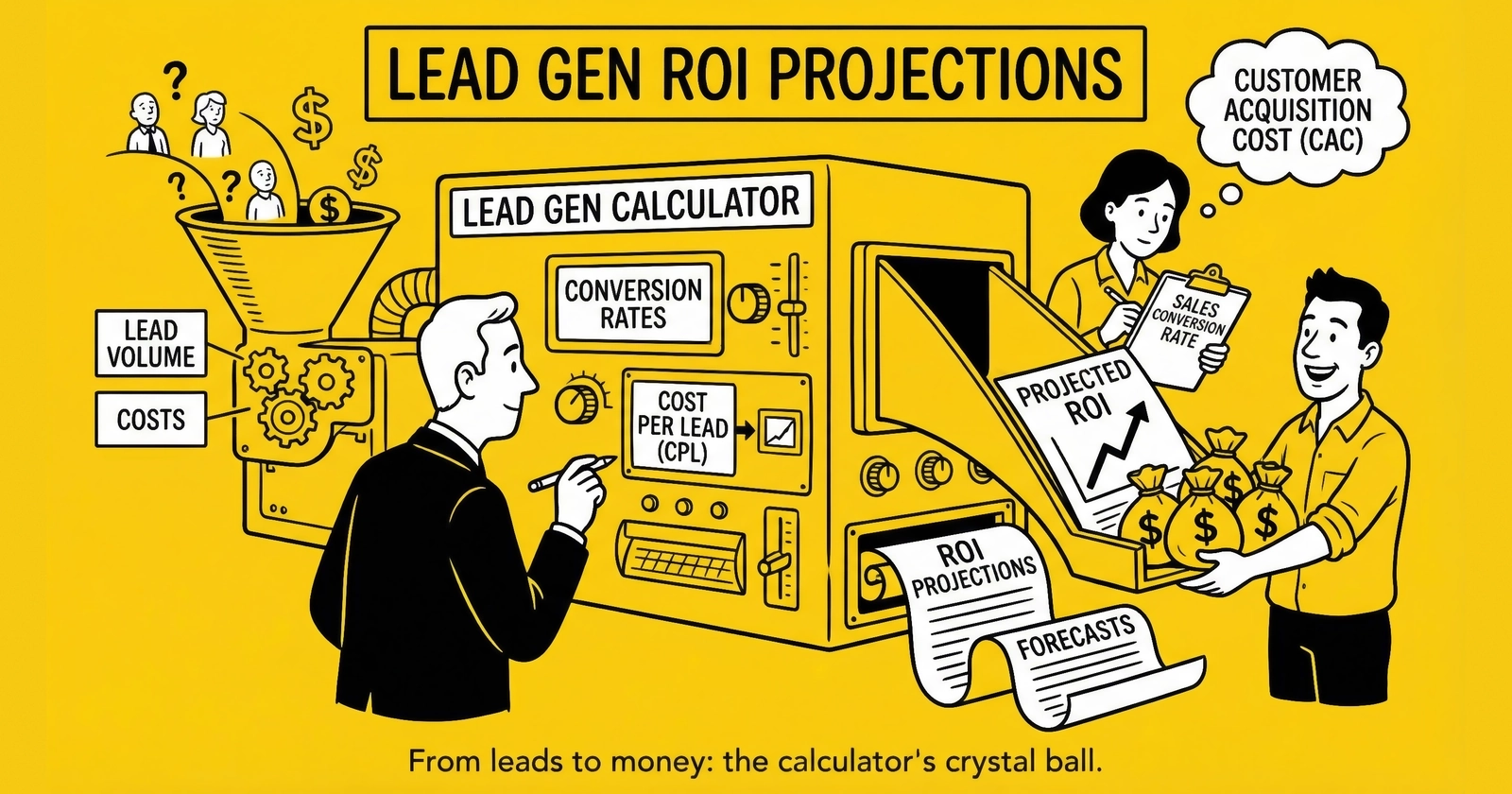
Most lead generation operations cannot accurately answer the question: “What does a customer actually cost us?” Without that answer, every investment decision is a guess.
The difference between lead generation programs that scale successfully and those that stall lies in measurement precision. Organizations with rigorous ROI calculation capabilities make confident investment decisions, identify optimization opportunities, and defend budgets with quantified evidence. Those without reliable ROI frameworks operate on intuition, discovering profitability problems only after substantial capital has been deployed.
Yet most lead generation operations measure ROI incompletely or incorrectly. Common errors include calculating CPL without accounting for operational costs, ignoring lead quality variation across sources, using static conversion rates when actual rates vary significantly by lead characteristics, and failing to incorporate customer lifetime value into payback calculations. Each error distorts decision-making in ways that compound over time. For a deeper understanding of lead generation business models and economics, see our guide to how the lead economy works.
This guide provides the calculation frameworks necessary for accurate ROI assessment across lead generation scenarios. The formulas apply whether you’re buying leads, generating them through paid media, or building organic acquisition programs. The underlying economics share common structure even when specific variables differ by model.
According to Forrester research, organizations with mature ROI measurement capabilities achieve 20-30% better marketing efficiency than those with limited measurement infrastructure. The efficiency gains come not from the calculations themselves but from the decisions they enable: reallocating budget toward high-performing sources, killing underperforming campaigns before they consume excessive capital, and setting appropriate investment levels based on actual rather than assumed returns.
The frameworks presented here are designed for practical application. Each formula includes worked examples using realistic industry benchmarks. Scenario comparison tools help evaluate strategic alternatives. Sensitivity analysis approaches reveal which assumptions most affect outcomes. The goal is ROI calculation capability that drives better decisions, not theoretical models that stay abstract.
Core ROI Calculation Framework
The Fundamental ROI Formula
Return on investment calculation follows a standard form that applies across marketing investments. The framework compares what you received (value generated) against what you invested (resources consumed) to produce a percentage expressing efficiency.
ROI = (Revenue - Cost) / Cost × 100
For lead generation, the formula requires precise definition of both numerator and denominator components. Revenue attribution determines what counts as value generated. Cost accounting determines what counts as investment consumed. Errors in either component distort the entire calculation.
Revenue in lead generation typically means customer revenue attributed to the lead program – the purchases made by customers who originated as leads from the sources being evaluated. Customer lifetime value (LTV) provides the most accurate revenue figure because it captures the full economic value of acquired customers rather than just initial transactions. Using initial purchase value instead of LTV understates true ROI for businesses with repeat purchases or ongoing relationships.
Cost in lead generation must encompass total program expense, not just the obvious line items. Lead purchase costs or media spend represent the visible expense, but operational costs (sales team time, technology, management) often equal or exceed acquisition costs. Calculating ROI on acquisition costs alone overstates actual returns.
Example calculation:
- Leads purchased: 1,000
- Lead cost: $40 each = $40,000
- Operational cost (sales, tech, overhead): $15,000
- Total cost: $55,000
- Customers acquired: 50 (5% conversion)
- Average LTV: $2,500
- Total revenue attributed: $125,000
- ROI = ($125,000 - $55,000) / $55,000 × 100 = 127%
This 127% ROI indicates the program generates $1.27 in value for every $1 invested – healthy returns justifying continued and potentially expanded investment.
Component Variables Explained
Each ROI component breaks into constituent variables that can be measured, benchmarked, and optimized. Understanding these variables enables both more accurate calculation and identification of improvement opportunities.
Lead Volume (L): The number of leads entering the system. Volume may come from purchases, paid media campaigns, organic channels, or combinations. Volume directly affects scale economics – fixed costs spread across more leads reduce per-unit burden.
Cost Per Lead (CPL): The acquisition cost per lead, calculated as total acquisition spend divided by lead volume. CPL varies dramatically by vertical, lead type, and source quality. Low CPL is not inherently good – cheap leads that don’t convert cost more per customer than expensive leads that do.
Operational Cost (O): All non-acquisition expenses required to process leads into customers. This includes sales team compensation allocated to lead processing, technology costs (CRM, dialers, tracking), management time, and overhead allocation. Many organizations undercount operational costs, inflating apparent ROI.
Contact Rate (CR): The percentage of leads successfully reached through your communication channel. Contact rates typically range 25-40% for phone outreach on fresh leads. Low contact rates indicate data quality problems or channel-response mismatches.
Qualification Rate (QR): The percentage of contacted leads meeting your actual buyer criteria. Not every lead that answers represents a genuine opportunity. Qualification rates below 50% suggest targeting problems at the source.
Close Rate (ClR): The percentage of qualified leads converting to customers. Close rates depend on both lead quality and sales capability. Vertical benchmarks provide reference points, but your actual rate reflects your specific operation.
Average Order Value (AOV): The revenue from a typical customer transaction. For subscription or repeat-purchase businesses, consider lifetime value rather than initial transaction.
Customer Lifetime Value (LTV): The total revenue expected from a customer over the entire relationship. LTV = AOV × purchase frequency × customer lifespan. Using LTV rather than AOV in ROI calculations captures the full value of customer acquisition.
| Variable | Symbol | Formula | Typical Range |
|---|---|---|---|
| Lead Volume | L | Count of leads | N/A |
| Cost Per Lead | CPL | Acquisition Spend / L | $15-800+ by vertical |
| Operational Cost | O | Sales + Tech + Overhead | 30-50% of acquisition cost |
| Contact Rate | CR | Contacts / L | 25-40% |
| Qualification Rate | QR | Qualified / Contacts | 50-70% |
| Close Rate | ClR | Closed / Qualified | Vertical-specific |
| Customer LTV | LTV | AOV × Frequency × Lifespan | Vertical-specific |
The Extended ROI Formula
Combining these variables produces an extended formula enabling granular analysis:
Customers = L × CR × QR × ClR
Total Revenue = Customers × LTV
Total Cost = (L × CPL) + O
ROI = (Total Revenue - Total Cost) / Total Cost × 100
This extended formula reveals which variables most affect outcomes and where optimization efforts should focus. If contact rate is low, improving data quality or response speed may yield better ROI than negotiating CPL reduction. If close rate is the constraint, sales training or qualification criteria adjustment may help more than source changes.
Calculating True Cost Per Lead
Direct vs. Total CPL
The cost per lead figure vendors quote represents only acquisition expense – what you pay for the lead itself. True CPL must incorporate all costs required to transform a lead record into a contactable opportunity, including operational expenses that spread across your lead volume.
Direct CPL: The purchase price or media cost per lead. Vendor-quoted figure.
Total CPL: Direct CPL plus allocated operational costs per lead.
Total CPL = Direct CPL + (Operational Costs / Lead Volume)
Operational costs to include:
- Sales team compensation (portion allocated to lead processing)
- CRM and dialer platform costs
- Validation and enrichment service fees
- Management time for vendor relationships and program oversight
- Overhead allocation (facilities, administrative support)
Example calculation:
- Monthly lead volume: 5,000
- Monthly acquisition cost: $200,000 ($40 direct CPL)
- Monthly sales cost allocated to lead processing: $80,000
- Technology platform costs: $5,000
- Validation services: $2,500
- Management and overhead: $12,500
- Total operational costs: $100,000
- Total CPL = $40 + ($100,000 / 5,000) = $40 + $20 = $60
The $60 total CPL is 50% higher than the $40 direct CPL – a significant difference when modeling program economics. Organizations using direct CPL in ROI calculations systematically overstate returns.
CPL by Source Quality Tier
Leads from different sources vary in quality, which affects their true cost per customer acquisition. A low-CPL source that converts poorly may cost more per customer than a high-CPL source with strong conversion rates.
Customer Acquisition Cost (CAC) = Total CPL / (CR × QR × ClR)
This formula reveals the real cost to acquire a customer through each source, enabling apples-to-apples comparison that raw CPL cannot provide.
Comparison example:
| Source | Direct CPL | Total CPL | Contact Rate | Qual Rate | Close Rate | CAC |
|---|---|---|---|---|---|---|
| Source A | $35 | $50 | 30% | 60% | 8% | $3,472 |
| Source B | $55 | $75 | 40% | 70% | 12% | $2,232 |
| Source C | $25 | $40 | 25% | 45% | 5% | $7,111 |
Source B’s $55 CPL produces the lowest CAC because its quality metrics compound favorably. Source C’s attractive $25 CPL produces the highest CAC because poor quality multiplies through the funnel. Optimizing for direct CPL would worsen outcomes; optimizing for CAC improves them. For detailed guidance on calculating true cost per lead, including hidden costs many operators overlook, see our dedicated analysis.
Conversion Funnel Economics
Funnel Stage Calculations
Each funnel stage introduces conversion loss that affects comprehensive economics. Modeling these stages reveals where leads fall out and where optimization focus should direct.
Stage 1: Lead to Contact
- Input: Lead volume (L)
- Conversion: Contact rate (CR)
- Output: Contacted leads = L × CR
Stage 2: Contact to Qualified
- Input: Contacted leads
- Conversion: Qualification rate (QR)
- Output: Qualified leads = L × CR × QR
Stage 3: Qualified to Closed
- Input: Qualified leads
- Conversion: Close rate (ClR)
- Output: Customers = L × CR × QR × ClR
Example funnel calculation:
- Starting leads: 1,000
- Contact rate: 35%
- Contacted: 350
- Qualification rate: 60%
- Qualified: 210
- Close rate: 10%
- Customers: 21
Starting with 1,000 leads and ending with 21 customers represents a 2.1% overall conversion rate. Each stage contributes to the attrition, but different-sized improvements at each stage produce different absolute gains.
Improvement Impact Analysis
Understanding which funnel stage improvements yield the largest gains enables strategic optimization prioritization. The analysis compares the impact of equal percentage improvements at each stage.
Baseline scenario (from above):
- 1,000 leads, 35% contact, 60% qualification, 10% close = 21 customers
Scenario A: 10% improvement in contact rate (35% → 38.5%)
- 1,000 × 38.5% × 60% × 10% = 23.1 customers (+2.1 customers, +10%)
Scenario B: 10% improvement in qualification rate (60% → 66%)
- 1,000 × 35% × 66% × 10% = 23.1 customers (+2.1 customers, +10%)
Scenario C: 10% improvement in close rate (10% → 11%)
- 1,000 × 35% × 60% × 11% = 23.1 customers (+2.1 customers, +10%)
Equal percentage improvements produce equal absolute gains across stages – the funnel math is linear in this regard. However, the difficulty and cost of achieving improvements varies by stage. A 10% improvement in close rate might require substantial sales training investment, while a 10% improvement in contact rate might come from faster response times at minimal cost.
Prioritization framework:
- Identify improvement potential at each stage (how far from benchmark?)
- Estimate investment required for each improvement
- Calculate ROI of each improvement option
- Prioritize highest ROI improvements
Customer Lifetime Value Integration
LTV Calculation Methods
Customer lifetime value estimation determines the revenue side of ROI calculations. Accurate LTV enables appropriate acquisition spending and prevents both underinvestment (when LTV is underestimated) and overinvestment (when LTV is overestimated).
Simple LTV formula: LTV = Average Transaction Value × Purchase Frequency × Customer Lifespan
This formula suits businesses with predictable repeat purchases and stable customer relationships. A lawn care service with $50 monthly revenue per customer and 36-month average retention has LTV of $50 × 12 × 3 = $1,800.
Cohort-based LTV: More sophisticated LTV calculation tracks actual revenue by customer cohort over time. The cohort method captures variation in customer quality by source, acquisition period, or segment. Cohort LTV data enables source-specific ROI calculation rather than averaging across all customers.
Predictive LTV: Machine learning models predict individual customer LTV based on early behavior patterns. Predictive LTV enables faster ROI assessment (without waiting for actual LTV to materialize) and segment-specific acquisition strategies.
LTV to CAC Ratio
The ratio of lifetime value to customer acquisition cost provides a key efficiency metric and investment decision threshold.
LTV:CAC Ratio = Customer LTV / Customer Acquisition Cost
| LTV:CAC Ratio | Interpretation | Typical Action |
|---|---|---|
| Below 1:1 | Losing money on each customer | Urgent optimization needed |
| 1:1 to 2:1 | Marginal or low profitability | Improve efficiency |
| 2:1 to 3:1 | Healthy profitability | Maintain and optimize |
| 3:1 to 5:1 | Strong returns | Consider scaling investment |
| Above 5:1 | Potentially underinvesting | Increase acquisition spend |
The optimal ratio depends on business model characteristics. Businesses with high gross margins can tolerate lower ratios. Businesses with long payback periods need higher ratios to manage cash flow. Venture-backed growth companies may accept lower ratios strategically.
Example calculation:
- Customer LTV: $2,500
- Customer acquisition cost: $800
- LTV:CAC ratio: 3.1:1
A 3.1:1 ratio indicates healthy unit economics – each customer generates approximately three times their acquisition cost in lifetime value.
Payback Period Calculation
Payback period measures how long before customer revenue recovers acquisition cost. This metric matters for cash flow management and capital efficiency.
Payback Period = CAC / (LTV / Customer Lifespan)
Or equivalently:
Payback Period = CAC / Monthly Revenue per Customer
Example:
- CAC: $800
- Customer LTV: $2,500 over 36 months
- Monthly revenue: $2,500 / 36 = $69.44
- Payback period: $800 / $69.44 = 11.5 months
An 11.5-month payback means customer acquisition investment requires nearly a year to recover before generating profit. Organizations must fund this period through either cash reserves or external financing. Short payback periods enable faster scaling; long payback periods constrain growth to available capital.
Scenario Comparison Framework
Building Scenario Models
Strategic decisions often involve comparing alternative approaches: different lead sources, pricing models, or investment levels. Scenario models provide structured comparison enabling confident selection.
Each scenario should include:
- Lead volume assumptions
- CPL and operational cost assumptions
- Conversion rate assumptions by funnel stage
- LTV assumptions
- Calculated outputs (customers, revenue, ROI, CAC, LTV:CAC)
Vary only the factors that differ between scenarios to enable clean comparison. If comparing lead sources, hold operational costs constant unless sources require different handling. If comparing investment levels, scale variable costs proportionally while holding fixed costs constant.
Three-Scenario Analysis Template
Most strategic comparisons can be structured as three scenarios representing conservative, expected, and optimistic cases. This range captures uncertainty and supports decision-making under incomplete information.
Conservative scenario: Uses pessimistic assumptions for each variable. Answers “What if things go poorly?”
Expected scenario: Uses best-estimate assumptions based on available data. Answers “What’s our realistic projection?”
Optimistic scenario: Uses favorable assumptions within reasonable bounds. Answers “What if things go well?”
Example: Evaluating new lead source
| Variable | Conservative | Expected | Optimistic |
|---|---|---|---|
| Lead Volume | 500/month | 500/month | 500/month |
| CPL | $45 | $40 | $35 |
| Contact Rate | 28% | 33% | 38% |
| Qualification Rate | 55% | 62% | 68% |
| Close Rate | 7% | 9% | 11% |
| Customer LTV | $2,000 | $2,500 | $3,000 |
| Customers/month | 5.4 | 9.2 | 14.2 |
| Revenue/month | $10,780 | $23,000 | $42,636 |
| Cost/month | $32,500 | $30,000 | $27,500 |
| ROI | -67% | -23% | +55% |
This analysis reveals the source is risky – profitable only under optimistic conditions, losing money in conservative and expected cases. The decision: either negotiate better terms, prove assumptions through limited testing, or decline the source.
Sensitivity Analysis
Sensitivity analysis identifies which assumptions most affect outcomes. Variables with high sensitivity deserve more research effort and monitoring attention.
To perform sensitivity analysis:
- Establish baseline scenario with expected values
- Vary each input variable by fixed percentage (e.g., ±20%)
- Calculate outcome change for each variable change
- Rank variables by outcome sensitivity
Example sensitivity analysis:
| Variable | -20% Change | +20% Change | Outcome Impact |
|---|---|---|---|
| CPL | ROI +31% | ROI -27% | High sensitivity |
| Contact Rate | ROI -21% | ROI +24% | High sensitivity |
| Close Rate | ROI -21% | ROI +24% | High sensitivity |
| Qualification Rate | ROI -21% | ROI +24% | High sensitivity |
| LTV | ROI -26% | ROI +28% | High sensitivity |
In this example, all variables show similar sensitivity – improvements anywhere would help comparably. In other analyses, one or two variables may dominate, indicating where focus should concentrate.
Vertical-Specific Benchmarks
Insurance Lead Generation Benchmarks
Insurance lead generation economics vary dramatically by line and lead type. These benchmarks provide reference points for calculating expected ROI.
| Lead Type | Typical CPL Range | Contact Rate | Close Rate | Customer LTV Range |
|---|---|---|---|---|
| Auto (Shared) | $15-35 | 30-40% | 6-10% | $800-1,500 |
| Auto (Exclusive) | $45-100 | 40-50% | 10-15% | $800-1,500 |
| Home (Shared) | $25-50 | 30-40% | 5-8% | $1,200-2,500 |
| Medicare Supplement | $35-80 | 35-45% | 4-8% | $1,500-4,000 |
| Life Insurance | $20-50 | 25-35% | 3-6% | $2,000-8,000 |
| Commercial Lines | $40-100 | 30-40% | 5-10% | $3,000-15,000 |
Sample insurance ROI calculation:
- Lead type: Medicare Supplement (exclusive)
- CPL: $65
- Volume: 200/month
- Contact rate: 42%
- Qualification rate: 65%
- Close rate: 6%
- LTV: $3,200
- Customers: 200 × 42% × 65% × 6% = 3.3
- Revenue: 3.3 × $3,200 = $10,560
- Cost: (200 × $65) + $5,000 operational = $18,000
- ROI: ($10,560 - $18,000) / $18,000 = -41%
This negative ROI indicates the program loses money under these assumptions. Improvement paths include negotiating lower CPL, improving close rate through sales training, or increasing qualification rate through better targeting. For guidance on evaluating and negotiating with lead vendors, see our essential questions for evaluating lead vendors.
Mortgage Lead Generation Benchmarks
Mortgage economics are highly rate-sensitive. These benchmarks reflect normal rate environments; during rate-driven demand spikes, conversion rates improve substantially.
| Lead Type | Typical CPL Range | Contact Rate | Close Rate | Revenue per Loan |
|---|---|---|---|---|
| Purchase (Shared) | $30-60 | 30-40% | 3-5% | $3,000-6,000 |
| Purchase (Exclusive) | $75-150 | 40-50% | 5-8% | $3,000-6,000 |
| Refinance (Shared) | $25-50 | 35-45% | 3-6% | $2,000-4,000 |
| Refinance (Exclusive) | $60-120 | 45-55% | 6-10% | $2,000-4,000 |
| FHA/VA (Specialized) | $35-75 | 35-45% | 4-7% | $2,500-5,000 |
Mortgage LTV calculations typically use single-transaction revenue rather than lifetime value because refinance and repeat purchase occur unpredictably. However, organizations with strong retention see substantial repeat business that justifies higher acquisition spend.
Solar Lead Generation Benchmarks
Solar lead economics depend heavily on geographic market, system size, and installer capacity.
| Lead Type | Typical CPL Range | Contact Rate | Close Rate | Revenue per Install |
|---|---|---|---|---|
| Residential (Shared) | $50-100 | 30-40% | 3-6% | $3,000-6,000 |
| Residential (Exclusive) | $120-200 | 40-55% | 6-10% | $3,000-6,000 |
| Commercial | $100-250 | 35-45% | 5-8% | $15,000-50,000 |
| Battery/Storage | $75-150 | 35-45% | 4-7% | $2,000-5,000 |
Solar programs should track referral and repeat business (battery additions, maintenance contracts) that add to initial installation revenue over customer lifetime.
Home Services Lead Generation Benchmarks
Home services spans diverse categories with varying economics. These benchmarks cover common high-volume categories.
| Category | Typical CPL Range | Contact Rate | Close Rate | Job Value Range |
|---|---|---|---|---|
| HVAC | $25-75 | 40-55% | 10-18% | $300-10,000 |
| Roofing | $40-100 | 35-50% | 8-15% | $5,000-25,000 |
| Plumbing | $20-50 | 45-60% | 15-25% | $200-2,500 |
| Windows/Doors | $35-85 | 35-50% | 8-15% | $3,000-20,000 |
| Pest Control | $15-40 | 45-60% | 12-20% | $500-2,000 |
Home services businesses with recurring revenue models (pest control, HVAC maintenance) should calculate LTV rather than single-job value.
Building Your ROI Calculator
Essential Input Variables
An effective ROI calculator requires input fields capturing all variables that affect calculations. Group inputs logically for user clarity.
Acquisition Inputs:
- Lead volume (monthly)
- Cost per lead (by source if multiple)
- Number of lead sources
Operational Inputs:
- Sales team size (FTEs processing leads)
- Loaded cost per sales FTE
- Technology costs (monthly)
- Overhead allocation (monthly)
Conversion Inputs:
- Contact rate (overall or by source)
- Qualification rate (overall or by source)
- Close rate (overall or by source)
Revenue Inputs:
- Average transaction value
- Purchase frequency (if recurring)
- Customer retention period (if recurring)
- Calculated LTV (or direct input)
Output Metrics to Display
Calculator outputs should include both summary metrics and detailed breakdowns enabling analysis.
Summary Metrics:
- Total ROI (percentage)
- Total profit/loss (currency)
- LTV:CAC ratio
- Payback period
Per-Unit Metrics:
- Total cost per lead
- Customer acquisition cost
- Cost per contact
- Cost per qualified lead
Funnel Metrics:
- Customers acquired (monthly)
- Contacts achieved (monthly)
- Qualified leads (monthly)
- Conversion rates by stage
Scenario Comparison Features
Useful calculators enable comparing multiple scenarios side-by-side. Implementation options include:
- Multiple scenario tabs: Separate input sets for each scenario with combined comparison view.
- Variable range inputs: Minimum/maximum/expected values for key variables with three-scenario automatic generation.
- Sensitivity toggles: One-click adjustment of individual variables to see impact on outcomes.
- What-if analysis: Goal-seek functionality answering questions like “What close rate would I need for positive ROI?”
Building Interactive Calculator Tools
For organizations wanting interactive calculator functionality, several implementation approaches exist:
- Spreadsheet-based: Excel or Google Sheets with input cells, formula calculations, and output dashboards. Advantages include flexibility and familiar interface. Limitations include version control and sharing challenges.
- Web-based tools: Custom calculators built with JavaScript enabling public sharing and branded experience. Advantages include accessibility and lead capture integration. Limitations include development cost and maintenance.
- BI platform integration: Calculators embedded in business intelligence tools like Tableau or Power BI, connected to actual performance data for benchmark comparison. Advantages include live data integration. Limitations include technical complexity.
For most organizations, spreadsheet calculators provide sufficient capability for internal analysis. Web-based tools become valuable when calculators serve marketing purposes (lead capture through value-add tool offerings). Organizations using lead distribution platforms like boberdoo, LeadsPedia, or Phonexa often benefit from the built-in reporting and ROI tracking these platforms provide.
Common Calculation Errors
Underestimating Operational Costs
The most prevalent ROI calculation error is using direct CPL rather than total CPL, omitting the operational costs required to convert leads to customers. This error consistently overstates ROI, sometimes dramatically.
Symptoms: ROI calculations show healthy returns, but bank account doesn’t grow correspondingly. “Profitable” lead programs somehow consume cash.
Fix: Audit all costs touching lead processing. Include sales compensation, technology, management time, and overhead allocation. When in doubt, include the cost – conservatism produces more reliable planning than optimism.
Using Average Conversion Rates
Applying a single conversion rate across all lead sources ignores quality variation that significantly affects economics. High-quality sources deserve more investment; low-quality sources deserve less – but averaging obscures which is which.
Symptoms: Some sources appear similarly priced but produce vastly different customer acquisition costs. Optimization feels impossible because all sources look the same.
Fix: Track conversion metrics by source. Calculate source-specific CAC and ROI. Make allocation decisions based on source-level economics, not portfolio averages.
Ignoring Time Value
ROI calculations that ignore when costs occur and when revenue arrives misrepresent true returns. A program with 100% eventual ROI but 24-month payback is very different from one with 100% ROI and 3-month payback.
Symptoms: Positive ROI programs create cash flow strain. Growth is constrained despite apparent profitability.
Fix: Calculate payback period alongside ROI. Discount future cash flows for programs with long payback periods. Factor financing costs into programs requiring substantial float.
Misattributing Revenue
Giving lead programs credit for revenue they didn’t influence inflates apparent ROI. Common errors include crediting leads for organic customers who would have converted anyway, or double-counting customers across multiple programs.
Symptoms: Total attributed revenue across all programs exceeds actual company revenue. ROI looks spectacular, but overall business performance is mediocre.
Fix: Implement proper attribution methodology. Use holdout tests to measure incremental contribution. Reconcile attributed revenue against actual business results.
Key Takeaways
-
True CPL includes operational costs, not just acquisition costs – using vendor-quoted CPL overstates ROI, sometimes by 50% or more. Include sales, technology, and overhead for accurate calculation. Understanding what makes a lead generation operation successful requires mastering these economic fundamentals.
-
Customer acquisition cost provides better comparison than CPL – low CPL with poor conversion costs more per customer than high CPL with strong conversion. Optimize for CAC, not CPL.
-
LTV:CAC ratio is the fundamental unit economics metric – ratios below 2:1 indicate efficiency problems; ratios above 5:1 may indicate underinvestment in growth.
-
Payback period matters for cash flow management – ROI tells you whether programs are profitable, but payback tells you when. Long payback programs constrain growth velocity.
-
Funnel stage analysis identifies where to focus optimization – equal percentage improvements at each stage produce equal customer gains, but implementation cost varies. Prioritize highest-ROI improvement opportunities.
-
Three-scenario analysis captures uncertainty appropriately – conservative, expected, and optimistic cases reveal risk ranges and support decision-making under incomplete information.
-
Sensitivity analysis reveals which assumptions matter most – variables with high outcome sensitivity deserve more research and monitoring attention.
-
Source-specific metrics enable portfolio optimization – averaging across sources obscures the quality variation that drives allocation decisions. Calculate and track metrics by source.
Sources
- MBA Mortgage Bankers Performance Reports - Quarterly and annual data on per-loan production costs, revenue, and profitability across mortgage origination channels
- SEIA U.S. Solar Market Insight - Quarterly market data on solar installation volumes, customer acquisition costs, and residential solar economics
- Google Ads Help: Quality Score - Official documentation on how Quality Score affects ad rank, cost-per-click, and campaign performance
- Google Ads Help: Measure Your Advertising ROI - Google’s methodology for calculating return on investment from paid search campaigns
- WordStream Google Ads Industry Benchmarks - Annual benchmark data on CPC, conversion rates, and cost-per-lead across 20+ industry verticals
- HubSpot State of Marketing Report - Annual survey of marketing professionals covering ROI benchmarks, budget allocation, and channel performance metrics
Frequently Asked Questions
What ROI should I expect from lead generation programs?
Expected ROI varies by vertical, lead type, and operational capability. Well-optimized programs in favorable verticals achieve 100-200% ROI. Challenging verticals or early-stage programs may achieve 25-75% ROI while developing. Negative ROI is common during ramp-up periods before optimization improves efficiency. Reference the vertical benchmarks in this article for specific expectations, but recognize that your actual results depend heavily on operational execution alongside lead quality.
How do I calculate ROI if I generate leads myself rather than buying them?
For internally generated leads, replace purchase cost with media cost plus content/campaign production cost plus personnel time for campaign management. The formula structure remains identical – you’re calculating what leads cost to acquire through your efforts rather than through purchases. Include all costs: ad spend, creative production, landing page development, campaign management time, technology costs. The temptation to undercount internal costs (especially labor) should be resisted for accurate ROI assessment.
How long should I run a program before calculating ROI?
ROI calculation timing depends on your sales cycle length. At minimum, run programs long enough for leads to progress fully through your funnel. If your sales cycle is 30 days from lead to customer, wait at least 60-90 days before drawing ROI conclusions – earlier evaluation catches only partial conversion. For long-cycle businesses (solar, mortgage), 90-180 days may be necessary for meaningful ROI data. During ramp-up periods, focus on leading indicators (contact rate, qualification rate) that predict eventual ROI rather than demanding immediate profitability.
Should I use LTV or first-purchase value in ROI calculations?
Use LTV when customers generate repeat or ongoing revenue. This includes subscription businesses, service contracts, and businesses with high repeat purchase rates. Using first-purchase value understates ROI for these models and can lead to underinvestment in customer acquisition. Use first-purchase value when customer relationships are primarily single-transaction or when you lack reliable LTV data. Even rough LTV estimates are better than ignoring repeat value entirely – refine estimates as you gather data rather than defaulting to first-purchase.
What LTV:CAC ratio should I target?
The appropriate ratio depends on your business model, margin structure, and growth strategy. General guidelines: ratios below 2:1 indicate unit economics problems requiring immediate attention; 2:1 to 3:1 represents acceptable profitability; 3:1 to 5:1 indicates strong economics enabling confident scaling; above 5:1 may indicate underinvestment in growth (you could afford to acquire more customers). Capital-efficient businesses and bootstrapped companies should target higher ratios. Well-funded growth companies may accept lower ratios strategically to capture market share faster.
How do I handle leads that convert months after purchase?
Long conversion cycles require either patience in ROI calculation or predictive estimation. The patient approach waits until leads fully convert before calculating ROI – accurate but slow to produce actionable data. The predictive approach estimates eventual conversion based on funnel progression and historical patterns – faster but subject to estimation error. Many organizations use both: predictive estimates for ongoing optimization decisions, with periodic validation against actual outcomes. Ensure your calculation timeframes are clear when reporting – “90-day ROI” and “complete ROI” are different metrics.
How can I improve ROI if leads are expensive in my vertical?
High-CPL verticals require strong conversion execution and high LTV to achieve positive ROI. Focus optimization on factors you control: speed-to-contact (dramatically impacts contact rate), qualification precision (ensures sales effort targets viable opportunities), sales capability (improves close rates), and customer experience (increases LTV through retention and referrals). Negotiate CPL when possible, but recognize that if all operators face similar prices, price is a market condition rather than a vendor problem. Differentiation must come from superior conversion of expensive leads rather than finding cheap leads that don’t exist.
What’s the difference between ROI and ROAS?
ROI (Return on Investment) measures profit relative to total investment: (Revenue - Total Cost) / Total Cost. ROAS (Return on Ad Spend) measures revenue relative to advertising spend only: Revenue / Ad Spend. ROAS excludes operational costs and is typically higher than ROI for the same program. ROAS is commonly used in media buying contexts where ad spend is the variable being optimized. ROI provides a more complete picture of program economics but requires comprehensive cost accounting. Use ROAS for media optimization decisions and ROI for overall program evaluation and investment decisions.
How should I allocate budget across lead sources with different ROI?
In theory, allocate marginal budget to the highest-ROI source until diminishing returns equalize ROI across sources. In practice, several factors complicate this: sources may have volume caps limiting allocation; quality may degrade as volume increases; and diversification provides risk management value even if some sources have lower ROI. A reasonable approach: allocate majority budget to proven high-ROI sources, maintain minority allocation to secondary sources for diversification and testing, and continuously test new sources to discover optimization opportunities. Reallocate as performance data indicates, but maintain some diversification even in steady state.
This guide provides calculation frameworks reflecting lead generation economics as of February 2026. Actual results depend on execution quality, market conditions, and operational capability. Apply these frameworks with your specific data for accurate projections.