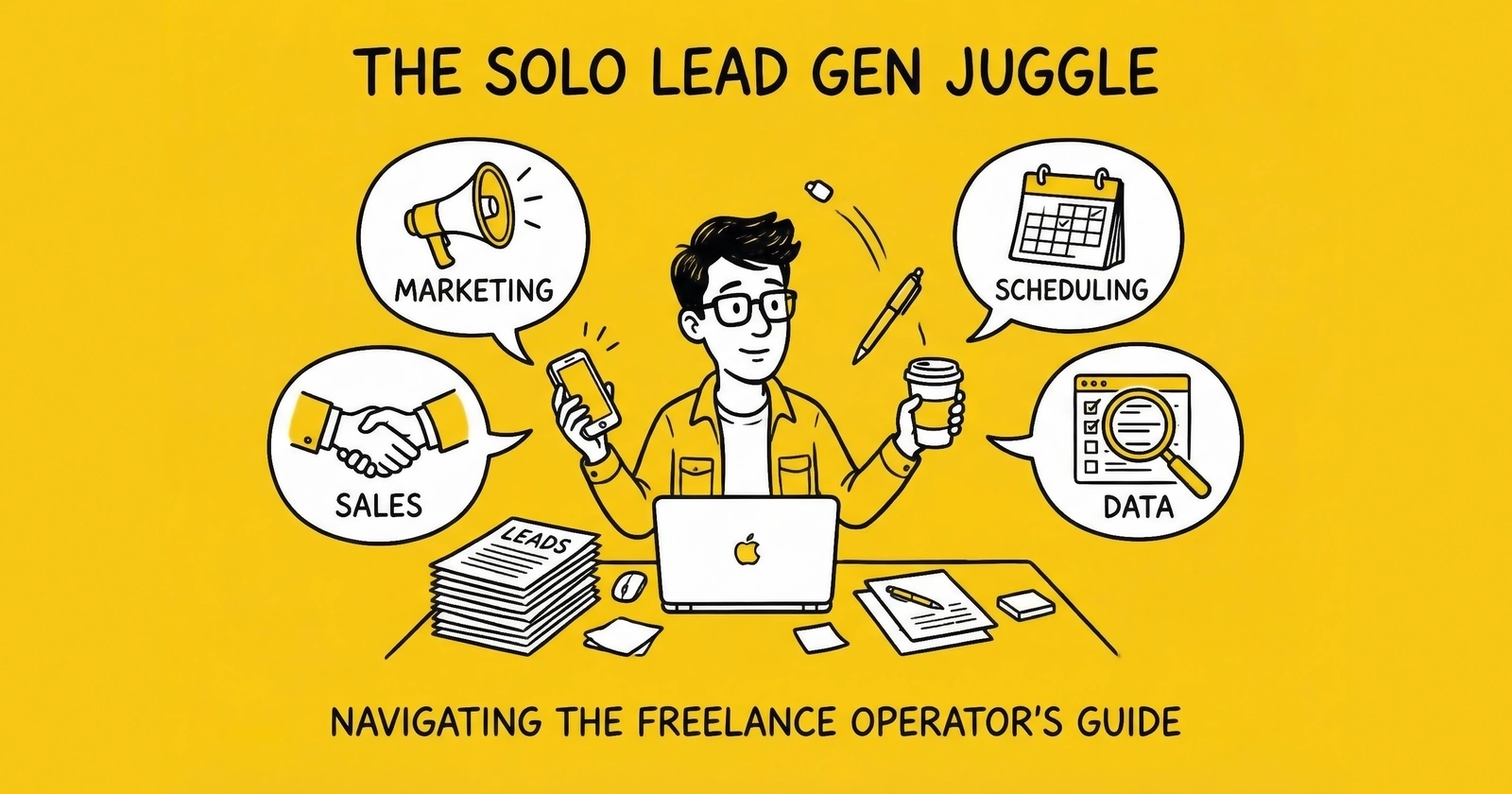
The realistic path to building a profitable freelance lead generation business – capital requirements, skill development, client acquisition, and the operational discipline that separates sustainable income from expensive lessons.
Introduction: What Freelance Lead Generation Actually Means
Freelance lead generation occupies a specific position in the lead economy. You are not building an agency with employees. You are not simply running affiliate campaigns through networks. You are building a solo operation where you control the client relationships, own the processes, and capture the full margin between your costs and what clients pay.
The appeal is obvious. Low overhead. Location independence. Income that scales with skill rather than hours worked. The lead generation industry processes billions in annual transaction value, and freelance operators can capture meaningful slices without venture capital or large teams.
The reality is more nuanced. Freelance lead generation requires a specific combination of skills: traffic acquisition, conversion optimization, client management, and operational discipline. Most people who attempt this path fail within six months – not because the opportunity is not real, but because they underestimate what solo operation actually requires.
This guide covers what it takes to succeed as a freelance lead generation operator in 2025. The numbers are based on actual operator experiences. The timelines are realistic, not aspirational. If you finish this guide and decide freelancing is not your path, that is valuable information. If you proceed, you will have a framework that accounts for how this business actually works.
Defining the Freelance Lead Generation Model
Before examining the path to success, clarity on what freelance lead generation means – and what it does not mean – matters.
What Freelance Lead Generation Is
Freelance lead generation means operating independently to generate and sell leads to clients. You handle traffic acquisition, landing page creation, lead capture, and delivery. You maintain direct relationships with buyers who pay you for leads. You are responsible for compliance, quality, and operational execution.
The distinguishing characteristic is direct client relationships combined with solo operation. Unlike affiliate marketing where you promote others’ offers through networks, you build your own assets and sell directly. Unlike agency models where you hire team members, you execute everything yourself or through contractors you manage.
Typical freelance operators work with 3-8 clients simultaneously, generating anywhere from 500 to 5,000 leads monthly depending on vertical and capacity. Revenue ranges from $5,000 to $50,000 monthly for established operators, with net margins of 30-50% after traffic costs and tools.
What Freelance Lead Generation Is Not
Freelance lead generation is not passive income. Every client relationship requires active management. Traffic sources need constant optimization. Compliance requirements demand ongoing attention. Those who describe their income as “passive” are either lying or about to discover why their business stopped working.
Freelance lead generation is not affiliate marketing with a different name. Affiliates promote offers owned by others and accept whatever payouts networks provide. Freelance operators own the client relationship, negotiate their own pricing, and control the entire lead generation process. The margin opportunity is higher, but so is the operational complexity.
Freelance lead generation is not a get-rich-quick path. Building sustainable freelance income typically requires 6-12 months of dedicated effort. Those who achieve six-figure income do so through years of skill development and relationship building, not through discovering some secret shortcut.
Capital Requirements: Starting Lean vs. Starting Right
The capital question dominates early planning. How much money do you actually need to launch a freelance lead generation operation?
Minimum Viable Capital: $5,000-$15,000
This range represents the floor for meaningful entry. At this level, you can test your capabilities, acquire initial clients, and validate whether freelance lead generation suits your skills and temperament.
Breaking Down the Minimum:
| Category | Amount | Purpose |
|---|---|---|
| Traffic Testing | $2,000-$5,000 | Initial paid media experiments |
| Technology Stack | $1,000-$3,000 | Landing pages, tracking, forms (6 months) |
| Compliance Tools | $500-$1,500 | Consent capture, basic validation |
| Operating Reserve | $1,500-$5,000 | Buffer for unexpected costs |
At minimum capital, you operate with constraints. You can test one or two verticals, not five. You can work with smaller clients who pay quickly, not enterprise accounts with 60-day payment terms. You will spend significant personal time on execution because you cannot afford to outsource anything.
The minimum path works best for operators with existing digital marketing skills. If you have run profitable paid media campaigns before, the learning curve is shorter and capital efficiency is higher.
Recommended Capital: $25,000-$50,000
This range provides meaningful runway to learn, fail, adjust, and ultimately succeed. You can survive the inevitable early mistakes without running out of money before finding your footing.
Breaking Down the Recommended:
| Category | Amount | Purpose |
|---|---|---|
| Traffic and Testing | $10,000-$20,000 | Substantial testing across sources and verticals |
| Technology Infrastructure | $3,000-$6,000 | Professional-grade tools and platforms |
| Compliance Setup | $2,000-$5,000 | Comprehensive consent and validation |
| Working Capital Float | $5,000-$10,000 | Cover timing gaps between spending and collecting |
| Operating Reserve | $5,000-$10,000 | 3-month runway for fixed costs |
At recommended capital levels, you can afford to test multiple approaches, weather a bad month, and invest in professional tools that improve efficiency. You are not operating in constant survival mode.
The Hidden Cost: Working Capital Float
Most newcomers underestimate the cash flow challenge. You pay for traffic immediately. Clients may pay you Net-15 to Net-30. That timing gap must be funded from capital.
Consider the math: If you spend $5,000 on traffic this week and generate $8,000 worth of leads, you have a profitable operation. But if clients pay in 30 days and you need to continue buying traffic, you must fund four weeks of spending before collecting the first payment.
At $5,000 weekly traffic spend with 30-day payment terms, you need $20,000 in float capital just to maintain operations – before any buffer for returns, disputes, or slow-paying clients.
Many otherwise profitable freelance operations fail during the growth phase because they cannot fund the float their own success requires.
Essential Skills for Solo Operators
Freelance lead generation demands a specific skill stack. Some skills can be learned on the job. Others require baseline competency before launch.
Non-Negotiable Skills
Traffic Acquisition: You must know how to buy traffic profitably. This means understanding platform mechanics (Google Ads, Meta Ads, native networks), campaign structure, bidding strategies, audience targeting, and creative testing. If you have never run profitable paid media campaigns, budget 6-12 months of learning before expecting freelance income.
Conversion Optimization: Traffic without conversion is expensive research. You need to understand landing page design principles, form optimization, trust element placement, and A/B testing methodology. Even modest improvements in conversion rate dramatically affect unit economics.
Basic Analytics: You cannot optimize what you cannot measure. Comfort with Google Analytics, tracking pixels, UTM parameters, and attribution fundamentals is essential. You will make data-driven decisions daily.
Learnable-on-the-Job Skills
Client Relationship Management: You will learn buyer psychology through experience. Understanding what clients need, how to communicate quality issues, and when to push back on unreasonable demands comes through doing the work.
Compliance Implementation: While you need baseline TCPA awareness before launch, the operational details – consent language, documentation retention, validation workflows – can be refined as you operate.
Vertical Knowledge: Deep expertise in specific industries (insurance, solar, legal) develops over time. You can start with general lead generation skills and develop vertical specialization through client work.
Skills to Outsource or Automate
Design Work: Unless you have genuine design skills, outsource landing page design to professionals. The cost is minimal compared to the conversion impact of poor design.
Complex Development: Custom integrations, API development, and technical troubleshooting often justify contractor costs. Your time is better spent on client acquisition and campaign optimization.
Bookkeeping: Basic financial tracking takes time that could be spent generating revenue. A bookkeeper at $200-$500 monthly handles the administrative burden effectively.
Client Acquisition: Finding Buyers Before Generating Leads
The fundamental mistake in freelance lead generation: building traffic capabilities before securing clients. Successful freelancers invert this sequence.
Why Client-First Matters
Without confirmed clients, you are generating leads into a vacuum. You do not know what prices are achievable. You do not know what quality standards to meet. You do not know what delivery specifications are required. Every assumption you make during setup will likely be wrong.
With confirmed clients, everything changes. You know exact pricing, so you can calculate whether traffic sources are profitable. You know quality requirements, so you can design capture processes accordingly. You know delivery specifications, so you can build integrations before spending on traffic.
Client-first also reduces risk. If you spend $5,000 on traffic and generate 200 leads with no buyer, you have incurred a loss. If you secure a buyer first, those 200 leads become revenue.
Where to Find Freelance Lead Generation Clients
Direct Outreach to End Buyers: Insurance agents, loan officers, solar installers, home service contractors – these businesses need leads and often lack sophisticated acquisition capabilities. Research potential clients, understand their business model, and reach out with specific value propositions.
A typical outreach might read: “I specialize in generating [vertical] leads for businesses in [geography]. I’m looking for 2-3 clients to work with on an exclusive basis. Would you have 15 minutes to discuss what lead quality and volume would be valuable for your operation?”
Expect 10-20% response rates on targeted outreach. From 50 contacts, you should generate 5-10 conversations.
Industry Events and Communities: Lead generation conferences like LeadsCon connect buyers and sellers efficiently. Industry LinkedIn groups provide access to buyers actively discussing lead acquisition challenges. These channels require relationship building over time but produce higher-quality connections than cold outreach.
Referrals from Initial Clients: Once you deliver results for one client, they know other businesses with similar needs. A satisfied insurance agent knows other agents. A successful contractor has vendor relationships with complementary businesses. Ask for referrals explicitly – most clients are willing if you have delivered value.
Aggregators and Networks as Stepping Stones: While direct relationships are the goal, aggregators and networks provide initial revenue while you build direct client relationships. They pay less than direct buyers, but they provide immediate demand that validates your capabilities.
Structuring Client Relationships
Pricing Models: Most freelance operators use cost-per-lead pricing with simple terms. You charge $X per lead delivered, with clear specifications for what constitutes an acceptable lead. Avoid complex retainer arrangements until relationships are established.
Starting price discovery is straightforward: ask potential clients what they currently pay and what they would consider fair. Industry benchmarks provide reference points, but local market conditions and lead quality expectations vary.
Return Policies: Every client relationship needs clear return policies. Industry standard is 5-15% return allowance for invalid contact information, duplicate leads, or consumers outside agreed criteria. Get terms in writing before delivering any leads.
Payment Terms: Freelancers should prioritize quick payment. NET-7 or NET-15 terms are reasonable for small-to-medium clients. Avoid NET-30 or longer until you have cash reserves to support float. Consider requiring payment deposits for new clients until payment reliability is established.
Building Your Freelance Technology Stack
Your technology stack must handle three core functions: lead capture, lead delivery, and performance tracking. Solo operators need efficiency – every tool must earn its place.
Essential Tools for Freelance Operations
Landing Page Platform ($100-$300/month): Unbounce, Leadpages, or Instapage provide templates optimized for lead capture, built-in A/B testing, and integrations with delivery systems. Choose based on your technical comfort and budget. All three work for freelance operations.
Form Builder and Lead Capture: Many landing page platforms include form functionality. For more complex multi-step forms, tools like Typeform or Jotform provide advanced logic and conditional fields. Budget $50-$100/month for dedicated form tools if needed.
Consent Documentation ($0.15-$0.50/lead): TrustedForm or Jornaya provide independent verification of consent capture – essential for TCPA compliance. At typical freelance volumes of 500-2,000 leads monthly, expect $75-$1,000 monthly for consent documentation.
Lead Delivery System: For 3-5 clients, manual delivery via email or simple CRM integrations may suffice initially. As you scale beyond 1,000 leads monthly or manage more clients, consider lead distribution platforms like boberdoo or LeadsPedia. Setup typically costs $250-$500 plus usage-based fees.
Tracking and Analytics: Google Analytics 4 provides baseline traffic analysis at no cost. For multi-touch attribution, consider dedicated tools like Triple Whale, Hyros, or Wicked Reports ($100-$500/month). Server-side tracking implementations recover data lost to browser restrictions.
Monthly Technology Costs by Stage
Startup Phase (0-500 leads/month):
- Landing page platform: $100-$150
- Basic tracking: Free (GA4)
- Consent documentation: $75-$150
- Form and delivery tools: $50-$100
- Total: $225-$400/month
Growth Phase (500-2,000 leads/month):
- Landing page platform: $150-$250
- Attribution tools: $100-$200
- Consent documentation: $150-$600
- Lead distribution platform: $300-$500
- Validation services: $50-$200
- Total: $750-$1,750/month
Established Phase (2,000+ leads/month):
- Professional landing pages: $250-$400
- Advanced attribution: $200-$500
- Consent and compliance: $400-$1,000
- Distribution platform: $500-$1,000
- Validation and enrichment: $200-$500
- Total: $1,550-$3,400/month
Technology costs scale with volume but should remain 5-10% of revenue. If technology consumes 20% of revenue, evaluate whether each tool provides proportional value.
Day-to-Day Operations: What Solo Lead Generation Actually Looks Like
Understanding daily workflow helps prospective freelancers assess whether this lifestyle suits them.
A Typical Day for an Established Freelance Operator
Morning (1-2 hours): Performance review across all client campaigns. Check overnight metrics: leads generated, delivery success rates, return notifications. Identify any issues requiring immediate attention – failed deliveries, quality complaints, budget pacing problems.
Mid-Morning (2-3 hours): Campaign optimization. Pause underperforming ads. Increase budget on winners. Launch new creative tests. Analyze landing page data and queue A/B tests. This is where profitable operators spend most of their creative energy.
Afternoon (1-2 hours): Client communication. Respond to quality feedback. Discuss volume adjustments. Address delivery issues. Proactive communication prevents problems from escalating.
Late Afternoon (1 hour): Administrative tasks. Invoice preparation. Payment tracking. Tool updates. Documentation. The unsexy work that keeps the business running.
Throughout Day: Monitoring. Checking campaigns for unusual patterns. Responding to urgent client requests. Troubleshooting delivery failures.
Total active working time: 6-9 hours on typical days. Some days require 12+ hours when launching new clients or troubleshooting problems. Some days require 3-4 hours when everything runs smoothly.
Weekly and Monthly Rhythms
Weekly: Comprehensive performance review across all clients. Source-level profitability analysis. Client check-ins for feedback. Planning for upcoming tests and optimizations.
Monthly: Financial reconciliation. Client invoicing and collections. Technology subscription reviews. Strategic planning for client acquisition or expansion.
Quarterly: Deeper business analysis. Client relationship assessment. Pricing evaluation. Skill development and learning investments.
The Realities of Solo Operation
Working alone means no one covers for you when you are sick, on vacation, or simply having an off day. Campaigns require daily attention. Clients expect responsiveness. Problems do not wait for convenient times.
Successful solo operators build systems that provide flexibility: automated monitoring alerts, clear documentation for common issues, and client expectations calibrated to reasonable response times.
The freedom of freelance work comes with the responsibility of freelance work. No boss mandates your schedule, but no employer provides a safety net either.
Scaling Within the Solo Model
Growth creates tension for freelance operators. More clients mean more revenue but also more complexity. At some point, solo operation reaches capacity constraints.
Capacity Limits for Solo Operators
Most freelance lead generation operators effectively manage 5-8 active clients generating 1,000-3,000 leads monthly. Beyond this level, operational complexity typically exceeds individual capacity without quality degradation.
The constraint is not hours – it is attention. Each client relationship requires quality monitoring, communication, and problem-solving. Each traffic source requires optimization. Each landing page requires testing. The cognitive load compounds faster than hours worked.
Strategies for Scaling Within Solo Constraints
Increase Revenue Per Client: Rather than adding more clients, deepen existing relationships. If a client currently buys 200 leads monthly and could use 500, serving their growth is more efficient than acquiring new clients.
Improve Unit Economics: Better conversion rates, lower traffic costs, and reduced operational overhead increase profit without increasing volume. A 10% improvement in margins on existing volume provides the same income boost as 10% volume growth at constant margins.
Selective Client Upgrading: As you develop capabilities, replace lower-value clients with higher-value opportunities. An operator with five clients generating $30,000 monthly can reach $50,000 by replacing the lowest-margin clients with better opportunities rather than adding volume.
Strategic Outsourcing: Certain tasks can be delegated without building a full agency. Virtual assistants handle administrative work. Freelance designers create landing pages. Media buying contractors execute campaigns you design. You maintain strategic control while reducing execution burden.
The Agency Transition Question
At some point, successful freelance operators face a choice: remain solo with capped but sustainable income, or transition toward agency models with higher ceilings and different challenges.
Neither choice is inherently better. Some operators prefer the lifestyle of solo work – the autonomy, simplicity, and direct relationship with their income. Others want to build larger businesses and accept the management complexity that entails.
The transition typically happens between $20,000-$40,000 monthly revenue, when the operator consistently turns away opportunities due to capacity constraints. If you reach this point and want to grow further, agency building becomes relevant. If you are satisfied with that income level, optimizing the solo model makes more sense.
Financial Management for Freelance Operators
Financial discipline separates sustainable freelance businesses from expensive hobbies. Several practices prove essential.
Separating Business and Personal Finances
Form a legal entity (LLC for most practitioners) and maintain separate bank accounts. This separation provides liability protection, simplifies tax preparation, and creates clear visibility into business performance.
Commingling personal and business finances makes it nearly impossible to understand profitability, and it weakens the liability protection that business entities provide.
Managing Cash Flow Timing
The sixty-day float rule applies even to freelance operations. Maintain cash reserves sufficient to cover 60 days of operating expenses including traffic spend. This buffer protects against slow-paying clients, unexpected returns, and revenue fluctuations.
If monthly traffic spend is $8,000 and fixed costs are $2,000, maintain at least $20,000 in business reserves. More conservative practitioners maintain 90 days.
Pricing for Profitability
New freelancers often underprice to win initial clients. This creates problems: insufficient margin to invest in optimization, inability to survive inevitable problems, and difficulty raising prices later.
Calculate your true costs before setting prices. Include traffic acquisition, technology, compliance tools, your time (at market rates), and margin for variability. If the resulting price seems high, you may be underestimating what sustainable operation requires.
Target gross margins of 40-60% on lead sales. After all costs, net margins of 25-40% indicate a healthy freelance operation. Margins below 20% leave insufficient buffer for problems and make the business fragile.
Tax and Legal Considerations
Freelance income is self-employment income, subject to both income tax and self-employment tax (15.3% for Social Security and Medicare). Quarterly estimated tax payments are required. Work with an accountant familiar with self-employment to structure tax planning effectively.
Consider business insurance. General liability coverage is standard. Errors and omissions (E&O) coverage matters for lead generation given TCPA liability exposure. Cyber liability covers data-related risks. Budget $1,000-$3,000 annually for adequate coverage.
Common Failure Patterns and How to Avoid Them
Specific failure patterns recur across freelance lead generation attempts. Understanding them helps you avoid the same mistakes.
Failure Pattern 1: Traffic Before Clients
Building traffic capabilities before securing buyers creates leads with nowhere to go. By the time you find buyers, your capital is depleted and your leads have aged.
Prevention: Confirm at least 2-3 buying relationships before spending on traffic. Know your prices, quality requirements, and delivery specifications before generating a single lead.
Failure Pattern 2: Undercapitalization
Starting with insufficient capital means running out of money before the learning curve is complete. Most freelance operators need 4-6 months to reach consistent profitability.
Prevention: Start with recommended capital levels, not minimums. Maintain reserves for the learning period. If you cannot afford recommended capital, consider gaining experience through employment or affiliate work first.
Failure Pattern 3: Single Client Dependency
Concentrating revenue in one client creates existential risk. When that client reduces volume, changes terms, or churns, your business collapses.
Prevention: Maintain the 30% rule: no single client should exceed 30% of revenue. Diversify from day one, even if it means accepting smaller initial clients.
Failure Pattern 4: Compliance Shortcuts
Skipping consent documentation, using non-compliant disclosure language, or ignoring validation seems to save money until a lawsuit arrives. TCPA settlements average $6.6 million for class actions.
Prevention: Implement TrustedForm or Jornaya from the start. Have an attorney review disclosure language. Retain consent records for at least five years. The cost is pennies per lead; the protection is worth millions.
Failure Pattern 5: Lifestyle Inflation
Early success leads to spending increases. New software subscriptions. Unnecessary tools. Higher personal expenses. When a bad month arrives, the inflated cost structure creates crisis.
Prevention: Maintain minimal fixed costs during the first 12-18 months. Build reserves before increasing spending. Live below your business income until sustainability is proven.
Frequently Asked Questions
How much can I realistically earn as a freelance lead generation operator?
First-year earnings for freelance operators typically range from $0 (the learning year often loses money) to $50,000 for those who execute well. Year two to three can reach $75,000-$150,000 for operators who have established client relationships and optimized their operations. The top tier of freelance operators – those with 3-5 years of experience, strong client relationships, and efficient operations – can earn $200,000-$400,000 annually while maintaining solo operation. However, these income levels represent the top 10-20% of outcomes, not typical results.
Do I need prior marketing experience to succeed as a freelance lead generator?
Prior experience significantly improves outcomes. Operators with 2-3 years of paid media experience – whether from agency roles, in-house marketing, or affiliate marketing – typically reach profitability in 3-6 months. Operators without marketing experience often take 6-12 months to develop baseline competency before even beginning the client acquisition phase. If you lack marketing fundamentals, consider gaining experience through employment or structured education before attempting freelance operation.
What is the best vertical for freelance lead generation beginners?
Insurance (particularly auto and Medicare) and home services (HVAC, roofing, plumbing) offer the best combination of market size, accessible traffic costs, moderate compliance complexity, and buyer availability for beginners. Legal and mortgage verticals offer higher CPLs but demand more specialized knowledge and carry heavier compliance burdens. Solar requires geographic expertise. Start with one vertical and develop specialization before considering expansion.
How many clients should a freelance lead generation operator work with?
Most successful solo operators manage 4-8 active client relationships. Fewer than 3-4 clients creates concentration risk and underutilizes capacity. More than 8-10 clients typically exceeds solo operational capacity without quality degradation. The optimal number depends on client complexity, lead volume per client, and your operational efficiency. Start with 2-3 clients and add gradually as you develop systems and capacity.
How long before freelance lead generation becomes profitable?
Realistic timeline for well-capitalized, competently executed freelance operations: 4-8 months to consistent profitability. Months 1-2 involve setup, initial testing, and likely losses. Months 3-4 involve optimization and early client delivery. Months 5-8 involve scaling what works and building sustainable income. Undercapitalized operators often fail between months 3-6 – right when the model is starting to work – because they run out of runway before reaching profitability.
What are the biggest compliance risks for freelance lead generators?
TCPA (Telephone Consumer Protection Act) violations represent the primary compliance risk. TCPA class action settlements average $6.6 million, with individual statutory damages of $500-$1,500 per violation. Freelance operators must implement proper consent capture (TrustedForm, Jornaya), use compliant disclosure language reviewed by an attorney, and maintain consent documentation for at least five years. Additional risks include FTC advertising violations, state-specific regulations (California CCPA, state mini-TCPA laws), and vertical-specific requirements (CMS rules for Medicare, state insurance regulations).
Can I run a freelance lead generation business part-time?
Yes, particularly during the setup and early client acquisition phases. However, expect the timeline to profitability to extend proportionally. A 20-hour weekly commitment typically requires 8-12 months to reach the results a full-time operator achieves in 4-6 months. Part-time operation works best as a transition strategy – maintaining employment income while building freelance capabilities – rather than a permanent arrangement. Lead generation rewards consistent attention; sporadic engagement produces sporadic results.
What technology costs should I expect monthly as a freelance operator?
Entry-level freelance operations require $200-$400 monthly for basic tools: landing page platform, tracking, consent documentation. Growth-phase operations generating 1,000-2,000 leads monthly typically spend $750-$1,500 monthly on more sophisticated platforms, attribution tools, and distribution systems. Technology costs should remain 5-10% of revenue. If technology consumes more than 15% of revenue, evaluate whether each tool delivers proportional value.
How do I handle client relationships when quality issues arise?
Quality issues are inevitable. The key is proactive communication and systematic resolution. When a client reports quality problems, acknowledge the concern immediately, investigate thoroughly, provide data-driven analysis, and implement specific corrections. Document everything. Most client relationships can survive quality issues if handled professionally – it is the operators who become defensive or unresponsive who lose clients. Build quality monitoring into your operations so you identify problems before clients do.
Should I specialize in one vertical or offer lead generation across multiple industries?
Start with one vertical and achieve competency before considering expansion. Specialization creates expertise that commands premium pricing and builds competitive advantage. Generalists spread resources across multiple learning curves and rarely achieve excellence in any vertical. Once you have established yourself in one vertical – typically 12-18 months – consider selective expansion to related verticals that leverage existing knowledge. The most successful freelance operators are known for deep expertise in 1-2 verticals, not broad capabilities across many.
Key Takeaways
-
Freelance lead generation means solo ownership of client relationships and full-stack execution. You are not an affiliate promoting others’ offers. You build direct buyer relationships, own the lead generation process, and capture full margins.
-
Capital requirements range from $5,000-$15,000 minimum to $25,000-$50,000 recommended. Minimum capital creates constraints that extend timelines. Recommended capital provides runway for learning curves and inevitable mistakes.
-
Client acquisition comes before traffic investment. The typical failure pattern is building capabilities without buyers. Successful freelancers secure 2-3 committed clients before spending on lead generation.
-
Essential skills include traffic acquisition, conversion optimization, and analytics. Prior paid media experience significantly accelerates path to profitability. Without marketing fundamentals, budget 6-12 months of learning before expecting freelance income.
-
Technology costs scale from $200-$400 monthly at entry to $1,500+ at growth phase. Consent documentation (TrustedForm/Jornaya) is non-negotiable from day one regardless of budget level.
-
Solo operators effectively manage 4-8 clients generating 1,000-3,000 leads monthly. Beyond this level, operational complexity typically exceeds individual capacity without quality degradation.
-
Timeline to profitability is 4-8 months for well-executed operations. The first 1-2 months involve setup and testing. Months 3-4 bring optimization and initial delivery. Months 5-8 establish sustainable income patterns.
-
The 30% rule applies immediately. No single client should exceed 30% of revenue. Concentration risk kills freelance businesses when key clients churn.
-
TCPA compliance is non-negotiable. Consent capture, compliant disclosure language, and documentation retention protect against multi-million dollar litigation exposure.
-
Financial discipline determines survival. Separate business finances, maintain 60-day reserves, price for profitability, and resist lifestyle inflation until sustainability is proven.
The freelance lead generation path works for operators with the right combination of skills, capital, and temperament. The freedom and income potential are real. So are the demands on attention, discipline, and continuous improvement. Success comes to those who approach the opportunity with realistic expectations and systematic execution.
This article is part of The Lead Economy series on building and operating lead generation businesses. Statistics and regulatory information current as of late 2024/early 2025. Capital requirements, timelines, and market conditions vary – validate current data and consult with legal and tax professionals before making business decisions.