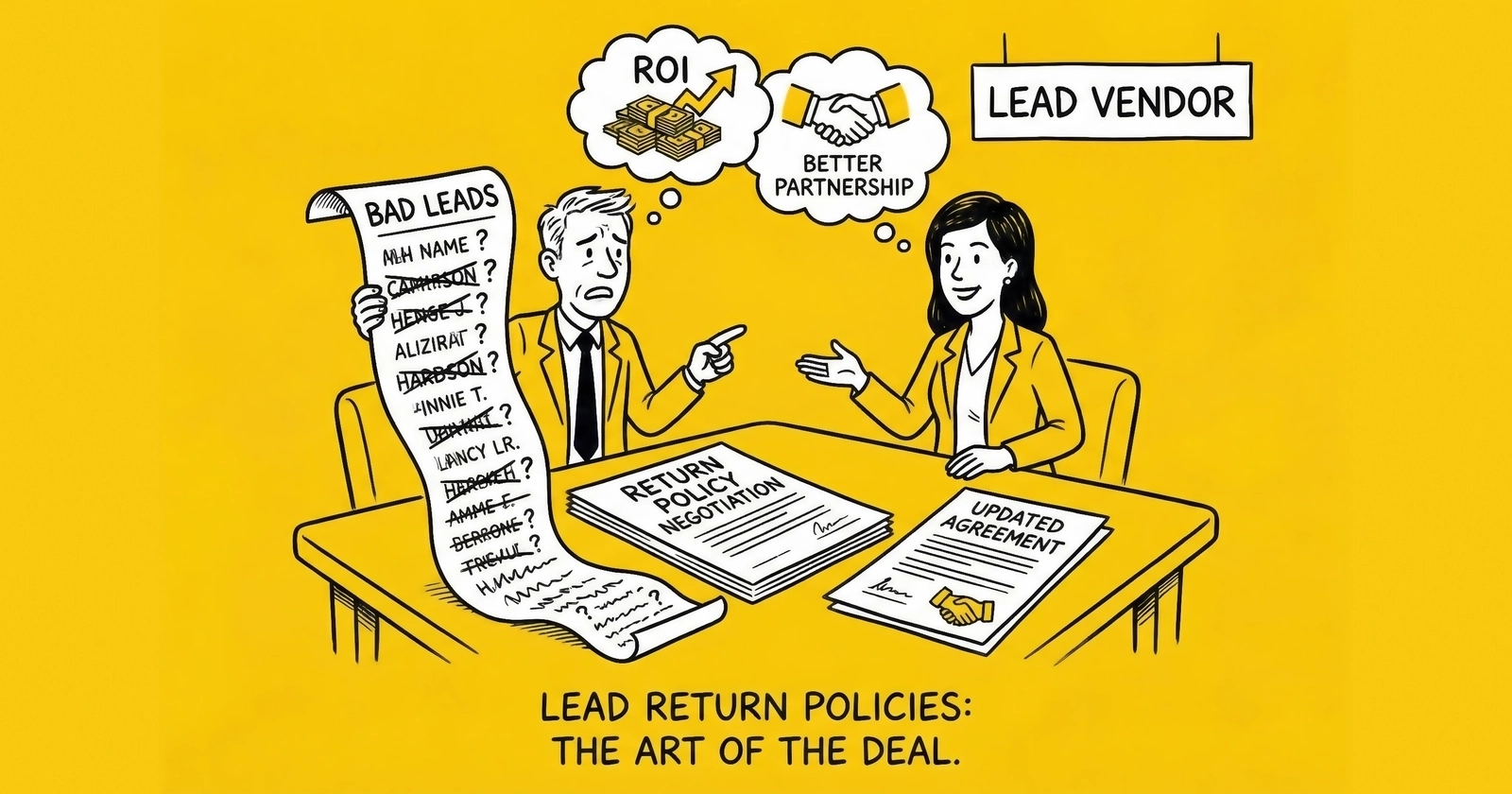
Master the art of structuring, negotiating, and managing lead return policies to protect your margins while building sustainable buyer relationships.
Returns kill more lead businesses than competition does.
That statement sounds dramatic until you run the numbers. A lead generation operation humming along at 8% returns can look entirely different from one struggling at 15%. Same traffic sources. Same buyers. Same vertical. The difference between those two return rates transforms a profitable business into a cash-burning disaster.
I have watched operators obsess over CPL optimization, traffic source diversification, and buyer acquisition strategies while completely ignoring the return policies that reshape every assumption in their P&L. You can negotiate a $50 lead price and celebrate the margin, only to discover six weeks later that your effective revenue is $42 after returns, disputes, and chargebacks consume the difference.
This guide covers everything operators need to understand about lead return policies: what constitutes fair terms, how to negotiate from both sides of the transaction, vertical-specific benchmarks that define reasonable expectations, and the operational infrastructure required to manage returns without destroying buyer relationships or your own profitability.
Those who master return management build sustainable businesses that compound over time. The ones who treat returns as an afterthought learn expensive lessons that often prove fatal.
What Is a Lead Return?
A lead return occurs when a buyer rejects a lead after purchase and requests a refund. The buyer accepted the lead, attempted to work it, and determined it did not meet agreed-upon quality standards. The distinction from rejection is critical: rejections happen in real-time during the transaction, before money changes hands. Returns happen after acceptance, after payment is initiated, and after the lead enters the buyer’s system.
The mechanics follow a predictable pattern across the industry:
Lead Delivery: You deliver the lead through your agreed delivery method. The buyer’s system accepts it. Payment is initiated or logged according to your billing arrangement.
Work Attempt: The buyer’s sales team attempts to contact the consumer. They call, text, or email according to their internal workflow. This phase typically spans 24 to 72 hours for real-time leads.
Problem Identification: Something fails. The phone number disconnects. The consumer denies ever submitting a request. The data does not match the buyer’s stated criteria. The consumer turns out to be a competitor or a known litigator.
Return Request: The buyer submits a return through your portal, via email, or through your distribution platform’s return management system. This submission should include a specific reason code and any required documentation.
Dispute Review: You evaluate the return against your stated policy. Valid returns meeting documented criteria receive credit. Invalid claims get disputed with supporting evidence.
Credit Processing: For valid returns, you issue a credit or refund to the buyer. Your revenue decreases. Your supplier, if you purchased the lead upstream, still expects payment unless you can successfully dispute the return within their window.
The timing creates the critical problem that most practitioners underestimate. Returns arrive after you have paid your suppliers, after you have counted the revenue, and often after you have spent the margin on operational expenses. A lead that costs $30 to acquire and sells for $50 generates $20 of margin in your accounting system. When the return arrives three weeks later, that $20 margin becomes a $30 loss because you already paid your supplier and cannot recover those funds.
Why Returns Matter More Than You Think
Returns represent margin erosion in disguise. A $60 lead with a 15% return rate is really a $51 lead. Understanding, structuring, and managing return policies is essential to protecting the margins you have worked to build.
Consider a worked example that demonstrates the true impact:
You operate as a broker buying leads at $30 and selling them at $50. That is $20 gross margin on paper, representing 40% of your sale price.
At 8% Returns:
- Daily volume: 100 leads
- Revenue generated: $5,000
- Returns: 8 leads worth $400
- But you already paid for those 8 leads: $240
- Plus processing costs at $6.25 per return: $50
- Net daily margin: $1,510
- Effective margin: 30.2%
At 15% Returns:
- Daily volume: 100 leads
- Revenue generated: $5,000
- Returns: 15 leads worth $750
- But you already paid for those 15 leads: $450
- Plus processing costs: $93.75
- Net daily margin: $1,006.25
- Effective margin: 20.1%
The swing from 8% to 15% returns represents a 33% reduction in net margin. That is the difference between a healthy business generating $550,000 annual profit and one struggling at $367,000. Both operations look identical from the outside. The difference is entirely in how they manage and negotiate returns.
Beyond the direct revenue impact, returns create hidden costs that compound over time:
Processing burden. Every return requires investigation. Someone reviews the return reason, checks the original data, evaluates the buyer’s documentation, decides whether to accept or dispute, and processes the credit. At 15 minutes per return and $25 per hour loaded labor cost, each return carries $6.25 in processing overhead before you count the actual credit.
Supplier strain. High return rates strain upstream relationships. If you are purchasing leads and returning significant volume to your suppliers, they may require prepayment, reduce credit terms, or terminate the relationship entirely. Your buyer’s quality standards become your supplier’s problem.
Buyer erosion. Buyers track return rates by source. Even when returns are legitimate and processed promptly, high return rates create friction. Buyers spending time submitting and tracking returns are not spending time buying more leads. Eventually, they find sources that require less maintenance.
Cash flow amplification. Returns arrive after you have paid suppliers but before many buyers have paid you. The cash flow timing mismatch compounds as return rates increase, creating working capital pressure that can overwhelm undercapitalized operations.
Return Rate Benchmarks by Vertical
Return rates vary dramatically across verticals, and understanding your benchmark helps assess whether your operation is performing normally or bleeding money unnecessarily. These benchmarks represent 2024-2025 industry standards based on data from lead distribution platforms and industry surveys.
Auto Insurance: 8-15%
Auto insurance leads maintain relatively low return rates due to straightforward qualification criteria. Vehicle information, driver details, and coverage needs are easily validated. Phone verification technology works well for this data set, and buyers have established processes for working these leads quickly.
A well-run auto insurance operation targets the 8-10% range. Rates above 12% signal problems with data quality or source management. At 15%, margins become thin for most brokers operating on standard spreads.
Medicare: 12-20%
Medicare leads carry higher return rates due to compliance complexity and demographic factors. Seniors may not remember requesting information, particularly during busy enrollment periods. Family members sometimes submit on behalf of parents, creating consent complications. The Annual Enrollment Period generates volume spikes that stress quality controls across the entire supply chain.
Strong Medicare lead generators maintain 12-15% returns during open enrollment. Off-season rates often climb as lead quality becomes harder to verify and buyer demand contracts. Operations running above 18% should audit their sources immediately.
Solar: 15-25%
Solar leads experience the highest return rates among major verticals. The qualification requirements are demanding: homeownership verification, roof condition assessment, sun exposure evaluation, utility cost validation, and creditworthiness screening. Geographic constraints add complexity since a lead from a shaded lot or an area without installer coverage cannot convert regardless of consumer intent.
Top solar lead generators achieve 15-18% returns through aggressive pre-qualification and geographic targeting. Operations at 20% or higher often struggle with homeownership verification or geographic filtering. At 25%, the business model becomes nearly impossible without premium pricing that few buyers will accept.
Mortgage: 10-18%
Mortgage leads sit in the middle range, with return rates tied closely to rate environments and property verification accuracy. When rates drop and refi volume surges, quality controls often slip as operators rush to capture demand. When rates rise and volume contracts, buyers become more aggressive about returning marginal leads to protect their own economics.
Steady operations maintain 10-14% returns in normal rate environments. Rate-sensitive periods can push returns to 16-18% temporarily, which should trigger immediate source review and buyer communication. Persistent rates above 15% indicate fundamental source or qualification issues that require structural remediation.
Legal: 5-12%
Legal leads maintain the lowest return rates among major verticals. The high value of legal leads, often $100-500 or more for personal injury and mass tort cases, creates strong incentives for careful pre-qualification on the seller side and thorough evaluation on the buyer side. Intake specialists at law firms are generally more persistent in their contact attempts before concluding a lead is invalid.
Quality legal lead operations run 5-8% returns. Rates above 10% suggest problems with case qualification criteria, consent documentation, or source quality. Mass tort leads may see slightly higher rates due to statute of limitations complications or geographic restrictions that vary by case type.
Valid vs. Invalid Return Reasons
Clear return criteria reduce disputes, establish expectations, and protect both parties. The industry has developed relatively consistent standards for what constitutes legitimate grounds for return versus what falls outside acceptable reasons.
Generally Accepted Return Reasons
Disconnected or invalid phone number. The phone number is no longer in service, has been disconnected, or cannot receive calls. Most practitioners accept these returns without dispute when verified through HLR lookup or similar validation. The consumer cannot be contacted regardless of intent quality.
Wrong number. The person who answers is not the lead and has no knowledge of the request. This differs from no-answer situations; the number works, but it belongs to someone else entirely. Documentation typically required includes call recording or detailed notes.
Consumer denies submission. The consumer explicitly states they never filled out a form or requested information. This suggests either fraud, identity issues, or severe confusion. Consent certificate review becomes critical for dispute resolution.
Duplicate within agreed window. The buyer already has this consumer in their system from a recent purchase, either from you or another source. Standard duplicate windows range from 30 to 90 days depending on vertical and buyer type. Documentation showing the prior lead with matching identifiers supports the return.
Outside specified criteria. The lead does not match the buyer’s stated filtering requirements. Wrong geography, wrong product type, wrong age range, or other explicit filter violations justify return. This category should be rare if your filtering works correctly.
Clear fraud indicators. The submission shows obvious signs of fraud: synthetic identity patterns, known bot signatures, incentivized traffic markers, or data from compromised databases. Evidence must be specific and documentable.
Invalid Return Reasons to Reject
No answer after attempts. A consumer who does not answer the phone is not necessarily a bad lead. They might be at work, screening calls, or temporarily unavailable. This is an operational challenge for the buyer, not a quality defect in the lead.
Consumer not interested. Sales objections differ from lead quality issues. A consumer who was interested when they submitted but changed their mind after speaking with the buyer remains a valid lead that was delivered as promised.
Buyer capacity exceeded. If the buyer cannot work the lead due to their own operational constraints, that is not grounds for return. Caps and volume management should prevent over-delivery.
Consumer changed circumstances. Life changes happen. A consumer who decided they no longer need insurance, canceled their moving plans, or received better terms elsewhere provided valid intent at submission.
Requested DNC after submission. A consumer who submits a form and later requests to be placed on Do Not Call lists is exercising a legitimate right, but the lead was valid at delivery. The buyer’s obligation is to honor the request, not to return the lead.
Soft email bounce. Temporary email delivery failures differ from hard bounces. Soft bounces may resolve on retry and do not indicate an invalid email address.
Could not qualify on phone. If the consumer answers but does not meet the buyer’s additional qualification criteria discovered during conversation, that reflects the difference between form data and live qualification. Unless the form data was demonstrably false, the lead delivered what was promised.
Negotiating Return Windows
Return windows define the timeframe within which buyers can submit return requests. These windows represent one of the most consequential negotiation points in any lead purchase agreement, directly affecting cash flow, operational complexity, and margin protection.
Standard Industry Windows
The industry has developed relatively consistent window expectations by lead type:
Real-time leads: 24 to 72 hours from delivery timestamp. This provides sufficient time for initial contact attempts while limiting seller exposure. Premium buyers who commit to immediate contact often accept shorter windows in exchange for pricing concessions.
Aged leads: 7 to 14 days from delivery. Extended windows reflect the reality that aged leads require more contact attempts and that buyers expect lower contact rates. Pricing should reflect this extended exposure.
Live call transfers: 24 hours or same-day. The immediate nature of transferred calls means quality issues are apparent quickly. Extended windows are rarely appropriate for this delivery type.
Negotiation Leverage Points
Quality track record justifies shorter windows. Sellers with documented low return rates can reasonably request compressed windows. If historical data shows 6% returns within 48 hours and minimal additional returns after that point, a 48-hour window protects the seller without materially disadvantaging the buyer.
Volume commitments secure longer windows. Buyers providing significant, consistent volume often negotiate extended windows as a relationship benefit. A buyer taking 500 leads daily might receive a 7-day window where a buyer taking 50 leads daily receives 3 days.
Pricing trades against window length. Shorter windows reduce seller risk and should command lower prices. Longer windows increase seller risk and justify price premiums. Make these tradeoffs explicit in negotiations.
Tiered windows by return reason. Some agreements specify different windows for different return categories. Contact failure (disconnected numbers) might have a 48-hour window, while duplicate detection might have a 14-day window reflecting the reality that buyers sometimes take longer to identify duplicates in their systems.
Window Alignment Strategy
Your buyer windows must align with your supplier windows, with adequate buffer for processing time. If you offer buyers 72 hours, ensure your suppliers offer at least 96 hours. If you offer 7 days, ensure suppliers offer 10 days. This buffer provides time to receive buyer returns, evaluate them, and submit upstream before your supplier window closes.
Misalignment creates unrecoverable losses. A buyer who returns a lead on day six of a seven-day window gives you one day to evaluate, dispute if appropriate, and submit upstream. If your supplier window is also seven days, you will likely miss it, absorbing a loss that should have passed through.
Negotiating Return Caps
Return caps limit total returns regardless of individual return legitimacy. They protect sellers from catastrophic exposure while providing buyers reasonable quality assurance.
Cap Structures
Percentage caps per period. The most common structure limits returns to a percentage of delivered volume. “Returns shall not exceed 12% of monthly delivered leads” provides clear boundaries while accommodating normal variation.
Rolling period caps. Some agreements use rolling windows instead of fixed calendar periods. “Returns shall not exceed 15% of leads delivered in any rolling 30-day period” provides smoother limits than monthly caps that reset.
Absolute volume caps. For high-volume relationships, absolute numbers sometimes replace percentages. “Returns shall not exceed 500 leads per month regardless of delivered volume” protects against extreme scenarios.
Tiered caps by return category. Sophisticated agreements may specify different caps for different return types. Invalid contact returns might cap at 10% while duplicate returns cap at 5%, reflecting different baseline expectations for each category.
Cap Consequences
Agreements should specify what happens when caps are exceeded:
Excess returns denied. Returns beyond the cap are not credited, period. The buyer absorbs the loss. This protects the seller but may create relationship friction if quality genuinely declines.
Price adjustment triggers. Exceeding caps triggers automatic price increases for subsequent periods, compensating the seller for higher-than-expected quality costs while maintaining the relationship.
Review period initiation. Caps exceeded in any period trigger mandatory quality review, source audits, and potential agreement modification. This collaborative approach preserves relationships while addressing problems.
Termination rights. Persistent cap violations over multiple periods may trigger termination rights for either party. The seller can exit if quality demands become unreasonable. The buyer can exit if quality fails to meet minimum standards.
Negotiation Strategy
Sellers should always negotiate caps into buyer agreements. Uncapped return policies expose you to unlimited downside risk. Even legitimate quality issues can generate unsustainable return volumes during unusual periods.
Start cap negotiations with historical data. If your typical return rate is 10%, propose a 13-15% cap. This provides buffer for normal variation while protecting against extreme scenarios.
Consider seasonal adjustments for verticals with documented volatility. Medicare leads during Annual Enrollment Period may justify temporary cap increases. Solar leads during peak season may operate under different parameters than off-season.
Documentation Requirements for Returns
Documentation requirements create accountability, reduce frivolous returns, and provide evidence for dispute resolution. Specify these requirements explicitly in your agreements.
Standard Documentation by Return Type
Disconnected/invalid phone returns: HLR lookup result showing disconnection or carrier rejection. Timestamp of verification attempt. The validation should occur within 24 hours of the return request.
Wrong number returns: Call recording demonstrating that a different person answered who has no knowledge of the lead. If recordings are not available, detailed call notes with specific quotes and agent attestation.
Consumer denial returns: Call recording or detailed notes documenting the consumer’s explicit statement that they did not submit a request. Ideally, the consumer provides specific denials rather than simply expressing lack of interest.
Duplicate returns: Evidence of the prior lead record, including the original submission date, source, and matching data points. For cross-source duplicates (buyer received the same consumer from a different vendor), the buyer’s internal documentation showing the prior record.
Filter mismatch returns: Specific identification of which filter criterion was violated and documentation showing the discrepancy between stated requirements and delivered data.
Seller Documentation for Disputes
When disputing returns, sellers should provide:
Consent certificate. TrustedForm or Jornaya certificate showing the consumer’s form submission, including timestamp, IP address, consent language presented, and user action taken.
Validation logs. Records of phone verification, email validation, and any other quality checks performed before delivery.
Original submission data. Complete lead record as received, demonstrating that delivered data matched what was captured.
Delivery confirmation. Proof of successful delivery including timestamp, buyer acceptance response, and any acknowledgment codes.
Dispute Resolution Process
Establish formal dispute procedures in your agreements:
Level 1: Operational review. Account managers from both parties review the disputed return with submitted documentation. Most disputes resolve at this level within 48-72 hours.
Level 2: Escalation. Unresolved disputes escalate to operations leadership or designated dispute resolution contacts. Additional documentation may be requested from both parties.
Level 3: Final resolution. Commercial or executive level review for disputes that threaten the relationship. This level should be rare and reserved for pattern issues rather than individual leads.
Binding decisions. Specify that final dispute resolutions are binding on both parties. This prevents endless appeals that consume operational resources.
Return Policy Red Flags
Certain policy provisions should trigger careful evaluation or negotiation before acceptance.
For Sellers (Red Flags in Buyer Demands)
Unlimited return windows. Any agreement allowing returns “at any time” or with no specified window creates unbounded liability. Decline these terms entirely.
Subjective quality standards. Return policies allowing returns for “low quality” or “poor performance” without specific, measurable criteria invite abuse. Require objective, documentable reasons.
No documentation requirements. Policies that credit returns automatically without requiring supporting evidence encourage frivolous returns. Mandate documentation for every category.
Uncapped returns. Agreements without return rate limits expose you to catastrophic losses. Always negotiate caps.
Extended windows without price adjustment. Windows longer than industry standard should command premium pricing. If a buyer wants 14 days for real-time leads, price accordingly.
Return of converted leads. Some buyers attempt to return leads that actually converted, typically through administrative error or bad faith. Policies should explicitly exclude leads that resulted in sales or appointments.
For Buyers (Red Flags in Seller Policies)
Unreasonably short windows. Windows under 24 hours for real-time leads prevent adequate evaluation. Sellers pushing very short windows may be hiding quality issues.
Excessive documentation requirements. Requiring notarized statements, executive sign-off, or burdensome evidence for routine returns suggests a seller who does not intend to honor returns.
Narrow return categories. Policies that only accept returns for “fraud” while rejecting disconnected numbers, duplicates, and filter mismatches are designed to minimize legitimate credits.
No dispute process. Sellers who deny disputes entirely or reserve sole discretion on all return decisions leave buyers without recourse for legitimate quality issues.
Hidden caps. Caps buried in contract fine print rather than explicitly discussed suggest a seller preparing to deny returns you expect to be honored.
Managing Returns Operationally
Return policy negotiation is only half the challenge. Operational execution determines whether your policies actually protect your margins.
Daily Monitoring Requirements
Review every day:
Total returns by volume and rate. Establish baseline expectations and flag deviations immediately. A typical Tuesday seeing 50% more returns than usual requires investigation, not end-of-month discovery.
Returns by buyer. Some buyers return more than others for legitimate reasons (different quality standards, different use cases). But sudden spikes from specific buyers often indicate policy disputes, operational problems, or relationship deterioration.
Returns by source. One traffic source running 25% returns can destroy the economics of an operation averaging 12%. Source-level visibility is non-negotiable.
Returns by reason code. Emerging patterns in return reasons signal specific problems. A sudden increase in “duplicate” returns might indicate your deduplication system is failing. A spike in “wrong number” returns might indicate phone validation issues.
Weekly Analysis
Conduct deeper analysis weekly:
Trend lines by source and buyer combination. Some source-buyer pairings work better than others. Identify the problematic combinations and address through routing changes or pricing adjustments.
Return reason distribution changes. The mix of return reasons should remain relatively stable. Shifts in distribution suggest either quality changes or buyer behavior changes.
Financial impact calculation. Convert return rates to actual dollar impact. A 2% increase in returns sounds manageable until you calculate the $45,000 monthly margin impact.
Source qualification decisions. Weekly reviews should inform source management. Sources persistently exceeding return thresholds should face volume reductions or termination.
Alert Thresholds
Configure automated alerts for:
Source exceeding 2x normal return rate. If a source typically runs 10% returns and suddenly hits 20%, something has changed. Investigate immediately.
Buyer return rate exceeding cap threshold. Know before the end of the period that a buyer is approaching or exceeding their cap. This enables proactive communication and prevents surprises.
Single-day return volume exceeding historical norms. Volume spikes often indicate systematic issues rather than random variation.
New return reason appearing in volume. If buyers suddenly start using a return reason code they have never used before, something has changed in their evaluation process.
Process Return Requests Promptly
Process returns within 24-48 hours of submission. Delayed processing creates several problems:
Cash flow uncertainty. Unprocessed returns create liability that does not show in your accounting until credited. Fast processing provides accurate financial visibility.
Buyer frustration. Buyers tracking returns want to see credits appear quickly. Delays suggest you are looking for reasons to deny rather than processing in good faith.
Dispute complexity. The longer a return sits unprocessed, the harder it becomes to gather evidence for disputes. Memories fade, logs rotate, and documentation becomes harder to retrieve.
Upstream timing. If you need to dispute returns upstream to your suppliers, delays in your processing consume the buffer time you need for that process.
Building Return Management Infrastructure
Mature operations require systematic infrastructure rather than ad-hoc processes.
Required Systems
Return submission portal. Buyers should submit returns through a structured system that captures required information, enforces documentation requirements, and creates audit trails. Email-based returns work at low volume but become unmanageable at scale.
Automated validation. Basic checks should occur automatically: Is the lead ID valid? Is the return within the window? Has this lead been returned before? Does the reason code match documented return reasons?
Evidence storage. Return documentation, dispute evidence, and resolution records must be retrievable. Store call recordings, consent certificates, and correspondence for minimum five years.
Integration with distribution platform. Returns should flow into your lead management system, updating source performance metrics, buyer relationship data, and financial records automatically.
Reporting and analytics. Dashboards should display return trends at aggregate, buyer, and source levels. Export capabilities support deeper analysis when needed.
Process Documentation
Document your return procedures thoroughly:
Acceptance criteria. Specific requirements for each return category, including documentation requirements and evaluation standards.
Dispute procedures. How disputes are initiated, what evidence is required, who reviews, and how decisions are communicated.
Escalation paths. Who handles exceptions, pattern issues, and relationship-threatening disputes.
Training materials. How new team members learn return evaluation, dispute handling, and buyer communication standards.
Negotiation Strategies by Position
Your negotiation approach depends on whether you are buying or selling leads, your relative market power, and your operational priorities.
Strategies for Lead Sellers
Start with data. Before negotiating return policies, gather historical performance data. Know your current return rates by vertical, source, and buyer type. This data supports your positions and prevents agreeing to unrealistic terms.
Propose caps early. Do not wait for buyers to suggest unlimited returns. Introduce caps as standard terms from the beginning of negotiation.
Tie windows to pricing. If a buyer wants extended return windows, explicitly trade that for price adjustments. “Our standard is 48 hours at $50. We can offer 7 days at $55.”
Require documentation. Make documentation requirements non-negotiable. Returns without documentation should be denied regardless of buyer pressure.
Build in review triggers. Agreement terms should include triggers for renegotiation if return patterns exceed expectations significantly.
Offer quality guarantees with limits. Rather than unlimited returns, consider offering specific quality guarantees: “We guarantee 85% contact rate and will credit leads that contribute to shortfall.” This provides buyer protection while capping your exposure.
Strategies for Lead Buyers
Understand your needs. Before negotiating, know what return protection you actually need. What are your biggest quality concerns? What return rate would make the relationship unprofitable?
Request performance data. Ask sellers for historical return rates from other buyers in your vertical. If they refuse to share, that tells you something about likely quality.
Negotiate category-specific terms. Rather than a single return policy, negotiate different terms for different issues. You might accept a 48-hour window for contact failures but need 14 days for duplicate detection.
Establish clear escalation paths. Know who to contact when disputes arise. Agreements should name specific individuals or roles responsible for dispute resolution.
Test before committing to volume. Start with small volume to assess actual return needs before locking into long-term agreements with fixed terms.
Document everything from day one. Record calls, log contact attempts, and maintain evidence that supports legitimate returns. Returns without documentation will be disputed.
Frequently Asked Questions
What is a reasonable return rate for purchased leads?
Return rates vary significantly by vertical. Auto insurance typically runs 8-12% for well-managed operations. Medicare ranges from 12-18%. Solar runs higher at 15-22% due to complex qualification requirements. Legal maintains the lowest rates at 5-10% because high lead values incentivize careful pre-qualification. Any return rate significantly above these vertical benchmarks signals either source quality issues or misaligned buyer expectations that should be addressed.
How long should buyers have to return leads?
Industry standard for real-time leads is 48-72 hours from delivery timestamp. This provides adequate time for initial contact attempts and basic quality evaluation. Aged leads typically receive 7-14 day windows reflecting lower contact expectations. Live transfers often have 24-hour or same-day windows since quality issues are apparent immediately. Windows significantly longer than these standards should command premium pricing.
Should sellers dispute returns from buyers?
Dispute returns that violate your stated policy or lack required documentation. Accept returns that meet your criteria even when they hurt financially. Building trust with buyers requires honesty in both directions. That said, disputing legitimate returns damages relationships faster than the credit savings justify. Reserve disputes for genuine policy violations, not buyer dissatisfaction you would rather not acknowledge.
What documentation should be required for returns?
Documentation requirements depend on return category. Disconnected phone returns should include HLR lookup results. Wrong number returns require call recordings or detailed notes. Duplicate returns need evidence of the prior lead record with matching identifiers. Consumer denial returns benefit from call recordings capturing the explicit denial. Filter mismatch returns should specify exactly which criterion was violated. Generic return requests without supporting evidence should be questioned.
How do return policies differ for exclusive vs. shared leads?
Exclusive leads typically carry stricter return policies than shared leads. Because the buyer is paying a premium for exclusivity and receiving sole access to the consumer, sellers reasonably expect fewer returns. Shared leads, sold to multiple buyers, often have more permissive return policies since buyers compete for the same consumer and expect lower contact rates. Return windows and caps should reflect these differences.
What happens when buyers exceed return caps?
Consequences should be specified in your agreement. Common approaches include: denial of returns exceeding the cap, automatic price increases for subsequent periods, mandatory quality review and source audits, or termination rights after repeated cap violations. The appropriate consequence depends on relationship value, quality trends, and operational priorities. Whatever the consequence, it should be documented in advance rather than negotiated during a dispute.
How quickly should return credits be processed?
Process valid returns within 24-48 hours of submission. Fast processing demonstrates good faith and provides accurate financial visibility for both parties. Delayed processing creates buyer frustration and suggests you are searching for reasons to deny rather than evaluating fairly. For disputed returns, aim to resolve within 3-5 business days with clear communication about status.
Can return policies be renegotiated mid-contract?
Most agreements allow renegotiation with notice, and significant changes in quality patterns often trigger review rights. If return rates substantially exceed historical norms, either party may reasonably request policy adjustments. The key is documenting these triggers in advance rather than attempting renegotiation when one party faces unexpected losses. Proactive communication about quality trends prevents adversarial renegotiation.
How should operators handle seasonal return rate variation?
Some verticals experience predictable seasonal variation in return rates. Medicare returns typically increase during Annual Enrollment Period volume surges. Solar returns may spike during peak installation seasons. Build this expectation into your agreements through seasonal cap adjustments or temporary policy modifications during known high-variation periods. Document the expectation upfront rather than disputing seasonal patterns after they occur.
What recourse exists when return disputes cannot be resolved?
Well-drafted agreements specify escalation procedures including designated senior contacts for unresolved disputes. Beyond internal escalation, parties may agree to mediation or arbitration for significant disputes. In practice, most return disputes involve amounts too small to justify formal dispute resolution, making relationship quality and communication the practical resolution mechanism. Choose your partners carefully; you will need to work through disputes together.
Key Takeaways
Returns destroy margins faster than any other operational factor. A swing from 8% to 15% returns can transform a profitable operation into a loss-making one without any change in traffic quality, pricing, or buyer composition. Monitor returns with the same intensity you apply to acquisition costs.
Benchmark your vertical before setting expectations. An 18% return rate is catastrophic for auto insurance but acceptable for solar. Know your industry standard and measure performance against it. Reasonable policies reflect vertical realities.
Negotiate caps into every buyer agreement. Uncapped return policies expose you to unlimited downside risk. Even legitimate quality issues can generate unsustainable return volumes during unusual periods. Standard caps range from 10-20% depending on vertical and relationship maturity.
Align your windows with your suppliers. If you offer buyers 72 hours, ensure your suppliers offer at least 96 hours. Misalignment creates losses that cannot be recovered regardless of quality.
Require documentation for all returns. Returns without evidence should be questioned. Clear documentation requirements discourage frivolous returns and provide evidence for legitimate disputes.
Process returns promptly and communicate clearly. Fast processing builds trust even when you are crediting money back. Delayed processing suggests bad faith and damages relationships.
Source-level tracking is non-negotiable. Aggregate return rates hide critical variation. One underperforming source can destroy overall economics while remaining invisible in blended reporting.
Establish dispute procedures before you need them. Document escalation paths, evidence requirements, and resolution timelines. The middle of a dispute is the wrong time to establish process.
Building Sustainable Return Management
Return management separates sustainable lead businesses from those that cycle through boom-and-bust patterns. Those who master returns build operations that compound over time. The ones who treat returns as an afterthought learn expensive lessons that often prove fatal.
The path forward requires three commitments:
Structural protection through negotiation. Build return policies that protect your margins while maintaining fair treatment of legitimate buyer concerns. Negotiate caps, windows, and documentation requirements before they become crisis points.
Operational excellence through process. Implement monitoring, tracking, and response systems that catch problems early and process returns efficiently. Daily visibility prevents monthly disasters.
Relationship investment through communication. Clear expectations, prompt processing, and fair dispute resolution build trust that survives quality variations. The relationships you build matter more than any individual policy provision.
Return policies are not paperwork exercises. They are fundamental architecture that determines whether your lead business generates sustainable returns or consumes capital indefinitely. Invest the attention they deserve.
This article provides educational information about lead return policies and negotiation strategies. Industry standards vary by vertical, region, and relationship type. Specific terms should be negotiated based on your operational context and reviewed by qualified legal counsel. Statistics and benchmarks reflect 2024-2025 industry data.
Related resources from The Lead Economy: Chapter 26 covers pricing strategies including return impact on margins. Chapter 10 addresses common mistakes including undercapitalization from return timing. Appendix E provides contract templates including return policy frameworks.