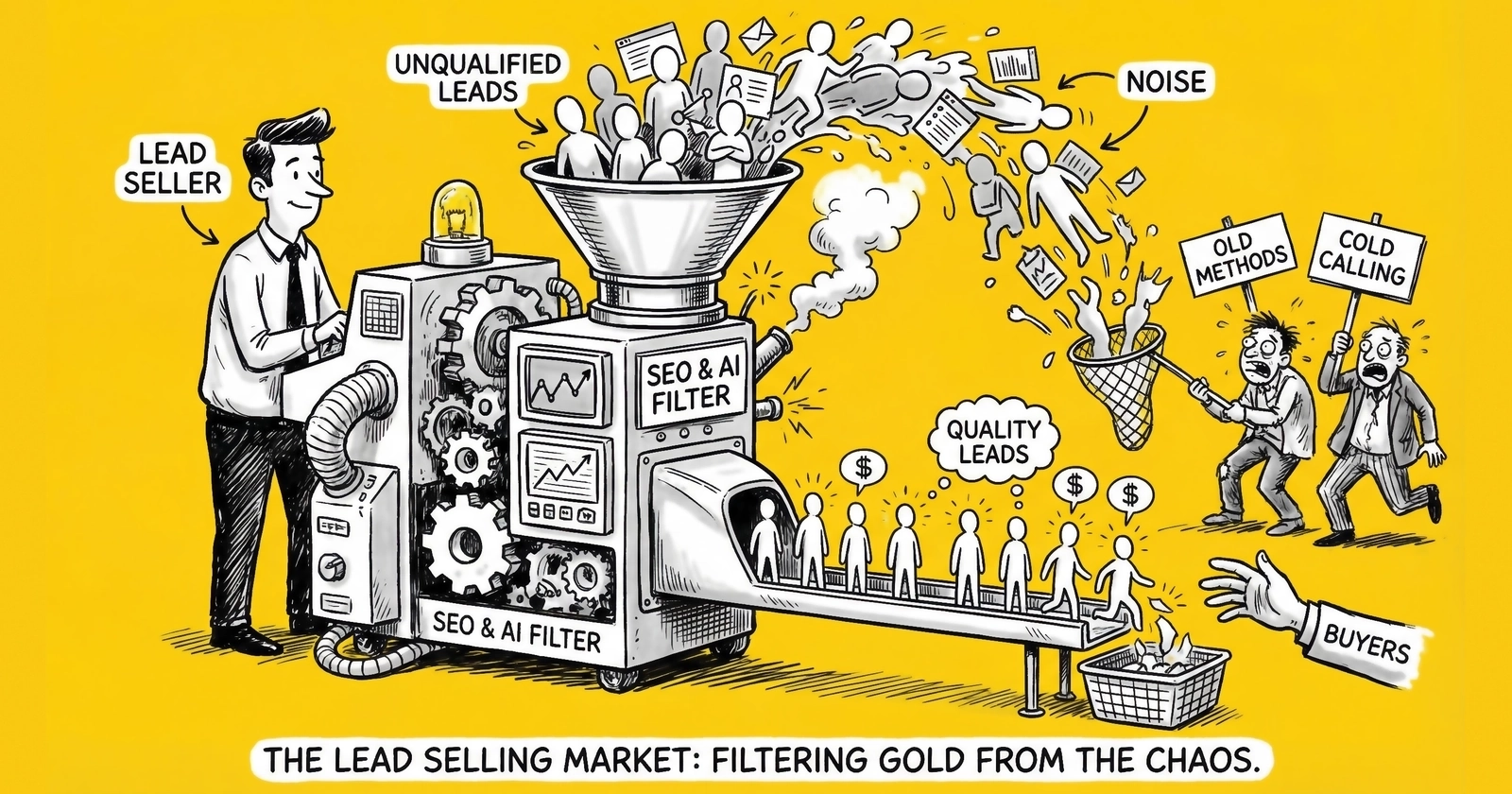
The B2B lead generation market will reach $32.85 billion by 2035. Every lead buyer searching for providers represents potential revenue – and they’re increasingly finding providers through AI assistants rather than Google. Lead sellers optimizing only for traditional search are becoming invisible during the discovery process that determines vendor selection.
Lead selling has always been a visibility business. Buyers can’t purchase leads from providers they don’t know exist. For two decades, that visibility equation meant one thing: rank well on Google for relevant queries, and buyers would find you.
That equation is changing. When a marketing director asks ChatGPT “Who are the best exclusive mortgage lead providers?”, the AI doesn’t consult Google’s ranking algorithm. It draws from its training data and retrieval systems, citing sources based on authority patterns that differ fundamentally from PageRank. A lead seller ranking #1 for “mortgage leads” might be completely absent from AI recommendations.
This creates both threat and opportunity. Established players relying on traditional SEO face disruption from competitors who understand AI visibility. New entrants can build AI authority faster than they could accumulate backlinks. The lead sellers who navigate this transition successfully will capture disproportionate market share during a period of fundamental channel shift. For a deeper exploration of LLMO citation strategies, understanding these patterns is essential.
The $32.85 Billion Lead Generation Market
Market Size and Growth
The global B2B lead generation market reached $10.09 billion in 2024 and is projected to grow to $32.85 billion by 2035 – an 11.33% compound annual growth rate representing significant expansion over the next decade.
| Year | Market Size | Growth |
|---|---|---|
| 2024 | $10.09B | Baseline |
| 2026 | $12.48B | +23.7% |
| 2030 | $19.82B | +96.4% |
| 2035 | $32.85B | +225.6% |
Regional Distribution
North America dominates with 40-45% of global revenue, driven by mature digital marketing ecosystems, established lead distribution infrastructure, and regulatory frameworks (TCPA) that professionalized the industry.
Europe, Asia-Pacific, and other regions represent growing opportunities, particularly as digital marketing adoption accelerates and local lead generation infrastructure develops.
Vertical Concentration
Lead generation spending concentrates heavily in specific verticals:
| Vertical | Market Share | Average CPL |
|---|---|---|
| Insurance | 25-30% | $20-150 |
| Financial Services | 20-25% | $50-300 |
| Real Estate/Mortgage | 15-20% | $30-200 |
| Home Services | 10-15% | $15-100 |
| Legal | 8-12% | $50-400 |
| Education | 5-8% | $30-150 |
These verticals represent both the largest opportunity and the most competitive SEO landscapes. Visibility in these verticals drives the majority of lead selling revenue.
The Discovery Problem
Despite market size and growth, lead buyers face a fundamental discovery problem: how do they find qualified lead providers?
Traditional Discovery Channels
- Google search for lead providers
- Industry conferences and trade shows
- Referrals from peers
- Lead generation industry directories
Emerging Discovery Channels
- AI assistant recommendations
- LinkedIn and professional networks
- Industry publications and thought leadership
- Podcast sponsorships and content
The shift toward AI-mediated discovery changes which lead sellers get found. Buyers asking AI assistants for recommendations receive answers based on AI citation patterns, not search engine rankings. Lead sellers absent from AI training data and retrieval systems become invisible during this critical discovery phase. Understanding how the lead economy actually works provides context for why this visibility matters so much.
Keyword Strategy for Lead Sellers
Buyer-Intent Keywords
Lead sellers must target keywords that capture actual buyer intent – people looking to purchase leads, not generate them. The distinction is critical:
Buyer Keywords (High Intent)
- “Buy mortgage leads”
- “Exclusive leads for sale”
- “Lead vendor comparison”
- “Lead marketplace pricing”
- “Best lead providers [vertical]”
Non-Buyer Keywords (Lower Intent)
- “How to generate leads”
- “Lead generation tips”
- “Lead magnet ideas”
- “Landing page optimization”
Many lead sellers mistakenly target lead generation content that attracts marketers looking to generate their own leads rather than buyers looking to purchase leads. This fundamental targeting error wastes resources on traffic that won’t convert.
Vertical-Specific Targeting
Generic “lead” keywords face intense competition. Vertical-specific targeting reduces competition while improving relevance:
Insurance Vertical
"Medicare lead providers"
"Auto insurance leads for sale"
"Life insurance lead vendors"
"Final expense lead marketplace"
"Health insurance lead pricing"
Financial Services
"Mortgage lead providers"
"Debt consolidation leads for sale"
"Solar financing lead vendors"
"Personal loan lead marketplace"
Home Services
"HVAC lead providers"
"Roofing leads for sale"
"Plumbing lead vendors"
"Window replacement lead pricing"
Each vertical has distinct buyer behavior, pricing models, and competitive dynamics. Content optimized for specific verticals performs better than generic lead selling content.
Geographic Modifiers
Geographic targeting captures buyers with location-specific needs:
State-Level Targeting
- “Mortgage leads California”
- “Auto insurance leads Florida”
- “Home improvement leads Texas”
Regional Targeting
- “Lead providers Northeast”
- “West Coast lead marketplace”
- “Southeast lead vendors”
Metro-Level Targeting
- “Leads for sale Los Angeles”
- “Dallas lead providers”
- “Miami lead marketplace”
Geographic modifiers often have lower competition than national terms while capturing highly relevant buyer intent. A California mortgage lender searching for leads specifically wants California leads – national providers may be irrelevant.
Long-Tail Opportunity
Long-tail keywords capture specific buyer needs with lower competition:
| Head Term | Long-Tail Variation | Search Intent |
|---|---|---|
| ”Mortgage leads" | "Exclusive FHA mortgage leads California” | Specific product, exclusive, geographic |
| ”Insurance leads" | "Medicare supplement leads over 65 Florida” | Product type, demographic, geographic |
| ”Auto leads" | "Subprime auto loan leads with credit score” | Credit tier, data requirements |
Long-tail keywords often indicate buyers further in the purchase process with specific requirements. These buyers convert at higher rates and often have higher lifetime value. Before purchasing, smart buyers should review our guide on evaluating lead vendors to understand what questions to ask.
Content Strategy for Dual Visibility
Content Types That Work for Both Channels
Effective lead seller content serves traditional search and AI visibility simultaneously:
Comparison Content
“Top 10 Mortgage Lead Providers” or “[Platform A] vs [Platform B]” content ranks well in traditional search while providing structured information AI systems can cite.
## Best Mortgage Lead Providers 2026

### 1. [Provider Name]
- Lead types: Exclusive, shared, aged
- Pricing: $40-150 exclusive, $15-35 shared
- Verticals: Purchase, refinance, reverse
- Notable: TrustedForm integration, real-time delivery

### 2. [Provider Name]
...
This format serves buyers scanning for options while creating citation-friendly content for AI systems answering provider recommendation queries.
Methodology Documentation
Detailed explanation of lead generation and quality processes establishes expertise signals:
## Our Lead Quality Methodology

### Source Verification
Every lead passes through 7-point source verification:
1. Publisher authenticity check
2. Traffic source validation
3. Consent language verification
...

### Data Validation
Real-time validation includes:
- Phone number verification (carrier lookup)
- Email deliverability check
- Address standardization (USPS database)
...
This content builds trust with human buyers while providing specific, authoritative information AI systems can cite.
Vertical Analysis
Deep analysis of specific verticals demonstrates market expertise:
## Mortgage Lead Market Analysis 2026

### Market Dynamics
- Purchase leads: $45-80 exclusive, down 15% from 2025
- Refinance leads: $30-55 exclusive, down 40% from rate spike
- Reverse mortgage: $120-200 exclusive, stable demand

### Buyer Behavior
- Average buyer purchases 200-500 leads monthly
- 67% prefer exclusive over shared
- 45% use multiple vendors for comparison
This analysis positions you as an authoritative market source – exactly what AI systems look for when users ask market questions.
Compliance Content
TCPA compliance is a major buyer concern. Comprehensive compliance documentation serves multiple purposes:
- Addresses buyer due diligence questions
- Establishes regulatory expertise
- Creates AI-citation opportunities for compliance queries
- Differentiates from less-compliant competitors
## TCPA Compliance for Lead Buyers

### Consent Requirements
Lead buyers inherit compliance responsibility. Key requirements:

1. **Prior Express Written Consent**
   Required for: Autodialed calls, prerecorded messages
   Documentation: TrustedForm certificate, consent language capture

2. **Consent Language Standards**
   Must include: Clear identification of seller, description of calls
   Cannot include: Pre-checked boxes, hidden consent language
...
Content for AI Citation
Beyond dual-purpose content, certain content specifically targets AI citation:
Definitional Content
When users ask AI systems “What is lead generation?” or “How does lead selling work?”, AI systems cite authoritative definitions. Create definitive explanatory content:
## What Is Lead Selling?

Lead selling is the practice of generating prospective customer
information and selling that information to businesses seeking
new customers. Lead sellers generate leads through digital
marketing (search, social, display), then sell those leads to
buyers who contact the prospects to offer products or services.

The lead selling ecosystem includes three primary participants:
1. Lead generators (who create leads)
2. Lead buyers (who purchase leads)
3. Distribution platforms (who facilitate transactions)
Statistics and Benchmark Content
AI systems frequently cite content containing specific data:
## Lead Industry Benchmarks 2026

### Average Lead Pricing by Vertical
| Vertical | Exclusive | Shared | Aged |
|----------|-----------|--------|------|
| Mortgage | $45-80 | $15-25 | $5-15 |
| Auto Insurance | $25-50 | $10-20 | $3-10 |
...

### Conversion Benchmarks
- Exclusive lead contact rate: 45-65%
- Shared lead contact rate: 20-35%
- Industry average close rate: 3-8%
This data-rich content gets cited when users ask AI systems about lead pricing, benchmarks, or industry statistics.
Building Authority as a Lead Seller
E-E-A-T for Lead Sellers
Google’s E-E-A-T framework (Experience, Expertise, Authoritativeness, Trustworthiness) applies to lead selling with specific implications:
Experience Signals
- Years in operation
- Lead volume processed
- Client testimonials
- Case studies with outcomes
Expertise Signals
- Team credentials (compliance, marketing, technology)
- Industry certifications
- Thought leadership content
- Speaking engagements
Authority Signals
- Industry publication mentions
- Association memberships
- Media coverage
- Client roster (with permission)
Trust Signals
- TrustedForm certification
- Compliance documentation
- Transparent pricing
- Privacy policy clarity
For AI systems, E-E-A-T signals influence citation decisions. Content from established, authoritative sources gets cited more than content from unknown entities – even if the information is similar. Understanding how to calculate true cost per lead and measure ROI accurately demonstrates the analytical expertise that builds authority.
Building Credibility Markers
Specific credibility markers improve both traditional search and AI visibility:
Certifications and Memberships
## Compliance & Certifications

- TrustedForm Certified Partner
- LeadiD Integration
- Digital Advertising Alliance member
- PACE Member (Professional Association for Customer Engagement)
Data and Results
## Results

- 2.4M leads delivered in 2025
- 94.7% data accuracy rate
- 45-second average delivery time
- 98.2% uptime
Transparency
## How We Price Leads

### Exclusive Leads
Sold to one buyer only. Pricing reflects:
- Vertical competition
- Geographic demand
- Lead recency
- Data completeness

### Pricing Factors
[Detailed explanation of what affects pricing]
Transparency builds trust with human buyers while providing specific information AI systems can cite.
Case Study Development
Case studies demonstrate operational experience – the “first E” in E-E-A-T:
## Case Study: Regional Mortgage Lender

### Challenge
XYZ Lending needed 500 qualified mortgage leads monthly
for their California market. Previous vendors delivered
40% contact rates and 2% close rates.

### Solution
- Implemented exclusive lead program
- Added real-time TrustedForm verification
- Integrated direct-to-CRM delivery

### Results
- Contact rate increased to 62%
- Close rate improved to 4.2%
- Cost per funded loan decreased 35%
- ROI: 340% on lead spend
Case studies provide concrete evidence that AI systems can cite when recommending providers. They also satisfy buyer due diligence needs.
Technical SEO for Lead Marketplaces
Site Architecture
Lead marketplace site architecture should serve both navigation and search visibility:
Homepage
├── Verticals
│   ├── Insurance Leads
│   │   ├── Auto Insurance
│   │   ├── Medicare
│   │   └── Life Insurance
│   ├── Mortgage Leads
│   │   ├── Purchase
│   │   └── Refinance
│   └── Home Services Leads
├── How It Works
│   ├── For Buyers
│   └── For Sellers
├── Pricing
├── Resources
│   ├── Blog
│   ├── Guides
│   └── Case Studies
└── Company
    ├── About
    ├── Compliance
    └── Contact
This architecture creates clear topical hierarchies that search engines and AI systems can understand. Each vertical section builds topic authority.
Schema Markup for Lead Services
Implement schema markup to help AI systems understand your services:
{
  "@context": "https://schema.org",
  "@type": "Organization",
  "name": "LeadGen Provider",
  "@id": "https://www.example.com/#organization",
  "url": "https://www.example.com",
  "description": "B2B lead generation and distribution platform serving insurance, mortgage, and home services verticals",
  "foundingDate": "2015",
  "numberOfEmployees": {
    "@type": "QuantitativeValue",
    "minValue": 50,
    "maxValue": 100
  },
  "areaServed": {
    "@type": "Country",
    "name": "United States"
  },
  "hasOfferCatalog": {
    "@type": "OfferCatalog",
    "name": "Lead Services",
    "itemListElement": [
      {
        "@type": "Service",
        "name": "Exclusive Mortgage Leads",
        "description": "Real-time exclusive mortgage leads with TrustedForm verification",
        "provider": {"@id": "https://www.example.com/#organization"}
      },
      {
        "@type": "Service",
        "name": "Insurance Lead Distribution",
        "description": "Multi-vertical insurance leads via ping/post distribution"
      }
    ]
  }
}
Page Speed and AI Crawler Access
Technical performance affects both traditional rankings and AI crawler success:
| Metric | Target | Impact |
|---|---|---|
| TTFB | Under 200ms | Critical for AI crawler time budgets |
| LCP | Under 2.5s | 40% increase in crawler visits |
| FID | Under 100ms | Improved user and crawler experience |
| CLS | Under 0.1 | Better content extraction |
Lead marketplace platforms often have dynamic content (pricing, availability) that can slow page speed. Implement:
- CDN for static assets
- Database query optimization
- Caching for semi-static content
- Server-side rendering for core content
Mobile Optimization
Lead buyers increasingly research vendors on mobile devices. Mobile optimization affects both user experience and search rankings:
- Responsive design for all page types
- Touch-friendly navigation
- Readable typography without zooming
- Fast mobile page speed
Google’s mobile-first indexing means mobile experience determines desktop rankings. Poor mobile experience hurts all search visibility. For organizations comparing distribution options, our lead distribution platforms comparison examines how technical capabilities affect market positioning.
Competitive Differentiation in AI Search
The Differentiation Problem
AI systems cite authoritative sources but don’t duplicate information already covered elsewhere. If 10 lead sellers provide identical descriptions of lead generation, AI systems have no reason to cite all 10 – they cite the most authoritative source for that generic information.
Differentiation in AI search requires unique positioning:
Unique Perspectives Instead of: “We provide high-quality leads” Write: “Our 7-point quality framework catches 23% more fraudulent leads than industry standard validation”
Proprietary Data Instead of: “The lead market is competitive” Write: “Our analysis of 2.4M leads shows mortgage lead pricing dropped 15% in Q4 2025, with California exclusive leads averaging $67”
Specialized Expertise Instead of: “We serve multiple verticals” Write: “Our insurance division includes 3 former state insurance commissioners who built our compliance framework”
Vertical Specialization
Deep vertical expertise creates differentiation AI systems recognize:
Specialist Positioning
## Medicare Lead Specialists

We focus exclusively on Medicare leads. This specialization
enables:

- AEP/OEP timing optimization (65% of our annual volume)
- Age-verified targeting (65+ only, no younger prospects)
- T65 identification (turning 65 within 90 days)
- Supplement vs Advantage intent classification
- CMS compliance verification
This depth signals expertise that generalist competitors lack. AI systems citing Medicare lead information have reason to reference specialized sources.
Unique Methodology Documentation
Document processes that competitors don’t explain:
## Our Proprietary Lead Scoring System

### TCPA Risk Score (0-100)
We score every lead for TCPA compliance risk:

0-25: Low risk
- Clear consent language captured
- Single opt-in recorded
- TrustedForm certificate valid

26-50: Moderate risk
- Consent language non-standard
- Multiple opt-ins aggregated
- Longer certificate age

51-75: Elevated risk
[Detailed criteria]

76-100: High risk
[Detailed criteria]

### How Buyers Use Risk Scores
[Practical application guidance]
This unique methodology content creates citation opportunities that generic competitors can’t match.
Measuring Lead Seller SEO Success
Traditional Metrics
Standard SEO metrics still matter for lead sellers:
| Metric | Target | Significance |
|---|---|---|
| Organic traffic | Growing trend | Overall visibility |
| Buyer-intent keywords ranking | Top 10 | High-intent visibility |
| Conversion rate | 2-5% | Traffic quality indicator |
| Lead form submissions | Monthly growth | Direct business impact |
AI Visibility Metrics
Add AI-specific measurement:
Citation Monitoring
- Use AI citation tools (LLMO Metrics, Peec AI) to track brand mentions
- Search AI platforms for industry queries and monitor source citations
- Track referral traffic from AI platforms (chat.openai.com, perplexity.ai)
Query Coverage
- List target queries (e.g., “best mortgage lead providers”)
- Test queries across AI platforms monthly
- Document which sources get cited
- Track changes over time
Competitive Position
- Identify which competitors AI systems cite
- Analyze cited content for patterns
- Identify content gaps and opportunities
Attribution Challenges
AI traffic attribution remains imperfect. Many AI interactions don’t result in direct referrals – users may see recommendations, then navigate directly to sites later. This creates attribution gaps where AI influence isn’t captured in referral data.
Proxy Indicators
- Direct traffic increases (may include AI-influenced visits)
- Brand search volume (indicates awareness building)
- Time on site from AI referrals (engagement quality)
- Quote request language patterns (users may mention AI recommendation)
Key Takeaways
-
The lead generation market reaches $32.85B by 2035 – visibility during buyer discovery directly impacts revenue capture from this growing market.
-
Buyer-intent keywords matter most – target “buy leads” and “lead providers” rather than “lead generation tips” to reach actual purchasers.
-
Vertical specialization improves both ranking and relevance – deep expertise in specific verticals creates differentiation AI systems recognize.
-
Dual-visibility content serves both channels – comparison content, methodology documentation, and compliance guides work for traditional search and AI citation.
-
E-E-A-T signals influence AI citations – established authority markers affect both Google rankings and AI source selection.
-
Technical performance affects AI crawler access – TTFB under 200ms and server-side rendering ensure AI systems can access your content.
-
Differentiation requires unique value – AI systems cite distinct perspectives and proprietary data rather than duplicating generic information.
-
Compliance content serves multiple purposes – TCPA documentation addresses buyer concerns, establishes expertise, and creates AI citation opportunities.
-
Measurement must include AI-specific metrics – citation monitoring and query coverage tracking reveal AI visibility beyond traditional SEO metrics.
-
The shift is happening now – lead sellers building AI visibility today will capture market share as AI-mediated discovery becomes dominant.
Frequently Asked Questions
How quickly is AI changing how buyers find lead providers?
The shift is accelerating but not complete. AI-referred sessions grew 527% in five months during early 2025. Vercel reports 10% of their signups now come from ChatGPT. For lead selling specifically, enterprise buyers are increasingly comfortable using AI assistants for vendor research.
The transition creates a window of opportunity. Lead sellers building AI visibility now – while competitors focus exclusively on traditional SEO – can establish citation authority before the market fully shifts. Waiting until AI dominates discovery means playing catch-up against established AI authority.
Traditional search isn’t disappearing, but its share of buyer discovery is declining. Smart lead sellers optimize for both channels.
What’s the biggest SEO mistake lead sellers make?
Targeting content creators instead of lead buyers. Many lead seller websites rank for “lead generation strategies” or “how to generate leads” – content that attracts marketers looking to generate their own leads, not buyers looking to purchase leads.
This fundamental targeting error produces high traffic with low conversion. A site getting 50,000 monthly visits for lead generation tips but only 500 visits for buyer-intent keywords will underperform a competitor with the reverse pattern.
Focus keyword strategy on buyer intent: “buy leads,” “leads for sale,” “lead providers,” “lead marketplace.” These keywords have lower volume but dramatically higher conversion potential.
How do I know if AI systems are citing my competitors?
Test directly. Ask ChatGPT, Claude, Perplexity, and Gemini questions your buyers would ask:
- “Who are the best mortgage lead providers?”
- “How much do exclusive insurance leads cost?”
- “What should I look for in a lead vendor?”
Document which sources each platform cites. Do this monthly to track changes.
AI citation tools like LLMO Metrics and Peec AI automate this monitoring, tracking your brand mentions and competitor citations across platforms. These tools reveal competitive positioning you can’t see in traditional SEO tools.
Should I focus on one vertical or multiple?
Specialization generally outperforms generalization for AI visibility. Deep vertical expertise creates distinctive content that AI systems have reason to cite – generic content about lead selling doesn’t differentiate from dozens of competitors saying similar things.
Consider your business model:
Single Vertical Focus: If you only sell mortgage leads, go deep on mortgage content. Comprehensive mortgage lead coverage builds unassailable vertical authority.
Multiple Verticals: Create dedicated sections with vertical-specific depth. Each vertical should have comprehensive coverage – not thin pages covering many verticals superficially.
The worst strategy: shallow content across many verticals that doesn’t establish authority anywhere.
What content converts lead buyers best?
Content that answers buyer due diligence questions:
Compliance Documentation: Buyers need to understand your TCPA compliance. Detailed documentation reduces perceived risk and accelerates decisions.
Pricing Transparency: Even if pricing varies, benchmark information helps buyers understand what to expect. Hiding pricing creates friction.
Process Explanations: How do you generate leads? What quality controls do you use? How does delivery work? Buyers want to understand what they’re buying.
Results Evidence: Case studies, testimonials, and benchmark data prove you can deliver. Generic promises don’t convert – specific evidence does.
Integration Information: How does your system connect to buyer CRMs and dialers? Technical compatibility matters for implementation decisions.
How much should I invest in AI SEO versus traditional SEO?
Current recommendation: 70% traditional SEO, 30% AI-specific optimization. This ratio will shift toward AI as the market evolves, but traditional search still drives the majority of discovery.
Fortunately, much optimization overlaps. Quality content, clear structure, authoritative sources, and technical performance benefit both channels. AI-specific investments include:
- Citation-optimized content structure
- llms.txt implementation
- AI platform testing and monitoring
- LLMO-specific content elements (answer capsules, list structures)
The overlap means AI investment often improves traditional performance simultaneously.
What technical improvements have the biggest impact?
Page speed and rendering method matter most:
TTFB Under 200ms: AI crawlers operating under time constraints may skip slow-responding pages. This single metric significantly impacts AI crawler success rates.
Server-Side Rendering: Most AI crawlers don’t execute JavaScript. If your lead forms, pricing, or content load via JavaScript, AI systems may not see them. Server-side rendering ensures content accessibility.
Schema Markup: Structured data helps AI systems understand content relationships. Organization, Service, and Article schema particularly help lead sellers.
These improvements benefit traditional search too – page speed is a Google ranking factor, and schema enables rich results.
How do I create content that AI systems will cite?
Focus on content characteristics AI systems favor:
Definitional Authority: Provide clear, comprehensive definitions. When users ask “What is lead selling?”, AI systems cite authoritative definitional content.
Specific Data: Include concrete numbers, benchmarks, and statistics. AI systems prefer citing specific facts over vague generalities.
Comprehensive Coverage: Address topics completely. AI systems synthesize information from sources that cover subtopics thoroughly.
Structured Format: Use clear headings, lists, and tables. This format enables AI extraction and citation.
Unique Perspective: Offer distinctive insights or proprietary data. AI systems don’t need multiple sources saying identical things – they cite sources adding unique value.
What role do backlinks play in AI visibility?
Less than in traditional SEO, but they still matter. AI systems use different authority signals than Google’s PageRank, but backlinks indicate credibility that may influence training data inclusion and citation decisions.
More important for AI visibility:
- Content authority and depth
- Citation by other authoritative sources
- Brand mentions in industry contexts
- Social proof and recognition
Don’t abandon link building, but don’t assume traditional link authority translates directly to AI visibility. Create content worth citing – links and AI citations may follow from the same underlying authority.
How do I differentiate from larger competitors with more content?
Specialization and unique value creation:
Go Deeper in Narrow Areas: Large competitors spread content across everything. You can create the definitive resource on a specific topic they cover superficially – Medicare Supplement leads in Florida, for example.
Provide Proprietary Data: Share insights from your own data that competitors can’t replicate. Your pricing trends, conversion benchmarks, and market observations are unique.
Document Unique Processes: Your specific quality methodology, compliance approach, or technology stack differs from competitors. Document it in detail.
Target Long-Tail Keywords: Large competitors dominate head terms. Long-tail variations often have lower competition and higher conversion intent.
Build E-E-A-T Signals: Demonstrate experience through case studies, expertise through credentials, authority through recognition, and trust through transparency. These signals compound over time.
What should my content calendar look like?
Balance foundational and fresh content:
Foundational Content (One-Time Creation)
- Comprehensive vertical pages (mortgage leads, insurance leads, etc.)
- Process documentation (how it works, quality methodology)
- Compliance guides (TCPA requirements, state regulations)
- Service pages (exclusive leads, shared leads, aged leads)
Regular Updates (Quarterly)
- Market analysis and pricing benchmarks
- Regulatory updates and compliance changes
- Technology and platform developments
- Competitive landscape analysis
Fresh Content (Monthly)
- Case studies and success stories
- Industry news commentary
- Trend analysis
- FAQ expansions
AI systems favor fresh content – 89.7% of ChatGPT’s top cited pages were updated in 2025. Regular updates signal ongoing authority.
How long until I see results from lead seller SEO?
Timeline varies by starting position and investment level:
Traditional SEO Results
- Technical improvements: 2-4 weeks for crawling impact
- Content publication: 3-6 months for ranking improvements
- Authority building: 6-12+ months for competitive keywords
AI Visibility Results
- Real-time retrieval systems (Perplexity): Days to weeks
- Training-based systems (Claude): Months to years
- Citation momentum: Builds over 3-6+ months
The compounding effect rewards patience. Early investment builds authority that accelerates later results. Lead sellers starting now will have 6-12 months of AI authority building when competitors finally recognize the importance of AI visibility.
Measure progress through proxy indicators (citation monitoring, query coverage) before direct business impact becomes obvious.