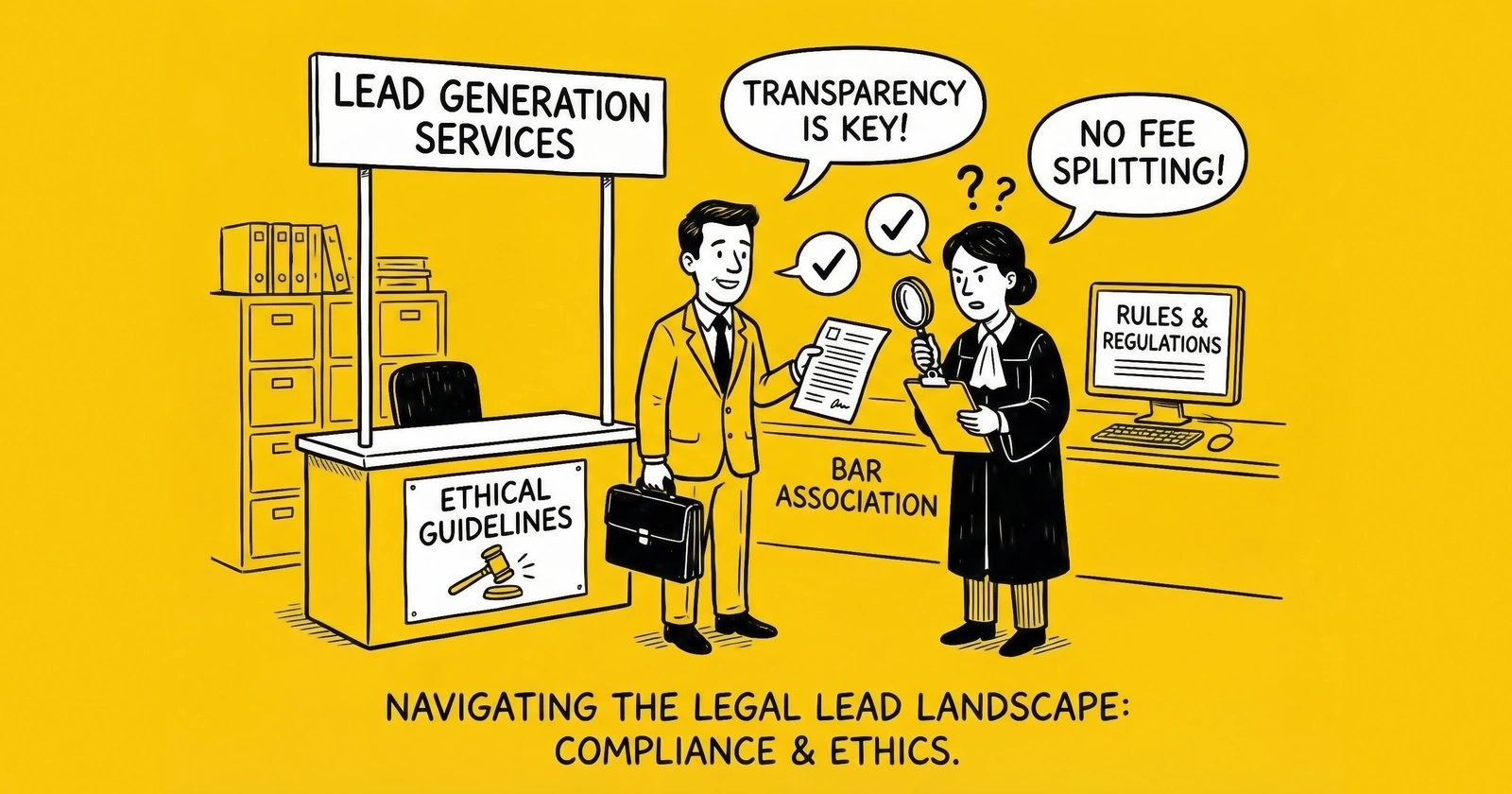
How ABA Model Rules, state bar regulations, and ethical frameworks govern attorney lead generation, and what lead generators must know to operate lawfully in the legal vertical.
The legal lead generation industry operates under ethical constraints unlike any other vertical. Where insurance lead generators worry about licensing requirements and mortgage generators navigate RESPA, legal lead generators face a fundamentally different challenge: the regulatory framework governing attorney advertising was designed to protect consumers from predatory solicitation, and violations can result in criminal prosecution.
State bar associations across all 50 states maintain rules of professional conduct that govern how attorneys acquire clients. These rules extend to lead generators who work with attorneys, creating a web of compliance requirements that varies by jurisdiction. An advertising practice that is perfectly legal in California might constitute professional misconduct in Texas. A lead generation tactic that works for insurance leads might be felony barratry when applied to legal leads.
The stakes are high. Personal injury leads command $200-800+ per lead precisely because attorneys operate on contingency and case values justify premium acquisition costs. Mass tort campaigns can generate millions in lead revenue during peak periods. But these economics attract operators who underestimate the compliance complexity until they face regulatory consequences.
This guide covers the complete ethical framework for legal lead generation: the ABA Model Rules that form the foundation of attorney advertising regulation, the state-by-state variations that create compliance complexity, the practical requirements for operating lawfully, and the specific practices that cross the line from legitimate lead generation into prohibited solicitation.
The Foundation: ABA Model Rules of Professional Conduct
The American Bar Association’s Model Rules of Professional Conduct provide the framework for attorney advertising and client solicitation rules across the United States. While the ABA itself does not regulate attorneys (that authority rests with state bar associations), the Model Rules serve as a template that most states have adopted with modifications.
Understanding these rules is essential for legal lead generators because they define the boundaries between permitted advertising and prohibited solicitation. Rules 7.1 through 7.5 directly govern attorney marketing activities and, by extension, the lead generation practices that support attorney client acquisition.
Rule 7.1: Communications Concerning a Lawyer’s Services
Rule 7.1 establishes the foundational prohibition against false or misleading communications. The rule states:
A lawyer shall not make a false or misleading communication about the lawyer or the lawyer’s services. A communication is false or misleading if it contains a material misrepresentation of fact or law, or omits a fact necessary to make the statement considered as a whole not materially misleading.
For lead generators, this rule has direct implications across four key areas.
Accuracy Requirements
Every claim in your advertising must be truthful and verifiable. Statements about case results, settlement amounts, or attorney qualifications must reflect documented facts. A claim like “We’ve recovered millions for accident victims” requires documentation of those recoveries.
Outcome Representations
Any discussion of past case results must not create unjustified expectations about future outcomes. Most states require disclaimers stating that prior results do not guarantee similar outcomes. The specific disclaimer language varies by jurisdiction.
Comparative Statements
Claims that compare an attorney to others (such as “best” or “top-rated”) typically require objective third-party verification. Self-awarded distinctions do not satisfy this requirement.
Testimonials and Endorsements
Client testimonials are permitted in most jurisdictions but require careful handling. Many states require disclosures about whether the testimonial provider was compensated, and whether the testimonial represents typical results.
Rule 7.2: Communications Concerning a Lawyer’s Services (Advertising)
Rule 7.2 permits attorney advertising through various media while establishing requirements for how such advertising must be conducted:
A lawyer may communicate information regarding the lawyer’s services through any media.
The rule further specifies three key requirements that affect lead generation operations.
Responsible Attorney Identification
Advertisements must include the name and contact information of at least one lawyer responsible for the content. For lead generation sites that work with multiple attorneys, each attorney listing typically needs to identify the responsible attorney for that listing.
Retention Requirements
Attorneys must retain copies of advertisements and the record of when and where they were used. This obligation extends to lead generators who create advertising on behalf of attorneys. Most states require retention for 2-3 years, though some require longer periods.
Payment for Referrals
The traditional prohibition against paying for referrals has been modified in most states following the 2018 ABA amendments. Attorneys may now pay for marketing services, including lead generation, under certain conditions. However, the line between permissible marketing payments and prohibited referral fees remains significant.
Rule 7.3: Solicitation of Clients
Rule 7.3 draws the critical distinction between advertising (generally permitted) and solicitation (generally prohibited). This rule is the central compliance challenge for legal lead generators.
A lawyer shall not solicit professional employment by live person-to-person contact when a significant motive for the lawyer’s doing so is pecuniary gain, unless the contact is with a: (1) lawyer; (2) person who has a family, close personal, or prior business or professional relationship with the lawyer or law firm; or (3) person who routinely uses for business purposes the type of legal services offered by the lawyer.
What This Means for Lead Generators
Solicitation involves targeting specific individuals known to need legal services with live, real-time contact. This includes in-person visits to accident victims, cold-calling individuals identified from police reports, real-time electronic messaging to identified potential clients, and live chat initiated by the generator to people with known legal needs.
Advertising, by contrast, involves reaching the general public without targeting specific individuals. Search engine advertising targeting keywords, social media advertising targeting interests or demographics, display advertising on websites, content marketing, and responding to consumer-initiated inquiries all qualify as advertising rather than solicitation.
The distinction is not about the channel used but about whether you are targeting identified individuals with known legal needs versus reaching the general public.
Written Communications Exception
Rule 7.3(c) permits written solicitations (including email) that are targeted to specific individuals under certain conditions. The communication must be labeled as advertising, must not be coercive, and must provide the recipient a way to opt out of future communications. Additionally, the communication must comply with any state-specific waiting periods, such as Florida’s 30-day rule for accident victims.
This exception does not extend to live electronic contact such as instant messaging, live chat initiated to specific individuals, or social media direct messages.
Rule 7.4: Communication of Fields of Practice
Rule 7.4 governs how attorneys may describe their practice areas:
A lawyer may communicate the fact that the lawyer does or does not practice in particular fields of law. A lawyer shall not state or imply that a lawyer is certified as a specialist in a particular field of law, unless: (1) the lawyer has been certified as a specialist by an organization that has been approved by an appropriate authority of the state or the District of Columbia or a U.S. Territory…
Implications for Lead Generators
Never describe an attorney as a “specialist” or “expert” unless they hold recognized certification. Terms like “specializes in” or “expertise in” create compliance risk. Safer alternatives include phrases such as “focuses on,” “practice areas include,” “handles cases involving,” or “dedicated to.”
Many states have disciplined attorneys for advertising that implied specialization without certification. Lead generators whose marketing makes unauthorized specialization claims expose their attorney clients to discipline.
Rule 7.5: Firm Names and Letterheads
Rule 7.5 governs law firm names and may affect lead generation operations that create or promote law firm branding. Key requirements include that firm names cannot be misleading, trade names are permitted but cannot imply connection to government or public institutions, and multi-jurisdictional firms must comply with rules in each jurisdiction.
State Bar Variations: The Compliance Patchwork
While the ABA Model Rules provide a framework, actual regulation occurs at the state level. Each state bar association has adopted its own version of attorney advertising rules, creating significant variations that affect lead generation operations.
Understanding these variations is essential because legal lead generation often crosses state lines. A lead generator in Florida might generate leads for attorneys in Texas, California, and New York. The advertising must comply with rules in every jurisdiction where leads are generated and where attorneys operate. For state-by-state detail, see our guide to attorney advertising rules by state.
Texas: Among the Strictest Requirements
Texas maintains some of the nation’s most restrictive attorney advertising rules, with active enforcement that affects lead generation operations.
Pre-Filing Requirements
Texas requires attorneys to file certain advertisements with the State Bar of Texas Advertising Review Committee. While this obligation rests on attorneys, it affects lead generators because attorneys will require you to create compliant materials that can be filed.
Disclosure Requirements
Texas Disciplinary Rules of Professional Conduct Rule 7.02 imposes several specific requirements. The phrase “ATTORNEY ADVERTISEMENT” must appear on certain communications. Past results must include specific disclaimers about case outcomes. The name and office address of at least one responsible attorney must appear. Testimonials face strict requirements about authenticity and appropriate disclaimers.
The Barratry Statute
Texas Penal Code Section 38.12 makes barratry a criminal offense. This statute prohibits solicitation of employment in violation of professional conduct rules and prohibits using runners, cappers, or steerers to solicit business. Penalties are severe: repeat violations constitute a third-degree felony carrying 2-10 years imprisonment, civil penalties range from $10,000-$50,000 per violation, and improperly solicited clients can void their representation agreements.
2025 Digital Solicitation Update
Texas updated its barratry statutes specifically to address digital solicitation, making clear that electronic communications targeting identified individuals known to need legal services constitute prohibited solicitation. The message is explicit: the traditional runner showing up at emergency rooms and the digital operator sending targeted messages to identified accident victims face identical legal exposure.
California: Permissive but Disclosure-Heavy
California generally permits attorney advertising but requires extensive disclosures that affect lead generation content.
Advertising Label Requirements
California Rules of Professional Conduct Rule 7.2 requires that communications that would reasonably be understood as advertising must be clearly labeled as such.
Testimonial Requirements
California permits client testimonials with appropriate disclaimers. If testimonials reference specific results, disclaimers must indicate that past results do not guarantee future outcomes.
Runner and Capper Statute
California Business and Professions Code Section 6151 prohibits runners and cappers:
A runner or capper is any person… who contracts with, is employed by, or is associated with… any attorney… and who acts as an agent for an attorney… in the solicitation or procurement of business for the attorney.
Consequences are significant. Violations constitute misdemeanor criminal penalties with fines up to $15,000 and potential jail time. Furthermore, contracts procured through runners are void, meaning clients can recover fees paid.
The “Aids” Standard
California requires anyone who “aids” in the solicitation of insurance to hold a license under certain circumstances. The California Department of Insurance has taken the position that certain aggressive lead generation activities – particularly those involving detailed product discussions or steering consumers toward specific providers – constitute aiding in solicitation. While this interpretation applies primarily to insurance, it reflects California’s aggressive stance toward lead generation activities that cross into regulated territory.
Florida: Middle Ground with Active Enforcement
Florida’s attorney advertising rules occupy a middle ground between Texas’s strict approach and California’s relative permissiveness, but Florida actively enforces its requirements.
The 30-Day Rule
Florida Bar Rule 4-7.18 prohibits direct contact with accident victims or their families within 30 days of the accident. This “30-day rule” directly affects personal injury lead generation. Lead generators cannot use accident data sources such as police reports or hospital records to contact victims within 30 days. Even written solicitations are prohibited during this period. The restriction applies to leads generated in Florida for Florida attorneys.
Objectively Verifiable Claims
Florida requires that advertising claims be “objectively verifiable.” Superlative statements like “the best lawyer” or “top-rated attorney” face scrutiny unless supported by objective third-party verification.
Active Enforcement
The Florida Bar maintains an active advertising enforcement program through its Attorney Consumer Assistance Program (ACAP). The Bar investigates advertising complaints and has pursued discipline against attorneys for misleading advertising claims, improper solicitation, failure to include required disclaimers, and violations of the 30-day rule.
New York: Aggressive Stance on Unlicensed Activity
New York takes an aggressive enforcement position on attorney advertising, with particular attention to lead generation activities that may constitute unlicensed practice.
Strict Interpretation
New York courts and bar regulators have interpreted attorney advertising rules strictly. The New York Department of Financial Services (in conjunction with bar regulators) has pursued enforcement actions against lead generators whose marketing materials were deemed too specific about case outcomes or legal advice.
Filing Requirements
Some New York attorney advertisements required pre-approval filing with the state bar, though these requirements have been reduced in recent years. However, retention requirements remain strict.
Consumer Protection Focus
New York emphasizes consumer protection in its advertising enforcement. Marketing that could confuse consumers about whether they are dealing with attorneys or lead generators receives particular scrutiny.
Practical Compliance: What Lead Generators Must Do
Understanding the rules is the first step. Implementing compliant operations requires specific practices, documentation, and ongoing attention to regulatory developments.
Advertising Practices That Are Generally Permitted
The following lead generation practices typically fall within the scope of permitted advertising rather than prohibited solicitation.
Keyword-Targeted Search Advertising
Purchasing search advertising that appears when consumers search for legal-related terms is advertising, not solicitation. You are reaching consumers based on their expressed interest, not targeting identified individuals with known legal needs. Permitted examples include Google Ads targeting “car accident lawyer,” Bing Ads for “personal injury attorney near me,” and Microsoft Advertising for “medical malpractice help.”
Interest-Based Social Media Advertising
Advertising on social platforms that targets users based on interests, demographics, or behaviors constitutes advertising rather than solicitation. Permitted examples include Facebook ads targeting people interested in “personal injury law,” Instagram ads reaching users who follow law-related pages, and LinkedIn ads targeting professionals in certain industries.
Display and Native Advertising
Placing display ads on websites or native ads in content feeds reaches general audiences and constitutes advertising.
Content Marketing and SEO
Creating educational content that attracts organic search traffic is advertising. Consumers who find your content through search initiated the contact.
Responding to Consumer-Initiated Inquiries
Once a consumer contacts you – by filling out a form, calling your phone number, or initiating a chat – you are responding to their inquiry rather than soliciting.
Practices That Cross the Line into Prohibited Solicitation
The following practices typically constitute prohibited solicitation and should be avoided.
Cold-Calling Accident Victims
Obtaining lists of accident victims from police reports, hospital records, or insurance sources and calling them directly is prohibited solicitation in virtually all jurisdictions. This includes purchasing police report data and calling accident victims, obtaining emergency room visitor logs and contacting patients, and calling individuals identified through insurance claim databases.
Targeting Identified Individuals on Social Media
Sending direct messages or creating specifically targeted ads to identified individuals known to have legal needs constitutes solicitation. Prohibited examples include sending Facebook messages to people who posted about accidents, creating custom audiences from accident victim lists, and direct messaging Instagram users who mentioned legal problems.
Real-Time Electronic Solicitation
Initiating live chat, instant messaging, or other real-time electronic contact with individuals identified as needing legal services is prohibited. This includes proactively opening chat with website visitors identified as accident victims, sending text messages to phone numbers from accident reports, and WhatsApp messages to individuals who posted about legal issues.
In-Person Solicitation
Approaching individuals at accident scenes, hospitals, funeral homes, or other locations where they might need legal services is explicitly prohibited.
Using Runners or Cappers
Employing individuals to solicit clients on behalf of attorneys – whether in person, by phone, or electronically – violates runner and capper statutes in most states.
The Gray Area: Retargeting and Audience Building
Some practices fall into gray areas that require careful analysis.
Retargeting Website Visitors
Retargeting users who visited your legal lead generation website is generally permitted because you are advertising to people who already expressed interest by visiting your site. However, if your site visitor list includes people who were specifically identified as needing legal services through prohibited means, retargeting could extend the solicitation violation.
Lookalike Audiences
Creating lookalike audiences based on people who converted on your site is generally permitted. The lookalike audience reaches people similar to your converters, not identified individuals with known legal needs.
Third-Party Data Targeting
Using third-party data segments to target advertising (for example, targeting people flagged as “in-market for legal services”) falls into a gray area. The key question is whether the targeting identifies specific individuals known to need legal services or reaches a general audience segment. Most third-party data targeting reaches audience segments rather than identified individuals and is likely permissible, but practices vary.
State-by-State Waiting Periods and Restrictions
Several states impose waiting periods before attorneys (or those acting on their behalf) can contact accident victims. Lead generators must account for these restrictions when generating and delivering leads.
| State | Waiting Period | Applies To | Key Requirements |
|---|---|---|---|
| Florida | 30 days | Accident victims and their families | No direct contact; written solicitation with specific disclosures permitted after 30 days |
| Texas | No specific waiting period | N/A | But barratry statutes prohibit any solicitation of identified victims |
| California | No waiting period | N/A | But runner/capper statutes apply |
| Kentucky | 30 days | Personal injury cases | Applies to both attorneys and those acting on their behalf |
| Alabama | 30 days | Most personal injury matters | Prohibition on solicitation within 30 days |
| Georgia | No waiting period | N/A | But aggressive solicitation scrutinized |
The practical implication is significant. If you generate personal injury leads in states with waiting periods, you cannot sell leads obtained through prohibited solicitation during the waiting period. However, leads from consumers who initiate contact through advertising are not subject to waiting periods because those consumers chose to seek legal assistance.
Documentation and Compliance Programs
Operating lawfully in legal lead generation requires systematic documentation and compliance programs that can withstand regulatory inquiry.
Required Documentation
Advertising Archive
Maintain copies of all advertising materials including landing pages (archived screenshots with dates), ad creative (text, images, video), targeting parameters used, dates and platforms where ads ran, and any modifications made and when. The retention period should be minimum 3-5 years. While many states require 2-3 years, statute of limitations for discipline proceedings can extend longer.
Consent Records
Document consumer consent including the timestamp of consent, IP address, device information, the consent language presented, and verification that consent was affirmatively provided. TrustedForm certificates or equivalent provide defensible documentation of consent events.
Lead Source Documentation
For every lead, document how the consumer found you (ad click, organic search, referral), the advertising content that generated the lead, and that the consumer initiated contact rather than being solicited.
Attorney Buyer Verification
Before selling leads to any attorney, verify that the bar license status is active (check state bar websites), the license is in good standing, the attorney is licensed in the state where leads originate, and no disciplinary actions are pending related to advertising. Maintain dated records of verification.
Compliance Program Components
Written Policies
Document your compliance approach in writing, covering how you distinguish advertising from solicitation, what targeting practices you prohibit, how you verify attorney buyer compliance, and your documentation retention practices. These written policies demonstrate compliance intent if regulatory inquiries occur.
Training
If you have employees or contractors involved in lead generation, train them on the advertising/solicitation distinction, provide clear guidance on prohibited practices, and document training with dates and attestations.
Regular Audits
Conduct periodic reviews of advertising content for accuracy and required disclosures, targeting practices for potential solicitation issues, documentation completeness, and attorney buyer license status.
Regulatory Monitoring
Track changes in attorney advertising rules by subscribing to state bar newsletters, monitoring ABA updates, reviewing enforcement actions for lessons, and updating practices as rules change.
Working with Attorneys: Shared Responsibility
Legal lead generation involves shared compliance responsibility between lead generators and attorney buyers. Understanding this dynamic helps you build sustainable relationships while managing risk.
What Attorneys Risk
Attorneys who purchase leads from non-compliant sources face significant risks. They may receive bar discipline including public reprimand, suspension, or disbarment. They face malpractice liability if representation agreements are voided, civil liability if clients seek return of fees, and reputational damage from disciplinary proceedings. Because attorneys face these consequences, sophisticated law firms scrutinize their lead sources carefully.
What Attorneys Expect
When working with law firm buyers, expect them to require several key elements.
Compliance Attestations
They will request written representations that your lead generation practices comply with applicable bar rules, do not involve prohibited solicitation, and include appropriate consent documentation.
Documentation Access
They want the ability to review your advertising materials, consent processes, and documentation practices. Some firms conduct audits of lead sources before purchasing.
Indemnification
They will seek contractual provisions requiring you to indemnify the firm against claims arising from your lead generation practices. Review these provisions carefully and ensure you can stand behind them.
Cooperation in Investigations
If bar authorities investigate the attorney’s advertising practices, you may need to provide documentation, respond to inquiries, or cooperate in proceedings.
Protecting Yourself
Understand What You Are Promising
Before signing compliance attestations, ensure you actually comply. Making false representations creates liability.
Limit Indemnification Where Possible
Negotiate reasonable limits on indemnification provisions. Unlimited indemnification for attorney compliance failures extends beyond lead generation activities and creates unreasonable risk.
Document Everything
Your documentation protects both you and your attorney buyers. Complete records of compliant practices are your best defense against claims.
Work with Compliance-Focused Buyers
Attorneys who ask tough questions about compliance are better partners than those who never inquire. Sophisticated buyers value compliant sources and pay appropriately.
Mass Tort Lead Generation: Special Considerations
Mass tort lead generation involves additional considerations beyond standard personal injury leads.
Reduced Solicitation Concerns
Mass tort campaigns often involve reduced solicitation concerns compared to individual personal injury cases. When a mass tort is widely publicized – pharmaceutical litigation, product liability, environmental contamination – attorneys advertising to potential claimants are not “soliciting” in the traditional sense because the legal matter is public knowledge.
Bar ethics opinions in many jurisdictions distinguish between soliciting individual accident victims (typically prohibited) and advertising to potential participants in ongoing, publicized mass litigation (generally permitted).
However, this distinction does not eliminate all restrictions. You still cannot cold-call individuals identified as having used a specific drug or product. The advertising must reach general audiences; the response must come from individuals who self-identify as potential claimants.
Multi-Jurisdictional Complexity
Mass tort campaigns frequently involve plaintiffs nationwide represented by attorneys in multiple states. Lead generators must navigate bar rules in every state where leads originate (where potential claimants are located) and where participating attorneys are licensed (where services will be provided).
An advertisement compliant in California may violate Texas rules. Lead generators working with multi-state attorney networks need state-specific compliance logic or must meet the strictest state requirements across all states.
Qualification Requirements
Mass tort leads face stricter qualification requirements across three key dimensions.
Exposure Verification
Qualification requires documentation of product use, employment at facility, or residence in affected area. Timeline confirmation must show exposure during the relevant period. Medical records or diagnosis documentation provide critical substantiation.
Prior Representation Screening
Leads already represented by other firms on the same matter create ethical complications. Contacting represented parties violates bar rules. Qualification must identify prior representation to avoid violations.
Statute of Limitations
Filing deadlines vary by litigation and can change. Leads outside relevant timelines have no value and contacting them wastes resources.
Enforcement: What Happens When You Get It Wrong
Understanding enforcement mechanisms helps you appreciate the real consequences of non-compliance.
Bar Discipline Proceedings
When attorneys violate advertising rules, state bar disciplinary bodies investigate and adjudicate. Outcomes range in severity.
A private reprimand serves as a confidential warning for minor or first-time violations. The attorney’s record is noted but public disclosure is limited.
A public reprimand is a public statement of discipline that appears in the attorney’s bar record. This affects reputation and may impact business relationships.
Suspension temporarily prohibits practicing law. Duration varies based on violation severity, ranging from weeks to years.
Disbarment represents permanent removal of license to practice law. This penalty is reserved for the most serious violations or patterns of misconduct.
Criminal Prosecution
In states with criminal barratry or runner/capper statutes, lead generators face potential criminal prosecution.
In Texas, repeat barratry violations constitute a third-degree felony carrying up to 10 years imprisonment and a $10,000 fine. Civil penalties range from $10,000-$50,000 per violation.
In California, first offenses are misdemeanors carrying up to $15,000 in fines and up to one year in county jail. Felony charges are possible for organized schemes.
Civil Liability
Attorneys and lead generators may face civil liability through several mechanisms.
Contract voidability means that representation agreements procured through improper solicitation can be voided by clients. Attorneys must return fees already collected.
Consumer protection claims provide remedies under state consumer protection laws for consumers harmed by misleading advertising.
Competitor claims allow competitors to bring claims for unfair business practices under state law.
Recent Enforcement Examples
Texas Barratry Prosecutions (2023-2024)
Texas prosecutors have brought barratry charges against individuals and organizations involved in soliciting accident victims for legal representation. Cases have involved both traditional runner activities and digital solicitation schemes. Penalties have included prison sentences and substantial fines.
Florida Bar Advertising Actions (2024)
The Florida Bar pursued discipline against attorneys for violating the 30-day rule by contacting accident victims too quickly, making misleading advertising claims about case results, and using improper testimonials without required disclaimers.
California Runner/Capper Cases
California has prosecuted individuals operating as runners for law firms, including cases involving digital solicitation of accident victims identified through social media and online sources.
Technology and Compliance: Tools That Help
Technology can support compliance efforts in legal lead generation.
Consent Documentation Platforms
TrustedForm
TrustedForm provides certificate-based consent documentation that captures the timestamp of form submission, IP address and device information, session replay showing user interaction, and a certificate URL for later verification. TrustedForm certificates provide defensible evidence that consumers initiated contact and provided consent.
Jornaya (LeadiD)
Jornaya’s LeadiD provides similar consent documentation with additional features for tracking consumer journey and detecting potentially fraudulent lead submissions.
Advertising Archive Tools
Maintain advertising archives using screenshot tools with timestamp verification, content management systems with version control, and dedicated advertising archive platforms. Some lead generators use automated tools that capture landing page screenshots daily to document exact advertising content over time.
License Verification
Verify attorney buyer licenses using state bar website license lookup tools, national databases that aggregate license information, and periodic verification checks conducted monthly or quarterly. Document verification with screenshots including date stamps.
Frequently Asked Questions
1. What is the difference between attorney advertising and solicitation under bar rules?
Advertising reaches the general public through media like search ads, social media, display advertising, and content marketing without targeting specific individuals known to need legal services. Solicitation involves direct contact with individuals who have been identified as needing legal services for a particular matter. The distinction matters because advertising is generally permitted while solicitation is generally prohibited. A Google ad targeting “car accident lawyer” is advertising. Cold-calling someone identified from a police report as an accident victim is solicitation. Lead generators must ensure their practices fall within advertising parameters, meaning consumers should find you through general advertising and initiate contact themselves.
2. Which states have the strictest attorney advertising rules?
Texas maintains among the strictest requirements, including pre-filing requirements for certain advertisements, specific disclaimer language mandates, and criminal barratry statutes with third-degree felony penalties for repeat violations. Florida imposes a 30-day waiting period before contacting accident victims and actively enforces advertising rules through its bar discipline process. New York takes an aggressive stance on unlicensed activity and has pursued enforcement against lead generators. California, while relatively permissive, has strong runner/capper statutes with criminal penalties up to $15,000 and potential jail time. Lead generators working across multiple states must comply with the requirements of each jurisdiction where leads originate or attorneys operate.
3. Can lead generators cold-call potential legal clients?
No. Cold-calling individuals identified as needing legal services constitutes prohibited solicitation under bar rules in virtually all states. This includes calling accident victims identified from police reports, hospital records, or insurance claim databases. It also includes calling individuals identified from social media posts about accidents or legal problems. Texas criminal barratry statutes specifically address this practice with felony penalties. The prohibition extends to those acting on behalf of attorneys, not just attorneys themselves. Lead generators must generate leads through advertising that reaches general audiences and allows consumers to initiate contact.
4. What documentation should legal lead generators maintain?
Maintain comprehensive documentation including: advertising archives with screenshots of all landing pages, ad creative, targeting parameters, and dates of use (retain 3-5 years minimum); consent records with timestamps, IP addresses, device information, and the consent language presented (TrustedForm certificates provide defensible documentation); lead source documentation showing how each consumer found you and that they initiated contact; and attorney buyer verification confirming license status, good standing, and licensing in relevant states. Written compliance policies documenting your approach to distinguishing advertising from solicitation, prohibited practices, and documentation retention also protect you in regulatory inquiries.
5. How does the ABA Model Rule 7.3 affect legal lead generation?
ABA Model Rule 7.3 prohibits lawyers from soliciting professional employment through live person-to-person contact when the primary motivation is financial gain. This prohibition extends to those acting on behalf of attorneys, including lead generators. The rule means lead generators cannot engage in real-time contact with individuals identified as needing legal services. This includes cold calls, live chat initiated to identified potential clients, instant messaging, and text messages. However, the rule permits advertising that reaches general audiences and allows consumers to initiate contact. It also permits written solicitations (including email) that comply with disclosure requirements. Understanding this distinction is essential for structuring compliant lead generation operations.
6. What are runner and capper laws, and how do they apply to lead generators?
Runner and capper statutes prohibit individuals from soliciting legal clients on behalf of attorneys for compensation. California Business and Professions Code Section 6151 defines a runner as anyone acting for consideration as an agent for an attorney in the solicitation or procurement of business. Texas Penal Code Section 38.12 makes barratry a criminal offense with third-degree felony penalties for repeat violations. These statutes apply to lead generators whose practices cross from advertising into solicitation. The key question is whether your activities involve identifying specific individuals who need legal services and contacting them directly (prohibited) versus advertising to general audiences and processing consumer-initiated inquiries (permitted). Violations can result in criminal prosecution, fines up to $50,000 per violation, and voided representation contracts.
7. Are there waiting periods before contacting accident victims about legal services?
Yes, several states impose waiting periods. Florida prohibits contact with accident victims or their families within 30 days of the accident. Kentucky and Alabama have similar 30-day restrictions. These waiting periods apply to direct contact and written solicitation, though advertising that reaches general audiences remains permitted. Lead generators must account for these restrictions when generating and delivering leads in affected states. Importantly, these waiting periods apply to solicitation, not to responding to consumer-initiated contact. If a consumer in Florida sees your Google ad and fills out a form on Day 1 after an accident, you can respond to their inquiry because they initiated the contact through your advertising.
8. How should legal lead generators handle compliance when working across multiple states?
Multi-state legal lead generation requires compliance with rules in every jurisdiction where leads originate and where attorneys operate. Options include: meeting the strictest state requirements across all states (simplest but may be overly restrictive); implementing state-specific compliance logic that applies different rules based on lead origin and attorney licensing (more complex but optimizes flexibility); or focusing on states with compatible requirements to reduce compliance complexity. Documentation must track which state rules apply to each lead. Work with compliance counsel licensed in your primary states. When state requirements conflict, the stricter requirement typically controls. Attorney buyers often specify which states they serve and expect leads to comply with those states’ requirements.
9. What happens if a lead generator violates attorney advertising rules?
Consequences vary based on the violation and jurisdiction. Lead generators may face: criminal prosecution under barratry or runner/capper statutes with penalties including fines ($15,000-$50,000 or more) and imprisonment (up to 10 years in Texas for repeat violations); civil liability for contracts voided due to improper solicitation; consumer protection claims from harmed consumers; and termination of relationships with attorney buyers who discover non-compliance. Attorney buyers face separate consequences including bar discipline (reprimand, suspension, or disbarment), malpractice liability, and requirement to return fees from improperly solicited clients. Because attorneys face discipline for their lead sources’ practices, sophisticated buyers audit lead generator compliance and terminate relationships with non-compliant sources.
10. How do mass tort lead generation ethics differ from standard personal injury leads?
Mass tort campaigns often involve reduced solicitation concerns because the litigation is publicly known. Bar ethics opinions distinguish between soliciting individual accident victims (prohibited) and advertising to potential participants in ongoing public litigation (generally permitted). However, mass tort lead generation still cannot involve cold-calling individuals identified as having used specific products or drugs. Multi-jurisdictional complexity is greater because mass tort claimants may be located nationwide while attorneys are licensed in specific states. Qualification requirements are stricter, with buyers requiring exposure verification, timeline documentation, medical diagnosis confirmation, and screening for prior representation. Campaign lifecycle timing affects both economics and compliance as requirements may evolve during different phases of litigation.
Key Takeaways
-
The ABA Model Rules provide the foundation for attorney advertising regulation, with Rules 7.1-7.5 governing communications, advertising, solicitation, and specialization claims. State bar associations adopt these rules with modifications, creating a compliance patchwork that varies significantly by jurisdiction.
-
The advertising vs. solicitation distinction is the central compliance challenge. Advertising reaches general audiences through media and allows consumers to initiate contact. Solicitation targets identified individuals known to need legal services. Lead generation falls within advertising when consumers find you through general advertising and initiate contact themselves.
-
State variations create complexity. Texas imposes criminal barratry penalties up to third-degree felony for repeat violations. Florida enforces a 30-day waiting period before contacting accident victims. California criminalizes runner and capper activities with fines up to $15,000. Lead generators working across states must meet each jurisdiction’s requirements.
-
Documentation is essential. Maintain advertising archives (3-5 years minimum), consent records with timestamps and device information, lead source documentation showing consumer-initiated contact, and attorney buyer verification confirming active licenses in relevant states.
-
Criminal liability is real. Unlike most lead generation compliance issues that result in civil penalties, legal lead generation violations can result in criminal prosecution with imprisonment. Texas barratry is a third-degree felony. California runner/capper violations are misdemeanors potentially escalating to felonies.
-
Attorneys share responsibility. Because attorneys face bar discipline for their lead sources’ practices, sophisticated buyers audit lead generator compliance. Work with compliance-focused buyers who ask hard questions and value compliant sources.
-
Mass tort campaigns have different dynamics. Public litigation reduces some solicitation concerns but increases multi-jurisdictional complexity and qualification requirements. Exposure verification, timeline documentation, and prior representation screening are essential.
Conclusion
Legal lead generation offers premium CPLs for a reason. The ethical framework that governs attorney advertising creates barriers to entry that protect margins for operators who understand and respect the rules. Personal injury leads at $200-800+ and mass tort leads reaching $5,000+ for signed cases attract operators who see the economics without understanding the compliance complexity.
Those who succeed in this space build compliance into their operations from the beginning. They understand the distinction between advertising and solicitation. They document their practices thoroughly. They work with attorneys who share their commitment to ethical client acquisition. They monitor regulatory developments and adapt as rules evolve.
Those who fail discover that legal lead generation is the only vertical where compliance violations can result in criminal prosecution. Texas barratry charges have led to prison sentences. California runner/capper prosecutions have resulted in substantial fines and jail time. Bar disciplinary proceedings have ended attorney careers. The regulatory consequences are not theoretical risks to be managed through insurance and reserves. They are real consequences that have destroyed businesses and imprisoned violators.
The choice is straightforward: invest in understanding the ethical framework that governs this space, or accept that you are operating with uncompensated risk that could end your business and your freedom. For those who commit to compliance, legal lead generation offers the highest CPLs in the industry with sustainable competitive advantage. For those who cut corners, the consequences arrive eventually.
Build your legal lead generation business on the foundation of compliant practices, comprehensive documentation, and genuine respect for the rules that govern attorney-client relationships. The economics reward operators who do it right.
Regulatory information current as of late 2025. Attorney advertising rules vary by state and change over time. This article provides general information and does not constitute legal advice. Consult with an attorney specializing in legal ethics and advertising compliance for jurisdiction-specific guidance.