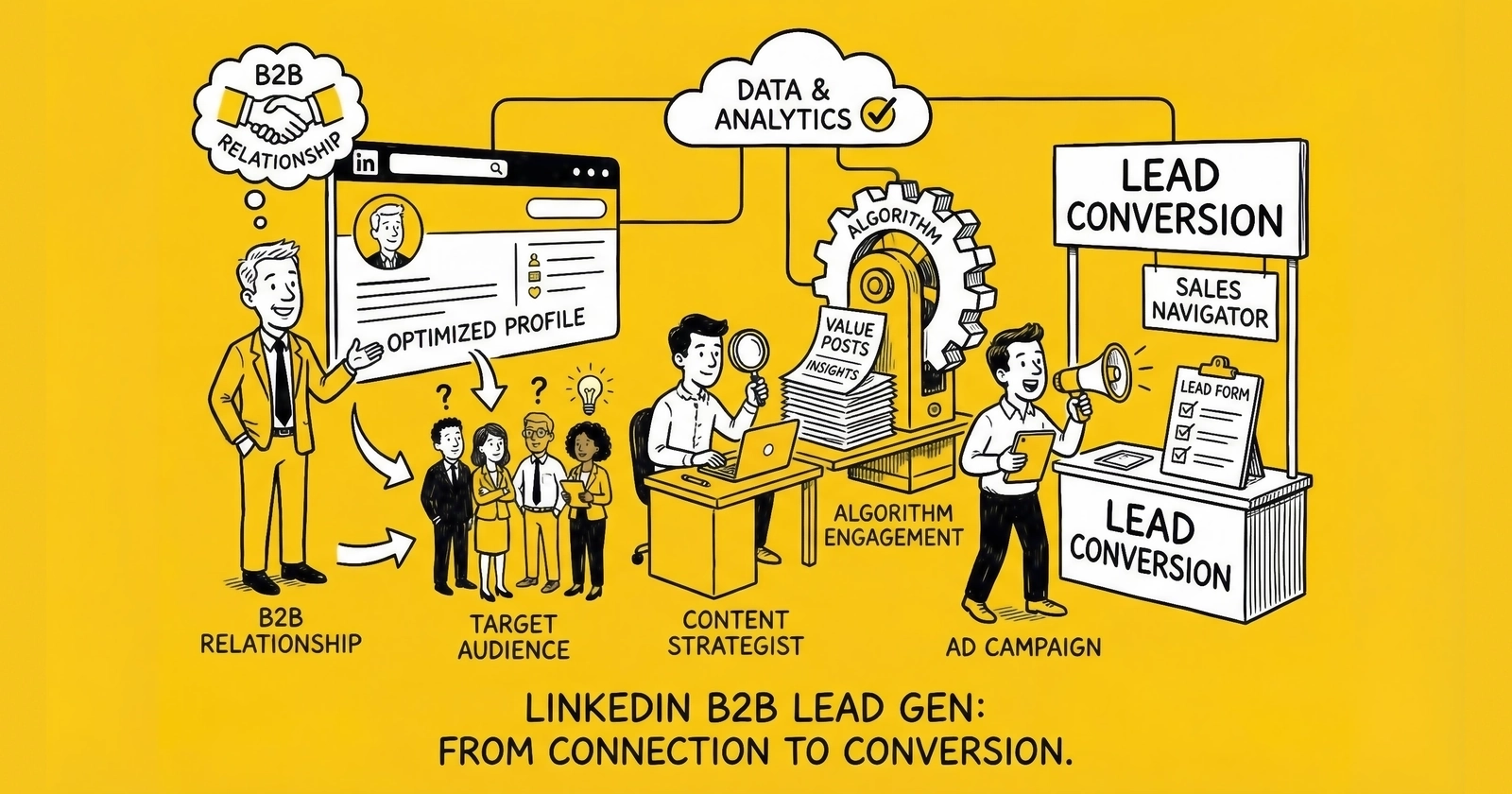
Master the only platform where professional identity drives targeting precision. This comprehensive guide covers ad formats, Sales Navigator mastery, InMail optimization, and the economics that make LinkedIn worth 2-5x the cost of other social channels.
LinkedIn is not a social media platform. It is a professional identity database with social features attached.
This distinction matters more than any tactical advice in this article. On Facebook, you target inferred behaviors and interests. On Google, you target intent keywords. On LinkedIn, you target professional identity: job title, company size, industry, seniority, and the organizational context that determines purchase authority.
For B2B lead generation, this makes LinkedIn simultaneously the most expensive and the most valuable platform available. LinkedIn CPLs run 2-5x higher than other social platforms. But LinkedIn leads convert at 2-3x higher rates and close at 2x higher deal values.
LinkedIn reports over 1 billion members across 200+ countries, with 65+ million decision-makers and 10+ million C-level executives. Four out of five LinkedIn members drive business decisions at their companies. This concentration of professional decision-makers with verified job titles, company affiliations, and career histories does not exist anywhere else online.
The economics work when you understand them. A $150 LinkedIn lead that converts at 5% costs $3,000 per customer. A $30 Facebook lead that converts at 0.5% costs $6,000 per customer. The platform that looks expensive on a CPL basis may be the cheapest when you measure what matters: cost per closed deal.
This guide covers everything you need to generate B2B leads on LinkedIn profitably: advertising formats, targeting capabilities, cost benchmarks, Sales Navigator strategies, InMail optimization, organic content approaches, and the measurement framework that reveals true ROI. Whether you are spending $5,000 or $50,000 monthly, the principles remain constant.
Understanding LinkedIn’s Position in B2B Lead Generation
LinkedIn occupies a unique position in the digital marketing landscape because it solves the fundamental B2B targeting problem: identifying professional decision-makers without relying on inferred behaviors.
On every other platform, B2B targeting requires proxy signals. You target people who read business publications, visit technology websites, or demonstrate behaviors that suggest professional responsibility. These proxies work imperfectly because the same behaviors appear across many population segments.
LinkedIn eliminates the proxy problem. When you target “Vice President of Marketing at companies with 1,000-5,000 employees in the SaaS industry,” you are targeting people who have explicitly declared those attributes on their profiles. The targeting is deterministic rather than probabilistic.
This precision comes at a cost. LinkedIn’s auction operates with fewer advertisers for narrow professional audiences, but the CPMs and CPCs exceed general social platforms because the value per impression is substantially higher. Advertisers accept higher costs because the audience quality justifies the expense.
The platform also benefits from a fundamentally different user mindset. LinkedIn users arrive in professional mode. They expect business content. They engage with industry insights, company updates, and career-relevant information. Advertising feels less intrusive because the context is inherently commercial.
For B2B marketers, this mindset alignment reduces friction throughout the conversion process. The user receiving your Sponsored Content is already thinking about work challenges. The decision to engage with your content does not require context-switching from entertainment to professional consideration.
The B2B Buying Group Reality
Modern B2B purchasing decisions involve committees rather than individuals. Research shows the average B2B buying group includes 6-10 stakeholders, with enterprise deals stretching to 14-23 people involved in the decision. LinkedIn’s professional context enables you to reach multiple stakeholders within target organizations, mapping to how B2B purchases actually happen.
This buying group dynamic means LinkedIn lead generation should focus on reaching multiple roles at target accounts rather than maximizing individual lead volume. Three contacts from one active buying group often prove more valuable than ten isolated leads from different companies.
LinkedIn Ad Formats for Lead Generation
LinkedIn offers five primary advertising formats for lead generation, each serving different objectives within your marketing funnel. Understanding when to deploy each format determines whether you capture value or waste budget.
Sponsored Content
Sponsored Content appears natively in the LinkedIn feed alongside organic posts from connections and followed companies. This format offers the broadest reach and most versatile creative options.
Format Options:
- Single Image Ads: Static image with headline, description, and CTA. The workhorse format for most campaigns.
- Video Ads: Native video up to 30 minutes, though optimal length is 15-30 seconds for awareness and 1-3 minutes for consideration.
- Carousel Ads: Up to 10 swipeable cards, each with unique image, headline, and destination.
- Document Ads: PDF or PowerPoint content users can preview in-feed before downloading.
- Thought Leader Ads: Sponsored organic posts from individual employees rather than company pages, launched in 2023 and performing particularly well for authenticity.
Performance Benchmarks (2024-2026): Sponsored Content averages 0.44% CTR across all campaigns, with well-optimized campaigns reaching 0.6-0.8%. CPM ranges from $30-50 for broad audiences, dropping to $20-35 for optimized campaigns with strong relevance. CPC typically falls between $5-12, though competitive B2B verticals like financial services and enterprise technology see CPCs of $15-25.
Best Practices: Lead with value, not pitch. Educational content outperforms promotional content by 3:1 in engagement metrics. Content that helps the reader solve a problem earns attention; content that describes your product features gets scrolled past.
Use statistics in headlines. Numbers improve CTR by 20-30% compared to qualitative statements. “7 Strategies for Reducing Churn” outperforms “The Best Strategies for Reducing Churn” consistently.
Include faces in images. Human faces increase engagement by 38% compared to abstract graphics or product screenshots. Authenticity matters: real employees outperform stock photos, and candid shots outperform staged professional photography.
Lead Gen Forms
Lead Gen Forms are LinkedIn’s native lead capture mechanism. When users click your CTA, a form opens within LinkedIn pre-populated with profile data: name, email, company, job title, and other fields you configure.
This format dramatically reduces friction compared to landing page redirects. Users complete forms in 2-3 clicks rather than navigating to an external site, waiting for page load, and manually entering information.
Performance Benchmarks: Lead Gen Forms convert at 10-15% from click to lead, compared to 2-5% for landing page flows. CPL reductions of 30-50% are typical when switching from landing page campaigns to Lead Gen Form campaigns.
Once a user opens a form, completion rates exceed 80%. The pre-population removes the primary abandonment driver: typing on mobile devices.
Field Configuration Strategy: Each additional field reduces completion rates by 5-10%. Limit forms to 3-4 fields for maximum conversion. The required fields you can select include:
- Contact info: First name, last name, email, phone
- Work info: Job title, job function, seniority, company name
- Company info: Company size, industry
- Education: Degree, field of study, university
- Custom questions: Single line, multiple choice, or checkbox
Phone number inclusion drops completion rates 15-20%. Only require phone if telephone contact is essential to your sales process. Email-first nurture sequences often outperform immediate phone outreach for complex B2B sales.
Lead Retrieval: Download leads daily or integrate via API. Lead value decays rapidly: response within one minute increases conversion rates by 391%, and leads contacted within five minutes are 21x more likely to qualify than those contacted after 30 minutes. If you cannot respond same-day, Lead Gen Forms may generate volume you cannot convert.
Message Ads (InMail)
Message Ads deliver personalized messages directly to member inboxes. These appear with a “Sponsored” label but otherwise look similar to organic messages from connections.
The format excels at reaching senior decision-makers with high-value offers. Executives who ignore feed advertising may engage with a well-crafted message that speaks directly to their role.
Performance Benchmarks: Open rates average 50-60%, far exceeding email marketing benchmarks. CTR runs 3-5% from opened messages. Cost per send ranges from $0.80-1.20 depending on audience targeting.
Critical Constraint: Members receive maximum one Sponsored Message per 45 days. LinkedIn enforces this cap to protect inbox quality. This means frequency strategy differs fundamentally from other advertising: you cannot retarget the same user repeatedly with Message Ads.
Message Strategy: Keep messages under 500 characters. Brevity increases response rates by 25% compared to longer formats. Get to the point: state who you are, what you are offering, and why the recipient should care.
Make the ask explicit and singular. Messages with one clear CTA outperform multi-option messages by 2x. “Schedule a demo” works better than “Schedule a demo, read our whitepaper, or visit our website.”
Personalization tokens matter. “Hi [First Name], I noticed you lead [Company]‘s marketing team” creates relevance that generic copy cannot match.
Conversation Ads
Conversation Ads extend the Message Ad format with interactive branching logic. Users receive multiple CTA options and choose their own path through a decision tree.
Example Flow: Initial message presents three options: “Learn about our pricing,” “See customer case studies,” or “Talk to an expert.” Each choice leads to a different follow-up message with relevant content and new choices.
Performance Benchmarks: Open rates mirror Message Ads at 50-55%. Click rates improve to 5-8% because users choose engagement type. CPL runs 30-40% lower than single-CTA Message Ads because qualification happens within the conversation.
Best Use Cases: Conversation Ads excel when your audience contains multiple segments with different needs. Rather than guessing which offer resonates, you let users self-select into appropriate tracks.
Dynamic Ads
Dynamic Ads appear in the right-hand column on desktop and automatically personalize with the viewer’s profile photo and name. The personalization creates attention in a format typically ignored.
Performance Benchmarks: CTR averages 0.06-0.08% with CPC of $3-6. The format works better for follower acquisition and remarketing than direct lead generation.
Limitations: Desktop-only placement excludes the 60%+ of LinkedIn usage on mobile devices. The format serves specific use cases but should not anchor lead generation strategy.
LinkedIn Targeting Capabilities
LinkedIn’s targeting separates it from every other advertising platform. The ability to reach specific professional populations with deterministic rather than probabilistic targeting justifies premium pricing.
Professional Attribute Targeting
Job Title: Target exact titles or LinkedIn-grouped related titles. Specificity matters: “Chief Marketing Officer” reaches different people than “VP Marketing” or “Marketing Director.” However, title inflation affects interpretation: 40% of “Directors” at companies under 50 employees function as individual contributors.
Job Function: Target by department regardless of title variations. Marketing, Sales, Operations, Engineering, Finance, HR, IT: each function grouping captures professionals with relevant responsibilities even when titles differ across organizations.
Seniority Level: Target by hierarchical level from Entry through CXO. Combine seniority with company size for precision: VP at a 50-person startup has different authority than VP at a 50,000-person enterprise.
Company Size: Target by employee count bands from 1-10 through 10,001+. Essential for B2B segmentation: products priced for enterprise rarely convert from small business audiences, and SMB-focused solutions waste budget on enterprise targets.
Industry: Target by LinkedIn’s 100+ industry taxonomy. Industries segment audiences with fundamentally different needs, buying processes, and budget cycles.
Company Name: Upload lists of up to 300,000 company names for Account-Based Marketing. Match rates typically run 60-80% depending on company name standardization. Essential for ABM programs targeting specific accounts.
Skills and Interest Targeting
Skills Targeting: Target members based on profile skills including specific technologies (Salesforce, HubSpot, AWS), methodologies (Agile, Lean Six Sigma), and disciplines (Financial Modeling, Data Analysis). Skills are user-declared, not inferred, providing precision other platforms cannot match.
Member Groups: Target members of specific LinkedIn Groups. Group membership indicates topic interest and professional investment: someone who joined “B2B Marketing Leaders” has explicitly identified with that community.
Member Interests: Target based on content engagement patterns. Less precise than professional attributes but useful for layering on additional signals.
Matched Audiences
Contact Targeting: Upload email lists with minimum 300 matches. Match rates range 30-60% depending on email type: work emails match better than personal emails. Use for remarketing, customer expansion, or conquest campaigns against competitor customer lists.
Company Targeting: Upload company name lists for account-based targeting. Match rates of 60-80% make this highly effective for ABM programs.
Website Retargeting: Target visitors via LinkedIn Insight Tag installed on your website. Create audiences based on specific page visits, recency windows, and engagement depth.
Lookalike Audiences: Generate similar audiences from seed lists of customers or high-value leads. LinkedIn’s algorithm identifies common professional characteristics and finds similar members.
Targeting Strategy Principles
Avoid targeting too narrowly. Audiences below 50,000 cannot optimize effectively through LinkedIn’s algorithm. Costs spike and results vary wildly. If your initial targeting produces small audiences, broaden one dimension while keeping others tight.
Avoid targeting too broadly. “Marketing professionals” reaches coordinators and CMOs at identical CPM. Layer function + seniority + company size to narrow appropriately. The goal is reaching everyone who could buy, but no one who cannot.
Use exclusions strategically. Upload lists of current customers, competitors, and unqualified companies. Every impression served to someone who cannot convert wastes budget that could reach prospects.
LinkedIn Advertising Costs: 2026 Benchmarks
LinkedIn costs more than any other social advertising platform. Understanding the cost structure prevents sticker shock and enables realistic budget planning.
Cost Benchmarks by Metric
| Metric | LinkedIn Average | Optimized Campaigns | High-Competition Verticals |
|---|---|---|---|
| CPM | $30-50 | $20-35 | $50-80 |
| CPC | $5-12 | $3-8 | $15-25 |
| CPL (Landing Page) | $75-200+ | $50-100 | $150-400 |
| CPL (Lead Gen Form) | $40-150 | $30-80 | $100-250 |
CPL Benchmarks by Industry
Industry vertical significantly impacts cost benchmarks because buyer value and competition vary dramatically.
| Industry | Typical CPL Range | Premium Tier CPL |
|---|---|---|
| SaaS/Technology | $50-150 | $150-300 |
| Financial Services | $100-250 | $200-500 |
| Professional Services | $75-175 | $150-350 |
| Manufacturing | $60-150 | $100-250 |
| Healthcare/Pharma | $100-300 | $200-500+ |
| HR/Recruiting | $40-100 | $100-200 |
| Education/Training | $50-125 | $100-250 |
Making the LinkedIn Economics Work
The CPL comparison that matters is not LinkedIn versus other platforms. The comparison that matters is cost per qualified opportunity and cost per closed deal.
Example Calculation:
LinkedIn Campaign:
- Monthly spend: $10,000
- CPL: $100
- Leads captured: 100
- Lead-to-MQL rate: 35% (35 MQLs)
- MQL-to-Opportunity rate: 25% (9 opportunities)
- Opportunity-to-Close rate: 22% (2 closed deals)
- Average deal value: $75,000
- Revenue generated: $150,000
- ROAS: 15:1
Facebook Campaign (same budget):
- Monthly spend: $10,000
- CPL: $40
- Leads captured: 250
- Lead-to-MQL rate: 12% (30 MQLs)
- MQL-to-Opportunity rate: 15% (4-5 opportunities)
- Opportunity-to-Close rate: 20% (1 closed deal)
- Average deal value: $60,000 (smaller deals from less qualified leads)
- Revenue generated: $60,000
- ROAS: 6:1
The platform that appears 60% cheaper on CPL basis produces 60% less revenue. LinkedIn’s premium pricing reflects premium audience quality.
Minimum Budget Requirements
LinkedIn requires $10 daily minimum per campaign. However, meaningful testing requires $3,000-5,000 monthly to generate sufficient data for optimization decisions. Enterprise B2B programs typically run $10,000-50,000 monthly for mature, scaled operations.
At budgets below $3,000 monthly, sample sizes remain too small for reliable performance assessment. You cannot distinguish platform problems from statistical noise without sufficient volume.
LinkedIn Sales Navigator for Lead Generation
Sales Navigator is LinkedIn’s premium sales intelligence tool, priced at $99.99/month for the Core plan through $169.99/month for Advanced and custom pricing for Advanced Plus with CRM integration.
Used correctly, Sales Navigator delivers significant returns for B2B lead generation teams. Used incorrectly, it becomes an expensive LinkedIn premium membership with unused features.
Core Capabilities
Advanced Search Filters: 40+ filters including company headcount growth, technologies used, recent job changes, funding events, and shared connections. These filters enable precision targeting impossible through standard LinkedIn search.
Lead Lists: Build and save lists aligned with sales territories, account assignments, or campaign targets. Track updates and job changes automatically. Receive alerts when saved leads engage with your company’s content.
InMail Credits: 50 credits monthly on Core and Advanced tiers. InMail enables direct outreach to members outside your network without connection requests.
Intent Signals: Track who viewed your profile, which target accounts engaged with your Company Page, and funding or hiring signals indicating buying potential.
AI Features (Advanced Tier):
- Account IQ: AI-generated account summaries including strategic priorities and potential pain points
- Lead IQ: Background research and communication preferences for individual prospects
- Message Assist: AI-drafted personalized outreach messages
CRM Integration (Advanced Plus):
- Sync leads and accounts bi-directionally with Salesforce, HubSpot, Microsoft Dynamics 365, or Oracle Sales
- Track engagement without manual data entry
- ROI reporting linking LinkedIn activity to closed revenue
Sales Navigator Workflow for Lead Generation
Step 1: Build Ideal Customer Profile Search
Define your ICP using Sales Navigator filters. Example for B2B SaaS selling to mid-market marketing teams:
- Job Function: Marketing
- Seniority: Director, VP, CXO
- Company Size: 201-5,000 employees
- Industry: Technology, Computer Software, Internet
- Geography: United States
- Technologies Used: HubSpot or Salesforce (indicating marketing sophistication)
- Recent Activity: Posted content in last 30 days (indicating LinkedIn engagement)
Step 2: Apply Intent Filters
Layer intent signals to prioritize outreach:
- Recent job changes (new roles = new initiatives)
- Company funding announcements (capital = budget)
- Hiring for relevant roles (investment = priority)
- Connection path through team members (warm introduction potential)
Step 3: Save Leads and Create Alerts
Add qualified prospects to lead lists. Configure alerts for:
- Job changes
- Content posts
- Company mentions in news
- Shared connection updates
Alerts provide outreach triggers: “Congratulations on the new role” messages have 3x higher response rates than cold outreach.
Step 4: Engage Before Outreach
Like and comment on prospects’ posts before sending InMail. Prospects recognize your name and reciprocity psychology increases response likelihood. Two weeks of thoughtful engagement before outreach increases acceptance rates 40-60%.
Step 5: Execute Personalized Outreach
Reference specific details: their recent content, company announcements, or shared connections. Generic templates perform poorly on LinkedIn where personalization expectations are high.
ROI Calculation
Annual cost per seat: $1,200 (Core) to $2,028 (Advanced). One additional qualified meeting per quarter typically delivers 10-50x ROI for most B2B sales motions.
The math: If your average deal value is $30,000 and close rate from qualified meetings is 20%, one additional closed deal per year ($30,000) from Sales Navigator activity ($1,200 annual cost) produces 25x ROI.
InMail Strategy and Best Practices
LinkedIn InMail – whether through Sales Navigator or Sponsored InMail campaigns – enables direct outreach to prospects outside your network. The channel has become increasingly competitive, making strategy and execution quality determinative of results.
InMail Fundamentals
Open Rates: InMail open rates average 50-60%, far exceeding email marketing. Recipients see messages in their LinkedIn inbox, which most professionals check regularly.
Response Rates: Response rates vary dramatically with personalization quality. Generic templates see 5-10% response. Personalized messages referencing specific context achieve 20-30%.
Timing: InMail sent Tuesday through Thursday during business hours outperforms weekend or evening sends by 15-25%. Recipients are in professional mode during work hours.
InMail Message Structure
The effective InMail follows a simple structure: context, relevance, ask.
Context (1-2 sentences): Why are you reaching out to this specific person now? Reference their content, company news, shared connection, or specific role.
Relevance (2-3 sentences): Why should they care? Connect your offering to their likely challenges or goals. Demonstrate understanding of their situation.
Ask (1 sentence): What do you want them to do? Make the ask specific, time-bound, and low-friction.
Example:
“Hi Sarah,
I noticed your post last week about the challenges scaling demand gen with a lean team. We’ve helped three companies in your space solve the same problem – Acme cut their CAC 40% while doubling MQL volume.
Would you be open to a 20-minute call this week to explore whether something similar might work for [Company]?”
Total length: 56 words. The message respects the recipient’s time while providing enough context for informed decision.
InMail Personalization Tactics
Reference specific content: “Your article on product-led growth raised a point we don’t see enough – the handoff from self-serve to sales-assist is where most companies leak revenue.”
Acknowledge mutual connections: “I noticed we’re both connected to David Chen. He mentioned you’re doing interesting work on market expansion.”
Reference company news: “Congratulations on the Series B. Growth-stage often means the tech stack decisions you made at seed no longer scale – are you finding that with [specific tool]?”
Reference role-specific challenges: “New CMOs typically inherit attribution problems from their predecessors. The first 90 days often reveal surprises about what’s actually driving pipeline.”
InMail Mistakes to Avoid
The pitch dump: Sending product descriptions without establishing relevance. Recipients delete without reading.
The fake personalization: “I see you’re at [Company Name]” is not personalization. Specific reference to the company’s situation demonstrates actual research.
The multiple ask: “Would you like to schedule a call, or if you prefer, I could send over some resources, or we could connect on LinkedIn first.” Decision fatigue reduces response rates.
The wall of text: 300+ word messages overwhelm. Respect time by editing ruthlessly.
The automation tell: “Hi [[FirstName]]” or clearly templated language signals mass outreach and triggers deletion.
2026 Platform Changes: Automation Crackdown
LinkedIn has significantly tightened enforcement against automation tools in 2026. Understanding these restrictions is critical for lead generation operations.
New Restrictions (2026)
150 Daily Action Cap: LinkedIn now enforces a combined daily limit of approximately 150 actions across connection requests, messages, profile views, and likes. Exceeding this threshold triggers warnings and potential account restrictions.
Automation Tool Detection: LinkedIn’s detection algorithms have improved substantially. Third-party automation tools (even those claiming to be “undetectable”) increasingly trigger:
- Warning messages
- Temporary feature restrictions
- Account suspension
- Permanent bans for repeat offenders
Sales Navigator Rate Limiting: Even paid Sales Navigator accounts face restrictions on aggressive prospecting patterns. Sending too many InMails too quickly or viewing profiles at machine-like speeds triggers review.
Compliant Alternatives
Native Sales Navigator Sequences: LinkedIn’s built-in sequence functionality provides compliant automation within platform limits. These workflows avoid detection because they are officially sanctioned.
Content-Based Inbound: Thought leadership and content marketing attract prospects rather than pushing outreach. This approach generates inbound interest without triggering rate limits.
LinkedIn Ads with Lead Gen Forms: Paid reach through advertising with native lead capture accomplishes scale that manual outreach cannot, without automation risk.
LinkedIn Events: Organic event marketing provides audience building and engagement opportunities without triggering outreach restrictions.
Risk Mitigation
- Audit current tools: Any third-party automation should be evaluated against current detection risk
- Diversify prospecting: Spread activity across organic content, paid advertising, and manual outreach
- Monitor account health: Warning messages should prompt immediate behavior adjustment
- Document compliant processes: Clear SOPs help teams stay within platform guidelines
The operators succeeding on LinkedIn in 2026 combine quality manual outreach within daily limits with scaled paid advertising, rather than relying on automation tools that create account risk.
Organic LinkedIn Lead Generation
Paid advertising reaches audiences. Organic content builds credibility that makes paid advertising more effective. The combination outperforms either approach alone.
Company Page Optimization
Your Company Page is the destination ad-clickers visit before making conversion decisions. An empty or outdated page destroys credibility built through advertising.
Essential Elements:
- Banner Image: 1128 x 191 pixels. Update quarterly with current campaign, value proposition, or social proof.
- About Section: First 156 characters appear in search results. Lead with what you do, not company history.
- Specialties: Up to 20 keywords influencing search visibility. Include terms prospects search.
- Featured Content: Pin high-performing posts that demonstrate expertise.
Posting Strategy: Post 3-5 times weekly minimum. Consistency matters more than optimization. Content mix: 80% value content (insights, how-to, research) and 20% promotional (product, company news, case studies).
Employee Advocacy
Personal posts receive 561% more reach than identical Company Page posts. LinkedIn’s algorithm favors individual voices over brand accounts.
The multiplier effect: three percent of employees sharing content generates 30% of total company engagement. A small group of active advocates expands reach dramatically beyond Company Page limitations.
Implementation:
- Identify 10-20 willing advocates across departments
- Provide ready-to-share content weekly with suggested context
- Coach on personalization: personal perspective outperforms robotic reposts
- Track engagement and expand program based on results
Advocacy content should feel authentic. Employees adding their perspective on company content outperforms copy-paste sharing by 5x.
Content That Generates Leads
Works:
- Problem-focused posts articulating audience pain points
- Counterintuitive insights challenging conventional wisdom
- Tactical how-to content readers can implement immediately
- Original data and benchmarks
- Strong point-of-view pieces that stake a position
Wastes Effort:
- Generic motivational quotes
- Self-congratulatory company announcements
- Reshared news without added perspective
- Self-promotional posts disguised as thought leadership
- Engagement bait (“Comment ‘YES’ if you agree”)
Content Format Performance
| Format | Engagement Level | Lead Generation Potential |
|---|---|---|
| Native Documents (PDFs) | Very High | Medium-High |
| Carousel Posts | High | Medium-High |
| Text Posts | High | Low-Medium |
| Native Video | Medium-High | Medium |
| Newsletters | Medium | High |
| Long-Form Articles | Low-Medium | Medium |
Native documents and carousels receive algorithmic preference because they keep users on platform. The swipe interaction signals engagement that LinkedIn rewards with additional distribution.
Posting Frequency and Timing
Minimum: 3 posts per week Optimal: 5-7 posts per week (daily during business days) Best Days: Tuesday, Wednesday, Thursday Best Hours: 8-10 AM, 12-1 PM, 5-6 PM (audience local time)
Consistency beats optimization. Posting daily at random times outperforms posting twice weekly at theoretically optimal times.
Measuring LinkedIn Lead Generation ROI
Accurate ROI measurement requires tracking leads through the full funnel to revenue, not just counting form submissions.
Platform Metrics
LinkedIn Campaign Manager provides:
- Impressions: How many times ads appeared
- Clicks: Click-through to destination
- CTR: Click-through rate
- Leads: Form submissions for Lead Gen Form campaigns
- CPL: Cost per lead
- Engagement Rate: Likes, comments, shares, follows
These metrics inform optimization but do not measure ROI.
Marketing Metrics
Connect LinkedIn leads to your marketing automation and CRM to track:
- Lead-to-MQL Rate: Percentage of LinkedIn leads meeting qualification criteria
- MQL-to-SQL Rate: Percentage accepted by sales
- SQL-to-Opportunity Rate: Percentage becoming pipeline
- Pipeline Value: Total opportunity value from LinkedIn leads
- Average Deal Size: Compare LinkedIn versus other sources
Revenue Metrics
Ultimate ROI requires revenue attribution:
- Closed-Won Revenue: Total revenue from LinkedIn-sourced leads
- Customer Lifetime Value: Total expected revenue per acquired customer
- Customer Acquisition Cost (CAC): LinkedIn spend + labor + tools divided by customers acquired
- LTV:CAC Ratio: Target 3:1 minimum; 5:1+ indicates efficient acquisition
Tracking Implementation
LinkedIn Insight Tag: Install on all website pages for retargeting and conversion tracking.
UTM Parameters: Apply to all ad destinations for analytics attribution:
?utm_source=linkedin&utm_medium=paid&utm_campaign=campaign-name&utm_content=ad-nameCRM Lead Source: Create LinkedIn as distinct source in CRM. Track leads through full lifecycle.
Multi-Touch Attribution: B2B buyers touch multiple channels before converting. Implement attribution modeling that credits LinkedIn appropriately alongside other touchpoints.
Evaluation Timeline
Allow 3-6 months to evaluate LinkedIn ROI for B2B sales cycles exceeding 60 days. Month one establishes baselines. Months 2-3 reveal lead quality patterns. Months 4-6 show true conversion rates as leads progress through sales cycles.
Premature ROI judgment based on 30-day data leads to incorrect optimization decisions. The platform that looks expensive at 30 days may be most profitable at 180 days.
Common LinkedIn Advertising Mistakes
LinkedIn’s premium pricing amplifies the cost of mistakes. At $10+ CPC, every optimization error wastes meaningful budget.
Targeting Too Broadly: “Marketing professionals” reaches coordinators and CMOs at identical CPM. Layer function + seniority + company size for appropriate precision.
Targeting Too Narrowly: Audiences below 50,000 cannot optimize effectively. Costs spike and performance varies wildly between weeks.
Creative That Looks Like Advertising: Feed users scroll past obvious ads. Test authentic creative – UGC style, real employees, candid situations – against polished brand content.
Ignoring Lead Quality: A $50 lead with 1% conversion costs $5,000 per customer. A $150 lead with 5% conversion costs $3,000. Track leads through to revenue, not just CPL.
Inconsistent Messaging: Ad promises “free template,” landing page requests demo. Match message, offer, and destination throughout the user journey.
Neglecting Follow-Up Speed: LinkedIn leads decay rapidly. Set SLA for same-day response on high-CPL leads. If you cannot respond within hours, reduce volume to what you can work effectively.
No Organic Presence: Ad-clickers check Company Pages. Empty or outdated pages destroy credibility. Build organic foundation before scaling ad spend.
Missing Exclusions: Upload lists excluding current customers, competitors, and known unqualified accounts. Every impression to the wrong audience wastes budget.
Insufficient Testing: Minimum at launch: 3 creative variants, 2 audience segments, 2 offers. LinkedIn’s algorithm needs variation to optimize.
Expecting Immediate Results: B2B sales cycles run 3-12 months. Allow appropriate time before judging campaign effectiveness.
Frequently Asked Questions
What is a good cost per lead on LinkedIn?
Average LinkedIn CPLs range from $75-200 for most B2B campaigns. However, “good” CPL depends entirely on downstream economics. A $200 lead that converts to a $100,000 deal with 20% close rate delivers $20,000 revenue at $1,000 customer acquisition cost – strong economics. A $50 lead that never closes costs infinite dollars per customer. Evaluate CPL against lead-to-customer conversion rates and customer lifetime value, not against other platforms’ raw CPL benchmarks. LinkedIn’s premium CPL often produces superior cost per closed deal.
How do Lead Gen Forms compare to landing pages?
Lead Gen Forms reduce CPL by 30-50% compared to landing page flows due to pre-population and reduced friction. Form completion rates exceed 80% once opened, versus 2-5% landing page conversion rates from click. However, Lead Gen Forms can produce lower-quality leads because the ease of submission captures more casual interest. Test both formats against downstream conversion rates, not just CPL. Use Lead Gen Forms for awareness-stage offers like content downloads. Use landing pages for high-commitment offers like demo requests where friction filters for seriousness.
What is the minimum budget for LinkedIn advertising?
LinkedIn requires $10 daily minimum per campaign. However, meaningful testing requires $3,000-5,000 monthly to generate sufficient data for optimization. Enterprise B2B programs typically run $10,000-50,000 monthly for mature operations. At budgets below $3,000 monthly, statistical noise overwhelms signal. You cannot distinguish good performance from lucky weeks without adequate sample sizes.
How do I target specific companies on LinkedIn for ABM?
Upload company name lists via Matched Audiences in Campaign Manager. Prepare CSV files with company names matching LinkedIn’s database. Match rates typically run 60-80% depending on name standardization. Combine company targeting with title, seniority, and function filters to reach specific roles at target accounts. For example: target decision-makers at 500 named accounts by combining the company list with Director+ seniority and relevant job functions.
Should I use Sponsored Content or Message Ads?
Sponsored Content excels at scale, awareness building, and reaching broad professional audiences with content that provides value. Message Ads excel at direct response with high-value, narrow audiences where personalized outreach makes sense. Many programs use both: Sponsored Content for top-of-funnel awareness and remarketing, Message Ads for bottom-of-funnel conversion of engaged prospects. The 45-day frequency cap on Message Ads limits their use as a standalone channel.
How often should I post organic content on LinkedIn?
Post minimum 3-5 times weekly for Company Pages. Daily posting (5-7 per week) is optimal for sustained reach. Consistency matters more than optimization: posting every day at random times outperforms twice-weekly at theoretically optimal times. For personal profiles, 3-5 posts weekly builds audience. Engaging authentically on others’ content – thoughtful comments, not just likes – accelerates growth.
Is Sales Navigator worth the cost?
Yes, if three conditions hold: (1) outbound prospecting is part of your sales motion, (2) average deal values exceed $10,000, and (3) you will actively use advanced search and intent signals. At $99-170 monthly, one additional closed deal per quarter delivers 10-50x ROI. Sales Navigator is not worth the cost if your model relies entirely on inbound marketing, deal values are too small to justify outbound effort, or you will not use the advanced features regularly.
How do I measure lead quality from LinkedIn?
Track downstream metrics through your CRM: Lead-to-MQL rate (what percentage meet qualification criteria), MQL-to-Opportunity rate (what percentage become pipeline), average deal size by source, and sales cycle length. Compare LinkedIn performance against other channels on these metrics, not just cost per lead. High-quality signals include: higher MQL rates than other sources, larger average deal sizes, faster sales cycles, and higher close rates. Aggregate CPL means nothing without these downstream conversions.
What content generates the most LinkedIn leads?
Native documents (PDFs) and carousel posts generate highest engagement due to algorithmic preference. For direct lead generation, content offering immediate practical value – frameworks, templates, checklists, benchmarks – drives form fills more effectively than thought leadership. Text posts with clear CTAs drive direct message inquiries. Video builds trust and credibility but generates fewer direct leads than document content. Test formats against your specific audience rather than assuming general patterns apply.
How long before LinkedIn advertising shows ROI?
Allow 3-6 months minimum for B2B sales cycles exceeding 60 days. Month one establishes baseline performance. Months 2-3 reveal lead quality patterns as leads progress through qualification. Months 4-6 show true conversion rates as deals close or fail. Judging LinkedIn ROI at 30 days leads to incorrect conclusions. A campaign that appears expensive may be generating the highest-quality pipeline; you simply cannot see it until deals close.
Key Takeaways
-
LinkedIn costs 2-5x more and delivers 2-3x higher quality leads. The math works when deal values justify CPL and conversion rates compound favorably through the funnel. Evaluate cost per closed deal, not cost per lead.
-
Target professional identity, not inferred interests. LinkedIn’s power is deterministic targeting of actual job titles, company sizes, and industries. Layer multiple dimensions for precision without over-narrowing below 50,000 audience size.
-
Lead Gen Forms reduce CPL 30-50% but require quality monitoring. Test both forms and landing pages against downstream conversion rates. Lower friction can mean lower intent.
-
Sales Navigator pays for itself with one additional qualified meeting per quarter. Use advanced search, intent signals, and structured workflows to justify the subscription cost through closed revenue.
-
InMail response rates depend entirely on personalization quality. Generic templates achieve 5-10% response. Personalized messages referencing specific context reach 20-30%. The extra research time pays off.
-
Organic presence amplifies paid performance. Build content foundation before scaling ad spend. Empty Company Pages destroy credibility with ad-clickers who research before converting.
-
Measure leads through to revenue, not just CPL. Track cost per qualified opportunity and customer acquisition cost. The platform with highest CPL may have lowest CAC.
-
Common mistakes magnify at $10+ CPC. Broad targeting, poor creative, inconsistent messaging, and slow follow-up waste budget faster than on cheaper platforms. Optimize before scaling.
-
Allow 3-6 months for true ROI measurement. B2B sales cycles require patience. Premature judgment leads to incorrect optimization decisions.
-
Multi-channel strategies outperform LinkedIn-only approaches. Combine LinkedIn’s targeting precision with Google’s intent signals and content marketing’s organic reach for comprehensive coverage.
LinkedIn is the most expensive B2B lead generation platform because it offers targeting precision unavailable elsewhere. The professional identity database enables reaching specific decision-makers at specific companies in specific roles. When your economics justify the premium – deal values high enough, conversion rates strong enough, and sales cycles manageable – LinkedIn delivers unmatched B2B lead quality. Master the targeting, optimize the creative, track through to revenue, and the high CPLs produce high returns.
Statistics and platform information current as of Q4 2024 / Q1 2025. LinkedIn updates features and pricing regularly; verify current specifications before campaign launch.