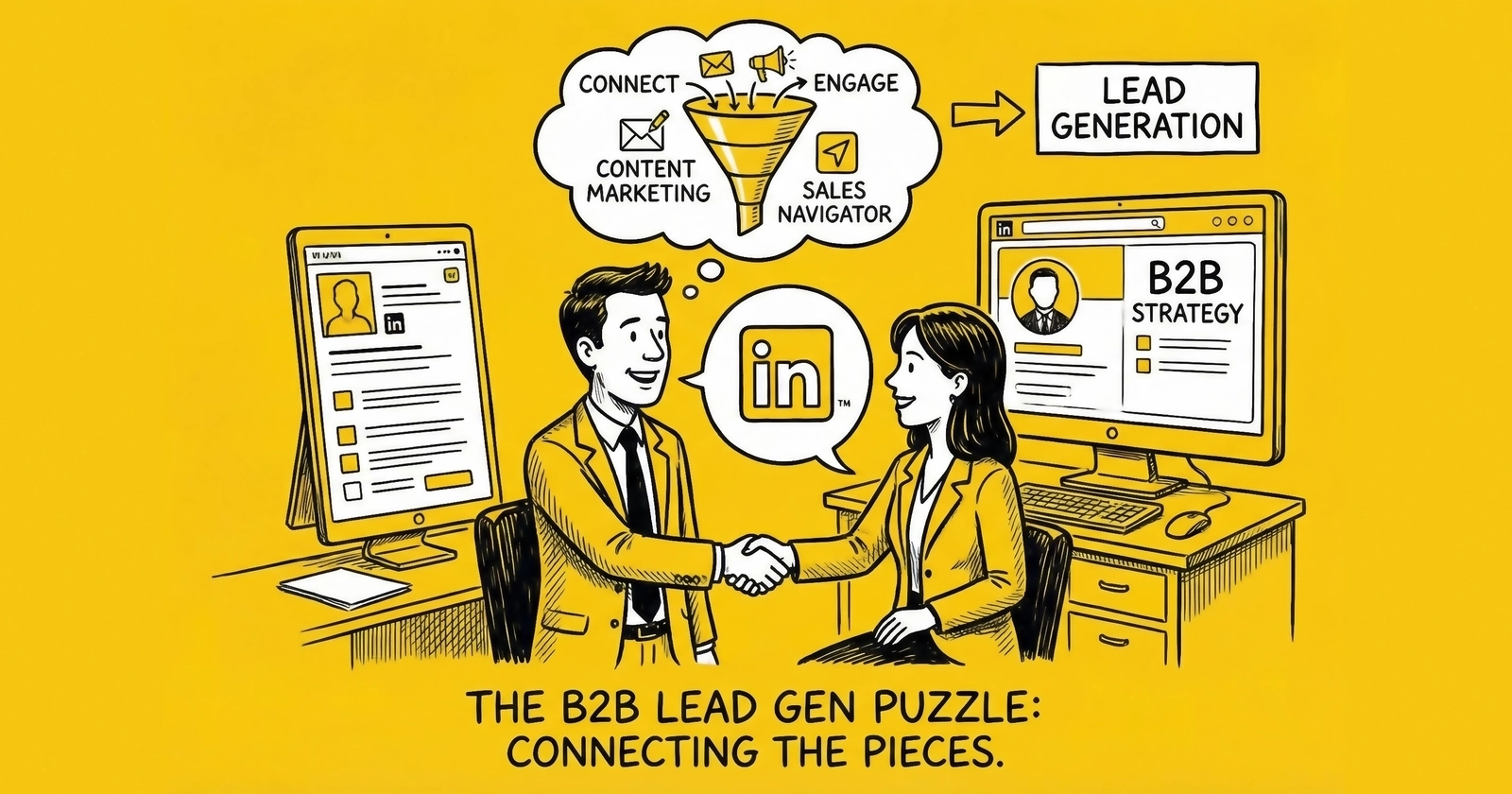
How lead generation vendors use LinkedIn to reach lead buyers – the procurement managers, agency owners, and operations leaders who purchase lead programs – rather than to generate leads from LinkedIn users themselves.
Lead generation vendors have a customer acquisition problem that most B2B marketing advice does not address directly. The customers they need to reach are not consumers shopping for insurance or homeowners considering solar. The customers they need to reach are the operations managers at insurance agencies who buy 500 leads per week, the CMOs at regional mortgage companies who manage six-figure monthly lead budgets, and the procurement leads at home services franchises deciding which vendors to keep on contract.
LinkedIn solves this problem with a precision no other platform can match.
The logic is inverted from standard lead generation. The goal is not to reach homeowners and convert them into solar leads. The goal is to reach the Director of Marketing at a regional solar installer who buys solar leads, and to demonstrate that the vendor’s lead program is worth a conversation. The targeting works on professional identity – job title, company size, industry – rather than consumer intent signals.
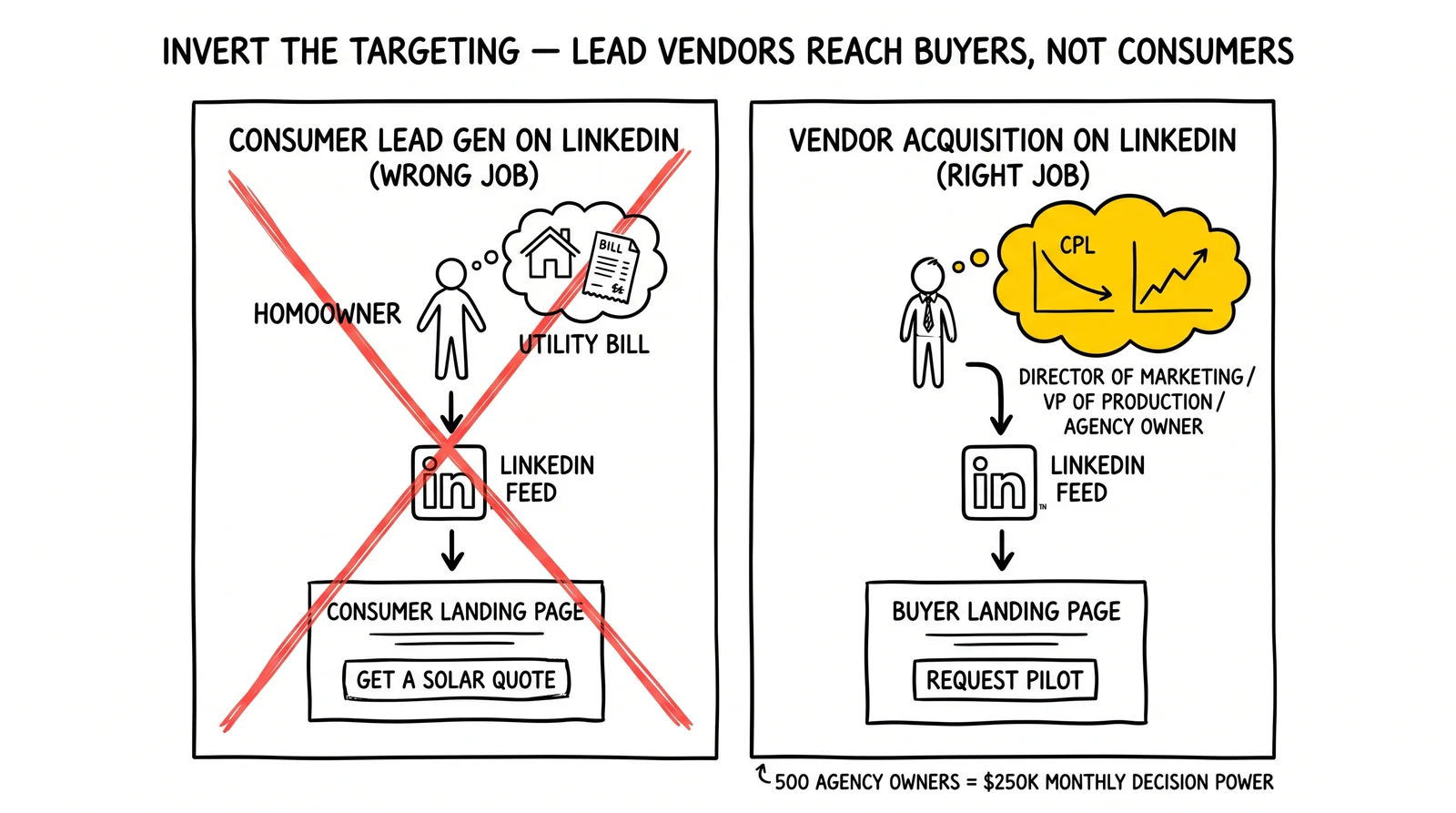
This guide covers the full picture: audience construction for buyer acquisition, ad formats that work for lead program sales, messaging strategy that speaks to buyer economics rather than consumer benefits, and the conversion infrastructure that turns LinkedIn traffic into signed vendor agreements.
Understanding the Lead Buyer’s Buying Process
Before building LinkedIn campaigns to reach lead buyers, understand how they evaluate and select vendors. The buying process is different from consumer purchases, and the LinkedIn strategy must reflect it.
Who Makes Lead Buying Decisions
Lead buying authority sits in different places depending on company type and size:
Insurance agencies (independent, 1-50 agents): The agency owner or principal makes vendor decisions. They evaluate based on CPL, vertical fit, contact rate, and payment terms. They are price-sensitive and experienced – they have bought leads before and been disappointed. They are skeptical by default.
Insurance agencies (50+ agents, regional): A dedicated marketing manager or director of operations typically owns the vendor relationship, with principal sign-off on contracts above a threshold (often $10K-25K monthly). The marketing manager cares about process and integration. The principal cares about return on investment.
Mortgage companies and brokers: Compliance-oriented environments mean the compliance officer often has veto power even if they are not the initiator. The loan officer production manager or marketing director typically initiates vendor evaluation. Large companies may have a dedicated lead operations role.
Home services companies (franchise): Corporate franchise operations may have centralized vendor selection. Individual franchise owners select vendors independently. These two audiences require different LinkedIn campaigns – the franchise corporate buyer responds to scale and consistency; the franchise owner responds to local market fit and immediate ROI.
Solar installers: Sales directors or VP of Sales typically own lead vendor relationships. They care intensely about contact rate and qualification rate because their installation crews represent fixed costs. Poor leads create idle capacity.
Understanding this structure determines who to target on LinkedIn and what message resonates.
The Lead Buyer Evaluation Cycle
Lead buyers do not impulsively sign vendor agreements. The evaluation cycle typically runs 3-8 weeks and includes:
- Problem identification: Current vendor quality decline, price increase, volume capacity issues, or compliance concern triggers search for alternatives
- Vendor discovery: Referrals from peers, LinkedIn outreach, industry events, or search
- Initial conversation: 20-30 minute call to assess fit, discuss pricing, and check compliance
- Pilot structure: Small volume test (typically 50-200 leads) at defined criteria
- Pilot evaluation: 2-4 weeks of analysis on contact rates, qualification rates, return rates
- Scale decision: Increase volume, maintain test level, or discontinue
LinkedIn’s role is stages 2-3: generating discovery and enabling the initial conversation. The platform does not close vendor agreements – it generates qualified introductions to buyers who are ready to evaluate.
Audience Construction for Lead Buyer Targeting
LinkedIn’s professional targeting enables reaching lead buyers with accuracy unavailable on any other platform. The construction approach depends on the buyer type.
Targeting Insurance Lead Buyers
Insurance agency owners and marketing decision-makers cluster in specific LinkedIn profile attributes:
Job titles to target:
- Agency Owner / Insurance Agency Owner
- Agency Principal
- Director of Marketing (at insurance companies)
- Marketing Manager (at insurance agencies 20+ agents)
- VP of Business Development
- Operations Manager (at independent agencies)
- Director of Operations
Company targeting: Industry: Insurance (LinkedIn’s taxonomy) Company size: 11-200 employees covers independent agencies through mid-size regional operations. Larger carriers have procurement processes that require different approaches.
Geography: State-by-state if the lead program is state-specific. National if the program operates across multiple states. Exclude states where the lead program lacks inventory.
Company name lists: Upload matched lists of known insurance agency networks (Keystone Insurers Group, Smart Choice, Agents Alliance members, etc.) for account-based targeting. Match rates typically run 60-75% on company name lists.
Skills targeting as additional signal: Insurance, Property & Casualty Insurance, Health Insurance, Life Insurance as skill targets layer onto job function to filter for actual insurance professionals versus people who work at insurance-adjacent companies.
Targeting Mortgage Lead Buyers
Mortgage lead buying authority sits in specific operational roles:
Job titles:
- VP of Production
- Director of Marketing
- Marketing Manager (at mortgage companies 20+ loan officers)
- Mortgage Branch Manager (at 50+ LO operations)
- Chief Operating Officer (at smaller brokerages)
- President (at brokerages under 20 LOs)
Industry: Financial Services, Banking, Mortgage Company size: 11-500 employees for brokers and mid-size lenders; avoid targeting retail banks where lead buying is not part of the model
Intent filter: Recent job changes (last 90 days) in target roles often indicate someone new to a position who is evaluating vendors and has fresh budget authority. This is one of the highest-converting intent signals available.
Targeting Home Services Lead Buyers
Home services targeting is more fragmented because buyer authority varies significantly:
HVAC and plumbing companies:
- Owner/President (for companies under 20 technicians)
- Director of Marketing / VP of Marketing (for companies 20+ technicians)
- Call Center Manager / Lead Center Manager (for high-volume operations)
Roofing companies:
- Owner / Managing Partner (most roofing operations are owner-operated or small partnerships)
- Sales Manager (at larger roofing companies with direct sales teams)
Franchise operations:
- Director of Marketing (corporate franchise)
- Franchise Operations Manager
- Individual franchise owners are harder to target because their LinkedIn profiles often do not reflect franchise affiliation
Industry targeting: Construction, Consumer Services, Facilities Services
The Exclusion Strategy
Exclusions prevent wasted impressions on audiences that cannot become buyers:
- Exclude: Students (eliminate entry-level profiles), Entry level seniority
- Exclude: Companies with <10 employees (most lack lead buying budget)
- Exclude: Current customers by uploading customer company lists
- Exclude: Competitor companies by uploading competitor name lists
- Exclude: Job functions: Engineering, Legal, Human Resources, Finance (unless the vertical specifically involves these roles in buying decisions)
Proper exclusions typically reduce audience size by 30-40% while maintaining or improving conversion rates. The cost of impressions on non-buyers accumulates quickly at LinkedIn’s CPM rates.
Ad Formats That Work for Vendor Acquisition
Lead generation vendor acquisition has different creative requirements than consumer lead generation. The buyer is sophisticated, skeptical, and evaluating based on economic criteria, not emotional response.
Sponsored Content for Awareness and Education
Sponsored content – native ads in the LinkedIn feed – works best for the awareness and education phase of the vendor buying cycle. Lead buyers who are not actively searching for new vendors need to know the vendor exists before they will respond to direct outreach.
Effective awareness content for lead gen vendors addresses problems the buyer already knows they have:
Problem-focused angles that convert:
- Contact rate benchmarks by vertical (buyers immediately know whether their current vendor is underperforming)
- Return rate analysis (the financial cost of accepting bad leads is often unclear to buyers until presented with numbers)
- Compliance risk in lead programs (the 2025 FCC one-to-one consent rule created acute awareness of compliance exposure)
- Speed-to-lead economics (buyers often underestimate the revenue impact of slow lead routing)
What does not work for lead buyer awareness:
- Generic “we have great leads” positioning
- Testimonials without specific metrics
- Case studies with redacted numbers (buyers are sophisticated enough to recognize vague claims)
- Content about generating leads from consumers (entirely wrong audience)
Format recommendations: Document Ads (PDFs and slide decks) perform well for this audience. A 12-slide deck titled “Contact Rate Benchmarks by Vertical: 2025 Industry Data” reaches buyers in research mode and positions the vendor as an information source rather than just a sales organization. Document format receives algorithmic preference for engagement, and the download action provides a data signal for retargeting.
Single image ads with data-driven headlines – “Insurance Lead Return Rates Across 300 Agencies: What We Found” – outperform creative-heavy image advertising. This audience reads; they do not click on attractive images.
Message Ads for Direct Outreach
Message Ads (Sponsored InMail) reach lead buyers directly in their LinkedIn inbox. At $0.80-1.20 per send, the cost is manageable when targeting small, precise audiences. For a campaign targeting 500 insurance agency owners, the reach cost is $400-600 – less than one premium lead in some verticals.
The message structure that works for lead buyer outreach:
Subject line (60 character limit): Be specific. “Insurance lead program for [State] agencies” outperforms “Lead generation opportunity.” Specificity signals relevance before the message opens.
Message structure:
- First sentence: Establish relevance (vertical, geography, volume range)
- Second-third sentence: Lead with economics (specific CPL range, typical contact rates, what a pilot looks like)
- Fourth sentence: Low-friction ask (15-minute call, not a demo, not a proposal)
Example: “Agency owners in the southeast typically buy auto insurance leads at $25-45/lead. We deliver shared leads at $28 with 58% contact rates on 3,000+ leads monthly for regional agencies. If your current vendor’s contact rates have softened, worth 15 minutes to compare.”
This message is 52 words. It contains specific numbers. It references a problem (contact rates softening) without being presumptuous. It asks for a short meeting, not a commitment.
What not to do: send a wall of text describing the company’s history and capabilities. Lead buyers receive these messages regularly. They have a pattern-recognition filter for vendor pitches that have no numbers and lots of adjectives.
The 45-day frequency cap on Message Ads means each contact in the target audience receives one message per 45-day window. Small audiences require careful sequencing – the first message should be strong enough to generate response because there are limited second chances.
Lead Gen Forms for Bottom-of-Funnel Conversion
For buyers who have engaged with awareness content or been retargeted, Lead Gen Forms capture contact information with reduced friction. The form appears as an overlay when the user clicks the ad, pre-populated from their LinkedIn profile.
Effective Lead Gen Form offers for lead vendor acquisition:
- “Request a sample lead file from our [vertical] program” – concrete, low-commitment, buyer-controlled
- “Get our contact rate benchmark report for [vertical]” – information exchange, not a sales call request
- “Request pricing for our [state] [vertical] program” – appropriate for buyers who have already engaged with awareness content
What does not work: “Schedule a demo” or “Request a proposal” at the awareness stage. Buyers are not ready to commit that level of engagement based on a feed ad. These offers work better in retargeting campaigns after the buyer has consumed multiple pieces of content.
Lead Gen Form completion rates run 10-15% from click, compared to 2-5% for landing page flows. However, the LinkedIn email address captured may be outdated or a personal address – always verify and have a follow-up sequence that does not rely exclusively on the captured email.
Conversation Ads for Qualification
Conversation Ads present branching choice trees that qualify buyers before routing to appropriate follow-up. For lead vendor acquisition, the branching structure can filter for the right buyer profile:
Initial message: “Looking to evaluate [vertical] lead programs? Tell us about your operation.”
Branch options:
- “We’re a licensed agency/company buying leads for our team” → Routes to pricing and contact rate information
- “We’re a lead reseller looking for supply” → Routes to wholesale pricing information
- “We’re evaluating compliance of current lead programs” → Routes to compliance resource content
This pre-qualification prevents the sales team from spending time on browsers who have no buying intent or who are the wrong buyer type entirely.
Messaging Strategy: What Lead Buyers Actually Respond To
The central strategic error vendors make when approaching lead buyers via LinkedIn is treating them like consumers. Lead buyers are evaluating a business investment with specific financial criteria. Emotional appeals do not work. Generic quality claims do not work. Numbers work.
The Five Economic Claims That Open Doors
Lead buyers evaluate vendors on a short list of criteria. LinkedIn messaging that addresses these criteria directly outperforms messaging that does not:
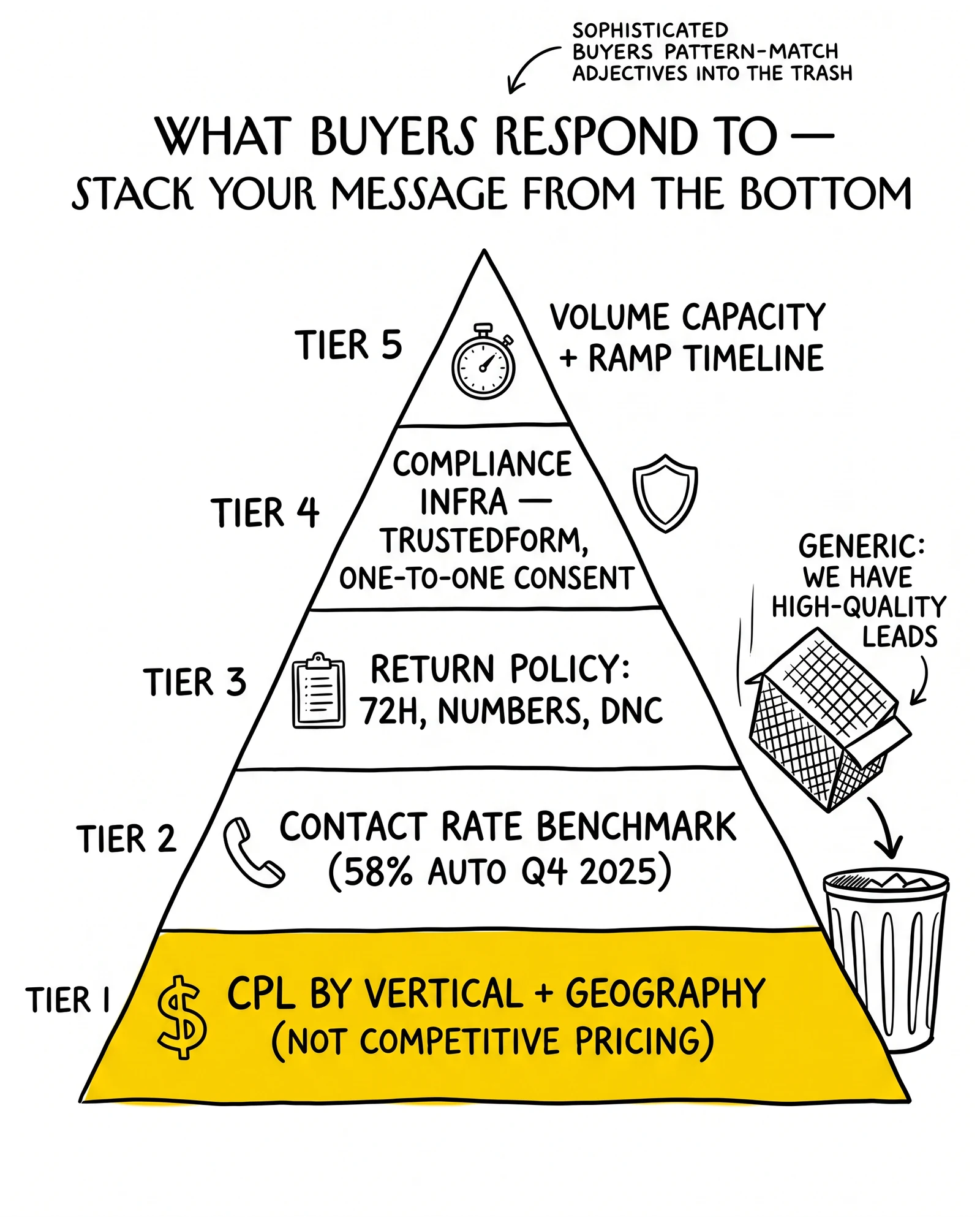
1. CPL by vertical and geography, not “competitive pricing” A buyer evaluating auto insurance leads in Georgia wants to know if the vendor delivers at $32-38/lead, not that pricing is “competitive.” Publishing ranges – even ranges that include worse-case scenarios – builds credibility and filters for budget-fit buyers before the conversation.
2. Contact rate benchmarks, with vertical-specific ranges Contact rates for insurance leads run 50-65% at established vendors. Publishing a specific number – “58% contact rate on auto leads in 2024” – tells the buyer exactly how to compare against their current vendor. A buyer whose current vendor delivers 51% contact rate on auto insurance leads immediately understands the relevance.
3. Return rate policy and process, not just the claim of fairness Return rate disputes are the largest operational friction in buyer-vendor relationships. Messaging that specifies the return window, the grounds for return, and the process (e.g., “returns accepted within 72 hours for wrong number, already-insured, and DNC conflicts”) removes a major objection before the conversation starts.
4. Compliance infrastructure, not just compliance claims Since the FCC’s 2025 one-to-one consent rule, every buyer has compliance exposure on purchased leads. Messaging that specifies “TrustedForm certified on all leads” or “TCPA consent captured at form submission with timestamped documentation” addresses the buyer’s compliance concern with specifics rather than assurances.
5. Volume capacity and ramp timeline Buyers switching vendors often have volume requirements that must be met within a specific timeframe. Messaging that addresses capacity – “currently delivering 3,000-5,000 auto insurance leads monthly in the southeast, capacity for additional buyers” – eliminates uncertainty about whether the vendor can actually serve them.
Objection-Forward Positioning
Lead buyers have bought bad leads before. They enter every vendor evaluation with defensive posture. Messaging that acknowledges this defensive posture outperforms messaging that ignores it.
Examples of objection-forward messaging:
“We know you’ve heard ‘high quality leads’ before. Here’s what we actually mean: 58% contact rate on auto in Q4 2025, 9.2% return rate, TrustedForm certified, shared up to 3x. Call us on any of those numbers.”
“Most agencies that call us have the same story: previous vendor’s quality declined after month three. Here’s how our quality metrics have moved over the past 12 months.” (Then show the data.)
This approach requires having defensible data. Vendors without it cannot use it. Vendors with it should lead with it, because sophisticated buyers use the presence or absence of real data as their first quality filter.
Timing and Trigger Events
Lead buyer acquisition benefits from targeting trigger events – moments when buyers are most likely to evaluate new vendors:
New hire in marketing/operations role: A new Director of Marketing at an insurance agency has mandate to evaluate all vendors in the first 90 days. LinkedIn’s intent filter for recent job changes surfaces these buyers. An InMail sent within the first two weeks of a new role – referencing the role transition – has 2-3x higher response rates than cold outreach to tenured contacts.
Compliance regulation changes: The FCC’s 2025 one-to-one consent rule triggered compliance audits at agencies throughout the insurance industry. Content addressing compliance infrastructure during regulatory change cycles reaches buyers at maximum awareness of the problem.
Vertical market events: Open enrollment periods for health insurance, storm seasons for property insurance and roofing, refinance rate windows for mortgage – buyers in these verticals scale up purchasing before and during peak periods. LinkedIn messaging timed to the 6-8 weeks before these peaks reaches buyers when they are actively evaluating volume increases.
Conversion Infrastructure for LinkedIn-Sourced Buyers
LinkedIn generates awareness and interest. Converting that interest to signed vendor agreements requires infrastructure that most lead generation vendors underinvest in.
The Vendor Landing Page Problem
Most lead generation vendors have consumer-facing websites optimized for lead capture from consumers, not for buyer conversion. A home services lead vendor’s website designed to capture homeowners requesting contractor quotes does not serve an HVAC company operations manager evaluating lead vendors.
Buyer-specific landing pages need different elements:
What belongs on a buyer landing page:
- Vertical and geography coverage map (specific states and metros, not “nationwide”)
- Volume delivery capacity (current monthly output, buyer capacity)
- Pricing ranges (specific ranges, not “contact for pricing”)
- Contact rate and return rate data (recent, specific, attributed to methodology)
- Compliance documentation approach (TrustedForm, one-to-one consent, TCPA coverage)
- Lead delivery method (API, email, portal, ping-post – with documentation)
- Payment terms (net-30, weekly, prepaid – buyers evaluate cash flow requirements)
- Pilot program terms (volume, duration, quality criteria, return process)
What buyer landing pages should not have:
- Consumer testimonials (“Great leads, I got an appointment the same day!”)
- Consumer-facing pricing (“Starting at $X per inquiry”)
- Generic “quality leads” claims without supporting data
- Contact forms with no indication of what happens after submission
The Pilot Offer as Conversion Mechanism
The most effective conversion mechanism for lead vendor acquisition is a structured pilot offer. The standard direct sales close – “Sign a three-month contract” – creates too much commitment from a buyer who has no quality data.
A structured pilot offer inverts the risk:
“We’ll deliver 100 leads in your vertical and geography over two weeks. You pay our standard CPL. If contact rate doesn’t hit X%, we’ll issue credit for the difference. After the pilot, we agree on volume and terms.”
This offer removes the primary buyer objection (they have been burned before) while creating a purchase event that begins the relationship. Buyers who complete pilots and achieve acceptable quality results typically convert to volume agreements – the buyer has already invested time in integration and review.
LinkedIn campaigns that promote the pilot offer specifically – not a generic “call us to discuss” – generate higher-quality leads because the pilot commitment self-selects for buyers who are serious about evaluating.
CRM Integration for LinkedIn Lead Routing
LinkedIn Lead Gen Forms can route directly to CRM via native integrations (Salesforce, HubSpot) or Zapier/Make connections. For lead vendor acquisition, routing speed matters – buyers who submit a form and receive no contact for 48 hours conclude the vendor’s operations are disorganized.
Build the routing infrastructure before running LinkedIn campaigns:
- Form submission routes to CRM with LinkedIn source tag
- Auto-response triggers within 5 minutes: “Thanks – our team will call within 2 hours with specifics on our [vertical] program. Here’s what to expect on the call…” (set expectations)
- Sales team assignment with specific buyer profile context (vertical, company size, state)
- Follow-up sequence if no sales team contact within 24 hours
The irony for lead generation vendors: they sell speed-to-lead as a quality differentiator to their buyers, and then fail to contact their own inbound leads quickly. The speed-to-lead standard that vendors sell applies equally to their own buyer acquisition.
Budget Allocation and Performance Benchmarks
LinkedIn buyer acquisition has different economics than consumer lead generation. Setting accurate expectations prevents budget commitment based on consumer marketing benchmarks.
Expected CPL for Buyer Acquisition
Acquiring a new lead buyer via LinkedIn typically costs $150-600 per conversion (form submission or direct response), depending on how “conversion” is defined:
| Conversion Definition | Typical LinkedIn CPL |
|---|---|
| Lead Gen Form submission | $80-200 |
| Pilot program inquiry | $150-350 |
| Completed discovery call | $200-500 |
| Signed pilot agreement | $400-900 |
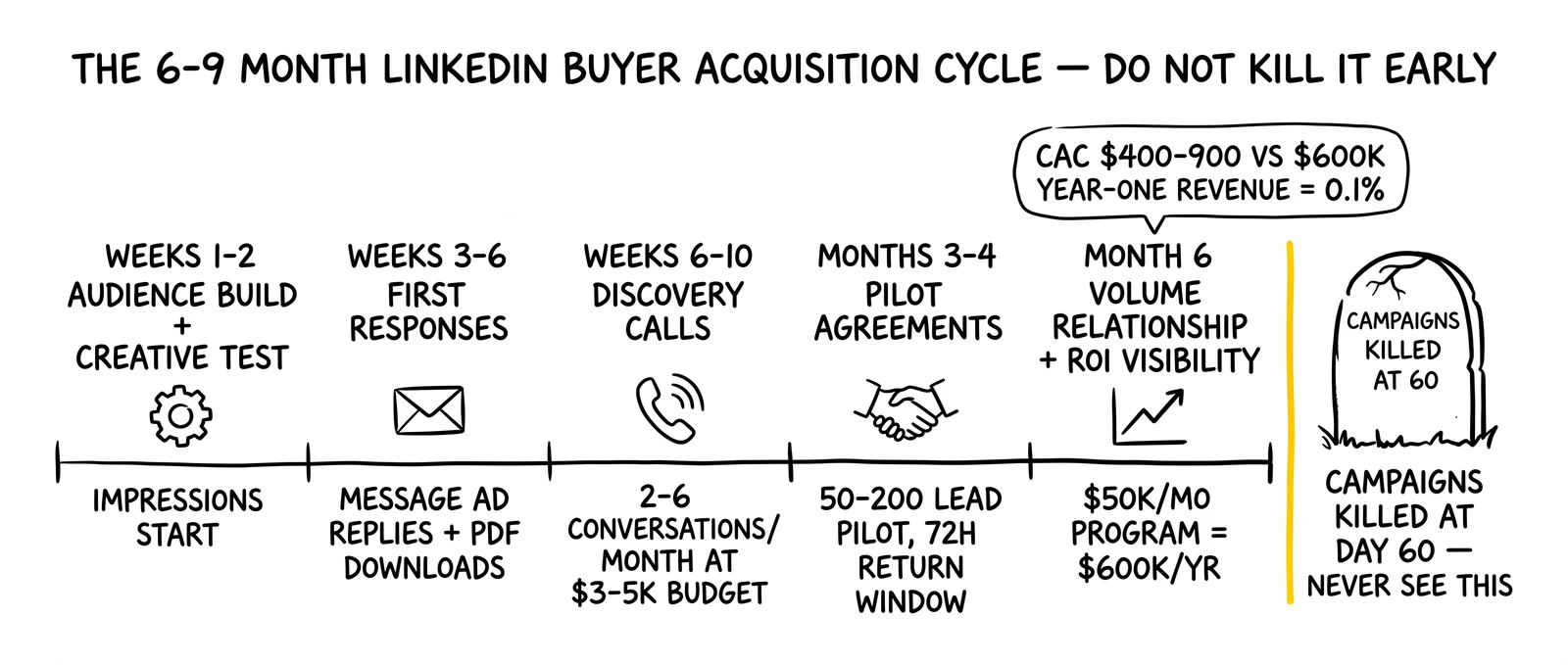
These CPLs look high compared to consumer lead generation. The context: a single buyer signing a $50K/month lead program agreement represents $600K/year in revenue. A $600 CPL to acquire that buyer is 0.1% of first-year revenue. The economics support significantly higher acquisition costs than consumer lead generation allows.
Minimum Budget for Meaningful Testing
LinkedIn’s minimum is $10 daily. Meaningful testing for lead vendor acquisition requires $3,000-5,000 monthly minimum – enough to generate 15-30 buyer contacts across Message Ads and Sponsored Content per month.
At this budget, expect:
- 2,000-4,000 monthly impressions on target audiences
- 8-20 ad clicks or form submissions
- 2-6 meaningful conversations with potential buyers
- 0-1 pilot agreements per month (depending on sales process efficiency)
Scale from this baseline based on what the conversations reveal about audience quality, not based on impression volume.
Timeline for First Results
Lead buyer acquisition via LinkedIn takes longer to show results than consumer lead generation:
- Weeks 1-2: Audience build, creative testing, first impressions
- Weeks 3-6: First responses from Message Ads and document downloads
- Weeks 6-10: First discovery calls from LinkedIn-sourced contacts
- Months 3-4: First pilot agreements attributable to LinkedIn sourcing
- Month 6: ROI visibility on early LinkedIn investments
The long timeline reflects the buyer evaluation cycle, not platform inefficiency. A buyer who clicks a LinkedIn ad in month one may not be ready to evaluate until month three. LinkedIn’s value is positioning the vendor in the buyer’s consideration set during this period.
Organic LinkedIn Strategy for Lead Vendors
Paid campaigns reach audiences. Organic content builds the credibility that makes paid campaigns more effective and generates inbound buyer interest independently.
Content That Reaches Lead Buyers
Lead buyers follow industry content – compliance updates, market conditions, benchmark data – even if they are not actively evaluating vendors. A lead vendor who consistently publishes industry-relevant content becomes a recognized name in the buyer’s awareness before any paid outreach.
Content that lead buyers engage with:
Compliance updates: FCC rule changes, state mini-TCPA developments, consent requirement evolution. Buyers care about compliance exposure. Vendors who interpret regulatory changes for the buyer audience establish expertise.
Market benchmark data: Contact rate benchmarks, CPL trends by vertical, return rate patterns. Buyers compare their performance against industry benchmarks constantly. Publishing this data – attributed to the vendor’s own lead program data – positions the company as a data-driven operation.
Operational case studies: How specific operational changes improved contact rates or reduced returns. These are more credible than testimonials because they describe mechanisms, not outcomes.
Vertical market intelligence: Rate environment impact on mortgage lead volume, open enrollment timing effects on health insurance lead quality, weather event impacts on property insurance and roofing demand. Buyers in these verticals value operational intelligence.
What does not work: Consumer-facing content (“Why solar is a great investment”) reaches consumers, not buyers. Promotional content announcing new programs before establishing credibility with the audience reads as advertising, not information. Award announcements (“We’re proud to have won…”) generate zero buyer engagement.
Company Page vs. Personal Profile
Lead vendor company pages serve as verification anchors – buyers who encounter a personal post or Message Ad check the company page for legitimacy. A well-maintained company page with posting history, employee headcount, and updated information is necessary infrastructure.
Personal profiles of founders and senior sales team members generate substantially more organic reach than company pages for the same content. The LinkedIn algorithm rewards personal content over branded content. For lead vendors with credible principals willing to post publicly, personal profile content reaches buyer audiences at no cost with organic distribution.
The practical approach: maintain the company page as a verification resource, invest personal content effort on 1-3 principals who have authentic industry perspective and are willing to post 3-5 times weekly.
Measuring Buyer Acquisition from LinkedIn
Standard LinkedIn metrics – impressions, CTR, CPL – do not capture what matters for vendor acquisition. The measurement framework must trace to revenue.
The Measurement Chain for Lead Vendor Acquisition
- Impression to engagement: How many target buyers are seeing and engaging with content
- Engagement to conversation: What percentage of engagements generate discovery calls
- Conversation to pilot: What percentage of discovery calls result in pilot agreements
- Pilot to volume: What percentage of pilots convert to ongoing volume relationships
- Volume to LTV: What is the lifetime value of a buyer acquired via LinkedIn
Without the full chain, optimization is impossible. An operation that tracks CPL but not pilot conversion rate cannot tell whether they are generating cheap contacts who never become buyers, or expensive contacts who reliably sign.
Attribution Challenges
LinkedIn attribution in CRM requires deliberate infrastructure. Lead Gen Form submissions include a LinkedIn source automatically if the form routes via the native integration. Message Ad responses require manual CRM entry or conversation tagging. Document downloads tracked via UTM parameters attribute to LinkedIn but lose the individual-level data unless combined with form capture.
The minimum viable attribution infrastructure:
- LinkedIn Insight Tag installed on all vendor website pages
- UTM parameters on all ad URLs:
utm_source=linkedin&utm_medium=paid&utm_campaign=[campaign-name] - LinkedIn as a distinct source in CRM, tracked through pilot stage and volume stage
- Quarterly review of LinkedIn-sourced buyer LTV versus other acquisition channels
Evaluating LinkedIn ROI for Vendor Acquisition
Allow 6-9 months before making definitive LinkedIn ROI assessments. The buyer evaluation cycle and pilot-to-volume timeline mean that first-month LinkedIn investments may not show revenue attribution until month six or seven. Premature evaluation – common in operations used to measuring consumer lead generation performance weekly – leads to correct campaigns being shut down before they produce results.
Leading indicators (weeks 1-8): engagement rate on content, Message Ad response rate, form completion rate, quality of discovery call conversations.
Lagging indicators (months 3-9): pilot conversion rate, pilot-to-volume conversion rate, LTV of LinkedIn-sourced buyers versus other channels.
Frequently Asked Questions
Is LinkedIn effective for selling leads to individual insurance agents versus agencies?
Individual agents (under 5 agents) are difficult to reach efficiently on LinkedIn because their profiles often do not reflect insurance industry affiliation specifically, and their decision-making processes differ from agencies. The economics also differ – individual agents typically buy 20-50 leads per week, while agencies buy 200-1,000+. LinkedIn campaigns targeting agency principals at companies 11-200 employees yield better return than campaigns targeting “insurance agents” broadly.
What content performs best for building lead buyer awareness on LinkedIn?
Data-driven content – benchmark reports, contact rate analyses, CPL trend data – outperforms opinion content for this audience. Lead buyers are analytical. Content that gives them numbers they can compare against their own operation generates engagement. Specific, attributed data (“auto insurance leads in Q4 2025, 3,200 leads, 61% contact rate”) outperforms claimed ranges (“typically 55-65%”).
How do you reach mortgage company buyers without targeting everyone in the financial services industry?
Layer targeting dimensions: Company industry (Mortgage, Financial Services) + Job Function (Marketing, Business Development, General Management) + Company Size (11-500 employees) + Seniority (Manager, Director, VP, C-level). This reduces the target audience from millions of financial services professionals to thousands of actual mortgage company marketing decision-makers. The narrower audience costs more per impression but generates fewer irrelevant contacts.
What is the realistic conversion rate from LinkedIn Message Ad to scheduled discovery call?
Well-targeted, well-written Message Ads to insurance and mortgage buyer audiences generate 8-15% response rates, with approximately 40-60% of responses converting to scheduled calls. This translates to 3-9% of Messages Ads converting to a scheduled call. At $0.80-1.20 per Message send, the cost per scheduled discovery call typically runs $90-400 depending on message quality and audience targeting precision.
How often should LinkedIn content be published to build meaningful lead buyer awareness?
Posting 3-5 times per week on a company page generates the minimum frequency for algorithmic reach. Personal profile posts from company principals 3-5 times weekly achieve substantially higher reach – personal content receives 5-10x the algorithmic distribution of company page content for the same content. A company posting 3x weekly plus two principals posting 3x weekly generates more buyer reach than the company posting daily alone.
Can LinkedIn lead buyer acquisition work for smaller lead vendors doing under $100K monthly revenue?
Yes, but the economics require careful management. At the $3,000-5,000 monthly LinkedIn budget that enables meaningful testing, a vendor at $100K monthly revenue is committing 3-5% of revenue to acquisition testing. This is manageable if the vendor has a realistic 6-9 month timeline expectation and tracks carefully from first contact to signed buyer. Small vendors often find Message Ads more efficient than Sponsored Content at their budget level – direct outreach to a precisely targeted list of 200-300 buyers generates more qualified conversations than broad awareness campaigns at the same budget.
Key Takeaways
LinkedIn buyer acquisition for lead generation vendors requires an inverted mental model from consumer lead generation. The audience is not consumers seeking products – it is the operations managers, agency owners, and marketing directors who purchase lead programs for their organizations.
The targeting precision that makes LinkedIn expensive for consumer campaigns is exactly what makes it efficient for buyer acquisition. Reaching 500 insurance agency owners at $250K monthly spend decisions is worth $1,000 in CPM. Reaching those same 500 people through any other channel requires either mass reach (expensive, inefficient) or manual prospecting (slow, not scalable).
Messaging that works for lead buyers leads with economic specifics: CPL by vertical, contact rate benchmarks, return rate policy, compliance infrastructure. Generic quality claims fail against buyers who have been burned by vendors making identical claims.
The pilot offer – structured, risk-limited, criteria-defined – converts buyer interest into revenue more reliably than direct contract sales. Buyers who complete pilots convert to volume relationships at high rates because they have already invested in integration and evaluation.
Attribution and patience are both required. LinkedIn buyer acquisition investments made in month one may not show revenue attribution until month six. Operations that shut down LinkedIn campaigns after 60 days have not given the buyer evaluation cycle time to complete.
Lead generation vendors who use LinkedIn to reach consumers they can convert into leads are using the right tool for the wrong job. The vendors who use it to reach the buyers who pay for those leads – and who approach that audience with the economic credibility those buyers require – find the platform delivers buyer acquisition at unit economics that justify the higher CPM.
Sources
- LinkedIn Marketing Solutions campaign benchmarks and targeting documentation
- FCC Telephone Consumer Protection Act rulemaking (one-to-one consent, April 2025)
- The Campaign Registry (TCR) A2P messaging documentation
- InsideSales.com / MIT Lead Response Management Study (speed-to-lead and conversion timing)
- LinkedIn Sales Navigator pricing and feature documentation (2025)