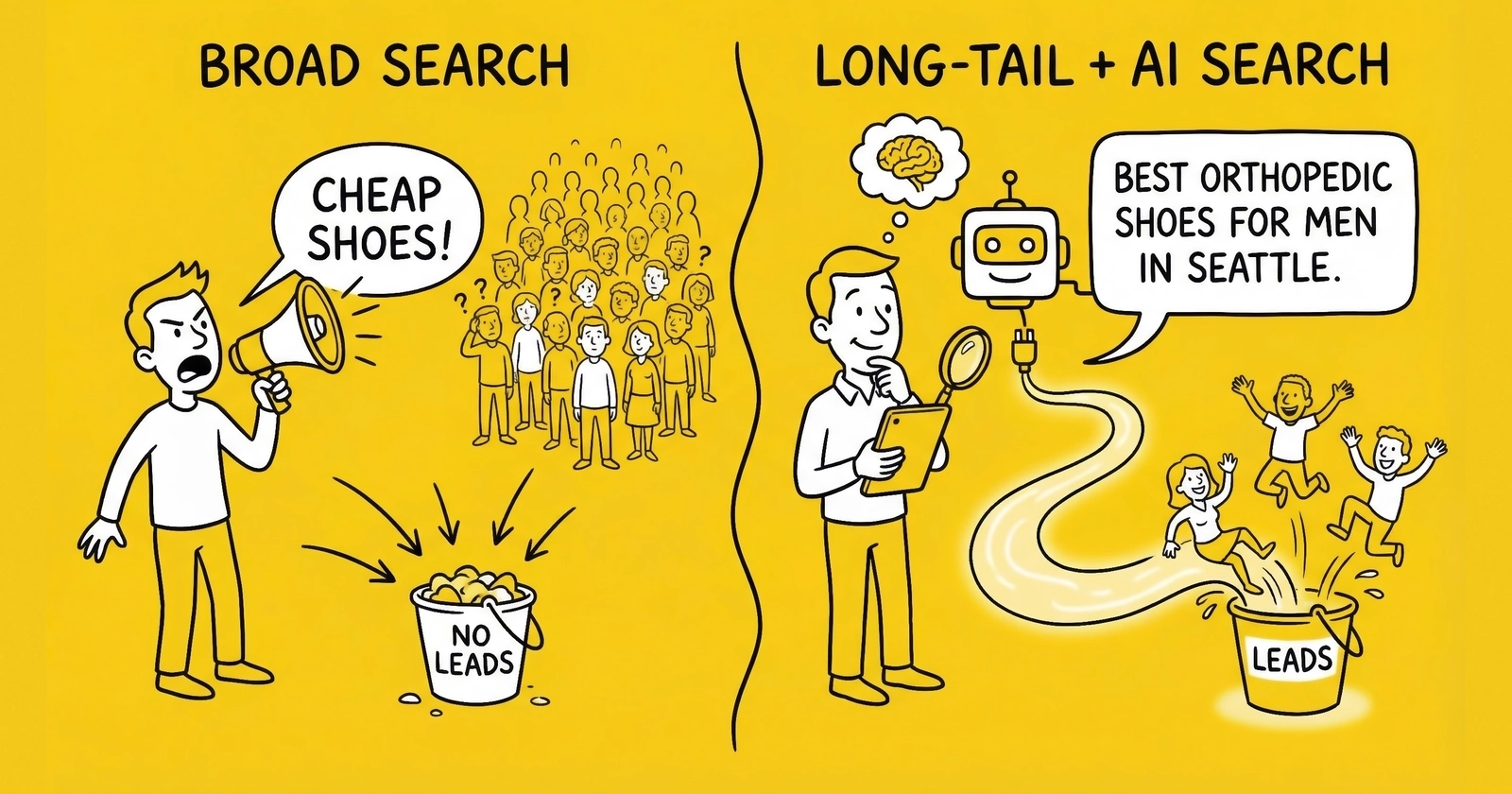
Approximately 70% of all Google searches are long-tail phrases. Voice queries run 20% longer than typed searches. AI systems favor specific, contextual queries over generic keywords. The traditional keyword hierarchy – head terms dominating competitive attention – no longer reflects market reality.
A lead generation company invests $50,000 quarterly targeting “mortgage leads.” The keyword has 12,000 monthly searches. Competition includes every major lead provider, aggregator, and platform vendor in the market. Cost per click exceeds $15. Rankings fluctuate monthly as competitors adjust their strategies.
A competing company invests the same $50,000 targeting phrases like “exclusive mortgage leads for credit unions,” “FHA purchase leads in Texas,” and “refinance leads with 700+ credit score.” Each keyword has 200-800 monthly searches. Competition is fragmented. Cost per click averages $4. Rankings stabilize because fewer competitors target these specifics.
The second company acquires more customers at lower cost. Their traffic converts at 2.5x the rate because users searching specific phrases are further along in their decision journey. They know exactly what they want.
This is the long-tail keyword advantage in 2026 – amplified by AI systems that understand and reward specificity. Understanding how the lead generation industry works helps contextualize why specific terminology matters so much in this market.
The Mathematics of Specificity
The traditional keyword hierarchy places short-tail terms at the top: “leads,” “insurance,” “mortgage.” These keywords have highest search volume and highest competition. Below sit medium-tail keywords: “mortgage leads,” “insurance leads,” “lead generation.” At the bottom sit long-tail keywords: “exclusive mortgage leads for independent loan officers,” “real-time auto insurance leads in California,” “Medicare Supplement leads during AEP.”
This hierarchy made sense when search engines matched keywords mechanically. Position one for a head term could generate significant traffic. Brands invested heavily in these terms.
But the hierarchy is increasingly broken for lead generation – and understanding why reveals the opportunity.
Why 70% of Searches Are Long-Tail
Research consistently shows that approximately 70% of all Google searches are long-tail phrases. This isn’t a new phenomenon, but its implications have intensified.
Consider how people actually search for lead generation services:
| Search Type | Example Query | User Intent |
|---|---|---|
| Head term | ”leads” | Vague, research phase |
| Medium-tail | ”insurance leads” | Category browsing |
| Long-tail | ”exclusive auto insurance leads for captive agents under $30 CPL” | Ready to buy |
The user searching “exclusive auto insurance leads for captive agents under $30 CPL” has:
- Identified the specific product (exclusive, not shared)
- Defined their business model (captive agents)
- Set a budget parameter (under $30 CPL)
- Reached decision stage
This user isn’t browsing. They’re ready to purchase. They know exactly what they need. They’ve moved past awareness, past consideration, into active shopping mode.
The user typing “insurance leads” might be:
- A student researching the industry
- A competitor analyzing the market
- Someone early in research
- A journalist writing about lead generation
Maybe 10% of these users will become customers. Maybe 1%.
The 2.5x Conversion Multiplier
Long-tail keywords generate 2.5x higher conversion rates than head-term targeting. This multiplier comes directly from intent matching.
For lead generation businesses, the math is compelling:
Head-term scenario:
- 10,000 monthly visitors from “mortgage leads”
- 1.5% conversion rate
- 150 new customers
- $15 average CPC = $150,000 annual spend
- $1,000 customer acquisition cost
Long-tail scenario:
- 4,000 monthly visitors from long-tail cluster
- 4% conversion rate
- 160 new customers
- $4 average CPC = $48,000 annual spend
- $300 customer acquisition cost
Same customer volume. 70% lower acquisition cost. The efficiency gain compounds: lower CPC, higher conversion, better customer quality.
The Volume Misconception
“But long-tail keywords have lower search volume.” True for individual keywords. False for aggregate strategy.
A comprehensive long-tail strategy doesn’t target one specific keyword. It targets clusters of related phrases:
Example cluster for a lead generation company:
- “exclusive auto insurance leads” (1,200 monthly)
- “real-time auto insurance leads” (800 monthly)
- “auto insurance leads for independent agents” (600 monthly)
- “auto insurance leads with warm transfer” (400 monthly)
- “auto insurance leads California” (500 monthly)
- “auto insurance leads under $25” (300 monthly)
- “high-intent auto insurance leads” (400 monthly)
Aggregate volume: 4,200 monthly searches across a coherent theme. Combined with 10-15 similar clusters across verticals and lead types, total addressable volume exceeds head-term targeting.
The difference: you’re capturing high-intent traffic across many specific variations rather than low-intent traffic from one generic term.
Long-Tail Keywords in AI-Powered Search
The shift toward AI-powered search amplifies long-tail keyword advantages. Language models specifically benefit from the characteristics that make long-tail keywords effective.
Why AI Systems Favor Specificity
Traditional search engines matched keywords. AI systems understand intent.
When a user asks ChatGPT “how do I find high-quality mortgage leads for my brokerage in Texas that include credit scores,” the language model needs to:
- Understand the user’s business context (mortgage brokerage)
- Identify geographic constraints (Texas)
- Recognize quality requirements (high-quality, credit scores)
- Match to authoritative sources
Content optimized for the head term “mortgage leads” provides none of this context. Content optimized for “mortgage leads for brokerages in Texas with credit score data” provides exactly the context the AI needs to generate a useful response.
Long-tail keywords inadvertently solve the intent-matching problem. Because they’re longer and more specific, they naturally include more context. They contain not just the core topic but modifiers that clarify intent:
- Business type: “for independent agents,” “for agencies,” “for captive agents”
- Geography: “in California,” “Texas-only,” “nationwide”
- Quality indicators: “exclusive,” “verified,” “real-time”
- Price sensitivity: “under $30,” “affordable,” “premium”
- Lead type: “warm transfer,” “data leads,” “live calls”
All this context happens to be exactly what AI systems need to understand and process queries effectively.
Voice Search and Conversational Queries
Voice search represents the culmination of the shift toward long-tail keywords. Multiple research findings converge:
- Voice queries are 20% longer than typed queries
- Voice searches are 3x more likely to include location
- 71% of voice queries use long-tail, question-based formats
- Voice users are significantly more likely to take immediate action
When a user speaks to Alexa, Siri, or Google Assistant, they don’t say “insurance leads.” They ask “Where can I find real-time auto insurance leads that include phone verification?”
For lead generation companies, voice search optimization means optimizing for these longer, conversational queries. The company ranking for “insurance leads” gets lost in a sea of competitors. The company ranking for “real-time auto insurance leads with phone verification” becomes the ideal answer to the specific question.
Featured Snippets and Direct Answers
AI systems increasingly provide direct answers rather than link lists. Google’s AI Overviews, ChatGPT responses, and Perplexity answers synthesize information from sources rather than directing users to click through.
Long-tail content earns these direct answers more effectively:
Generic content:
“Lead quality matters in lead generation. Better leads convert more.”
Long-tail optimized content:
“Auto insurance leads priced under $25 typically show 23% lower contact rates than leads priced $35-45. The cost savings rarely compensate for the conversion gap. For independent agents without dedicated call centers, mid-tier pricing ($30-40) optimizes for contact rate while maintaining sustainable CPL.”
The second version answers a specific question with specific data. It’s extractable. It’s citation-worthy. It addresses the exact query someone would phrase in conversational search.
Lead Generation Applications
Long-tail keyword strategy has specific implications for lead generation businesses across different market positions.
For Lead Generators
Lead generators creating content to attract buyers should target buyer-intent long-tail keywords:
Vertical-specific:
- “Medicare Supplement leads for final expense agents”
- “Solar leads for residential installers in Arizona”
- “Home improvement leads for kitchen remodelers”
Business model specific:
- “Exclusive leads vs shared leads comparison”
- “Real-time lead delivery via API integration”
- “Aged leads for new agent training”
Quality and compliance specific:
- “TCPA-compliant leads with documented consent”
- “TrustedForm certified leads explanation”
- “Leads with Jornaya verification”
Each keyword cluster addresses a specific buyer segment. The content answering these queries demonstrates expertise that generic content cannot. For comprehensive context, our guide on what lead generation actually is covers the fundamentals buyers need to understand.
For Lead Buyers
Lead buyers using content marketing should target consumer-intent long-tail keywords in their verticals:
Insurance example:
- “How much auto insurance do I need in California”
- “Best auto insurance for drivers with accidents”
- “Cheapest auto insurance for new drivers under 25”
These queries capture consumers at the moment they’re ready to request quotes – the exact moment lead generators want to capture them.
For Lead Technology Platforms
Platforms serving lead generators and buyers should target operational long-tail keywords:
Technical implementation:
- “How to integrate LeadsPedia with Salesforce”
- “TrustedForm certificate validation API”
- “Ping post lead distribution setup”
Comparison queries:
- “Boberdoo vs LeadsPedia comparison”
- “Best CRM for lead generation agencies”
- “Call tracking software for lead buyers”
These queries capture decision-makers evaluating solutions – high-value traffic that justifies significant content investment. For detailed analysis, see our lead distribution platforms comparison.
Implementing Long-Tail Strategy
Understanding the value of long-tail keywords requires structured execution.
Semantic Clustering Architecture
Rather than treating each long-tail keyword as an isolated opportunity, organize phrases into thematic clusters that reinforce each other’s authority.
Hub-and-spoke model for lead generation:
Hub page: “The Complete Guide to Auto Insurance Lead Generation”
- Comprehensive coverage of the topic
- Links to spoke pages for specific aspects
- Establishes topical authority
Spoke pages:
- “Exclusive vs Shared Auto Insurance Leads: Cost and Conversion Comparison”
- “Auto Insurance Leads for Independent Agents: What to Look For”
- “Real-Time Lead Delivery: API Integration Best Practices”
- “Auto Insurance Lead Pricing: What Determines CPL”
- “TCPA Compliance for Auto Insurance Lead Generators”
Each spoke targets a long-tail keyword cluster. Each spoke links to the hub. Users exploring specific interests find detailed spoke pages addressing their needs while discovering your broader authority.
From an AI perspective, this architecture demonstrates comprehensive knowledge. Language models encountering your content understand you’ve thought deeply about the topic across multiple dimensions.
Keyword Discovery Process
Sources for long-tail keyword discovery:
| Source | What It Reveals |
|---|---|
| Google “People Also Ask” | Questions users actually ask |
| Google Autocomplete | Query variations users type |
| Search Console | Queries driving impressions to your site |
| Competitor analysis | Keywords competitors rank for |
| Customer conversations | Language customers actually use |
| Industry forums | Questions practitioners discuss |
| Support tickets | Problems customers need solved |
Discovery should generate hundreds of opportunities. A comprehensive lead generation content strategy might identify 200-300 long-tail keyword variations across verticals, business models, compliance topics, and technical implementation.
Content Development Standards
Long-tail content requires higher quality than traditional keyword-optimized content. You’re not writing for a single keyword; you’re writing for a specific user need that multiple variations express.
Quality indicators:
- Specific data and examples
- Actionable recommendations
- Expert perspective and experience
- Citations to authoritative sources
- Regular updates with current information
Structure for AI extraction:
- Question-based headers matching search queries
- 40-60 word answer paragraphs opening each section
- Tables for comparisons and benchmarks
- Lists for steps and features
- FAQ sections addressing variations
Measurement Framework
Track metrics that reflect long-tail strategy effectiveness:
Traffic quality metrics:
- Conversion rate by keyword cluster
- Revenue per visitor by traffic source
- Time on site and engagement by query type
- Customer lifetime value by acquisition keyword
SEO performance metrics:
- Rankings for target long-tail keywords
- Featured snippet capture rate
- AI Overview inclusion frequency
- Citation frequency in AI responses
Efficiency metrics:
- Customer acquisition cost by keyword cluster
- Content ROI by topic area
- Paid media efficiency by keyword type
Long-Tail Keywords and LLMO Integration
Long-tail keyword strategy integrates directly with LLMO (Large Language Model Optimization) principles. For a comprehensive overview of these optimization approaches, see our LLMO guide for lead generation and GEO optimization strategies.
Content Structure Alignment
LLMO research shows AI systems favor specific content patterns:
- 80% of ChatGPT-cited articles include list sections
- Sequential H1-H2-H3 structure gets cited 3x more often
- 40-60 word answer capsules optimize for extraction
Long-tail content naturally incorporates these patterns. A page optimized for “how to evaluate mortgage lead quality” will likely include:
- Lists of quality indicators
- Clear heading hierarchy
- Direct answers to the specific question
The alignment isn’t coincidental. Long-tail optimization and LLMO optimization both require specificity and clarity.
Entity Architecture Support
LLMO emphasizes entity clarity – defining your business, products, and expertise precisely. Long-tail content supports entity definition by forcing specificity.
A page about “leads” provides no entity signals. A page about “exclusive Medicare Supplement leads for final expense agents during AEP” demonstrates:
- Vertical expertise (Medicare Supplement)
- Lead type knowledge (exclusive)
- Audience understanding (final expense agents)
- Timing awareness (AEP)
This specificity builds entity clarity that AI systems recognize.
Citation Probability
AI systems cite sources that answer specific questions. Long-tail optimized content addresses specific questions by design.
When a user asks ChatGPT “What’s the typical CPL for exclusive auto insurance leads in California,” the AI searches for sources addressing that specific query. Content optimized for “auto insurance leads CPL California exclusive” has higher citation probability than content optimized for “auto insurance leads.”
The more specific your content optimization, the more likely AI systems include you in responses to matching queries.
The Volume Aggregation Strategy
Individual long-tail keywords have lower volume than head terms. But aggregate long-tail strategy captures more total traffic.
Building Comprehensive Coverage
A lead generation company might target:
Vertical clusters (5 verticals × 20 keywords each = 100 keywords):
- Auto insurance (20 long-tail variations)
- Medicare (20 long-tail variations)
- Home services (20 long-tail variations)
- Legal (20 long-tail variations)
- Mortgage (20 long-tail variations)
Business model clusters (4 models × 15 keywords each = 60 keywords):
- Exclusive leads (15 variations)
- Shared leads (15 variations)
- Aged leads (15 variations)
- Live transfers (15 variations)
Compliance clusters (30 keywords):
- TCPA compliance (10 variations)
- State regulations (10 variations)
- Consent capture (10 variations)
Platform/technology clusters (30 keywords):
- CRM integration (10 variations)
- API implementation (10 variations)
- Lead tracking (10 variations)
Total: 220 long-tail keyword targets
Average monthly volume per keyword: 300 searches Aggregate monthly volume: 66,000 searches Average conversion rate: 4% Monthly conversions: 2,640
Compare to targeting “lead generation” (40,000 monthly searches, 1.5% conversion = 600 conversions).
The long-tail strategy delivers 4x more conversions while addressing more specific user needs.
Compounding Authority
Long-tail content clusters build authority that compounds over time. Each piece of content:
- Ranks for its target keywords
- Supports hub page authority
- Generates backlinks from specific queries
- Demonstrates expertise to AI systems
As the content library grows, topical authority strengthens. New content ranks faster because domain authority in the topic space is established. The efficiency gap between your long-tail strategy and competitors’ head-term strategy widens.
Key Takeaways
-
70% of all searches are long-tail phrases. The aggregate volume of long-tail targeting exceeds head-term volume despite lower individual keyword volumes.
-
Long-tail keywords generate 2.5x higher conversion rates because they capture users further along in their decision journey who know exactly what they want.
-
Voice search amplifies long-tail importance. Voice queries are 20% longer than typed searches and 3x more likely to include location specificity.
-
AI systems favor specific, contextual queries. Language models need context to generate accurate responses – long-tail keywords provide that context.
-
Semantic clustering maximizes efficiency. Hub-and-spoke architecture addresses multiple related keywords with comprehensive, authoritative resources.
-
Customer acquisition cost drops 60-70% when targeting long-tail versus head terms due to lower CPCs and higher conversion rates.
-
Long-tail customers have higher lifetime value because they’re further along in their purchase journey and less price-sensitive.
-
Long-tail strategy integrates with LLMO principles. The same content patterns that optimize for AI citation naturally emerge from long-tail optimization.
-
Aggregate long-tail volume exceeds head-term volume. A comprehensive strategy targeting 200+ long-tail variations captures more total traffic than single head-term focus.
-
Authority compounds over time. Each piece of long-tail content strengthens domain authority, making new content rank faster and earn citations more easily.
Frequently Asked Questions
What exactly is a long-tail keyword?
A long-tail keyword is a specific, multi-word search phrase that targets a narrow topic or intent. “Mortgage leads” is a head term. “Exclusive mortgage leads for credit unions in Texas” is a long-tail keyword. Long-tail keywords typically have lower individual search volume but higher conversion rates because they match specific user intent.
Should I abandon head-term keywords entirely?
No. The optimal strategy balances both. Head terms establish broad topical authority and attract early-stage research traffic. Long-tail keywords capture high-intent, high-conversion traffic. Most lead generation companies should weight resources more heavily toward long-tail targeting because ROI is typically 2-4x better.
How many long-tail keywords should I target?
A comprehensive strategy might target 150-300 long-tail keyword variations organized into thematic clusters. The specific number depends on your market scope (how many verticals, lead types, geographic areas you serve) and content creation capacity. Quality matters more than quantity.
Does optimizing for long-tail keywords hurt head-term rankings?
No – it often helps. Strong semantic clusters with comprehensive long-tail content build authority on the broader head term. You’re not sacrificing head-term potential; you’re building it through a more efficient pathway that also captures high-intent traffic.
How do long-tail keywords work with voice search?
Voice search overwhelmingly uses long-tail phrasing. When someone speaks to a voice assistant, they use complete sentences and questions: “Where can I find exclusive auto insurance leads for independent agents?” Optimizing for long-tail keywords inherently optimizes for voice search queries.
What’s the relationship between long-tail keywords and AI search?
AI systems favor specific, contextual content. Long-tail keywords force specificity by addressing narrow topics with detailed answers. Content optimized for long-tail phrases naturally includes the context AI systems need to understand intent and generate accurate responses. Long-tail optimization and LLMO optimization are complementary.
How do I find long-tail keywords for lead generation?
Use Google “People Also Ask,” Google Autocomplete, Search Console data (queries driving impressions), competitor analysis, customer conversations (language they use), industry forums, and support tickets. Each source reveals different long-tail variations worth targeting.
What content structure works best for long-tail keywords?
Use question-based headers matching search queries, 40-60 word answer paragraphs opening each section, tables for comparisons, lists for features and steps, and FAQ sections addressing variations. This structure optimizes for both user experience and AI extraction.
How long does it take to see results from long-tail strategy?
Initial rankings can appear within 2-4 weeks for low-competition long-tail keywords. Full semantic cluster authority typically develops over 3-6 months. The advantage compounds: as domain authority in your topic space grows, new content ranks faster.
How do I measure long-tail keyword ROI?
Track conversion rate by keyword cluster, customer acquisition cost by traffic source, revenue per visitor by query type, and customer lifetime value by acquisition keyword. Compare these metrics between long-tail and head-term traffic to quantify the efficiency advantage.
Can small lead generation companies compete on long-tail keywords?
Yes – this is where long-tail strategy provides greatest advantage. Large competitors dominate head terms through budget and domain authority. Long-tail keywords level the playing field because specificity and expertise matter more than budget. A small company with deep vertical expertise can outrank larger competitors for specific queries.
How do long-tail keywords affect paid search strategy?
Long-tail keywords typically have 50-75% lower CPCs than head terms due to reduced competition. Higher conversion rates compound the efficiency gain. Most lead generation companies should allocate significant paid budget to long-tail targeting, using head terms primarily for brand awareness and remarketing.
What’s the difference between long-tail keywords and semantic keywords?
Long-tail keywords are specific, multi-word phrases with clear intent. Semantic keywords are related terms that share meaning with your target keyword. A comprehensive strategy uses both: long-tail keywords as primary targets, semantic keywords as supporting content that demonstrates topical completeness to search engines and AI systems.
How often should long-tail content be updated?
Review and update long-tail content quarterly at minimum. Refresh data and statistics annually. Update immediately when regulations change (for compliance content) or market conditions shift. Add “last updated” dates to signal currency to users and search systems.
Can long-tail keywords work for highly competitive markets?
Yes – long-tail strategy is especially valuable in competitive markets. When head terms are expensive and dominated by well-funded competitors, long-tail keywords provide alternative paths to traffic. The specificity that defines long-tail keywords also creates natural competitive barriers based on expertise rather than budget.