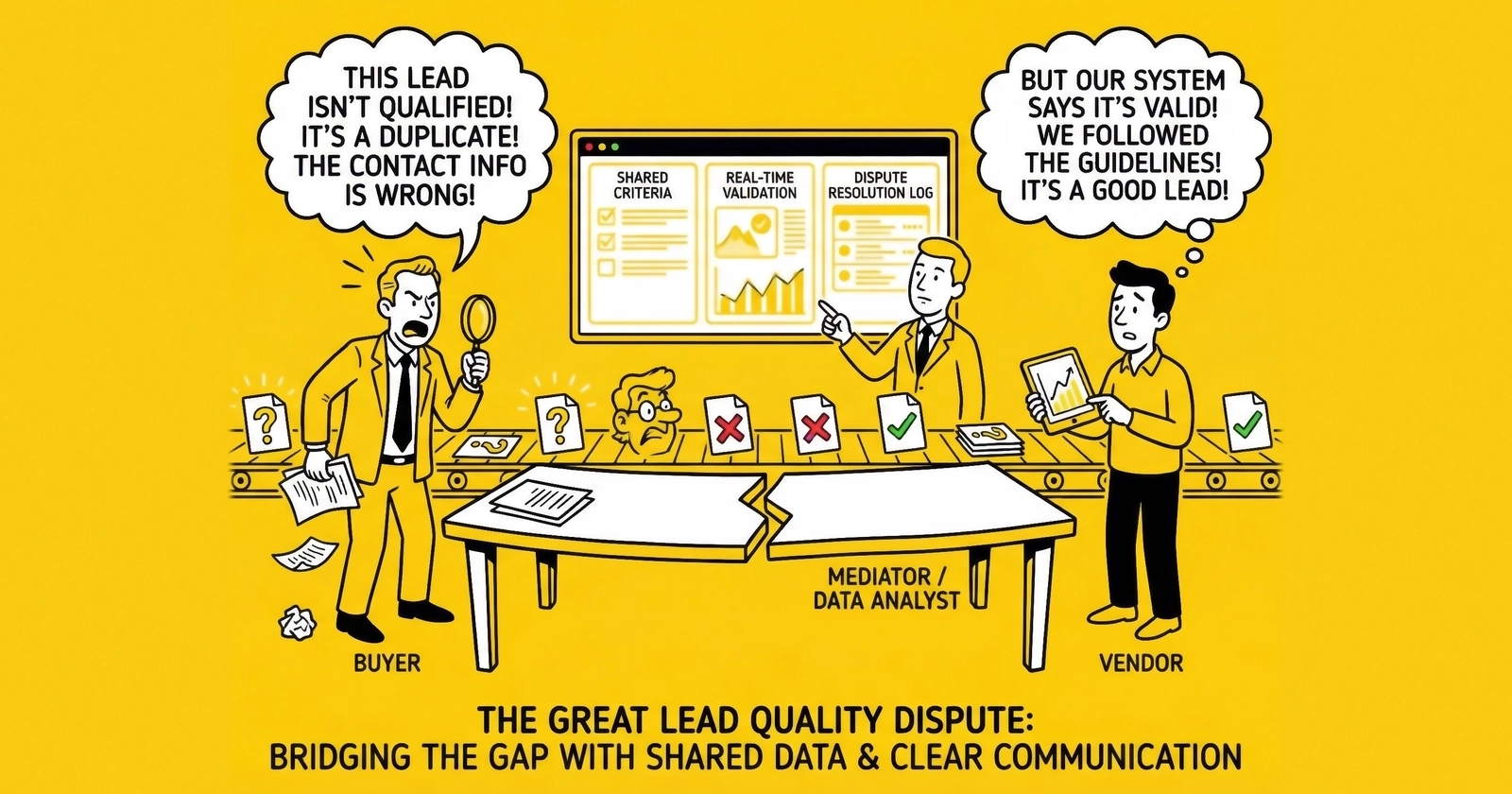
Lead quality disputes are the fracture points where profitable partnerships either strengthen or shatter.
Every operator who has spent more than six months in lead generation has faced the moment: a buyer calls to report that 40% of last week’s leads were invalid. Your supplier insists the leads met specifications. The data sits between you, generating friction where there should be revenue. How you navigate the next 48 hours determines whether you preserve both relationships or lose one – possibly both.
Most disputes are not actually about quality. They are about expectations, documentation, definitions, and communication. The leads themselves are often secondary to the real issues: ambiguous contracts, missing evidence, undefined terms, and broken feedback loops. Practitioners who master dispute resolution do not just win arguments. They build systems that prevent arguments from occurring in the first place.
This guide provides a comprehensive framework for managing lead quality disputes with vendors. We will cover the root causes of disputes, the evidence you need before any disagreement begins, the resolution process that protects relationships while defending legitimate positions, and the systems that minimize future conflicts. Whether you are a lead generator defending your inventory, a buyer protecting your investment, or a broker navigating both sides, these frameworks apply.
Understanding Why Lead Quality Disputes Occur
Disputes rarely emerge from a single bad lead. They accumulate from systemic issues that eventually reach a breaking point. Understanding the root causes helps you address problems before they become adversarial.
The Expectation Gap
The most common dispute trigger is not bad leads – it is misaligned expectations. Your supplier believes they are delivering exactly what was agreed. Your buyer believes they are receiving something materially different. Both may be telling the truth based on their interpretation of vague contract language.
Consider a common scenario. The contract specifies “verified homeowner leads for solar installation.” The supplier interprets “verified” as format validation – the lead passed syntax checks and the phone number connects. The buyer interprets “verified” as property verification – someone confirmed the consumer actually owns the property. Both definitions are defensible. Neither was specified clearly. The dispute becomes inevitable the moment delivery begins.
Expectation gaps form around several common ambiguities:
Quality Definitions. What makes a lead “valid” or “qualified”? Does a working phone number constitute validity, or must the consumer also demonstrate genuine purchase intent? Your definition and your partner’s definition may differ substantially.
Validation Standards. What verification occurred before delivery? Phone number format validation differs dramatically from real-time carrier lookup and line-type detection. “Validated email” might mean syntax checking or SMTP verification or deliverability testing.
Return Eligibility. Which specific scenarios justify returns? A consumer who does not answer after three attempts may be a valid lead having a busy week or may represent a fundamentally uncontactable submission.
Measurement Windows. How long does a buyer have to evaluate leads? How is duplicate detection window defined – from submission time, delivery time, or first contact attempt?
Documentation Failures
The second major dispute driver is insufficient evidence. When disagreements arise, the party with documentation wins. The party without documentation either concedes or escalates into relationship-damaging conflict.
Documentation failures manifest in several ways:
Missing Consent Evidence. Without TrustedForm certificates, Jornaya tokens, or equivalent consent documentation, you cannot prove a consumer actually submitted a request. Their claim that they “never filled out any form” becomes impossible to refute.
Absent Validation Records. If you validated phone numbers before delivery but did not log the results, you cannot prove the number was valid at time of sale. The buyer’s HLR lookup showing “disconnected” becomes the only evidence in play.
Incomplete Delivery Logs. Without timestamps, delivery confirmations, and accepted response codes, disputes about whether leads were actually delivered – and when – become unresolvable.
Lost Source Attribution. If you cannot trace a disputed lead back to its originating source, you cannot pursue chargebacks upstream or identify systematic quality issues.
The lead generation industry runs on data. Those who capture and retain comprehensive data resolve disputes quickly. Those who do not find themselves in “he said, she said” conflicts that damage relationships regardless of outcome.
Definition Drift
Relationships that start with clear agreements often drift over time. What was explicitly defined at contract signing becomes assumed knowledge that never gets recommunicated when team members change, systems update, or market conditions shift.
A buyer might tighten their acceptance criteria without formal notification, then begin returning leads that would have been accepted six months earlier. A supplier might shift traffic sources from search to social, materially changing lead characteristics without updating the buyer. Neither party intends to violate the agreement. Both parties end up in conflict because the working relationship drifted from the documented relationship.
Definition drift accelerates during:
- Staff turnover (new team members inherit undocumented assumptions)
- System migrations (technical changes alter actual behavior without contract updates)
- Volume scaling (processes that worked at 100 leads per day break at 1,000)
- Market stress (rising CPAs or declining conversion rates create pressure to cut corners)
Regular relationship reviews – quarterly at minimum for significant partners – catch definition drift before it generates disputes.
Building Your Dispute Prevention Infrastructure
The most effective dispute management happens before any dispute occurs. Building proper infrastructure eliminates the majority of potential conflicts and positions you to resolve those that remain.
Contract Clarity: The Foundation
Your Insertion Order (IO) or service agreement should eliminate interpretation ambiguity for every element that commonly generates disputes.
Lead Definition Specifications. Document exactly what constitutes a billable lead:
A billable lead must include:
- Phone number: 10-digit US format, validated via [specified service],
  line type confirmed as landline or mobile (VoIP excluded unless
  specifically approved)
- Email address: syntax validated, domain MX records confirmed,
  deliverability verified via SMTP check
- Physical address: CASS-certified, geocoded to provided coordinates
- Consent: TrustedForm certificate with minimum 30-day retention,
  capturing prior express written consent for contact by specified buyers
- Submission timestamp: within 15 minutes of delivery for real-time leads
Vague language like “quality leads” or “verified contact information” invites disputes. Precise specifications prevent them.
Return Policy Terms. Specify every element of the return process:
- Time window: hours from delivery timestamp
- Valid return reasons: exhaustive list with specific criteria
- Invalid return reasons: explicit exclusions
- Documentation requirements: what evidence must accompany returns
- Dispute process: escalation path and timeline for contested returns
- Return caps: maximum percentage before policy review triggers
Pricing and Payment. Document:
- Base pricing per lead or per tier
- Volume adjustments: discounts for commitments, premiums for on-demand
- Quality adjustments: bonuses for exceeding metrics, deductions for shortfalls
- Payment terms: due dates, methods, late payment consequences
- Credit limits: maximum outstanding balance before delivery pause
Consent Documentation Systems
Consent evidence is your primary defense against the most damaging dispute category: TCPA-related claims that a consumer never authorized contact.
Implement comprehensive consent capture including:
TrustedForm Certificates. Capture a certificate for every lead that records the consumer’s session, including form display, consent language visibility, and submission action. Retain certificates for a minimum of five years – litigation can surface long after the lead was generated.
Jornaya LeadiD. Track consumer journey across publishers to identify duplicate consent issues and provide additional verification that the consumer interacted with your form.
Session Replay. Record the consumer’s page interaction to demonstrate they saw and engaged with consent language before submitting.
Timestamp and IP Logging. Capture submission timestamp in UTC, consumer IP address, and user agent for every lead. These become critical when disputes involve questions of when and how submission occurred.
Consent Language Version Control. Maintain records of every consent language version deployed, with effective dates. When disputes arise about what the consumer agreed to, you need to prove exactly what language was displayed on the date of their submission.
Validation Documentation
Every validation step you perform should generate auditable records:
Phone Validation Logs. Record the validation service used, timestamp, result code, line type detected, carrier identified, and whether the number appeared on DNC registries.
Email Validation Logs. Record syntax check result, domain verification, SMTP response, and any disposition (deliverable, catch-all, disposable, etc.).
Address Validation Logs. Record CASS certification result, geocoding output, and any property data appended.
Fraud Detection Logs. Record IP analysis results, device fingerprint, behavior scoring, and any fraud indicators identified.
When a buyer returns a lead claiming invalid phone number, your validation log from delivery time becomes the evidence that shifts burden of proof. “Our HLR lookup at 14:32:07 UTC showed line type: mobile, carrier: Verizon, status: active” is far more powerful than “we validate all our leads.”
Source Tracking Infrastructure
Every lead you deliver should trace back to its originating source through complete attribution chain:
- Traffic source (campaign, ad group, keyword for paid; page URL for organic)
- Publisher or affiliate ID if sourcing from partners
- Landing page version
- Form version and consent language version
- All validation results
- Delivery timestamp and buyer response
This attribution enables:
Upstream Chargebacks. When you issue a credit to a buyer, source tracking lets you pursue equivalent credits from your suppliers.
Pattern Recognition. If one source generates 40% of your disputes despite representing only 15% of volume, you have a source problem, not a quality problem.
Performance-Based Pricing. Pay sources based on net sellable leads after returns, not gross submissions.
The Dispute Resolution Process
Despite best prevention efforts, disputes will occur. A structured resolution process protects relationships while defending legitimate positions.
Immediate Response Protocol
When a dispute arrives – whether a return request, quality complaint, or volume claim – respond within hours, not days. Speed demonstrates professionalism and prevents escalation.
Step 1: Acknowledge Receipt (Within 4 Hours). Confirm you received the dispute and provide timeline for review. “We received your return request for 47 leads. Our team will review the submission and respond with our assessment within 24 hours.” Acknowledgment alone defuses significant tension.
Step 2: Gather Evidence (Within 24 Hours). Before forming any position, collect all available documentation:
- Original lead data as delivered
- Consent certificates for disputed leads
- Validation logs from time of delivery
- Delivery confirmation and buyer response codes
- Source attribution for each lead
- Buyer’s stated reason and any documentation provided
Step 3: Analyze Patterns (Within 24 Hours). Do the disputes cluster around specific sources? Time periods? Lead characteristics? Pattern analysis often reveals root causes that individual lead review misses.
Evidence-Based Evaluation
Evaluate each disputed lead against your documented criteria and available evidence.
For Contact Failure Returns:
Compare your validation timestamp against the buyer’s contact attempt. If your HLR lookup showed the number active at 14:00 and the buyer attempted contact at 14:05, the five-minute gap makes buyer error unlikely – but number reassignment or carrier issues remain possible. If the buyer attempted contact 48 hours later, the gap creates uncertainty about when the number became invalid.
Request buyer documentation: call log timestamps, recording snippets demonstrating disconnect tones, carrier lookup results. Legitimate contact failure claims typically have supporting evidence.
For Qualification Mismatch Returns:
Review the original submission data against stated criteria. If the buyer specified “homeowners only” and your lead indicated “renter,” you have a validation failure to address. If the lead indicated “homeowner” but the buyer discovered otherwise during contact, the dispute requires determining whether the consumer misrepresented themselves or your verification failed.
For Duplicate Returns:
Request buyer documentation showing when they previously received the lead and from what source. If the duplicate predates your relationship, the lead may be valid under your agreement even if duplicate in their system. If the duplicate came from you within your agreed window, the return is valid.
For Fraud/Consent Returns:
Pull consent certificates immediately. If the certificate shows valid session recording with consent language displayed and submission captured, present that evidence. If the certificate is missing or invalid, you likely need to accept the return.
The Resolution Matrix
Based on evidence evaluation, each disputed lead falls into one of four categories:
| Situation | Evidence Position | Recommended Action |
|---|---|---|
| Buyer correct, your error | Buyer has documentation, yours contradicts or is absent | Accept return, investigate root cause |
| Buyer correct, source error | Buyer has documentation, your validation was accurate at delivery | Accept return, chargeback upstream |
| Buyer incorrect, your documentation strong | Your evidence contradicts buyer claim | Dispute with evidence, offer review call |
| Insufficient evidence either side | Neither party has conclusive documentation | Negotiate split or goodwill credit |
The worst outcome is extended conflict without resolution. When evidence is ambiguous, propose a resolution that preserves the relationship: 50/50 split, goodwill credit for partial amount, or credit this instance in exchange for clearer documentation requirements going forward.
Communication Best Practices
How you communicate during disputes shapes relationship outcomes as much as the resolution itself.
Lead With Data. “Our validation log shows phone verification at 14:32 UTC with result: active, carrier: T-Mobile, line type: mobile” is factual. “We definitely validated that number” is argumentative. Data reduces emotion and accelerates resolution.
Acknowledge Valid Points. If the buyer is correct about some leads, acknowledge immediately. “You’re right about leads 17, 23, and 31 – our validation missed those. We’re crediting those now. Let’s discuss the remaining 44 where our documentation differs from your claim.”
Propose Solutions, Not Positions. “We should split the credit 50/50” is a position. “Since neither of us has conclusive documentation on these 12 leads, I propose we split the credit and implement additional validation to prevent recurrence. Would that work for you?” is a solution.
Escalate Appropriately. If front-line resolution fails, escalate to relationship management or leadership. But escalate with documentation, not complaints. “We’ve exchanged evidence on this dispute three times without resolution. I’m bringing this to [leadership contact] with our full documentation and proposed resolution for their review.”
Return Rate Benchmarks and Warning Signs
Understanding normal return rates helps distinguish legitimate quality issues from buyer overreach or operational problems.
Industry Benchmarks by Vertical
Return rates vary significantly across verticals based on qualification complexity, validation capability, and buyer expectations:
| Vertical | Target Rate | Acceptable Rate | Warning Threshold |
|---|---|---|---|
| Auto Insurance | 6-8% | 10-12% | >15% |
| Medicare | 10-12% | 14-16% | >18% |
| Mortgage | 8-10% | 12-14% | >16% |
| Solar | 12-15% | 18-20% | >22% |
| Legal | 4-6% | 8-10% | >12% |
| Home Services | 10-12% | 14-16% | >18% |
Rates significantly below target may indicate overly lenient return policies, insufficient buyer contact effort, or lead flow too small for statistical significance. Rates above warning thresholds demand immediate investigation and intervention.
Warning Signs Requiring Immediate Action
Certain patterns indicate systematic problems requiring immediate response:
Sudden Spikes. Return rate jumps from 10% to 25% week-over-week without buyer volume or criteria changes. This typically indicates traffic source problems, validation system failures, or coordinated fraud.
Buyer-Specific Concentration. One buyer generates 60% of returns despite receiving only 20% of volume. Either their criteria changed without notification, their contact processes degraded, or they are gaming return policies.
Source-Specific Concentration. One source generates 35% of returns despite representing 15% of volume. That source requires immediate pause and investigation.
New Return Reason Emergence. Sudden appearance of return reasons not previously seen (e.g., “consumer claims they never submitted”) may indicate fraud infiltration or consent capture failures.
Time-Clustered Returns. Returns concentrate around specific dates or times may indicate batch processing problems, time-zone errors, or coordinated buyer behavior.
Chargeback Management with Upstream Suppliers
When you accept returns from buyers, you need parallel processes for pursuing credits from your sources. Without upstream chargeback capability, you absorb quality costs that should flow to responsible parties.
Contractual Requirements
Your supplier agreements should include:
Chargeback Rights. Explicit right to return leads that fail quality standards, with defined window and reasons.
Evidence Requirements. What documentation you must provide to support chargebacks (buyer return reason, your validation logs, consent certificate issues).
Processing Timeline. Maximum time from your request to credit issuance.
Dispute Process. How contested chargebacks are resolved.
Caps and Limits. Any thresholds above which additional scrutiny or policy review applies.
Chargeback Processing Protocol
When accepting a return from a buyer:
- Log return with complete documentation
- Identify source for the returned lead
- Prepare chargeback request with supporting evidence
- Submit to source within their chargeback window
- Track chargeback status and follow up on outstanding items
- Reconcile credits against buyer credits issued
Maintain accounting that tracks the delta between buyer credits issued and source chargebacks collected. Sustained negative delta indicates either loose return policies, sources that successfully dispute chargebacks, or gaps in your chargeback process.
When Suppliers Dispute Chargebacks
Suppliers may reject your chargeback requests. Handle these disputes using the same framework you apply to buyer disputes:
Evaluate Their Evidence. If the supplier provides validation documentation showing the lead was valid at delivery to you, the issue may have occurred in your processing or the buyer’s contact process.
Check Your Documentation. Review your validation logs. If you re-validated on receipt and found issues your supplier missed, that documentation supports your chargeback.
Pattern Analysis. Does this supplier dispute every chargeback regardless of merit? That is a relationship problem requiring escalation or termination. Do they dispute selectively based on documentation quality? That is a process problem you can address.
Building Dispute-Resistant Partnerships
Long-term partnerships with minimal disputes share common characteristics. Building these elements into your relationships reduces conflict while improving performance for both parties.
Shared Success Metrics
The strongest partnerships align incentives around shared metrics rather than adversarial positions.
Instead of: “I deliver leads, you pay me, disputes are your problem”
Build toward: “We both succeed when leads convert. Let’s share data to optimize toward conversion.”
Shared metrics might include:
- Conversion rate tracking with regular reporting
- Contact rate visibility across both systems
- Cost-per-acquisition benchmarking against market
- Lifetime value analysis for leads by source
When both parties optimize for the same outcomes, disputes shift from adversarial claims to collaborative problem-solving.
Regular Relationship Reviews
Scheduled reviews prevent the relationship drift that generates disputes:
Weekly Operational Check-Ins. Brief discussions of volume, quality metrics, and any emerging issues. Handle small problems before they compound.
Monthly Performance Reviews. Deeper analysis of metrics, return patterns, and optimization opportunities. Recalibrate expectations based on recent performance.
Quarterly Strategic Reviews. Assess overall relationship health, discuss upcoming changes (criteria, volume, pricing), and address any accumulated friction.
Document review outcomes. Written summaries create shared understanding and prevent future “I thought we agreed” disputes.
Transparent Data Sharing
Disputes thrive in information asymmetry. Transparency eliminates asymmetry.
Share Performance Data. Provide buyers with contact rates, conversion rates, and other metrics that help them evaluate your leads fairly.
Accept Feedback Loops. Request disposition data from buyers showing what happened to your leads. This data improves your quality and demonstrates collaborative intent.
Disclose Issues Proactively. If you identify a quality issue, tell partners before they discover it. “We identified a source sending elevated invalid numbers this week and have paused them. Leads from that source are flagged for your return review.” Proactive disclosure builds trust. Concealment destroys it.
Technology Systems for Dispute Management
Manual dispute management breaks down at scale. Technology systems that automate evidence collection, return processing, and pattern analysis are essential for operations handling significant volume.
Essential Platform Capabilities
Your lead distribution platform should provide:
Automated Return Processing. Buyers submit returns through portal with reason codes. System validates against policy (within window, acceptable reason, proper documentation) and routes for review or auto-acceptance.
Evidence Repository. Searchable database linking every lead to its consent certificate, validation logs, source attribution, and delivery confirmation.
Dispute Workflow. Tracking for disputed returns with status progression (submitted, under review, evidence requested, resolved), escalation triggers for stale items, and audit trail.
Analytics Dashboard. Real-time visibility into return rates by buyer, source, reason, and time period with alerting for anomalies.
Chargeback Management. Parallel tracking for upstream chargebacks with source linking, status monitoring, and reconciliation against buyer credits.
Major lead distribution platforms (boberdoo, LeadsPedia, Phonexa, etc.) provide most of these capabilities. Evaluate your current platform against these requirements and address gaps through configuration, integration, or platform migration.
Integration Requirements
Effective dispute management requires integration with:
Consent Verification Services. TrustedForm and Jornaya APIs for certificate retrieval and validation.
Phone Validation Services. HLR lookup for phone status verification at time of dispute.
CRM/Buyer Systems. Where possible, integrate disposition feedback for proactive quality monitoring.
Accounting Systems. Return credits and chargebacks must flow to financial reporting accurately.
Frequently Asked Questions
What is the most common cause of lead quality disputes?
Misaligned expectations cause more disputes than actual quality problems. Vague contract language allows different interpretations of terms like “valid,” “verified,” or “qualified.” For example, one party may interpret “verified phone number” as syntax validation while another expects real-time carrier lookup. The solution is granular specification in your contracts: define exactly what validation occurs, what criteria leads must meet, and what evidence accompanies delivery. Practitioners who invest time in precise contract language prevent the majority of disputes before they begin.
What documentation do I need to win a lead quality dispute?
Essential documentation includes consent certificates (TrustedForm or equivalent) with session replay capability, phone validation logs showing status at time of delivery, email verification results with SMTP response codes, complete source attribution tracing each lead to its origin, and delivery confirmation with buyer acceptance response. The party with comprehensive documentation typically prevails in disputes. Without this evidence, you are left arguing interpretations rather than presenting facts, which rarely ends favorably. Build documentation capture into your infrastructure from day one rather than attempting to reconstruct it during active disputes.
How quickly should I respond to a lead quality dispute?
Acknowledge receipt within four hours to prevent escalation and demonstrate professionalism. Provide initial assessment within 24 hours after gathering available evidence. Resolve straightforward cases within 48 hours when documentation clearly supports one position. Complex cases requiring additional evidence gathering may take 72 hours to one week, but should include regular status updates to the disputing party. Speed of acknowledgment and thoroughness of investigation are both essential – rushing to judgment creates new problems while delayed responses erode trust.
When should I accept a return versus dispute it?
Accept returns when buyer documentation supports their claim and your documentation does not contradict it. Dispute returns when your evidence shows the lead met specifications at delivery. When evidence is ambiguous with neither party holding conclusive documentation, negotiate a fair resolution that preserves the relationship rather than escalating to prolonged conflict. Consider offering a 50/50 split on genuinely ambiguous cases. The cost of extended disputes often exceeds the value of the leads in question, and damaged relationships have long-term revenue implications beyond the immediate dispute.
What is considered an acceptable return rate in lead generation?
Acceptable return rates vary significantly by vertical. For auto insurance, target 6-8% with concern thresholds above 15%. For Medicare leads, target 10-12% with concern above 18%. Solar leads typically run higher, targeting 12-15% with concern above 22%. Legal leads run lower, targeting 4-6% with concern above 12%. Any sudden spike of 50% or more above your baseline warrants immediate investigation regardless of absolute level. Sustained elevation over two to three weeks requires intervention including source analysis, validation review, and potentially partner communication to identify root causes.
How do I handle disputes about phone numbers that validated successfully but failed when the buyer contacted?
This common scenario requires comparing timestamps carefully. If your validation occurred within minutes of delivery and the buyer’s contact attempt occurred days later, carrier issues or number reassignment may explain the discrepancy – and the lead may have been valid when you delivered it. If the gap between validation and contact is small, investigate whether your validation method is adequate or if the buyer’s contact methodology has issues. Request buyer documentation showing call log timestamps, disconnect tone recordings, and their carrier lookup results to assess the situation fairly and determine where responsibility lies.
How do I pursue chargebacks with upstream suppliers when I accept returns from buyers?
Your supplier agreement should specify chargeback rights, evidence requirements, processing windows, and dispute procedures before you begin the relationship. When accepting buyer returns, immediately prepare parallel chargeback requests with supporting documentation including the buyer’s return reason, your validation logs, and any consent certificate issues. Submit to your source within their chargeback window, track status separately from buyer credits, and reconcile the delta monthly. Sustained negative delta between buyer credits issued and source chargebacks collected indicates loose return policies, successful supplier disputes, or gaps in your chargeback process that need addressing.
What should I do when a buyer claims leads are low quality but refuses to provide specific evidence?
Request specific lead IDs, return reasons, and supporting documentation for each claim. General complaints without specifics cannot be evaluated – you need to know which leads allegedly failed and why. If the buyer cannot or will not provide specifics, the claim may be invalid from a contractual standpoint. However, the relationship may still require attention. Vague quality complaints often signal underlying dissatisfaction that predicts churn, whether from sales process problems on their end, changing internal criteria they have not communicated, or general relationship friction that needs addressing through regular review meetings.
How do I handle disputes with a buyer who represents a significant portion of my revenue?
Major buyers deserve attentive service but not capitulation on every claim. Maintain documentation standards and evidence-based evaluation regardless of buyer size. Consider offering goodwill gestures on genuinely ambiguous cases while holding firm on claims that your documentation clearly refutes. A buyer who learns they can extract credits through volume pressure will continue and escalate that behavior. The best approach combines respectful but firm dispute resolution with regular relationship reviews that address concerns before they become disputes – prevention serves both parties better than reactive credit negotiations.
How long should I retain dispute records after resolution?
Retain dispute documentation indefinitely for pattern analysis, compliance defense, and relationship history. A dispute resolved three years ago may become relevant in litigation, when evaluating whether to re-engage a former partner, or when a buyer or supplier exhibits similar patterns in a new relationship. Dispute records also enable trend analysis that reveals systematic issues – a source that generated disputes two years ago may be exhibiting the same patterns under a different name or through a different channel. Storage costs are minimal compared to the value of comprehensive historical records.
Key Takeaways
Prevention Beats Resolution. Clear contracts, comprehensive documentation, and aligned expectations prevent more disputes than any resolution process resolves. Invest heavily in prevention infrastructure.
Documentation Determines Outcomes. In any dispute, the party with evidence prevails. Capture consent certificates, validation logs, delivery confirmations, and source attribution for every lead. Retain this documentation for years, not months.
Respond Quickly, Evaluate Thoroughly. Acknowledge disputes within hours to prevent escalation. But take adequate time to gather evidence and analyze patterns before forming positions. Speed of acknowledgment and thoroughness of investigation are both essential.
Distinguish Causes From Symptoms. A buyer complaining about quality may have received genuinely bad leads, may have changed their criteria without notification, may be experiencing internal operational issues they are externalizing, or may be gaming return policies. Root cause determines response.
Protect Relationships While Defending Positions. Long-term partnership value exceeds any single dispute. Accept valid returns promptly, dispute invalid claims with evidence rather than emotion, and always offer solutions rather than just positions.
Build Upstream Recovery. Every credit you issue to a buyer should flow upstream to the responsible source. Supplier agreements must include chargeback rights, and your processes must pursue those chargebacks consistently.
Monitor Patterns, Not Just Incidents. Individual disputes are noise. Patterns reveal systematic issues – problematic sources, unreasonable buyers, failing validation systems, or drifting definitions. Weekly pattern analysis catches problems while they are still manageable.
Align Incentives Wherever Possible. Partnerships optimized around shared success metrics generate fewer disputes than transactions between adversarial parties. Pursue data sharing, conversion visibility, and collaborative optimization.
Building Your Dispute Management System
Effective dispute management requires both infrastructure and process. Here is the implementation sequence for operators building or improving their dispute management capability:
Phase 1: Documentation Infrastructure (Weeks 1-4)
- Implement consent capture on all lead sources (TrustedForm or equivalent)
- Configure validation logging for all verification services
- Ensure complete source attribution for every lead
- Establish document retention policies and storage
Phase 2: Contract Review (Weeks 2-4)
- Audit existing buyer and supplier agreements for ambiguity
- Revise lead definitions, return policies, and dispute procedures
- Implement template language for new agreements
- Communicate clarifications to existing partners
Phase 3: Process Implementation (Weeks 4-8)
- Define dispute response workflow with ownership and timelines
- Create evidence gathering checklists
- Establish escalation triggers and paths
- Train team on dispute handling protocols
Phase 4: Technology Configuration (Weeks 4-12)
- Configure platform for automated return processing
- Integrate consent verification APIs
- Build dispute tracking and resolution workflow
- Create analytics dashboards for pattern monitoring
Phase 5: Ongoing Optimization (Continuous)
- Weekly pattern analysis for dispute trends
- Monthly relationship reviews with significant partners
- Quarterly process assessment and refinement
- Annual contract review and renegotiation
The lead generation operators who thrive over decades are not those who avoid all disputes – disputes are inevitable in any transaction volume. They are the operators who build systems that prevent avoidable disputes, resolve unavoidable disputes efficiently, and extract learning from every conflict that improves future performance.
Dispute management is not a cost center. It is a capability that protects margins, preserves partnerships, and compounds competitive advantage over time. The investment in prevention infrastructure and resolution processes pays returns for years.
Master dispute management, and you transform friction into insight, conflict into collaboration, and one-time problems into permanent improvements.
Statistics and industry benchmarks current as of late 2025. Regulatory and contractual requirements vary by jurisdiction and relationship. Consult legal counsel for specific compliance guidance.