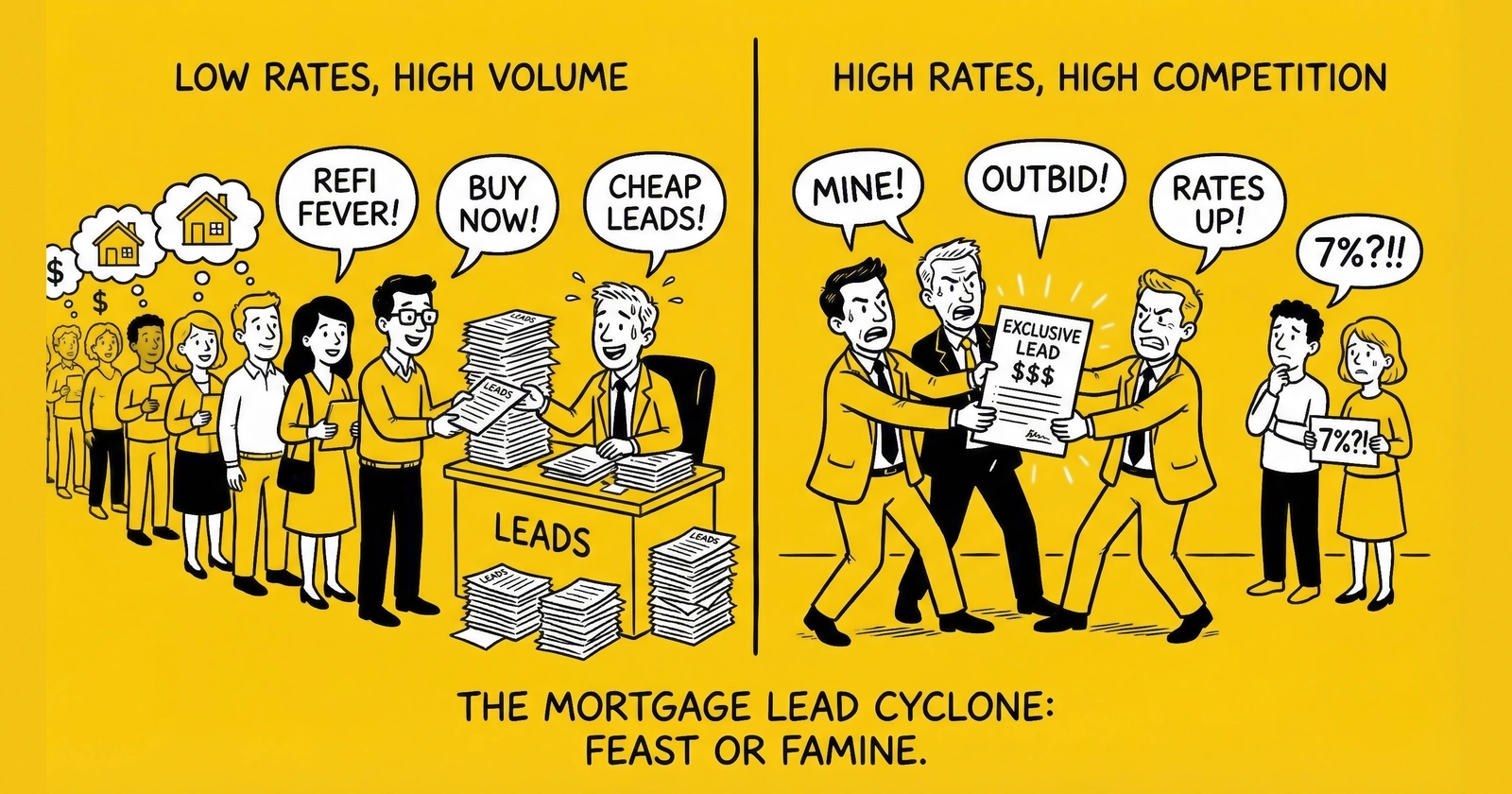
Interest rate cycles drive mortgage lead economics more than any other external factor. Understanding these dynamics enables strategic positioning rather than reactive scrambling.
The RATES Framework: Strategic Positioning Across Interest Rate Cycles
Navigating mortgage lead pricing through interest rate cycles requires more than reactive adjustments. The RATES Framework provides a structured approach for anticipating market shifts, positioning operations proactively, and capturing value that competitors miss while scrambling to adapt.
R - Rate Environment Recognition
The first component establishes systematic monitoring of rate environment indicators that predict market shifts before they fully manifest in lead pricing.
Primary Indicators (24-72 hour lead time): Treasury yield movements provide the earliest actionable signal. The 10-year Treasury yield correlates at 0.92 with 30-year mortgage rates over rolling 90-day periods. A sustained 15+ basis point Treasury move typically precedes equivalent mortgage rate movement by 2-5 business days. Monitor daily Treasury closes and flag movements exceeding one standard deviation from the 20-day moving average.
Secondary Indicators (1-4 week lead time): Federal Reserve communications signal policy direction well before implementation. FOMC meeting minutes, released three weeks after each meeting, reveal committee sentiment and voting patterns. The CME FedWatch Tool provides probability-weighted expectations for future rate decisions, updated continuously. When market-implied probabilities shift more than 20 percentage points within a two-week period, expect corresponding mortgage rate movement.
Tertiary Indicators (1-3 month lead time): Economic data releases that influence Fed policy create longer-term directional signals. Core PCE inflation readings above 2.5% year-over-year suggest rate maintenance or increases. Unemployment rate movements above 4.5% historically correlate with rate reduction cycles. GDP growth below 1.5% annualized creates accommodation pressure. Track these releases on economic calendars and update scenario probabilities monthly.
Recognition Benchmarks:
| Indicator Class | Monitoring Frequency | Action Threshold | Typical Lead Time |
|---|---|---|---|
| Treasury Yields | Daily | >15 bps sustained move | 2-5 days |
| Fed Probabilities | Weekly | >20% probability shift | 1-4 weeks |
| Economic Data | Monthly | Deviation from consensus | 1-3 months |
| Rate Volatility | Daily | VIX-equivalent spike >25% | 1-2 weeks |
A - Acquisition Cost Calibration
Rate environment changes create temporary dislocations between lead acquisition costs and lead selling prices. Understanding and managing these dislocations determines profitability during transitions.
Rate Decline Dynamics: When rates decline, demand increases occur before competitive acquisition cost increases manifest. This creates a 3-6 week window where conversion rates improve while CPCs remain at prior levels. Operators who recognize rate declines within the first week can capture 15-25% margin improvement during this window by maintaining acquisition volume at stable costs while selling into improving demand.
The calibration sequence for rate declines:
- Week 1-2: Rates decline visibly; demand signals emerge; maintain current bids
- Week 3-4: Conversion rates improve 15-30%; begin testing bid increases on proven campaigns
- Week 5-6: Competition enters; CPCs rise 20-40%; calibrate to new equilibrium
- Week 7+: New steady state; margin compression to sustainable levels
Rate Increase Dynamics: When rates increase, buyer demand contracts faster than acquisition costs decline. This creates a 4-8 week window of margin compression where lead prices fall while CPCs remain improved. Operators who recognize rate increases early can reduce acquisition costs proactively, limiting the compression window.
The calibration sequence for rate increases:
- Week 1-2: Rates rise visibly; buyer appetite contracts within days; reduce bids 10-15%
- Week 3-4: Lead prices decline 20-40%; reduce bids another 15-25%; pause marginal campaigns
- Week 5-8: Competition exits; CPCs decline; volume stabilizes at lower level
- Week 9+: New equilibrium; rebuild margin on reduced volume base
Calibration Benchmarks:
| Transition Type | Margin Window | Optimal Response Time | Cost Adjustment Range |
|---|---|---|---|
| Rate Decline (50+ bps) | 3-6 weeks positive | Within 1 week | Hold, then +20-40% |
| Rate Increase (50+ bps) | 4-8 weeks negative | Within 1 week | -25-40% immediate |
| Volatility Spike | 2-4 weeks uncertain | Within 3 days | Reduce 15-25% |
| Stability Return | 4-6 weeks recovery | Within 2 weeks | Gradual restoration |
T - Traffic Source Stratification
Different traffic sources respond differently to rate environment changes. Stratifying sources by rate sensitivity enables targeted adjustments rather than blanket changes.
High Rate Sensitivity Sources: Refinance-specific keywords show extreme rate sensitivity. “Refinance mortgage rates” search volume correlates at 0.89 with rate movements on a 2-week lag. When rates drop 50 basis points, these queries surge 60-80% within 30 days. When rates rise equivalently, volume collapses 50-70%. Budget allocation to these sources should flex dramatically with rate environment.
Moderate Rate Sensitivity Sources: General mortgage keywords show moderate sensitivity. “Mortgage rates” and “home loan” queries respond to rate movements but with dampened amplitude. Volume swings typically run 30-50% of refinance-specific swing magnitude. These sources provide baseline volume across rate environments with manageable adjustment requirements.
Low Rate Sensitivity Sources: Purchase-focused keywords show limited rate sensitivity because purchase decisions respond to life circumstances more than rate optimization. “Buy a home” and “first-time homebuyer” queries maintain relatively stable volume across rate cycles. Budget allocation to these sources should remain stable, providing portfolio ballast during transitions.
Stratification Matrix:
| Source Category | Rate Sensitivity | Budget Flex Range | Adjustment Speed |
|---|---|---|---|
| Refinance Keywords | Very High (0.85+) | 0-200% of baseline | Weekly |
| Rate Comparison | High (0.70-0.85) | 50-150% of baseline | Bi-weekly |
| General Mortgage | Moderate (0.40-0.70) | 75-125% of baseline | Monthly |
| Purchase Intent | Low (<0.40) | 90-110% of baseline | Quarterly |
E - Exposure Management
Rate cycle exposure extends beyond lead pricing to operational risk. Managing exposure across multiple dimensions protects against concentrated losses during transitions.
Buyer Concentration Exposure: Concentration in refinance-focused buyers creates asymmetric risk. When rates rise, these buyers contract volume 40-70% within 60 days. Operations with 50%+ revenue from refinance-focused buyers face existential pressure during rate increases. Target maximum 35% revenue concentration from any single buyer type.
Product Mix Exposure: Pure refinance operations face binary risk: strong performance during rate declines, potential collapse during rate increases. Product diversification across refinance, purchase, cash-out, and FHA/VA products provides portfolio smoothing. Target no more than 50% exposure to any single product category.
Geographic Exposure: High-cost markets (California, New York metros) show amplified rate sensitivity. A 50 basis point rate increase that reduces national affordability 8% might reduce San Francisco affordability 15%. Geographic diversification across market types provides stability. Target presence in at least three distinct market categories.
Exposure Benchmarks:
| Exposure Type | Risk Threshold | Target Maximum | Monitoring Frequency |
|---|---|---|---|
| Single Buyer | High concentration risk | 25% of revenue | Monthly |
| Buyer Type | Segment concentration | 35% of revenue | Quarterly |
| Product Type | Product concentration | 50% of volume | Monthly |
| Geographic | Market concentration | 40% from top market | Quarterly |
S - Scenario Planning and Response
Rate environments do not announce themselves. Scenario planning prepares operational responses before transitions force reactive decisions.
Scenario 1: Sustained Rate Decline (100+ bps over 6 months) Trigger signals: Fed pivot language, inflation below 2%, unemployment above 5% Preparation window: 2-4 months before full manifestation Operational response: Capacity expansion, refinance buyer development, traffic scaling tests Resource requirement: Capital for scaling, staffing pipeline, buyer relationship building Expected timeline: 6-18 months of favorable conditions
Scenario 2: Rapid Rate Increase (100+ bps over 3 months) Trigger signals: Inflation spike, Fed hawkish language, Treasury yield surge Preparation window: 2-6 weeks before full impact Operational response: Immediate cost reduction, product mix pivot, buyer communication Resource requirement: Cash reserves for transition, purchase capability, flexible cost structure Expected timeline: 3-12 months of compressed conditions
Scenario 3: Rate Volatility (50+ bps swings within 30 days) Trigger signals: Economic uncertainty, policy ambiguity, external shocks Preparation window: Days to weeks Operational response: Reduced exposure, hedged positioning, wait-and-see scaling Resource requirement: Operational flexibility, quick-reaction capability, cash cushion Expected timeline: 1-6 months of uncertainty
Scenario 4: Prolonged Stability (rates within 50 bps range for 6+ months) Trigger signals: Economic equilibrium, Fed pause, market consensus Preparation window: Emerges over 2-3 months of stability Operational response: Efficiency optimization, relationship deepening, margin improvement Resource requirement: Process improvement focus, technology investment, talent development Expected timeline: 6-24 months of operational opportunity
Response Readiness Assessment: Evaluate readiness quarterly across each scenario:
- Have we identified trigger signals and monitoring responsibility?
- Do we have documented response playbooks?
- Are resources allocated or earmarked for each scenario?
- Have we communicated scenario plans with key stakeholders?
- When did we last test or review each response plan?
The RATES Framework transforms rate cycle management from reactive scrambling to strategic positioning. Operators who internalize these components recognize rate environment shifts earlier, calibrate acquisition costs faster, manage exposure more deliberately, and execute scenario responses more confidently than competitors who simply watch market changes happen to them.
The Rate Cycle Reality in Mortgage Lead Generation
Mortgage lead pricing exists in perpetual motion, driven by interest rate cycles that reshape demand, competition, and conversion economics across the industry. A lead generator operating identically in January 2021 (rates at 2.65%) and January 2024 (rates at 6.69%) would experience different cost structures, different buyer appetite, and different conversion rates – not because of operational changes but because of rate environment changes that affect everything downstream.
The mortgage industry has always been cyclical, but the velocity and magnitude of recent rate swings have compressed decades of historical variation into mere months. Unlike seasonal trends that affect many lead generation verticals in predictable annual patterns, interest rate cycles follow macroeconomic forces that can shift rapidly and unexpectedly. Operators who built their businesses during the pandemic refinance boom discovered that strategies optimized for 3% rates became liabilities when rates doubled. Conversely, those who had weathered previous rate increases possessed institutional knowledge that proved invaluable when the market shifted. This cyclical reality means that sustainable mortgage lead generation requires not just tactical execution but strategic frameworks that anticipate and adapt to rate environment changes before they fully manifest in market pricing.
The relationship between interest rates and mortgage lead pricing is not linear or instantaneous. Rate changes trigger demand shifts that take weeks to manifest fully in lead pricing. Competitive responses compound initial effects. Buyer capacity constraints create bottlenecks that spike pricing beyond demand fundamentals. Understanding these dynamics – the mechanisms, the timing, and the magnitude – enables strategic decisions that create advantage rather than simply reacting to market moves.
According to Freddie Mac’s Primary Mortgage Market Survey, 30-year fixed mortgage rates have ranged from historic lows of 2.65% in January 2021 to cycle highs of 7.79% in October 2023, a 514 basis point swing within 33 months. This volatility created corresponding swings in lead demand, pricing, and conversion rates that reshaped the mortgage lead generation industry. Operators who anticipated these shifts positioned effectively; those who reacted slowly absorbed losses during transitions.
This analysis examines how interest rate cycles affect mortgage lead economics across the demand cycle, how historical patterns inform current positioning, and how lead generators can build operations resilient to rate volatility. The goal is strategic clarity about dynamics that most operators experience but few systematically understand.
The Mechanics of Rate-Driven Demand
Interest rates affect mortgage demand through multiple channels that operate on different timelines and affect different market segments. Understanding these mechanics enables forecasting that goes beyond simple rate-to-demand correlation.
The relationship between rates and demand appears straightforward on the surface: lower rates mean more borrowers can afford homes and more homeowners find refinancing attractive, while higher rates constrain affordability and eliminate refinance incentives. But this simple framework obscures the complex interplay of factors that actually determine how rate changes translate to lead demand. Consumer psychology, competitive dynamics among lenders, housing inventory constraints, and macroeconomic conditions all mediate the rate-to-demand relationship in ways that create both challenges and opportunities for informed operators.
Refinance Demand and Rate Sensitivity
Refinance demand shows the highest rate sensitivity in the mortgage market because refinancing decisions are almost purely economic. Homeowners refinance when the savings justify the costs and effort – a calculation that changes directly with rate movements.
The rule of thumb suggests refinancing becomes attractive when rates drop 50-75 basis points below a borrower’s current rate, generating enough monthly savings to recover closing costs within 2-3 years. When the average outstanding mortgage rate sits at 5% and current rates drop to 4%, approximately 15-20% of mortgage holders move into the refinance-advantaged position. When rates drop to 3.5%, that percentage expands to 30-40%. These percentages translate directly to demand volumes.
The refinance demand curve is asymmetric. Rate drops create immediate demand spikes as homeowners rush to lock savings. Rate increases cause demand collapse as the refinance math turns negative. This asymmetry means refinance lead generators experience boom-bust cycles more extreme than rate movements alone would suggest.
Data from the Mortgage Bankers Association shows refinance application volume swinging from peaks of 77% of total mortgage applications in early 2021 to below 30% by late 2022 – a shift entirely attributable to rate environment changes. Refinance lead pricing followed this volume curve with pricing peaks during high-demand periods and pricing collapse when demand evaporated.
Purchase Demand and Rate Influence
Purchase mortgage demand responds to interest rates but through more complex mechanisms that moderate the rate sensitivity compared to refinance.
Affordability effects dominate the purchase rate relationship. Higher rates reduce purchasing power – a buyer qualifying for $400,000 at 4% rates qualifies for only $320,000 at 7% rates (assuming constant debt-to-income ratios). This purchasing power reduction cools demand as fewer buyers can afford their target homes, particularly in price-improved markets.
Housing inventory interacts with rate effects. When rates rise, potential sellers with low-rate mortgages resist moving because they would surrender favorable financing. This “rate lock-in” effect constrains supply, supporting prices even as demand softens. The National Association of Realtors reported existing home sales falling to 4.09 million annualized units in 2023, the lowest since 1995, with rate lock-in cited as a primary factor.
Demographic demand provides a floor for purchase volume regardless of rates. Household formation, job relocations, family size changes, and other life events create purchase demand that persists across rate environments. Unlike refinance, which is purely optional, some purchase demand is non-discretionary.
Purchase lead pricing shows more stability than refinance across rate cycles, though the buyer-to-lead ratio changes. In low-rate environments, more buyers compete for each listing, increasing urgency. In high-rate environments, fewer qualified buyers mean more consideration time per transaction.
The Lag Structure of Rate Effects
Rate changes do not instantaneously translate to lead demand and pricing changes. Understanding the lag structure enables anticipatory positioning.
Awareness lag spans 1-2 weeks. Consumers do not check mortgage rates daily. Rate changes must penetrate general awareness before affecting search behavior and lead generation volume. Financial media coverage, lender marketing activation, and social discussion gradually spread rate news.
Decision lag adds 2-4 weeks. Even rate-aware consumers take time to decide whether to act. Refinance decisions require evaluating current mortgage terms, estimating closing costs, and comparing options. Purchase decisions involve coordination with home search and financial preparation.
Action lag contributes another 1-2 weeks. Decided consumers must complete lead forms, engage with lenders, and submit applications. Lead generation volume reflects consumers reaching this action stage.
Competitive lag overlays 2-4 weeks. Lead generators adjust acquisition spending in response to demand changes. Buyers adjust purchasing volume and pricing. These competitive responses amplify initial demand changes.
The total lag from rate change to full lead pricing adjustment typically spans 6-12 weeks. Lead generators who recognize rate movements and anticipate these lags can position ahead of competitive responses rather than chasing market changes after they fully manifest.
Historical Pricing Patterns Across Rate Cycles
Examining historical rate cycles reveals pricing patterns that inform current positioning. While each cycle has unique characteristics, certain patterns recur consistently. The past twenty years of mortgage market data provide a rich laboratory for understanding how lead pricing responds to rate environments, though the unprecedented nature of recent cycles demands careful interpretation rather than mechanical extrapolation.
Lead generators who study historical patterns gain two significant advantages. First, they develop pattern recognition that enables faster response when rate environment indicators begin shifting. Second, they build mental models for scenario planning that help them prepare contingencies before market moves make preparation impossible. The operators who navigated 2022-2023 most successfully were often those who had studied previous rate increase cycles and built their operations with cyclical resilience in mind.
The 2020-2021 Refinance Boom
The Federal Reserve’s pandemic response drove 30-year fixed rates from 3.72% in January 2020 to historic lows of 2.65% in January 2021. This 107 basis point decline triggered the largest refinance boom in mortgage history.
Refinance lead pricing escalated dramatically across this period. Exclusive refinance leads that traded at $40-60 in early 2020 reached $100-150 by mid-2021 in competitive markets. Shared leads followed similar trajectories at lower absolute levels. The pricing surge reflected genuine demand increases – MBA data showed refinance applications more than tripling from pre-pandemic levels.
Conversion rates improved alongside pricing because motivated borrowers with clear rate savings followed through at higher rates than typical. Buyers willingly paid premium prices because funded loan volume justified the investment.
The pattern demonstrated how extreme rate drops create compound effects: increased demand, increased conversion rates, increased buyer willingness to pay – all reinforcing pricing increases beyond what demand alone would suggest.
The 2022-2023 Rate Surge and Demand Collapse
The Federal Reserve’s inflation response reversed pandemic-era rate policy, driving 30-year fixed rates from 3.22% in January 2022 to 7.79% in October 2023 – a 457 basis point increase in 21 months.
Refinance lead pricing collapsed faster than rates rose. By Q3 2022, refinance lead pricing had fallen 60-70% from 2021 peaks as the refinance-eligible population shrank toward zero. Leads that traded at $120 in early 2022 traded at $35-45 by late 2022. Many refinance-focused operations exited the market entirely.
Purchase lead pricing proved more resilient, declining 20-35% from peak rather than collapsing. Buyers remained willing to pay for qualified purchase leads even in constrained markets because purchase demand, while reduced, persisted.
The transition period – roughly Q2-Q3 2022 – created particular challenges. Lead acquisition costs remained improved (reflecting lagged competitive adjustment) while lead prices collapsed (reflecting immediate buyer response to demand decline). Operators with thin margins absorbed losses during this transition period.
The 2024-2025 Rate Moderation
Mortgage rates moderated from 2023 peaks, trading in the 6.0-7.0% range through 2024 and into 2025. This stabilization enabled recalibration of lead economics to the “higher for longer” environment.
Refinance lead pricing found a new floor reflecting limited but persistent demand. Cash-out refinance leads maintained value as homeowners accessed equity regardless of rate comparison. Rate-and-term refinance remained suppressed but not eliminated – borrowers with 2022-2023 vintage mortgages at 7%+ rates became refinance-eligible as rates moderated toward 6%. Operators who adapted their high-rate environment strategies emerged stronger than those who simply waited for rates to decline.
Purchase lead pricing stabilized at levels below 2021 peaks but above 2023 troughs. Market normalization – adjusting to higher rates, increased inventory in some markets, moderating price appreciation – supported sustainable purchase lead economics.
The pattern demonstrated how rate stabilization, even at improved levels, enables operational calibration that extreme volatility prevents.
Rate Cycle Pricing Multipliers
Historical patterns reveal approximate pricing multipliers across rate cycle phases.
| Rate Environment | Refinance Lead Pricing | Purchase Lead Pricing | Market Character |
|---|---|---|---|
| Deep low (sub-3.5%) | 2.0-2.5x baseline | 1.3-1.5x baseline | Boom – capacity constrained |
| Low (3.5-4.5%) | 1.5-2.0x baseline | 1.1-1.3x baseline | Strong – competitive |
| Moderate (4.5-5.5%) | 1.0-1.2x baseline | 1.0x baseline | Normal – balanced |
| Improved (5.5-6.5%) | 0.6-0.8x baseline | 0.8-0.9x baseline | Soft – buyer’s market |
| High (6.5%+) | 0.4-0.6x baseline | 0.7-0.85x baseline | Constrained – selective |
These multipliers represent rough approximations that vary by market, lead type, and competitive dynamics. They illustrate the magnitude of rate-driven pricing swings that operators must navigate.
Buyer Behavior Across Rate Environments
Lead buyers respond to rate environments in ways that affect lead generator strategy across the cycle. Understanding buyer psychology and operational constraints during different rate periods enables lead generators to anticipate demand shifts and manage relationships proactively rather than reacting to buyer behavior changes after they occur.
Buyer behavior during rate transitions often appears irrational in real-time but follows predictable patterns when analyzed retrospectively. During rate declines, buyers become optimistic about conversion prospects and expansion potential, often over-committing to lead volume they cannot efficiently process. During rate increases, the same buyers contract rapidly, sometimes over-correcting relative to actual demand decline. These behavioral patterns create both risks and opportunities for lead generators who understand the underlying dynamics.
Buyer Expansion During Rate Declines
When rates drop and mortgage demand surges, buyer behavior shifts in predictable ways.
New buyer entry accelerates. The profit opportunity of high conversion rates and strong margins attracts new mortgage originators to lead purchasing. Fintech lenders with venture backing enter aggressively. Previously direct-only lenders explore lead-based acquisition. This buyer expansion creates demand for leads that exceeds immediate production capacity.
Existing buyer scaling intensifies. Current buyers increase volume to capitalize on favorable conversion economics. Capacity constraints emerge as processing pipelines fill. Lead purchasing becomes competitive, with buyers bidding up prices to secure inventory.
Quality tolerance expands. Buyers accept leads they would reject in normal environments because conversion rates justify broader acceptance. Return thresholds loosen. Price sensitivity decreases as funded loan volume matters more than cost efficiency.
For lead generators, this environment enables price increases, volume expansion, and working through lead inventory that might otherwise be challenging to monetize. The strategic risk is over-investment in capacity that becomes stranded when the cycle turns.
Buyer Contraction During Rate Increases
When rates rise and demand contracts, buyer behavior reverses.
Buyer exit accelerates. Marginal originators exit lead purchasing when conversion economics deteriorate. Lenders retrenching their operations cut marketing spend. Aggregators consolidate buyer relationships. The active buyer pool shrinks, reducing demand for leads.
Volume reductions compound. Remaining buyers reduce volume targets as their business contracts. A buyer purchasing 2,000 leads monthly at cycle peak might cut to 800 during contraction, compounding the buyer exit effect.
Quality requirements tighten. Buyers become stringent about lead quality when conversion rates fall. Return thresholds tighten. Price sensitivity increases as lenders protect margins during volume decline.
For lead generators, this environment demands cost reduction, quality improvement, and preservation of core buyer relationships. The strategic risk is maintaining expense structures calibrated to peak demand while revenue contracts.
Buyer Portfolio Shifts
Rate environments affect not just buyer volume but buyer portfolio mix.
Refinance-focused buyers dominate during low-rate periods. Lenders specializing in streamlined refinance processing can handle high volumes efficiently. These buyers may have limited purchase capability, creating refinance-heavy demand. Understanding the differences between mortgage lenders and brokers as lead buyers helps lead generators identify which buyer types thrive in each rate environment.
Purchase-focused buyers become relatively more important during high-rate periods. Lenders with real estate relationships, first-time buyer programs, and purchase-specific expertise maintain demand when refinance buyers contract.
Full-service buyers provide stability across environments. Large banks and diversified mortgage companies maintain demand across product types, though their volume mix shifts with rate environment.
Lead generators benefit from buyer portfolio diversity that maintains demand across rate environments. Over-concentration in refinance-focused buyers creates vulnerability to rate increases; over-concentration in purchase-focused buyers limits upside during rate declines.
Strategic Positioning for Rate Transitions
Rate transitions – the periods when rate environments shift meaningfully – create both risk and opportunity for lead generators. Strategic positioning during transitions determines outcomes. The operators who thrive across rate cycles are those who view transitions not as disruptions to endure but as strategic inflection points that can reshape competitive positioning.
Transition periods reward preparation and punish improvisation. A lead generator who enters a rate decline with buyer relationships already established, capacity expansion plans ready to execute, and traffic sources tested for scalability captures opportunity while competitors scramble to build what should have been prepared in advance. Similarly, a lead generator who recognizes rate increase signals early and begins cost reduction, product mix adjustment, and buyer communication before the market fully turns preserves margins and relationships that less prepared competitors sacrifice.
Anticipating Rate Transitions
Rate transitions rarely surprise those paying attention. Federal Reserve communications, economic data, and market indicators provide advance signals.
Federal Reserve forward guidance explicitly communicates policy direction. Fed meeting minutes, member speeches, and the dot plot projecting future rate expectations provide months of advance notice before actual policy changes. Lead generators monitoring Fed communications can anticipate rate direction before mortgage rates move.
Treasury yield movements often precede mortgage rate moves. The 10-year Treasury yield, which correlates strongly with 30-year mortgage rates, reflects market expectations about future rates. Sustained Treasury yield movements signal mortgage rate changes before they fully manifest.
Economic indicators that drive Fed policy – inflation readings, employment data, GDP growth – provide context for rate expectations. Understanding which data releases matter and how they affect rate expectations improves anticipation.
Mortgage rate volatility itself signals transition potential. Periods of improved rate volatility often precede sustained directional moves as markets price new information.
Positioning for Rate Declines
When rate declines appear likely, lead generators can position to capture opportunity.
Capacity expansion preparation enables volume capture when demand surges. Hiring and training before demand spikes puts operational capacity in place when leads become valuable. Waiting until demand manifests means competing with others who prepared earlier.
Buyer relationship development with refinance-focused lenders creates distribution channels ready to activate. Buyers prefer lead generators with established relationships and demonstrated quality over new vendors scrambling to sell into the boom.
Traffic source testing identifies channels that can scale when demand increases. Testing acquisition approaches at smaller scale enables rapid scaling when unit economics improve.
Cash preservation ensures resources exist to invest when the opportunity materializes. Rate transitions favor operators with capital to deploy over those constrained by prior over-investment.
Positioning for Rate Increases
When rate increases appear likely, lead generators can position to preserve value.
Cost reduction ahead of demand contraction maintains margins when revenue falls. Waiting until contraction manifests to cut costs means absorbing losses during the transition. Leading indicators of rate increases should trigger expense review before demand declines.
Purchase focus hedging reduces refinance exposure. Building purchase lead generation capability – different traffic sources, different landing pages, different buyer relationships – provides revenue streams that persist when refinance collapses.
Quality improvement becomes critical when buyer options contract. Leads that traded easily during demand surges face scrutiny during contractions. Improving lead quality ahead of tightening buyer standards maintains relationships.
Buyer diversification across lender types protects against concentrated buyer exit. If primary refinance buyers contract, having purchase-focused and full-service buyers maintains distribution options.
Transition Period Management
The weeks between rate environment shifts create operational challenges that require specific management.
Pricing lag management recognizes that acquisition costs adjust faster than lead prices during transitions. When rates rise, CPCs may remain improved (lagged competitive adjustment) while lead prices fall (immediate buyer response). Cash reserves bridge this temporary margin compression.
Buyer communication prevents surprises that damage relationships. Proactively communicating about rate environment changes, expected volume shifts, and pricing adjustments maintains buyer relationships through transitions.
Inventory management becomes critical during downward transitions. Leads acquired at high cost during a boom must be distributed before they age out of viability. Acceleration of lead delivery during transition periods prevents inventory write-offs.
Pipeline recalibration adjusts expectations and reporting to new rate environment realities. Conversion benchmarks, pricing targets, and volume forecasts all require updating as transitions complete.
Product Mix Dynamics Across Rate Cycles
Different mortgage products show different rate sensitivities, creating product mix dynamics that affect lead generation strategy.
Conventional Rate-and-Term Refinance
Conventional rate-and-term refinance shows the highest rate sensitivity. This product exists purely to reduce borrowing cost; when rates do not support savings, demand approaches zero.
During low-rate periods, conventional refinance dominates lead demand. High volumes, efficient processing, and clear borrower benefit make this the core product for refinance-focused operations.
During improved-rate periods, conventional refinance demand collapses for borrowers with existing low rates. However, borrowers with recent vintage high-rate mortgages (2022-2023 originations at 7%+) become eligible as rates moderate, creating a smaller but persistent demand segment.
Lead generators serving this product must accept cyclical volume or pivot toward other products during high-rate periods.
Cash-Out Refinance
Cash-out refinance shows moderate rate sensitivity because borrowers accept higher rates for equity access. The rate decision becomes comparing mortgage rates to alternative capital costs rather than comparing current to new mortgage rates.
During low-rate periods, cash-out competes with rate-and-term for borrower attention. Some borrowers who would otherwise do rate-and-term add cash-out given favorable rates.
During improved-rate periods, cash-out maintains demand from borrowers who need capital regardless of rate comparison. Debt consolidation at 6.5% beats credit cards at 22%. Home improvement financing at mortgage rates beats personal loans at 12%.
Lead generators can position cash-out as a countercyclical product that maintains relevance when rate-and-term collapses. Cash-out lead generation strategies differ from rate-and-term, requiring different messaging and targeting.
FHA and Government Loans
FHA and other government loan products show complex rate sensitivity that differs from conventional.
For purchase, FHA provides access for borrowers who cannot meet conventional requirements. This access function persists across rate environments, though absolute volume responds to overall housing market conditions.
For refinance, FHA Streamline products enable simplified refinancing that can make economic sense at smaller rate improvements than conventional refinance. FHA borrowers may refinance when conventional borrowers would not.
During improved-rate periods, FHA purchase volume becomes a larger share of total purchase activity as conventional-eligible buyers exit. Lead generators serving FHA segments maintain more stable demand across rate cycles than conventional-only operations.
Non-QM Products
Non-qualified mortgage products serve borrowers outside conventional guidelines – self-employed with complex income, recent credit events, investment property with non-standard documentation. These products show rate sensitivity through affordability effects but less rate-comparison sensitivity.
Non-QM borrowers often cannot access conventional rates regardless of rate environment. Their rate decision compares non-QM rates to private lending alternatives rather than to conventional mortgage rates.
During improved-rate periods, non-QM maintains relevance for its target segments. Rate increases that eliminate conventional refinance options have less impact on non-QM demand because the borrower pool differs fundamentally.
Lead generators with non-QM capability can serve segments that persist across rate cycles, though non-QM requires specialized buyers and different qualification approaches.
Geographic Rate Sensitivity Variation
Rate sensitivity varies geographically based on market characteristics that affect housing affordability and borrower profiles.
High-Cost Markets and Rate Sensitivity
Markets with improved home prices – coastal metros, major urban centers – show amplified rate sensitivity for purchase activity.
Affordability constraints intensify with rate increases. A buyer in San Francisco requiring $800,000 financing loses more purchasing power per rate point than a buyer in Memphis requiring $250,000. This amplification means high-cost markets experience sharper demand declines during rate increases.
Jumbo loan thresholds affect rate economics. Loans exceeding conforming limits (currently $766,550 in most markets, higher in designated high-cost areas) typically carry rate premiums that compound general rate environment effects.
For lead generators, high-cost market leads show greater volume volatility across rate cycles. Premium pricing during low-rate periods offsets volume risk, but operational planning must account for amplified swings.
Markets with Strong Appreciation
Markets experiencing rapid home price appreciation create equity that persists regardless of rate environment, supporting cash-out refinance demand.
Homeowners in appreciation markets accumulate tappable equity faster than national averages. This equity creates cash-out opportunities even when rate-and-term refinance becomes uneconomic.
Markets like Phoenix, Tampa, and Austin that experienced 40-60% appreciation between 2020-2022 created large pools of equity-rich homeowners. These borrowers represent cash-out demand that persists through improved-rate periods.
Lead generators can target appreciation markets for cash-out lead generation that partially hedges rate cycle exposure.
Markets with Recent Vintage Concentrations
Markets with high concentrations of recent mortgage originations (2022-2023 vintage) create refinance opportunity as rates moderate from peak levels.
Borrowers who purchased or refinanced at 7%+ rates become refinance candidates as rates decline toward 6%. Markets with active transaction volume during the 2022-2023 rate peak contain larger pools of these rate-reduction candidates.
Identifying markets with high recent vintage concentrations enables targeting refinance campaigns toward borrowers with economic motivation to act, even in generally improved rate environments.
Forecasting and Planning Across Rate Cycles
Building operations resilient to rate cycles requires forecasting approaches and planning frameworks that account for rate uncertainty.
Scenario-Based Planning
Rather than forecasting a single rate path, effective planning considers multiple scenarios and positions for each.
Base case planning assumes rate stability near current levels, enabling operational calibration to current environment economics. Most planning decisions can proceed on base case assumptions with defined adjustment triggers.
Downside case planning assumes meaningful rate declines that would trigger refinance demand. Preparation includes capacity expansion plans, buyer relationship development, and traffic scaling approaches ready to activate. The trigger might be sustained rates below a threshold (e.g., 5.5%) or rate decline exceeding a magnitude (e.g., 75 basis points from current levels).
Upside case planning (from lead generator perspective) assumes further rate increases that would compress demand further. Preparation includes cost reduction plans, product mix shifts, and buyer relationship concentration approaches. The trigger might be sustained rates above a threshold (e.g., 7.5%) or rate increase exceeding a magnitude.
Leading Indicator Monitoring
Regular monitoring of rate-relevant indicators enables faster response to changing conditions.
Federal Reserve indicators merit close attention. FOMC meeting schedules, member speeches, meeting minutes, and economic projections all provide forward guidance. Markets respond to these communications, often moving mortgage rates before policy actually changes.
Treasury market indicators lead mortgage rates. The 10-year Treasury yield, the 2-10 spread (indicating curve shape), and Treasury market volatility provide real-time signals about rate expectations.
Mortgage market indicators confirm rate environment effects. MBA application indices, mortgage rate surveys, and housing market data confirm whether rate changes are translating to demand changes as expected.
Economic indicators that drive Fed policy – inflation readings (CPI, PCE), employment data (payrolls, unemployment rate), and growth data (GDP, consumer spending) – provide context for rate expectations.
Flexible Capacity Models
Operations designed for rate cycle resilience incorporate flexible capacity rather than fixed capacity calibrated to a single environment.
Variable cost structures enable scaling cost with volume. Contractor relationships, performance-based compensation, and scalable technology create cost flexibility that fixed salary and infrastructure cannot provide.
Multi-product capability enables shifts between refinance and purchase, between conventional and FHA, between rate-and-term and cash-out. Single-product focus creates rate cycle vulnerability that diversification addresses.
Buyer portfolio diversity across lender types maintains distribution options regardless of which segments expand or contract. Relationships with refinance specialists, purchase specialists, and full-service lenders provide flexibility.
Capital reserves bridge transition periods when margins compress temporarily. Operations without reserves must make reactive decisions during transitions; operations with reserves can make strategic decisions.
Frequently Asked Questions
How quickly do mortgage lead prices respond to interest rate changes?
Mortgage lead prices respond to interest rate changes over a 6-12 week cycle that reflects lag in consumer awareness, decision-making, and competitive adjustment. Rate changes take 1-2 weeks to penetrate consumer awareness, another 2-4 weeks for decision-making, and 1-2 weeks for action. Competitive response from lead generators and buyers adds 2-4 weeks. Lead generators who recognize rate movements early can position ahead of this lag cycle rather than reacting after prices fully adjust. However, buyer response often leads producer response – buyers adjust purchasing and pricing immediately while lead acquisition costs take longer to adjust.
What is the typical pricing swing between low-rate and high-rate environments?
Historical patterns show refinance lead pricing swinging 2.5-4x between cycle extremes. Leads trading at $40-50 during improved-rate periods can reach $100-150 during deep low-rate periods in competitive markets. Purchase leads show more moderate swings of 1.5-2x because purchase demand has demographic drivers that persist regardless of rate environment. These multipliers vary by market, lead quality, and competitive dynamics, but they illustrate the magnitude of rate-driven pricing volatility that lead generators must navigate.
How should I allocate budget between refinance and purchase lead generation across rate cycles?
Budget allocation should shift with rate environment while maintaining core capabilities in both segments. During low-rate periods, refinance ROI typically exceeds purchase, justifying 60-70% refinance allocation. During improved-rate periods, purchase maintains better economics, justifying 70-80% purchase allocation or higher. Maintaining minimum presence in both segments preserves buyer relationships and operational capability needed to shift allocation when environments change. Pure refinance operations face existential risk during rate increases; pure purchase operations miss significant opportunity during rate declines.
What leading indicators should I monitor to anticipate rate changes?
Priority indicators include Federal Reserve communications (FOMC statements, meeting minutes, member speeches, dot plot projections), Treasury market signals (10-year yield level and direction, yield curve shape, market volatility), economic data releases that drive Fed policy (inflation readings, employment data, GDP growth), and mortgage market data (MBA application indices, rate surveys, housing market statistics). The Fed provides explicit forward guidance about policy direction months before actual changes. Markets respond to this guidance, often moving mortgage rates before policy changes take effect.
How do I maintain buyer relationships during demand contractions?
Buyer relationship maintenance during contractions requires proactive communication, quality focus, and realistic expectation setting. Communicate early about volume reductions and pricing adjustments rather than surprising buyers. Improve lead quality to maintain value even at reduced volume – buyers retain suppliers who deliver quality during difficult periods. Adjust pricing to reflect changed economics while preserving margin sustainability. Prioritize core relationships over maximizing short-term revenue from marginal buyers. Buyers remember which suppliers supported them through contractions and which suppliers disappeared.
Should I exit refinance lead generation during improved-rate periods?
Complete exit from refinance lead generation creates risks alongside benefits. Exit reduces losses from poor refinance economics during improved-rate periods. However, exit also means rebuilding capability from scratch when rates decline, which takes months while competitors capture opportunity. Consider maintaining minimal refinance presence to preserve buyer relationships and operational capability even when refinance economics are unfavorable. Cash-out refinance maintains relevance during improved-rate periods even when rate-and-term refinance collapses. The decision depends on your operation’s cost structure, buyer relationships, and ability to scale quickly when conditions change.
How do regional market differences affect rate cycle strategy?
Regional markets show varying rate sensitivity based on price levels, appreciation patterns, and borrower demographics. High-cost markets experience amplified purchase demand swings because affordability constraints intensify with rate increases. Markets with strong recent appreciation create equity that supports cash-out demand regardless of rate environment. Markets with high concentrations of recent vintage mortgages (2022-2023 at peak rates) create refinance opportunity as rates moderate. Geographic diversification across markets with different characteristics reduces rate cycle exposure compared to concentration in high-sensitivity markets.
What technology investments support rate cycle resilience?
Technology supporting rate cycle resilience includes flexible lead distribution systems that can rapidly adjust routing and pricing, real-time analytics that detect demand shifts quickly, scalable traffic acquisition infrastructure that can expand or contract with demand, CRM systems that support pipeline management across longer sales cycles, and integration capabilities that enable rapid buyer onboarding when new relationships develop. Fixed-capacity technology designed for specific volume levels creates rate cycle vulnerability. Scalable, configurable technology enables operational flexibility that matches rate cycle requirements.
How do I price leads during transition periods when acquisition costs and buyer prices diverge?
Transition period pricing requires accepting temporary margin compression while working to realign costs with revenue. When rates rise, acquisition costs remain improved (lagged competitive adjustment) while lead prices fall (immediate buyer response). Cash reserves bridge this period. Accelerate acquisition cost reduction through bid adjustments, channel mix shifts, and traffic source optimization. Communicate with buyers about transition dynamics and timeline to stabilized pricing. Consider volume reduction during acute transition periods to preserve margin rather than maintaining volume at losses. Transition periods typically resolve within 8-12 weeks as acquisition markets fully adjust.
What role do FHA and government loans play in rate cycle strategy?
FHA and government loan products provide partial hedging against rate cycle exposure. FHA purchase demand persists across rate environments because it serves borrowers who cannot access conventional loans regardless of rates. FHA Streamline refinance enables refinancing at smaller rate improvements than conventional. VA loans serve military borrowers with unique benefits regardless of rate environment. Building capability for government loan leads reduces pure conventional exposure that shows highest rate sensitivity. However, government loan leads require specialized buyer relationships with FHA and VA approved lenders.
Key Takeaways
-
Interest rate cycles drive mortgage lead economics more powerfully than any other external factor, creating pricing swings of 2.5-4x for refinance leads and 1.5-2x for purchase leads between cycle extremes. Lead generators who understand these dynamics can position strategically rather than reacting to market changes after they fully manifest.
-
The lag structure of rate effects – typically 6-12 weeks from rate change to full pricing adjustment – creates anticipation opportunity. Federal Reserve communications, Treasury yields, and economic data provide advance signals of rate direction. Monitoring these indicators enables positioning ahead of competitive adjustment.
-
Rate environments reshape buyer behavior in predictable patterns. Rate declines trigger buyer expansion, volume increases, and loosened quality requirements. Rate increases trigger buyer contraction, volume reductions, and tightened quality standards. Managing buyer relationships across these shifts requires proactive communication and realistic expectation setting.
-
Product mix provides hedging against rate cycle exposure. Cash-out refinance maintains relevance when rate-and-term collapses because borrowers accept higher rates for equity access. FHA and government loans serve populations with persistent demand regardless of rate environment. Purchase demand has demographic drivers that persist across rate cycles. Single-product operations face vulnerability that diversification addresses.
-
Geographic diversification further reduces rate cycle exposure. High-cost markets show amplified rate sensitivity; appreciation markets support equity-based products; markets with recent vintage concentrations create refinance opportunity during rate moderation.
-
Scenario-based planning prepares for multiple rate paths rather than betting on a single forecast. Base case enables current environment calibration; downside case prepares capacity expansion and relationship development; upside case prepares cost reduction and product mix shifts. Defined triggers activate contingency plans.
-
Flexible capacity models – variable cost structures, multi-product capability, buyer portfolio diversity, capital reserves – create resilience that fixed capacity cannot provide. Building operations that function across rate environments enables long-term sustainability regardless of where rates go next.
Market data and rate information current as of December 2025. Interest rates, lead pricing, and market conditions change continuously. Historical patterns inform but do not guarantee future dynamics. Validate current conditions through industry sources before making significant operational decisions. This article provides general information about mortgage lead generation dynamics and does not constitute financial advice.