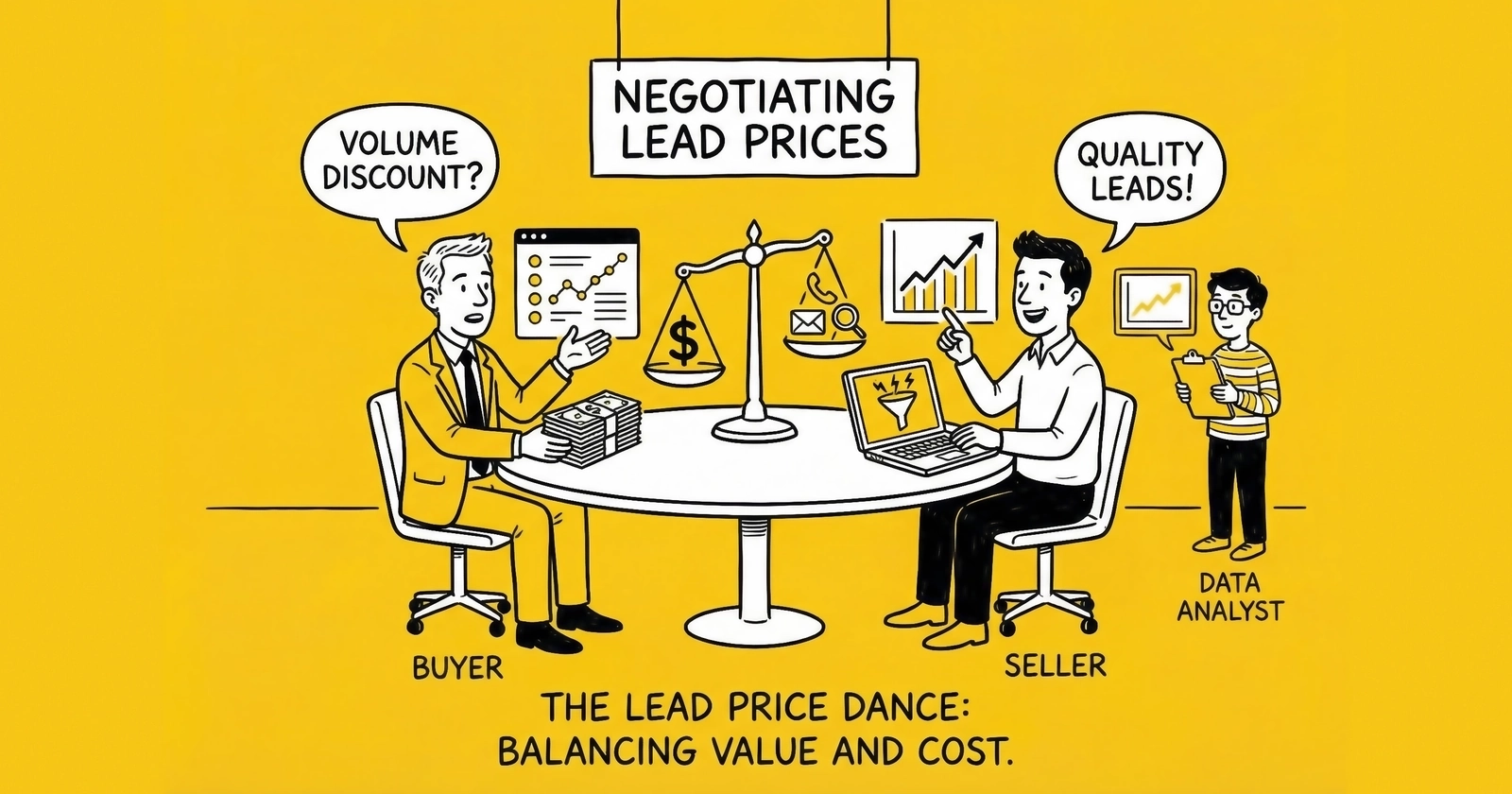
Master the art of lead price negotiation with proven strategies that protect margins while building sustainable partnerships – whether you’re buying, selling, or operating somewhere in between.
The lead price discussion usually starts the same way. A buyer wants lower prices. A seller wants higher prices. Both parties quote “market rates” that somehow favor their position. After awkward negotiations, someone capitulates – often the party with less leverage – and the relationship begins with one side feeling they lost before it started.
This is negotiation theater, not negotiation strategy.
Real lead price negotiation is a sophisticated discipline that considers economics on both sides of the table, accounts for quality differentials that dwarf headline pricing, and builds structures where improved performance benefits everyone. Those who master these dynamics build partnerships that last years while those stuck in transactional haggling churn through vendors and buyers wondering why nothing works.
After fifteen years negotiating lead prices on every side of the marketplace – as a publisher fighting for fair value, as a broker managing supplier and buyer relationships, and as a buyer optimizing acquisition costs – I’ve learned that the best negotiations don’t feel like negotiations at all. They feel like problem-solving sessions where both parties work to structure arrangements that make economic sense for everyone.
This guide covers the tactical, strategic, and relational aspects of lead price negotiation from both buyer and seller perspectives. Whether you’re a first-time lead buyer trying to establish fair terms or a seasoned publisher protecting margins against downward pressure, you’ll find frameworks and specific tactics that work in real market conditions.
Understanding the Lead Pricing Landscape
Before negotiating price, you need to understand what you’re actually pricing. A lead is not a commodity like a barrel of oil or a bushel of wheat. It’s a packaged bundle of consumer intent whose value varies dramatically based on characteristics that pricing discussions often ignore.
The Four Value Drivers
Every lead’s worth depends on four interconnected factors:
Recency is the first and often most important variable. Lead value decays approximately 50% every 24-48 hours in most verticals, as detailed in our aged leads strategy guide. A lead captured this morning is worth multiples of one captured last week. Research consistently shows that leads contacted within one minute convert at 391% higher rates. The first responder wins 78% of the time. This decay curve should inform every pricing discussion – a “real-time” lead justifies premium pricing, while an aged lead requires steep discounting.
Exclusivity creates the second major value tier. Exclusive leads – sold to exactly one buyer – command 2-3x the price of shared leads sold to multiple buyers. Buyers pay this premium because they don’t compete for the same consumer’s attention. A $75 exclusive lead might actually cost less per customer acquired than a $30 shared lead where you’re racing against five other callers.
Qualification depth represents the third driver. A lead with credit score, income, property value, and purchase timeline data is worth substantially more than one with just name and phone number – a principle explored in our lead quality scores guide. Additional data fields reduce buyer risk, improve routing precision, and enable better conversion. The more information captured at the form level, the more precisely the lead can be valued.
Vertical economics provide the context for all other variables. Auto insurance leads operate in a different economic universe than personal injury legal leads. The same negotiation tactics apply, but the numbers differ by an order of magnitude. Understanding the lifetime value of customers in your vertical – and how that translates to acceptable lead costs – anchors every pricing conversation in economic reality.
CPL Benchmarks by Vertical (2024-2025)
Current market rates provide context for negotiations, though remember that averages mask enormous variation based on quality, geography, and specific buyer economics:
| Vertical | Shared Lead Range | Exclusive Lead Range | Premium Tier |
|---|---|---|---|
| Auto Insurance | $20-45 | $50-100 | $120+ |
| Medicare | $30-60 | $75-150 | $175+ |
| Term Life | $25-55 | $60-120 | $140+ |
| Mortgage | $40-100 | $90-200 | $250+ |
| Solar | $60-150 | $120-300 | $350+ |
| Personal Injury Legal | $150-400 | $300-800 | $1,000+ |
| Home Services | $25-75 | $60-150 | $200+ |
These ranges shift based on market conditions, seasonality, and geographic factors. Use them as starting points for conversations, not as fixed ceilings or floors. A buyer with 12% close rates can pay significantly more than one struggling at 4%, even in the same vertical.
Buyer Negotiation Strategies
Buyers face a fundamental challenge: they need leads to grow, but overpaying for leads destroys profitability. The goal is establishing price points that deliver acceptable return on investment while maintaining access to quality volume.
Know Your Numbers Before Negotiating
The most powerful negotiation position comes from understanding your own economics with precision. Before any pricing discussion, calculate:
Your customer lifetime value (LTV). What does an average customer acquired from leads generate in total value over the relationship? In auto insurance, this might be $1,500-3,000 over a multi-year policy lifetime. In mortgage, it could be $3,000-8,000 depending on loan size and refinance potential. Know this number cold.
Your conversion rate by lead type. What percentage of leads actually become customers? This varies dramatically by lead quality, source, and your own sales capabilities. Track conversion separately for exclusive versus shared leads, by geography, and by source when possible.
Your cost to work a lead. Beyond the lead price itself, what does it cost to contact, qualify, and process each lead? This includes sales rep time, phone costs, CRM costs, and management overhead. Typical figures run $8-25 per lead depending on vertical and sales model.
Your target cost per acquisition (CPA). Given LTV and acceptable margins, what can you afford to pay per customer? Work backward from here to determine maximum acceptable lead prices.
Here’s the formula in practice: If your average customer LTV is $2,400, your conversion rate is 8%, and your cost to work a lead is $12, then:
- Maximum viable CPA (at 3:1 LTV ratio): $800
- Less contact costs at $12/lead: Leaves $788 for lead cost and margin
- At 8% conversion: Maximum CPL = $788 × 0.08 = $63
This means you can pay up to $63 per lead and maintain healthy economics – assuming these assumptions hold. Understanding this true cost per lead calculation arms you with knowledge rather than guesswork.
Volume Commitment Strategies
Sellers reward volume because it reduces their customer acquisition costs and provides revenue predictability. Use this leverage strategically:
Tiered volume commitments offer escalating discounts at higher thresholds. A seller might price leads at $50 for 100-250 monthly, $46 for 251-500, and $42 for 501+. Calculate whether the volume increase makes sense given your sales capacity before committing to higher tiers.
Guaranteed minimums with upside provide sellers with baseline revenue security in exchange for price breaks. You might guarantee 300 leads monthly at $44 each, with the option to take additional leads at the same price up to a cap. The seller gets predictable revenue; you get favorable pricing with flexibility.
Exclusivity premiums sometimes work in reverse. If you can commit to taking all of a seller’s leads in a specific geography or vertical slice, you may receive better pricing because you’ve simplified their distribution requirements.
Long-term contracts enable sellers to plan and invest, which they often reward with pricing concessions. A twelve-month agreement might secure 10-15% better pricing than month-to-month arrangements. The risk is locking in if quality declines – always include performance-based exit clauses.
Performance-Based Pricing Structures
The most sophisticated buyers negotiate pricing tied to outcomes rather than fixed per-lead rates. These structures align incentives and protect against quality deterioration:
Conversion-based adjustments tie future pricing to measured performance. The contract might specify: “Base price of $50 per lead, with price increasing to $55 if conversion rate exceeds 8% and decreasing to $45 if conversion falls below 6%.” Both parties win when quality improves.
Return rate caps protect against leads that don’t meet specifications. Standard terms might allow returns of 10-15% of volume for leads that are invalid, duplicates, or outside agreed filters. Negotiate the cap carefully – too low and you eat costs on legitimate quality issues; too high and you’ve essentially made returns unlimited.
Pilot period pricing establishes a testing phase with favorable terms. You might negotiate a 30-day pilot at 15% below standard pricing, with the understanding that rates normalize if performance meets expectations. This reduces your risk while giving the seller opportunity to prove quality.
Bonus structures for exceptional performance create upside that sellers will work to capture. If conversion rates exceed targets by significant margins, you might pay 10-20% premiums – willingly, because the economics justify it.
Negotiating Return Policies
Returns are margin protection in disguise. A $50 lead with 15% return rate is actually a $42.50 lead. Negotiate return policies that protect your economics:
Acceptable return categories should cover: invalid contact information (disconnected phones, bouncing emails), duplicates (consumer already in your system), filter criteria mismatches (wrong geography, product type), and consent issues. Document these clearly in your agreement.
Return windows determine how long you have to identify issues. Industry standard is 7-14 days for most categories. Push for longer windows if your sales cycle requires more time to evaluate lead quality. Shorter windows favor sellers; longer windows favor buyers.
Documentation requirements should be reasonable. Sellers will ask for call recordings or notes supporting return claims. Ensure your operations can produce this documentation without excessive burden.
Dispute resolution processes matter when disagreements arise. Establish escalation paths from account manager review to operations management to executive resolution. The goal is preventing disputes from damaging ongoing relationships.
The Vendor Diversification Leverage
Never become dependent on a single lead vendor. Beyond the operational risk of source concentration, monopoly suppliers have no competitive pressure to maintain quality or reasonable pricing.
The 40% rule provides a useful guideline: no single vendor should exceed 40% of your lead volume. This ensures you always have alternatives and leverage.
Parallel testing keeps vendors honest. When you’re consistently testing new sources alongside existing ones, incumbents know they can be replaced if performance slips.
Transparent performance comparison creates competitive pressure. When vendors know you’re tracking their contact rates, conversion rates, and return rates against competitors, they work harder to maintain quality.
Seller Negotiation Strategies
Sellers face the opposite challenge: maximizing revenue per lead while maintaining buyer relationships and volume. The goal is capturing fair value for quality without pricing yourself out of the market.
Value-Based Pricing Foundation
The shift from cost-plus to value-based pricing represents the most important strategic evolution for lead sellers. Stop calculating your traffic costs and adding a margin. Start calculating what your leads are worth to buyers and pricing accordingly.
Buyer economics analysis forms the foundation. What’s the typical LTV of customers acquired through your leads? What close rates do buyers achieve? What are their contact costs and operational overhead? This intelligence enables informed pricing.
For example, if you know that an average auto insurance buyer achieves $1,200 LTV on customers acquired from your leads, closes at 8%, and spends $12 per lead in contact costs:
- Expected revenue per lead: $1,200 × 8% = $96
- Less contact costs: $96 - $12 = $84 available value
- At 50% value capture: Achievable price = $42
This buyer can pay $42 for your lead and still make $42 per lead profit. That’s sustainable economics for them and likely far better than cost-plus pricing would suggest.
Quality differentiation enables premium pricing. If your leads genuinely outperform alternatives – higher contact rates, better conversion, cleaner consent documentation – document these advantages and price accordingly. Generic claims of “high quality” mean nothing; specific performance data creates pricing power.
Segment pricing captures value variation. Not all buyers have identical economics. Captive insurance agents often have better LTVs than independent agents because of cross-sell opportunities. Mortgage brokers in competitive urban markets may accept lower margins than those in underserved rural areas. Price different segments appropriately.
Protecting Against Downward Pressure
Buyers will always push for lower prices. Effective sellers maintain pricing discipline through several mechanisms:
Performance data shields provide objective justification for pricing. When a buyer says “We need 15% off,” you respond with: “Our leads convert 40% above the sources you’re comparing us to. At our current price, your CPA is $890. At those competitor prices, even with 15% savings, your CPA would be $1,100 because conversion drops. We’re actually your cheapest source on a per-customer basis.”
Volume-for-price trades protect per-lead margins while accommodating buyer needs. Instead of straight price cuts, offer: “I can’t discount the per-lead rate, but I can expand your daily cap from 50 to 75 leads at current pricing. You get 50% more volume, which achieves your budget efficiency goals while maintaining our quality investment.”
Service bundling adds value without price erosion. Enhanced reporting, priority support, custom data fields, dedicated account management – these additions cost you relatively little but provide tangible buyer value that justifies pricing.
Exclusivity tiers create natural price differentiation. Shared leads at $35, exclusive at $70, priority exclusive (first call routing guarantee) at $85. Buyers self-select into tiers based on their economics, and you capture appropriate value at each level.
Managing Return Negotiations
Returns erode margins. Sellers should negotiate return policies that are fair but not exploitable:
Clear, objective criteria prevent abuse. “Invalid contact” has a clear definition: the number doesn’t work. “Didn’t convert” is not a valid return reason – conversion is buyer responsibility.
Reasonable time windows balance buyer needs with seller exposure. Seven to fourteen days provides adequate time for buyers to identify genuine issues while preventing indefinite return exposure.
Return rate caps protect against buyer gaming. A 10-15% cap ensures some accountability while acknowledging that some returns are legitimate. Make clear that caps apply to total volume, not per-issue categories.
Quality guarantees with teeth demonstrate confidence. Offering minimum contact rate guarantees (e.g., 50% within 5 attempts) with credits for shortfalls can actually reduce return disputes by establishing objective quality metrics.
Price Increase Strategies
Costs rise. Market conditions change. Eventually, you need to increase prices. Here’s how to do it without destroying relationships:
Performance-justified increases are easiest to implement. “Your conversion rate has improved 25% over the past six months. Our leads are delivering more value. We’re adjusting pricing to reflect that value – still well below your cost-per-customer targets.”
Cost pass-throughs work when increases are industry-wide. “Google CPCs increased 18% last quarter across our target keywords. Traffic costs are up for everyone in the market. We’re passing through a 12% increase, absorbing part of the increase ourselves.”
Advance notice with transition periods maintains trust. Give 30-60 days notice of price changes. Offer existing buyers a grace period at current rates while new pricing takes effect.
Value additions with increases soften the impact. “We’re raising base pricing 10%, but we’re also adding consent certificate delivery, which normally costs $0.25 per lead. Net impact to you is closer to 5%.”
The Ping/Post Negotiation Framework
In auction-based ping/post environments, negotiation takes different forms. Prices are determined by real-time competitive bidding, not contract negotiations. But significant negotiation opportunities remain.
For Sellers in Ping/Post
Floor pricing establishes minimum acceptable bids. Setting floors too high means leads don’t sell; too low means leaving money on the table. Analyze historical bid distributions to identify optimal floor levels – typically at the 10th-20th percentile of winning bids, ensuring most leads clear while capturing value on outliers.
Buyer weighting influences auction outcomes beyond raw bid price. Some platforms allow sellers to weight bids based on historical acceptance rates. A $55 bid from a buyer with 95% post-acceptance might be preferred over a $60 bid from a buyer who rejects 30% of posts – the expected value calculation favors the reliable buyer.
Exclusivity premiums work in ping/post environments. Many sellers offer leads as exclusive or shared in the ping, with different floor prices for each. Buyers who need exclusivity bid against a higher floor; volume buyers compete on shared inventory.
Source quality signaling affects bid levels over time. Buyers track conversion performance by source. Sources that consistently deliver quality receive higher bids; sources with poor performance see bids decline. Investing in quality – better traffic sources, stronger validation, cleaner consent – pays dividends in auction prices.
For Buyers in Ping/Post
Bid optimization is continuous, not set-and-forget. Track your win rate against your bid levels. Winning 90% of auctions suggests overbidding; winning 10% suggests underbidding. Most buyers target 30-60% win rates, balancing volume needs against margin requirements.
Attribute-based bidding captures value variation. Don’t bid flat rates. Build pricing models that vary by credit tier, geography, time of day, and other relevant factors. A sophisticated buyer might bid $60 for 700+ credit leads but $35 for 620-660 range, reflecting the different economics of each segment.
Response time investment wins auctions. Ping/post auctions have strict timeout windows – typically 100 milliseconds. Buyers whose systems respond slowly simply don’t participate in many auctions. Invest in infrastructure that ensures sub-50ms response times.
Post-rejection discipline protects relationships. If you win auctions but reject leads on post, sellers will eventually stop sending you pings. Align your ping filters tightly with your post acceptance criteria to avoid frustrating sellers.
Common Negotiation Mistakes
Fifteen years of negotiations have revealed predictable failure patterns on both sides.
Buyer Mistakes
Optimizing for CPL instead of CPA. The cheapest lead is rarely the most profitable. A $25 lead with 2% conversion costs $1,250 per customer. A $50 lead with 6% conversion costs $833 per customer. Always negotiate with cost-per-acquisition in mind, not headline lead price.
Ignoring total cost of ownership. Lead price is one component of acquisition cost. Returns, contact costs, integration complexity, and management time all factor in. A $40 lead from a reliable vendor with 5% returns and seamless integration may cost less than a $35 lead from a problematic vendor with 15% returns and constant support issues.
Aggressive early negotiation. Demanding maximum discounts before demonstrating value as a buyer destroys relationships before they start. New buyers should accept reasonable market pricing, prove they can convert leads effectively, and then negotiate from a position of demonstrated value.
Volume commitments you can’t absorb. Committing to 500 leads monthly to get better pricing, then struggling to work 300 effectively, creates problems. You’re paying for leads you can’t convert, and the seller sees declining performance they attribute to their lead quality.
Single-source dependency. When one vendor controls your lead flow, they control your pricing. Diversify sources before you need to – leverage comes from alternatives.
Seller Mistakes
Racing to the bottom. Competing purely on price attracts price-sensitive buyers who will leave the moment someone undercuts you. Differentiate on quality and service, not just cost.
Not tracking buyer economics. If you don’t understand what your leads are worth to buyers, you can’t price them appropriately. Build buyer intelligence systematically.
Ignoring quality maintenance. Cutting corners on traffic quality or validation to maintain margins is short-term thinking. Buyers track performance. Quality declines show up in bid prices, return rates, and buyer departures.
Inflexible pricing structures. Pure fixed pricing leaves money on the table when demand spikes. Pure auction pricing creates revenue volatility that complicates operations. Hybrid approaches – guaranteed base with auction upside – often work best.
Neglecting relationship investment. Treating buyers as transactional counterparties rather than partners creates adversarial dynamics. The best buyer relationships involve mutual investment in shared success.
Building Long-Term Pricing Relationships
The most profitable lead relationships aren’t characterized by hard negotiations and extracted concessions. They’re characterized by transparent economics, aligned incentives, and continuous optimization that benefits both parties.
The Partnership Framework
True partnerships share certain characteristics:
Economic transparency. Both parties understand each other’s unit economics well enough to price fairly. Sellers know buyer conversion rates and LTV ranges. Buyers know seller traffic costs and margin requirements. This transparency enables pricing that works for everyone.
Performance visibility. Regular reporting on key metrics – contact rates, conversion rates, return rates, customer quality – keeps both parties aligned on reality rather than assumptions.
Joint optimization. When something isn’t working, partners troubleshoot together. Is conversion down because of lead quality or buyer sales process? The answer determines the solution, and finding it requires collaboration.
Fair value sharing. When performance improves, both parties benefit. When costs increase, both parties share the burden. Neither side captures 100% of upside or forces 100% of pain onto the other.
Quarterly Business Reviews
Formalize relationship management through quarterly business reviews that cover:
Performance metrics. Contact rates, conversion rates, return rates, customer LTV from leads. Track trends over time, not just snapshots.
Economic review. Are current prices working for both parties? Has anything changed in underlying economics that should affect pricing?
Quality initiatives. What are both parties doing to improve lead quality and buyer conversion? What investments are planned?
Volume planning. What are buyer needs for the coming quarter? Can the seller accommodate? Are there expansion opportunities?
Issue resolution. Any unresolved disputes or concerns? Address them systematically rather than letting them fester.
Price Review Triggers
Rather than annual negotiations that become adversarial events, establish triggers that prompt price discussions:
Performance thresholds. If conversion exceeds X% or falls below Y%, either party can request price review.
Volume thresholds. If monthly volume exceeds certain levels, pricing tiers may adjust.
Market condition triggers. Significant changes in traffic costs, competitive landscape, or regulatory environment warrant discussion.
Quarterly check-ins. Brief touchpoints to confirm pricing remains appropriate, with full review if either party identifies concerns.
This approach normalizes pricing discussions as operational matters rather than confrontational negotiations.
Frequently Asked Questions
What is the best way to negotiate lower lead prices as a buyer?
The most effective approach combines data-driven positioning with strategic concessions. First, know your economics precisely – your conversion rate, customer LTV, and maximum viable CPL. Present performance data showing your track record with other sources, demonstrating that you’re a reliable buyer worth accommodating. Rather than demanding straight price cuts, explore volume commitments, longer contract terms, or expanded geographic coverage that provide seller value in exchange for pricing concessions. Always frame discussions around mutual benefit: “How can we structure this so the economics work for both of us?”
How do sellers justify premium lead pricing to buyers?
Premium pricing requires demonstrable quality advantages. Track and present specific metrics: contact rate (percentage of leads reached), conversion rate (how your leads perform versus alternatives), return rate (indicating data quality), and consent documentation (reducing compliance risk). Generic claims of “high quality” carry no weight. Concrete data – “Our auto insurance leads show 52% contact rates versus industry average of 41%, and buyers report 9.2% conversion versus their 6.8% average across all sources” – provides justification buyers can validate against their own experience.
What return rate should buyers accept as normal?
Return rates of 5-10% are normal and manageable in most verticals. Returns in the 10-15% range indicate quality issues worth investigating but may still represent acceptable sources if conversion rates compensate. Returns consistently above 15% suggest systematic problems – either with source quality or with filter alignment between buyer expectations and seller delivery. When evaluating return rates, consider them relative to the value delivered: a source with 12% returns but exceptional conversion might outperform a source with 5% returns but mediocre conversion.
How should pricing differ for exclusive versus shared leads?
Exclusive leads typically command 2-3x the price of shared leads, reflecting their higher conversion potential. The buyer receives a lead no one else is calling – eliminating competition for that consumer’s attention. However, the math isn’t always straightforward. Calculate your effective cost per acquisition for each: if exclusive leads at $75 convert at 8% ($937 CPA) versus shared leads at $30 converting at 2.5% ($1,200 CPA), exclusive leads are actually cheaper despite the higher headline price. Let your actual performance data guide this decision rather than industry generalizations.
When should buyers walk away from a negotiation?
Walk away when the economics simply don’t work, regardless of negotiation skill. If a seller won’t budge below $60 per lead and your conversion rate means you need $45 CPL to maintain acceptable CPA, no amount of negotiation changes the underlying math. Also walk away when sellers resist transparency – unwillingness to discuss source quality, consent documentation, or return policies suggests potential problems. Finally, walk away when relationship dynamics become adversarial rather than collaborative. Short-term concessions extracted through hardball tactics rarely produce sustainable partnerships.
How do sellers handle requests for large price reductions?
Respond to significant discount requests by exploring underlying needs rather than immediately defending pricing. Ask: “What economics are you trying to achieve? What would make this work for your operation?” Often, buyers requesting 20% price cuts actually need better conversion, which might be addressed through lead quality improvements, different filtering, or exclusive distribution rather than price reduction. When price truly is the issue, explore value trades: volume commitments, longer terms, reduced service levels, or payment term adjustments that provide something in exchange for the concession.
What role do payment terms play in lead pricing?
Payment terms significantly affect economic value, though this is often underappreciated in negotiations. A seller offering Net-15 terms is effectively providing 15 days of free financing on lead inventory. Net-45 terms extend that financing substantially. The cost of float – the capital tied up between paying for traffic and receiving buyer payment – typically runs $0.50-1.00 per lead depending on volumes and capital costs. Faster payment terms (prepayment or Net-7) might justify 2-5% pricing concessions while actually improving seller economics. Use payment terms as a negotiation lever when direct price movement is difficult.
How should pricing adjust for lead quality tiers?
Tiered pricing should reflect measurable quality differences that affect buyer economics. Common tiering criteria include credit score ranges, property values, verification status, and source quality history. A typical structure might price leads with 720+ credit scores at 40-50% premium to base pricing, with lower tiers at progressively lower prices. The key is ensuring tier definitions are objective, measurable, and defensible. Buyers will challenge tier assignments that seem arbitrary. Document the criteria clearly and apply them consistently.
What is the impact of seasonality on lead pricing negotiations?
Seasonality creates predictable pricing cycles that sophisticated negotiators anticipate. Insurance leads typically peak during open enrollment periods (Medicare AEP, health insurance OEP) and following life events (new homes, new cars). Mortgage leads follow interest rate movements – rate drops spike demand and prices. Solar leads peak in spring and summer when homeowners think about installations. Structure contracts to acknowledge these patterns: locked pricing during predictable seasons, or caps on price increases during high-demand periods. Buyers should lock in favorable terms before seasonal spikes; sellers should resist deep discounts when they know demand is coming.
How can both parties protect themselves in long-term contracts?
Both parties should include performance-based exit clauses that allow termination if specific metrics aren’t met. Buyers might specify: “Either party may terminate with 30 days notice if conversion rate falls below 5% for two consecutive months.” Sellers might specify: “Either party may terminate if return rate exceeds 15% for 60 days.” Include pricing review triggers tied to significant market changes or cost shifts. Build in volume flexibility – minimums that protect sellers and caps that protect buyers. Finally, ensure all quality commitments, return policies, and service levels are documented in writing, not left to verbal understandings.
Key Takeaways
Lead price negotiation is ultimately about understanding economics on both sides of the table and structuring arrangements that work for everyone. The buyers and sellers who build lasting, profitable relationships share certain characteristics.
They know their numbers cold. Buyers understand LTV, conversion rates, and maximum viable CPL before any negotiation. Sellers understand buyer economics well enough to price based on value delivered, not just cost incurred.
They think in terms of total economics, not headline prices. The cheapest lead price often produces the most expensive customer acquisition. Return rates, contact rates, conversion rates, and service quality all factor into true cost.
They trade value rather than extract concessions. Volume commitments, payment terms, service levels, and contract length all provide negotiation currency beyond the per-lead price itself.
They maintain alternatives. Buyers never depend on single sources. Sellers never depend on single buyers. Alternatives create leverage and protect against relationship failure.
They invest in relationships. The best negotiations happen between parties who understand each other’s businesses, share performance data transparently, and work together to optimize outcomes.
They document everything. Return policies, quality standards, pricing tiers, and performance commitments all belong in writing. Verbal agreements invite disputes.
They review and adjust continuously. Markets change. Performance fluctuates. Costs shift. Regular review processes keep pricing aligned with current reality rather than historical assumptions.
Lead price negotiation isn’t about winning at the other party’s expense. It’s about finding the price where both parties profit – and then working together to make that profit as large as possible through quality improvement and operational optimization. Those who understand this build partnerships that last years. The ones stuck in transactional haggling keep starting over.
Pricing benchmarks and market conditions current as of late 2024 to early 2025. Lead economics, conversion rates, and competitive dynamics shift continuously. Validate current market conditions before making significant business decisions.