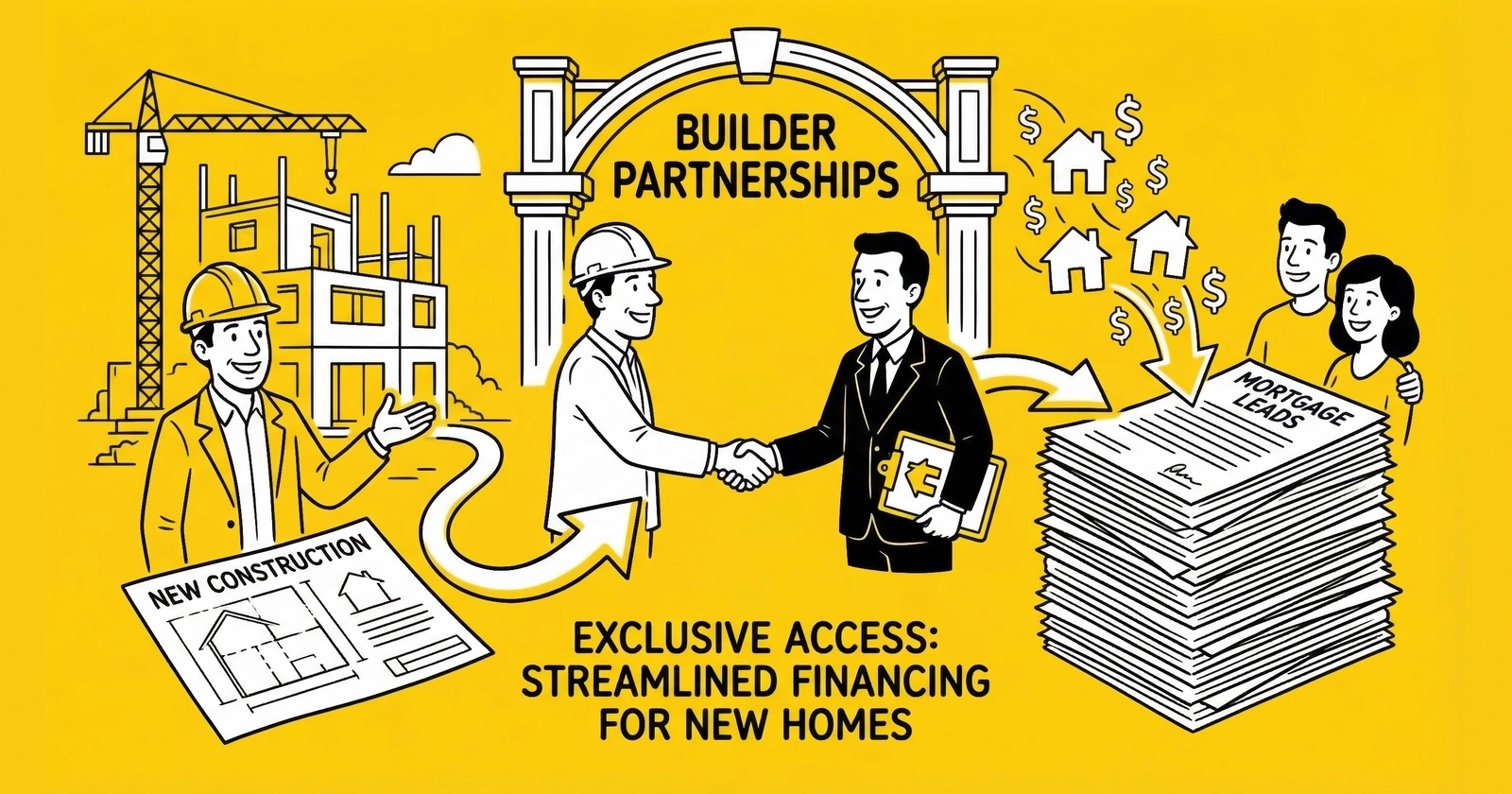
Those who crack builder partnerships access a lead channel that most competitors cannot touch. Here is how to structure relationships, capture exclusive arrangements, and build sustainable new construction mortgage lead flow in a market where builder financing incentives have become the default.
The Builder Advantage: Understanding the New Construction Opportunity
New construction represents a distinct segment of the mortgage lead market that operates under fundamentally different dynamics than resale home financing. When a buyer walks into a model home or contacts a builder’s sales office, they enter a sales ecosystem designed to convert them – and that ecosystem includes financing as a core component.
In 2024, new home sales reached 683,000 units, recovering from the 2023 trough while remaining below the 2021-2022 peak. The National Association of Home Builders projects 2025 single-family starts around 1.0-1.1 million units, up 4% from 2024 levels. Each of these transactions requires financing, and the majority of that financing flows through builder-affiliated lending channels.
The economics are compelling. New construction loans average 15-20% higher values than existing home purchases in the same markets – buyers choosing new construction typically purchase more home than comparable resale shoppers. Builder buyer profiles skew toward higher credit scores and more stable income documentation. First-time buyers represent approximately 35-40% of new construction purchases, creating opportunities for loan products with higher lifetime value through refinance and home equity relationships.
For mortgage lead generators and lenders, the builder partnership channel offers something increasingly rare: exclusive lead access at predictable volumes with reduced competition. A well-structured builder relationship can deliver 50-200 qualified purchase leads monthly from a single community, all pre-qualified by the builder’s sales process and predisposed to work with recommended financing partners.
The challenge is that builders have become sophisticated about extracting value from these relationships. This guide covers the mechanics of builder partnerships, the economics that make them work, and the operational requirements for capturing and converting new construction leads.
The Builder Financing Ecosystem
How Builder Lending Relationships Work
Most production builders maintain some form of affiliated or preferred lending arrangement. The structure varies, but the business logic remains consistent: builders benefit when their buyers can obtain financing quickly, reliably, and at competitive terms. Financing that falls through kills deals, delays closings, and creates cascading problems across production schedules.
Builder-Owned Mortgage Companies
The largest national builders operate captive mortgage subsidiaries. D.R. Horton operates DHI Mortgage, Lennar has Lennar Mortgage, PulteGroup owns Pulte Mortgage, and similar structures exist across the top 20 builders. These captive lenders capture 70-85% of their parent builders’ mortgage volume – a remarkable capture rate that demonstrates both the power of builder incentive structures and the convenience value of integrated financing.
Captive lender economics differ from independent mortgage operations. They operate as profit centers but also serve strategic purposes: ensuring closing reliability, enabling coordinated incentive programs, and providing another touchpoint for customer relationship management. Many captive lenders offer rates 25-75 basis points below market through builder subsidies, creating pricing advantages that independent lenders struggle to match.
Preferred Lender Programs
Regional and local builders who lack scale for captive lending operations typically establish preferred lender programs. These programs designate 2-5 lenders as “preferred” and recommend them to buyers, often with associated incentive structures.
Preferred lender arrangements take several forms:
Incentive-tied programs condition buyer incentives – closing cost credits, rate buydowns, upgrade allowances – on use of preferred lenders. A builder might offer $15,000 in closing costs with preferred lenders versus $5,000 with outside lenders. This creates powerful steering without formal exclusivity.
Performance-based programs grant preferred status based on closing reliability, communication quality, and buyer satisfaction scores. Lenders who perform well receive more referrals; those who cause closing delays lose preferred status.
Co-marketing arrangements involve lenders paying for on-site presence, marketing materials, or buyer appreciation events in exchange for referral flow. These arrangements require careful RESPA structuring.
Exclusive arrangements grant single-lender status for specific communities or developments. True exclusivity is rare but valuable – one lender receives all referrals in exchange for guaranteed service levels, competitive pricing, and often financial consideration.
The Sales Center Dynamic
Builder sales centers function as controlled environments optimized for conversion. Sales associates receive training on financing qualification, objection handling, and lender introduction protocols. The moment a buyer expresses serious interest, financing discussion begins.
Standard sales center process includes:
- Initial qualification conversation covering price range and payment expectations
- Introduction to on-site lender representative or preferred lender contact
- Pre-qualification or pre-approval before home selection
- Financing review integrated into purchase agreement signing
- Construction-period communication coordinated between sales, lending, and production
This process captures buyers at maximum intent – they’ve selected a home and are emotionally committed to the purchase. The financing discussion becomes “how we make this happen” rather than “whether we should proceed.”
Capture Rate Realities
Builder capture rates – the percentage of buyers who use builder-affiliated or preferred financing – vary significantly based on program structure and incentive strength:
| Program Type | Typical Capture Rate |
|---|---|
| Captive Lender (Large Builders) | 70-85% |
| Strong Preferred Program (3+ Points Incentive) | 50-70% |
| Moderate Preferred Program (1-2 Points) | 35-50% |
| Weak/No Preferred Program | 20-35% |
These capture rates reveal the opportunity. Even builders with captive lenders see 15-30% of buyers use outside financing. Preferred lender programs leave 30-50% of buyers available. For lead generators and lenders building builder relationships, the question is whether to compete for the open portion of builder flow or position for preferred status.
The builders themselves face trade-offs. Higher capture rates through stronger incentives reduce margin on each transaction but improve closing reliability and velocity. Builders in competitive markets often subsidize rates significantly to differentiate their communities. In seller’s markets, incentive requirements ease.
Building Builder Partnerships: The Relationship Framework
Identifying Partnership Opportunities
Not all builders represent equal partnership potential. Targeting requires analysis of builder characteristics, current lending arrangements, and market positioning.
Ideal Builder Partner Profile:
Volume and scale considerations: Target builders with sufficient volume to justify relationship investment but not so large that captive lending makes outside partnerships unlikely. Regional builders producing 200-1,000 homes annually often represent the sweet spot – enough volume to matter, typically operating preferred programs rather than captive lenders.
Geographic footprint: Builders with concentrated geographic presence enable efficient servicing. A builder with 10 communities within 50 miles allows for dedicated loan officer coverage. The same volume scattered across 500 miles creates operational challenges.
Community pipeline: Evaluate not just current production but planned communities. A builder with 5 active communities and 10 in development represents growth potential. Builders reducing land positions may offer diminishing opportunity.
Price point alignment: Match your lending capabilities to builder price points. Jumbo specialists should target luxury builders. FHA/VA expertise aligns with affordable housing focus. Misalignment creates operational friction.
Current lender relationships: Research existing preferred lender arrangements. Builders with exclusive agreements are poor near-term targets. Those with underperforming preferred lenders or no formal program present opportunity.
Research Methodology:
Builder research requires multiple sources:
Public information includes builder websites, community listings, price sheets, and incentive programs. Note which lenders appear in marketing materials or model home signage.
Industry databases such as Builder Magazine’s Builder 100, Metrostudy (now Zonda) market reports, and local Home Builders Association membership directories provide production data and market positioning.
NMLS searches identify current lending relationships. Search for loans originated at builder communities to identify active lenders.
Site visits to model homes reveal on-the-ground reality. Are lender representatives on-site? What incentive programs are promoted? How do sales associates discuss financing?
Relationship intelligence through industry events, trade associations, and professional networks often surfaces opportunities before formal RFP processes.
The Partnership Proposal
Approaching builders requires demonstrating value beyond commodity loan products. Builders evaluate potential lending partners on multiple dimensions.
What Builders Want:
Closing reliability. This matters more than rate. A lender who closes 95% of loans on time at market rates beats one offering rate advantages but causing closing delays. Builders measure preferred lenders on fall-through rates and closing timing more than borrower satisfaction scores.
Communication quality. Sales associates need visibility into loan status. Delays, documentation issues, and condition requirements must surface immediately so sales teams can intervene. Lenders who disappear into black boxes during processing create anxiety.
Incentive program flexibility. Builders structure various incentive programs – closing cost credits, rate buydowns, points contributions – and need lending partners who can implement these programs cleanly. Complex incentive calculations that delay processing frustrate everyone.
Construction lending knowledge. New construction loans have specific requirements: multiple appraisals, draw schedules for some products, rate lock extensions, completion timing coordination. Lenders inexperienced with new construction create problems that experienced partners avoid.
On-site presence at model homes and sales centers, particularly during high-traffic periods, demonstrates commitment and captures buyers at maximum intent.
Structuring Your Value Proposition:
Lead with operational excellence over pricing. Your proposal should address:
Service level commitments: Specific turnaround times for pre-qualification (24-48 hours), initial disclosure (same day as application), and clear-to-close (14-21 days from complete application). Include consequences for missing SLAs.
Communication protocols: Dedicated point of contact for sales associates, real-time status visibility (preferably via portal access), and defined escalation procedures for issues.
Builder incentive program capabilities: Detail how you’ll process closing cost credits, rate buydowns, and upgrade contributions. Provide sample disclosures and closing documents showing incentive application.
Co-marketing investment: On-site presence schedule, marketing material contributions, event sponsorship, and lead generation support.
Capture rate objectives: Commit to specific capture rate targets (e.g., 60% of referred buyers within 12 months) with quarterly review mechanisms.
Volume commitments: Some arrangements benefit from mutual volume commitments – you guarantee service levels for X monthly applications; they guarantee Y referral flow.
RESPA Considerations:
Builder-lender relationships face RESPA scrutiny. The Department of Housing and Urban Development and Consumer Financial Protection Bureau have focused enforcement attention on Affiliated Business Arrangements (AfBAs) and Marketing Services Agreements (MSAs) in this space.
Key compliance requirements:
Affiliated Business Arrangement disclosures when builder and lender share ownership require specific disclosure language, no required use provisions, and assurance that buyers understand they may choose other providers.
Marketing Services Agreement structuring for preferred lender payments requires that payments reflect fair market value for actual services rendered, not disguised referral fees. The more payments correlate with referral volume, the greater the enforcement risk.
Safe harbor practices include: never paying per-referral fees; ensuring any co-marketing payments reflect actual marketing activities at reasonable value; documenting services performed; and maintaining separation between marketing arrangements and referral expectations.
Legal review before entering builder partnerships is essential. The cost of counsel is trivial compared to RESPA enforcement exposure.
Converting Relationships to Exclusive Arrangements
True exclusivity – being the sole lending partner for a builder or community – represents the highest-value relationship structure. Exclusivity provides predictable volume, eliminates competition, and often includes deeper integration.
The Path to Exclusivity:
Few builders grant exclusivity to new partners immediately. The typical progression:
- Preferred lender status as one of 3-5 partners, earning referrals but competing for each buyer
- Reduced preferred field through performance differentiation, moving from 5 partners to 3, then to 2
- Community-level exclusivity for specific developments where you’ve demonstrated excellence
- Builder-wide exclusivity based on proven track record across multiple communities
Performance Metrics That Matter:
Builders evaluate preferred lenders on:
Capture rate among referred buyers – what percentage of buyers you touch actually close with you?
Fall-through rate – what percentage of started applications fail to close?
On-time closing percentage – do you hit scheduled closing dates?
Buyer satisfaction scores – Net Promoter Score or survey results from completed buyers
Response time – how quickly do you return pre-qualification requests and status inquiries?
Issue resolution – when problems arise, how effectively do you solve them?
Track and report these metrics proactively. Quarterly business reviews with builder leadership demonstrating performance create the foundation for exclusivity discussions.
Economic Models for Exclusivity:
Exclusive arrangements often involve financial components beyond normal marketing cooperation:
Minimum volume guarantees commit you to handle all referred volume regardless of peak fluctuations, requiring capacity reserves.
Rate competitiveness covenants may require pricing within defined spreads of market rates, documented through rate surveys.
Marketing investments above standard preferred lender levels – larger on-site presence, dedicated personnel, event sponsorship.
Technology integration such as direct API connections between builder sales systems and your loan origination system, enabling real-time status visibility.
Revenue sharing in some structures – though these require extremely careful RESPA analysis.
The exclusivity premium is worth paying for the right builder relationship. Predictable volume at reasonable capture rates often delivers better unit economics than fighting for share across multiple non-exclusive relationships.
Lead Flow and Conversion Dynamics
New Construction Lead Characteristics
Leads from builder partnerships differ from traditional mortgage leads in ways that affect both lead value and conversion approach.
Higher Qualification Rates
Builder sales processes include preliminary qualification before buyers are presented to lending partners. Sales associates discuss budget, down payment capacity, and credit situation during initial conversations. Buyers who clearly cannot qualify for financing typically don’t progress to lender introduction.
This pre-screening means builder-referred leads show higher qualification rates than standard mortgage leads:
| Lead Source | Pre-Qualification to Funded Rate |
|---|---|
| Standard Mortgage Lead (Aggregator) | 2-4% |
| Direct-to-Consumer Lead (Organic) | 4-7% |
| Real Estate Agent Referral | 5-10% |
| Builder Preferred Lender Referral | 12-18% |
| Builder Exclusive Lender Referral | 18-25% |
These elevated conversion rates transform unit economics – a dynamic covered in depth in our true cost per lead analysis. A $150 standard mortgage lead converting at 3% yields a cost per funded loan of $5,000. A builder lead at the same price converting at 15% yields $1,000 cost per funded. Even paying substantial premiums for builder access can deliver superior economics.
Longer Sales Cycles
New construction purchases involve extended timelines. From initial builder contact to home completion may span 6-18 months depending on community stage and production timeline:
To-be-built purchases for homes not yet started: 9-18 month timeline from contract to closing Under-construction purchases for homes in various completion stages: 3-9 months Spec home purchases for completed inventory: 30-90 days, similar to resale timing
These extended timelines require:
Rate lock strategy decisions – extended locks (270-360 day) incur significant costs that affect pricing Sustained borrower engagement across months of construction updates and milestone communications Requalification processes when borrower circumstances change during construction Coordination with builder production teams on completion timing
Construction-Specific Documentation
New construction loans require documentation beyond standard purchase mortgages:
Purchase agreement analysis to identify construction timeline, upgrade selections, builder incentive structures, and earnest money terms
Appraisal coordination including subject-to-completion appraisals for under-construction properties, which require coordination with builder on specifications and completion timeline
Builder verification confirming builder licensing, insurance, and warranty coverage meets investor requirements
Upgrade and option handling for pricing changes between contract and closing, which can affect loan amount and qualification
Earnest money tracking including builder deposit structures that may differ from resale transactions
Conversion Optimization
Converting builder-referred leads requires approaches tailored to the new construction sales environment.
Despite longer overall timelines, initial response speed matters as much for builder leads as any other source. The buyer standing in a model home talking to a sales associate represents peak intent. Responding to that introduction within minutes rather than hours dramatically improves conversion.
Best practices include:
On-site presence during high-traffic periods (weekends, evenings) enables immediate face-to-face engagement Instant notification systems alert assigned loan officers to new referrals immediately Mobile-optimized pre-qualification following mobile-first optimization principles allows buyers to complete initial applications from the model home Same-day pre-qualification delivery provides buyers and sales associates with qualification letters before the buyer leaves the community
Builder Sales Team Coordination
Your relationship with builder sales associates often determines referral quality and volume. Sales associates who trust you send their best buyers and advocate for your financing during buyer conversations. Those who’ve experienced problems route buyers elsewhere.
Cultivate sales associate relationships through:
On-site presence that builds personal connection beyond transaction processing Educational sessions on financing products, qualification requirements, and incentive programs Timely status updates that enable sales associates to manage buyer expectations Problem resolution that protects sales associate relationships with their buyers Recognition programs for communities or associates who drive strong capture rates
Construction Period Engagement
The months between contract and closing represent both risk and opportunity. Borrowers may experience life changes – job transitions, major purchases, credit impacts – that affect qualification. Proactive engagement reduces fall-through risk:
Monthly check-ins covering employment status, income changes, and credit activity Credit monitoring to identify issues before they affect qualification Construction milestone updates that maintain engagement and excitement Rate lock management including extension negotiations and float-down opportunities Document preparation to ensure complete files before construction completion
Handling Builder Incentives
Builder incentives require specific processing to avoid disclosure problems and investor issues:
Closing cost credits must be properly disclosed on loan documents and may be limited by investor guidelines (typically maximum 3-6% of purchase price depending on product), reflecting practices similar to those in exclusive lead arrangements Rate buydowns affect pricing and disclosure, requiring coordination between builder contribution and loan terms Upgrade contributions that affect purchase price require appraisal and documentation adjustment Earnest money credits have specific handling requirements depending on structure
Develop standard procedures for each incentive type your builder partners offer. Inconsistent handling creates compliance risk and processing delays.
Economics of Builder Partnership Lead Flow
Understanding Your True Cost Per Lead
Builder partnership costs extend beyond obvious payments. Calculating true CPL requires accounting for all investment required to generate and maintain lead flow.
Direct Costs:
On-site presence: Loan officer hours at model homes and sales centers. If a loan officer spends 15 hours weekly at builder locations, their loaded cost (salary, benefits, overhead) for that time constitutes direct lead generation expense.
Marketing contributions: Co-marketing payments, signage, materials, event sponsorship. These may be fixed monthly amounts or tied to specific programs.
Technology costs: CRM integrations, builder portal access, extended rate lock coverage, construction loan processing systems.
Extended lock premiums: Construction timeline loans often require 180-360 day rate locks. The premium above standard 30-60 day locks represents acquisition cost.
Indirect Costs:
Relationship development: Time invested in builder meetings, business reviews, problem resolution, and relationship maintenance.
Preference erosion: Builder partnerships often require pricing concessions – rates 12.5-25 basis points below your standard pricing, or fee waivers. The margin reduction applies to all loans originated through the relationship.
Volume commitment risk: Exclusive or semi-exclusive arrangements may include minimum volume handling requirements that create capacity obligations.
CPL Calculation Example:
Consider a regional builder partnership generating 40 leads monthly:
| Cost Category | Monthly Amount |
|---|---|
| LO On-Site Time (15 hrs/wk x $75/hr loaded) | $4,500 |
| Marketing Contribution | $2,000 |
| Technology/Integration | $500 |
| Extended Lock Premium (15 loans x $400) | $6,000 |
| Pricing Concession (15 loans x $1,500) | $22,500 |
| Total Monthly Investment | $35,500 |
CPL = $35,500 / 40 leads = $887.50
This CPL appears high until you consider conversion. At 15% conversion (6 funded loans), cost per funded loan is $5,917. If these loans average $450,000 with 2.5% revenue (origination plus servicing value), revenue per funded loan is $11,250. Net contribution per loan: $5,333.
Contrast with a standard lead aggregator source at $75 CPL but 3% conversion:
- CPL: $75
- Cost per funded: $2,500
- Revenue per funded (assume $350,000 average at 2.5%): $8,750
- Net contribution: $6,250
The aggregator source appears more efficient, but consider:
- Aggregator leads require higher servicing intensity (more contacts, longer sales cycles)
- Aggregator leads have higher fallout rates post-application
- Builder leads provide sustainable, predictable volume versus aggregator volatility
- Builder relationships compound – strong performance leads to exclusivity and additional communities
Pricing Strategy for Builder Programs
Builder partnerships often require pricing concessions. Structuring these concessions strategically preserves margin while meeting builder expectations.
Rate Buydown Strategies:
Rather than blanket rate reductions, structure pricing around builder-funded buydowns:
Builder-paid permanent buydowns where builder contributes 1-2 points to reduce borrower rate. You price at market; the effective rate comes from builder subsidy.
Temporary buydowns (2-1 or 3-2-1 structures) where builder pays for initial year rate reductions. These require less builder contribution while delivering meaningful payment reduction.
Seller credit structures where builder provides closing cost credit that borrower can apply toward buydown. Maintains pricing transparency while delivering rate benefit.
Fee Structure Optimization:
If margin compression is unavoidable, optimize where it occurs:
Origination fee waivers are more visible to borrowers and builders than processing/underwriting fee adjustments Credit pricing can be modestly reduced without full rate sheet adjustments Lender credits toward closing costs maintain rate while improving borrower economics
Volume-Based Pricing:
Structure pricing to improve with volume:
Tier 1 (1-10 monthly closes): Standard preferred lender pricing Tier 2 (11-25 monthly closes): 12.5 bps rate improvement Tier 3 (26+ monthly closes): 25 bps rate improvement
This structure rewards capture rate performance and exclusive relationships while protecting margin on lower-volume partnerships.
Lifetime Value Considerations
New construction borrowers often represent higher lifetime value than standard purchase borrowers:
Higher loan amounts increase initial origination value First-time buyer concentration creates future refinance and home equity opportunity Relationship depth through construction period engagement builds retention Builder community tenure often correlates with longer residence periods, reducing prepayment speed
Model lifetime value for builder-originated loans including:
- Initial origination revenue
- Servicing value (if retained)
- Refinance probability and timing
- Home equity product likelihood
- Referral potential
Lifetime value calculations often justify builder partnership investments that appear marginal on immediate origination economics.
Operational Requirements for Builder Partnerships
Staffing and Coverage
Successful builder partnerships require dedicated personnel and coverage models that align with builder operations.
Loan Officer Allocation:
Builder programs typically require dedicated or partially-dedicated loan officers rather than including builder leads in general distribution. Consider:
Full dedication: For builders generating 80+ leads monthly, dedicated loan officers focused exclusively on that builder relationship
Partial dedication: For moderate volume (30-80 leads monthly), loan officers with builder partnership as primary focus but some general production
Rotational coverage: For lower volume or multiple smaller builders, shared coverage with scheduled on-site presence
Coverage Hours:
Builder sales centers operate when buyers shop – evenings and weekends represent peak traffic. Coverage requirements typically include:
Saturday 10 AM - 5 PM: Highest traffic period, on-site presence essential Sunday 12 PM - 5 PM: Second-highest traffic, on-site presence recommended Weekday evenings 5 PM - 8 PM: Post-work shopping, phone availability minimum Weekday business hours: Processing and status updates, on-site as volume warrants
Operations optimized for Monday-Friday 9-5 cannot serve builder partnerships effectively.
Support Team Requirements:
Builder loan processing differs from standard flow:
Construction coordination specialists who understand completion timelines, draw schedules (for some products), and builder documentation requirements
Extended lock management for rate lock extensions, float-downs, and re-locks as construction timelines shift
Builder liaison roles for relationship maintenance, business reviews, and issue escalation
Technology Infrastructure
Builder partnerships benefit from technology integration that improves both operational efficiency and builder visibility.
CRM Integration:
Lead flow from builders should integrate with your CRM automatically:
- Real-time lead notification and assignment
- Builder community and sales associate tracking
- Activity logging visible to builder stakeholders (with appropriate access controls)
- Milestone tracking aligned with construction timeline
Builder Portal Access:
Sophisticated builder programs expect portal visibility into:
- Lead status by community
- Pipeline by stage (pre-qual, application, processing, closing)
- Capture rate and conversion metrics
- On-time closing performance
- Upcoming closings with expected dates
Building or configuring portal access demonstrates partnership commitment and enables builder sales management to monitor program performance.
Rate Lock Management:
Extended rate locks for construction timelines require:
- Lock tracking with extension deadlines
- Pricing alerts when market movement creates float-down opportunities
- Automated extension processing to avoid expiration
- Lock commitment management against overall lock position
Document Management:
Construction loans generate more documentation:
- Purchase agreement and amendments
- Specification sheets and upgrade summaries
- Construction progress documentation
- Appraisal updates if significant changes occur
- Builder insurance and warranty certificates
Organized document management reduces processing friction and supports faster time-to-close.
Quality and Compliance
Builder partnerships face heightened scrutiny for compliance and quality given the relationship structures involved.
RESPA Documentation:
Maintain comprehensive documentation of builder arrangements:
- Written agreements detailing services provided and compensation received
- Marketing activity logs for any co-marketing payments
- Disclosure copies for any Affiliated Business Arrangements
- Regular compliance review with legal counsel
Quality Metrics:
Track and report metrics that matter to builders:
- On-time closing percentage (target: 95%+)
- Fall-through rate (target: below 5%)
- Capture rate among referred leads
- Cycle time from application to clear-to-close
- Borrower satisfaction scores
Proactive quality reporting demonstrates operational excellence and supports preference/exclusivity discussions.
Audit Preparation:
Regulatory examination of builder-lender relationships occurs. Maintain files supporting:
- Fair market value basis for any payments made
- Services actually rendered for co-marketing compensation
- No correlation between payments and referral volume
- Proper disclosure of affiliated relationships
Market Dynamics and Strategic Positioning
Current New Construction Market Conditions
The 2024-2025 new construction market reflects transitional dynamics that create both challenges and opportunities for builder-focused lead generation.
Supply Conditions:
Housing supply constraints that characterized the 2020-2022 market have eased but not resolved. Single-family housing starts reached approximately 1.0 million units in 2024, below the 1.1-1.2 million annual pace many economists consider necessary to meet demand. This persistent undersupply supports builder pricing power and limits buyer negotiating leverage.
Builder Incentive Environment:
Elevated mortgage rates have pushed builders toward aggressive financing incentives as their primary demand-generation tool. Builder rate buydowns have become standard rather than promotional – many national builders routinely offer 1-2 point rate buydowns on preferred lender closings, effectively subsidizing rates 25-50 basis points below market.
This incentive environment affects lead generation in several ways:
- Preferred lender status becomes more valuable as rate buydowns increase
- Outside lenders face steeper disadvantages competing against subsidized rates
- Lead capture rates correlate strongly with incentive program strength
- Margin pressure increases as builders expect lender contribution to incentive programs
Regional Variation:
New construction activity concentrates in specific markets:
High-activity markets (Texas, Florida, Arizona, North Carolina): Builder volume supports multiple preferred lender relationships and active competition for partnership status
Moderate-activity markets (Midwest, Mountain West): Smaller builder footprints but less competition for partnerships; exclusivity more achievable
Constrained markets (California coastal, Northeast): Limited new construction due to land/regulatory constraints; premium pricing for available opportunities
Buyer Profile Shifts:
Rising rates and home prices have affected new construction buyer profiles:
- First-time buyer share has compressed from 40%+ to 30-35% in many markets
- Move-up and move-down buyers (trading existing homes) now represent larger share
- Cash buyer percentage has increased, particularly for quick-move inventory
- Credit profile has improved as marginal buyers have exited the market
Competitive Landscape
Builder partnership competition varies by market and builder tier:
National Builder Competition:
Captive lenders dominate national builder volume. Competing for D.R. Horton, Lennar, or PulteGroup preferred status means competing against their own mortgage subsidiaries – typically unsuccessful unless offering products (non-QM, jumbo) that captive lenders don’t offer.
Better opportunities exist for:
- Specific community niches (luxury communities where captive lenders lack jumbo expertise)
- Product gaps (FHA/VA specialization, renovation loans)
- Geographic edges (markets where captive lender coverage is thin)
Regional Builder Opportunity:
Regional builders (200-2,000 annual homes) represent the primary opportunity zone:
- Most operate preferred lender programs rather than captive lending
- Relationship-based decision making is accessible
- Performance differentiation can earn exclusivity
- Volume justifies dedicated partnership investment
Local Builder Dynamics:
Local builders (under 200 annual homes) offer relationship opportunities but volume challenges:
- Often lack formal preferred lender programs
- Personal relationship with builder owner/principals drives referrals
- Volume may not justify dedicated resources
- Aggregating multiple local builder relationships can create viable combined volume
Strategic Positioning Options
Several strategic positions exist within the builder partnership landscape:
Specialist Positioning:
Focus on specific builder segments where expertise creates advantage:
Luxury new construction requiring jumbo products, complex income documentation, and white-glove service expectations. Premium pricing supports higher service cost.
Affordable housing builders with FHA/VA expertise, down payment assistance program knowledge, and first-time buyer support. Volume-oriented economics.
Active adult communities (55+) with reverse mortgage, retirement income documentation, and specific product expertise for this demographic.
Custom and semi-custom builders requiring construction-to-permanent expertise, draw management, and specification flexibility.
Geographic Concentration:
Build density within specific geographic markets:
- Develop relationships with multiple builders in concentrated area
- Enable efficient on-site coverage across multiple communities
- Create market expertise that supports all builder relationships
- Build reputation that attracts new builder partnerships
Multi-Channel Integration:
Combine builder partnerships with other new construction lead sources:
- Real estate agent relationships in new construction communities
- Digital marketing targeting new construction search traffic
- Relocation company partnerships for corporate relocations to new communities
- New home search platform presence (NewHomeSource, Building Homes)
Integrated multi-channel approach reduces dependence on any single builder relationship while building new construction expertise.
Frequently Asked Questions
Q1: What are typical capture rates for builder preferred lender programs?
Capture rates vary significantly based on incentive strength and program structure. Captive lenders at national builders typically capture 70-85% of buyer volume. Strong preferred programs with meaningful incentive differentials (3+ points between preferred and non-preferred lenders) achieve 50-70% capture. Moderate programs with smaller incentive differentials see 35-50% capture. Weak or informal preferred arrangements may only capture 20-35%. For lead generators and lenders entering builder relationships, realistic initial capture targets are 40-50%, growing toward 60-70% as relationships mature and performance demonstrates value.
Q2: How do builder-affiliated mortgage companies affect partnership opportunities?
Large national builders with captive mortgage subsidiaries (DHI Mortgage, Lennar Mortgage, Pulte Mortgage) capture the majority of their parent company’s volume, limiting outside partnership opportunities. However, opportunities exist in specific niches: jumbo loans where captive lenders may lack competitive products, specialty programs (renovation, construction-to-perm) outside captive lender focus, geographic markets where captive coverage is thin, and product types like non-QM that captive lenders may not offer. Regional builders without captive lenders represent more accessible partnership opportunities, typically operating preferred lender programs with 2-5 participating lenders.
Q3: What RESPA considerations apply to builder-lender partnerships?
RESPA Section 8 prohibits paying or receiving anything of value for referral of settlement service business. Builder-lender partnerships face scrutiny when payments correlate with referral volume or appear to compensate for referrals rather than actual services. Safe practices include: ensuring any co-marketing payments reflect fair market value for documented marketing activities; avoiding per-referral fee structures; maintaining Affiliated Business Arrangement disclosures when ownership connections exist; documenting all services rendered; and obtaining legal review before entering or modifying partnership arrangements. CFPB and state enforcement actions have targeted improper Marketing Services Agreements in this space, making compliance review essential.
Q4: What makes builder-referred leads different from standard mortgage leads?
Builder-referred leads typically show higher qualification rates (12-25% conversion versus 2-4% for aggregator leads) because buyers have been pre-screened by builder sales processes. These leads represent longer sales cycles (6-18 months for to-be-built homes versus 30-60 days for resale). They require construction-specific expertise including extended rate locks, subject-to-completion appraisals, and builder incentive processing. Documentation requirements include construction timelines, specification sheets, and upgrade summaries beyond standard purchase documentation. The tradeoff is lower volume volatility and more predictable flow compared to market-responsive lead sources.
Q5: What on-site presence is typically expected for preferred lender status?
Builder expectations vary, but standard preferred lender programs typically expect: Saturday coverage during peak shopping hours (10 AM - 5 PM); Sunday coverage at minimum on high-traffic weekends or for active communities; availability during weekday evening hours (phone response if not on-site); attendance at builder events, grand openings, and realtor broker tours; participation in buyer appreciation events and closing celebrations. Exclusive arrangements often require more extensive presence including dedicated personnel at sales centers during all operating hours. Presence requirements should be explicitly negotiated and documented in preferred lender agreements.
Q6: How should extended rate locks for construction timelines be handled?
New construction timelines require rate locks significantly longer than standard 30-60 day locks. For to-be-built homes with 9-18 month construction periods, options include: extended locks (270-360 day) with associated premiums typically 0.5-1.5% of loan amount depending on market conditions; construction-to-permanent programs with single-close structures; float-down provisions allowing rate reduction if markets improve; and forward commitment structures for sophisticated operations. Lock costs should factor into partnership economics calculations. Some builder programs include lock extension provisions as part of incentive structures. Rate lock management systems become essential for tracking extensions and avoiding costly expirations.
Q7: What technology integration do builder partnerships require?
Effective builder partnerships benefit from: CRM integration enabling real-time lead notification and assignment from builder referrals; builder-facing portal access providing pipeline visibility by community and status; automated status updates keeping builder sales associates informed without manual reporting; rate lock management systems for extended lock tracking and extension processing; document management for construction-specific documentation; and API connections to builder sales systems for direct data transfer where available. Investment in technology integration demonstrates partnership commitment and reduces operational friction that can erode builder confidence.
Q8: How do you measure builder partnership ROI?
Calculate comprehensive partnership ROI including all costs: loan officer time at on-site presence and relationship maintenance; marketing contributions and co-marketing investments; technology and integration costs; extended lock premiums above standard lock costs; pricing concessions versus standard rate sheet (margin reduction); and volume commitment obligations. Compare against returns: origination revenue on funded loans; servicing value if retained; lifetime value including refinance and home equity probability; capture rate trends indicating relationship strength; and qualitative value of predictable, sustainable lead flow versus volatile aggregator sources.
Q9: What performance metrics matter most to builders?
Builders evaluate preferred lenders primarily on operational reliability rather than pricing. Key metrics include: on-time closing percentage (target 95%+) as delays disrupt production schedules and create buyer friction; fall-through rate (target under 5%) measuring loans started but not closed; capture rate among referred buyers indicating lender effectiveness; response time for pre-qualification and status inquiries; and buyer satisfaction scores reflecting quality of financing experience. Track these metrics proactively and share in regular business reviews. Performance differentiation on these metrics creates the foundation for exclusivity discussions.
Q10: What is the path to exclusive builder relationships?
Exclusivity rarely occurs immediately with new partners. Typical progression involves: entering as one of 3-5 preferred lenders; demonstrating superior performance on key metrics over 6-12 months; earning increased referral share as performance differentiates; achieving reduced preferred field (from 5 to 3 to 2 partners) as builder consolidates relationships; winning community-level exclusivity for specific developments; and eventually builder-wide exclusivity based on proven track record. Each step requires documented performance, proactive communication, and relationship investment. The timeline from initial preferred status to exclusivity typically spans 18-36 months for successful partners.
Key Takeaways
-
Builder partnerships provide exclusive access to high-converting leads. Builder-referred leads convert at 12-25% versus 2-4% for standard aggregator leads. This conversion advantage transforms unit economics, making higher effective CPLs economically superior to cheap low-conversion leads.
-
Capture rates depend on incentive structures. Strong preferred programs with meaningful buyer incentives capture 50-70% of volume. Understanding builder incentive structures helps identify partnership opportunities and realistic capture expectations.
-
RESPA compliance requires careful structuring. Builder-lender relationships face regulatory scrutiny. Any payments must reflect fair market value for actual services rendered. Legal review before entering partnerships protects against enforcement risk that can destroy businesses.
-
Operational reliability matters more than pricing. Builders evaluate preferred lenders on closing reliability, communication quality, and problem resolution. A lender who closes 95% on time at market rates beats one offering rate advantages but causing delays.
-
Extended timelines require different operational approaches. New construction sales cycles span 6-18 months, requiring sustained borrower engagement, extended rate lock management, and construction-specific processing expertise.
-
On-site presence builds relationships and captures intent. Weekend and evening coverage at model homes captures buyers at peak intent and builds sales associate relationships that drive referral quality and volume.
-
Performance metrics create the path to exclusivity. Track on-time closing, fall-through rates, capture rates, and buyer satisfaction. Proactive reporting and quarterly business reviews demonstrate value and support exclusivity progression.
-
Regional builders represent the primary opportunity. National builders with captive lenders leave limited outside opportunity. Regional builders operating preferred programs offer accessible partnerships where performance can earn exclusivity.
-
Technology integration demonstrates commitment. CRM integration, builder portal access, and rate lock management systems reduce operational friction and provide visibility that builds builder confidence.
-
Lifetime value justifies partnership investment. New construction borrowers represent higher loan amounts, first-time buyer concentration with refinance potential, and relationship depth through construction period engagement. Model lifetime value to properly evaluate partnership ROI.
Market data and operational benchmarks current as of late 2024/early 2025. Builder programs, incentive structures, and market conditions vary by region and change over time. Validate current conditions through direct builder engagement before making significant investment decisions. This article provides general information and does not constitute legal or financial advice. Consult qualified professionals for RESPA compliance and specific partnership structuring questions.