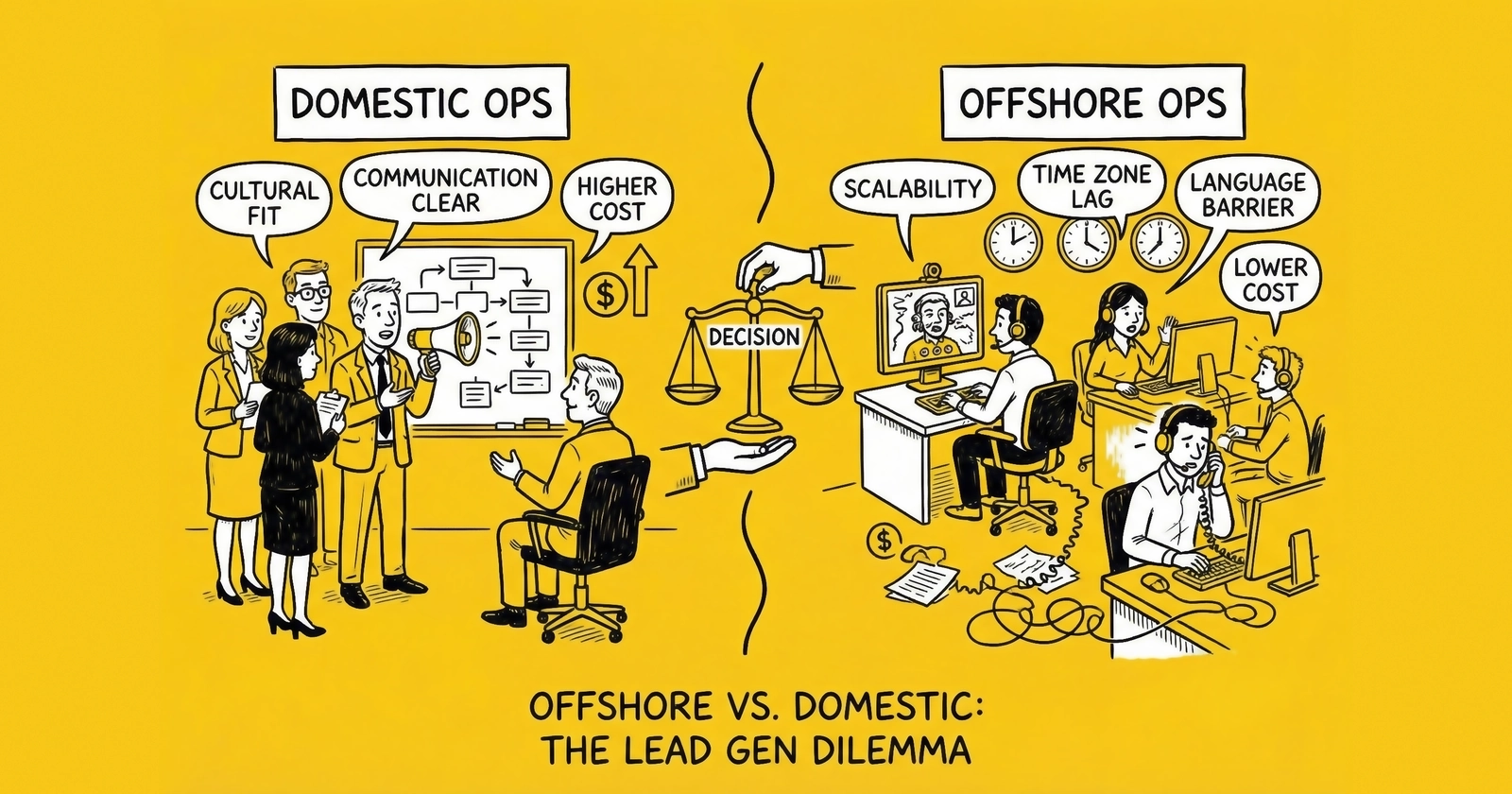
Offshore operations promise 70-80% labor cost savings, but fully-loaded costs compress actual savings to 50-65%. Organizations that treat this decision purely as a cost calculation frequently discover their projected economics bear little resemblance to reality.
The decision between offshore and domestic lead generation operations carries consequences that extend far beyond the obvious cost differential. While offshore operations can reduce labor costs by 60-80% in certain functions, the calculus becomes considerably more complex when factoring in quality control requirements, compliance exposure, time zone coordination challenges, and the hidden costs that surface months after initial deployment. Organizations that approach this decision purely through a cost lens frequently discover that the economics they projected bear little resemblance to the economics they experience.
This analysis examines the full spectrum of considerations that determine whether offshore, domestic, or hybrid operational models deliver optimal outcomes for lead generation businesses. The framework encompasses labor cost differentials across major offshore markets, quality benchmarking data by function and geography, compliance implications that vary dramatically by lead vertical, and the organizational capabilities required to manage distributed operations effectively. For lead generation operators evaluating their operational footprint, the evidence suggests that the right answer depends heavily on factors that generic cost comparisons obscure. For foundational context on how lead generation economics work, see our guide to how the lead economy operates.
The Evolving Geography of Lead Generation Operations
Lead generation operations have undergone substantial geographic redistribution over the past decade, driven initially by cost arbitrage and more recently by a complex interplay of technological capability, regulatory pressure, and talent availability. Understanding this evolution provides essential context for operational decisions that will shape competitive positioning for years to come.
The strategic importance of this decision extends beyond immediate cost considerations to encompass organizational capability development, risk exposure management, and long-term competitive positioning. Organizations that approach operational footprint decisions purely through a procurement lens frequently discover that the choices they make today constrain strategic options available tomorrow. The infrastructure, relationships, and institutional knowledge built through offshore or domestic operations create path dependencies that prove difficult to reverse.
Market observers note that the sophistication of offshore-domestic decisions has increased substantially as the industry has matured. Early adopters often moved operations offshore with minimal analysis, attracted by headline cost savings that sometimes failed to materialize when fully-loaded costs were calculated. Contemporary decision-makers benefit from a decade of industry experience that reveals which functions genuinely benefit from offshore execution and which suffer quality degradation that erases apparent savings. This accumulated wisdom enables more nuanced operational design than the binary offshore-or-domestic thinking that characterized earlier approaches.
Historical Patterns and Current State
The offshoring wave in lead generation began in earnest around 2008-2010, following patterns established in customer service and back-office processing. Early adopters targeted high-volume, low-complexity functions – primarily data entry, list building, and basic lead qualification. The Philippines emerged as the dominant destination for English-language voice operations, while India captured significant share of data processing and technical support functions. Eastern European markets, particularly Poland, Ukraine, and Romania, developed strength in content creation and more technically sophisticated marketing operations.
By 2024, industry surveys indicate that approximately 45% of lead generation companies with annual revenues exceeding $5 million maintain some offshore operational presence, according to research from the Professional Association for Customer Engagement. However, the nature of that presence has evolved considerably from the early cost-arbitrage model. Sophisticated operators now deploy offshore resources strategically across specific functions rather than wholesale operational migration, recognizing that the quality-cost trade-off varies dramatically by activity type.
The pandemic accelerated certain trends while reversing others. Remote work normalization eliminated the binary distinction between “offshore” and “domestic” for many functions – a quality assurance analyst working from Manila proved functionally equivalent to one working from Des Moines when both operated remotely. Simultaneously, supply chain disruptions and geopolitical instability prompted some organizations to reshore operations they had previously moved offshore, prioritizing resilience over cost optimization.
The Cost Differential Reality
Raw labor cost comparisons between offshore and domestic markets remain substantial, though the gap has narrowed in many categories as offshore markets mature and domestic wages in certain regions remain relatively flat.
| Role | US Average Hourly Cost | Philippines | India | Eastern Europe | Cost Savings |
|---|---|---|---|---|---|
| Lead Qualification (Voice) | $18-25 | $6-9 | $5-8 | $10-15 | 56-72% |
| Data Entry/Processing | $15-20 | $4-6 | $3-5 | $7-10 | 67-80% |
| Content Writing | $25-45 | $8-15 | $6-12 | $12-20 | 56-73% |
| Quality Assurance | $20-30 | $7-10 | $5-8 | $10-14 | 53-73% |
| Campaign Management | $35-55 | $12-18 | $10-15 | $15-25 | 55-71% |
| Technical/Development | $45-85 | $15-25 | $12-20 | $20-35 | 59-76% |
Source: Glassdoor global salary data, Robert Half International 2024, Outsource Accelerator 2024
These figures, while directionally accurate, mask significant variation within each market. Manila commands premium rates compared to provincial Philippine cities like Davao or Cebu. Bangalore and Hyderabad have experienced wage inflation that makes them 30-40% more expensive than emerging Indian tech hubs like Jaipur or Indore. Within Eastern Europe, Warsaw and Prague cost substantially more than Lviv or Bucharest.
The fully-loaded cost calculation extends well beyond hourly wages. Organizations must account for management overhead, quality control infrastructure, technology and connectivity requirements, training and onboarding investments, and the less quantifiable costs of coordination friction and error remediation. Research from Deloitte’s 2024 Global Outsourcing Survey indicates that actual realized savings typically run 15-25% below projected savings when these factors are fully incorporated, with the gap widest for complex, judgment-intensive functions.
Functional Analysis: Where Offshore Operations Excel and Struggle
The offshore advantage varies dramatically by function, and organizations that treat all activities as equivalent candidates for offshore migration typically encounter quality degradation that erases cost savings. A granular analysis of function-specific performance provides the foundation for intelligent operational design.
High-Suitability Functions for Offshore Operations
Certain lead generation activities demonstrate consistent success in offshore environments, characterized by clear process definition, objective quality measurement, and limited requirements for cultural context or real-time judgment.
Data hygiene and list processing represents perhaps the clearest offshore success case. Tasks like duplicate identification, format standardization, contact information verification, and database cleanup require attention to detail and process adherence rather than cultural nuance or complex judgment. Organizations report quality levels equivalent to domestic operations at 65-75% lower cost when proper training and quality control systems are implemented. The key success factor involves establishing unambiguous rules and automated validation wherever possible, minimizing the judgment required from individual processors.
Research and data enrichment similarly translates well to offshore environments, particularly when the research draws from publicly available sources and follows defined protocols. Building prospect lists, gathering firmographic data, identifying organizational hierarchies, and locating contact information all perform well offshore when clear specifications define what constitutes success. Companies like LeadGenius and Coresignal have built substantial businesses combining offshore research teams with technology-enabled quality control.
Initial lead qualification for inbound inquiries can succeed offshore when scripts are well-developed, qualification criteria are objective, and the product or service being discussed doesn’t require deep cultural context. Simple qualification questions – budget range, timeline, decision-making authority, current solution – translate across borders when delivered professionally. The Philippines in particular has developed strong capability in this function, benefiting from cultural affinity with American business communication norms and generally neutral English accents.
Moderate-Suitability Functions
Several lead generation activities present mixed track records offshore, succeeding under specific conditions but failing when those conditions aren’t met.
Content creation occupies contested territory. Factual content, data-driven analysis, and technical documentation can succeed offshore with proper editorial oversight. Creative content, culturally-specific messaging, and persuasive copywriting that requires understanding American consumer psychology presents substantially greater challenges. Organizations typically find that offshore content requires more extensive revision, eroding but not eliminating cost advantages. The most successful models pair offshore writers handling initial drafts with domestic editors who refine voice and cultural resonance.
Quality assurance and compliance review presents a nuanced picture. Offshore QA teams can effectively evaluate objective criteria – data accuracy, script adherence, form completion – at compelling economics. Evaluating subjective dimensions like conversation quality, appropriate judgment in edge cases, or culturally-appropriate communication proves more challenging. Many organizations adopt hybrid approaches: offshore teams handle volume QA against objective criteria, while domestic specialists review samples and handle escalations requiring nuanced judgment.
Campaign execution and optimization depends heavily on the complexity involved. Executing defined playbooks, monitoring dashboards, and making routine adjustments based on clear thresholds succeeds offshore. Strategic optimization requiring deep understanding of market dynamics, competitive positioning, and buyer psychology typically requires domestic expertise or very experienced offshore professionals who command rates that diminish cost advantages.
Low-Suitability Functions
Certain activities consistently underperform when executed offshore, with quality degradation that typically exceeds cost savings.
Complex sales conversations and consultative qualification require cultural fluency, real-time judgment, and the ability to navigate unscripted dialogue that offshore teams rarely deliver at acceptable quality levels. While offshore appointment setting can work for simple transactions, consultative engagements that require understanding business context, reading conversational cues, and adapting approach based on prospect responses perform markedly better with domestic resources. Organizations that have attempted to offshore complex B2B qualification typically report conversion rate declines of 25-40% that dwarf labor cost savings.
Compliance-sensitive customer interactions carry risk profiles that argue strongly for domestic execution, particularly in heavily regulated verticals. TCPA compliance, state-specific disclosure requirements, and real-time judgment about consent and opt-out handling require understanding that offshore teams struggle to maintain consistently. The cost of a single compliance violation – potentially $500-$1,500 per occurrence under TCPA – can eliminate years of offshore labor savings.
Strategic account management and client communication for lead generation businesses selling to domestic buyers almost universally performs better domestically. Time zone challenges, cultural communication differences, and the relationship depth required for strategic partnerships all favor domestic resources for client-facing roles.
Geographic Market Assessment
Each major offshore market brings distinct characteristics that make it more or less suitable for specific lead generation functions. Understanding these differences enables targeted deployment that maximizes the fit between function and geography.
The Philippines: Voice Operations Leader
The Philippines has established clear leadership in offshore voice operations for English-language markets, with an estimated 1.3 million Filipinos employed in business process outsourcing according to the IT and Business Process Association of the Philippines (IBPAP). Several factors underpin this dominance.
Cultural affinity with American communication styles runs deeper in the Philippines than in most offshore markets, a legacy of historical ties and sustained media exposure. Filipino agents typically demonstrate natural comfort with American idioms, humor, and conversational patterns that feels forced or awkward from other regions. This cultural resonance translates into higher customer satisfaction scores and conversion rates compared to other offshore options for voice-based lead qualification.
English proficiency, while strong, varies more than the market’s reputation suggests. Accent neutrality has improved significantly through industry investment in speech training, though some regional variations persist. Organizations should plan for screening and training investments to ensure consistent communication quality.
Time zone alignment with US operations presents challenges, with Manila 12-13 hours ahead of US Eastern time. However, the Filipino workforce demonstrates strong willingness to work night shifts for the premium wages BPO employment provides relative to local alternatives. This cultural acceptance of shift work that would face resistance in many markets enables 24/7 operations more readily than in other regions.
| Strength | Rating | Evidence |
|---|---|---|
| English voice quality | Strong | 89% customer satisfaction scores vs 82% India average (Everest Group 2024) |
| Cultural alignment | Strong | Highest “accent neutrality” ratings among Asian offshore markets |
| Night shift availability | Strong | 75% of workforce willing to work US-hours shifts |
| Technical depth | Moderate | Growing but still developing advanced technical capabilities |
| Cost competitiveness | Moderate | 15-25% premium over India but 30-40% below Eastern Europe |
India: Scale and Technical Capability
India offers unmatched scale for lead generation operations, with the ability to rapidly deploy hundreds or thousands of resources when projects demand. The technical workforce depth exceeds any other offshore market, making India particularly strong for data processing, technical content, and any function requiring analytical capability.
English proficiency presents a more complex picture than the Philippines. Written English capability is generally strong, particularly among university-educated workers. Spoken English varies more significantly, with accent differences that some American prospects find challenging. For voice operations targeting American consumers, India typically trails the Philippines on communication quality metrics, though the gap has narrowed with accent training investments.
Cost competitiveness remains India’s compelling advantage for non-voice functions. At 20-30% below Philippine rates for comparable roles, India delivers the strongest pure cost arbitrage among major markets. For high-volume data processing, research, and technical work where voice communication isn’t central, this cost advantage makes India difficult to match.
The Indian BPO workforce has matured significantly, with management talent capable of running sophisticated operations independently. This operational maturity enables models where Indian teams function as true extensions of domestic organizations rather than requiring intensive oversight.
Eastern Europe: Quality Premium Positioning
Eastern European markets – particularly Poland, Romania, Bulgaria, and Ukraine – position at the premium end of offshore options, offering cost savings of 40-55% versus domestic US operations while delivering quality levels that often match or approach domestic standards.
European cultural context provides advantages for certain lead generation applications, particularly those targeting European markets or requiring sophisticated business understanding. For US-focused operations, Eastern European resources bring strong analytical capability and educational backgrounds but less natural cultural fluency with American consumer communication.
The technical workforce in Eastern Europe demonstrates particular strength in content creation, development, and analytical functions. Countries like Poland and Romania have developed robust tech sectors that produce graduates with strong capabilities. English proficiency is generally high among educated workers, though accents can be more pronounced than in the Philippines.
Political and economic stability varies within the region. Poland and Romania offer EU membership and associated stability. Ukraine, despite its strong technical workforce and compelling cost structure, presents operational risk given ongoing conflict, though many organizations continue operations in western Ukraine with appropriate contingency planning.
| Market | Best For | Avoid For | Cost Index (US=100) |
|---|---|---|---|
| Philippines | Voice qualification, customer service | Complex technical, creative content | 35-45 |
| India | Data processing, technical, scale needs | Premium voice, relationship sales | 25-35 |
| Poland | Quality content, technical, EU focus | Cost-sensitive high volume | 55-65 |
| Romania | Technical, research, EU operations | Voice for US consumers | 45-55 |
| Ukraine | Technical, development, analytics | Risk-averse operations | 35-45 |
Cost index represents fully-loaded operational costs as percentage of equivalent US operations
Compliance Implications: The Hidden Complexity
Offshore lead generation operations introduce compliance dimensions that domestic operations avoid, creating exposure that varies dramatically by vertical and activity type. Organizations must evaluate these implications carefully, as compliance failures can generate liabilities that dwarf any operational cost savings.
TCPA and Telemarketing Compliance
The Telephone Consumer Protection Act (TCPA) applies to calls made to US consumers regardless of where the calling party is located. Offshore call centers making or initiating calls to US numbers bear the same compliance obligations as domestic operations – prior express consent requirements, do-not-call list scrubbing, calling time restrictions, and disclosure requirements all apply.
However, enforcement and quality control present greater challenges with offshore operations. Real-time supervision proves more difficult across time zones. Cultural differences in communication styles can lead to consent language that doesn’t meet legal requirements. Script adherence may drift without the oversight intensity that domestic operations typically maintain.
The mathematics of TCPA risk concentrate attention. With statutory damages of $500 per violation (trebled to $1,500 for willful violations), a single campaign placing 100,000 calls with a 2% compliance failure rate creates potential exposure of $1-3 million. This exposure exists whether calls originate from Cleveland or Manila, but the probability of failures may differ substantially based on operational control. For detailed guidance on calculating the true ROI of lead generation programs, including compliance cost factors, see our dedicated analysis.
Organizations with offshore calling operations report that compliance maintenance requires dedicated domestic compliance staff, more intensive call monitoring (typically 5-10% sample rates versus 2-3% for domestic operations), and regular training refresh cycles. These investments partially offset labor cost savings but meaningfully reduce compliance risk.
State-Specific Regulations
Beyond federal TCPA requirements, state regulations add layers of complexity that offshore operations often struggle to navigate. States like California (CCPA/CPRA), New York, and Florida impose specific requirements for lead generation activities that require real-time awareness of caller-specific obligations.
California’s regulations provide an illustrative example. Leads generated from California residents require specific disclosures, consent mechanisms, and data handling procedures that differ from federal requirements and most other states. An offshore agent handling calls from multiple states must correctly identify California-based prospects and apply the appropriate procedures – a judgment that requires training depth and real-time awareness that proves challenging to maintain consistently offshore.
The operational response typically involves technology-based solutions – systems that identify caller geography and trigger appropriate scripts and disclosures automatically – combined with ongoing training to ensure agents understand the rationale and can handle edge cases appropriately. Organizations report that state compliance adds 10-15% to offshore operational costs through these technology and training requirements.
Vertical-Specific Compliance Considerations
Compliance complexity varies dramatically by vertical, with regulated industries presenting challenges that may preclude offshore operations entirely for certain functions.
Insurance lead generation involves state-specific licensing requirements, disclosure obligations, and marketing restrictions that create substantial offshore complexity. Some states require that individuals soliciting insurance be licensed in the state where the prospect resides, a requirement that would necessitate licensing offshore agents – a practical impossibility in most cases. Compliant models typically limit offshore roles to non-solicitation functions like data verification and appointment scheduling, reserving licensed domestic agents for any discussion of insurance products.
Financial services lead generation faces similar constraints. The SEC, FINRA, and state regulators impose requirements that typically require US-based, properly registered individuals for any activity that could be construed as securities solicitation. Consumer lending faces federal (TILA, ECOA) and state requirements that create compliance risk for offshore customer contact.
Healthcare lead generation introduces HIPAA considerations that require careful operational design. Protected health information handling requires compliance infrastructure – BAA agreements, security protocols, training – that can be implemented offshore but adds complexity and cost that narrows the economic advantage.
| Vertical | Offshore Viability | Key Constraints | Recommended Approach |
|---|---|---|---|
| Insurance | Limited | Licensing requirements, state disclosures | Data only; domestic for customer contact |
| Financial Services | Limited | Registration requirements, disclosure complexity | Data and research; domestic for conversations |
| Healthcare | Moderate | HIPAA compliance requirements | Compliant infrastructure investment required |
| Home Services | High | Standard TCPA/state compliance | Full offshore potential with proper controls |
| Education | Moderate | State authorization, disclosure requirements | Varies by program type and state mix |
| Legal | Moderate | Attorney advertising rules, state bar regulations | Careful compliance design required |
Quality Control Architecture for Distributed Operations
Organizations that succeed with offshore lead generation operations share a common characteristic: they invest heavily in quality control infrastructure that would be unnecessary for purely domestic operations. This investment narrows the cost advantage but enables quality levels that justify offshore deployment.
Monitoring and Measurement Systems
Effective offshore quality control begins with measurement systems that capture performance with sufficient granularity to identify problems before they compound. The monitoring intensity required for offshore operations typically exceeds domestic requirements by a factor of 2-3x.
Call recording and review for voice operations should sample at minimum 5% of calls for offshore teams, compared to 2-3% typically adequate for domestic operations. Review should cover both compliance elements (proper disclosures, consent handling) and quality elements (communication clarity, objection handling, appropriate judgment). Dedicated domestic reviewers typically outperform offshore reviewers for quality assessment given the cultural context required for evaluation.
Real-time dashboards tracking key performance indicators enable rapid identification of performance drift. Metrics should include not just output measures (calls completed, leads generated) but quality indicators (conversion rates, customer satisfaction scores, compliance scores) that reveal problems that output metrics might mask. Anomaly detection algorithms that flag statistical outliers can surface issues faster than periodic review.
Feedback loops connecting quality findings to operational adjustment must operate with minimal latency. Weekly quality reviews prove insufficient for offshore operations; daily or near-real-time feedback enables correction before patterns become entrenched. The feedback mechanism should include both individual coaching and systemic adjustments when patterns indicate process or training gaps rather than individual performance issues.
Training and Knowledge Management
Offshore operations require more structured, comprehensive training than domestic equivalents, recognizing that cultural context domestic workers absorb implicitly must be transmitted explicitly to offshore teams.
Initial training for offshore lead generation roles should extend 40-60% longer than domestic equivalents, incorporating cultural context, communication norms, and compliance requirements that domestic workers would understand intuitively. Role-playing scenarios should emphasize edge cases and judgment calls, areas where cultural differences most commonly surface.
Ongoing training must address both skill development and knowledge decay. Compliance requirements evolve; market conditions change; product offerings update. Offshore teams separated from the domestic business context by distance, time zone, and communication barriers require more structured ongoing training to maintain current knowledge.
Knowledge management systems that capture and organize operational knowledge prove especially valuable for offshore operations. When agents can access structured information about products, compliance requirements, and procedural guidance, they depend less on judgment that may be culturally misaligned. Investment in comprehensive, accessible knowledge bases pays returns through reduced error rates and faster onboarding.
Organizational Structure for Distributed Teams
The management structure connecting offshore operations to domestic leadership significantly impacts outcomes. Organizations report better results from dedicated offshore management than from attempting to manage offshore teams directly from domestic locations.
On-site management in offshore locations – ideally with domestic leadership experience – bridges the cultural and communication gaps that otherwise fragment distributed operations. These managers understand domestic expectations and can translate them into locally-appropriate direction. They can conduct real-time coaching that time zone differences would otherwise prevent. They provide presence that remote management cannot replicate.
Escalation pathways must be clear and functional. Offshore agents need to know when and how to escalate situations beyond their judgment or authority. Escalation should reach domestic decision-makers capable of resolving issues appropriately. Escalation analysis provides valuable data about capability gaps that training or process changes might address.
Communication rhythms require intentional design when teams span time zones. Daily handoffs between offshore and domestic teams should follow structured protocols that ensure continuity. Regular synchronous touchpoints – even if scheduled at inconvenient hours for some participants – maintain alignment that asynchronous communication alone cannot achieve.
Hybrid Models: Combining Offshore and Domestic Capabilities
The binary choice between offshore and domestic operations obscures the hybrid models that often deliver optimal outcomes. Sophisticated operators deploy resources based on functional fit rather than categorical preferences, building operational architectures that capture offshore economics for suitable functions while maintaining domestic quality for activities that require it.
Function-Based Segmentation
The most common hybrid approach segments operations by function, placing each activity where the quality-cost trade-off optimizes.
A typical hybrid architecture for a mid-sized lead generation operation might deploy:
Offshore (Philippines): Inbound lead qualification for standard inquiries, initial appointment setting for straightforward products, customer service for existing leads, data verification and hygiene, research and list building.
Offshore (India): Data processing and enrichment, technical content development, campaign reporting and analytics, database management, quality assurance for objective criteria.
Domestic: Complex qualification requiring consultative selling, compliance-sensitive conversations, strategic client management, creative content and messaging development, compliance review and escalation handling.
This functional segmentation captures 40-60% of operational hours in offshore roles while maintaining quality for activities where domestic execution delivers meaningfully better outcomes.
Temporal Segmentation
Some organizations segment by time rather than function, using offshore resources to extend operating hours beyond what domestic staffing would economically support.
Lead generation buying patterns show significant temporal variation. Consumer inquiries peak during evening hours when prospects have time to research purchases. B2B inquiries concentrate during business hours but span time zones. Offshore resources can cover time periods that would require premium domestic labor (night shifts, weekends) at standard offshore rates, enabling 24/7 responsiveness without 24/7 domestic costs.
The temporal model works particularly well for follow-up and nurturing activities where immediate response matters more than deep expertise. A prospect requesting information at 10 PM Eastern time receives immediate attention from a Philippine team rather than waiting until morning for domestic follow-up – responsiveness that research consistently shows improves conversion probability.
Lead Quality Tiering
More sophisticated hybrid models segment based on lead value, applying domestic resources to high-potential leads while offshore resources handle high-volume, lower-value activities.
Scoring models that assess lead potential can route inquiries appropriately. Enterprise prospects with high lifetime value potential receive immediate domestic attention. Small business or consumer leads with lower individual value route to offshore qualification that captures basic information and schedules follow-up for prospects that meet initial criteria.
This tiered approach concentrates expensive domestic resources where the return on that investment is highest, while still capturing and qualifying the full lead volume efficiently. Organizations report that value-based routing improves overall unit economics by 15-25% compared to uniform handling approaches. For a comparison of different routing methodologies, see our analysis of waterfall versus round-robin lead routing.
Economic Modeling: Building an Accurate Comparison
Accurate cost comparison between offshore and domestic operations requires moving beyond hourly rate comparisons to fully-loaded cost models that capture the complete economic picture. Organizations that underestimate the non-labor costs of offshore operations consistently find actual economics disappointing relative to projections.
Direct Cost Components
Labor cost differences form the foundation of offshore economics, but even direct costs require careful accounting.
Loaded labor costs should include not just wages but employer-provided benefits, payroll taxes, and local employment costs. These additions vary significantly by market – Philippine labor law requires 13th-month pay and other benefits that add approximately 25-30% to base wages. Indian statutory benefits add 15-20%. These factors narrow the raw wage differential.
Facilities and infrastructure costs vary by market but run significantly lower offshore than domestic equivalents. However, some offshore operations require investment in facilities that domestic remote work would not – call centers in emerging markets may need generator backup, enhanced security, or transportation provisions that mature markets wouldn’t require.
Technology and connectivity costs may exceed domestic equivalents for offshore operations requiring robust international connectivity, VPN infrastructure for security, and redundant systems to ensure business continuity. Quality monitoring and management systems require investment that purely domestic operations might not need.
Indirect Cost Components
The indirect costs of offshore operations frequently surprise organizations that focus primarily on labor rate comparisons.
Management overhead for distributed teams exceeds domestic equivalents. Most organizations find they need dedicated offshore management resources, domestic points of contact for coordination, and additional administrative capacity to handle the complexity. A reasonable estimate adds 15-25% to offshore labor costs for management overhead, compared to 8-12% for domestic equivalents.
Quality control investment – monitoring, review, training, and remediation – runs 20-40% higher for offshore operations than domestic equivalents to achieve comparable quality outcomes. Organizations can choose to invest less and accept quality degradation or invest appropriately and capture reduced but still meaningful cost advantages.
Travel and coordination costs for offshore operations include periodic site visits, training trips, and relationship maintenance that purely domestic operations would not require. Annual travel budgets of $20,000-50,000 per offshore location are common for meaningful operational relationships.
Error and remediation costs prove difficult to estimate in advance but frequently surface as offshore operations mature. Lower initial quality rates, compliance issues requiring remediation, and customer experience problems that require recovery all create costs that should be factored into economic models.
Total Cost of Ownership Framework
A complete comparison model might structure as follows:
| Cost Category | Domestic (US) | Offshore (Philippines) | Offshore (India) |
|---|---|---|---|
| Base labor (per hour) | $22.00 | $7.50 | $6.00 |
| Benefits/taxes loading | +18% | +28% | +20% |
| Loaded labor | $25.96 | $9.60 | $7.20 |
| Management overhead | +10% | +22% | +25% |
| Quality control | +5% | +15% | +18% |
| Technology/infrastructure | +3% | +8% | +10% |
| Training | +2% | +6% | +8% |
| Travel/coordination | +0% | +4% | +5% |
| Fully loaded cost | $31.15 | $14.88 | $11.95 |
| Savings vs domestic | — | 52% | 62% |
These figures remain estimates that vary significantly based on specific circumstances, but the framework illustrates how fully-loaded costs narrow the apparent savings from raw wage comparisons. The 70-75% savings suggested by hourly rate comparisons compresses to 50-60% when complete costs are factored.
Break-Even and Payback Analysis
Offshore operations require transition investment that must be recovered through ongoing savings. Organizations should calculate break-even points before committing to offshore transitions.
Transition costs include vendor selection and contracting (legal, procurement time), initial training and knowledge transfer (typically 4-8 weeks of reduced productivity), technology setup and integration, travel for launch and stabilization, and the productivity dip that accompanies any operational transition. A reasonable estimate for transition costs runs $15,000-30,000 per offshore FTE for a well-managed transition.
Monthly savings after stabilization compound against transition investment. For a $15 per hour fully-loaded cost differential and 160 monthly hours per FTE, monthly savings approximate $2,400 per offshore FTE. Against $20,000 transition cost, break-even requires approximately 8-10 months of stable operations.
This timeline sensitivity explains why offshore operations often disappoint for short-term projects or highly variable workloads. The fixed investment in transition and capability building requires sustained volume to amortize – organizations expecting to ramp up and down rapidly may find domestic resources more economical despite higher unit costs.
Implementation Considerations: Managing the Transition
Organizations that decide offshore operations fit their strategy face implementation decisions that significantly impact outcomes. The transition approach often determines whether offshore operations deliver projected value or become expensive disappointments.
Build vs. Partner Decisions
The choice between building captive offshore operations and partnering with established BPO providers involves trade-offs without clear universal answers.
Captive operations – company-owned offshore facilities – offer maximum control, intellectual property protection, and long-term cost efficiency for sustained, stable workloads. However, they require substantial investment (typically $500K-2M to establish facilities and management infrastructure), assume volume commitments that may not materialize, and demand offshore management expertise that many organizations lack.
BPO partnerships with established providers offer faster deployment, reduced capital commitment, and access to operational expertise. Trade-offs include less control, shared resources that may create quality variability, and unit economics that may exceed captive operations for high-volume, long-term needs. Provider relationships require active management to prevent quality drift and ensure strategic alignment.
Hybrid approaches are increasingly common – organizations may begin with BPO partnerships to test offshore viability, then transition high-volume functions to captive operations while maintaining partner relationships for variable or specialized needs.
Vendor Selection Criteria
For organizations pursuing BPO partnerships, vendor selection significantly impacts outcomes. Key evaluation criteria extend beyond pricing to operational factors that determine success.
Operational capability assessment should include site visits, reference checks with comparable clients, and objective evaluation of technology infrastructure, training programs, and quality control systems. The sophistication gap between leading providers and marginal operators is substantial and not always reflected in pricing differences.
Cultural alignment matters more than many organizations recognize initially. Providers whose communication style, management philosophy, and quality standards align with client expectations integrate more smoothly than those requiring extensive adaptation. Site visits that include observation of live operations reveal cultural fit better than sales presentations.
Scalability and flexibility requirements should match provider capabilities. Organizations with variable volumes need partners capable of scaling up and down efficiently. Those with stable, predictable needs may prioritize unit economics over flexibility.
Financial stability of potential partners merits due diligence. The BPO industry includes both well-capitalized market leaders and thinly-resourced operators who may struggle to maintain service levels or even continue operations. Financial instability in a critical operational partner creates business continuity risk. The same vendor evaluation principles that apply to evaluating lead vendors apply when assessing BPO partners.
Transition Management
The transition period from domestic to offshore operations presents the highest risk of failure. Organizations should plan transition carefully and resource it appropriately.
Knowledge transfer forms the foundation of successful transition. Subject matter experts must document processes, decision criteria, and institutional knowledge that existing staff apply intuitively. This documentation effort frequently reveals process gaps and inconsistencies that benefit from standardization regardless of offshore outcomes.
Pilot approaches that begin with limited scope before full deployment reduce risk substantially. Running parallel operations – offshore and domestic handling similar workloads with comparative measurement – validates assumptions before full commitment. Most successful offshore implementations began as pilots that demonstrated viability before scaling.
Stabilization periods should be built into expectations. Offshore operations typically require 60-90 days to reach steady-state performance. Organizations that expect immediate results frequently abandon initiatives that would have succeeded with appropriate patience.
Strategic Implications: Beyond the Cost Calculation
While economics drive most offshore decisions, strategic considerations may ultimately matter more than cost analysis for organizations planning long-term competitive positioning.
Competitive Dynamics
As offshore operations have become common in lead generation, cost advantages have partially competed away. When competitors achieve similar cost structures through offshore deployment, the advantage becomes table stakes rather than differentiation. Organizations must consider whether offshore operations deliver competitive advantage or merely competitive parity.
Conversely, organizations that remain purely domestic in commoditizing markets may face structural cost disadvantages that constrain pricing flexibility and margin. The competitive equilibrium in many lead generation verticals now assumes some offshore component.
Talent and Capability Development
Offshore operations impact domestic talent strategies in ways that merit consideration. Functions moved offshore no longer develop domestic expertise. Organizations may find themselves without institutional knowledge in areas delegated to offshore partners if those relationships end.
Alternatively, offshore operations can free domestic resources for higher-value activities. Rather than performing routine qualification, domestic teams can focus on complex sales, strategic client relationships, and capability development that creates differentiation.
Risk and Resilience
Geographically distributed operations create both risks and resilience. Concentration of operations in single locations – whether domestic or offshore – creates vulnerability to localized disruption. Distributed operations provide redundancy but add complexity.
Organizations should assess risk tolerance and build operational architectures accordingly. Those prioritizing resilience may maintain domestic backup capability for critical functions. Those optimizing for efficiency may accept concentration risk as an acceptable trade-off.
Key Takeaways
-
Offshore cost savings of 50-65% after fully-loaded accounting represent realistic expectations, substantially below the 70-80% suggested by raw labor rate comparisons. Organizations that model complete costs including management overhead, quality control investment, and transition expenses avoid the disappointment of unmet projections.
-
Function-specific analysis should drive offshore decisions rather than categorical approaches. Data processing and routine qualification perform well offshore; complex sales conversations and compliance-sensitive activities typically do not. The optimal architecture deploys each function where the quality-cost trade-off favors that location. Understanding what lead generation entails helps clarify which functions are suitable for offshore execution.
-
The Philippines maintains leadership for English-language voice operations due to cultural affinity and accent neutrality that other markets struggle to match. India offers strongest economics for non-voice functions requiring scale. Eastern Europe delivers premium quality at moderate cost advantages.
-
Compliance exposure doesn’t disappear with offshore execution – TCPA and state regulations apply regardless of where calls originate. Offshore operations typically require more intensive compliance infrastructure, partially offsetting labor savings but maintaining manageable risk profiles with appropriate investment.
-
Hybrid models that segment by function, time, or lead value typically outperform pure approaches. Most sophisticated operators maintain both offshore and domestic capabilities, routing activities based on where each function performs best rather than applying categorical policies.
-
Quality control investment requirements for offshore operations run 2-3x higher than domestic equivalents to achieve comparable quality outcomes. Organizations that underinvest in monitoring, training, and management find quality degradation that erases cost savings.
-
Transition costs and stabilization periods create break-even timelines of 8-12 months for most offshore initiatives. Organizations expecting short-term projects or highly variable volumes may find domestic resources more economical despite higher unit costs.
-
The strategic calculus extends beyond cost to competitive positioning, talent development, and risk management. Organizations should evaluate offshore operations as strategic capability decisions rather than purely financial optimizations.
Frequently Asked Questions
What types of lead generation activities work best offshore?
Data-centric activities consistently perform well offshore, including list building, data hygiene, research, and database enrichment. Routine inbound qualification with clear scripts and objective criteria also translates effectively. These functions share common characteristics – defined processes, measurable outputs, and limited requirements for cultural judgment. The Philippines particularly excels for voice-based qualification where communication quality matters, while India offers strongest economics for non-voice data processing at scale. Activities requiring real-time cultural judgment, complex consultative selling, or compliance-sensitive conversations typically perform better domestically regardless of cost implications.
How much can organizations realistically expect to save with offshore operations?
Realistic savings expectations after accounting for all costs range from 50-65% for well-suited functions – substantially below the 70-80% suggested by raw wage comparisons. The fully-loaded cost calculation must include management overhead (15-25% addition), quality control investment (15-25%), technology infrastructure, training, and travel costs. Organizations should also factor transition expenses of $15,000-30,000 per FTE and anticipate 8-12 months to break even on that investment. The highest savings materialize for stable, high-volume functions where transition costs amortize effectively and ongoing management overhead spreads across significant operations.
How do compliance requirements differ for offshore lead generation?
Federal regulations like TCPA apply identically regardless of where operations are physically located – calls to US consumers carry the same consent requirements, disclosure obligations, and do-not-call provisions whether originating from Milwaukee or Manila. However, maintaining compliance proves more challenging offshore due to time zone separation limiting real-time supervision, cultural differences affecting judgment calls, and distance complicating rapid response to issues. Most organizations find they need more intensive monitoring (5-10% call sampling versus 2-3% domestic), dedicated domestic compliance oversight, and more frequent training refresh to maintain comparable compliance levels offshore.
Should organizations use BPO providers or build their own offshore operations?
The build versus partner decision depends on volume, stability, and organizational capability. BPO partnerships offer faster deployment, reduced capital commitment, and access to operational expertise without requiring offshore management experience. Captive operations provide greater control and potentially lower unit costs for sustained high-volume needs but require substantial investment ($500K-2M typically) and assume volume that may not materialize. Many organizations begin with BPO partnerships to validate offshore viability, then consider captive operations for proven, stable, high-volume functions. The hybrid approach captures benefits of both models while managing risks.
What quality control measures are necessary for offshore operations?
Offshore operations require quality infrastructure exceeding domestic requirements to achieve comparable outcomes. Essential elements include call recording with 5-10% review rates (versus 2-3% domestic), real-time performance dashboards with anomaly detection, daily or near-real-time feedback loops to address issues before patterns entrench, extended initial training (40-60% longer than domestic equivalents), structured ongoing training to address knowledge decay, and on-site management in offshore locations to bridge cultural and communication gaps. Organizations should budget 20-40% above base labor costs for quality control investment to maintain acceptable standards.
How do time zone differences affect offshore operations management?
Time zone separation creates coordination challenges that require intentional management design. Operations spanning 12-13 hours (typical US-Philippines differential) cannot rely on synchronous communication for routine matters. Effective models establish structured handoff protocols, comprehensive documentation systems, and clear escalation pathways that function across time zones. Scheduled synchronous touchpoints – even at inconvenient hours for some participants – maintain alignment. On-site management in offshore locations enables real-time coaching and supervision that remote management cannot provide. Organizations should expect 15-25% management overhead premium specifically attributable to time zone coordination.
What are the biggest risks of offshore lead generation operations?
Quality degradation represents the most common risk, typically manifesting as lower conversion rates, customer satisfaction declines, or compliance issues that erode or eliminate projected savings. Cultural misalignment in communication creates friction that affects prospect experience. Compliance failures carry substantial financial exposure – TCPA violations can cost $500-1,500 per occurrence. Operational dependencies on offshore locations create business continuity vulnerability to political instability, natural disasters, or infrastructure failures. Knowledge concentration offshore can leave organizations without institutional expertise if relationships end. These risks are manageable with appropriate investment and planning but should inform decisions about which functions to offshore and at what quality control investment level.
How long does it take to successfully transition operations offshore?
Well-managed offshore transitions typically require 4-6 months from decision to stable operations. The timeline includes vendor selection and contracting (4-8 weeks), knowledge transfer and documentation (4-6 weeks), initial training (4-8 weeks), pilot operation and refinement (6-8 weeks), and scaling to full operation (4-6 weeks). Stabilization to steady-state performance typically requires an additional 60-90 days beyond initial deployment. Organizations should expect 8-12 months to break even on transition investments through ongoing operational savings. Compressed timelines frequently result in quality problems that require remediation extending overall implementation time beyond patient, phased approaches.
Can offshore operations maintain the same quality as domestic operations?
Comparable quality is achievable for suitable functions with appropriate investment but not automatically. Research across multiple industries indicates that offshore operations can reach 90-95% of domestic quality levels for data-centric and routine voice functions when quality control infrastructure matches the task requirements. The investment required to achieve this quality – enhanced monitoring, extended training, on-site management – narrows but doesn’t eliminate cost advantages. For complex functions requiring cultural judgment or real-time adaptation, quality parity proves much more difficult. Organizations should set realistic quality expectations by function and invest accordingly rather than assuming uniform quality across all offshore activities.
What factors should determine the choice between different offshore markets?
Function fit represents the primary selection criterion. The Philippines leads for English-language voice operations due to cultural affinity and accent quality. India offers strongest economics for data processing, technical functions, and operations requiring rapid scaling. Eastern Europe delivers premium quality at moderate cost advantages, particularly for content creation and technically sophisticated work. Secondary factors include time zone alignment (Eastern Europe offers closer overlap with US Eastern time), political and economic stability, and existing organizational relationships or expertise. Most organizations serving US markets find Philippines optimal for voice functions and India optimal for non-voice data functions, with Eastern Europe considered when quality requirements justify premium pricing.
Sources
- Deloitte Global Outsourcing Survey 2024 - Biennial survey of outsourcing decision-makers covering cost savings, quality outcomes, and strategic drivers across global delivery models
- IT and Business Process Association of the Philippines - Philippine IT-BPM industry data including revenue ($38B in 2024), workforce size (1.82M), and growth projections for offshore operations
- BLS Occupational Employment and Wage Statistics - Bureau of Labor Statistics wage data for customer service representatives and related occupations used to benchmark domestic labor costs
- TCPA Statute – 47 U.S.C. § 227 - Full text of the Telephone Consumer Protection Act governing telemarketing, autodialed calls, and consent requirements affecting offshore compliance
- Kearney Global Services Location Index - Annual ranking of top 55 offshore destinations evaluating financial attractiveness, people skills, and business environment
- Everest Group Business Process Services Top 50 - Annual ranking and analysis of the world’s largest business process outsourcing providers by revenue, capability, and market impact
Conclusion
The offshore versus domestic decision in lead generation defies simple answers precisely because the optimal approach varies dramatically by function, vertical, organizational capability, and strategic priority. Organizations that approach this decision through purely economic analysis miss dimensions that often determine success or failure – quality implications that affect conversion economics, compliance considerations that create risk exposure, and strategic factors that shape long-term competitive positioning.
The maturation of the lead generation industry has produced sufficient experience data to move beyond the polarized advocacy that characterized earlier discussions. Neither the enthusiastic offshore proponents who promised transformative cost savings nor the skeptical domestic advocates who warned of inevitable quality collapse proved entirely correct. The reality that emerged reflects the complexity inherent in any significant operational decision: outcomes depend on how well execution matches the specific requirements of the functions being performed, the markets being served, and the organizational capabilities available to manage distributed operations.
The evidence supports hybrid architectures for most organizations of meaningful scale. Pure domestic operations sacrifice cost efficiency that competitors will capture. Pure offshore operations accept quality and compliance risks that threaten core business economics. The thoughtful combination – domestic resources for high-judgment functions and compliance-sensitive activities, offshore resources for data-centric operations and routine processes – captures meaningful cost advantages while maintaining the quality standards that sustainable lead generation businesses require.
Success in offshore operations requires investment that many organizations underestimate. Quality control infrastructure, management overhead, training, and coordination mechanisms all add costs that narrow apparent savings. Organizations that project based on labor rate comparisons and invest based on those projections typically find actual economics disappointing. Those that plan for fully-loaded costs and invest in operational excellence capture savings that, while more modest than initial projections, compound meaningfully over time into genuine competitive advantage.