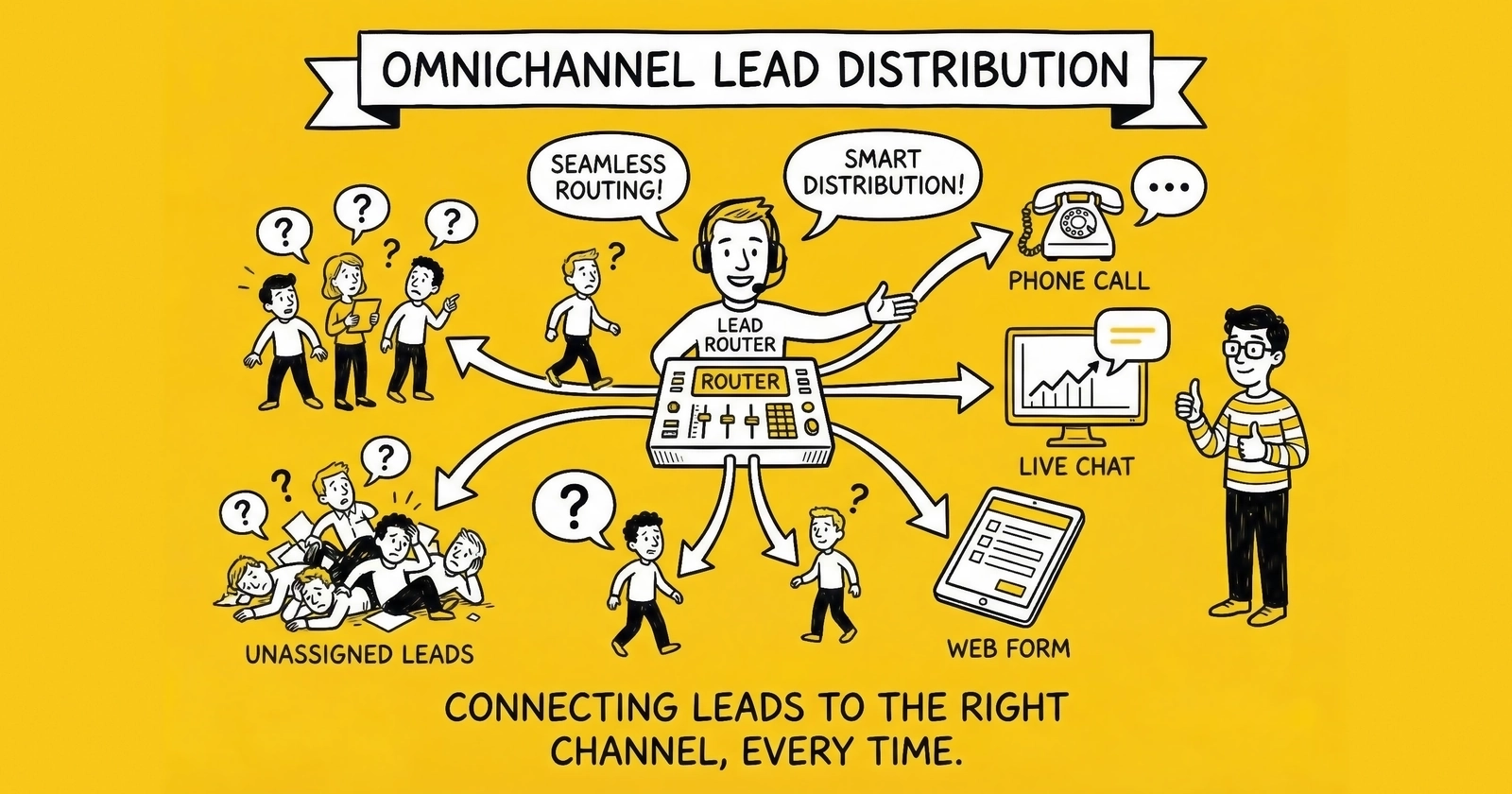
The single-channel approach to lead distribution is dying. Organizations still relying exclusively on email campaigns or phone-only outreach are watching engagement rates decline while competitors running coordinated multi-channel sequences capture the attention that used to be theirs.
The data is unambiguous: multi-channel campaigns achieve 300% higher engagement than single-channel approaches. Organizations implementing coordinated omnichannel strategies report 30-50% more meeting bookings. Yet most lead generation operations still treat channels as independent systems rather than coordinated touchpoints in a unified engagement strategy.
This isn’t about being everywhere at once. It’s about orchestrating the right channel at the right moment based on prospect behavior – and building systems that execute this orchestration automatically at scale. For foundational context on lead generation business models, see our guide to how the lead economy works.
The Evolution from Multi-Channel to Omnichannel
Understanding the distinction between multi-channel and omnichannel is essential. They sound similar but represent fundamentally different operational philosophies.
Multi-Channel: Parallel but Disconnected
Multi-channel operations run multiple channels simultaneously but independently. The email team sends campaigns. The phone team makes calls. The social team runs LinkedIn outreach. Each operates on its own schedule, targeting overlapping audiences with minimal coordination.
The problems are predictable:
Prospect fatigue. A lead receives an email Monday, a phone call Tuesday, a LinkedIn message Wednesday – all saying essentially the same thing without acknowledging previous touchpoints. The prospect feels spammed rather than engaged.
Missed timing signals. The email team doesn’t know the prospect answered a phone call. The phone team doesn’t know the prospect opened three emails. Engagement signals that should shape the next action get lost between systems.
Attribution chaos. When a lead converts, which channel gets credit? Without unified tracking, every team claims the win while accurate ROI measurement becomes impossible.
Resource inefficiency. Multiple teams work the same leads with redundant effort. High-intent signals in one channel don’t accelerate action in others.
Omnichannel: Unified and Adaptive
Omnichannel treats all channels as a single coordinated system. Context flows across channels. Actions in one channel trigger responses in others. The prospect experiences a coherent conversation that adapts to their behavior.
Behavioral triggers. If a prospect opens an email but doesn’t click, the system might trigger a LinkedIn connection rather than another email. If they visit the pricing page, it might accelerate a phone call. The system adapts based on engagement signals.
Unified context. Every touchpoint knows about previous touchpoints. The phone rep sees which emails were opened. The email sequence adjusts based on call outcomes. LinkedIn messages reference relevant prior interactions.
Smart sequencing. Channels deploy in intentional sequence. Email provides initial context. LinkedIn builds credibility. Phone creates urgency. SMS captures time-sensitive action. Each channel plays a distinct role.
Continuous optimization. Unified data reveals which channel sequences convert best. The system learns which paths work for different segments, lead sources, and buyer types.
Channel Roles in Omnichannel Distribution
Each channel has distinct strengths. Effective omnichannel orchestration deploys channels where they perform best rather than using them interchangeably.
Email: Foundation and Documentation
Email remains the workhouse of B2B lead engagement. It’s scalable, trackable, and provides documentation of the conversation. Email excels at:
Detailed value delivery. Complex information – case studies, ROI analyses, technical specifications – transmits effectively through email. Prospects can consume at their own pace and forward to colleagues.
Sequence automation. Email nurture sequences maintain contact over long sales cycles without manual intervention. Behavioral triggers can personalize sequences based on engagement.
Low-friction introduction. Cold outreach is most acceptable via email. Phone and LinkedIn feel more intrusive for initial contact.
Documentation trail. Email creates records of offers, proposals, and commitments that protect both parties.
The limitation: email increasingly competes for attention. Average B2B email open rates run 15-25%. Without channel diversity, most messages go unseen.
Phone: High-Intent Conversion
Voice communication creates urgency and builds rapport that text-based channels cannot match. Phone excels at:
Speed-to-lead. Inbound leads expecting immediate contact – form submissions, quote requests – convert dramatically better with fast phone response. Sub-5-minute response can improve conversion by 400% compared to 30-minute response. For strategies to optimize routing and achieve faster response times, see our comparison of waterfall versus round-robin routing methods.
Complex qualification. Discovery conversations that require back-and-forth questioning happen faster by phone than through email exchanges.
Objection handling. Real-time dialogue allows addressing concerns immediately rather than waiting for email response cycles.
Commitment securing. Asking for meetings, demos, or decisions works better in conversation than in text.
The limitation: answer rates on cold calls run 2-8%. Without prior engagement in other channels, phone outreach hits voicemail.
SMS: Time-Sensitive Action
Text messaging cuts through inbox noise with near-universal open rates (98%). SMS excels at:
Appointment reminders. Demo confirmations, meeting reminders, and event attendance nudges.
Time-sensitive offers. Limited availability, expiring promotions, or urgent follow-up.
Quick confirmations. Yes/no questions, scheduling confirmations, brief status updates.
Callback requests. “Can we call you in the next 10 minutes?” gets faster response via SMS than email.
The limitation: SMS requires explicit consent separate from email consent. Message length constraints limit detailed communication. Overuse creates unsubscribes.
LinkedIn: Credibility and Relationship
LinkedIn provides social context that other channels lack. Prospects can verify sender credentials, view mutual connections, and assess credibility. LinkedIn excels at:
Establishing credibility. Profile views before connection requests let prospects validate who’s contacting them.
Warm introductions. Mutual connections and shared groups create context for outreach.
Executive access. Senior decision-makers often respond to LinkedIn when they ignore email.
Multi-threaded engagement. Connecting with multiple stakeholders at target accounts builds relationship density.
The limitation: LinkedIn imposes connection and message limits. The platform restricts automated outreach. Response rates decline with volume.
Chat and Messaging: Real-Time Qualification
Website chat and messaging apps enable real-time conversation when prospects are actively engaged. Chat excels at:
Immediate qualification. Visitors on pricing pages or product pages can get questions answered instantly.
Progressive disclosure. Chatbots can qualify leads through conversational flows before routing to sales.
Scheduling integration. Chat can book meetings directly into calendars without email back-and-forth.
After-hours coverage. AI chatbots provide 24/7 response when live agents aren’t available.
Research shows AI chatbots increase qualified leads by 45% while reducing time-to-first-contact by 20%.
Channel Sequencing Strategy
Omnichannel effectiveness depends on sequencing – deploying the right channel at the right moment in the buyer journey. Several sequencing models have proven effective.
The Warm-Up Sequence
For outbound prospecting where no prior relationship exists:
| Day | Channel | Purpose |
|---|---|---|
| 1 | Professional introduction, value proposition | |
| 2 | Connection request with personalized note | |
| 4 | Follow-up with relevant content | |
| 5 | Phone | Voice message referencing email content |
| 6 | Engage with prospect’s content | |
| 8 | Case study or social proof | |
| 10 | Phone | Direct conversation attempt |
| 11 | SMS | Meeting request if phone unreached |
This sequence builds familiarity before phone contact, increasing answer rates and reducing cold resistance.
The Inbound Response Sequence
For leads who have taken an action – form submission, content download, webinar registration:
| Timing | Channel | Purpose |
|---|---|---|
| <60 seconds | Confirmation and value delivery | |
| <5 minutes | Phone | Immediate qualification attempt |
| If no answer | SMS | Callback availability question |
| +2 hours | Additional resources | |
| +24 hours | Phone | Second attempt |
| +48 hours | Connection and personalized note |
Speed matters for inbound. The 5-minute response window is critical for high-intent leads.
The Re-Engagement Sequence
For leads who’ve gone cold after initial engagement:
| Day | Channel | Purpose |
|---|---|---|
| 1 | New value angle, not rehash of old | |
| 3 | Engage with their recent content | |
| 5 | Industry news or relevant trigger | |
| 7 | Phone | Direct outreach with new reason |
| 10 | SMS | One-line re-engagement |
Re-engagement requires new value. Repeating the original pitch generates unsubscribes.
The Event-Triggered Sequence
For leads who’ve taken high-intent actions – pricing page visit, demo request, competitor comparison:
| Trigger | Channel | Timing |
|---|---|---|
| Pricing page view | <60 seconds | |
| Multiple page views | Phone | <10 minutes |
| Competitor page view | Differentiation content | |
| Return visit after 7 days | SMS | Personalized check-in |
| Meeting no-show | SMS + Phone | Immediate rescheduling |
Behavioral triggers accelerate sequences based on demonstrated intent.
Technology Architecture for Omnichannel
Building omnichannel capability requires technology integration across several layers.
Core Infrastructure Layer
CRM as system of record. All lead data, engagement history, and channel interactions centralize in the CRM. Without a unified view, omnichannel coordination is impossible.
Marketing automation. Email sequences, behavioral triggers, and lead scoring require automation capabilities. Platforms like HubSpot, Marketo, or Pardot provide this foundation.
Phone/SMS platform. Voice and text capability with tracking, recording, and CRM integration. Dialers, call routing, and SMS automation need to sync engagement data back to CRM. Major lead distribution platforms like boberdoo, LeadsPedia, and Phonexa provide integrated phone and SMS capabilities.
LinkedIn integration. Either Sales Navigator for manual outreach or tools like Lemlist or Apollo that integrate LinkedIn into sequences.
Orchestration Layer
Workflow automation. Platforms like Clay, Zapier, or native automation trigger cross-channel actions based on engagement signals. When email opens but no click, trigger LinkedIn. When phone connects, pause email sequence.
Intent data integration. Platforms like Bombora or 6sense identify accounts showing buying signals. Intent signals can accelerate sequences or trigger outreach to accounts not yet in pipeline.
Unified ID resolution. Matching a prospect’s email, phone, LinkedIn profile, and website activity to a single identity. Without this, cross-channel tracking fails.
Intelligence Layer
Conversation intelligence. Tools like Gong or Chorus analyze phone conversations, surfacing insights about objections, competitor mentions, and buying signals that can inform other channels.
Engagement scoring. Aggregate engagement across channels into unified scores. A prospect who opens emails, visits pages, and engages on LinkedIn has higher intent than one who only opens emails.
Channel preference detection. Some prospects respond to phone. Others prefer email. Track channel-specific response patterns and adapt sequences accordingly.
Minimum Viable Omnichannel Stack
For organizations starting omnichannel, the minimum viable stack:
| Function | Options | Monthly Cost |
|---|---|---|
| CRM | HubSpot (free tier), Salesforce | $0-150/user |
| Email automation | HubSpot, Mailchimp, Apollo | $0-100 |
| Phone/SMS | Aircall, RingCentral, Twilio | $25-75/user |
| Sales Navigator | $99/user | |
| Workflow | Zapier, native integrations | $0-50 |
Total minimum: ~$150-400/user/month for basic omnichannel capability.
Speed Requirements Across Channels
Response speed requirements differ by channel and lead type.
Real-Time Distribution Speed
For ping/post and real-time lead distribution systems, speed is measured in milliseconds:
Ping response time: 100-500 milliseconds expected. Buyers bidding on exclusive leads need instant response to win competitive auctions.
Post acknowledgment: Sub-second confirmation that lead data was received and accepted.
Routing decision: <2 seconds from receipt to buyer assignment.
These speeds require API infrastructure, not human intervention.
Human Response Speed
Once leads route to sales teams, human response windows apply:
| Lead Type | Target Response | Impact |
|---|---|---|
| Inbound high-intent | <5 minutes | 400% higher conversion vs 30 min |
| Inbound general | <30 minutes | 100% higher vs 1 hour |
| Outbound priority | <2 hours | Maintains sequence momentum |
| Re-engagement | <24 hours | Prevents lead decay |
Non-exclusive leads require particular urgency – multiple buyers received the same lead, and first contact often wins. For analysis of when exclusive leads justify their premium, see our guide on whether exclusive lead buying is worth it.
Automated Channel Speed
Automated channels should fire nearly instantly:
Email autoresponders: <60 seconds from trigger event.
SMS confirmations: <2 minutes from form submission.
Chat handoff: <30 seconds from bot qualification to live agent.
Calendar confirmations: Immediate upon booking.
Delays in automated channels signal poor systems and reduce confidence.
Attribution Across Channels
Measuring omnichannel effectiveness requires attribution models that credit channels fairly.
Attribution Models
First-touch attribution. Credits the channel that initially captured the lead. Useful for understanding acquisition efficiency but ignores the nurturing that often drives conversion.
Last-touch attribution. Credits the channel immediately before conversion. Overweights closing channels while ignoring awareness and nurturing.
Linear attribution. Distributes credit equally across all touchpoints. Simple but doesn’t account for the varying impact of different interactions.
Time-decay attribution. Weights touchpoints closer to conversion more heavily. Acknowledges that recent interactions likely had more influence.
Position-based attribution. Gives more credit to first and last touchpoints, less to middle interactions. Common for sales cycles with distinct acquisition and closing phases.
Data-driven attribution. Uses machine learning to determine actual channel impact based on conversion patterns. Requires significant data volume to be accurate.
Implementation Requirements
Accurate attribution requires:
Unified customer IDs. Track the same prospect across all channels using consistent identifiers – email address as primary key with phone and LinkedIn as secondary.
UTM parameter discipline. Every link in every channel should carry UTM parameters identifying source, medium, and campaign.
Call tracking numbers. Assign trackable phone numbers to different campaigns and channels.
CRM-marketing sync. Bidirectional sync between marketing automation and CRM so all touchpoints appear on lead records.
Conversion event definition. Clear definition of what constitutes conversion – meeting booked, opportunity created, deal closed – with consistent tracking across systems.
Channel Path Analysis
Beyond attribution, analyze the paths prospects take through channels:
Common paths to conversion. Which channel sequences appear most frequently in converted leads?
Channel switching points. Where do prospects move from one channel to another?
Drop-off points. At which channel or sequence step do prospects disengage?
Time between touches. How long between channel interactions for successful versus unsuccessful leads?
This analysis reveals which sequences actually work versus which seem logical but don’t perform.
Compliance Across Channels
Omnichannel distribution multiplies compliance complexity. Each channel has distinct requirements.
Phone and SMS Compliance
TCPA requirements for phone and SMS are more stringent than email:
Express consent. Written consent required before placing marketing calls or texts. Consent must be specific to the communication type.
One-to-one consent. Though the FCC’s one-to-one consent rule was vacated by the Eleventh Circuit in January 2025, many sophisticated buyers require consent that authorizes contact from one specific seller.
Opt-out honor. Opt-out requests must be honored within 24 hours for calls, 10 days for texts.
Time restrictions. Calls prohibited before 8 AM or after 9 PM local time.
Reassigned numbers. Liability exists for calling numbers reassigned to new subscribers who haven’t consented.
State mini-TCPA laws add additional requirements. Florida, Oklahoma, Washington, and others have stricter rules than federal TCPA.
Email Compliance
CAN-SPAM requirements for commercial email:
Clear identification. Emails must identify sender and include physical address.
Opt-out mechanism. Every email must include unsubscribe option.
Honor opt-outs. Unsubscribe requests must be processed within 10 business days.
Accurate headers. From, To, and subject lines cannot be deceptive.
LinkedIn Compliance
LinkedIn Terms of Service prohibit:
Automated scraping. Extracting data programmatically from profiles.
Mass messaging. Sending identical messages to large numbers of users.
InMail abuse. Using InMail for purposes other than legitimate business communication.
Violations can result in account suspension.
Consent Management
Omnichannel requires channel-specific consent tracking:
| Channel | Consent Type | Storage Requirement |
|---|---|---|
| Implied/Express | Subscription preferences | |
| Phone | Express written | Signed form or recorded verbal |
| SMS | Express written | Specific to SMS messages |
| Platform ToS | Connection acceptance |
A prospect may consent to email but not SMS. Your systems must track and respect these distinctions.
Personalization Without Invasion
Omnichannel creates personalization opportunities – and privacy pitfalls.
Appropriate Personalization
Reference information from direct interactions:
Legitimate: “I noticed you downloaded our pricing guide – any questions I can answer?”
Legitimate: “We met at the industry conference last month…”
Legitimate: “Your colleague [name] suggested I reach out…”
This feels relevant because it references explicit actions or connections.
Creepy Personalization
Avoid referencing inferred or surveillance-derived data:
Creepy: “I see your company just raised Series B – perfect timing for our solution.”
Creepy: “Based on your recent activity, it looks like you’re evaluating competitors…”
Creepy: “I noticed you’re hiring for 3 sales positions, which suggests…”
This feels invasive because it reveals you’re tracking them without their awareness.
Channel-Appropriate Context
Personalization acceptability varies by channel:
LinkedIn. More personal context is acceptable. You can see their profile, they can see yours. Reference shared connections, mutual groups, or their recent posts.
Email. Moderate personalization. Reference prior interactions, company, and role. Avoid highly personal or surveillance-derived details.
Phone. Reference prior touchpoints in this engagement. Don’t reveal tracking of their website behavior.
SMS. Keep brief and action-oriented. Minimal personalization beyond name and immediate context.
Measuring Omnichannel Effectiveness
Track metrics at channel, cross-channel, and outcome levels.
Channel-Specific Metrics
| Channel | Key Metrics |
|---|---|
| Open rate, click rate, reply rate, unsubscribe rate | |
| Phone | Answer rate, conversation rate, voicemail rate, callback rate |
| SMS | Delivery rate, response rate, opt-out rate |
| Connection rate, message response rate, profile views | |
| Chat | Engagement rate, qualification rate, meeting conversion |
Benchmark against industry standards and track trends over time.
Cross-Channel Metrics
Total touchpoints to conversion. How many touches across all channels before a lead converts? Is this increasing or decreasing?
Channel path frequency. Which sequences appear most often in converted leads?
Channel transition points. Where do prospects move between channels? Which transitions correlate with conversion?
Engagement velocity. How quickly do prospects progress through channels? Faster often correlates with higher intent.
Cross-channel engagement score. Composite score weighting engagement across all channels.
Outcome Metrics
Meeting booking rate. What percentage of engaged leads book meetings?
Pipeline influence. What pipeline value touched omnichannel sequences?
Conversion rate by sequence. Which specific channel sequences convert best?
Cost per meeting. Total channel costs divided by meetings booked.
Revenue per sequence. Which sequences generate highest-value deals?
Comparative Analysis
Compare omnichannel performance to single-channel baselines:
| Metric | Email-Only | Omnichannel | Lift |
|---|---|---|---|
| Response rate | 3% | 12% | 300% |
| Meeting rate | 1.5% | 4% | 167% |
| Conversion rate | 0.5% | 1.5% | 200% |
Document the lift that justifies omnichannel investment.
Common Implementation Mistakes
Organizations implementing omnichannel frequently make these errors.
Over-Sequencing
The mistake: Creating 15-20 touch sequences across all channels, overwhelming prospects.
The fix: 8-12 touches maximum. If someone hasn’t engaged after that, they’re not a fit right now. Move to low-frequency nurture.
Ignoring Channel Preference
The mistake: Forcing every prospect through identical sequences regardless of which channels they prefer.
The fix: Track response patterns. If a prospect only responds to email, don’t keep calling. Adapt sequences to observed preference.
Inconsistent Messaging
The mistake: Different value propositions, different tones, conflicting information across channels.
The fix: Unified messaging document that all channels draw from. Same core value prop, adapted to channel format.
Manual Orchestration
The mistake: Expecting sales reps to manually execute complex cross-channel sequences.
The fix: Automate what can be automated. Use behavioral triggers. Reduce manual steps to those requiring human judgment.
Insufficient Tracking
The mistake: No unified view of cross-channel engagement. Each channel tracked separately.
The fix: CRM as single source of truth. All channel data syncs to lead records. Unified reporting across channels.
Compliance Gaps
The mistake: Treating consent as one-time, one-channel event.
The fix: Track consent status per channel per contact. Different consent requirements for email, phone, and SMS.
Key Takeaways
-
Omnichannel outperforms single-channel by 300%. Multi-channel campaigns achieve dramatically higher engagement than any single channel alone. Organizations report 30-50% more meeting bookings from coordinated sequences. For strategies to maximize ROI across all acquisition channels, measurement precision is essential.
-
Channels serve distinct roles. Email for detailed value delivery, phone for high-intent conversion, SMS for time-sensitive action, LinkedIn for credibility building, chat for real-time qualification. Deploy each where it excels.
-
Sequencing determines success. The order and timing of channel deployment matters more than the channels themselves. Warm-up sequences build familiarity before phone contact, increasing answer rates.
-
Speed requirements vary by channel. Ping/post systems need 100-500ms response. Phone response to inbound leads should target under 5 minutes. Email autoresponders should fire within 60 seconds.
-
Technology integration is non-negotiable. CRM, marketing automation, phone/SMS platform, and workflow automation must connect. Without unified data, omnichannel coordination fails.
-
Attribution requires unified tracking. Same prospect across all channels needs consistent identity. UTM parameters, call tracking numbers, and CRM sync connect touchpoints for accurate measurement.
-
Compliance multiplies with channels. Phone and SMS require separate consent from email. State mini-TCPA laws add complexity. Track consent status per channel, not just per contact.
-
Personalization has boundaries. Reference direct interactions – downloads, meetings, referrals. Avoid surveillance-derived personalization that feels invasive.
-
Measure at multiple levels. Channel-specific metrics, cross-channel engagement patterns, and outcome metrics each reveal different insights. Compare against single-channel benchmarks.
-
Start simple, expand strategically. Minimum viable omnichannel: CRM, email automation, phone/SMS, LinkedIn. Add workflow automation, intent data, and conversation intelligence as capability matures.
Frequently Asked Questions
What is omnichannel lead distribution?
Omnichannel lead distribution is a coordinated approach to routing and engaging leads across multiple channels – email, phone, SMS, LinkedIn, and chat – based on prospect behavior and preferences. Unlike multi-channel approaches that use channels independently, omnichannel orchestrates channels as a unified system where actions in one channel trigger activities in others.
How much does omnichannel distribution improve lead engagement?
Research shows multi-channel campaigns achieve 300% higher engagement than single-channel approaches. Organizations implementing coordinated omnichannel strategies report 30-50% more meeting bookings compared to email-only campaigns. These improvements compound because prospects receive appropriately-timed outreach through their preferred channels.
What channels should be included in omnichannel lead distribution?
Core channels include email (detailed value delivery), phone (high-intent immediate engagement), SMS (time-sensitive actions), LinkedIn (relationship building and credibility), and chat/messaging (real-time qualification). The optimal mix depends on your industry, buyer preferences, and compliance requirements. B2B typically emphasizes email, phone, and LinkedIn. Consumer-facing may weight SMS and chat more heavily.
What’s the difference between multi-channel and omnichannel?
Multi-channel uses multiple channels independently – separate email campaigns, separate phone campaigns, separate social outreach. Omnichannel coordinates channels as a unified system. If a prospect opens an email but doesn’t respond, omnichannel triggers a LinkedIn connection or phone call rather than another email. Context flows across channels, creating coherent prospect experience.
How fast should leads be contacted across channels?
Speed varies by channel and lead type. Phone response should target under 5 minutes for high-intent inbound leads – research shows 400% higher conversion versus 30-minute response. Email should deploy within 60 seconds of form submission. SMS should fire within 2-3 minutes for time-sensitive offers. Ping response times in real-time distribution systems run 100-500 milliseconds.
What technology is required for omnichannel lead distribution?
At minimum: CRM with multi-channel tracking, email marketing automation, phone/SMS platform, and workflow automation. Advanced implementations add CDPs (Customer Data Platforms) for unified profiles, intent data integration for prioritization, conversation intelligence for phone insights, and real-time routing engines for ping/post distribution.
How do you track attribution across channels?
Use unified customer IDs across platforms – typically email address as primary key. Track first-touch attribution (initial channel), last-touch attribution (converting channel), and multi-touch attribution (weighted credit across all channels). Implement UTM parameters on all links, call tracking numbers by campaign, and bidirectional CRM sync.
What’s the optimal channel sequence for B2B leads?
A proven B2B sequence: Day 1 – email for professional introduction with value proposition. Day 2 – LinkedIn connection request with personalized note. Day 4 – phone call referencing email content. Day 5 – SMS if phone unreached asking for callback availability. Day 7 – retarget with display ads. Adjust timing based on engagement signals.
How does omnichannel work with ping/post distribution?
Ping/post handles real-time auction and routing – matching leads to buyers in 100-500ms based on bid prices and qualification criteria. Omnichannel orchestration takes over after routing, managing the multi-channel engagement sequence that converts the lead into a meeting or opportunity. Both systems share lead data through API integrations.
What compliance considerations affect omnichannel distribution?
Phone and SMS require express written consent – separate from email consent. LinkedIn outreach must follow platform terms of service. Email needs CAN-SPAM compliance including unsubscribe mechanisms. State mini-TCPA laws add additional requirements in Florida, Oklahoma, Washington, and others. Track consent status per channel, not just per contact.
How do you personalize across channels without being creepy?
Reference information from direct interaction – they downloaded a whitepaper, visited a pricing page, attended a webinar, were referred by a colleague. Avoid referencing inferred data about their company challenges or personal details you only know from surveillance. Channel-specific context matters: LinkedIn allows more personal context than cold email.
What metrics track omnichannel distribution effectiveness?
Track channel-specific metrics (open rates, answer rates, response rates), cross-channel metrics (total touchpoints to conversion, channel path analysis, engagement velocity), and outcome metrics (meeting bookings, opportunities created, revenue influenced). Compare against single-channel benchmarks to document omnichannel lift.