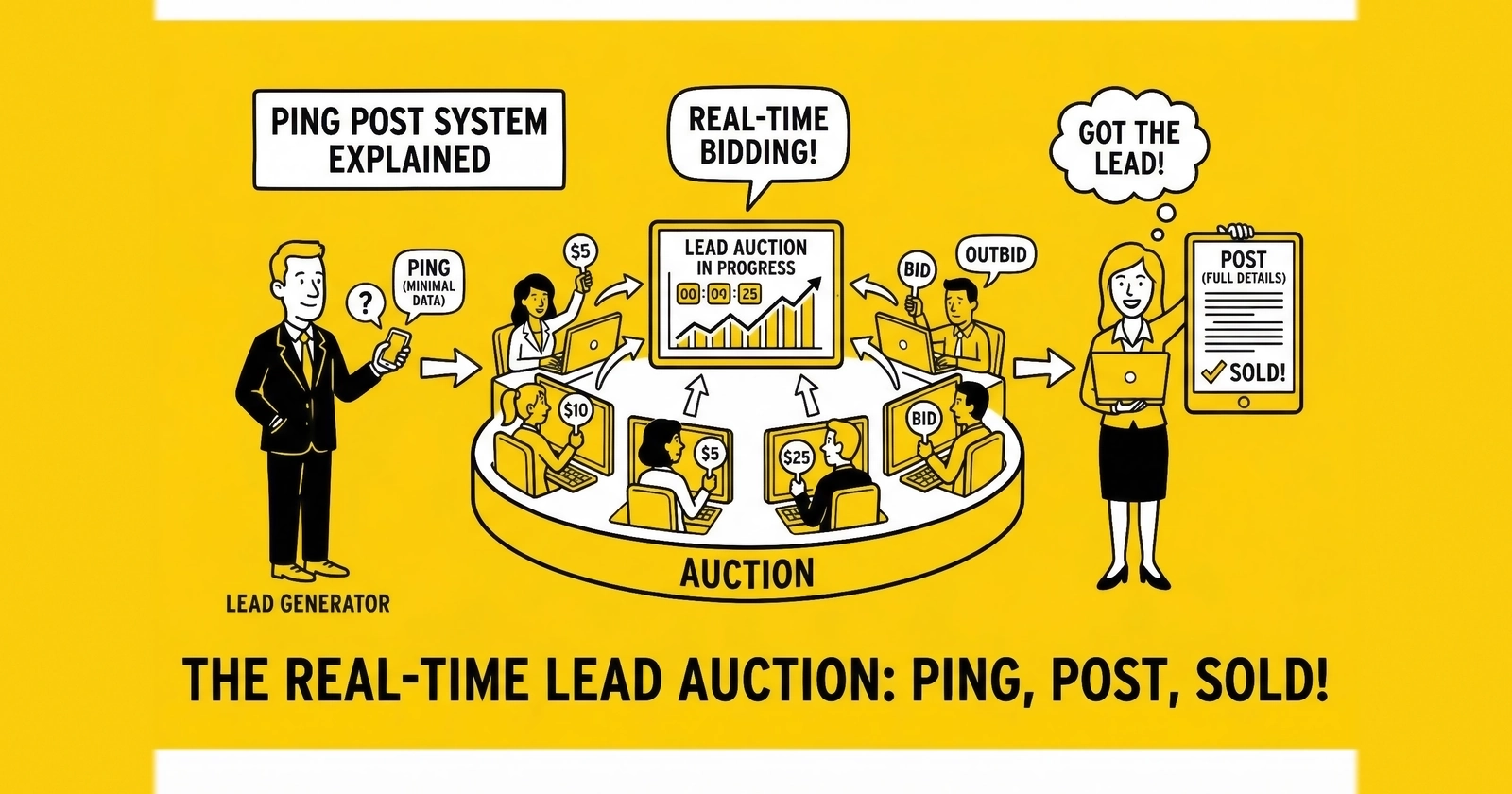
How millisecond-level bidding technology transforms lead distribution from fixed-price trading into dynamic price discovery that maximizes value for every transaction.
The infrastructure that powers modern lead distribution represents one of the most sophisticated real-time transaction systems outside of financial markets. Thousands of leads move through ping post auctions every minute across the United States, with each transaction completing in the time it takes a human to blink. Buyers and sellers who understand these systems operate with significant advantages over those who treat lead distribution as simple procurement.
For lead generators, ping post transforms pricing from a negotiation with individual buyers into a market mechanism that discovers the true value of each lead. A lead that might sell for $45 under a fixed-price contract could command $70 from a buyer who desperately needs that specific demographic and geographic profile. The systematic capture of these value variations across thousands of daily transactions creates meaningful revenue improvements that compound over time.
For buyers, ping post provides precision that fixed-price arrangements cannot match. Rather than paying the same amount for every lead regardless of quality indicators, buyers bid based on the specific attributes of each opportunity. High-value leads receive higher bids; lower-value leads receive lower bids or no bid at all. This alignment between price and expected value improves unit economics across the entire portfolio.
The technology that enables this value exchange operates at the edge of what distributed systems can accomplish. Latency measured in tens of milliseconds determines whether transactions complete successfully. Data structures optimized for speed rather than convenience process thousands of concurrent requests. The engineering challenges are substantial, which explains why most practitioners license commercial platforms rather than building custom infrastructure.
This guide examines the architecture, mechanics, and optimization strategies that separate sophisticated ping post operators from those simply participating in auctions they do not fully understand.
The moment a consumer clicks “submit” on an insurance quote form, a technical feat begins that would have seemed like science fiction two decades ago. Within 50-100 milliseconds, partial information about that lead travels simultaneously to a dozen potential buyers. Each buyer’s system evaluates the data against complex filtering rules, calculates a bid price, and returns a response. The platform identifies the winner, delivers the complete lead data, and the winning buyer can have an agent dialing within seconds.
This is ping post distribution. It represents the most sophisticated lead routing technology in the industry, and understanding its mechanics separates professional operators from those still trading leads at fixed prices negotiated quarterly. Whether you are buying leads, selling leads, or building the infrastructure that connects buyers and sellers, mastering ping post systems determines your ability to compete in the modern lead economy.
This guide takes you inside the architecture, the auction mechanics, and the optimization strategies that extract maximum value from every transaction.
What Is Ping Post?
Ping post is a bifurcated transaction protocol that splits lead distribution into two distinct phases. The first phase, the “ping,” broadcasts non-identifying lead attributes to potential buyers for bid solicitation. The second phase, the “post,” delivers complete lead data exclusively to the winning bidder after they have committed to purchase.
This separation solves fundamental problems that plagued earlier lead distribution models. Before ping post became the industry standard, lead distribution operated on the “static waterfall” model. A lead generator would establish fixed relationships with buyers, prioritized by some combination of price and reliability. When a lead arrived, the system would offer it to Buyer A first. If rejected, it moved to Buyer B, then C, and so on down the waterfall. (For more on waterfall versus round-robin routing methods, see our dedicated guide.)
The waterfall model had obvious limitations:
Fixed Pricing: Buyers had no incentive to increase their prices since they knew exactly where they sat in the queue. Whether they paid $40 or $60, they would receive the same priority position.
No Price Discovery: Sellers had no mechanism for discovering what leads were actually worth in the market. They simply accepted whatever their highest-priority buyer was willing to pay.
Sequential Latency: Each rejection added seconds to the total response time. By the time a lead cascaded through five buyers, its value had degraded significantly. Research shows that leads contacted within one minute have 391% higher conversion rates – a dynamic explored in depth in speed-to-lead response optimization.
Position Monopoly: First-position buyers captured disproportionate value. A buyer willing to pay $52 might never see a lead because a $40 buyer held first position.
Ping post solved these problems by introducing competitive bidding. Instead of sequential offers at fixed prices, ping post broadcasts to all buyers simultaneously and awards the lead to whoever values it most. The result is true market-based pricing for every individual lead.
The Market Transformation
The shift from waterfall to ping post mirrors broader market evolution across industries. Just as programmatic advertising replaced direct insertion orders with real-time bidding, ping post transformed lead distribution from procurement to trading.
Consider the economics: Under a waterfall system, a lead generator might sell 1,000 leads per day at $45 each to their first-position buyer, generating $45,000 in daily revenue. Under ping post with the same buyer pool, the same 1,000 leads might generate bids ranging from $30 to $80, with an average winning bid of $52. Daily revenue increases to $52,000 with no change in lead quality or buyer relationships.
This 15-30% revenue improvement explains why ping post has become the dominant distribution model for high-volume verticals including insurance, mortgage, solar, and legal leads. Public companies like MediaAlpha ($864.7 million in 2024 revenue) and EverQuote ($500.2 million in 2024 revenue) built their businesses on ping post infrastructure.
How Ping Post Works: The Two-Phase Process
Understanding ping post requires examining each phase in detail. The mechanics appear simple on the surface but involve considerable complexity in production implementation.
Phase 1: The Ping (Blind Bid Solicitation)
When a consumer completes a lead form, the distribution platform extracts non-identifying attributes and broadcasts them simultaneously to all qualified buyers. This happens within milliseconds of form submission.
The ping contains enough information for buyers to make informed bidding decisions without revealing the consumer’s identity:
Geographic Data:
- ZIP code (5-digit)
- State
- Area code
- Metropolitan statistical area (MSA)
Lead Attributes (Vertical-Specific):
- For auto insurance: Vehicle year/make/model, current carrier, driver count, incident history, credit tier
- For mortgage: Loan amount, property value, loan-to-value ratio, credit score bracket, loan purpose
- For solar: Homeownership status, electric bill range, roof shading classification, credit bracket
- For legal: Case type, injury date, liability clarity, medical treatment status
Metadata:
- Source ID (which publisher generated the lead)
- Sub-source IDs for granular tracking
- Timestamp
- Device information (mobile vs desktop)
- Exclusivity flag
The golden rule of ping design: never transmit personally identifiable information (PII) during the ping phase. The ping exists solely for bid solicitation. Buyers have not committed to purchase anything yet, and providing them with consumer contact information creates three serious problems:
-
Data Leakage: A buyer could build a database of consumer intent signals without ever purchasing a single lead. Even if they don’t deliberately exploit this data, its mere presence creates compliance and security obligations.
-
Cherry-Picking: If buyers can identify specific consumers from ping data, they can bid selectively based on information the seller did not intend to share.
-
Trust Erosion: Sellers who leak PII in pings quickly find their buyers losing confidence in the system’s integrity.
Buyer Bid Logic
When a buyer’s system receives a ping, it executes a sequence of operations that typically complete in 20-50 milliseconds:
-
Validation: Confirm the ping contains all required fields. Malformed pings get rejected immediately.
-
Filter Evaluation: Match ping attributes against buyer targeting criteria. A buyer targeting only California might immediately reject a Texas ping. A buyer at daily cap might reject all pings regardless of quality.
-
Bid Calculation: If the lead passes filters, calculate a bid price based on pricing rules.
Sophisticated buyers implement tiered pricing that varies based on multiple factors. A simplified example:
- Base bid: $30
- Credit score 700+: +$10
- High-value ZIP code: +$15
- Mobile device: -$5
The calculation produces a final bid reflecting the buyer’s estimated value of that specific lead.
Rejection Codes: When buyers reject pings, they return standardized codes explaining why:
- Geographic mismatch (lead outside target area)
- Filter criteria not met
- Daily cap reached
- Duplicate detection
- Price floor not met
These codes help sellers diagnose distribution problems and optimize their buyer mix.
Phase 2: The Post (Full Delivery)
Once the ping auction closes and a winner emerges, the post phase begins. The platform transmits complete lead information to the winning buyer.
Bid Aggregation: The platform waits for all buyer responses or until the timeout window expires, whichever comes first. Late responses get ignored even if they would have won. This strict timeout enforcement forces buyers to maintain fast systems.
Winner Selection: For exclusive leads, the highest bid typically wins. For shared (non-exclusive) distribution, the calculation becomes more complex.
The platform compares exclusive bids against the sum of potential shared sales. If Buyer A bids $60 for exclusive rights but Buyers B, C, and D collectively offer $35 + $28 + $25 = $88 for shared access, the optimal financial outcome is shared distribution.
Some platforms weight bids based on factors beyond raw price. A buyer with 95% historical acceptance rate might receive a weighting advantage over a buyer with 70% acceptance rate. The logic: a $55 bid with 95% acceptance probability has higher expected value ($52.25) than a $60 bid with 70% acceptance probability ($42.00).
PII Transmission: When the post delivers complete lead information, it crosses a significant threshold. The buyer receives everything needed to contact the consumer: name, phone number, email address, full street address, and all detailed qualification data. This transmission is encrypted, logged for compliance purposes, and represents the actual asset being purchased.
Only the winning buyer receives consumer contact information. Losing bidders receive nothing beyond a bid-loss notification. This ensures ping post systems do not become mechanisms for data harvesting.
Post-Rejection Recovery: Even after winning the auction and receiving the full post, buyers sometimes reject leads. Perhaps the full data reveals a duplicate they did not catch during the ping phase. Perhaps the consumer’s detailed information triggers a fraud flag. Perhaps the buyer’s CRM validation fails on a data formatting issue.
Post-rejection triggers waterfall-on-failure logic. The platform immediately evaluates remaining bidders, recalculates the best scenario given current conditions, and attempts delivery to the next-best option. Industry data suggests that well-implemented waterfall-on-failure systems recover 20-40% of revenue that would otherwise be lost to post rejections, buyer timeouts, and system failures.
Technical Implementation Requirements
Operating a ping post system at scale requires substantial technical infrastructure. The difference between a well-optimized system and a mediocre one can represent millions of dollars in annual revenue.
Latency Requirements
Speed is not just a technical nice-to-have in ping post systems. It is a fundamental constraint that shapes every architectural decision.
Industry Standards:
- Ping response time: Sub-100 milliseconds
- Total ping phase (broadcast to bid collection): 100-200 milliseconds
- Post delivery: 500-1,000 milliseconds
- Total transaction time: 650-1,500 milliseconds
Buyers who consistently exceed these thresholds get fewer leads because auctions close before their responses arrive. Sellers who operate slow platforms lose buyer participation and face increased post-rejection rates.
Consider what happens during a typical ping post auction: The seller’s platform broadcasts a ping to fifteen buyers simultaneously. Each buyer has 100 milliseconds to receive the ping, evaluate it against potentially hundreds of filter rules, calculate a bid price, and return a response. The seller then has 50 milliseconds to aggregate bids, identify the winner, and initiate the post. The winning buyer has another 500-1,000 milliseconds to validate and accept the lead.
Infrastructure Components
A production ping post system requires:
Geographic Distribution: Co-locating servers near major buyer concentrations reduces round-trip times. A buyer in Miami evaluating a ping that originated in Seattle and routes through a server in Dallas adds precious milliseconds with each network hop.
Database Optimization: Filter evaluations and pricing calculations cannot create bottlenecks. Query optimization, index tuning, and caching strategies keep database response times in single-digit milliseconds. Many platforms move frequently-accessed data (filter rules, pricing tables) into memory stores like Redis to eliminate disk I/O entirely.
Asynchronous Processing: The system must ping multiple buyers simultaneously rather than sequentially. Connection pooling eliminates the overhead of establishing new connections for each transaction.
Horizontal Scaling: Whether processing 100 leads daily or 10,000 leads hourly, the system architecture must scale without performance degradation. Auto-scaling systems add capacity automatically when volume increases. Load balancers distribute traffic evenly across server clusters.
Uptime Requirements: Professional platforms maintain 99.99% uptime regardless of volume fluctuations. A five-minute outage at 10,000 leads per hour costs 833 leads.
API Standardization and Field Mapping
The lead generation ecosystem involves constant data exchange between systems. How efficiently that data moves determines operational throughput.
Data Transformation: When one traffic source sends leads as JSON and another uses XML, when one buyer expects “FirstName” and another expects “fname,” the platform handles these transformations without manual intervention.
Format Support: At minimum, platforms support JSON, XML, and HTTP POST. Many extend to SOAP APIs for legacy system integration, CSV batch processing, and webhook-based event notifications.
Field Mapping: Your internal data model almost never matches buyer formats perfectly. Platforms must support:
- Static mappings (direct field-to-field)
- Concatenation (joining first and last name into full name)
- Splitting (parsing compound fields into components)
- Value translation (converting “Y” to “Yes” or “California” to “CA”)
Advantages of Ping Post Distribution
Ping post has become the dominant distribution model for high-volume verticals because it provides measurable advantages for both sellers and buyers.
For Sellers (Publishers/Generators)
Maximum Revenue Per Lead: Every lead sells at market value, not at a negotiated average. A lead that would sell for $50 under fixed pricing might fetch $80 from a buyer who desperately needs that particular geographic or demographic profile.
True Price Discovery: Competitive bidding reveals what leads are actually worth. This intelligence informs traffic acquisition decisions, source optimization, and capacity planning.
Reduced Buyer Concentration Risk: Instead of depending on one or two major buyers, sellers can work with dozens of buyers who compete on every lead. If one buyer reduces spend, others fill the gap.
Quality Incentive Alignment: Higher-quality leads command higher bids. This creates direct financial incentive for quality investments in validation, consent documentation, and traffic quality.
Real-Time Market Intelligence: Bid patterns reveal which lead attributes buyers value most. A seller who notices that credit score 700+ leads consistently bid 40% higher can optimize traffic acquisition toward that segment.
For Buyers
Pay True Value: Buyers never overpay for leads. Their bid reflects their calculated value for that specific lead’s attributes. If they win, the lead is worth what they paid.
Granular Targeting: Instead of buying “auto insurance leads” at a flat rate, buyers bid based on exact specifications: credit tier, vehicle type, geographic area, current carrier, and dozens of other attributes.
Volume Control: Daily caps, budget limits, and pacing rules give buyers precise control over lead volume. They never receive more than they can work effectively. For detailed implementation strategies, see lead caps and throttling for volume control.
No Position Lock-In: Unlike waterfall systems where position determines access, ping post allows any buyer to win any lead if they value it appropriately.
Reduced Waste: Pre-qualification through ping filtering means buyers only receive leads matching their criteria. Returns due to filter mismatch decline significantly.
Pricing Dynamics
The real power of ping post emerges when buyers implement granular, attribute-based pricing rather than flat rates:
Credit Score Tiers: A buyer might bid $60 for 700+ credit scores, $45 for 660-699, $30 for 620-659, and $0 (no bid) for anything below 620. This tiering reflects dramatically different conversion rates and customer values across credit segments.
Geographic Adjustments: Some states have more competitive environments, higher customer values, or better regulatory conditions. Bids adjust accordingly. Progressive Insurance spent $3.5 billion on advertising in 2024, creating intense competition for leads in states where they are expanding.
Time-of-Day Factors: Leads arriving at 11 PM have lower value than leads arriving at 11 AM because there is no agent available for immediate contact. Some buyers shut off bidding entirely during off-hours; others bid at steep discounts.
Source Quality Scoring: Buyers tracking conversion rates by publisher might pay 30% more for leads from high-performing sources and 30% less for sources with poor historical outcomes.
Disadvantages and Challenges
Ping post is not without complications. Understanding the challenges helps operators make informed decisions about adoption and implementation.
Technical Complexity
The infrastructure requirements are substantial:
Development Investment: Building a production-quality ping post system requires years of development, not months. Most practitioners license commercial platforms rather than building custom systems.
Maintenance Burden: Buyer integrations require ongoing attention. Endpoints change, authentication expires, formats evolve. Each integration adds maintenance overhead.
Latency Monitoring: Every millisecond matters. Continuous monitoring and optimization of response times requires dedicated engineering resources.
Buyer Capability Requirements
Not all buyers can participate effectively in ping post systems:
Technical Integration: Buyers need systems capable of evaluating pings and returning bids in sub-second timeframes. Smaller buyers often lack this capability.
Bid Logic Development: Effective ping post participation requires sophisticated pricing logic. Buyers who simply set flat bids lose to those with granular, attribute-based pricing.
Volume Unpredictability: Unlike fixed-price contracts that guarantee specific volumes, ping post creates variable outcomes. Buyers cannot predict exactly how many leads they will receive each day.
Seller Complexity
For sellers, ping post introduces operational challenges:
Revenue Volatility: Prices fluctuate based on real-time supply and demand. Revenue can vary 20-30% day-to-day based on buyer activity.
Buyer Management: Managing relationships with dozens of buyers requires different processes than managing a few fixed-price contracts.
Floor Pricing Decisions: Setting floors too high means leads go unsold. Setting them too low means leaving money on the table. Optimal floor pricing requires continuous optimization.
Market Dynamics
Bid Shading: In first-price auctions (the most common model in lead distribution), sophisticated buyers learn to “shade” their bids, submitting less than their true willingness to pay because they only need to exceed the next-highest bid. This can suppress prices below theoretical market value.
Concentration Risk: If most volume flows through a few major platforms, those platforms gain significant market power. Sellers may face take-it-or-leave-it terms.
Information Asymmetry: Buyers with better data and more sophisticated bidding algorithms capture more value than those with basic implementations.
Fill Rate Optimization Strategies
Fill rate measures the percentage of leads that successfully sell through the ping post system. A 90% fill rate means 10% of leads receive no acceptable bids and generate zero revenue. Improving fill rate directly impacts the bottom line.
Industry Benchmarks
| Metric | Poor | Acceptable | Strong | Elite |
|---|---|---|---|---|
| Fill Rate | <70% | 70-80% | 80-90% | >90% |
| Time-to-Route | >2 sec | 1-2 sec | 500ms-1 sec | <500ms |
| Buyer Acceptance | <60% | 60-75% | 75-85% | >85% |
| Waterfall Recovery | <10% | 10-20% | 20-30% | >30% |
| Return Rate | >15% | 10-15% | 5-10% | <5% |
Buyer Coverage Expansion
The most direct path to higher fill rates is ensuring leads have enough potential bidders.
Geographic Expansion: If your buyer network only covers 40 states, leads from the other 10 states have zero fill rate by definition. Building out buyer coverage in underserved markets directly improves fill rates.
Vertical Expansion: Adding buyers for adjacent product types creates additional bidding opportunities. An auto insurance lead might also qualify for home insurance or life insurance cross-sells.
Buyer Density: More buyers competing for the same lead type creates pricing tension and reduces the probability that no buyer wants a given lead. Aim for 5-15 active bidders per segment.
Floor Pricing Calibration
Floor pricing establishes minimum acceptable bids from the seller’s perspective. A seller might set a $25 floor for exclusive auto insurance leads, meaning any bid below that threshold is treated as a rejection.
Market-Based Floors: Set floors based on actual market data, not arbitrary targets. If your leads consistently attract $35-55 bids, a $30 floor captures most volume while protecting against race-to-the-bottom pricing.
Dynamic Floors: Adjust floors based on supply and demand conditions. During high-demand periods, raise floors to capture surplus value. During low-demand periods, consider lowering floors to clear inventory.
Tiered Floors: Different lead types warrant different floors. Premium leads with strong validation and high-intent signals command higher minimums than basic leads.
Secondary Distribution Channels
For leads that do not sell in the primary auction, secondary channels recover partial value:
Aged Lead Buyers: Some buyers specialize in purchasing leads that did not sell in real-time, typically at 5-20% of fresh lead value.
Cross-Vertical Routing: A lead that did not match insurance buyers might find value with home improvement or financial services buyers.
Batch Aggregation: Collect unsold leads and offer them as bulk packages to buyers with different economics than real-time purchasers.
Lead Quality Improvements
Buyer willingness to bid increases with lead quality:
Enhanced Validation: Phone verification, email validation, and address confirmation increase buyer confidence and bid amounts.
Consent Documentation: TrustedForm certificates and Jornaya LeadiD provide compliance protection that many buyers require for participation.
Fraud Prevention: Removing fraudulent leads before they enter the auction improves buyer experience and increases future bid amounts. Industry data indicates that 30% of third-party leads contain fraudulent or materially false information, making fraud prevention essential.
Bid Optimization for Buyers
From the buyer side, optimizing bid responses determines how many auctions you win and at what prices. Effective optimization requires systematic testing and continuous refinement.
Win Rate Analysis
Compare your bids against win rates:
- Win rate above 80%: You are likely overbidding. Lower prices and still win most leads while improving margins.
- Win rate below 20%: Your bids are too conservative. You are missing volume that could be profitable.
- Target range: 30-60% depending on volume needs and margin requirements.
Response Time Optimization
Track your average response time and timeout rate. If you are timing out on 5% of pings, that is 5% of potential volume you are missing entirely. Invest in infrastructure or simplify bid logic to reduce response times.
Filter Alignment
Prevent wasted bids by aligning ping filters with post acceptance criteria. If you bid on leads you will ultimately reject during the post phase, you are consuming processing capacity without generating revenue and frustrating sellers with inconsistent behavior.
Margin-Based Bidding
Use performance data to improve profitability. Track conversion rates and customer lifetime values by lead source, geography, and other attributes. Adjust bids to reflect actual economic value rather than assumptions.
Example Bid Modifier Strategy:
- Base bid: $40
- Weekend leads: +20%
- Mobile traffic: -15%
- High-value ZIP codes: +25%
- Pre-7 AM leads: -30%
The final bid reflects the product of all applicable modifiers, creating granular pricing that matches lead value.
Buyer Economics Framework
Understanding buyer economics helps set appropriate bid levels:
| Vertical | Avg Customer LTV | Typical Close Rate | Contact Cost | Max Viable CPL |
|---|---|---|---|---|
| Auto Insurance | $800-1,200 | 6-10% | $8-15 | $55-85 |
| Medicare | $1,500-2,500 | 8-15% | $10-20 | $80-150 |
| Term Life | $2,000-4,000 | 3-6% | $12-25 | $45-95 |
| Mortgage Refinance | $3,000-6,000 | 2-5% | $15-30 | $60-150 |
| Solar Installation | $4,000-8,000 | 4-8% | $20-40 | $120-250 |
| Personal Injury Legal | $8,000-25,000 | 1-3% | $25-50 | $150-400 |
Major Ping Post Platforms
Several platforms dominate the ping post distribution market. Understanding their capabilities helps operators select appropriate technology. For a comprehensive breakdown of platform features and pricing, see our lead distribution platforms comparison.
boberdoo
The industry standard for high-volume ping post distribution. Features include:
- Parallel pinging to all matched buyers simultaneously
- Scenario optimization that recalculates best outcomes after post rejects, recovering 20-40% of revenue from rejected leads
- 85+ standard reports covering every dimension of lead operations
- Financial instrumentation for cash flow management
Pricing typically starts around $1,000/month plus setup and transaction fees. Best suited for enterprise-scale operations processing significant lead volume.
LeadExec
Browser-based platform supporting web leads, phone leads, chat leads, and ping post leads. Features include:
- Five distribution methods (price-based, priority, round robin, weighted, percentage)
- Nine delivery methods for buyer integration flexibility
- Lead Grading validation system
- Native TCPA consent capture at $0.03 per check
Offers a free tier (250 leads/month, 10,000 pings/month) with paid plans scaling based on volume. Good option for operations needing multi-channel capabilities.
LeadsPedia
Hybrid platform combining lead distribution with affiliate management. Features include:
- Unified tracking for both clicks and leads in single dashboard
- Web lead and phone call handling in same interface
- User-friendly interface with quick setup
Pricing ranges from $450-2,500/month depending on features. Best suited for operations running both affiliate programs and lead distribution.
Phonexa
Enterprise multi-channel suite with “Ping Post Calls 2.0” supporting all five lead flows:
- Ping-Post Web Leads
- Calls
- Click Listings
- Direct Post
- Ping Post Calls
Call Logic module provides predictive modeling for call routing. Best suited for large operations monetizing across multiple channels.
Lead Prosper
API-first platform designed for smaller operations. Features include:
- Lightweight routing without enterprise complexity
- “Bid penalties” that automatically adjust for high-return buyers
- All features available at every pricing tier
Transaction-based pricing with volume tiers. Good entry point for operators who need basic ping post without extensive configuration.
LeadHoop
Aggregator-focused with full funnel visibility and integrated compliance validation (Jornaya, TrustedForm). Custom pricing based on volume.
ActiveProspect (LeadConduit)
Compliance middleware that layers in front of other platforms. TrustedForm creator with volume-based pricing. Best for compliance-critical operations.
Ping Post for Calls: Voice Channel Bidding
The convergence of voice and data channels has created a new frontier in lead distribution. Traditional ping post routes form submissions to buyers. Ping Post Calls extends this model to live phone calls, enabling real-time competitive bidding on callers before connecting them to the winning buyer’s agent.
How It Works
When a consumer calls, an IVR system collects basic information through voice prompts or keypad inputs: ZIP code, insurance type needed, whether they currently have coverage, credit range. This data feeds a ping to potential buyers while the consumer waits (typically hearing hold music or promotional messaging). Buyers bid based on caller attributes, and the winning buyer’s dedicated phone number receives the transferred call.
The key insight: the consumer’s hold time, which they experience anyway in traditional call routing, becomes productive auction time. The caller waits perhaps 15 seconds listening to hold music while buyers compete in real-time for the right to receive that call.
Demographics and Bidding
Ping Post Calls enables buyers to bid on callers the same way they bid on form leads:
- High-value ZIP code with 700+ credit: $80 bid
- Low-value market with poor credit: $25 bid
The demographic data available depends on IVR design. Simple IVRs collect only ZIP code and general intent. Sophisticated systems gather insurance type, current carrier, household size, homeownership status, credit range, and more.
The trade-off is caller patience. Every IVR question adds seconds to hold time and increases abandon rates. Effective IVR design collects maximum bidding data with minimum friction, typically through 3-5 quick questions.
Call Value Premium
Calls convert at dramatically higher rates than web forms:
- Inbound calls: 25-40% conversion rate
- Web form leads: Approximately 2% conversion rate
This conversion advantage explains why call leads command significant premiums. A caller actively engaging by phone demonstrates higher intent than someone who filled out a form between other browser tabs.
Measuring Ping Post Performance
Effective measurement enables continuous optimization. Track metrics across three dimensions: revenue performance, operational efficiency, and buyer health.
Core Performance Metrics
| Metric | Definition | Target | Warning Sign |
|---|---|---|---|
| Average Bid Price | Mean of winning bids | Varies by vertical | Declining trend |
| Fill Rate | Percentage of leads receiving bids | >85% | Below 70% |
| Post Acceptance Rate | Percentage of posts accepted | >90% | Below 80% |
| Ping Response Time | Lead receipt to broadcast | <50ms | Above 100ms |
| Bid Response Time | Ping send to bid receipt | <100ms | Timeout >5% |
| Waterfall Recovery | Rejected leads resold | 20-40% | Below 15% |
| Total Transaction Time | Form to post acceptance | <2 seconds | Above 3 seconds |
Buyer Health Metrics
| Metric | Definition | Target | Warning Sign |
|---|---|---|---|
| Participation Rate | Bids returned / pings sent | >50% | Below 20% |
| Win Rate | Auctions won / bids submitted | 20-40% | <5% or >80% |
| Return Rate | Leads returned / accepted | <10% | Above 15% |
| Buyer Lifetime Value | Revenue minus returns/disputes | Growing Q/Q | Declining |
Build automated alerts for metrics that cross thresholds. A 10% drop in fill rate or doubling of response time warrants immediate investigation.
The Economics of Ping Post Implementation
The decision to implement ping post distribution involves economic considerations beyond the straightforward comparison of fixed-price versus auction pricing. Understanding the full economic picture helps practitioners evaluate whether ping post is appropriate for their specific situation and how to maximize returns from implementation.
Implementation Cost Analysis
Ping post systems require substantial upfront and ongoing investment. The cost structure varies based on whether practitioners build custom systems or license commercial platforms.
Commercial Platform Costs
Commercial platforms like boberdoo, LeadsPedia, and Phonexa charge monthly fees ranging from $450 to several thousand dollars depending on features and volume. Transaction fees add per-lead costs that accumulate at scale. Integration development, whether internal or using external developers, adds implementation costs. Training time for operations staff represents opportunity cost during the ramp-up period.
A realistic budget for commercial platform implementation should include $500-2,500 monthly platform costs, $5,000-15,000 in integration development, 40-80 hours of internal staff time for configuration and training, and 60-90 days before full production operation. Total first-year cost often runs $15,000-50,000 depending on scale and complexity.
Custom Development Costs
Building custom ping post infrastructure requires substantial engineering investment. A production-quality system with appropriate reliability, scaling, and monitoring capabilities typically requires 6-12 months of development time and $150,000-500,000 in engineering costs. Ongoing maintenance adds 20-30% of initial development cost annually.
Custom development only makes economic sense for operations at significant scale where platform transaction fees would exceed development costs, or where specific requirements cannot be met by commercial platforms. For most practitioners, commercial platforms offer better economics despite their costs.
Revenue Impact Assessment
The economic case for ping post rests on revenue improvements from competitive pricing. Realistic impact assessment requires honest evaluation of current pricing efficiency and market conditions.
Revenue Lift Calculation
If current fixed-price arrangements already capture fair market value, ping post may not significantly improve revenue. The 15-30% revenue improvement frequently cited assumes that current pricing leaves substantial value uncaptured. Practitioners should evaluate whether their current pricing reflects market conditions or whether significant value remains on the table.
Factors that suggest ping post will improve revenue include pricing that has not been renegotiated recently, limited buyer competition under current arrangements, leads with attribute variation that would create different values for different buyers, and buyers who have expressed willingness to pay more for specific lead characteristics.
Factors that suggest ping post impact may be modest include recently negotiated competitive pricing, buyers who already cherry-pick based on lead attributes, limited buyer pool in the relevant vertical, and leads with homogeneous characteristics that do not vary in value across buyers.
Break-Even Analysis
The break-even point for ping post implementation depends on volume, current pricing, and expected revenue lift. A simple framework: if monthly platform costs are $1,500 and expected revenue lift is 15%, break-even requires $10,000 in monthly lead revenue. Higher volume operations reach break-even faster; lower volume operations may not justify implementation costs.
Operational Efficiency Considerations
Beyond direct revenue impact, ping post affects operational efficiency in ways that influence total economic value.
Time-to-Lead Improvements
Ping post’s simultaneous broadcast model delivers leads faster than sequential waterfall systems. Faster delivery improves contact rates and downstream conversion. For operations where speed-to-contact significantly affects conversion, the efficiency gains from ping post compound with direct revenue improvements.
Buyer Relationship Simplification
Counter-intuitively, ping post can simplify buyer relationships despite involving more buyers. Automated auction mechanics replace manual price negotiations. Standardized APIs reduce integration maintenance. Performance-based buyer selection replaces relationship-based priority assignment. These efficiencies may reduce operational costs even as buyer count increases.
Data and Intelligence Value
Ping post generates rich data about market conditions, buyer preferences, and lead value by attribute. This intelligence enables informed decisions about traffic acquisition, lead quality investment, and market positioning. The strategic value of this information often exceeds direct revenue improvements, particularly for operations seeking to optimize comprehensively rather than incrementally.
Frequently Asked Questions
What is ping post in lead generation?
Ping post is a two-phase lead distribution system used for real-time competitive bidding on leads. In the first phase (ping), partial lead information without personally identifiable data broadcasts to multiple potential buyers who return bids. In the second phase (post), complete lead data including name, phone, and email delivers exclusively to the winning bidder. This bifurcated approach enables price discovery through competition while protecting consumer data until a purchase commitment is made. Ping post has become the industry standard for high-volume verticals including insurance, mortgage, solar, and legal leads because it typically generates 15-30% higher revenue than fixed-price arrangements.
How fast do ping post systems need to operate?
Industry standards require ping responses within 50-100 milliseconds and total transaction completion within 650-1,500 milliseconds. Buyers whose systems cannot respond within timeout windows are excluded from auctions. The typical timing breaks down as: ping broadcast under 20ms, buyer response under 100ms, bid aggregation under 50ms, winner selection under 30ms, post delivery under 300ms, and post acceptance under 1,000ms. Platforms processing millions of transactions maintain these speeds through geographic server distribution, in-memory caching, asynchronous processing, and horizontal scaling. Speed is a competitive requirement because slow systems lose auction participation and revenue.
What data is included in a ping versus a post?
The ping contains geographic data (ZIP code, state, area code), vertical-specific lead attributes (credit tier, loan amount, vehicle type, coverage needs), and metadata (source ID, timestamp, device type, exclusivity flag). The ping never contains personally identifiable information. The post includes everything from the ping plus complete PII: consumer name, phone number, email address, full street address, date of birth if collected, all form responses, and consent documentation such as TrustedForm certificates. Only the winning bidder receives post data, ensuring that buyers who did not win cannot harvest consumer information.
What is a good fill rate for ping post distribution?
Strong operations achieve 80-90% fill rates, meaning 80-90% of leads receive acceptable bids and sell successfully. Elite operations exceed 90%. Fill rates below 70% indicate problems requiring attention: insufficient buyer coverage, floor prices set too high, or lead quality issues causing buyer rejection. Fill rate directly impacts revenue since unsold leads generate zero value. Improving fill rate requires expanding buyer coverage (geographic and vertical), calibrating floor prices based on market data rather than arbitrary targets, implementing secondary distribution channels for leads that do not sell in primary auction, and investing in lead quality improvements that increase buyer willingness to bid.
How do buyers calculate their ping post bids?
Sophisticated buyers implement granular pricing with multiple variables rather than flat bids. A typical structure includes: base bid by vertical and geography, adjustments for credit tier (perhaps +$10 for excellent credit), time-of-day modifiers (perhaps -$5 for evening leads), source quality factors (+15% for known high-converting publishers), and capacity considerations. The final bid reflects the buyer’s estimated value of that specific lead based on their conversion rates and customer lifetime value in that segment. Buyers track performance data by lead source, geography, and attributes, then adjust bidding to reflect actual economic outcomes rather than assumptions.
What happens when the winning buyer rejects the post?
Post rejection triggers waterfall-on-failure logic. The platform immediately recalculates the best scenario among remaining bidders, considering current conditions such as cap status and updated bids. The lead then attempts delivery to the next-best option. This cascade continues until a buyer accepts or all options exhaust. Well-implemented waterfall-on-failure systems recover 20-40% of revenue that would otherwise be lost to post rejections, buyer timeouts, and system failures. Common post rejection reasons include duplicate detection (buyer already has this consumer), stricter validation in the full data, system errors, or capacity changes between ping and post phases.
What platforms support ping post distribution?
Major platforms include boberdoo (enterprise standard with 85+ reports and scenario optimization, starting around $1,000/month), LeadExec (multi-channel with free tier available), LeadsPedia (hybrid lead and affiliate management, $450-2,500/month), Phonexa (call-focused with Ping Post Calls 2.0), Lead Prosper (SMB-accessible with transaction-based pricing), and LeadHoop (aggregator-focused with compliance integration). For compliance layering, ActiveProspect LeadConduit serves as middleware with TrustedForm integration. Platform selection depends on volume requirements, vertical focus, technical capabilities, and budget. Most new operations start with platforms offering free tiers or transaction-based pricing before scaling to enterprise solutions.
How does ping post work for phone calls?
Ping Post Calls uses IVR (Interactive Voice Response) systems to collect caller qualification data while the consumer waits on hold. The system pings potential buyers with this data, buyers return bids, and the call routes to the winning bidder’s dedicated number. The caller’s hold time (typically 10-20 seconds) becomes the auction window. This approach combines the high intent of phone calls (25-40% conversion rate versus approximately 2% for web forms) with the price optimization of competitive bidding. Modern platforms support multiple call flow configurations including inbound IVR, click-to-call, warm transfer, outbound calls, and hybrid web-plus-call scenarios.
What is the difference between first-price and second-price auctions?
In first-price auctions (dominant in lead distribution), the winning bidder pays exactly what they bid. If Buyer A bids $50 and Buyer B bids $45, Buyer A wins and pays $50. In second-price auctions, the winner pays slightly more than the second-highest bid, so Buyer A would pay $46. Second-price auctions theoretically encourage truthful bidding since buyers never pay more than necessary to win. However, lead distribution has largely settled on first-price models because buyers find second-price confusing and sellers find it revenue-suppressing. First-price auctions may encourage strategic bid shading where buyers submit less than their true willingness to pay.
How many buyers are needed for effective ping post?
Effective price discovery requires 5-15 active bidders per segment. Fewer than five buyers limits competitive pressure and may not justify ping post infrastructure investment. More than fifteen buyers rarely adds material revenue but increases system complexity and monitoring overhead. Geographic or vertical specialization may require different buyer counts for different segments. A seller focused on California auto insurance needs strong California buyer coverage; having twenty Texas buyers does not help. The minimum viable scale for ping post typically starts at 5,000-10,000 leads monthly, below which the technology investment may exceed the revenue lift from competitive bidding.
What return rate is acceptable in ping post?
Target return rates below 10%. Rates of 5-8% are typical for well-matched buyer/seller relationships. Rates above 15% signal problems: filter misalignment, source quality issues, or buyer relationship friction. Industry average return rates run 8-15%, though this varies significantly by vertical and lead quality tier. Investigate return patterns by source, attribute, and buyer to identify root causes. Common valid return reasons include invalid contact information (disconnected phone, bounced email), duplicate leads (consumer already in buyer’s system), and filter criteria mismatch. Invalid return reasons include no contact after reasonable attempts, lead did not convert, or consumer misrepresented themselves.
Key Takeaways
-
Ping post is a bifurcated transaction protocol that separates bid solicitation (ping with partial data) from lead delivery (post with complete PII). This architecture enables competitive pricing while protecting consumer data until purchase commitment. The separation solved the fundamental problems of fixed-price waterfall distribution: no price discovery, data leakage risk, and position monopoly.
-
Speed is a structural requirement, not a preference. Industry standards require sub-100 millisecond ping responses and total transaction times under 1,500 milliseconds. Systems that cannot meet these thresholds lose auction participation and revenue. Achieving this speed requires geographic server distribution, in-memory caching, asynchronous processing, and horizontal scaling capability.
-
Ping post typically generates 15-30% higher revenue than fixed-price arrangements because every lead sells at market value rather than negotiated averages. The improvement comes from price discovery (revealing what buyers will actually pay) and competitive tension (buyers bidding against each other for desirable leads).
-
Fill rate optimization requires buyer coverage (geographic and vertical), appropriate floor pricing (market-based rather than arbitrary), and secondary channels for leads that do not sell in the primary auction. Strong operations achieve 80-90%+ fill rates; rates below 70% indicate problems requiring attention.
-
Buyer success in ping post requires granular pricing (varying bids by lead attributes), win rate monitoring (targeting 30-60%), response time optimization (staying within timeouts), and filter alignment (bidding only on leads you will accept post-delivery). Track conversion rates and customer lifetime values to adjust bids based on actual economic outcomes.
-
Major platforms include boberdoo (enterprise standard at ~$1,000+/month), LeadExec (multi-channel with free tier), LeadsPedia (affiliate hybrid at $450-2,500/month), Phonexa (call-focused), Lead Prosper (SMB accessible), and LeadHoop (aggregator-focused). Platform selection should match operational requirements and scale.
-
Ping Post Calls extends auction mechanics to live phone calls using IVR qualification during hold time. Callers convert at 25-40% rates compared to approximately 2% for web forms, justifying significant price premiums for call leads.
-
Post-rejection recovery through waterfall-on-failure logic captures 20-40% of revenue that would otherwise be lost. This automated failover from rejected winners to next-best bidders is a critical system capability that distinguishes professional platforms from basic implementations.
For comprehensive coverage of lead distribution systems, routing frameworks, and distribution platform selection, explore The Lead Economy, the complete guide to building and operating profitable lead generation businesses.