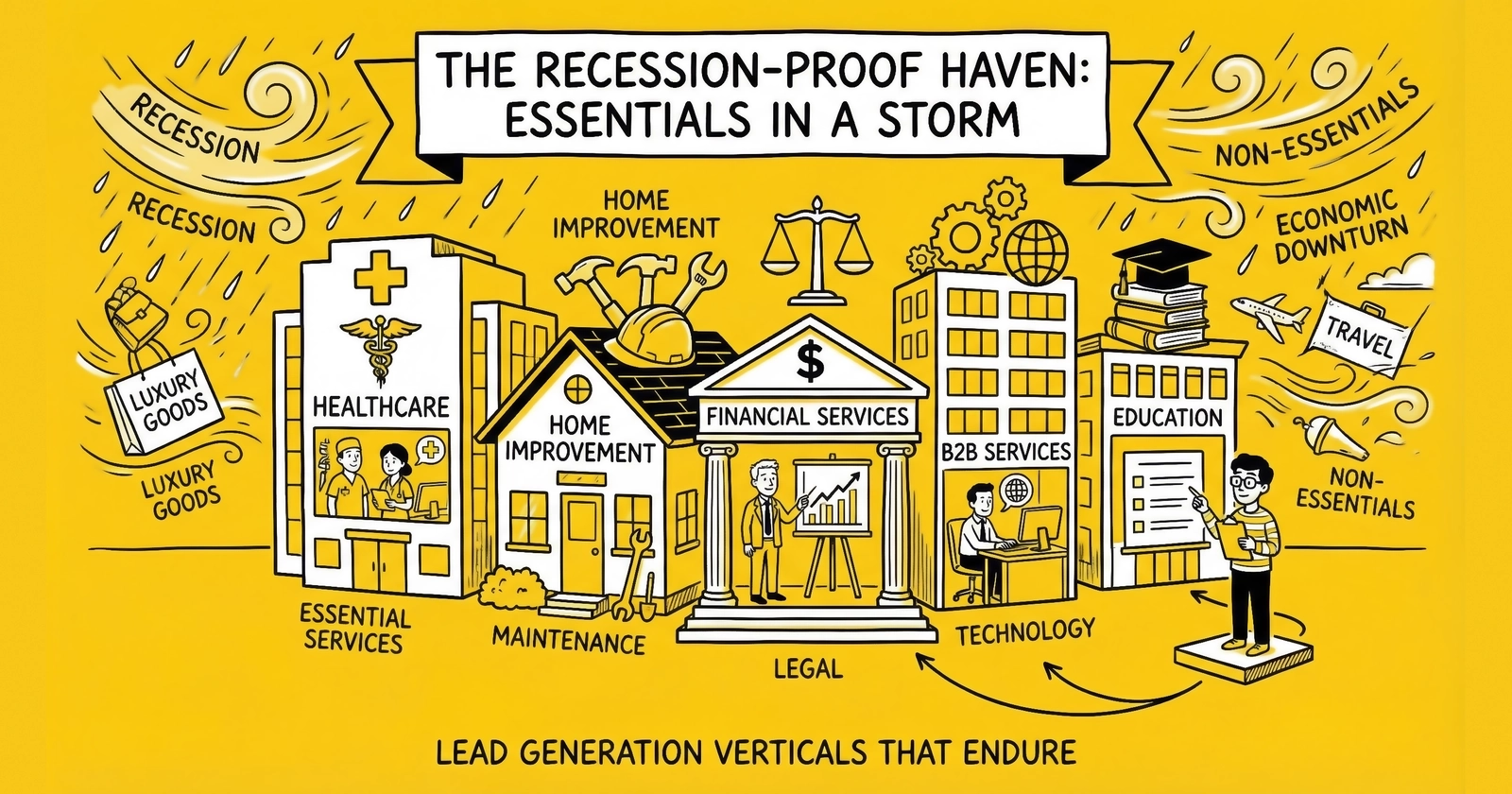
When competitors cut marketing budgets during economic contractions, advertising costs drop 15-25% and demand concentrates in categories serving fundamental needs. The lead generators who understand which verticals thrive in downturns don’t just survive recessions – they build market positions that compound for years.
Economic uncertainty reshapes marketing economics with striking predictability – advertising costs collapse as competitors retreat, while consumer demand concentrates in categories that serve fundamental needs rather than discretionary wants. For lead generation professionals, recessions represent not merely survival challenges but strategic opportunities to build market position that compounds for years after recovery begins. The 2008-2009 financial crisis and 2020 pandemic recession revealed consistent patterns: certain verticals maintain or increase lead demand regardless of economic conditions, while others crater alongside consumer confidence. Understanding which categories demonstrate genuine recession resistance – and why – provides the strategic foundation for portfolio diversification that smooths revenue volatility across economic cycles.
This analysis examines historical performance data across lead generation verticals during economic contractions, identifies the structural characteristics that create recession resistance, and provides frameworks for building diversified vertical portfolios that maintain profitability regardless of macroeconomic conditions. The insights draw from performance patterns across multiple recessions and the operational realities that make certain verticals inherently more stable than others.
The Economics of Recession-Resistant Lead Generation
Recession resistance in lead generation stems from a simple principle: demand for certain products and services persists – or actually increases – when household budgets contract. Understanding this dynamic requires examining both consumer psychology during economic stress and the structural characteristics of industries that serve non-discretionary needs.
Why Advertising Economics Favor Counter-Cyclical Investment
When recessions hit, most marketers reduce advertising spend immediately. Corporate budget cuts typically target marketing first, with advertising spending historically declining 15-25% during recessions according to data from the Association of National Advertisers. This retreat creates a supply-demand imbalance in digital advertising markets that benefits operators who maintain or increase investment.
Cost-per-click rates on Google Ads declined 18% on average during the 2020 pandemic recession across most verticals, according to WordStream benchmarks. Facebook CPM rates dropped 35% in Q2 2020 before recovering. For lead generators maintaining consistent spend, these lower costs translated directly to reduced cost-per-lead and expanded margins – assuming they operated in verticals where demand held steady.
The math compounds favorably for counter-cyclical investors. A lead generation operation spending $100,000 monthly on advertising that sees 20% cost reduction effectively gains $25,000 in monthly capacity at the same spend level. If lead prices to buyers remain stable – common in recession-resistant verticals where buyer demand persists – margin expansion follows automatically.
Historical analysis from McKinsey examining companies that increased marketing investment during recessions found they achieved 20% higher revenue growth during recovery periods compared to peers who cut spending. The mechanism is straightforward: reduced competition for attention during downturns builds market share that persists after competitors return.
Structural Characteristics of Recession-Resistant Verticals
Certain characteristics consistently predict recession resistance across lead generation verticals:
| Characteristic | Why It Creates Recession Resistance | Example Verticals |
|---|---|---|
| Essential service provision | Demand persists regardless of economic conditions | Healthcare, insurance, utilities |
| Problem-solving orientation | Economic stress creates the problems these services solve | Debt relief, job placement, legal services |
| Counter-cyclical demand | Economic downturns directly increase demand | Bankruptcy, refinancing, government assistance |
| Long consideration cycles | Decisions made before recession often convert during recession | Education, major healthcare procedures |
| Regulatory requirements | Legal mandates create demand regardless of economy | Tax services, compliance services, insurance |
The strongest recession-proof verticals combine multiple characteristics. Debt settlement, for example, serves an essential need (debt reduction), solves problems created by recession (inability to pay bills), and experiences counter-cyclical demand spikes (financial stress increases during downturns). This combination creates not merely stable demand but demand acceleration during economic contractions.
Historical Performance Analysis by Vertical Category
Examining lead generation vertical performance across the 2008-2009 financial crisis and 2020 pandemic recession reveals consistent patterns that inform portfolio construction decisions. While individual company performance varied, vertical-level trends demonstrated remarkable consistency.
Financial Services: The Counter-Cyclical Powerhouse
Financial services lead generation splits into distinctly different recession profiles depending on product category. Mortgage purchase leads crater during recessions as housing transactions decline. Credit card leads similarly collapse as issuers tighten underwriting and reduce acquisition budgets. However, several financial services subcategories demonstrate strong counter-cyclical performance.
Debt Settlement and Credit Counseling
Debt settlement lead demand increased 340% between 2007 and 2010, according to data from the National Foundation for Credit Counseling. The mechanism is direct: job losses and income reduction created inability to service existing debt, driving consumers to seek settlement options. Lead buyers in this vertical – debt settlement companies and credit counseling agencies – increased acquisition budgets throughout the recession to capture improved demand.
The 2020 recession produced a more muted response initially, as government stimulus programs delayed financial distress. However, debt settlement lead volumes increased 89% in 2022 as stimulus effects faded and inflation eroded purchasing power, according to industry data from the American Fair Credit Council.
Refinance and Rate-Sensitive Products
Mortgage refinance demonstrates complex recession dynamics. During the 2008-2009 period, refinance demand spiked as interest rates dropped, but supply constraints emerged as lenders tightened underwriting standards. The result: high-quality refinance leads commanded premium prices despite chaotic mortgage market conditions.
The 2020 recession created near-perfect refinance conditions: rates dropped to historic lows while employment remained relatively stable for homeowners with equity. Refinance lead volumes exceeded 2019 levels by 180% in Q3 2020, with CPL rates declining despite surging demand due to reduced advertising competition in adjacent categories.
Tax Resolution Services
Tax debt resolution lead generation shows consistent counter-cyclical patterns. IRS data indicates tax delinquency rates increase 15-25% during recessions as households prioritize immediate needs over tax obligations. This delinquency creates demand for resolution services that persists for years after recession ends, as tax debt accumulates penalties and interest until resolved.
Insurance: Stability with Vertical Variation
Insurance lead generation demonstrates vertical-dependent recession resistance. Auto insurance maintains remarkably stable demand regardless of economic conditions – vehicles must be insured legally, and household transportation needs persist. Health insurance shows similar stability, amplified during periods of job loss when individual market enrollment increases.
| Insurance Vertical | 2008-2009 Change | 2020 Change | Stability Rating |
|---|---|---|---|
| Auto Insurance | -3% | +2% | Very High |
| Health Insurance | +12% | +28% | High |
| Life Insurance | -18% | -8% | Moderate |
| Homeowners Insurance | -22% | +5% | Moderate |
| Medicare Supplements | +8% | +15% | High |
Medicare Supplement and Medicare Advantage lead generation demonstrates particular recession resistance due to demographic factors. The over-65 population – primary Medicare customers – experiences less employment volatility during recessions and maintains healthcare purchasing regardless of economic conditions. AEP (Annual Enrollment Period) lead volumes remained stable or increased during both major recessions.
Legal Services: Problem-Solving During Crisis
Legal services lead generation shows mixed recession performance depending on practice area. Bankruptcy, foreclosure defense, and consumer protection claims surge during recessions. Personal injury, while not directly recession-linked, maintains stability as accidents continue regardless of economic conditions.
Bankruptcy Lead Generation
Bankruptcy filings increased 31% during the 2008-2009 recession, according to American Bankruptcy Institute data. This translated to proportional increases in bankruptcy attorney lead demand. Notably, bankruptcy lead generation maintains profitability even as filing volumes eventually decline – the pipeline of consumers considering bankruptcy extends well beyond actual filings.
The 2020 recession produced an unusual pattern: bankruptcy filings initially declined 30% in 2020-2021 as government stimulus delayed distress, then increased 19% in 2022-2023 as deferred financial problems materialized. Lead generators who maintained bankruptcy vertical presence through the stimulus period captured improved demand during the delayed wave.
Employment Law
Employment law lead generation – discrimination claims, wrongful termination, wage disputes – demonstrates counter-cyclical tendencies. Layoffs increase during recessions, generating employment disputes. Surviving employees face increased pressure that produces workplace violations. Employment law lead volumes increased 45% during 2008-2009 and 38% during 2020-2021 according to industry surveys.
Education: Mixed Signals with Long Horizons
Higher education lead generation shows complex recession dynamics. Community college and trade school enrollment increases during recessions as unemployed workers seek credential upgrades. Traditional four-year enrollment remains stable or increases as reduced employment options make education more attractive relative to entering the workforce.
Graduate school enrollment consistently increases during recessions. MBA program applications increased 32% during the 2008-2009 recession according to Graduate Management Admission Council data. Law school applications showed similar patterns. This creates sustained demand for higher education leads during economic downturns.
However, for-profit education – historically a major lead generation vertical – faces regulatory and reputational challenges that complicate recession analysis. The sector’s decline has less to do with economic cycles than regulatory pressure and student outcome concerns.
Healthcare: Procedural vs. Essential Services
Healthcare lead generation divides into discretionary and essential categories with different recession profiles. Essential healthcare – primary care, chronic disease management, emergency services – maintains demand regardless of economic conditions. Discretionary procedures – cosmetic surgery, elective orthopedics, dental cosmetics – typically decline 15-25% during recessions.
| Healthcare Category | Recession Profile | Demand Pattern |
|---|---|---|
| Primary Care | Essential | Stable |
| Chronic Disease | Essential | Stable to increasing |
| Mental Health | Counter-cyclical | Increases during downturns |
| Addiction Treatment | Counter-cyclical | Increases during downturns |
| Cosmetic Surgery | Discretionary | Declines 15-25% |
| Elective Procedures | Discretionary | Declines 10-20% |
| Senior Care | Essential | Stable |
Mental health and addiction treatment lead generation demonstrates counter-cyclical demand. Economic stress increases substance abuse and mental health challenges, driving treatment-seeking behavior. Addiction treatment lead volumes increased 28% during 2008-2009 and 45% during 2020-2021, with the latter reflecting both economic stress and pandemic-specific factors.
Building a Recession-Resistant Vertical Portfolio
Translating recession resistance patterns into portfolio construction requires balancing several competing objectives: maximizing growth during expansion periods, minimizing volatility during contractions, maintaining operational efficiency across verticals, and positioning for recovery acceleration.
Portfolio Diversification Framework
Optimal recession-resistant portfolios combine verticals with different cyclical profiles. A portfolio entirely concentrated in counter-cyclical verticals – debt settlement, bankruptcy, employment law – maximizes recession performance but underperforms during economic expansions when these categories experience reduced demand.
The most resilient portfolios include three vertical categories:
Counter-Cyclical Anchors (30-40% of portfolio) These verticals provide revenue acceleration during recessions, offsetting declines in cyclical categories. Primary options include debt settlement, bankruptcy law, tax resolution, and unemployment-related services. These verticals require maintained operational capacity even during low-demand expansion periods to capture recession opportunities.
Stability Verticals (40-50% of portfolio) Non-cyclical verticals that maintain consistent demand regardless of economic conditions form portfolio foundation. Auto insurance, Medicare products, essential healthcare, and compliance-driven services provide predictable revenue that supports operational overhead regardless of cycle position. Understanding seasonal trends across lead generation verticals helps distinguish cyclical from truly stable categories.
Growth Verticals (15-25% of portfolio) Cyclical verticals with high growth potential during expansions – mortgage purchase, home improvement, luxury services – provide upside during favorable conditions. These verticals may be scaled down during recessions while maintaining minimal operational capability for recovery.
Vertical Entry Timing Considerations
Recession periods provide optimal entry points for counter-cyclical verticals for several reasons. Advertising costs reach cycle lows, reducing customer acquisition expenses. Competitors focused on cyclical verticals exit or reduce counter-cyclical operations, reducing competition. Buyer demand peaks, allowing favorable contract terms and pricing.
Conversely, expansion periods favor entry into growth verticals when demand supports rapid scaling and before competition intensifies.
| Vertical Category | Optimal Entry Timing | Rationale |
|---|---|---|
| Debt Settlement | Recession | Peak demand, low ad costs |
| Bankruptcy | Recession | Peak demand, competitor retreat |
| Mortgage Purchase | Early expansion | Rising demand, moderate competition |
| Home Improvement | Mid-expansion | Established demand, proven buyer economics |
| Auto Insurance | Any time | Stable demand, consistent economics |
| Medicare | Any time | Demographic-driven, regulation-dependent |
Operational Considerations for Multi-Vertical Portfolios
Managing recession-resistant portfolios requires operational flexibility that many lead generation businesses struggle to maintain. Each vertical requires specific expertise: compliance knowledge, buyer relationships, traffic source understanding, and creative assets. Maintaining capabilities across multiple verticals during periods of low demand in any individual vertical creates overhead that can erode profitability.
Successful multi-vertical operators typically adopt one of two organizational models:
Centralized Platform Model Core infrastructure – technology, compliance, finance – serves all verticals with specialized vertical teams layered on top. This model achieves operational efficiency but requires substantial scale to justify fixed costs. Organizations below $10 million annual revenue often struggle with centralized model economics. For guidance on building infrastructure that scales, see our lead generation operations growth guide.
Portfolio Holding Model Semi-autonomous vertical operations share minimal infrastructure beyond capital allocation and strategic oversight. This model allows specialized optimization within each vertical but sacrifices potential synergies. It works well for operators with strong vertical expertise in distinct categories.
Deep Dive: Top Recession-Resistant Verticals
Several verticals consistently demonstrate superior recession resistance and merit detailed examination for operators considering portfolio expansion or rebalancing.
Debt Settlement and Credit Counseling
Debt settlement represents perhaps the most reliably counter-cyclical lead generation vertical. The fundamental demand driver – consumer debt stress – increases directly and proportionally with economic deterioration. During the 2008-2009 recession, debt settlement industry revenue increased from $1.2 billion to $3.8 billion according to Government Accountability Office estimates, driven by surging consumer demand for debt relief solutions.
Market Structure and Buyer Dynamics
The debt settlement industry consolidation that occurred between 2010-2020 created a smaller number of larger buyers with substantial lead acquisition budgets. Major players including Freedom Debt Relief, National Debt Relief, and Accredited Debt Relief maintain aggressive acquisition programs that sustain lead demand even during moderate economic periods.
Lead pricing in debt settlement typically ranges from $40-$120 depending on debt amount, debt type, and geographic factors. During recession periods, lead prices often increase despite higher volume due to intensified buyer competition for available leads – a favorable dynamic for generators.
Compliance Considerations
Debt settlement lead generation operates under FTC Telemarketing Sales Rule requirements that prohibit certain claims and require specific disclosures. State-level regulation varies significantly, with some states prohibiting debt settlement entirely. Compliant operation requires ongoing attention to regulatory developments and creative review processes. Standard operating procedures documented in lead generation operational playbooks help maintain compliance across teams.
Tax Resolution Services
Tax resolution – helping consumers resolve IRS tax debt – combines counter-cyclical demand with recurring seasonal patterns that enable predictable business planning. The IRS reports that tax delinquency accounts – consumers owing back taxes – increased 23% during 2008-2010 and 18% during 2020-2022. These accounts generate demand for resolution services that persists for years as penalties accumulate.
Demand Timing Patterns
Tax resolution lead demand peaks during two annual periods: immediately following tax filing deadline (April-June) when consumers discover they owe taxes they cannot pay, and October-December when IRS collection activity typically intensifies. These predictable patterns allow operational planning that maximizes efficiency.
Buyer Economics
Tax resolution firms typically operate on contingency or hybrid fee models, collecting substantial fees (often 15-25% of tax debt resolved) upon successful resolution. This lucrative unit economics supports aggressive lead acquisition – CPL rates of $150-$400 are common for qualified tax debt leads. The high buyer margins create resilient demand even during challenging economic periods.
Medicare Products
Medicare lead generation demonstrates recession resistance through demographic rather than economic mechanisms. The over-65 population grows predictably regardless of economic conditions, and Medicare enrollment is mandatory for most Americans reaching that age. This creates demand that is entirely disconnected from consumer confidence, employment rates, or GDP growth.
Annual Enrollment Period Dynamics
Medicare lead generation concentrates in the Annual Enrollment Period (October 15 - December 7) when beneficiaries can change Medicare Advantage or Part D plans. This concentration creates seasonal revenue spikes but also predictability that enables efficient operational planning.
Regulatory Environment
CMS (Centers for Medicare and Medicaid Services) strictly regulates Medicare marketing, with rules governing permitted claims, required disclaimers, and prohibited tactics. Compliant operation requires specialized knowledge and ongoing monitoring of regulatory updates. The compliance burden creates barriers to entry that benefit established operators with developed compliance infrastructure.
Addiction Treatment and Mental Health
Behavioral health lead generation – addiction treatment and mental health services – demonstrates counter-cyclical patterns driven by the relationship between economic stress and behavioral health challenges. Research consistently shows increased substance abuse and mental health symptoms during recessions, driving treatment-seeking behavior.
Market Evolution
The behavioral health lead generation market evolved substantially following the 2018-2020 regulatory crackdown on unethical patient brokering practices. Current market structure favors compliant operators with transparent practices and documented quality processes following lead quality control frameworks. Major treatment center networks have largely abandoned lead aggregators in favor of direct relationships with trusted lead generation partners.
Quality and Compliance Requirements
Addiction treatment lead generation operates under state-level patient brokering laws that prohibit payment for patient referrals in many jurisdictions. Compliant structures typically involve marketing services agreements rather than per-lead compensation, requiring careful legal structuring. The complexity creates barriers to entry but also sustainable competitive advantages for compliant operators.
Risk Factors and Limitations
While recession-resistant verticals offer portfolio stability benefits, several risk factors require acknowledgment.
Regulatory Volatility
Counter-cyclical verticals often serve financially distressed consumers, attracting regulatory attention focused on consumer protection. Debt settlement faced significant FTC enforcement and rule changes following the 2008-2009 recession. Tax resolution encounters IRS scrutiny of marketing claims. These regulatory risks can materialize suddenly and substantially impact operations.
Mitigation Strategies
- Maintain robust compliance infrastructure
- Build relationships with regulatory-aware buyers
- Diversify across multiple counter-cyclical verticals
- Monitor regulatory developments proactively
Buyer Concentration Risk
Recession-resistant verticals sometimes feature concentrated buyer markets where a small number of large buyers dominate lead acquisition. This concentration creates dependency risk – losing a major buyer relationship can substantially impact revenue without obvious replacement options.
| Vertical | Top 5 Buyer Market Share | Concentration Risk |
|---|---|---|
| Debt Settlement | 65% | High |
| Tax Resolution | 45% | Moderate |
| Medicare | 55% | Moderate-High |
| Auto Insurance | 40% | Moderate |
| Addiction Treatment | 35% | Moderate |
Demand Timing Uncertainty
While counter-cyclical verticals increase demand during recessions, the timing and magnitude of demand changes remain uncertain. The 2020 recession demonstrated that government policy can significantly delay recession impacts – debt settlement demand increases expected in 2020 largely materialized in 2022-2023 instead, after stimulus effects faded.
This timing uncertainty complicates operational planning. Organizations that significantly expanded capacity in anticipation of immediate demand increases may face extended periods of overcapacity before demand materializes.
Strategic Implementation Roadmap
Organizations seeking to build recession-resistant portfolios should approach implementation systematically, balancing opportunity capture against operational complexity.
Phase 1: Current State Assessment (Weeks 1-4)
Begin by analyzing existing vertical portfolio against recession resistance characteristics. Map current revenue distribution across vertical categories and estimate cyclical exposure. Identify operational capabilities and gaps for potential expansion verticals.
Key assessment questions include:
- What percentage of current revenue comes from counter-cyclical verticals?
- Which recession-resistant verticals align with existing operational capabilities?
- What buyer relationships exist that could facilitate new vertical entry?
- What compliance infrastructure would new verticals require?
Phase 2: Target Vertical Selection (Weeks 4-8)
Select expansion verticals based on recession resistance characteristics, operational fit, and market opportunity. Prioritize verticals where existing capabilities provide competitive advantage over pure greenfield entry.
Consider partnership opportunities where entering new verticals independently presents excessive risk or capability gaps. Established operators in target verticals may welcome performance marketing partnerships that provide incremental volume without requiring their own lead generation capabilities.
Phase 3: Pilot Implementation (Weeks 8-16)
Launch pilot programs in selected verticals with limited investment to validate assumptions about economics, operations, and buyer relationships. Pilots should test complete vertical economics including traffic acquisition, conversion rates, lead quality, and buyer acceptance before committing substantial resources.
Phase 4: Scale and Optimization (Weeks 16+)
Scale successful pilots while maintaining performance monitoring to identify potential issues before they become material problems. Continue portfolio rebalancing based on observed performance and evolving macroeconomic conditions.
Future Considerations and Emerging Opportunities
Several emerging trends will shape recession-resistant lead generation over coming economic cycles.
AI and Automation Impact
Artificial intelligence capabilities increasingly influence both lead generation operations and buyer organizations. AI-powered lead scoring, conversation intelligence, and automated qualification may alter the economics of lead generation across verticals. Operators who integrate AI capabilities effectively may achieve cost advantages that enhance recession resilience.
Climate-Related Verticals
Climate change creates emerging vertical opportunities with counter-cyclical characteristics. Insurance claims assistance following weather events, property hardening services, and energy efficiency improvements may develop into substantial lead generation verticals with recession-resistant profiles.
Healthcare Cost Pressures
Ongoing healthcare cost inflation creates expanding opportunities in healthcare cost reduction verticals – medical bill negotiation, healthcare price transparency tools, and alternative care options. Economic downturns amplify consumer focus on healthcare costs, potentially creating counter-cyclical demand patterns.
Key Takeaways
-
Economic recessions create strategic opportunities for lead generators who maintain investment while competitors retreat – advertising costs typically decline 15-25% during downturns, expanding margins for operators in stable-demand verticals.
-
Counter-cyclical verticals including debt settlement, bankruptcy, tax resolution, and employment law demonstrate demand increases during recessions, making them essential portfolio components for revenue stability across economic cycles.
-
Stability verticals including auto insurance, Medicare, and essential healthcare maintain consistent demand regardless of economic conditions, providing reliable revenue foundation that supports operational overhead during uncertain periods.
-
Optimal recession-resistant portfolios combine 30-40% counter-cyclical verticals, 40-50% stability verticals, and 15-25% growth verticals to balance recession protection with expansion-period upside.
-
The 2020 recession demonstrated that government policy can significantly delay recession impacts on lead generation demand, requiring operators to maintain patience and capacity through extended adjustment periods.
-
Regulatory risk concentrates in counter-cyclical verticals serving financially distressed consumers, necessitating robust compliance infrastructure and diversification across multiple recession-resistant categories.
-
Buyer concentration varies significantly across recession-resistant verticals, with debt settlement showing highest concentration (65% top-5 share) and addiction treatment showing more distributed buyer markets.
-
Medicare lead generation demonstrates recession resistance through demographic rather than economic mechanisms, making it uniquely insulated from consumer confidence and employment fluctuations.
-
Recession periods provide optimal entry timing for counter-cyclical verticals when advertising costs reach cycle lows and competitor retreat reduces competition.
-
Mental health and addiction treatment verticals show strong counter-cyclical patterns driven by established relationships between economic stress and behavioral health challenges.
Frequently Asked Questions
What makes a lead generation vertical recession-proof?
Recession-proof verticals share specific structural characteristics that insulate demand from economic fluctuations. The most resilient verticals serve essential needs that persist regardless of economic conditions – healthcare, legally required insurance, tax obligations. Counter-cyclical verticals go further, experiencing demand increases during downturns because economic stress creates the problems these services solve – debt relief, bankruptcy protection, employment dispute resolution. The strongest recession-proof verticals combine multiple characteristics: essential service provision, problem-solving orientation, and regulatory requirements that mandate service usage regardless of consumer discretionary spending capacity.
How much should advertising costs decrease during a recession?
Historical data indicates digital advertising costs typically decline 15-25% during recessions, though variation exists across platforms and verticals. The 2020 pandemic recession saw Google Ads CPC rates decline approximately 18% on average according to WordStream benchmarks, while Facebook CPM rates dropped as much as 35% in Q2 2020. These declines result from reduced advertiser competition as companies cut marketing budgets during economic uncertainty. For lead generators maintaining consistent spend in recession-resistant verticals, these lower costs translate directly to improved unit economics – the same budget produces more leads at lower cost-per-lead, expanding margins assuming lead prices remain stable.
Which financial services verticals perform best during recessions?
Financial services shows dramatic performance divergence during recessions depending on product category. Debt settlement and credit counseling demonstrate strongest counter-cyclical performance – demand increased 340% during the 2008-2010 period as consumers sought help managing unaffordable debt. Tax resolution shows similar patterns, with tax delinquency increasing 15-25% during economic contractions. Mortgage refinance performs well when recessions coincide with interest rate declines, though underwriting tightening can constrain supply. Conversely, mortgage purchase, credit card acquisition, and personal loan leads typically decline 30-50% during recessions as both consumer demand and lender appetite contract simultaneously.
How should lead generation portfolios be structured for recession protection?
Optimal recession-resistant portfolios balance three vertical categories with different cyclical profiles. Counter-cyclical anchors – debt settlement, bankruptcy, tax resolution – should represent 30-40% of portfolio, providing revenue acceleration during downturns that offsets declines elsewhere. Stability verticals – auto insurance, Medicare, essential healthcare – should comprise 40-50% of portfolio, delivering consistent revenue regardless of economic conditions. Growth verticals – mortgage purchase, home improvement, discretionary services – should represent 15-25% of portfolio, capturing expansion-period upside while accepting recession-period declines. This structure smooths revenue volatility across economic cycles while maintaining growth potential during favorable conditions.
What are the main risks of focusing on recession-proof verticals?
Counter-cyclical verticals often serve financially distressed consumers, attracting regulatory scrutiny focused on consumer protection. Debt settlement, tax resolution, and bankruptcy services have all experienced significant regulatory changes following recessions when enforcement agencies observe increased consumer complaints. Buyer concentration presents additional risk – many recession-resistant verticals feature concentrated buyer markets where losing a major relationship substantially impacts revenue. Finally, demand timing remains uncertain; the 2020 recession demonstrated that government policy can delay expected demand increases by 18-24 months, creating potential overcapacity situations for operators who expand too aggressively in anticipation of immediate demand spikes.
How does Medicare lead generation demonstrate recession resistance?
Medicare lead generation operates on demographic rather than economic drivers, making it uniquely insulated from recession impacts. The over-65 population grows predictably at approximately 10,000 new beneficiaries daily regardless of GDP growth, employment rates, or consumer confidence. Medicare enrollment is legally mandated for most Americans reaching age 65, creating demand that exists independently of economic conditions. Additionally, the Medicare population experiences less employment volatility during recessions – most are already retired – and maintains healthcare purchasing regardless of economic anxiety. The Annual Enrollment Period creates predictable seasonal demand patterns that enable efficient operational planning across economic cycles.
When is the best time to enter counter-cyclical verticals?
Recession periods provide optimal entry timing for counter-cyclical verticals for multiple reinforcing reasons. Advertising costs reach cycle lows as competitors reduce spending, lowering customer acquisition expenses. Competitors focused primarily on cyclical verticals often exit or reduce counter-cyclical operations, reducing competition for traffic and buyer relationships. Buyer demand peaks during recessions, allowing favorable contract terms and pricing negotiations. However, entering during recessions requires maintaining operational capacity and cash reserves to survive the initial investment period. Organizations entering counter-cyclical verticals during expansion periods face higher acquisition costs and lower demand but avoid the cash flow pressures of recession-period entry.
How do addiction treatment and mental health leads perform during downturns?
Behavioral health lead generation – addiction treatment and mental health services – demonstrates consistent counter-cyclical patterns driven by established relationships between economic stress and behavioral health challenges. Research documents increased substance abuse and mental health symptoms during recessions as financial stress, unemployment, and uncertainty take psychological tolls. Addiction treatment lead volumes increased 28% during 2008-2009 and 45% during 2020-2021, with the latter reflecting both economic stress and pandemic-specific isolation factors. The behavioral health market structure has evolved substantially since 2018 regulatory changes, now favoring compliant operators with documented quality processes over volume-focused aggregators.
What compliance considerations apply to recession-proof verticals?
Recession-resistant verticals serving financially distressed consumers operate under heightened regulatory scrutiny. Debt settlement requires compliance with FTC Telemarketing Sales Rule provisions prohibiting advance fees and requiring specific disclosures. Tax resolution faces IRS oversight of marketing claims regarding resolution outcomes. Medicare lead generation operates under CMS marketing rules governing permitted claims, required disclaimers, and prohibited tactics. Addiction treatment must navigate state-level patient brokering laws that prohibit payment for patient referrals in many jurisdictions. Successful operation in these verticals requires dedicated compliance infrastructure, ongoing regulatory monitoring, and relationships with legal counsel familiar with vertical-specific requirements.
How quickly does demand shift when recessions begin?
Demand shifts vary substantially by vertical and recession characteristics. Debt settlement and bankruptcy typically show demand increases within 3-6 months of recession onset as consumers exhaust savings and credit options. Tax resolution demand follows annual filing cycles regardless of recession timing, though delinquency volumes increase over 12-18 month periods. The 2020 recession demonstrated that government intervention can significantly delay demand shifts – expected debt settlement surges largely materialized 18-24 months after recession began, after stimulus effects faded. This timing uncertainty requires operators to maintain patience and capacity through extended adjustment periods rather than expecting immediate demand increases upon recession announcement.
Should lead generators maintain counter-cyclical capacity during expansions?
Maintaining counter-cyclical vertical capacity during economic expansions creates overhead without corresponding revenue, but abandoning these verticals eliminates recession protection benefits. The optimal approach depends on organizational scale and risk tolerance. Larger organizations with sufficient margin can maintain reduced but operational counter-cyclical teams, accepting lower efficiency in exchange for recession readiness. Smaller organizations may maintain minimal capability – technology infrastructure, buyer relationships, compliance knowledge – without dedicated operational teams, planning to scale quickly when recession indicators emerge. Partnership structures with established counter-cyclical operators provide alternative approaches that preserve optionality without requiring full operational maintenance.
Sources
- McKinsey: Beyond Belt-Tightening – How Marketing Can Drive Resiliency During Uncertain Times - Research showing companies that maintain marketing spend during downturns capture disproportionate market share
- American Bankruptcy Institute Bankruptcy Statistics - Monthly and annual bankruptcy filing data tracking Chapter 7 and Chapter 13 volumes across economic cycles
- U.S. Courts Bankruptcy Filing Statistics - Official federal judiciary data on bankruptcy filings by district, chapter, and filing type
- CMS Medicare Enrollment Dashboard - Centers for Medicare and Medicaid Services enrollment data showing demographic-driven growth independent of economic conditions
- SAMHSA Treatment Episode Data Set - Substance Abuse and Mental Health Services Administration data on behavioral health treatment admissions and facility utilization
- WordStream Google Ads Industry Benchmarks - Annual cost-per-click and conversion rate benchmarks across industry verticals for paid search planning