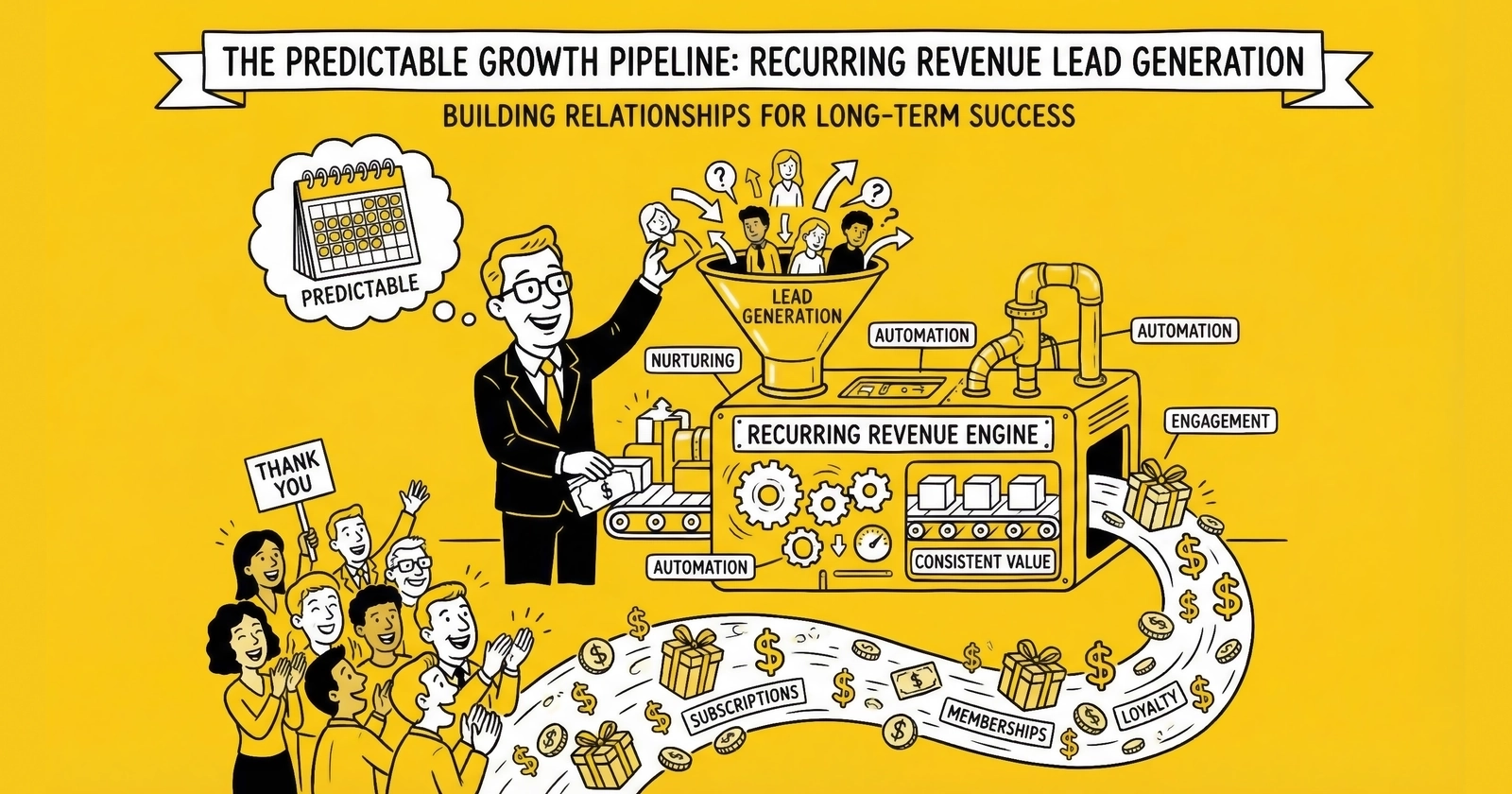
How to transform your transactional lead business into a predictable revenue engine – without sacrificing the performance economics that make lead generation profitable.
The Recurring Revenue Opportunity in Lead Generation
Lead generation is inherently transactional. You generate a lead, you sell it, you move on to the next one. There is no natural subscription component, no monthly renewal, no guaranteed revenue stream. Tomorrow’s income depends entirely on tomorrow’s traffic, tomorrow’s conversions, and tomorrow’s buyer demand.
This transactional reality creates operational stress that compounds over time. Practitioners who build sustainable wealth in this industry eventually discover the same truth: the most valuable lead generation businesses layer recurring revenue streams atop their transactional core. They maintain the performance economics that make lead generation attractive while reducing the daily uncertainty that burns operators out.
This guide examines the strategies, models, and economics of building recurring revenue within lead generation operations. The approaches range from simple retainer arrangements to sophisticated platform models that fundamentally change how value flows through your business. Not every approach fits every operator. But understanding the full spectrum of options lets you select and sequence the strategies that match your capabilities, capital, and ambitions.
Those who master recurring revenue build businesses that survive market downturns, command premium valuations at exit, and generate wealth without requiring constant hustle. The ones who ignore this dimension build lifestyle businesses that depend entirely on their daily attention – which is fine until it isn’t.
Why Transactional Lead Generation Creates Fragility
Before exploring recurring revenue strategies, you need to understand precisely why pure transactional models create vulnerability. The fragility isn’t a bug to be fixed. It’s a structural feature of how the business works.
The Cash Flow Volatility Problem
In transactional lead generation, revenue resets to zero every morning. Yesterday’s performance provides no guarantee of today’s results. Traffic costs fluctuate, platform algorithms change, buyers adjust caps, and seasonal patterns shift demand. A single policy update from Google or Meta can eliminate profitable campaigns overnight.
Consider the cash flow pattern of a typical lead generation operation. Month one delivers strong performance with revenue exceeding projections by 15%. Then an algorithm change in month two reduces conversion rates, dropping revenue by 20%. Month three sees recovery back to baseline, only for a key buyer to reduce caps in month four, causing revenue to drop 25%. By month five, a new buyer fills the gap and revenue recovers. This volatility makes financial planning nearly impossible. Payroll, rent, and platform fees remain constant regardless of whether leads are flowing or not. The mismatch between fixed costs and variable revenue creates perpetual anxiety for operators.
The Working Capital Trap
Transactional lead generation requires substantial working capital. The 60-day float rule means you need approximately 60 days of operating costs available as cash to bridge the gap between paying suppliers and collecting from buyers. For an operation processing $200,000 monthly in lead transactions, this means $400,000 or more in working capital just to maintain operations. That capital sits idle in the cash flow cycle, generating no return, but essential for survival.
Recurring revenue reduces working capital intensity because contracted revenue arrives predictably. A $50,000 monthly retainer collected on the first of the month reduces your effective float requirement by $100,000 across the 60-day cycle. The cash flow benefits compound as recurring revenue grows, eventually creating the stability that lets you pursue opportunities rather than simply survive volatility.
The Valuation Discount
When lead generation businesses sell, acquirers apply significant discounts to purely transactional operations. Transaction-based operations typically command 2-4x EBITDA, while recurring revenue operations command 6-10x ARR (Annual Recurring Revenue). The difference is dramatic. A transactional lead business generating $500,000 annual profit might sell for $1-2 million. The same profit, restructured as $600,000 in annual recurring revenue, might command $3.6-6 million.
This valuation differential reflects risk perception. Buyers of transactional businesses know that revenue could evaporate if the founder leaves, if traffic sources change, or if key buyers churn. Recurring revenue creates contractual obligations that survive transitions. When acquirers evaluate your business, they’re pricing risk as much as profit. Recurring revenue dramatically reduces that risk premium.
The Founder Dependency Problem
Most transactional lead generation businesses are highly founder-dependent. The founder’s relationships, traffic knowledge, and operational intuition are difficult to transfer. When the founder steps away – for vacation, illness, or eventual exit – performance often declines. This dependency caps your lifestyle options and your exit value.
Recurring revenue creates systems that operate independently of founder attention. A platform subscription renews automatically. A technology licensing agreement generates revenue whether you’re working or not. This structural independence is essential for eventual exit or lifestyle optimization. The goal isn’t to make yourself unnecessary – it’s to ensure the business produces value even when you’re not actively pushing leads through the system.
The Recurring Revenue Spectrum in Lead Generation
Recurring revenue in lead generation exists on a spectrum from lightweight retainer arrangements to full platform models. Understanding where each model sits helps you select appropriate strategies for your current capabilities and resources.
Model 1: Minimum Commitment Contracts
The simplest form of recurring revenue involves buyers committing to purchase minimum lead volumes at agreed prices over extended terms. The structure typically involves 6-12 month contracts with minimum monthly or quarterly volume commitments. Buyers agree to purchase, say, 500 leads monthly at $55 each regardless of their actual demand, generating guaranteed revenue of $27,500 per month ($330,000 annually) per committed buyer.
The economics work because buyers accept minimum commitments when you demonstrate consistent quality, reliable delivery, and competitive pricing. The discount you offer – typically 5-15% from spot pricing – reflects the reduced uncertainty you gain. A 10% discount for 100% volume certainty is often worthwhile from both sides of the transaction. Implementation requires legal contracts with clear specifications and enforcement mechanisms, quality guarantees that protect buyers if you underperform, capacity planning to ensure you can fulfill commitments, and relationship depth sufficient to negotiate binding agreements.
The limitations are real, though. Minimum commitments reduce volatility but don’t create true recurring revenue. Buyers may negotiate out of commitments during market shifts, and enforcement is expensive and relationship-damaging. Consider this the training wheels version of recurring revenue – valuable for building the muscle memory of predictable income, but not the destination.
Model 2: Retainer-Plus-Performance Arrangements
A hybrid structure where buyers pay a fixed monthly retainer plus per-lead fees creates more meaningful recurring revenue. The retainer covers your fixed costs and guarantees baseline revenue, while performance fees reward successful lead generation. Monthly retainers typically range from $5,000-$25,000 plus CPL fees at reduced rates. The retainer often covers account management, dedicated resources, and priority allocation.
Consider a concrete example. A $15,000 monthly retainer combined with a discounted CPL of $45 (versus $55 in the spot market) at 400 leads monthly generates total monthly revenue of $33,000 – $15,000 from the retainer plus $18,000 in performance fees. That’s $396,000 per client annually, with the retainer representing 45% of revenue.
Buyers accept retainers when you provide value beyond raw lead delivery: dedicated account management, custom integration, exclusive access, and strategic consultation. The retainer isn’t a markup – it’s payment for enhanced service that reduces their operational burden. Implementation requires account management capability to justify retainer value, custom integration or reporting that creates switching costs, service level agreements with meaningful guarantees, and clear scope definitions to prevent scope creep. This model works best for operations serving enterprise buyers or complex B2B sales cycles where lead delivery is only part of the value you provide.
Model 3: Technology Licensing
Building or acquiring technology that you license to other operators represents a significant step up in recurring revenue sophistication. This might be lead routing software, landing page frameworks, or specialized tools that other lead generators need. The structure involves monthly or annual subscription fees for access to your technology platform, with pricing typically following per-seat, per-lead, or tier-based models.
The economics are compelling. Subscription pricing ranges from $500-$5,000 monthly depending on capability and volume, with implementation fees of $2,000-$25,000 as one-time revenue. Gross margins run 70-85% – true software economics. Customer lifetime averages 24-48 months for sticky technology.
Consider a practical implementation. An operator who builds sophisticated server-side tracking might license that capability to other lead generators struggling with cookie deprecation. At $1,500 monthly with 50 customers, that’s $75,000 monthly recurring revenue – $900,000 annually – with 80% gross margins. The math transforms your P&L from lead generation economics to software economics.
Technology must solve a genuine problem that others cannot easily solve themselves. The solution needs to be sticky – creating dependency through integration depth, data accumulation, or workflow embedding. Implementation requires development resources to build and maintain software, customer success infrastructure for onboarding and retention, documentation and self-service capability, and security and compliance appropriate to handling lead data.
The limitations are substantial. Technology licensing requires significant upfront investment ($100,000-$500,000 minimum for viable product) and ongoing development resources. Most practitioners lack the capital or expertise. This model suits operators with technical backgrounds or partnership access to development resources.
Model 4: Data and Analytics Subscriptions
Your lead generation operation accumulates data: conversion patterns, geographic performance, buyer economics, and market trends. This data has value to others in your ecosystem. Subscription access to anonymized benchmarking data, market intelligence reports, or analytics dashboards that help others optimize their operations creates recurring revenue from assets you’re already generating.
Subscription pricing ranges from $200-$2,000 monthly depending on data depth, with custom reports or research commanding $5,000-$25,000 per project. Gross margins run 80-90% – pure information product economics. A multi-vertical lead generator with data across insurance, mortgage, and solar might develop a benchmarking platform where buyers subscribe at $500 monthly to compare their performance against anonymized industry averages. At 200 subscribers, that’s $100,000 monthly recurring revenue.
Data must be unique, actionable, and continuously refreshed. Static reports lose value quickly. The data needs to help subscribers make better decisions that they cannot make without your insights. Implementation requires data infrastructure for collection, anonymization, and analysis, visualization and reporting tools, continuous content and analysis updates, and clear value demonstration for subscriber retention.
The limitations are significant. Data businesses require scale to generate meaningful insights. A small operation’s data is too narrow to provide useful benchmarks. This model suits operators processing 50,000+ leads monthly across multiple verticals or geographies.
Model 5: Platform Marketplace Fees
Building a platform that connects generators with buyers, taking transaction fees or subscription revenue from both sides, represents the highest-value recurring revenue model – and the hardest to execute. You build a marketplace where generators post leads and buyers bid, charging platform fees of 5-15% of transaction value or subscription fees for access and enhanced features.
At $10 million annual transaction value with a 10% take rate, platform revenue reaches $1 million annually. At $100 million annual transaction value, platform revenue reaches $10 million. The major players demonstrate these economics at scale: MediaAlpha processed over $1.5 billion in transaction value in 2024, generating $864.7 million in revenue with a take rate running approximately 15% after adjusting for business model variations. EverQuote generated $500.2 million in 2024 with similar marketplace economics.
Marketplace success requires liquidity on both sides. Buyers need sufficient lead supply to justify platform integration. Generators need buyer demand to justify listing inventory. Breaking the chicken-and-egg problem requires subsidizing one side (typically generators) until critical mass develops. Implementation requires significant technology investment of $500,000-$2,000,000 minimum, months to years of network development through relationship building, regulatory compliance infrastructure, and capital to operate at loss during the network building phase.
Platform models require venture-scale capital and multi-year timelines. Most practitioners lack the resources. This model is included for completeness, not as a realistic near-term option for typical operators.
The Retainer Model Deep Dive
Of all recurring revenue models, retainer arrangements offer the most accessible path for established lead generation operators. They require no technology development, no platform building, and relatively modest capital investment. They do require relationship depth, service capability, and operational discipline.
Why Buyers Accept Retainers
Understanding buyer motivations helps you structure retainer proposals that align with their needs. Buyers with sales teams need predictable lead flow for capacity planning – a retainer guarantees you prioritize their needs over spot market opportunities, and they pay for that certainty. Enterprise buyers want dedicated resources: account managers who understand their business, not whoever answers the phone. Retainers fund dedicated attention.
Custom integration drives retainer acceptance as well. Buyers with sophisticated operations want leads delivered exactly to their specifications – specific CRM formats, custom data fields, tailored routing logic. Retainers fund the development and maintenance of custom integrations. Some buyers want strategic partnership: more than leads, they want market intelligence, competitive insights, and strategic consultation. Retainers fund the time and attention for these conversations. Finally, enterprise procurement departments prefer budget predictability – fixed monthly costs over variable expenses that complicate budgeting. Retainers fit corporate finance requirements.
Structuring Effective Retainer Agreements
The details of retainer structure determine whether arrangements succeed or fail. Scope definition is critical – clearly define what the retainer covers, including account management hours, lead volume commitments, integration maintenance, and reporting frequency. Vague scope leads to scope creep and relationship friction.
Performance tiers work well for structuring retainers with clear volume and quality expectations. A first tier at $15,000 monthly might include up to 400 leads at $40 CPL, weekly reporting, and monthly strategy calls. A second tier at $25,000 monthly could include up to 800 leads at $38 CPL, daily reporting, weekly strategy calls, and a dedicated account manager. A third tier at $50,000 monthly might encompass up to 2,000 leads at $35 CPL, real-time dashboard access, a dedicated team, and quarterly business reviews.
Volume flexibility protects both parties. Build in reasonable volume variance because buyers should not pay for leads they cannot absorb. Consider rollover provisions for unused capacity or credits against future periods. Quality guarantees demonstrate confidence – include return rate caps and quality floors, and if return rates exceed agreed thresholds, provide credits or volume adjustments. This protects buyers and demonstrates confidence in your quality.
Term and renewal structures typically run 6-12 months with automatic renewal and advance notice for cancellation. Build in annual price increase provisions of 3-5% to prevent margin erosion. Exit provisions should define clear termination conditions: material quality failures, repeated service failures, or business cessation should allow termination. Avoid lock-in provisions that trap unhappy buyers – they damage relationships more than they protect revenue.
Retainer Pricing Strategy
Pricing retainers requires balancing the certainty value you provide against the discount buyers expect. The certainty premium method calculates the value of guaranteed revenue to your operation – if eliminating volatility is worth 20% of revenue to you, consider offering 10% discounts while capturing 10% value. The service cost method calculates the actual cost of enhanced services – dedicated account management, custom integration, priority support – and prices retainers to cover these costs plus appropriate margin. The market comparison method researches what similar service providers charge for comparable arrangements; marketing agencies charge retainers of 10-20% of managed media spend, and applying similar ratios to lead economics provides useful guidance.
Consider a concrete calculation. With a spot market lead price of $55 and a monthly volume target of 500 leads, spot revenue potential reaches $27,500. A 15% retainer discount drops the lead price to $46.75, generating $23,375 in monthly lead revenue. Add an $8,000 retainer fee covering account management, integration, and priority, and total monthly revenue reaches $31,375 – an effective premium over spot of 14%. This structure works because the buyer pays more in total but receives enhanced value. You receive more revenue with greater predictability.
Common Retainer Pitfalls
Several failure modes undermine retainer arrangements. Scope creep tops the list – without clear boundaries, retainer clients expect unlimited attention. Define scope precisely and charge for out-of-scope work. Quality drift occurs when the pressure to fill retainer commitments tempts you to deliver marginal leads. Quality problems destroy retainer relationships faster than they destroy spot relationships.
Underpricing plagues many practitioners who underprice initial retainers to win business, then struggle to raise prices. Price appropriately from the start. Overcapacity creates a different problem – don’t commit to retainer volumes you cannot reliably fulfill, because failed commitments damage reputation more than conservative commitments. Dependency emerges when retainer clients represent more than 30% of revenue, because their departure creates crisis. Diversify retainer relationships as you build the model.
Building Technology-Based Recurring Revenue
Technology licensing represents the highest-margin recurring revenue opportunity in lead generation. Software margins of 70-85% dramatically exceed the 15-25% net margins typical of transactional lead operations. But technology products require significant investment, technical expertise, and patience to develop.
Identifying Technology Opportunities
The best technology opportunities solve problems that operators face repeatedly and painfully. Compliance documentation represents a major opportunity because every serious lead generator needs consent verification, TrustedForm integration, and audit trail maintenance. Tools that simplify compliance carry premium value. Server-side tracking has become urgent as cookie deprecation creates need for solutions that maintain signal accuracy – operators struggling to maintain attribution will pay for proven solutions.
Lead validation encompasses phone verification, email validation, and fraud detection. These services are essential but often fragmented across multiple vendors. Integrated solutions carry premium value. Distribution optimization – routing logic, price optimization, buyer matching – requires sophisticated technology that many practitioners lack the expertise to build. Reporting and analytics that help operators understand their economics through dashboards, alerting, and trend analysis inform better decisions and command recurring fees.
Build vs. Partner
most practitioners should partner rather than build. Technology development requires software engineering expertise (typically $150,000-$300,000 annually per engineer), product management capability, customer success and support infrastructure, ongoing maintenance and security, and capital for 12-24 months before meaningful revenue. Unless you have these resources or access to them, partnering with technology providers who offer white-label or revenue-share arrangements makes more sense.
Partnership structures take several forms. White-label licensing lets you resell another company’s technology under your brand. Revenue share arrangements earn you 20-40% of subscription revenue from customers you bring. Integration partnerships involve building integration between your operation and a technology platform, earning referral fees. Consider a concrete partnership model: a lead distribution platform offers a partner program where for each customer you refer who subscribes at $1,000 monthly, you receive 25% ongoing commission. Refer 20 customers and you receive $5,000 monthly recurring revenue with no development investment.
Technology Product Development
For practitioners with resources to build, technology product development follows a predictable pattern across four phases. The first phase, lasting 6-12 months, involves building technology to solve your own problems as an internal tool. Use it internally and refine based on your own experience. This validates the concept with no external customer risk.
The second phase, lasting 3-6 months, involves beta testing. Offer free access to select industry contacts, gather feedback, identify gaps, and build case studies from their success. The third phase, another 3-6 months, involves paid pilots where you charge discounted rates to early adopters. Validate pricing and value proposition, then refine positioning based on what resonates. The fourth phase is market launch with full pricing, marketing, and sales infrastructure, customer success for retention, and an ongoing development roadmap.
Expect 18-36 months from concept to meaningful recurring revenue and $200,000-$500,000 minimum investment for a viable product.
Unit Economics for Technology Products
Technology products require different financial thinking. Customer Acquisition Cost (CAC) measures what it costs to acquire a new subscriber – for B2B software in lead generation, expect $500-$2,500 per customer depending on sales model. Lifetime Value (LTV) equals monthly subscription multiplied by expected lifetime – a $1,000 monthly subscription with 24-month average lifetime equals $24,000 LTV.
Target an LTV:CAC ratio of 3:1 or better. At $1,500 CAC and $24,000 LTV, the ratio is 16:1 – excellent economics. Monitor churn rate, the monthly percentage of customers who cancel. Technology products should target under 3% monthly churn (36% annual). Above 5% monthly signals product-market fit problems. Payback period measures months until CAC is recovered through subscription revenue. At $1,500 CAC and $1,000 monthly subscription, payback is 1.5 months – very healthy.
Data Monetization as Recurring Revenue
Lead generation operations accumulate valuable data that others will pay to access. Converting that data into recurring revenue requires infrastructure, compliance, and creative packaging.
Data Assets in Lead Generation
Your operation generates multiple data streams worth monetizing. Market data includes conversion rates, CPL trends, buyer demand patterns, and seasonal variations. Aggregated and anonymized, this data helps others understand market dynamics. Benchmark data comprises performance metrics across sources, verticals, and geographies – operators want to know how their performance compares to peers.
Buyer intelligence reveals which buyers pay fastest, have lowest return rates, and offer best terms. This is valuable competitive intelligence for generators. Source intelligence identifies which traffic sources produce quality leads and which produce fraud – publishers want to know where to buy traffic. Consumer trends track what products consumers research, what factors influence their decisions, and how intent patterns change over time.
Data Product Structures and Pricing
Subscription benchmarking provides monthly access to anonymous performance benchmarks where subscribers see how their metrics compare to aggregated industry data. Market reports offer quarterly or annual analysis of trends, opportunities, and risks, sold as subscriptions or one-time purchases. Custom research delivers bespoke analysis answering specific client questions at higher price points but lower volume. API access provides real-time data feeds for integration into other systems at premium pricing for automated access.
Data pricing varies dramatically based on uniqueness, depth, and freshness. Benchmarking subscriptions run $200-$1,000 monthly for individual operators and $2,000-$10,000 monthly for enterprise buyers. Market reports command $500-$5,000 per report. Custom research ranges from $5,000-$50,000 per project. API access runs $1,000-$5,000 monthly depending on volume and depth.
Consider an example model: a benchmarking subscription at $500 monthly with 150 subscribers generates $75,000 monthly recurring revenue. At 85% gross margin (minimal incremental cost per subscriber), annual recurring revenue reaches $900,000. At scale, data products generate excellent economics. The challenge is achieving scale – which requires marketing investment, content development, and sustained attention to customer success.
Compliance Considerations
Data monetization requires careful compliance attention. Consumer data cannot be resold without appropriate consent – your consumer disclosures must authorize the intended uses. Benchmark and market data must be sufficiently anonymized that individual consumers cannot be identified. Business performance data requires careful handling because publishing named buyer performance could damage relationships. Have legal counsel review data products before launch. CCPA, state privacy laws, and industry regulations all apply.
Subscription Services for Buyers
An often-overlooked recurring revenue opportunity involves selling subscription services directly to the buyers you serve. You already have relationships. You already understand their needs. Extending those relationships into subscription services is natural.
Service Categories and Structures
Lead nurturing subscriptions charge buyers monthly fees for you to nurture their unconverted leads through email and SMS sequences, returning them when engagement signals reappear. Aged lead programs give subscribers access to aged lead inventory at subscription pricing rather than per-lead fees – fixed monthly cost for unlimited aged leads.
Market intelligence subscriptions provide monthly briefings on market conditions, competitive activity, and opportunity assessment. Strategic insight subscribers cannot easily obtain elsewhere. Compliance support retainers cover compliance monitoring, consent documentation review, and regulatory update briefings. Training and development subscriptions offer access to training content, best practices documentation, and expert consultation for buyer sales teams.
Consider a concrete lead nurturing subscription example. A $3,000 monthly fee includes nurturing of up to 500 unconverted leads monthly, automated email and SMS sequences, engagement scoring and alerts, monthly performance reporting, and return of re-engaged leads at no additional cost. The value proposition is clear: buyers currently discard unconverted leads, and this subscription extracts residual value from leads they have already paid for.
A market intelligence subscription at $1,500 monthly might include weekly market briefings (15-minute call or recorded update), monthly competitive analysis reports, quarterly strategic consultation (60 minutes), and alert notifications on significant market events. The value proposition: buyers lack time and access to stay current on market dynamics, and this subscription keeps them informed with minimal time investment.
Implementing Recurring Revenue: A Phased Approach
most practitioners should implement recurring revenue gradually, building capabilities and relationships over time rather than attempting dramatic transformation. A four-phase approach spanning 18-36 months produces the best outcomes.
Phase 1: Minimum Commitments (Months 1-6)
The goal of this phase is converting 20-30% of transactional buyer relationships to minimum commitment contracts. Start by identifying your top 10 buyers by volume and relationship quality. Propose 6-month minimum commitment contracts with 5-10% discount, develop contract templates with clear specifications, and negotiate and execute agreements with 3-5 buyers.
Success in this phase means signing 3-5 minimum commitment contracts, putting 25% of monthly revenue under contract, and reducing revenue volatility month-over-month. This phase builds the foundation for deeper recurring revenue relationships.
Phase 2: Retainer Transition (Months 6-12)
The goal of this phase is upgrading select minimum commitment buyers to full retainer arrangements. Develop an enhanced service offering that includes account management, custom integration, and priority allocation. Identify 3-5 candidates for retainer upgrade based on relationship depth and enterprise characteristics, propose retainer-plus-performance structures, and build account management capability by hiring or allocating a dedicated resource.
Success means establishing 2-3 retainer relationships, putting 35-40% of monthly revenue into recurring streams, and having retainer revenue cover your fixed cost base. This is the phase where recurring revenue starts to meaningfully change your operations.
Phase 3: Service Extension (Months 12-18)
The goal of this phase is adding subscription services that extend value beyond lead delivery. Identify the highest-value service extension – whether nurturing, intelligence, or compliance. Develop and pilot the service with 2-3 friendly buyers, refine based on feedback, and launch broadly with defined packaging and pricing.
Success means having 1-2 subscription services generating revenue, 10-15 subscription customers, and 10% of revenue from non-lead services. This phase diversifies your revenue base beyond pure lead transactions.
Phase 4: Platform or Data Play (Months 18-36)
The goal of this phase is establishing technology or data-based recurring revenue if resources permit. Evaluate build versus partner options, execute development or partnership strategy, launch to an initial customer cohort, and scale based on product-market fit signals.
Success means having a platform or data product generating revenue, 50% of total revenue recurring, and a clear path to 75%+ recurring within 24 months. This phase transforms your business from a lead generation operation into a diversified revenue engine.
Financial Modeling for Recurring Revenue
Transforming your financial model to incorporate recurring revenue requires new metrics and forecasting approaches.
Key Metrics
Monthly Recurring Revenue (MRR) represents total contracted recurring revenue recognized monthly, excluding transactional lead revenue. Annual Recurring Revenue (ARR) equals MRR multiplied by 12 and is used for valuation and planning purposes. Recurring Revenue Ratio – MRR divided by Total Monthly Revenue – should target 50%+ for meaningful stability.
Net Revenue Retention equals (Starting ARR + Expansion - Contraction - Churn) divided by Starting ARR. Target 100%+, indicating that existing customers grow faster than churn. Customer Lifetime Value equals average revenue per customer multiplied by average customer lifetime. For retainers, calculate as monthly retainer multiplied by average contract term in months.
Forecasting Recurring Revenue
Build realistic assumptions into your forecasts. Budget 5-10% annual contraction from existing contracts due to downgrades and reduced scope. Budget 10-20% annual churn for retainer clients and 20-30% for subscription services. Budget 10-15% annual expansion from existing clients through upgrades and scope increases.
An example forecast starting from $0 MRR might show $15,000 in new MRR in month one, reaching $15,000 ending MRR ($180,000 ARR). By month six, starting MRR of $45,000 plus $8,000 new MRR and $5,000 expansion, minus $3,000 churn, yields $55,000 ending MRR ($660,000 ARR). By month twelve, starting MRR of $85,000 plus $12,000 new MRR and $8,000 expansion, minus $7,000 churn, yields $98,000 ending MRR ($1,176,000 ARR).
Valuation Impact
The valuation premium for recurring revenue is substantial, as detailed in lead generation exit strategies. A transactional business generating $500,000 annual EBITDA at a 3x multiple (industry average) commands a valuation of $1,500,000. The same business with 50% recurring revenue – $500,000 annual EBITDA and $600,000 ARR – commands a blended multiple of 5-6x, yielding a valuation of $2,500,000-$3,000,000. With 75% recurring revenue ($500,000 annual EBITDA and $900,000 ARR), the recurring-weighted multiple rises to 7-8x ARR, yielding a valuation of $3,500,000-$4,000,000.
The valuation math makes recurring revenue transformation one of the highest-ROI initiatives available to lead generation operators.
Frequently Asked Questions
What is the best way to add recurring revenue to a lead generation business?
Start with minimum commitment contracts for your largest buyers. These require no new capabilities – just contract negotiation skills you already have. Aim to convert 25-30% of transactional volume to 6-12 month commitments with modest discounts of 5-10%. Once commitments are established, upgrade select relationships to full retainer arrangements that include enhanced services like dedicated account management, custom integration, and priority allocation. This phased approach builds recurring revenue without requiring technology development or significant capital investment.
How much discount should I offer for minimum volume commitments?
Typical discounts range from 5-15% depending on commitment length and volume size. A 6-month commitment might warrant 5-8% discount, while a 12-month commitment with guaranteed minimums might warrant 10-12%. Calculate your break-even: if revenue volatility costs you 15-20% in lost opportunities (having to decline business when you’re at capacity, for example), then a 10% discount for guaranteed volume creates net value. Never discount more than the certainty is worth to your operation.
Can I implement retainer pricing without dedicated account managers?
Retainers without dedicated resources create scope creep and relationship problems. Buyers paying retainers expect priority attention. If you cannot provide dedicated account management, consider lighter retainer structures: guaranteed allocation priority, enhanced reporting, faster response SLAs. These create value without requiring full-time dedicated staff. Alternatively, price retainers to fund account management hires – a $15,000 monthly retainer easily supports a dedicated account manager at $60,000-$80,000 annual salary.
What technology tools support recurring revenue models?
For contract management, HubSpot, Salesforce, or PandaDoc track agreements and renewals. For subscription billing, Stripe Billing, Chargebee, or Recurly handle recurring payments and invoicing. For customer success, Gainsight, ChurnZero, or Vitally help monitor customer health and identify churn risk. For reporting, your existing lead distribution platform should track volume and quality by client. The specific tools matter less than having systematic processes for contract tracking, billing automation, and customer health monitoring.
How long does it take to transition from transactional to recurring revenue?
Expect 18-36 months to achieve meaningful recurring revenue representing 50%+ of total revenue. The timeline varies based on buyer relationships, operational capability, and strategic focus. Phase 1 (minimum commitments) can generate results in 3-6 months. Phase 2 (retainers) adds 6-12 months. Phases 3 and 4 (services and platform) require 12-24 months each. Practitioners who rush the transition often damage buyer relationships or overpromise on service capabilities. Patient, systematic execution produces better outcomes than aggressive transformation attempts.
What percentage of revenue should be recurring for optimal business health?
Target 50% recurring revenue for meaningful stability and 75%+ for premium valuations at exit. At 50% recurring, your fixed costs are covered by predictable revenue, reducing the stress of transactional volatility. At 75%+, your business operates more like a SaaS company than a traditional lead generator, commanding SaaS-like valuation multiples (6-10x ARR versus 2-4x EBITDA). However, maintain some transactional capacity to capture market opportunities and test new approaches. Pure recurring can reduce operational agility.
How do I prevent scope creep with retainer clients?
Define scope precisely in contracts. Specify hours of account management included, reporting frequency and format, response time commitments, meeting cadence, and what constitutes out-of-scope work. When clients request out-of-scope work, document it as such and either decline, propose scope expansion with pricing adjustment, or offer as occasional accommodation while reinforcing boundaries. Track time by client to identify scope creep early. Build quarterly scope reviews into contracts to address accumulated drift before it becomes problematic.
Should I build technology products or partner with existing platforms?
Partner unless you have substantial resources including a technical team, $200,000+ development budget, and 18+ month runway. Building technology products requires sustained investment before revenue materializes. Most practitioners underestimate the ongoing maintenance burden – security updates, feature requests, customer support, competitive response. Partnerships offer faster time to revenue with lower risk. Revenue share arrangements (20-40% of subscription revenue) provide meaningful recurring income without development burden. Build only if you have unique technical capabilities that create genuine competitive advantage.
What happens to recurring revenue if I want to sell my business?
Recurring revenue dramatically increases business value and sale probability. Acquirers prefer businesses with predictable revenue streams because they reduce post-acquisition risk. During due diligence, expect scrutiny of contract terms, renewal rates, customer concentration, and churn history. Strong recurring revenue with documented customer satisfaction commands premium multiples. Weak recurring revenue with high churn or customer concentration may receive little valuation credit. Focus on retention and diversification as much as recurring revenue growth – quality of recurring revenue matters as much as quantity.
How do I price subscription services for lead generation buyers?
Start with value-based pricing. Estimate the value your service creates for buyers – recovered leads, saved time, reduced compliance risk – and price at 20-30% of that value. Validate through customer conversations before launching. Test pricing with early adopters at discounted rates, then increase for subsequent customers based on demonstrated value. Consider tiered pricing: basic tier for smaller buyers, premium tier with enhanced features for enterprise customers. Monitor price sensitivity through win/loss analysis and adjust quarterly. Industry benchmarks: data subscriptions run $200-$2,000 monthly, nurturing services $2,000-$5,000 monthly, compliance support $1,000-$3,000 monthly.
What are the tax implications of recurring revenue versus transactional revenue?
Consult a tax professional for your specific situation. Generally, recurring revenue creates predictable taxable income that may push you into higher tax brackets if not managed. Consider timing strategies: if you have annual contracts, you may be able to structure payment timing to manage taxable income across years. Retainer revenue is typically recognized as earned, not when received, which affects quarterly estimated payments. The shift to recurring revenue may warrant entity restructuring – LLCs may convert to S-Corps for more favorable treatment of self-employment taxes. Engage a CPA familiar with service business taxation before making significant recurring revenue transitions.
Key Takeaways
Transactional lead generation creates structural fragility through revenue volatility, working capital intensity, and founder dependency that limit both lifestyle quality and exit value. Recurring revenue addresses all three dimensions.
The recurring revenue spectrum offers options for every operator, from simple minimum commitments requiring no new capabilities to platform models requiring venture-scale investment. Opportunities exist at every resource level.
Retainer arrangements provide the most accessible path for most practitioners. Convert transactional relationships to retainer-plus-performance structures. Buyers accept retainers when you provide value beyond raw lead delivery – account management, custom integration, strategic consultation.
Technology and data products offer highest margins but require significant investment. Software margins of 70-85% exceed transactional lead margins dramatically, but development requires $200,000-$500,000 minimum and 18-36 months before meaningful revenue.
Implementation should be phased over 18-36 months. Start with minimum commitments, progress to retainers, extend to subscription services, and consider platform plays only with adequate resources. Rushing the transition damages buyer relationships and operational stability.
Target 50% recurring revenue for stability and 75%+ for premium valuation. At 50%, fixed costs are covered by predictable revenue. At 75%+, valuation multiples approach SaaS levels (6-10x ARR versus 2-4x EBITDA for transactional businesses).
Scope creep is the primary retainer risk. Define scope precisely, track time by client, and build quarterly scope reviews into contracts. Retainers that expand without compensation erode margins and create resentment.
Partner before building technology. Unless you have technical teams and substantial capital, partnership arrangements (white-label, revenue share, referral) provide recurring revenue without development burden.
Recurring revenue transformation is a 3-year journey. Patient, systematic execution produces better outcomes than aggressive transformation attempts. Build capabilities and relationships progressively rather than attempting dramatic change.
The valuation math is compelling. A business generating $500,000 EBITDA might sell for $1.5 million as a transactional operation or $3.5-4 million with 75% recurring revenue. Few initiatives offer comparable ROI.
This article is adapted from “The Lead Economy” by industry professionals with 15+ years of operational experience across lead generation business models. Statistics and market data current as of late 2025.