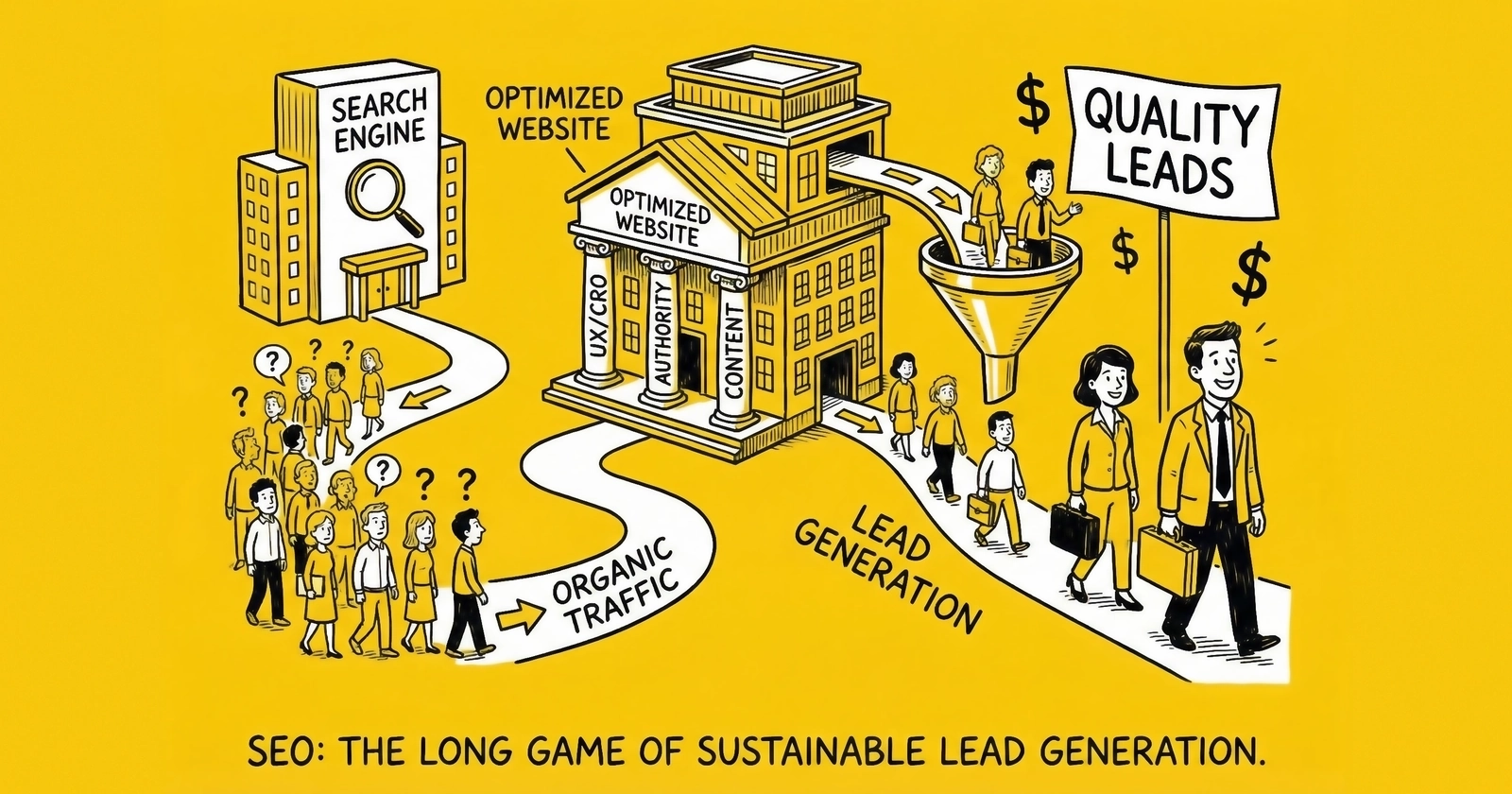
Organic search traffic represents the most economically attractive acquisition channel for lead generation operations – zero marginal cost per visitor, compounding returns over time, and audience intent that typically exceeds paid channels. Yet most lead generation businesses underinvest in SEO, viewing it as too slow, too uncertain, or too technical to prioritize over paid advertising’s immediate gratification. This perspective misunderstands both the economics and the strategic positioning that organic traffic provides. Operations with mature SEO programs achieve 40-60% lower blended customer acquisition costs than paid-only competitors, according to analysis of lead generation businesses across multiple verticals.
This analysis examines the specific SEO strategies that generate qualified leads rather than mere traffic, the technical foundations that enable search visibility, the content approaches that attract and convert high-intent visitors, and the measurement frameworks that connect organic efforts to lead generation outcomes. For a comprehensive understanding of how the lead generation industry operates, this context helps frame why organic visibility matters so much. The insights address lead generation specifically – where conversion optimization and intent matching matter more than raw traffic volume, and where local and vertical-specific search dynamics create opportunities that general SEO guidance overlooks.
The Economics of Organic Lead Generation
Understanding SEO economics clarifies why organic traffic investment deserves strategic priority despite longer time horizons than paid acquisition.
Cost Structure Comparison
Paid traffic operates on a variable cost model – each click requires payment, and costs scale linearly (or worse) with volume. Organic traffic operates on a fixed cost model – investment in content, technical optimization, and authority building produces traffic without per-click costs. This structural difference creates compounding advantages for organic-focused operations.
| Metric | Paid Search | Organic Search |
|---|---|---|
| Cost per click | $15-75+ (vertical dependent) | $0 marginal cost |
| Cost structure | Variable (scales with volume) | Fixed (investment amortizes) |
| Time to results | Immediate | 6-18 months |
| Sustainability | Ends when spending stops | Persists with maintenance |
| Traffic quality | High intent (keyword targeted) | Very high intent (self-selected) |
| Competitive dynamics | Costs increase with competition | Position earned through value |
Consider the economics over a five-year horizon for a lead generation operation in a vertical with $35 average CPC:
Paid-Only Scenario:
- Year 1-5: $420,000 annual ad spend (1,000 clicks/month)
- Total 5-year cost: $2,100,000
- Traffic stops immediately when spending stops
SEO Investment Scenario:
- Year 1: $150,000 investment, minimal traffic
- Year 2: $100,000 investment, 500 visits/month
- Year 3: $80,000 investment, 2,000 visits/month
- Year 4: $60,000 investment, 4,000 visits/month
- Year 5: $60,000 investment, 5,000 visits/month
- Total 5-year cost: $450,000
- Traffic continues with maintenance investment
The organic scenario produces 138,000 cumulative visits over five years at roughly $3.25 per visit, versus $35 per click for paid. The organic traffic also continues delivering value into year six and beyond with modest maintenance investment.
Intent Quality Differential
Organic traffic typically demonstrates higher conversion rates than paid traffic because of self-selection mechanisms. Users who navigate organic results have chosen to explore options, often after evaluating multiple results. Paid traffic includes users who click ads somewhat indiscriminately, particularly in mobile environments where ad placement can cause accidental clicks.
Lead generation operations with mature organic programs commonly report:
- 20-40% higher conversion rates from organic versus paid search
- 15-30% lower return/rejection rates from organic-sourced leads
- Higher downstream conversion rates (lead to customer) for organic leads
These quality differentials compound the cost advantages, making organic traffic even more valuable on a per-lead basis than raw traffic economics suggest. Understanding how to calculate true cost per lead helps quantify these differences precisely.
Risk Diversification Value
Operations dependent entirely on paid traffic face existential vulnerability to platform changes, policy updates, and cost inflation. Google and Meta regularly modify policies in ways that disrupt lead generation campaigns – sometimes permanently eliminating previously effective approaches. Organic traffic provides diversification that reduces this concentration risk.
The 2020-2022 period illustrated this vulnerability. iOS 14.5 tracking changes disrupted Meta advertising effectiveness for many lead generators. Google policy changes eliminated certain lead generation ad formats. Operators with substantial organic traffic weathered these disruptions; paid-only operators faced immediate revenue crises.
Technical SEO Foundations for Lead Generation
Technical SEO establishes the foundation that enables content and authority-building efforts to produce results. Without technical soundness, investment in content and links produces diminished returns.
Site Architecture for Lead Capture
Lead generation sites require architecture that balances SEO requirements with conversion optimization – sometimes conflicting objectives that require thoughtful resolution.
Landing Page Architecture
Traditional SEO guidance recommends consolidating content to build page authority. Lead generation often benefits from multiple landing pages targeting specific audiences, keywords, or geographic areas. Reconciling these requires hierarchical architecture:
Homepage (domain authority hub)
├── Service Category Pages (SEO-optimized, comprehensive)
│   ├── Location-Specific Pages (geo-targeting)
│   │   └── Lead Capture Forms
│   └── Sub-Service Pages (long-tail keywords)
│       └── Lead Capture Forms
├── Resource Content (authority building)
│   ├── Guides and How-To Content
│   ├── Industry Information
│   └── Comparison and Evaluation Content
└── Conversion Pages (minimal SEO, maximum conversion)
This architecture concentrates authority while enabling targeting flexibility. Service category pages earn links and rankings; location-specific and sub-service pages inherit authority while targeting specific search intents.
URL Structure Best Practices
Lead generation sites benefit from clean, descriptive URL structures that communicate relevance to both users and search engines:
| URL Pattern | Example | Purpose |
|---|---|---|
| /service/ | /auto-insurance/ | Primary service targeting |
| /service/location/ | /auto-insurance/texas/ | Geographic targeting |
| /service/modifier/ | /auto-insurance/quotes/ | Intent targeting |
| /resources/topic/ | /resources/how-auto-insurance-rates-work/ | Informational content |
Avoid URL patterns that obscure content purpose (/page?id=12345) or create unnecessary depth (/services/insurance/auto/personal/quotes/).
Core Web Vitals and Page Experience
Google’s page experience signals directly impact rankings, making site performance a competitive factor. Lead generation sites face particular challenges because conversion optimization elements – forms, tracking pixels, chat widgets – often degrade performance.
Performance Benchmarks:
| Metric | Good | Needs Improvement | Poor |
|---|---|---|---|
| Largest Contentful Paint (LCP) | <2.5s | 2.5-4.0s | >4.0s |
| First Input Delay (FID) | <100ms | 100-300ms | >300ms |
| Cumulative Layout Shift (CLS) | <0.1 | 0.1-0.25 | >0.25 |
Common Lead Generation Performance Issues:
Third-Party Scripts Lead tracking, conversion pixels, and analytics scripts often load synchronously, blocking page rendering. Solutions include asynchronous loading, script deferral, and consolidating tracking through tag management systems.
Form Libraries Complex form implementations with validation, conditional logic, and integrations can significantly impact performance. Evaluate form libraries for performance impact; consider lighter alternatives for simpler use cases.
Image Optimization Lead generation landing pages often include trust signals, testimonials, and partner logos that add image weight. Implement lazy loading, modern formats (WebP, AVIF), and appropriate compression.
Mobile Optimization
Mobile search represents the majority of searches across most lead generation verticals, making mobile optimization non-negotiable. Beyond responsive design, mobile optimization for lead generation involves:
Touch-Friendly Forms Form fields sized for finger input (minimum 44x44 pixel touch targets), appropriate input types (tel for phone, email for email), and autofill support that reduces friction.
Click-to-Call Implementation Mobile users expect tap-to-call functionality. Implement clickable phone numbers using tel: links, and track these conversions appropriately.
Mobile-First Indexing Awareness Google indexes mobile versions of sites preferentially. Ensure mobile versions contain all content and functionality present on desktop; hidden mobile content may not be indexed.
Schema Markup for Lead Generation
Structured data helps search engines understand page content and can produce enhanced search results (rich snippets) that improve click-through rates.
Relevant Schema Types:
| Schema Type | Application | Benefit |
|---|---|---|
| LocalBusiness | Location-specific landing pages | Local pack eligibility, business information display |
| FAQPage | FAQ sections on landing pages | FAQ rich results in search |
| HowTo | Process explanation content | Step-by-step rich results |
| Review | Testimonial and rating displays | Star ratings in search results |
| Service | Service descriptions | Service information display |
Implementation Example (LocalBusiness):
{
  "@context": "https://schema.org",
  "@type": "InsuranceAgency",
  "name": "AutoInsure Texas",
  "address": {
    "@type": "PostalAddress",
    "streetAddress": "123 Main Street",
    "addressLocality": "Dallas",
    "addressRegion": "TX",
    "postalCode": "75201"
  },
  "telephone": "+1-555-555-5555",
  "url": "https://example.com/auto-insurance/texas/",
  "areaServed": "Texas"
}
Crawl Budget and Indexation Management
Large lead generation sites with many location pages, landing page variations, or content archives may encounter crawl budget limitations that prevent complete indexation.
Crawl Budget Management:
- Consolidate thin or duplicate pages that provide minimal unique value
- Use canonical tags to indicate preferred versions of similar pages
- Implement XML sitemaps that prioritize important pages
- Use robots.txt to exclude low-value pages from crawling
- Monitor Google Search Console for crawl errors and indexation issues
- Avoid creating pages that exist solely for keyword targeting without unique value
For comprehensive platforms to manage lead flow at scale, our lead distribution platforms comparison evaluates the major options.
Content Strategy for Lead Generation SEO
Content serves dual purposes in lead generation SEO: attracting organic traffic through search visibility and converting that traffic into leads through persuasive communication.
Content Type Mapping to Funnel Stages
Different content types serve different stages of the lead generation funnel, each requiring distinct optimization approaches:
| Funnel Stage | User Intent | Content Type | SEO Focus |
|---|---|---|---|
| Awareness | Informational | Guides, explanations, educational content | High-volume keywords, comprehensive coverage |
| Consideration | Commercial investigation | Comparisons, reviews, evaluations | Comparison keywords, decision-support content |
| Decision | Transactional | Landing pages, quote forms, contact pages | High-intent keywords, conversion optimization |
Awareness Content Strategy
Awareness content attracts users early in their journey, building brand familiarity and trust before purchase intent crystallizes. This content targets informational queries – “how does auto insurance work,” “what affects insurance rates,” “types of coverage explained.”
Effective awareness content:
- Provides genuine educational value without immediate conversion pressure
- Targets long-tail informational keywords with meaningful search volume
- Links internally to consideration and decision content for users ready to progress
- Builds domain authority through link attraction (informational content earns links more easily than commercial content)
Consideration Content Strategy
Consideration content helps users evaluate options, comparing alternatives and understanding tradeoffs. This content targets commercial investigation queries – “best auto insurance companies,” “cheap auto insurance options,” “auto insurance comparison.”
Effective consideration content:
- Provides balanced evaluation that builds credibility through objectivity
- Includes comparison tables and evaluation frameworks
- Addresses common concerns and objections
- Creates natural pathways to decision content and lead capture
Decision Content Strategy
Decision content serves users ready to act, minimizing friction between intent and conversion. This content targets transactional queries – “auto insurance quotes,” “get auto insurance,” “apply for auto insurance.”
Effective decision content:
- Prioritizes conversion over comprehensiveness
- Removes distractions that delay conversion
- Includes trust signals and urgency elements
- Maintains sufficient content for search relevance without overwhelming users
Local SEO for Lead Generation
Many lead generation verticals have geographic components – insurance, home services, legal services, healthcare – making local SEO strategically important.
Google Business Profile Optimization
For operations with physical locations, Google Business Profile (GBP) optimization directly impacts local pack visibility:
- Complete all profile fields with accurate, consistent information
- Select appropriate primary and secondary categories
- Add photos of location, team, and work (where applicable)
- Respond to reviews promptly and professionally
- Post updates regularly to demonstrate active management
- Ensure NAP (Name, Address, Phone) consistency across web presence
Location Page Strategy
Location pages target geographic search queries for service areas. Effective location pages require unique, relevant content – not templated pages with only location names changed.
Unique location page elements:
- Location-specific service information (pricing, availability, requirements)
- Local team or representative information
- Location-relevant testimonials and case studies
- Geographic context (service area maps, nearby areas served)
- Local contact information and directions
Service Area Business Considerations
Lead generation operations that serve areas without physical locations (service area businesses) require modified local SEO approaches:
- GBP profiles without displayed addresses for service area businesses
- Content that targets “near me” and location-modified queries
- Multiple landing pages for major service areas (avoiding thin content duplication)
- Geographic relevance signals through local citations and content
Content Quality and E-E-A-T
Google’s quality guidelines emphasize Experience, Expertise, Authoritativeness, and Trustworthiness (E-E-A-T) – particularly important for “Your Money or Your Life” (YMYL) topics common in lead generation verticals like finance, insurance, healthcare, and legal services.
Demonstrating E-E-A-T:
Experience Evidence that content creators have real-world experience with topics discussed. For lead generation, this might include:
- Industry credential disclosure
- Years of experience references
- Practical examples from actual operations
- Process descriptions that demonstrate hands-on knowledge
Expertise Subject matter depth that demonstrates genuine understanding. Quality indicators include:
- Comprehensive topic coverage
- Technical accuracy verified by experts
- Citation of authoritative sources
- Nuanced treatment of complex topics
Authoritativeness Recognition as a trusted source within the industry. Authority building involves:
- Earning links from respected industry publications
- Building author profiles with demonstrated credentials
- Creating content that others reference and cite
- Participating in industry discussions and publications
Trustworthiness Signals that the site and organization are trustworthy. Trust elements include:
- Clear contact information and business identification
- Transparent about-us and team pages
- Privacy policies and terms of service
- Secure site implementation (HTTPS)
- Accurate, honest content without manipulation
Content Production and Optimization Process
Sustainable SEO content production requires processes that maintain quality while achieving volume sufficient for competitive visibility.
Content Development Workflow:
-
Keyword Research and Prioritization Identify target keywords based on search volume, competition, and relevance. Prioritize keywords that align with lead generation objectives over pure traffic potential.
-
Search Intent Analysis Analyze top-ranking content for target keywords to understand user expectations. Content that mismatches intent – commercial content for informational queries or vice versa – fails regardless of quality.
-
Content Brief Development Create detailed briefs specifying target keywords, intent, required elements, competitor benchmarks, and quality standards. Briefs ensure consistent output from internal writers or freelancers.
-
Production and Review Develop content following briefs with editorial review for quality, accuracy, and optimization. Include subject matter expert review for YMYL topics.
-
Optimization and Publication Implement on-page optimization (title tags, meta descriptions, headers, internal links), add structured data, and publish with performance tracking.
-
Monitoring and Iteration Track rankings, traffic, and conversions. Update content based on performance data and competitive changes.
Link Building for Lead Generation Sites
Backlinks remain a primary ranking factor despite Google’s evolution toward evaluating link quality over quantity. Lead generation sites face particular challenges in link building because commercial content attracts links less naturally than informational content.
Link Building Strategies by Effectiveness
| Strategy | Effectiveness | Difficulty | Scalability |
|---|---|---|---|
| Original Research/Data | Very High | High | Low |
| Expert Interviews/Roundups | High | Medium | Medium |
| Resource/Tool Creation | High | High | Low |
| Guest Posting | Medium | Low | High |
| Broken Link Building | Medium | Medium | Medium |
| Digital PR | Very High | High | Low |
| Industry Directory Listings | Low-Medium | Low | High |
Original Research and Data
Creating original research that provides unique data attracts links from publications seeking sources. Lead generation operations can apply proprietary data – lead volumes, conversion rates, market trends – to create linkable research assets.
Example approaches:
- Annual industry benchmark reports using internal data
- Consumer survey research on industry topics
- Market analysis combining multiple data sources
- Trend reports documenting changes over time
Expert Interviews and Roundups
Interviewing industry experts creates content with built-in promotion incentives – interviewees typically share and link to content featuring them. Roundup posts aggregating multiple expert perspectives multiply this effect.
Resource and Tool Creation
Interactive tools, calculators, and resources attract links from sites that reference them. Lead generation operations can create:
- Insurance quote estimators
- Mortgage payment calculators
- Cost comparison tools
- Decision-support quizzes
Digital PR
Creating newsworthy content and pitching to journalists generates high-authority links from news publications. Effective digital PR requires:
- Story angles with genuine news value
- Data or research that supports the angle
- Timely connection to current events or trends
- Relationships with relevant journalists
Local Link Building
For lead generation operations with geographic focus, local link building complements national strategies:
Local Link Opportunities:
- Chamber of commerce memberships
- Local business association directories
- Community event sponsorships
- Local news coverage
- Partnerships with complementary local businesses
- Local charity and nonprofit involvement
Link Quality Assessment
Not all links provide equal value. Assessing link quality helps prioritize building efforts:
Positive Quality Indicators:
- Relevant topical context (insurance site linking to insurance content)
- Editorial placement within content (not footer or sidebar lists)
- Authoritative linking domain (established publications, government, educational institutions)
- Traffic to linking page (links from visited pages transfer more value)
- Anchor text relevance (natural, varied anchor text)
Negative Quality Indicators:
- Irrelevant or unrelated linking sites
- Paid link patterns (multiple sites with similar profiles)
- Low-quality or spammy linking domains
- Excessive reciprocal linking
- Links from penalized or deindexed sites
Conversion Optimization for Organic Traffic
Organic traffic value realizes only through conversion – turning visitors into leads. Conversion optimization for organic traffic requires balancing SEO requirements with conversion best practices.
Landing Page Optimization
Landing pages serving organic traffic must satisfy both search engines (sufficient content for relevance determination) and users (clear value proposition and easy conversion path).
Content-Conversion Balance:
The traditional conversion optimization principle of minimizing distractions conflicts with SEO’s preference for comprehensive content. Resolution involves:
- Above-the-fold conversion focus with supporting content below
- Content that builds trust and addresses objections before conversion elements
- Clear visual hierarchy that guides attention to conversion points
- Multiple conversion opportunities throughout content without overwhelming
Trust Signal Integration
Organic visitors arrive without paid advertising’s implicit endorsement, making trust signals particularly important:
- Testimonials and reviews with attribution
- Industry certifications and accreditations
- Partner logos and associations
- Security badges and compliance certifications
- Contact information and physical address (where applicable)
Form Optimization
Lead capture forms represent the critical conversion point. Form optimization balances information collection needs against friction that reduces completion.
Form Field Optimization:
| Field Count | Typical Conversion Impact | Recommended For |
|---|---|---|
| 3-4 fields | Maximum conversion rate | Initial qualification, high-volume needs |
| 5-7 fields | Moderate conversion rate | Balanced qualification, most use cases |
| 8+ fields | Lower conversion rate | High-value leads, extensive qualification |
Progressive Profiling
Rather than collecting all information upfront, progressive profiling collects basic information initially, then requests additional details through follow-up:
- Initial form: Name, contact information, basic intent signal
- Thank you page: Additional qualifying questions
- Follow-up communication: Detailed qualification
This approach maximizes initial conversion while still collecting necessary information.
Conversion Tracking for Organic Traffic
Accurate conversion tracking connects organic traffic investments to lead generation outcomes:
Essential Tracking Elements:
- Google Analytics goal tracking for form submissions and key actions
- Source/medium attribution to isolate organic traffic performance
- Landing page-level conversion tracking to identify high-performing content
- Geographic and device segmentation to understand performance variations
- Assisted conversions to capture organic’s contribution to multi-touch journeys
Attribution Considerations:
Organic traffic often initiates journeys that convert through other channels. Users may discover a site through organic search, leave without converting, then return through direct or paid channels to complete conversion. Attribution models that credit only the final touchpoint undervalue organic’s contribution.
Consider:
- Multi-touch attribution models that credit organic discovery
- Assisted conversion analysis in Google Analytics
- First-touch attribution analysis for comparison
- Time-lag reports showing typical decision timelines
SEO Measurement and Reporting
Connecting SEO activities to business outcomes requires measurement frameworks that go beyond traffic metrics to capture lead generation impact.
Key Performance Indicators
| Metric Category | Specific Metrics | Business Relevance |
|---|---|---|
| Visibility | Rankings, impressions, click-through rate | Leading indicators of traffic potential |
| Traffic | Organic sessions, users, new vs. returning | Channel health indicators |
| Engagement | Time on site, pages per session, bounce rate | Content quality indicators |
| Conversion | Lead form submissions, conversion rate | Direct business outcome |
| Quality | Lead acceptance rate, downstream conversion | Lead value verification |
| Economics | Cost per organic lead, ROI | Investment justification |
Reporting Cadence and Focus
Different reporting frequencies serve different purposes:
Weekly Monitoring:
- Traffic trends versus previous week/year
- Ranking changes for priority keywords
- Technical issues (crawl errors, indexation problems)
- Conversion anomalies requiring investigation
Monthly Reporting:
- Comprehensive traffic and conversion analysis
- Content performance evaluation
- Link building progress
- Competitive position assessment
Quarterly Reviews:
- Strategy assessment and adjustment
- ROI analysis and budget evaluation
- Goal progress and resetting
- Resource allocation decisions
SEO ROI Calculation
Calculating organic SEO ROI requires capturing all investments and attributing appropriate value to organic-sourced leads:
Investment Components:
- Content creation costs (internal or external)
- Technical SEO resources
- Link building efforts
- Tools and platforms
- Analytics and reporting time
Value Calculation:
Organic lead value can be calculated by:
- Equivalent paid cost: What would paid traffic cost to generate the same leads?
- Revenue attribution: What revenue do organic-sourced leads generate downstream?
- Blended contribution: How does organic traffic affect overall lead generation economics?
Example ROI calculation:
- Annual SEO investment: $150,000
- Organic leads generated: 5,000
- Equivalent paid acquisition cost: $75/lead = $375,000
- ROI: ($375,000 - $150,000) / $150,000 = 150%
Competitive SEO Analysis
Understanding competitive positioning informs strategy development and resource allocation.
Competitive Analysis Framework
Domain Authority Comparison
Compare domain authority metrics (Ahrefs Domain Rating, Moz Domain Authority) to understand competitive strength. Substantial authority gaps require significant investment to overcome; narrow gaps suggest opportunity for relatively quick gains.
Keyword Gap Analysis
Identify keywords where competitors rank but you don’t, revealing content opportunities. Prioritize gaps based on:
- Search volume and traffic potential
- Conversion relevance (transactional versus informational)
- Competition difficulty
- Content creation requirements
Content Gap Analysis
Beyond keywords, analyze what content types competitors produce that you lack:
- Resource centers or guides
- Interactive tools
- Video content
- Local content coverage
Backlink Gap Analysis
Identify sites linking to competitors but not to you. These represent link building targets with demonstrated willingness to link to industry content.
Competitive Response Strategy
Competitive analysis informs but shouldn’t dictate strategy. Appropriate responses to competitive insights include:
Direct Competition (same keywords/content): Create superior content that better serves user intent – more comprehensive, more current, better designed, more trustworthy.
Flanking Strategy (adjacent opportunities): Target keywords and content types competitors neglect rather than competing directly for their strongest positions.
Differentiation: Develop unique content angles, data, or perspectives that competitors cannot easily replicate.
The GROWTH Framework: Systematic SEO for Lead Generation Operations
Most lead generation operations approach SEO as a collection of tactics rather than an integrated system. The GROWTH framework provides a structured methodology for building organic traffic programs that compound over time while maintaining focus on lead quality rather than raw traffic volume.
G – Geographic Targeting Architecture
For lead generation operations serving defined geographic markets, geographic targeting determines whether organic traffic converts into serviceable leads or wasted visitor sessions.
Geographic Content Hierarchy Model:
| Content Level | Target Scope | Example | SEO Value | Conversion Value |
|---|---|---|---|---|
| National hub | Entire market | ”Auto Insurance Guide” | Highest link potential | Lower conversion |
| State cluster | State-level | ”Texas Auto Insurance Requirements” | Medium link potential | Medium conversion |
| Metro pages | Major cities | ”Houston Auto Insurance Quotes” | Lower link potential | Higher conversion |
| Micro-local | Neighborhoods/suburbs | ”Auto Insurance Sugar Land TX” | Minimal link potential | Highest conversion |
Geographic Content Development Benchmarks:
Operations should develop geographic content based on serviceable market size:
| Market Scope | Recommended Pages | Monthly Content Investment | Expected Time to Rank |
|---|---|---|---|
| Single metro | 15-30 location pages | 4-8 pieces | 6-12 months |
| Multi-metro/regional | 50-100 location pages | 8-15 pieces | 9-18 months |
| Statewide | 100-250 location pages | 15-25 pieces | 12-24 months |
| National | 500-2,000 location pages | 25-50 pieces | 18-36 months |
Geographic Page Quality Standards:
Each location page requires differentiated content to avoid thin content penalties:
- Minimum 800 words of unique content per location
- Location-specific data points (local statistics, regulations, market conditions)
- Local testimonials or case studies (where available)
- Local contact information or service details
- Internal links to relevant service and informational content
Quality Verification Formula:
Location page quality score = (Unique word count × 0.3) + (Local data points × 15) + (Local reviews × 20) + (Local images × 10)
Target score: 300+ for competitive markets, 200+ for lower-competition markets.
R – Ranking Velocity Measurement System
Traditional SEO reporting focuses on current rankings, missing the trajectory information that predicts future performance. Ranking velocity tracking identifies opportunities and threats before they materialize in traffic changes.
Ranking Velocity Categories:
| Velocity Category | Movement Pattern | Interpretation | Recommended Action |
|---|---|---|---|
| Rapid ascent | 20+ positions/month | Strong content-market fit | Increase internal linking, add supporting content |
| Steady climb | 5-20 positions/month | Healthy progress | Maintain current strategy |
| Plateau | ±5 positions/month | Competitive equilibrium | Assess competitive gaps, consider content refresh |
| Gradual decline | -5 to -20 positions/month | Content aging or competition | Refresh content, add new information |
| Rapid decline | -20+ positions/month | Algorithm impact or technical issue | Immediate technical audit |
Velocity Tracking Implementation:
Track position changes weekly for priority keywords across three tiers:
| Keyword Tier | Tracking Frequency | Alert Threshold | Example Keywords |
|---|---|---|---|
| Tier 1 (conversion) | Daily | ±3 positions | ”insurance quotes [city]“ |
| Tier 2 (consideration) | Weekly | ±5 positions | ”best auto insurance [state]“ |
| Tier 3 (awareness) | Bi-weekly | ±10 positions | ”how car insurance works” |
Benchmark Velocity Standards by Keyword Difficulty:
| Keyword Difficulty | Expected Monthly Velocity (new content) | Warning Zone |
|---|---|---|
| Low (KD 0-30) | +15 to +30 positions | Under +10 |
| Medium (KD 31-50) | +8 to +15 positions | Under +5 |
| High (KD 51-70) | +3 to +8 positions | Under +2 |
| Very High (KD 71+) | +1 to +3 positions | Stagnant |
O – Organic Conversion Rate Optimization Protocol
SEO success metrics must extend beyond traffic to capture lead quality and conversion performance. The OCR Protocol establishes measurement frameworks that connect organic visibility to business outcomes.
Organic Traffic Quality Scoring:
| Quality Indicator | Measurement | High Quality Threshold | Low Quality Threshold |
|---|---|---|---|
| Bounce rate | Analytics | Under 45% | Over 70% |
| Time on page | Analytics | Over 2:30 | Under 0:45 |
| Pages per session | Analytics | Over 2.5 | Under 1.3 |
| Return visitor rate | Analytics | 15-30% | Under 5% |
| Form start rate | Behavior tracking | Over 8% | Under 2% |
| Form completion rate | Analytics | Over 3% | Under 0.5% |
Lead Quality by Organic Entry Point:
Different content types attract leads with different conversion potential:
| Entry Point Type | Expected Conversion Rate | Expected Lead Quality Score | Nurture Requirement |
|---|---|---|---|
| Transactional pages | 4-8% | High (8-10) | Minimal |
| Comparison content | 2-4% | Medium-High (6-8) | Light |
| Educational guides | 0.5-2% | Medium (4-6) | Moderate |
| Blog posts | 0.2-1% | Variable (3-7) | Significant |
| News/commentary | Under 0.5% | Lower (2-4) | Heavy |
Content-to-Lead Attribution Model:
First-touch attribution understates organic content contribution since awareness content often initiates journeys completed through other channels. Implement assisted conversion tracking:
- Tag all organic entry points with content type identifiers
- Track touchpoint sequences leading to conversion
- Calculate content contribution scores weighting position in sequence
- Allocate conversion credit proportionally
Attribution Credit Distribution Formula:
Content credit = Base credit × Position weight × Recency factor
Where:
- Base credit = 1 ÷ Total touchpoints
- Position weight = 1.3 for first touch, 1.0 for middle, 1.5 for last touch
- Recency factor = 1.0 for same session, 0.8 for same week, 0.6 for same month
W – Website Authority Building Strategy
Domain authority determines competitive ceiling for keyword difficulty. Operations targeting competitive keywords must systematically build authority through link acquisition and brand signals.
Authority Building Investment Benchmarks:
| Current Domain Rating | Target Keywords | Monthly Link Building Budget | Expected DR Growth |
|---|---|---|---|
| DR 0-20 | Low difficulty only | $500-1,500 | +3-5 DR/month |
| DR 21-40 | Low-medium difficulty | $1,500-3,500 | +2-3 DR/month |
| DR 41-60 | Medium-high difficulty | $3,500-7,500 | +1-2 DR/month |
| DR 61-80 | Most keywords accessible | $7,500-15,000 | +0.5-1 DR/month |
| DR 81+ | Maintenance mode | $5,000-10,000 | Maintain position |
Link Acquisition Quality Standards:
| Link Type | DR Threshold | Relevance Requirement | Monthly Target | Cost Range |
|---|---|---|---|---|
| Editorial mentions | DR 50+ | Topical relevance | 2-5 | $500-2,000 each |
| Guest contributions | DR 40+ | Industry relevance | 4-8 | $200-800 each |
| Resource page links | DR 30+ | Content relevance | 5-15 | $100-400 each |
| Directory citations | DR 20+ | Geographic/industry | 10-30 | $0-100 each |
| HARO/journalist responses | DR 60+ | Story relevance | 1-3 | Time investment |
Link Velocity Monitoring:
Track referring domain growth to ensure healthy link building patterns:
| Growth Pattern | Monthly New RD | Interpretation | Algorithm Safety |
|---|---|---|---|
| Conservative | 5-15 new RD | Safe, sustainable | High |
| Moderate | 15-40 new RD | Normal growth | Medium-High |
| Aggressive | 40-100 new RD | Requires quality maintenance | Medium |
| Rapid | 100+ new RD | Potential flag risk | Monitor closely |
T – Technical SEO Performance Standards
Technical SEO creates the foundation for content and link building success. Operations with technical deficiencies experience diminished returns on all other SEO investments.
Core Web Vitals Benchmarks by Page Type:
| Page Type | LCP Target | FID Target | CLS Target | Mobile Score Target |
|---|---|---|---|---|
| Homepage | Under 2.0s | Under 50ms | Under 0.05 | 90+ |
| Service pages | Under 2.5s | Under 75ms | Under 0.08 | 85+ |
| Location pages | Under 2.5s | Under 75ms | Under 0.08 | 85+ |
| Blog content | Under 3.0s | Under 100ms | Under 0.1 | 80+ |
| Lead forms | Under 2.0s | Under 50ms | Under 0.05 | 90+ |
Crawl Efficiency Standards:
| Site Size | Crawl Budget Target | Index Coverage Target | Orphan Page Tolerance |
|---|---|---|---|
| Under 100 pages | 95%+ crawled monthly | 95%+ indexed | Under 5% |
| 100-1,000 pages | 80%+ crawled monthly | 90%+ indexed | Under 8% |
| 1,000-10,000 pages | 60%+ crawled monthly | 85%+ indexed | Under 10% |
| 10,000+ pages | 40%+ priority pages monthly | 80%+ indexed | Under 12% |
Schema Implementation Requirements:
| Schema Type | Implementation Priority | Lead Gen Impact | Validation Method |
|---|---|---|---|
| LocalBusiness | Critical | Direct | Rich Results Test |
| FAQPage | High | Moderate | Rich Results Test |
| Service | High | Moderate | Structured Data Testing |
| Review/AggregateRating | High | Direct | Rich Results Test |
| BreadcrumbList | Medium | Indirect | Search Console |
| Organization | Medium | Indirect | Knowledge Panel monitoring |
H – Holistic Content Ecosystem Development
Individual content pieces underperform compared to interconnected content ecosystems that establish topical authority and support user journey progression.
Content Ecosystem Structure:
Build content clusters around core topics:
| Ecosystem Component | Content Volume | Word Count Range | Internal Link Requirement |
|---|---|---|---|
| Pillar page | 1 per topic | 3,000-6,000 words | Links to all cluster content |
| Cluster content | 8-15 per pillar | 1,500-2,500 words | Links to pillar + 2-3 related |
| Supporting articles | 15-30 per cluster | 800-1,500 words | Links to parent cluster |
| FAQ content | 5-10 per cluster | 500-1,000 words | Links to relevant cluster/pillar |
Content Freshness Maintenance Schedule:
| Content Type | Full Refresh Cycle | Minor Update Cycle | Metrics Trigger for Refresh |
|---|---|---|---|
| Pillar content | Annual | Quarterly | 20%+ traffic decline |
| Cluster content | 18 months | Semi-annual | 30%+ traffic decline |
| Transactional pages | Semi-annual | Monthly | Conversion rate decline |
| Location pages | Annual | Quarterly | Ranking position decline |
| Blog content | As needed | Annual audit | 50%+ traffic decline |
Content Performance Thresholds:
| Metric | Keep and Maintain | Refresh Required | Consider Consolidation |
|---|---|---|---|
| Monthly organic sessions | 100+ | 25-100 | Under 25 |
| Ranking positions | Top 20 | Position 21-50 | Position 50+ |
| Backlinks | 3+ referring domains | 1-2 referring domains | Zero referring domains |
| Conversion rate | Meeting benchmark | 50%+ below benchmark | 75%+ below benchmark |
Advanced SEO Strategies for Lead Generation
Beyond foundational optimization, advanced strategies create competitive separation for operations ready to invest in sophistication.
Programmatic SEO
Programmatic SEO creates large numbers of pages targeting long-tail keywords through templated approaches. For lead generation, this typically involves location and service permutations:
Example Implementation:
- Template: “[Service] in [City], [State]”
- Variables: 50 services × 500 cities = 25,000 potential pages
Success Requirements:
- Unique, relevant content on each page (not just variable substitution)
- Sufficient search demand for targeted variations
- Technical implementation that enables efficient creation and updating
- Quality controls that prevent thin or duplicate content
Risks: Google has penalized sites with low-quality programmatic pages. Each page must provide genuine value, not merely exist to capture keywords.
Entity SEO and Knowledge Graph
Google increasingly understands entities (people, places, things, concepts) rather than just keywords. Establishing entity presence can improve visibility for related queries.
Entity Establishment:
- Consistent NAP information across web presence
- Wikipedia presence (where notable)
- Knowledge panel eligibility through structured data
- Consistent brand mentions across authoritative sources
AI Search Optimization (LLMO)
As AI-powered search experiences grow, optimizing for AI citation becomes increasingly important:
AI Optimization Principles:
- Create definitive, quotable statements that AI systems can extract
- Provide clear definitions and explanations
- Structure content with clear hierarchies and sections
- Include specific data and statistics with sources
- Build topical authority through comprehensive coverage
For detailed strategies on optimizing for AI citation, see our guides on LLMO for lead generation and GEO optimization.
Key Takeaways
-
Organic traffic economics dramatically outperform paid acquisition over multi-year horizons – fixed cost structures versus variable costs create compounding advantages that typically result in 40-60% lower blended acquisition costs for operations with mature SEO programs.
-
Technical SEO foundations – site architecture, performance, mobile optimization, and schema markup – establish the infrastructure that enables content and link building investments to produce results; without technical soundness, other investments produce diminished returns.
-
Content strategy must map to funnel stages: awareness content builds authority and attracts early-stage visitors, consideration content helps users evaluate options, and decision content minimizes friction for users ready to convert.
-
Local SEO creates significant opportunity for geographically-focused lead generation verticals through Google Business Profile optimization, location page strategies, and local link building that competitors often underinvest in.
-
E-E-A-T (Experience, Expertise, Authoritativeness, Trustworthiness) signals carry particular importance for YMYL lead generation verticals like finance, insurance, healthcare, and legal services where Google applies heightened quality standards.
-
Link building remains essential despite evolution toward quality over quantity – original research, expert content, and digital PR generate high-value links, while local link opportunities support geographic targeting.
-
Conversion optimization for organic traffic requires balancing SEO content requirements against conversion best practices, using above-the-fold conversion focus with supporting content below, trust signal integration, and form optimization.
-
Measurement frameworks must connect SEO activities to lead generation outcomes, tracking not just traffic but conversion rates, lead quality, and economic impact to justify and optimize organic investment.
-
Competitive analysis informs but shouldn’t dictate strategy – direct competition for competitor keywords, flanking into neglected opportunities, and differentiation through unique content all represent valid strategic responses.
-
Advanced strategies including programmatic SEO, entity optimization, and AI search optimization create competitive separation for operations ready to invest in sophistication beyond foundational optimization.
Frequently Asked Questions
How long does SEO take to produce results for lead generation?
SEO typically requires 6-12 months to produce meaningful traffic results for lead generation sites, with full maturity taking 18-24 months. The timeline depends on several factors: starting authority (new domains take longer than established ones), competitive intensity (highly competitive verticals require more time and investment), and content investment level (more content production accelerates results). Initial results usually appear around months 4-6 with rankings for long-tail keywords, followed by increasing traffic as authority builds and rankings improve. Lead generation outcomes lag traffic results by another 1-2 months as conversion optimization occurs. Operations should plan investment horizons accordingly, recognizing that SEO is a medium-term strategy rather than immediate-results channel.
What should lead generation sites prioritize: traffic or conversion optimization?
Lead generation sites should prioritize traffic acquisition and conversion optimization simultaneously, as both are necessary for organic lead generation success – traffic without conversion produces no leads, and conversion optimization without traffic produces no scale. For frameworks to measure these tradeoffs, see our guide on calculating true ROI in lead generation. However, if forced to sequence, establish baseline conversion capability first (functional forms, reasonable user experience, basic trust signals), then focus on traffic acquisition until meaningful volume exists, then optimize conversion as traffic provides sufficient data for testing and improvement. The optimal ratio of investment shifts over time: early stages emphasize traffic building; mature programs can allocate more resources to conversion optimization where incremental improvements multiply against established traffic.
How many landing pages should a lead generation site have?
The appropriate number of landing pages depends on service offerings, geographic coverage, and target keyword universe. A general guideline: create landing pages where unique value exists – distinct services, meaningfully different geographic areas, or genuinely different user intents. Avoid creating pages solely for keyword targeting without substantive content differences. For location-focused lead generation, a common pattern involves 10-50 primary service pages plus 50-200 location-specific pages targeting major service areas. Each page should contain unique, relevant content; templated pages with only location names changed risk thin content penalties and provide poor user experiences. Quality matters more than quantity; fewer excellent pages outperform many mediocre ones.
Is link building still important for lead generation SEO?
Link building remains critically important for lead generation SEO despite Google’s evolution toward evaluating link quality over quantity. Backlinks continue to function as primary ranking factors; sites without competitive link profiles cannot rank for valuable keywords regardless of content quality. The approach to link building has evolved – manipulative tactics produce penalties, while earned links from quality content, relationships, and genuine value drive sustainable results. Lead generation sites should invest in link building through original research and data that attracts citations, expert content that earns editorial links, digital PR that generates news coverage, and local link building for geographic targeting. Expecting to rank without link building investment sets operations up for disappointment.
How should lead generation sites handle duplicate content across location pages?
Location pages create duplicate content risk when similar content appears across multiple geographic variations. Managing this requires creating genuinely unique content for each location rather than simply substituting city names. Unique elements should include: location-specific service details (pricing, availability, requirements), local testimonials and case studies, geographic context (service area information, local market conditions), and location-specific calls to action. Consolidate locations with minimal search volume or business opportunity rather than creating thin pages for every possible city. Use canonical tags for any remaining similar pages to indicate the preferred version. Monitor Google Search Console for duplicate content warnings and indexation issues that signal problems requiring attention.
What content types generate the most leads for organic traffic?
Decision-stage content optimized for transactional keywords typically generates the highest conversion rates – users searching “auto insurance quotes” convert at higher rates than those searching “how auto insurance works.” However, this content faces the most competition and difficulty ranking. A balanced content strategy includes: decision content (landing pages, quote pages) for direct conversion, consideration content (comparisons, reviews) that captures users evaluating options and guides them to conversion, and awareness content (educational guides, how-to content) that attracts early-stage visitors and builds domain authority. Many leads originate from awareness content visitors who return later to convert, making comprehensive content coverage valuable even when direct conversion rates are lower.
How does local SEO differ from general SEO for lead generation?
Local SEO emphasizes geographic relevance signals that general SEO doesn’t require. Key differences include: Google Business Profile optimization as a primary ranking factor for local pack visibility, NAP (Name, Address, Phone) consistency across all web presence, local citation building in directories and business listings, location-specific content that demonstrates genuine local presence, local link building from community organizations and local businesses, and geographic schema markup that communicates service areas. Local SEO also involves managing reviews and reputation more intensively, as Google prominently displays reviews for local businesses. Operations serving specific geographic markets should dedicate substantial SEO resources to local optimization rather than treating it as secondary to general SEO efforts.
What role does technical SEO play in lead generation site success?
Technical SEO establishes the foundation that enables content and link building to produce results. Without technical soundness, even excellent content may fail to rank due to crawling issues, indexation problems, or page experience deficiencies. Critical technical elements for lead generation include: site architecture that enables both SEO and conversion optimization, Core Web Vitals performance that meets Google’s page experience standards despite conversion tracking elements, mobile optimization for the mobile-majority search environment, schema markup that enhances search result appearance, crawl budget management for sites with many pages, and secure site implementation. Technical SEO typically requires 15-25% of total SEO investment; underinvesting creates invisible ceilings that limit results from other efforts.
How should lead generation sites measure SEO success?
SEO measurement should connect activities to business outcomes rather than stopping at traffic metrics. A comprehensive measurement framework includes: visibility metrics (rankings, impressions, click-through rates) as leading indicators, traffic metrics (organic sessions, users, geographic distribution) as channel health indicators, engagement metrics (time on site, pages per session, bounce rate) as content quality indicators, conversion metrics (form submissions, conversion rates by landing page) as direct business outcomes, quality metrics (lead acceptance rates, downstream conversion) as value verification, and economic metrics (cost per organic lead, ROI versus paid alternatives) as investment justification. Monthly reporting should cover all categories; quarterly reviews should assess strategy based on comprehensive data.
Can lead generation sites compete against larger, more established competitors?
Lead generation sites can compete against larger competitors through strategic focus rather than direct competition. Effective approaches include: targeting long-tail keywords and niche topics where large competitors haven’t invested, building authority in specific geographic areas where national competitors lack local relevance, creating content types that competitors neglect, developing unique data or perspectives that cannot be easily replicated, and focusing on conversion optimization to extract more value from traffic than less-focused competitors. Large competitors often have advantages in broad keyword competition but leave opportunities in specific niches, locations, and content angles. Smaller operations should identify these gaps and dominate narrower positions rather than attempting to compete directly for the most competitive terms.
How frequently should lead generation sites update their SEO content?
Content update frequency depends on content type, competitive dynamics, and performance data. Decision content (landing pages) should be reviewed quarterly and updated when conversion data suggests improvements or competitive changes require response. Consideration content (comparisons, reviews) requires more frequent updates – at least annually and whenever significant market changes occur (new competitors, product changes, pricing shifts). Awareness content (educational guides) can persist longer but should be audited annually for accuracy and updated when outdated information undermines credibility. Pages with declining performance (traffic drops, ranking losses) should be prioritized for refresh. Avoid updating content without purpose; updates should improve user value or competitive positioning rather than occurring for arbitrary freshness signals.
Conclusion
Organic search traffic represents a strategic asset for lead generation operations – providing traffic without marginal acquisition costs, visitors with high intent and quality, and diversification against paid channel volatility. The investment horizon exceeds paid advertising’s immediate results, but the economics compound favorably over time, creating sustainable competitive advantages for operations that commit to organic excellence.
Building organic lead generation capability requires coordinated investment across technical foundations, content development, link building, and conversion optimization. No single element succeeds in isolation; technical excellence without content produces nothing to rank, content without links struggles against competition, and traffic without conversion generates no business value.
For lead generation operations evaluating channel strategy, organic search deserves consideration as a core strategic priority rather than a secondary complement to paid advertising. The businesses achieving lowest blended acquisition costs and most sustainable competitive positions have typically invested significantly in organic traffic over extended periods. Beginning that investment creates advantages that compound with each passing year.