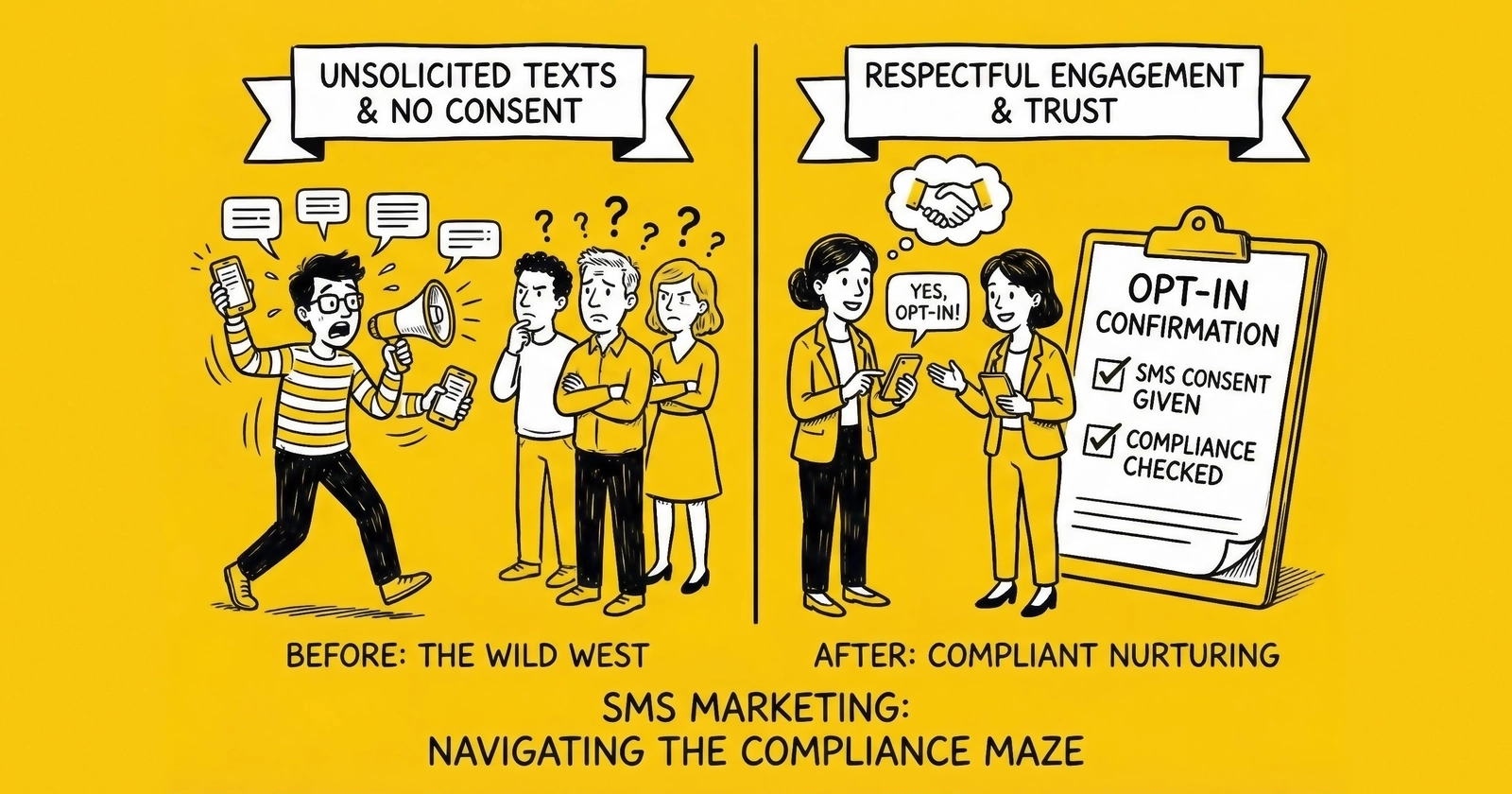
A comprehensive guide to using SMS as a lead nurturing channel – covering the 98% open rate advantage, TCPA compliance requirements, timing strategies, and platform selection for lead generation professionals.
Speed determines conversion in lead generation. A lead contacted within one minute converts at 391% higher rates. Understanding speed-to-lead optimization is critical for maximizing conversion. SMS delivers that speed advantage with 98% open rates versus 20% for email – making it the highest-engagement channel available for lead nurturing.
But SMS also carries the highest regulatory risk. A single non-compliant text message campaign can generate $500 to $1,500 in statutory damages per message. At scale, the math becomes existential: 10,000 text messages without proper consent means $5 million to $15 million in potential liability.
This guide covers everything lead generation professionals need to implement SMS marketing that converts without creating compliance exposure. From consent requirements to platform selection, timing optimization to ROI measurement – the complete framework for SMS lead nurturing that works.
SMS Open and Response Rates: The Data Behind the Channel
Email marketing dominated digital communication for two decades. SMS has surpassed it for engagement metrics that matter in lead conversion.
The Core Statistics
98% open rate. SMS messages are opened nearly universally. Email averages 20% open rates, meaning 80% of your email nurturing messages go unseen. SMS eliminates this visibility problem entirely.
90% read within 3 minutes. The average SMS is read within 90 seconds of delivery. Email messages sit in inboxes for hours or days before attention. For time-sensitive lead nurturing – where value decays 50% within 48 hours – this speed advantage compounds dramatically.
45% response rate. SMS response rates range from 30-45% depending on industry and message quality. Email response rates hover around 6%. A nurturing sequence that requires consumer action – confirming interest, scheduling appointments, providing additional information – performs dramatically better via SMS.
209% higher response than phone. Consumers increasingly screen calls and let unknown numbers go to voicemail. SMS bypasses this screening behavior. The same consumer who ignores your call will read your text within minutes.
Why These Numbers Matter for Lead Nurturing
Lead nurturing exists because not every lead converts immediately. The consumer who requested an insurance quote at 2 AM is not ready to talk to an agent until morning. The homeowner researching solar panels needs information before committing to a consultation.
Nurturing sequences bridge the gap between initial interest and conversion-ready engagement. The channel you use for nurturing determines whether your messages reach the consumer at all.
Consider a standard 7-touch nurturing sequence:
| Metric | Email Only | SMS Only | Combined |
|---|---|---|---|
| Messages Seen | 1.4 (20% open) | 6.9 (98% open) | 5.6 |
| Responses | 0.4 (6% response) | 2.8 (40% response) | 1.8 |
| Appointments Set | 0.08 | 0.56 | 0.36 |
The SMS-only approach delivers 7x more appointments per sequence than email-only. The economics shift accordingly: if your cost per sequence is $3 in messaging fees and labor, SMS generates 7x return on that investment.
Channel Preference by Demographic
Consumer preferences vary by age and context:
- 18-34 years old: 75% prefer SMS over phone for business communication
- 35-54 years old: 52% prefer SMS, 28% prefer phone, 20% prefer email
- 55+ years old: 38% prefer phone, 35% prefer email, 27% prefer SMS
For verticals skewing younger – solar, education, personal loans – SMS-first nurturing aligns with preference. For verticals with older demographics – Medicare supplements, reverse mortgages – multi-channel approaches work better.
TCPA Compliance for SMS Marketing
Every statistic from the previous section becomes irrelevant if your SMS program generates regulatory liability. The Telephone Consumer Protection Act applies fully to text messages, with the same statutory damages and private right of action that make phone compliance critical.
SMS Falls Under TCPA
Courts have consistently held that SMS messages are “calls” under the TCPA. The statutory language prohibits using an automatic telephone dialing system to make any call to a wireless number without consent. The FCC has confirmed that text messages fall within this definition.
Every compliance requirement for automated calling applies equally to text messaging:
- Prior express written consent required for marketing messages
- 8 a.m. to 9 p.m. calling hours (8 a.m. to 8 p.m. in Florida and Maryland)
- Immediate revocation honoring when consumers opt out
- Seller identification in consent language
Prior Express Written Consent Requirements
Valid consent for SMS marketing requires specific elements under 47 CFR § 64.1200(f)(9):
Written agreement. The consent must be documented in writing. Electronic signatures satisfying E-SIGN requirements work, but the intersection of TCPA and E-SIGN creates additional disclosure requirements.
Signature of the person. The individual receiving messages must have signed the consent. A checkbox click or typed confirmation qualifies if it meets E-SIGN standards.
Clear authorization. The consent language must explicitly authorize text message marketing. Generic “contact me” language is insufficient.
Specific phone number. The agreement must identify the exact phone number authorized for contact.
Not a purchase condition. Consent cannot be required to complete a transaction. Mandatory consent buried in terms of service violates TCPA requirements.
Clear and conspicuous disclosure. The consent language must be apparent to a reasonable consumer – not buried in fine print or hidden behind hyperlinks.
Sample Compliant Consent Language
By clicking “Get My Quotes,” I provide my electronic signature and give prior express written consent to be contacted by [Company Name] and [specifically named partners if applicable] at the phone number provided above. I consent to receive marketing calls and text messages using automated technology. I understand this consent is not required to purchase any goods or services. Message and data rates may apply. Reply STOP to opt out at any time.
Key elements in this language:
- Clear authorization for text messages specifically
- Identification of who will send messages
- Statement that consent is not required for purchase
- Standard carrier disclaimer
- Opt-out instructions
Revocation Handling
The FCC’s April 2025 revocation rules require companies to honor opt-out requests within 10 business days through any reasonable method.
Definitive opt-out keywords. The FCC identified specific terms that trigger immediate revocation when received via text: “stop,” “quit,” “revoke,” “opt out,” “cancel,” “unsubscribe,” and “end.” These terms require immediate cessation regardless of other language in the consumer’s message.
Any reasonable method. Consumers may revoke consent through any reasonable means. You cannot require specific revocation procedures that preclude other methods. If a consumer replies “take me off your list,” that constitutes valid revocation even though it does not match the standard keywords.
10 business day deadline. Following revocation, you have 10 business days to implement the change across all systems. Build your SMS platform with real-time suppression capabilities – waiting 10 days to update your suppression list creates unnecessary risk.
State Mini-TCPA Requirements
Several states impose requirements beyond federal TCPA standards:
Florida (FTSA): 8 a.m. to 8 p.m. calling hours (one hour narrower than federal), broader autodialer definition, enhanced penalties up to $1,500 per violation ($3,000 for subsequent violations).
Oklahoma (OTSA): Stricter consent requirements, call frequency limits, state DNC registration requirements, private right of action.
Maryland (Stop the Spam Calls Act): 8 a.m. to 8 p.m. calling hours, broader autodialer definition than post-Duguid federal standard.
For comprehensive coverage of these regulations, see our guide to state mini-TCPA laws including FTSA and OTSA.
For national SMS campaigns, build compliance to the most restrictive applicable standard. Default to 8 a.m. to 8 p.m. recipient local time for all messages.
When to Use SMS in Lead Nurturing
SMS excels in specific lead nurturing scenarios. Using it everywhere wastes budget and risks consumer fatigue. Strategic deployment maximizes ROI.
Immediate Post-Submission Acknowledgment
The highest-value SMS touchpoint comes within seconds of lead submission. An immediate text confirms receipt, sets expectations, and establishes first contact before competitors can respond.
Example immediate acknowledgment:
Thanks for requesting your insurance quotes, [First Name]. A licensed agent will call you within 15 minutes. Reply YES to confirm this is the best number to reach you.
This message accomplishes three objectives:
- Confirms the request was received (reduces duplicate form submissions)
- Sets expectation for follow-up timing
- Validates the phone number through response request
The response request is optional but valuable. Consumers who reply “YES” demonstrate engagement and verify the number works. Non-responders can be flagged for additional validation or deprioritized in outreach sequences.
Appointment Reminders and Confirmations
No-show rates for phone appointments average 25-35% in lead-dependent businesses. SMS reminders reduce no-shows by 38% on average.
Example appointment reminder sequence:
- 24 hours before: “Reminder: Your insurance consultation with [Agent Name] is tomorrow at [Time]. Reply C to confirm or R to reschedule.”
- 2 hours before: “Your appointment with [Agent Name] is in 2 hours. We’ll call you at [Phone Number]. Questions? Reply to this text.”
- If no answer on first call: “We just tried calling for your scheduled consultation. When is a good time to reach you?”
Re-Engagement for Aged Leads
Leads that did not convert immediately still hold value. SMS re-engagement campaigns outperform email for reactivation.
Example re-engagement message:
Hi [First Name], you requested home insurance quotes 3 weeks ago. Rates have changed since then – want us to run updated numbers? Reply YES for new quotes.
Re-engagement works because:
- The consumer previously expressed intent
- Circumstances may have changed (they were busy, got quotes elsewhere that did not work out)
- SMS cuts through the noise better than email
- Simple yes/no response reduces friction
Lead Qualification
Use SMS to gather qualifying information before transferring to sales. This pre-qualifies leads, improving close rates and reducing wasted sales time.
Example qualification sequence:
Message 1: “To find you the best rates, quick question: Are you currently insured? Reply YES or NO” [If YES] Message 2: “Great. Are you happy with your current coverage or looking for better rates?” [If NO] Message 2: “No problem. Have you had a lapse in coverage of more than 30 days? Reply YES or NO”
This exchange gathers underwriting-relevant information through a conversational format.
When NOT to Use SMS
SMS is not the right channel for:
Long-form content delivery. Educational content, detailed product information, and complex explanations belong in email. SMS works for short, action-oriented messages.
Every touchpoint in the sequence. Consumer fatigue sets in with excessive texting. Limit SMS to 2-4 messages per week maximum. Supplement with email for lower-urgency touches.
Compliance-sensitive disclosures. Regulatory disclosures requiring specific language and formatting should go via email where formatting control is better.
SMS Timing and Frequency
When you send matters nearly as much as what you send. Timing optimization can improve response rates by 30% or more.
Optimal Send Times by Vertical
Response rates vary by time of day and industry:
Insurance leads:
- Peak response: 10-11 a.m. and 2-4 p.m. local time
- Avoid: Before 9 a.m. (people commuting) and after 7 p.m. (family time)
- Best days: Tuesday through Thursday
Mortgage leads:
- Peak response: 9-11 a.m. and 3-5 p.m. local time
- Saturday morning (9-11 a.m.) performs surprisingly well for refinance
- Avoid: Friday afternoon through Saturday evening
Solar leads:
- Peak response: 10 a.m.-12 p.m. and 5-7 p.m. local time
- Weekend afternoons work well (homeowners are home)
- Avoid: Work hours for working professionals
Home services leads:
- Peak response: 5-7 p.m. local time (homeowners after work)
- Weekend mid-morning performs well
- Avoid: Work hours for residential leads
Frequency Limits
Consumer tolerance for SMS marketing is lower than email. Exceeding frequency limits triggers opt-outs and complaints.
General guidelines:
- Maximum 2-4 marketing messages per week per consumer
- Maximum 8-12 messages total in any nurturing sequence
- Space messages at least 24 hours apart (exceptions for immediate transactional confirmations)
- Reduce frequency after 7 days if no engagement
Time Zone Handling
Compliance requires sending within permitted hours in the recipient’s time zone. Marketing optimization means sending at optimal times in the recipient’s time zone.
Implementation requirements:
- Capture ZIP code or area code at lead submission
- Map to time zone in your SMS platform
- Schedule sends based on recipient local time
- Build suppression windows for before 8 a.m. and after 8 p.m.
A lead in California should receive their 10 a.m. optimal-time message at 10 a.m. Pacific – not 10 a.m. Eastern, which would arrive at 7 a.m. their time and potentially violate calling hour restrictions.
Message Templates That Work
Effective SMS copy differs from email copy. Shorter, more direct, action-oriented.
Immediate Acknowledgment Templates
Insurance:
Thanks [First Name]. Your insurance quote request is in. An agent will call within 10 min. Reply YES to confirm your number.
Mortgage:
Got it, [First Name]. A loan officer will reach out shortly with rates based on your info. Best time to call today?
Solar:
Hi [First Name]. Thanks for your solar inquiry. We’re checking incentives for your area. Expect a call within the hour.
Re-Engagement Templates
Rate change hook:
Hi [First Name]. Rates have moved since your quote request. Want us to run updated numbers? Reply YES.
Seasonal hook:
Open enrollment starts soon. Still need health coverage? Reply YES and we’ll connect you with an advisor.
Simple check-in:
[First Name], still looking for [service]? Our team is ready when you are. Reply YES to get started.
Qualification Templates
Yes/No questions:
Quick question: Do you currently have [insurance type]? Reply YES or NO.
Multiple choice:
What’s most important to you? Reply 1 for lower rates, 2 for better coverage, 3 for both.
Copy Best Practices
- Lead with value or context. “Your quote is ready” beats “Hi, this is ABC Insurance.”
- Use first names. Personalization improves response rates 15-25%.
- One clear call-to-action. Multiple CTAs confuse and reduce response.
- Keep under 160 characters when possible. Single-segment messages have higher deliverability.
- Include opt-out option in marketing messages. “Reply STOP to opt out” is standard.
- Avoid spam trigger words. “FREE,” “WINNER,” “URGENT” trigger carrier filtering.
SMS Platforms for Lead Generation
Platform selection determines what is possible with your SMS program. The lead generation industry has specific requirements that general-purpose SMS tools often miss.
Key Selection Criteria
Compliance features:
- Time zone-aware sending with automatic suppression outside permitted hours
- DNC list integration and real-time scrubbing
- Opt-out processing with immediate suppression
- Consent documentation and audit trails
- TCPA litigator suppression list integration
Integration capabilities:
- Real-time API for lead platform connectivity
- CRM integration (Salesforce, HubSpot, custom)
- Lead routing system compatibility (boberdoo, LeadsPedia, Phonexa)
- Webhook support for event-driven messaging
Automation:
- Drip sequence building
- Conditional logic (if/then branching)
- Time-based triggers
- Response-based triggers
- A/B testing for message variants
Platform Comparison
| Platform | Strength | Best For | Pricing |
|---|---|---|---|
| Twilio | Developer-friendly API, massive scale | Custom infrastructure builds | ~$0.0075/SMS |
| Podium | Two-way conversations, webchat | Local service businesses | $289-599/month |
| Salesmsg | Sales team focus, CRM sync | Shared SMS inbox | $25-49/user/month |
| EZTexting | Easy setup, templates | SMB campaigns | From $20/month |
| Convoso | Combined dialer + SMS | Contact centers | Contact for pricing |
10DLC Registration Requirements
As of 2023, carriers require 10DLC (10-Digit Long Code) registration for application-to-person SMS messaging.
Registration process:
- Brand registration with The Campaign Registry (TCR)
- Campaign registration describing message use cases
- Carrier vetting and approval
- Throughput allocation based on trust score
Timeline: 2-8 weeks for full approval Cost: $4-15 monthly per campaign, one-time brand registration fee Consequence of non-registration: Carrier filtering, message blocking, potential number suspension
Two-Way SMS Conversations
The highest-performing SMS programs move beyond one-way broadcasts to genuine two-way conversations.
Conversation Design Principles
Open with a question. Questions invite responses. Responses create engagement.
Not this: “Your solar consultation is confirmed for Tuesday at 2pm.” This instead: “Your solar consultation is confirmed for Tuesday at 2pm. Will you be home or should we call you?”
Provide clear response options. Reduce friction by making response easy.
“Are you still interested in refinancing? Reply 1 for YES, 2 for NO, 3 for LATER.”
Acknowledge responses immediately. Even if a human agent will follow up, send immediate automated acknowledgment.
Automation vs. Human Handoff
Not every conversation requires human intervention. Design your system with clear handoff triggers.
Automate:
- Confirmations (YES/NO responses to standard questions)
- Simple qualification questions with defined answer sets
- Appointment rescheduling with standard time slots
- Opt-out processing
Escalate to human:
- Complex questions about products or pricing
- Complaints or concerns
- High-value lead signals (urgent timeline, large project)
- Confusion or frustration indicators
- Requests to speak with someone
Build escalation with context transfer. When a human agent picks up the conversation, they should see the full message history and any data captured through automation.
SMS + Other Channel Orchestration
SMS performs best as part of a multi-channel sequence, not in isolation.
The Multi-Channel Lead Nurturing Sequence
Optimal sequence for a new lead:
| Timing | Channel | Purpose |
|---|---|---|
| 0-30 seconds | SMS | Instant acknowledgment, confirmation request |
| 30-90 seconds | Phone | First contact attempt while intent is fresh |
| 2 minutes | Detailed information, backup contact | |
| 1 hour | SMS (if no phone contact) | “Just tried calling - when is a good time?“ |
| 4 hours | Phone | Second attempt |
| 24 hours | Educational content, value demonstration | |
| 48 hours | Phone | Final urgent attempt |
| 7 days | SMS | Re-engagement if no conversion |
This sequence uses each channel for its strengths:
- SMS for speed and visibility
- Phone for conversion conversations
- Email for content and documentation
Channel Coordination Rules
Avoid channel collision. Do not send SMS and email within the same hour about the same topic. Space touches to avoid overwhelming.
Consistent messaging across channels. If your SMS says “a specialist will call within 15 minutes,” the phone call should reference the SMS. Create a coherent narrative.
Honor channel preferences. If a consumer responds to SMS but ignores phone calls, shift weight toward SMS. If they answer calls but ignore texts, adjust accordingly.
Unified suppression. When a consumer opts out via any channel, suppress across all channels. An SMS opt-out should stop email marketing (unless separate consent exists).
Measuring SMS Campaign Performance
You cannot optimize what you do not measure.
Core SMS Metrics
Delivery rate: Percentage of messages successfully delivered to the carrier network. Target: 97%+. Below 95% indicates number quality issues, carrier filtering, or 10DLC registration problems.
Response rate: Percentage of messages that generate a consumer reply. Varies by message type:
- Confirmation requests: 40-60%
- Qualification questions: 25-40%
- Re-engagement: 8-15%
- Broadcast marketing: 5-10%
Opt-out rate: Percentage of recipients who unsubscribe. Target: Under 2% per campaign. Above 3% indicates frequency or relevance problems.
Conversion rate: Percentage of SMS recipients who complete the desired action (appointment set, form completed, purchase made). The ultimate measure of SMS effectiveness.
Cost per conversion: Total SMS spend (platform fees + messaging costs) divided by conversions. Compare against other channel CPAs.
ROI Calculation Framework
Example calculation:
- SMS program cost: $500/month (platform + messaging)
- Leads in SMS nurturing: 2,000/month
- Conversion rate with SMS: 12%
- Conversion rate without SMS: 8%
- Incremental conversions: 80
- Average conversion value: $150
- Incremental revenue: $12,000
- ROI: ($12,000 - $500) / $500 = 2,300%
This example illustrates why SMS generates strong ROI despite per-message costs. The engagement advantage translates to conversion lift that overwhelms messaging expense.
Common SMS Compliance Mistakes
The litigation environment makes compliance errors costly. These are the mistakes that generate lawsuits.
Mistake 1: Assuming Web Form Consent Covers SMS
A lead who fills out a form requesting information has not necessarily consented to SMS marketing. Consent language must explicitly authorize text messages.
The problem: “By submitting this form, you agree to be contacted regarding your request.”
The solution: “By submitting this form, I consent to receive marketing calls and text messages at the number provided using automated technology…”
Mistake 2: Ignoring Time Zone Differences
Sending a 9 a.m. Eastern message to a California lead at 6 a.m. Pacific violates both compliance and common sense.
The solution:
- Capture ZIP code or area code at lead submission
- Map to time zone in your SMS platform
- Configure sends based on recipient local time
- Build hard stops for before 8 a.m. and after 8 p.m. recipient time
Mistake 3: Delayed Opt-Out Processing
The FCC requires honoring revocation within 10 business days, but that is the outer limit. Real-time suppression should be the goal.
The solution:
- Real-time opt-out detection and suppression
- Immediate confirmation: “You’ve been unsubscribed. No more messages will be sent.”
- Sync suppression across all systems within minutes, not days
Mistake 4: Re-Engaging Opted-Out Consumers
Once a consumer opts out, you need fresh consent before texting again. You cannot re-add them to a list after 90 days.
Mistake 5: Missing 10DLC Registration
Unregistered SMS campaigns face carrier filtering, reduced deliverability, and potential number suspension.
Mistake 6: Inadequate Record Retention
When litigation arrives, you must prove consent existed.
The solution:
- Retain consent records for minimum 4 years (statute of limitations)
- Store: timestamp, IP address, consent language shown, phone number captured
- Ensure records survive platform migrations
- See our detailed guide on consent documentation for TCPA compliance
Frequently Asked Questions
1. Do I need consent to send an informational text after form submission?
Yes. Under TCPA, any text message sent using automated technology to a wireless number requires prior express consent. If your message contains marketing content, prior express written consent is required. Even purely informational messages require consent when sent via automated systems.
2. What is the difference between express consent and express written consent?
Prior express consent can be given orally or in writing and is sufficient for informational, non-marketing messages. Prior express written consent requires a written agreement with specific elements: clear authorization, identification of the phone number, disclosure that consent is not a purchase condition, and clear/conspicuous presentation. Marketing messages require written consent.
3. How quickly should I respond when someone replies?
During business hours, target sub-5-minute response times for human responses. Automated acknowledgments should be immediate. After hours, send an immediate automated response setting expectations, then prioritize for next business day follow-up.
4. Can I text leads purchased from a third party?
Only if the consent the lead generator obtained explicitly covered your company or you are a specifically named partner in the consent language. Generic consent to “partners” is insufficient. Review the consent language from your lead sources carefully.
5. What opt-out rate indicates a problem?
Target under 2% opt-out rate per campaign. Rates above 3% indicate problems – typically message frequency that is too high, content that is not relevant, or poor targeting.
6. How do I handle SMS for leads in states with stricter laws?
Apply the most restrictive standards across your national campaign, or implement state-specific logic. For time zones, this means 8 a.m. to 8 p.m. rather than 8 a.m. to 9 p.m. Our guide to telemarketing calling hours by state provides a complete state-by-state breakdown.
7. Is there a limit to how many text messages I can send?
No statutory limit exists, but practical limits apply. Consumer tolerance typically maxes out at 2-4 marketing messages per week. Beyond that, opt-out rates spike and engagement drops.
8. How do SMS costs compare to other channels?
SMS costs approximately $0.01-0.02 per message for most platforms. Email is essentially free at the margin. Phone calls cost $0.05-0.20 per minute. But cost per message is the wrong comparison – cost per conversion matters. SMS typically delivers lower cost-per-conversion than email due to higher engagement.
9. What happens if I accidentally text someone who opted out?
A single message following opt-out request creates $500-1,500 potential liability under TCPA. The statutory damages are strict liability. Implement real-time opt-out processing and audit your suppression systems regularly. Understanding TCPA litigation statistics can help quantify your risk exposure.
10. Should I use short code or 10DLC?
For most lead generation operations, 10DLC (10-digit long code) is appropriate. Short codes offer higher throughput (100+ messages per second vs. 1-15 for 10DLC) but cost significantly more ($500-1,000/month). 10DLC is sufficient for conversational SMS and moderate-volume nurturing campaigns.
Key Takeaways
-
SMS achieves 98% open rates versus 20% for email. For time-sensitive lead nurturing where every hour of delay costs conversion probability, SMS visibility advantage is substantial.
-
TCPA applies fully to text messages. Every compliance requirement for automated calls applies to SMS – prior express written consent, calling hour restrictions, revocation handling, and seller identification. Non-compliance creates $500-1,500 liability per message.
-
Use SMS strategically, not universally. Immediate acknowledgment, appointment reminders, re-engagement, and qualification conversations are ideal SMS use cases.
-
Timing optimization improves response rates 30%+. Send based on recipient local time, respect 8 a.m. to 8 p.m. windows, and align with vertical-specific optimal hours.
-
Two-way conversation outperforms broadcast. Messages that invite response generate engagement. Design for dialogue.
-
Multi-channel orchestration multiplies impact. SMS works best coordinated with phone and email in integrated sequences.
-
Platform selection determines compliance capability. Choose SMS platforms with time zone handling, real-time opt-out processing, and 10DLC support.
-
Document everything. Consent records must be retrievable when litigation arrives. Retain timestamped proof of consent, the exact language shown, and the phone number captured.
-
Start with compliance, then optimize for conversion. No SMS ROI justifies the liability of non-compliant messaging.
SMS marketing delivers the highest engagement rates of any digital channel for lead nurturing. Combined with proper compliance infrastructure, strategic timing, and multi-channel orchestration, it becomes a conversion multiplier that justifies its investment many times over. Those who implement SMS properly gain a speed and visibility advantage their email-only competitors cannot match.