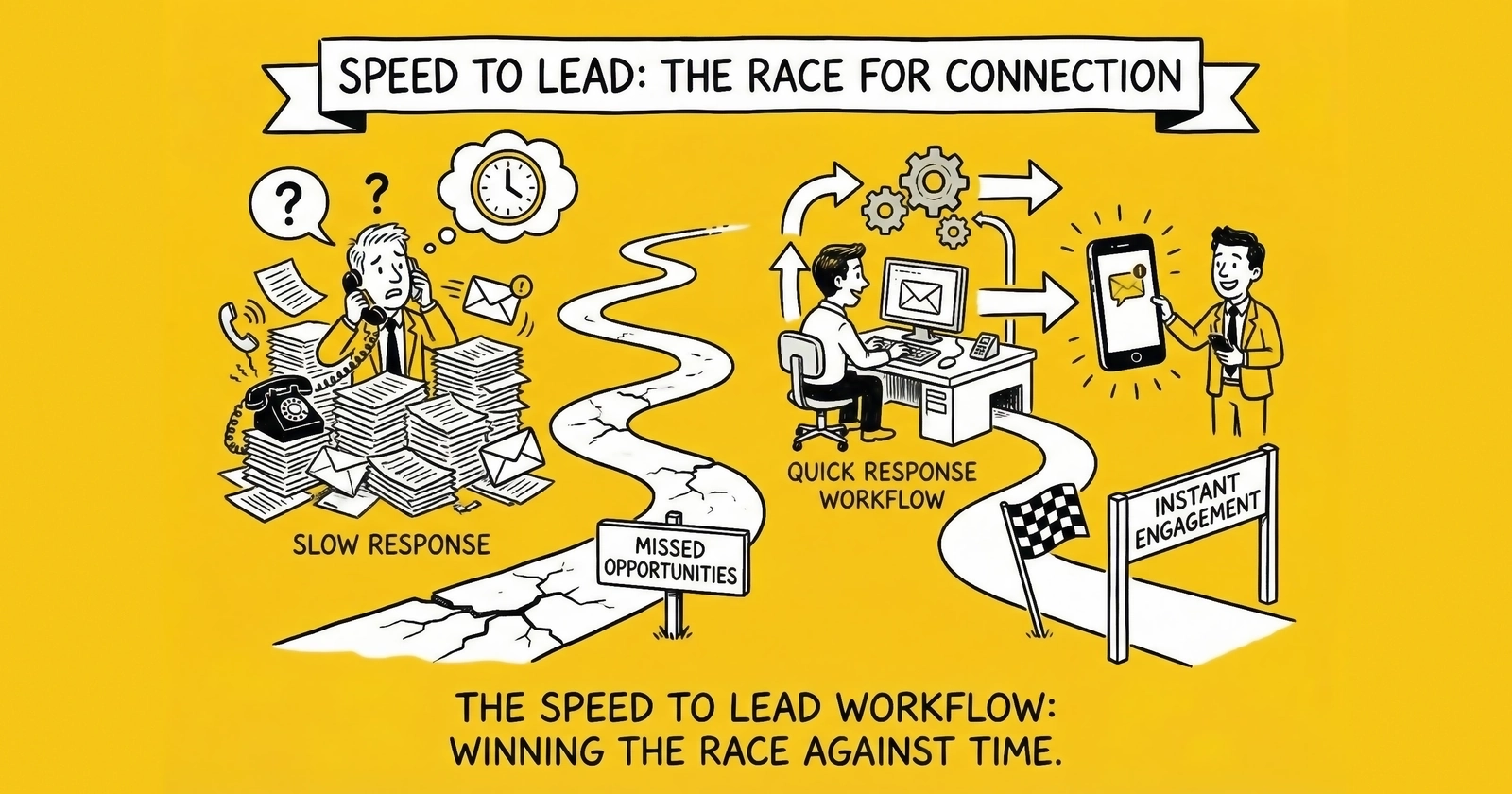
The science of immediate engagement and why the first five minutes determine 78% of your sales outcomes.
Speed to lead is not a metric. It is the single most predictive variable in determining whether a lead becomes a customer or a missed opportunity. The research is unambiguous: leads contacted within one minute convert at 391% higher rates. Yet the average business takes 42-47 hours to respond to an inbound lead, and 63% of leads never receive any response at all.
This gap between what works and what happens represents the largest operational opportunity in lead generation. Companies that master speed to lead build sustainable competitive advantages. Those that treat response time as an afterthought watch their competitors capture customers who should have been theirs.
This article provides a comprehensive framework for optimizing your lead response workflow, from the moment a lead submits their information to the point of first human contact. You will learn the exact metrics that matter, the technology stack that enables sub-minute response, the operational processes that sustain speed at scale, and the common failure modes that undermine even well-intentioned efforts.
The Science Behind Speed to Lead
Before diving into optimization tactics, you need to understand why speed matters so profoundly. This is not about arbitrary urgency or sales pressure. The science reveals fundamental truths about consumer psychology and competitive dynamics.
The Decay Curve of Intent
Consumer intent is perishable. When someone fills out a form requesting insurance quotes, mortgage rates, or solar installation estimates, they are signaling active readiness to act. They have moved past awareness and consideration into the active shopping phase. That behavioral signal has a half-life measured in minutes, not hours.
Research from multiple sources confirms this decay pattern with striking consistency. Lead value decays approximately 50% within 48 hours without contact, with the steepest decline occurring in the first hour after submission. By 24 hours, contact rates drop 50-70% compared to immediate outreach. By day seven, the original intent may be entirely forgotten.
Consider what happens in practice. A consumer who fills out a solar quote form at 2 PM is highly motivated. By 6 PM, they have cooled off. By tomorrow, they have forgotten why it seemed urgent. By next week, they have either purchased from someone else or moved on entirely.
This decay curve drives the entire industry obsession with speed. It is not about creating artificial urgency. It is about engaging consumers while their intent remains active.
The Five-Minute Window
The numbers on response time are not suggestions. They are survival statistics.
Research from Velocify found that responding within one minute increases conversion rates by 391%. This finding has been replicated across multiple studies and verticals. The explanation is straightforward: at one minute, the consumer is likely still thinking about their request, still has their phone in hand, still has the topic top of mind.
The Lead Response Management Study demonstrated that you are 21 times more likely to qualify a lead if you respond within five minutes versus waiting 30 minutes. The qualification gap widens dramatically with each additional minute of delay.
The Lead Connect Survey established that 78% of customers purchase from the company that responds first. Not the best. Not the cheapest. The first. In shared lead environments where multiple buyers receive the same lead, this statistic determines who wins and who wastes their lead spend.
InsideSales.com research found that the chance of qualifying a lead drops by 80% after the first five minutes. The window is not thirty minutes. It is not even ten minutes. The critical threshold is five minutes, and every minute beyond that compounds the probability loss.
For personal injury leads specifically, firms with response times over 30 minutes convert just 15% of leads, compared to 45% for those responding under five minutes. That represents a 3x conversion differential based solely on speed.
First Responder Advantage
The first responder advantage explains why speed matters even more in competitive lead environments.
When a consumer requests quotes from multiple providers, the vendor who responds first captures a disproportionate share of conversions. The 78% first-responder win rate reflects several psychological dynamics working in combination.
Recency and attention play a crucial role. The first responder reaches the consumer while they are still in shopping mode, with the original intent fresh. Commitment escalation compounds this advantage. Once a consumer begins engaging with one vendor, they become incrementally committed to that conversation. Starting over with another vendor requires effort most consumers prefer to avoid.
Satisficing behavior explains much of consumer decision-making. Most consumers are not optimizing for the absolute best option. They are seeking a good-enough solution from a responsive vendor. The first responder who meets basic criteria often wins by default. Meanwhile, every minute you wait increases the probability that a competitor has already made contact and potentially closed the deal.
In exclusive lead environments, speed still matters. Even without direct competition, the consumer may lose interest, begin researching alternatives, or simply forget the original inquiry.
Benchmarking Your Current Performance
Before optimizing, you need to measure. Most organizations dramatically overestimate their response speed because they lack precise measurement systems.
The Metrics That Matter
Understanding which metrics to track separates effective optimization from random improvement efforts.
Time to First Contact (TTFC) measures the elapsed time from lead submission to first attempted contact. This is your primary speed metric. Measure it in minutes, not hours. Time to First Human Conversation tracks the elapsed time from lead submission to an actual conversation with a salesperson. TTFC captures attempts; this metric captures connections.
Contact Rate represents the percentage of leads successfully reached on the first attempt. Lower contact rates often indicate speed problems because leads contacted quickly answer more frequently. Conversion Rate by Response Time Cohort tracks conversion rates segmented by response time buckets: under 1 minute, 1-5 minutes, 5-15 minutes, 15-60 minutes, 1-4 hours, 4-24 hours, and 24+ hours. This data reveals your specific speed-to-conversion relationship.
Lead Assignment Time measures how long it takes from lead receipt to assignment to a specific rep. This intermediate metric identifies routing bottlenecks. After-Hours Lead Handling examines what happens to leads that arrive outside business hours. Separate tracking for these leads often reveals systemic gaps that damage overall performance.
Conducting a Speed Audit
Before implementing improvements, baseline your current performance with a structured audit.
Start with sample selection by pulling your last 100 inbound leads from your CRM. Select leads across different times, days, and sources to capture representative variation. For time extraction, record the timestamp of lead creation, the timestamp of first outreach attempt, the timestamp of first successful contact if applicable, the rep or system that made first contact, and the source or campaign that generated the lead.
Calculate TTFC for each lead, then compute the average, median, and distribution across time buckets. During pattern identification, look for systematic issues: Are certain times of day consistently slower? Are certain lead sources handled differently? Are certain reps or teams slower than others? What happens to leads during lunch hours, shift changes, or after hours?
For bottleneck mapping, trace the journey of your slowest 20 leads. Identify where time was lost: in the routing system, in queue waiting for assignment, waiting for rep availability, or in delayed manual processes.
most practitioners who complete this audit discover they are 3-5x slower than they assumed. That discovery is not failure. It is the starting point for improvement.
Industry Benchmarks for Context
While your specific targets depend on your vertical and business model, these benchmarks provide context:
| Response Time | Performance Level | Competitive Position |
|---|---|---|
| Under 1 minute | Elite | Industry-leading advantage |
| 1-5 minutes | Strong | Competitive baseline |
| 5-15 minutes | Acceptable | Losing some opportunities |
| 15-60 minutes | Below Average | Significant revenue leakage |
| 1-4 hours | Poor | Most opportunities lost |
| 4-24 hours | Critical | Emergency improvement needed |
| 24+ hours | Failing | Fundamental process failure |
The industry average of 42-47 hours places most organizations in the failing category. This is not an aspirational benchmark. It is a condemnation of the status quo.
The Technology Stack for Sub-Minute Response
Achieving consistent sub-minute response requires technology infrastructure designed for speed. Manual processes cannot scale to this performance level.
Real-Time Lead Delivery Systems
The first requirement is instantaneous lead delivery to your response system. Any delay in lead transmission compounds downstream delays.
API-based delivery ensures leads flow via real-time API posts, not email or batch files. API delivery happens in milliseconds while email notification can take minutes. Real-time bidding systems demonstrate how sub-second delivery impacts lead value. Direct CRM integration creates records directly in your CRM or sales platform without intermediate steps, because every manual import or data transformation adds delay.
Webhook triggers fire immediately when leads arrive, initiating assignment, notification, and auto-dialer queue insertion in a single cascade. Delivery monitoring alerts you immediately when lead delivery fails or lags. A broken integration discovered hours later represents hours of lost leads.
Intelligent Routing Engines
Once leads arrive, they must reach the right person instantly. Intelligent routing eliminates the delays of manual assignment.
Skills-based routing matches leads to reps based on geography, vertical expertise, language, or product knowledge. Proper matching improves both speed and conversion. Load balancing distributes leads across available reps to prevent queue buildup while any individual rep has capacity.
Availability-aware routing sends leads only to reps who are currently available. Routing leads to reps in meetings, on calls, or at lunch delays contact unnecessarily. Round-robin with timeout implements automatic reassignment if the primary recipient does not respond within a defined window, typically 60-90 seconds. Capacity management tracks rep capacity in real-time. When a rep is handling maximum concurrent leads, new leads route to others with available capacity.
Multi-Channel Engagement Platforms
Speed to lead is not just about phone calls. Modern engagement requires coordinated multi-channel outreach.
Power dialers and predictive dialers call leads immediately upon receipt, eliminating the delay of manual dialing. Power dialers handle one call at a time per rep and provide controlled speed. Predictive dialers manage multiple concurrent calls for maximum speed at the cost of potential dropped calls.
SMS automation reaches leads in seconds, often before a phone call connects. A text saying “Hi [Name], this is [Rep] calling about your insurance request. Is now a good time?” can increase answer rates dramatically. Email triggers establish contact even when phone calls go to voicemail. Personalized emails with clear next steps maintain momentum.
Chat and callback widgets allow immediate engagement while the consumer is still on your site. Callback widgets let them request an immediate call. Voicemail drop ensures that when calls go to voicemail, pre-recorded messages deploy instantly, ensuring consistent messaging and freeing rep availability for the next lead.
Calendar and Scheduling Integration
When immediate conversation is not possible, instant scheduling prevents lead decay.
Automated scheduling links included in first-response emails and texts let leads book their own callback at a convenient time. Calendar availability checking ensures systems check rep calendars in real-time to offer only available time slots. Instant confirmation sends immediate confirmation of scheduled appointments with calendar invites. Reminder sequences deploy automated reminders before scheduled calls to reduce no-show rates.
AI and Chatbot Pre-Qualification
AI-powered systems can engage leads instantly while human reps are being assigned.
Conversational AI chatbots ask qualifying questions, gather additional information, and maintain engagement during the seconds before a human connects. AI phone agents answer calls immediately, qualify intent, and transfer to human reps when ready, eliminating hold times and ensuring 24/7 coverage. Smart forms adapt based on responses, completing qualification during submission and reducing the need for follow-up questions.
Technology Stack Summary
A complete speed-to-lead technology stack includes:
| Layer | Function | Key Capabilities |
|---|---|---|
| Lead Capture | Receive leads in real-time | API endpoints, webhook triggers |
| Lead Distribution | Route to right person instantly | Skills routing, load balancing, availability awareness |
| Engagement | Multi-channel outreach | Power dialer, SMS platform, email automation |
| Scheduling | Enable self-service booking | Calendar integration, availability checking |
| AI Layer | Immediate engagement | Chatbots, voice AI, smart qualification |
| Monitoring | Track and alert | Real-time dashboards, latency alerts |
Implementing this stack requires investment, but the ROI calculation is straightforward. If faster response converts even 10% more leads, the technology pays for itself within months at most volume levels.
Operational Processes That Sustain Speed
Technology enables speed. Processes sustain it. Without the right operational disciplines, even the best technology produces inconsistent results.
The Speed-First Culture
Speed to lead must be a cultural value, not just a metric. This cultural shift requires several elements working in concert.
Visible metrics displayed on real-time dashboards visible to the entire sales team create awareness and peer accountability. Celebrate sub-minute responses. Call attention to delays. Accountability means making response time a key performance indicator for individual reps, teams, and managers. Include speed metrics in performance reviews and compensation structures.
Process ownership assigns clear responsibility for lead response performance. Someone must be accountable for monitoring, troubleshooting, and improving speed. Leadership example matters because sales leadership must demonstrate urgency about speed, not just mandate it. When leaders visibly prioritize speed, teams follow.
Staffing for Speed
Staffing models directly determine response time performance.
Coverage mapping matches your lead volume patterns by hour and day with staffing levels. Staff to match demand patterns, not arbitrary schedules. Peak period optimization identifies your peak lead hours and ensures maximum staffing during these windows. A single unstaffed half-hour during peak times can produce dozens of delayed leads.
Overlap during transitions builds redundancy between shifts to prevent gaps during handoffs. Lead volume does not pause for shift changes. Flex capacity maintains the ability to add capacity during volume spikes through on-call reps, cross-trained team members, or outsourced overflow capacity.
After-hours strategy requires explicit decisions about leads outside business hours. Options include extended hours staffing, outsourced after-hours service, AI-powered immediate engagement with next-day follow-up, international teams in different time zones, and callback scheduling for business hours.
Queue Management Disciplines
Lead queues are where speed goes to die. Effective queue management prevents accumulation.
The target state is zero queued leads because every lead in queue is a lead losing value. Queue monitoring provides real-time visibility into queue depth across all reps and channels, with alerts when queues exceed thresholds. Queue busting protocols trigger backup capacity when queues build through reallocating reps from other tasks, activating on-call resources, or temporarily reducing call handling time.
Priority sequencing addresses unavoidable queuing by sequencing by lead value and age. High-value leads and fresh leads should jump the queue. Queue aging alerts ensure leads queued for defined thresholds (2 minutes, 5 minutes, 10 minutes) trigger escalating alerts.
Rep Readiness Protocols
Reps must be ready to engage leads instantly. This requires eliminating distractions and non-essential tasks during lead handling periods.
Lead handling mode defines specific times when reps focus exclusively on leads with all distractions minimized. Pre-call preparation ensures reps can see lead information before the call connects. Screen pops with lead data eliminate fumbling during the critical first seconds.
Script and resource access makes call scripts, pricing tools, and reference materials instantly accessible because searching for information during calls wastes time. Status management requires reps to accurately maintain their availability status since systems routing to “available” reps who are actually unavailable create delays and frustration.
Daily Operating Rhythm
Consistent daily rhythms maintain speed performance over time.
Morning speed checks begin each day with a review of previous day’s speed metrics to identify anomalies or patterns. Real-time monitoring ensures designated individuals watch speed dashboards throughout the day and intervene when delays occur. End-of-day reconciliation clears any remaining leads in queue with clear protocols for handling end-of-day leads.
Weekly speed reviews analyze trends, identify systemic issues, and implement improvements. Monthly optimization cycles identify one aspect of the speed workflow to improve each month because continuous improvement compounds over time.
After-Hours and Weekend Strategies
Most lead generation happens during business hours, but leads do not stop arriving at 5 PM. How you handle after-hours leads significantly impacts overall performance.
The After-Hours Problem
Traditional business hours coverage leaves significant gaps. Leads submitted after hours wait 12-16 hours for first contact. Weekend leads may wait 48+ hours. Holiday leads face even longer delays. Consumers who submit leads after hours may be working non-traditional schedules and prove harder to reach during business hours.
By the time business hours resume, these leads have decayed substantially.
After-Hours Options
Extended hours coverage represents the simplest approach. Adding coverage from 6 PM to 9 PM captures evening leads while they are fresh. Split shift models cover morning and evening peaks while reducing mid-day staffing rather than running one continuous shift.
Outsourced after-hours service provides coverage through third-party call centers, often at lower cost than internal staffing. Ensure they can access your systems, follow your scripts, and maintain quality standards.
Automated engagement ensures that even if human contact waits until morning, systems engage immediately through instant confirmation emails with company information, SMS messages acknowledging receipt and setting expectations, chatbots that answer questions and schedule callbacks, and AI voice systems that conduct basic qualification.
Geographic distribution allows larger organizations to leverage distributed teams across time zones. A team in the Eastern time zone handles morning leads while a Pacific time zone team handles evening. Callback scheduling allows after-hours leads to schedule their own callback for a convenient time, maintaining engagement while setting appropriate expectations.
Weekend Optimization
Weekends present unique challenges but also unique opportunities. Consumers often have more time for conversations on weekends, and competition may be lower.
Many verticals see significant weekend activity. Saturday morning through mid-afternoon often justifies dedicated coverage. Sunday volume is typically lower, making full coverage harder to justify. Automated engagement with Monday follow-up may be appropriate.
Weekend urgency messaging acknowledges the weekend context in your outreach. “I know it’s Saturday, but I saw your request come in and wanted to reach out while it’s fresh…” resonates with consumers who appreciate the responsiveness.
The Persistence Factor
Speed matters for initial contact, but persistence matters for conversion. Most leads do not convert on the first call.
Persistence Statistics
Research consistently shows that most conversions require multiple touches. Eighty percent of prospects say “no” four times before they say “yes,” yet 44% of salespeople give up after just one follow-up. A second follow-up call increases closing probability by 70%. Sixty-five percent of sales occur after five or more follow-ups, and 60% of customers say no four times before saying yes.
The gap between how many touches buyers need and how many sellers provide represents significant lost revenue.
Designing Follow-Up Cadences
Effective follow-up requires structured cadences that balance persistence with respect.
Day 1 Cadence (Lead Day):
| Timing | Channel | Purpose |
|---|---|---|
| 0-1 minute | Call + SMS | Immediate contact attempt |
| 15 minutes | Call | Second attempt if no answer |
| 1 hour | Value-add information | |
| 2 hours | Call | Third attempt |
| 4 hours | SMS | Different approach/question |
| End of day | Voicemail if needed | Summarize and set expectation |
During days 2-7, attempt 2-3 calls per day, send 1-2 SMS messages per day, and deploy 1 email per day. Vary timing to catch different availability windows. During days 8-14, reduce to 1-2 call attempts per day, email every other day, and SMS twice per week. During days 15-30, call every 2-3 days, send weekly email, and use SMS as appropriate.
Beyond 30 days, transition to a nurture sequence with monthly or bi-weekly touches. Focus on value-add content rather than sales asks.
Multi-Channel Orchestration
Effective persistence uses multiple channels in coordinated fashion.
Channel preferences matter because some consumers prefer text, others prefer email, and some only answer calls. Multi-channel outreach meets consumers in their preferred channel. Channel escalation responds to unresponsiveness by shifting channels. If calls go unanswered, escalate to SMS. If SMS goes unread, try email. Vary the approach to find what works.
Consistent messaging ensures that while channels vary, the consumer experiences a coherent conversation, not disconnected outreach. Timing variation attempts contact at different times of day to identify when the consumer is available. A lead unreachable at 10 AM may answer at 7 PM.
Automation vs. Human Touch
The right persistence model combines automation and human effort.
Automate initial confirmation messages, scheduled follow-up reminders, email sequences, SMS sequences, voicemail drops, and call scheduling with reminders. Keep human interaction for live conversations, complex qualification, objection handling, negotiation and closing, and high-value or high-complexity leads.
The goal is not to replace human connection with automation, but to ensure humans spend their time on conversations rather than administrative tasks.
Speed Optimization by Channel
Different lead sources require different speed approaches. Optimization must account for the specific dynamics of each channel.
Web Form Leads
Web forms are the primary lead source for most verticals. Optimization focuses on minimizing the time between form submission and first contact.
Technical optimization requires AJAX form submissions to eliminate page load delays, real-time validation to prevent bad data submissions, immediate CRM record creation via API, instant routing trigger upon submission, and tracking to measure form-to-CRM latency.
Process optimization ensures web leads route to dedicated high-speed response teams. Configure auto-dialers to call immediately upon receipt. Send automated SMS within 30 seconds of submission. Display lead information to reps before calls connect.
Form design for speed captures phone numbers early in the form for partial submissions. Use progressive profiling to reduce form completion time. Include callback time preference for scheduling optimization.
Inbound Phone Calls
Inbound calls represent the highest-intent leads. These consumers are calling because they want to talk now.
Answering speed targets three rings or less, approximately 15 seconds. Implement queue callback for high-volume periods. Use AI-powered IVR to maintain engagement during waits. Display wait time estimates to reduce hangups.
Transfer speed requires minimizing transfers between departments. Warm transfers preserve context and speed. Train first-responders to handle most inquiries directly.
Missed call handling calls back missed calls within 60 seconds, sends immediate SMS acknowledging the missed call, and adds missed calls to priority callback queues.
Chat and Messaging Leads
Chat leads expect immediate response. The medium itself sets expectations for instant engagement.
Response time standards require first response within 15 seconds, subsequent responses within 30 seconds, and no conversation gaps exceeding 2 minutes.
A hybrid human-AI approach deploys AI chatbots for instant greeting and qualification while human agents take over for complex conversations. Seamless handoff eliminates consumer friction.
Off-chat conversion captures phone numbers early in chat, offers immediate callback as conversations progress, and schedules calls for later if immediate conversation is not possible.
Third-Party Leads
Leads purchased from aggregators or publishers require different speed considerations. Understanding first-party vs third-party lead dynamics helps optimize your approach.
Delivery method impacts speed significantly. Real-time API posts enable sub-second delivery. Batch files create inherent delays that make speed optimization harder. Email notifications are unacceptable for speed-sensitive operations.
Shared lead dynamics mean leads go to multiple buyers simultaneously. First responder advantage is critical. Every second of delay benefits competitors.
Publisher quality variation requires tracking speed-to-contact by source. Some publishers deliver fresher leads than others. Optimize routing based on source-specific timing patterns.
Measuring and Improving Performance
Optimization requires measurement, testing, and continuous improvement.
Key Performance Indicators
Track these metrics to understand and improve speed performance.
Primary speed metrics include average Time to First Contact (TTFC), median Time to First Contact, percentage of leads contacted within 1 minute, percentage of leads contacted within 5 minutes, and percentage of leads contacted within 1 hour.
Secondary speed metrics track lead assignment time from receipt to rep assignment, queue time from assignment to first attempt, dial time measuring system latency between leads, and after-hours lead response time.
Outcome metrics by speed cohort measure contact rate, conversion rate, revenue per lead, and customer quality by response time bucket.
Operational metrics track leads per rep per hour, talk time vs. wrap time vs. idle time, channel utilization across calls, SMS, and email, and system uptime and latency.
Dashboard Design
Effective dashboards make speed visible and actionable.
Real-time dashboard elements include current queue depth with age indicators, average TTFC for the past 30 minutes and past hour, lead volume vs. staffing levels, any leads currently exceeding response time thresholds, and system health indicators.
Historical dashboard elements display TTFC trends over time at daily, weekly, and monthly intervals, response time distribution through histograms, performance by rep, team, source, and hour, and correlation between speed and outcomes.
Alert configuration triggers notifications when queue depth exceeds thresholds to alert team leads, when any lead exceeds 5-minute response time to alert supervisors, when average TTFC exceeds target for 15+ minutes to alert management, and when system latency spikes to alert IT and operations.
A/B Testing Speed Improvements
Test changes systematically rather than implementing broadly without validation.
Testing approaches split traffic between current process and proposed improvement, randomize by lead rather than time period to control for volume variations, run tests long enough for statistical significance (typically 1-2 weeks minimum), and measure both speed improvement and downstream outcomes.
Test ideas include new routing logic vs. current routing, AI pre-qualification vs. direct routing to reps, different dialer configurations, alternative staffing models, and new technology vendors.
Continuous Improvement Framework
Speed optimization is never “done.” Implement a continuous improvement framework.
Weekly optimization reviews examine speed metrics from the past week, identify specific leads or time periods with poor performance, diagnose root causes, and implement one targeted improvement.
Monthly deep dives analyze speed performance across all dimensions, identify systemic patterns, plan larger improvement initiatives, and review technology vendor performance.
Quarterly strategic assessments evaluate overall speed strategy, assess technology stack adequacy, review staffing model effectiveness, and set improvement targets for next quarter.
Common Failure Modes and Solutions
Even well-intentioned speed initiatives fail. Understanding common failure modes helps you avoid them.
Failure Mode 1: Measurement Without Action
Organizations track speed metrics but performance does not improve. This happens when metrics are not visible to those who can act on them, when no accountability ties to speed performance, when data arrives too late to be actionable, or when too many metrics create confusion.
Solutions include making real-time dashboards visible to reps and supervisors, including speed in performance evaluations and compensation, implementing real-time alerts instead of just daily reports, and focusing on 2-3 key metrics rather than dozens.
Failure Mode 2: Technology Without Process
Organizations invest in speed technology but response times remain slow. This occurs when technology is configured but not integrated into workflow, when reps lack training on new systems, when processes are not redesigned to leverage technology, or when technology capabilities do not match actual needs.
Solutions require mapping end-to-end workflow before implementing technology, investing in training and change management, redesigning processes to leverage new capabilities, and starting with simpler solutions that match current capabilities.
Failure Mode 3: Speed Without Quality
Response times improve but conversion rates decline. This happens when reps rush calls to handle volume, when quality of initial engagement suffers, when qualification is skipped for speed, or when automation replaces needed human touch.
Solutions balance speed and quality metrics, train reps on efficient yet thorough engagement, use AI for pre-qualification while preserving humans for connection, and monitor call quality alongside speed.
Failure Mode 4: Peak Period Blindness
Average speed looks acceptable but peaks are terrible. This occurs when staffing does not match volume patterns, when metrics obscure variation because averages hide peaks, or when peak periods are not specifically monitored.
Solutions track speed by hour instead of just daily average, staff to peaks rather than averages, set peak-specific performance targets, and implement automatic queue-busting during peaks.
Failure Mode 5: After-Hours Neglect
Business-hours speed is excellent but after-hours leads are abandoned. This happens when focus remains only on business-hours operations, when after-hours leads are not measured separately, or when no strategy exists for extended coverage.
Solutions track after-hours performance separately, implement after-hours engagement strategy, consider automated engagement as minimum standard, and evaluate extended-hours coverage ROI.
Failure Mode 6: Channel Fragmentation
Speed varies dramatically by channel or source. This occurs when different teams handle different channels, when separate systems have different latencies, or when processes are inconsistent across channels.
Solutions consolidate lead handling across channels, implement unified lead distribution platforms, apply consistent speed standards to all sources, and track and optimize each channel specifically.
Vertical-Specific Considerations
Speed optimization varies by vertical. Each industry has unique dynamics that affect optimal response approaches.
Insurance Leads
Insurance consumers are often comparing multiple carriers simultaneously. First responder advantage is extreme.
Speed targets require web form leads under 30 seconds, click-to-call instant answer, and maximum urgency for shared leads since competitors are calling now.
Special considerations include quote delivery speed mattering as much as contact speed, licensed agent availability by state affecting routing, and carrier appointment requirements potentially limiting instant sales.
Mortgage Leads
Mortgage leads have longer consideration cycles but intense competition for purchase leads.
Speed targets require purchase leads under 1 minute due to high urgency, refinance leads under 5 minutes given high competition, and rate-sensitive leads immediately since rates change daily.
Special considerations include pre-qualification happening quickly while full application takes time, loan officer licensing limiting geographic flexibility, and rate volatility creating urgency spikes.
Solar Leads
Solar leads often involve scheduled appointments rather than immediate sales. Speed affects appointment-setting success. For more on the solar lead nurturing process, see our 90-day journey guide.
Speed targets require immediate engagement under 2 minutes with appointment setting within first contact if possible.
Special considerations include property verification taking time but not delaying contact, geographic territory management affecting routing, and system design complexity limiting instant closing. Solar lead qualification covers the specific data points that affect solar lead value.
Legal Leads
Legal leads, especially personal injury, require careful handling that balances speed with compliance.
Speed targets require personal injury leads under 5 minutes because they are time-sensitive but relationship-focused. Other practice areas vary by urgency of matter.
Special considerations include attorney licensing limiting who can engage, intake balancing speed with thorough information gathering, and statute of limitations creating absolute urgency for some cases.
Home Services
Home service leads often involve urgent needs like broken HVAC or plumbing emergencies where speed directly impacts customer experience.
Speed targets require emergency services under 1 minute, non-emergency under 5 minutes, and quote requests within 15 minutes.
Special considerations include service area limitations affecting routing, technician availability potentially limiting same-day service, and seasonal demand creating capacity challenges.
Frequently Asked Questions
What is the ideal lead response time?
The ideal lead response time is under one minute for high-intent leads like form submissions and quote requests. Research consistently shows that leads contacted within one minute convert at rates 391% higher. For practical purposes, sub-five-minute response should be your minimum standard. Beyond five minutes, qualification probability drops by 80%, and competitors may have already made contact with shared leads.
How do I improve lead response time if I have a small team?
Small teams can achieve fast response times through strategic technology investment and process optimization. Implement auto-dialers that call leads immediately upon receipt, eliminating manual dialing delays. Use SMS automation to engage leads while calls are being connected. Leverage AI chatbots or voice agents to provide instant engagement before human handoff. Consider outsourced after-hours coverage rather than extending staff hours. Focus staff on peak lead volume periods and use automation during low-volume times. Even a two-person team can achieve sub-minute response with the right technology stack.
What is the best technology for speed to lead?
The best speed-to-lead technology stack includes several components working together. At minimum, you need real-time lead delivery via API (not email), intelligent routing that matches leads to available reps instantly, and an auto-dialer or power dialer that initiates calls automatically. Beyond these basics, SMS automation, AI chatbots, and calendar integration add significant speed. Specific vendors depend on your volume, budget, and existing systems, but avoid any solution that requires manual steps between lead receipt and first contact attempt.
How do I handle leads that come in after business hours?
After-hours leads require explicit strategy since waiting until morning sacrifices significant value. Options range from simple to comprehensive: At minimum, send automated acknowledgment via email and SMS immediately upon receipt, and schedule these leads for priority handling first thing in the morning. Better approaches include extended hours coverage (even 7 AM to 9 PM captures most evening leads), outsourced after-hours call centers, AI-powered phone or chat engagement, and allowing consumers to schedule callbacks via automated systems. The right approach depends on lead volume and value in after-hours periods.
Does speed to lead matter for shared leads or exclusive leads?
Speed matters for both, but the dynamics differ. For shared leads, speed is absolutely critical because you are competing directly with other buyers who received the same lead. The first responder wins 78% of the time. Every second of delay gives competitors an advantage. For exclusive leads, you are not racing competitors, but you are racing lead decay. The consumer’s intent fades with every passing minute. Even with no competition, a lead contacted at 5 minutes converts better than one contacted at 30 minutes. Speed matters for every lead type.
How does speed to lead affect lead quality and return rates?
Speed actually improves effective lead quality. Leads contacted quickly answer more frequently (higher contact rates), engage more substantively (they remember why they inquired), and convert at higher rates. From a return perspective, speed helps in two ways: you reach consumers before they have spoken with competitors, reducing “already bought elsewhere” returns, and you contact them while intent is fresh, reducing “not interested anymore” returns. Some operators mistakenly believe that slowing down improves quality by allowing more research. The opposite is true.
What is the relationship between speed to lead and conversion rate?
The relationship between speed and conversion is well-documented and dramatic. Leads contacted within one minute convert at nearly four times the rate of leads contacted at two minutes. Leads contacted within five minutes are 21 times more likely to qualify than leads contacted at 30 minutes. The relationship is not linear. The first five minutes show the steepest improvement curve. After 30 minutes, additional delay matters less because most of the value has already been lost. Optimizing from 30 minutes to 25 minutes matters less than optimizing from 5 minutes to 1 minute.
How do I maintain speed at scale as lead volume grows?
Maintaining speed at scale requires systematic capacity management. First, forecast lead volume by hour and day based on historical patterns. Staff to match demand curves, not flat headcount. Implement load balancing that distributes leads across available reps to prevent queue buildup. Build automatic escalation protocols that add capacity when queue depth exceeds thresholds. Consider tiered response where high-value leads get premium speed while lower-value leads may experience slightly longer response times. Monitor speed metrics continuously and set alerts when performance degrades. Finally, invest in technology that scales efficiently. Manual processes that work at 100 leads per day often fail at 1,000 leads per day.
What metrics should I track for speed to lead optimization?
Track primary speed metrics including average and median time to first contact, percentage of leads contacted under 1 minute, under 5 minutes, and under 1 hour. Track intermediate metrics like lead assignment time and queue time to identify bottlenecks. Track outcome metrics segmented by speed cohort: contact rate, conversion rate, and revenue by response time bucket. This segmentation proves the business case for speed investment by showing exactly how much faster response improves outcomes. Also track operational metrics like leads per rep per hour and system latency to identify capacity and technology constraints.
How do I get my sales team to respond faster?
Getting sales teams to respond faster requires cultural and operational changes. Start with visibility: display real-time speed metrics on visible dashboards so the team sees performance constantly. Add accountability: include speed metrics in performance reviews, scorecards, and compensation structures. Remove barriers: ensure leads auto-route to available reps, auto-dialers connect calls immediately, and systems provide all needed information without searching. Create competition: leaderboards showing fastest responders create positive peer pressure. Most importantly, show the math: when reps see that faster response means higher close rates and more commission, the behavior change becomes self-reinforcing.
Key Takeaways
-
The five-minute window is not arbitrary. Leads contacted within one minute convert at 391% higher rates. Leads contacted within five minutes are 21x more likely to qualify than those contacted at 30 minutes. Beyond five minutes, conversion probability drops by 80%.
-
First responder advantage determines outcomes in competitive environments. 78% of customers buy from the first company that responds. In shared lead scenarios, speed is the primary differentiator between winners and losers.
-
Technology enables speed but process sustains it. Implement real-time API delivery, intelligent routing, auto-dialers, and multi-channel automation. Then build the operational discipline, staffing models, and cultural commitment to maintain performance consistently.
-
After-hours leads require explicit strategy. The average 42-47 hour response time across industries reflects organizations that treat after-hours leads as next-day problems. Implement immediate automated engagement at minimum, with extended coverage where volume and value justify it.
-
Persistence compounds the value of speed. Speed gets you to the lead first, but systematic follow-up converts leads who do not answer the first call. Design cadences that balance persistence with respect, and automate what can be automated while preserving human connection for conversations.
-
Measurement without action wastes data. Real-time dashboards, targeted alerts, and weekly optimization reviews convert metrics into improvement. Track speed by cohort to prove ROI and identify specific bottlenecks.
-
Speed optimization never ends. As volume grows, as technology evolves, as competitor practices change, your speed advantage requires continuous investment. Build improvement into your operating rhythm rather than treating it as a one-time project.
Conclusion
Speed to lead is not a tactic. It is a strategic capability that compounds over time. The organization that consistently contacts leads within one minute builds advantages that slower competitors cannot easily overcome: higher conversion rates, better customer relationships, stronger reputation, and greater efficiency in marketing spend.
The gap between best practice (sub-one-minute response) and industry average (42-47 hours) represents extraordinary opportunity for operators willing to invest in the technology, processes, and culture required for speed. Every lead you contact faster converts at higher rates. Every lead your competitors contact first is revenue you have lost.
Begin with measurement. Audit your current performance to understand where you actually stand, not where you assume you stand. Then invest in the highest-leverage improvements: technology that eliminates delays, processes that sustain speed, and accountability that drives behavior.
The five-minute window is not a suggestion. It is a competitive requirement. Practitioners who treat it as optional will continue wondering why their conversion rates disappoint. Those who treat it as non-negotiable will capture the customers their competitors are too slow to reach.
The leads are not going to wait. Neither should you.
Statistics and research referenced in this article reflect findings from studies by Velocify, InsideSales.com, Lead Response Management Study, Lead Connect, and industry analysis current as of 2024-2025. Response time benchmarks vary by vertical and should be validated against your specific market conditions.