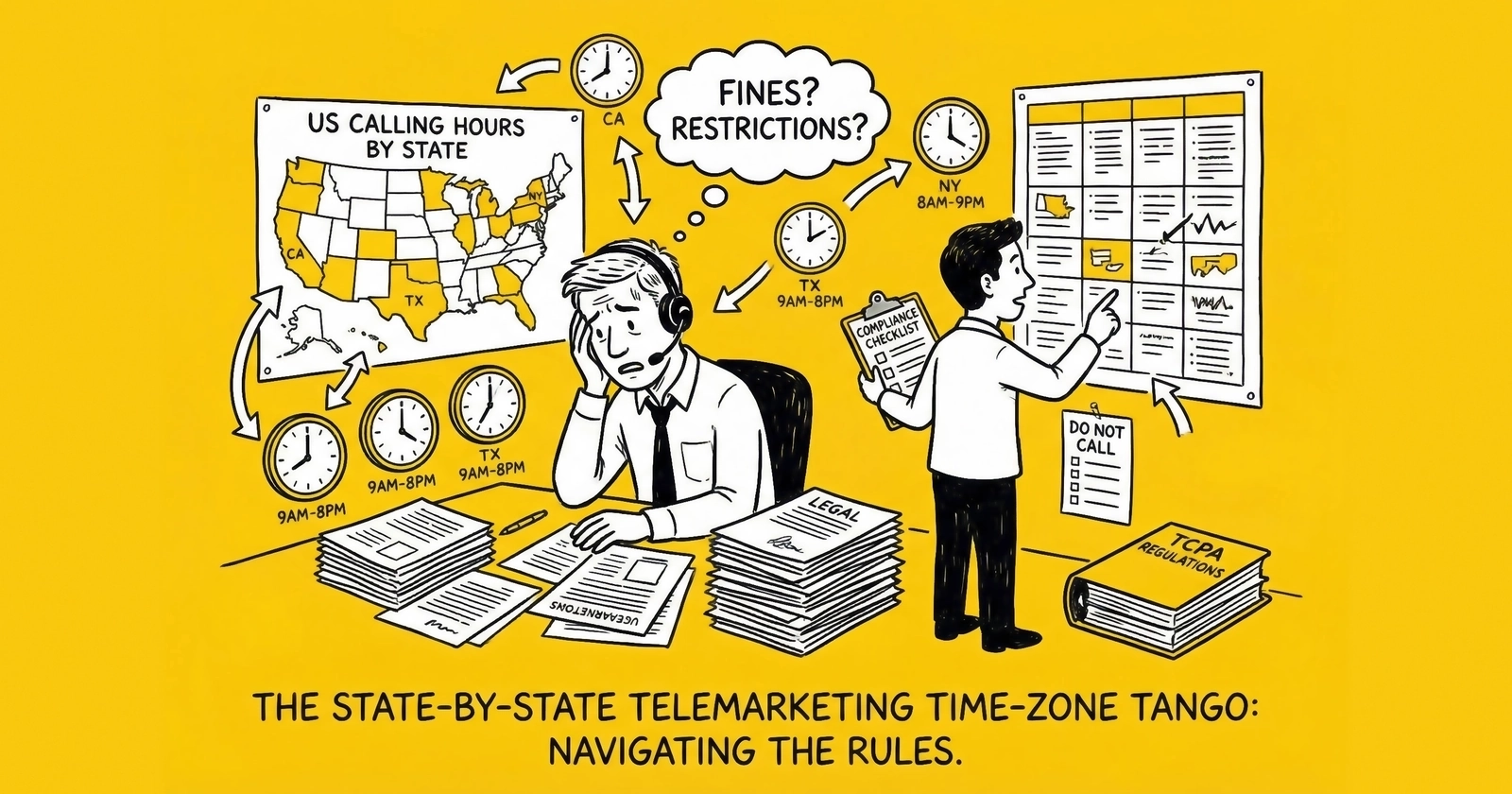
A comprehensive state-by-state reference for telemarketing call timing compliance, including federal TCPA requirements, stricter state laws, time zone considerations, and technology solutions for automated enforcement.
Why Calling Hour Compliance Matters
A single text message sent at 9:15 PM in the recipient’s time zone costs $500. Send that message to 1,000 people and you face $500,000 in potential liability. If a court finds the violation was willful, damages triple to $1.5 million.
This is not hypothetical. In March 2025, a South Florida law firm filed over 100 TCPA lawsuits alleging time-of-day violations from text messages sent outside permitted hours, with the total exceeding 480 cases by mid-2025. These cases targeted lead generators, insurance agencies, and solar companies whose automated systems failed to account for recipient time zones.
Calling hour violations are among the easiest TCPA claims to prove. Unlike consent disputes that require document retrieval and interpretation, time violations have clean timestamps. The call log shows 9:03 PM. The recipient’s location shows Eastern Time. The violation is binary and undeniable.
The federal Telephone Consumer Protection Act establishes a baseline: no telemarketing calls before 8:00 AM or after 9:00 PM in the recipient’s local time zone. But federal law is the floor, not the ceiling. Multiple states impose stricter hours, and compliance requires following the most restrictive applicable rule.
This reference guide provides the complete state-by-state breakdown, technical implementation guidance, and penalty context you need to build compliant calling operations.
Federal TCPA Calling Hours
The federal baseline comes from the TCPA and FCC regulations at 47 CFR 64.1200(c)(1).
The Federal Rule
Telephone solicitations are prohibited before 8:00 AM or after 9:00 PM local time at the called party’s location.
This rule applies to:
- Live telemarketing calls to residential lines
- Autodialed calls to any number for telemarketing purposes
- Prerecorded voice calls for telemarketing
- Text messages for telemarketing purposes (courts have consistently held that SMS messages are subject to TCPA calling hour restrictions)
What “Local Time” Means
The critical phrase is “local time at the called party’s location.” A call center in Los Angeles calling a consumer in New York must stop calling at 9:00 PM Eastern Time, not 9:00 PM Pacific. A consumer’s area code does not determine their time zone – a 212 (New York) area code could belong to someone who moved to California. The burden is on the caller to determine the recipient’s actual local time.
What the Federal Rule Does Not Cover
The federal calling hour restriction applies specifically to telephone solicitations. It does not apply to:
- Informational calls (appointment reminders, delivery notifications, account alerts)
- Calls made with prior express consent for non-marketing purposes
- Calls from tax-exempt nonprofits
- Survey calls that do not include sales pitches
However, even exempt calls should respect reasonable hours. A debt collection call at 11 PM may not violate TCPA calling hour rules, but it could violate the Fair Debt Collection Practices Act or create other liability.
Complete State-by-State Calling Hours Table
The following table provides calling hour restrictions for all 50 states plus the District of Columbia. States marked with an asterisk (*) have calling hours stricter than the federal 8 AM - 9 PM standard.
| State | Permitted Hours | Weekend Restrictions | Holiday Restrictions | Citation |
|---|---|---|---|---|
| Alabama* | 8 AM - 8 PM | No calls on Sundays | No calls on legal holidays | Ala. Admin. Code r. 770-X-5-.17 |
| Alaska | 8 AM - 9 PM | None | None | Federal TCPA applies |
| Arizona | 8 AM - 9 PM | None | None | A.R.S. 44-1271 |
| Arkansas | 8 AM - 9 PM | None | None | Ark. Code 4-99-304 |
| California | 8 AM - 9 PM | None | None | Cal. Bus. & Prof. Code 17592 |
| Colorado | 8 AM - 9 PM | None | None | C.R.S. 6-1-304 |
| Connecticut* | 9 AM - 8 PM | None | None | Conn. Gen. Stat. § 42-288a(c) |
| Delaware | 8 AM - 9 PM | None | None | 6 Del. C. 2503 |
| District of Columbia | 8 AM - 9 PM | None | None | D.C. Code 22-3226.06 |
| Florida* | 8 AM - 8 PM | None | See note below | Fla. Stat. § 501.616 |
| Georgia | 8 AM - 9 PM | None | None | Ga. Code 46-5-23 |
| Hawaii | 8 AM - 9 PM | None | None | Federal TCPA applies |
| Idaho | 8 AM - 9 PM | None | None | Federal TCPA applies |
| Illinois | 8 AM - 9 PM | None | None | 815 ILCS 413/20 |
| Indiana | 8 AM - 9 PM | None | None | Ind. Code 24-5-14 |
| Iowa | 8 AM - 9 PM | None | None | Iowa Code 714.16A |
| Kansas | 8 AM - 9 PM | None | None | Kan. Stat. 50-670a |
| Kentucky* | 10 AM - 9 PM | None | None | KRS 367.46955 |
| Louisiana* | 8 AM - 8 PM | No calls on Sundays | No calls on legal state holidays | La. R.S. 45:844.31 |
| Maine* | 9 AM - 5 PM (auto) | Weekdays only (auto) | None | 10 M.R.S. § 1498 |
| Maryland* | 8 AM - 8 PM | None | None | Md. Com. Law 14-3201 |
| Massachusetts* | 8 AM - 8 PM | None | None | MGL Ch. 159C § 3 |
| Michigan* | 9 AM - 9 PM | None | None | MCL 750.540e(f) |
| Minnesota* | 9 AM - 9 PM | None | None | Minn. Stat. § 325E.30 |
| Mississippi* | 8 AM - 8 PM | No calls on Sundays | None | Miss. Code Ann. § 77-3-723 |
| Missouri | 8 AM - 9 PM | None | None | Mo. Rev. Stat. 407.1098 |
| Montana | 8 AM - 9 PM | None | None | Mont. Code 30-14-1403 |
| Nebraska | 8 AM - 9 PM | None | None | Neb. Rev. Stat. 86-248 |
| Nevada | 8 AM - 9 PM | None | None | NRS 598.0917 |
| New Hampshire | 8 AM - 9 PM | None | None | RSA 359-E:4 |
| New Jersey | 8 AM - 9 PM | None | None | N.J. Stat. 56:8-126 |
| New Mexico | 8 AM - 9 PM | None | None | Federal TCPA applies |
| New York | 8 AM - 9 PM | None | None | NY Gen. Bus. Law 399-z |
| North Carolina | 8 AM - 9 PM | None | None | N.C. Gen. Stat. 75-100 |
| North Dakota | 8 AM - 9 PM | None | None | N.D. Cent. Code 51-28-05 |
| Ohio | 8 AM - 9 PM | None | None | ORC 4719.02 |
| Oklahoma* | 8 AM - 8 PM | None | None | 15 Okl. St. § 775C.4 |
| Oregon | 8 AM - 9 PM | None | None | ORS 646A.020 |
| Pennsylvania* | 8 AM - 9 PM | No calls on Sundays before noon | None | 73 P.S. 2245.4 |
| Rhode Island* | 9 AM - 6 PM (M-F), 10 AM - 5 PM (Sat) | No calls on Sundays | No calls on holidays | R.I. Gen. Laws § 5-61-2 |
| South Carolina | 8 AM - 9 PM | None | None | S.C. Code 16-17-446 |
| South Dakota | 8 AM - 9 PM | None | None | Federal TCPA applies |
| Tennessee | 8 AM - 9 PM | None | None | Tenn. Code 47-18-1503 |
| Texas* | 9 AM - 9 PM | No calls before noon on Sundays | None | Tex. Bus. & Com. Code § 301.051 |
| Utah* | 8 AM - 9 PM | No calls on Sundays | No calls on holidays | Utah Code Ann. § 13-25a-103 |
| Vermont | 8 AM - 9 PM | None | None | 9 V.S.A. 2464a |
| Virginia | 8 AM - 9 PM | None | None | Va. Code 59.1-514 |
| Washington* | 8 AM - 8 PM | None | None | RCW 80.36.390 |
| West Virginia | 8 AM - 9 PM | None | None | W. Va. Code 46A-6F-501 |
| Wisconsin | 8 AM - 9 PM | None | None | Wis. Stat. 100.52 |
| Wyoming* | 8 AM - 8 PM | None | None | Wyo. Stat. § 40-12-302 |
States with Stricter Hours Than Federal Law
Eighteen states impose calling hour restrictions more stringent than the federal 8 AM - 9 PM rule. If you call consumers in these states, you must follow the stricter state standard.
Quick reference: Rhode Island has the narrowest window (9 AM - 6 PM weekdays). Kentucky has the latest start (10 AM). Ten states require an 8 PM cutoff. Four states prohibit Sunday calls entirely. See the table above for the complete list—detailed compliance guidance for each state follows below.
Florida: 8 AM - 8 PM
Florida’s Telephone Solicitation Act (FTSA) restricts telemarketing calls and texts to the hours between 8:00 AM and 8:00 PM local time. This is one hour earlier than the federal cutoff.
Key Provisions
The FTSA applies to telephonic sales calls and commercial telephone solicitation, explicitly including text messages within its scope. The statute limits calls to 3 per 24-hour period on the same subject matter and provides a private right of action with damages of $500 per violation, increasing to $1,500 for willful violations.
Note on Holiday Restrictions: Many industry guides cite Florida holiday restrictions, but a review of Fla. Stat. § 501.616 reveals no explicit holiday prohibition language. See the Holiday Restrictions section below for details.
Practical Impact
Florida generated 330 TCPA-related lawsuits in 2024 – approximately 12% of all filings despite representing 6.5% of the U.S. population. The South Florida plaintiff’s bar is particularly aggressive on time-of-day violations. Any automated system calling Florida consumers must enforce the 8 PM cutoff, not the federal 9 PM standard.
Citation: Fla. Stat. § 501.616(6)(a)
Maryland: 8 AM - 8 PM
Maryland’s “Stop the Spam Calls Act” restricts telemarketing calls to 8:00 AM - 8:00 PM local time.
Key Provisions
The Maryland statute applies to telephone solicitation calls and maintains a broader autodialer definition than the post-Duguid federal standard. A private right of action is available under the law, giving consumers direct enforcement capability.
Practical Impact
Maryland’s stricter hours and broader autodialer definition create compounded risk. A call made at 8:30 PM using technology that qualifies as an autodialer under Maryland law but not federal law could trigger state violations without federal exposure.
Citation: Md. Com. Law 14-3201
Massachusetts: 8 AM - 8 PM
Massachusetts regulations restrict telephone solicitations to 8:00 AM - 8:00 PM.
Key Provisions
The Massachusetts restriction applies to commercial telephone solicitation and is enforced by the Attorney General’s Consumer Protection Division rather than through private litigation.
Citation: MGL Ch. 159C § 3; 201 CMR 12.02
Connecticut: 9 AM - 8 PM
Connecticut restricts telemarketing calls to 9:00 AM - 8:00 PM local time on all days, including Sundays. This is both one hour later start (9 AM vs federal 8 AM) and one hour earlier end (8 PM vs federal 9 PM).
Key Provisions
SB 1058 (effective October 1, 2023) significantly expanded Connecticut telemarketing requirements, including mandatory prior express written consent. Penalties can reach $20,000 per violation.
Practical Impact
Connecticut’s narrower window (9 AM - 8 PM) requires separate configuration from federal hours. National calling operations must account for both the later start time and earlier cutoff.
Citation: Conn. Gen. Stat. § 42-288a(c)
Louisiana: 8 AM - 8 PM Plus Sunday and Holiday Restrictions
Louisiana restricts telemarketing calls to 8:00 AM - 8:00 PM Monday through Saturday, prohibits all calls on Sundays, and prohibits calls on legal state holidays.
Key Provisions
No calls are permitted on any Sunday, and no calls are permitted on Louisiana legal holidays. Importantly, Louisiana holidays may differ from federal holidays, requiring operators to maintain a separate holiday calendar for this state.
Practical Impact
Weekend calling campaigns must exclude Louisiana entirely on Sundays. Holiday exclusion lists must include Louisiana-specific holidays such as Mardi Gras (Fat Tuesday), Good Friday, and election days.
Citation: La. R.S. 45:844.31
Alabama: 8 AM - 8 PM Plus Sunday and Holiday Restrictions
Alabama restricts telemarketing calls to 8:00 AM - 8:00 PM and prohibits all calls on Sundays and state holidays.
Key Provisions
Alabama recognizes 17 legal holidays under Ala. Code § 1-3-8, including several unique to the state: Confederate Memorial Day (4th Monday in April), Jefferson Davis’ Birthday (1st Monday in June), and Mardi Gras (in Mobile and Baldwin counties).
Practical Impact
Alabama’s complete Sunday prohibition and extensive holiday list require careful calendar management. Combined with the 8 PM cutoff, Alabama presents multiple compliance touchpoints.
Citation: Ala. Admin. Code r. 770-X-5-.17
Oklahoma: 8 AM - 8 PM (OTSA)
Oklahoma enacted the Oklahoma Telephone Solicitation Act of 2022 (OTSA), effective November 1, 2022, modeled on Florida’s FTSA.
Key Provisions
The OTSA restricts calls to 8:00 AM - 8:00 PM local time and limits calls to 3 per 24-hour period on the same subject matter. Oklahoma’s autodialer definition is broader than federal TCPA post-Duguid, capturing “automated system for the selection or dialing of telephone numbers or the playing of a recorded message.”
Practical Impact
Oklahoma’s broader autodialer definition creates exposure for systems that might not qualify as ATDS under federal law. The $500/$1,500 per-violation damages mirror federal TCPA.
Citation: 15 Okl. St. § 775C.1-775C.6
Texas: 9 AM - 9 PM with Sunday Noon Start
Texas restricts telemarketing calls to 9:00 AM - 9:00 PM on weekdays and Saturdays, but noon - 9:00 PM on Sundays.
Key Provisions
Recent SB 140 amendments (effective September 1, 2025) extended Texas rules to SMS/MMS text messages. Texas’s mini-TCPA spans Chapters 301-305 of the Business and Commerce Code.
Practical Impact
Texas’s Sunday noon start creates a 3-hour shorter calling window on Sundays compared to other days. Weekend campaigns must delay Texas calling until noon local time on Sundays.
Citation: Tex. Bus. & Com. Code § 301.051(b)(2)
Washington: 8 AM - 8 PM
Washington restricts telemarketing calls to 8:00 AM - 8:00 PM local time.
Key Provisions
HB 1051 (effective July 23, 2023) significantly strengthened Washington’s law, increasing damages from $100 to $1,000 per violation. The law extends liability to those who “assist in the transmission” of illegal robocalls and expands the ATDS definition to include artificial voices and voicemail-only messages.
Practical Impact
Washington’s $1,000 per-violation penalty and third-party liability provisions create significant exposure for lead generators and their technology partners.
Citation: RCW 80.36.390, RCW 80.36.400
Maine: 9 AM - 5 PM Weekdays Only (Automated Calls)
Maine imposes the strictest automated calling restrictions in the nation, limiting automated telephone calling devices to weekdays 9:00 AM - 5:00 PM Maine time only.
Key Provisions
Maine’s 10 M.R.S. § 1498 prohibits automated calling devices from calling:
- Cell phones or paging devices
- Residential telephone numbers
- Unlisted or unpublished numbers
- Emergency numbers
Additionally, automated callers may complete only 1 call per 8-hour period to any number (regardless of subject matter), must disconnect within 5 seconds of recipient hanging up, and must retain call transcripts for 24 months.
Practical Impact
Maine’s restrictions effectively prohibit most automated dialing to Maine consumers. The cell phone and residential number prohibitions, combined with the weekday-only 9-5 window, make Maine one of the most restrictive states for automated telemarketing. Live agent calls may have different requirements.
Citation: 10 M.R.S. § 1498
Pennsylvania: Sunday Morning Restrictions
Pennsylvania prohibits telephone solicitation before noon on Sundays.
Practical Impact
Sunday calling campaigns can operate in Pennsylvania only after 12:00 PM local time. Combined with other Sunday-restricted states, this limits the effective window for national weekend calling.
Citation: 73 P.S. 2245.4
Virginia: Special Considerations (Updated January 2026)
While Virginia follows the federal 8 AM - 9 PM standard for calling hours, the state’s updated telemarketing law (Virginia Telephone Privacy Protection Act, effective January 1, 2026) imposes significant restrictions beyond calling windows.
10-Year SMS Opt-Out Period. Virginia now explicitly covers text messages and requires that opt-out requests made by replying “STOP” or “UNSUBSCRIBE” be honored for at least 10 years – double the typical 5-year standard. This creates long-tail suppression obligations for any SMS campaigns targeting Virginia residents.
Caller Identification Requirements. The law requires telephone solicitors to identify themselves during calls, creating documentation requirements for outbound campaigns.
Practical Impact. While Virginia’s calling hours match federal standards, the 10-year SMS suppression requirement means Virginia opt-outs from 2026 must remain suppressed until at least 2036. Build your suppression systems to timestamp Virginia opt-outs and maintain records for the full decade.
Citation: Va. Code § 59.1-514
Rhode Island: 9 AM - 6 PM Weekdays, 10 AM - 5 PM Saturdays (Most Restrictive State)
Rhode Island imposes the most restrictive telemarketing calling hours in the nation under its Telephone Sales Solicitation Act.
Key Provisions
Rhode Island restricts telephone solicitations to:
- Monday through Friday: 9:00 AM - 6:00 PM
- Saturday: 10:00 AM - 5:00 PM
- Sunday: No calls permitted
- Holidays: No calls permitted on state or federal holidays
The statute explicitly defines “hours of operation” in R.I. Gen. Laws § 5-61-2, and placing calls outside these hours constitutes a misdemeanor punishable by up to $500 per violation and potential imprisonment up to one year for willful violations.
Practical Impact
Rhode Island’s 6 PM weekday cutoff eliminates evening calling entirely. Combined with the 5 PM Saturday cutoff and complete Sunday/holiday prohibition, Rhode Island offers the narrowest calling window in the U.S. National calling operations must implement specific Rhode Island suppression rules or risk criminal penalties in addition to civil liability.
Citation: R.I. Gen. Laws § 5-61-2
Kentucky: 10 AM - 9 PM (Latest Start Time)
Kentucky restricts telemarketing calls to 10:00 AM - 9:00 PM, making it the latest start time of any state.
Key Provisions
Kentucky’s Telemarketing No Call law (KRS 367.46951-367.46999) prohibits telephone solicitations before 10:00 AM. Penalties can reach $5,000 per violation under KRS 367.990(25), and three knowing violations in one calendar year constitutes a Class D felony.
Practical Impact
Morning calling campaigns cannot reach Kentucky consumers until 10 AM local time—two hours later than the federal 8 AM standard. This significantly impacts B2B calling where early morning contact rates are typically higher.
Citation: KRS 367.46955
Utah: 8 AM - 9 PM with Sunday and Holiday Restrictions
Utah restricts telemarketing calls to 8:00 AM - 9:00 PM Monday through Saturday, with complete prohibitions on Sundays and holidays.
Key Provisions
Utah Code Ann. § 13-25a-103 prohibits telephone solicitations on Sundays and state or federal holidays. If a holiday falls on Sunday, the following Monday is observed as the holiday. Violations can result in penalties up to $2,500 per violation and constitute a Class A misdemeanor.
Practical Impact
Utah’s Sunday and holiday prohibitions require weekend calling campaigns to exclude Utah entirely on Sundays. The state’s Telephone and Facsimile Solicitation Act also requires solicitor registration with the Utah Division of Consumer Protection.
Citation: Utah Code Ann. § 13-25a-103
Mississippi: 8 AM - 8 PM with Sunday Restrictions
Mississippi restricts telemarketing calls to 8:00 AM - 8:00 PM Central Time and prohibits all calls on Sundays.
Key Provisions
The Mississippi Telephone Solicitation Act (Miss. Code Ann. § 77-3-723) explicitly states: “No telephone solicitations may be made on a Sunday.” The statute also establishes the 8 PM cutoff, one hour earlier than federal standards. Violations constitute a misdemeanor with fines up to $1,000 or imprisonment up to one year.
Practical Impact
Mississippi’s Sunday prohibition and 8 PM cutoff require specific configuration in calling systems. Note that Mississippi uses Central Standard Time for determining calling hours.
Citation: Miss. Code Ann. § 77-3-723
Wyoming: 8 AM - 8 PM
Wyoming restricts telemarketing calls to 8:00 AM - 8:00 PM Mountain Standard Time under the Wyoming Telephone Solicitation Consumer Protection Act.
Key Provisions
Wyo. Stat. § 40-12-302 establishes the 8 AM - 8 PM window, one hour shorter than federal standards. Violations can result in civil penalties up to $10,000 per violation.
Practical Impact
Wyoming’s Mountain Time zone and 8 PM cutoff require attention for national calling operations, particularly those calling from Eastern or Central time zones where the Wyoming window closes relatively early in the caller’s local time.
Citation: Wyo. Stat. § 40-12-302
Michigan: 9 AM - 9 PM
Michigan restricts telemarketing calls to 9:00 AM - 9:00 PM under its Penal Code.
Key Provisions
MCL 750.540e(f) makes it a misdemeanor to make “an unsolicited commercial telephone call” between 9 PM and 9 AM. This applies to both live callers and recording devices. Violations can result in damages of $250 or actual damages (whichever is greater) plus attorney fees.
Practical Impact
Michigan’s 9 AM start time—one hour later than federal—limits morning calling campaigns. This restriction applies to both live and automated calls.
Citation: MCL 750.540e(f)
Minnesota: 9 AM - 9 PM
Minnesota restricts telemarketing calls to 9:00 AM - 9:00 PM under Minn. Stat. § 325E.30.
Key Provisions
The statute states: “a caller shall not use an automatic dialing-announcing device nor make any commercial telephone solicitation before 9:00 a.m. or after 9:00 p.m.” This applies to both automated systems and live commercial solicitations.
Practical Impact
Minnesota’s 9 AM start creates a one-hour delay compared to federal standards. Combined with neighboring Michigan’s similar restriction, Midwest calling operations must account for later start times across the region.
Citation: Minn. Stat. § 325E.30
Time Zone Considerations
The United States spans six time zones in the contiguous states plus Alaska and Hawaii. Proper time zone handling is among the most technically challenging aspects of calling hour compliance.
Time Zone Overview
| Time Zone | UTC Offset (Standard) | UTC Offset (Daylight) | States (Partial or Full) |
|---|---|---|---|
| Eastern (ET) | UTC-5 | UTC-4 | 22 states |
| Central (CT) | UTC-6 | UTC-5 | 20 states |
| Mountain (MT) | UTC-7 | UTC-6 | 12 states |
| Pacific (PT) | UTC-8 | UTC-7 | 5 states |
| Alaska (AKT) | UTC-9 | UTC-8 | Alaska |
| Hawaii (HST) | UTC-10 | No DST | Hawaii |
Split-State Complexity
Twelve states span multiple time zones, creating particular complexity for compliance. Florida, Indiana, Kentucky, Michigan, and Tennessee straddle the Eastern and Central time zones. Kansas, Nebraska, North Dakota, South Dakota, and Texas span Central and Mountain time zones. Idaho and Oregon divide between Mountain and Pacific time zones.
For consumers in these states, area code alone does not reliably indicate time zone. A 502 area code (Louisville, Kentucky) is Eastern Time. A 270 area code (Bowling Green, Kentucky) is Central Time. Both are Kentucky numbers.
Daylight Saving Time Complications
Most U.S. states observe Daylight Saving Time, shifting clocks forward one hour in March and back one hour in November. However, Arizona does not observe DST (except the Navajo Nation), and Hawaii does not observe DST.
During DST transitions, your calling window calculations must account for the exact time of the transition (2:00 AM local time on the relevant Sunday), which states have transitioned, and the fact that Arizona remains on Mountain Standard Time when surrounding states shift.
A call made at 8:01 PM Mountain Daylight Time to an Arizona consumer is actually 7:01 PM in Arizona (Mountain Standard Time) – compliant. But the same call to a Utah consumer would be 8:01 PM – also compliant, but at the margin.
Area Code Portability
Number portability regulations allow consumers to keep their phone numbers when moving. A 212 (Manhattan) area code may belong to someone now living in Los Angeles, and a 305 (Miami) area code may belong to someone who moved to Chicago. The area code provides presumptive but not definitive time zone information.
For mobile numbers, area code-based time zone determination is increasingly unreliable. Pew Research data indicates approximately 10% of U.S. adults have mobile numbers with area codes that do not match their current state of residence, with rates reaching 40% at the metro level in urban areas.
Determining Recipient Time Zone
Accurate time zone determination is essential for compliance but technically challenging. Several approaches are available.
Area Code Lookup
The simplest approach maps phone numbers to time zones based on area code. This works for most landlines and many mobile numbers.
Strengths and Limitations
Area code lookup is fast, inexpensive, and easy to implement, working reliably for most calls. However, this approach fails for ported numbers and does not account for split-timezone states. As mobile portability grows, area code-based determination becomes increasingly inaccurate.
Implementation
Maintain a database mapping all area codes to time zones. Update quarterly as new area codes are introduced. For area codes spanning time zones, use the more restrictive assumption (earlier cutoff).
ZIP Code Enhancement
Adding ZIP code data (when available from lead capture) improves time zone accuracy.
Strengths and Limitations
ZIP code data is more precise than area code alone, properly accounts for split-timezone states, and works reliably when billing address is available. The approach requires an additional data point that may not exist for all leads, and consumers may have moved from their billing address since providing it.
Implementation
Cross-reference phone number area code with captured ZIP code. If they align to the same time zone, proceed with confidence. If they conflict, use the more restrictive time zone or skip the record.
IP Geolocation
For leads captured online, IP geolocation at the time of form submission provides location data.
Strengths and Limitations
IP geolocation reflects the consumer’s actual location at time of capture, works regardless of phone number origin, and is available at the moment of consent. However, VPN usage can defeat accuracy, consumers may be traveling when filling out the form, and this method is unavailable for leads from offline sources.
Implementation
Capture IP address and geolocated time zone during form submission. Store as a lead attribute alongside phone number. Use for calling hour calculations.
Third-Party Verification Services
Several vendors provide phone number-to-time zone verification using multiple data sources, including Neustar/TransUnion caller ID data, Experian phone append services, and specialty verification providers.
Strengths and Limitations
Third-party services combine multiple data sources for higher accuracy than single-source methods and are regularly updated to reflect number portability changes. However, they incur per-query costs, introduce API latency into calling operations, and are still not 100% accurate.
Implementation
Query verification service before placing call. Cache results for the lead to avoid repeated lookups. Establish accuracy threshold for skip decisions.
Conservative Default Strategy
When time zone cannot be determined with confidence, assume the most restrictive time zone that is plausible for the area code, apply the most restrictive calling hours for any state the consumer might be in, and stop calling earlier rather than later.
For example, an 850 area code (Florida Panhandle) could be Eastern or Central Time. Florida’s calling hours are 8 AM - 8 PM. The conservative approach assumes Eastern Time and stops calling at 8 PM Eastern, even though the consumer might be in Central Time (where 8 PM Eastern is only 7 PM local).
This approach leaves some calling window on the table but eliminates time-based violation risk.
Holiday Calling Restrictions
Beyond daily calling hour limits, some states prohibit telemarketing on specific holidays.
Florida Holiday Restrictions
Important Note: While many industry compliance guides cite Florida holiday restrictions, a review of Fla. Stat. § 501.616 and the Florida Administrative Code reveals no explicit holiday prohibition language. The 9 holidays often cited (New Year’s Day, MLK Day, Memorial Day, Independence Day, Labor Day, Veterans Day, Thanksgiving, day after Thanksgiving, Christmas) exist under Fla. Stat. § 110.117 as paid holidays for state government employees—not as telemarketing restrictions.
Given this ambiguity, conservative operators may choose to voluntarily exclude calling on Florida state holidays as a risk mitigation measure, but this may not be a statutory requirement. Consult with Florida-licensed counsel or the Florida Department of Agriculture and Consumer Services for authoritative guidance.
| Holiday | Date |
|---|---|
| New Year’s Day | January 1 |
| Martin Luther King Jr. Day | Third Monday in January |
| Memorial Day | Last Monday in May |
| Independence Day | July 4 |
| Labor Day | First Monday in September |
| Veterans Day | November 11 |
| Thanksgiving | Fourth Thursday in November |
| Friday after Thanksgiving | Fourth Friday in November |
| Christmas | December 25 |
Louisiana Holiday Restrictions
Louisiana prohibits telephone solicitation on state legal holidays. Louisiana observes additional holidays not recognized federally:
| Holiday | Date |
|---|---|
| Mardi Gras (Fat Tuesday) | Varies (February/March) |
| Good Friday | Varies (March/April) |
| Election Day | Primary and general elections |
| All Saints Day | November 1 |
The variable nature of Mardi Gras and Good Friday requires annual calendar updates.
Best Practice: National Holiday Exclusion
Many operations voluntarily exclude calling on major national holidays regardless of state requirements, including New Year’s Day, Memorial Day, Independence Day, Labor Day, Thanksgiving, and Christmas Day.
This practice reduces consumer complaints, improves contact rates (consumers are less receptive on holidays), and provides a margin of safety for state-specific restrictions that might be missed.
Technology for Time Compliance
Automated calling systems must enforce time restrictions without human intervention. Technology solutions span from basic to sophisticated.
Dialer Platform Features
Most modern dialing platforms include built-in time zone management.
Basic Features (Standard)
Standard dialer features include area code to time zone mapping, configurable calling windows by time zone, and automatic call suppression outside permitted hours. These features handle the majority of compliance requirements but may not address state-specific variations.
Advanced Features (Premium)
Premium platforms offer multiple time zone database support at the NPA-NXX level (more granular than area code alone), state-specific rule configuration, holiday calendar integration, and real-time DST handling. These features are essential for national calling operations targeting states with stricter requirements.
Vendor Examples
Five9 provides time zone management with state-specific rules. Genesys offers configurable calling windows by region. RingCentral includes contact center time compliance features. Convoso provides multi-timezone dialer controls.
CRM Integration Requirements
Time zone compliance must integrate with CRM systems. Store recipient time zone as a lead field and pass time zone data to dialer during list upload. Update time zone if better data becomes available, and flag records with uncertain time zone for review.
Compliance Technology Stack
A complete compliance stack for calling hour management includes:
| Component | Function | Example Solutions |
|---|---|---|
| Time Zone Database | Map phone to time zone | MaxMind, Neustar |
| Dialer Controls | Enforce calling windows | Five9, Convoso, Genesys |
| Calendar Service | Holiday exclusion | Custom, Platform built-in |
| Audit Logging | Document compliance | CRM, Platform logs |
| Alerting | Flag violations | Custom monitoring |
Configuration Checklist
Before launching any calling campaign:
- Verify time zone assignment for all records
- Configure dialer calling windows for each state
- Enable holiday exclusion calendars
- Configure Rhode Island special hours (9 AM - 6 PM M-F, 10 AM - 5 PM Sat, no Sun/holidays)
- Set stricter 8 PM windows for AL, CT, FL, LA, MD, MA, MS, OK, WA, WY
- Set later 9 AM start times for CT, MI, MN
- Set Kentucky 10 AM start time (latest in nation)
- Configure Maine automated call restrictions (weekdays 9 AM - 5 PM only)
- Configure Sunday prohibitions for AL, LA, MS, UT
- Configure Sunday noon restrictions for PA, TX
- Configure holiday prohibitions for AL, LA, RI, UT
- Test with records in edge-case time zones
- Verify DST handling is current
- Enable audit logging for call timing
- Set up alerts for calls near window boundaries
Penalties for Time Violations
Time-of-day violations carry the same statutory penalties as other TCPA violations, but they present unique risks due to their provability.
Statutory Damages
| Violation Type | Standard Damages | Willful Damages |
|---|---|---|
| Per violation | $500 | $1,500 |
| No aggregate cap | Unlimited | Unlimited |
The March 2025 South Florida Litigation Wave
In March 2025, The Law Offices of Jibrael S. Hindi filed over 100 TCPA lawsuits specifically targeting “quiet hours” violations, with the total exceeding 480 cases and demand letters by mid-2025. These cases shared common characteristics that reveal the litigation strategy and exposure risk.
Plaintiff Profile
The plaintiffs were consumers who received text messages after 9 PM local time (or 8 PM in Florida). Many cases involved insurance and solar lead generation campaigns, and some plaintiffs had received multiple messages across different campaigns, amplifying their individual claims.
Claims and Settlement Dynamics
Claims alleged time-of-day violations under federal TCPA, Florida FTSA violations for the 8 PM cutoff, and class allegations for all consumers contacted outside hours. Clear timestamp evidence made liability difficult to dispute, causing cases to settle faster than consent-based claims. Per-violation damages applied to every out-of-hours contact, creating substantial exposure even for single campaigns.
Why Time Violations Are Uniquely Dangerous
Easy to Prove
Unlike consent disputes that require retrieving certificates and interpreting disclosure language, time violations are binary. The call log shows a timestamp. The recipient’s location is verifiable. Either the call was made during permitted hours or it was not.
No Good Defense
Common TCPA defenses do not apply to time violations. Valid consent does not excuse off-hours calls. The Duguid ATDS definition does not affect time restrictions. Prior business relationship provides no safe harbor. The violation stands regardless of other compliance measures.
Class Certification
Time violation classes are relatively easy to certify. All consumers called outside permitted hours share a common claim. Call records contain timestamps, making class member identification straightforward.
Real Case Examples
Insurance Lead Generator Settlement (2024)
A Florida-based insurance lead generator settled a class action alleging 8,500 text messages sent between 8:00 PM and 9:00 PM to Florida consumers. The company’s system used federal TCPA hours (9 PM cutoff) without accounting for Florida’s stricter 8 PM rule. Settlement: $425,000 plus compliance upgrades.
Solar Company Class Action (2024)
A national solar company faced class claims after its automated text platform failed to update for Daylight Saving Time correctly, resulting in messages sent at 9:03-9:15 PM local time to Eastern Time zone consumers. The company argued the 3-15 minute margin was de minimis. The court disagreed, finding each message a separate violation.
Frequently Asked Questions
1. What are the federal TCPA calling hours?
The federal TCPA prohibits telephone solicitations before 8:00 AM or after 9:00 PM local time at the called party’s location. This applies to telemarketing calls, texts, and autodialed communications. The caller must determine the recipient’s local time, not their own.
2. Which states have stricter calling hours than federal law?
Most restrictive: Rhode Island allows calls only 9:00 AM - 6:00 PM weekdays and 10:00 AM - 5:00 PM Saturdays, with no Sunday or holiday calls—the narrowest window in the nation.
8 PM cutoff states (10 states): Alabama, Connecticut, Florida, Louisiana, Maryland, Massachusetts, Mississippi, Oklahoma, Washington, and Wyoming restrict calls to 8:00 PM instead of federal 9 PM.
Later start times: Kentucky requires waiting until 10:00 AM (latest in the nation). Michigan and Minnesota require 9:00 AM starts. Connecticut also starts at 9:00 AM.
Sunday prohibitions: Alabama, Louisiana, Mississippi, and Utah prohibit Sunday calls entirely. Texas and Pennsylvania restrict Sunday calls to noon start.
Holiday prohibitions: Alabama, Louisiana, Rhode Island, and Utah prohibit calls on state holidays. Maine restricts automated calling devices to weekdays 9:00 AM - 5:00 PM only.
3. Do calling hour restrictions apply to text messages?
Yes. Courts have consistently held that SMS text messages are subject to TCPA calling hour restrictions. A telemarketing text sent at 9:15 PM local time violates calling hour rules the same as a voice call would.
4. How do I determine the recipient’s time zone?
Start with area code lookup, which works for most numbers. Enhance with ZIP code data when available from lead capture. Use IP geolocation for web-sourced leads. For critical accuracy, use third-party verification services that combine multiple data sources. When uncertain, assume the most restrictive plausible time zone.
5. What happens if a consumer’s area code does not match their actual location?
You bear the risk. Number portability allows consumers to keep phone numbers when moving. A 212 (New York) area code could belong to someone living in California. If you call based on area code and guess wrong, you face violation liability. Conservative operations use multiple data points or err toward earlier calling windows.
6. Are there penalties for calling during holidays?
In states with holiday restrictions (Alabama, Louisiana, Rhode Island, Utah), calling on prohibited holidays creates the same per-violation liability as off-hours calls: $500-$1,500 per call. Additionally, calling on major holidays generates consumer complaints and poor contact rates regardless of legal requirements.
7. How do I handle Daylight Saving Time transitions?
Ensure your calling systems update for DST transitions on the correct dates (second Sunday of March, first Sunday of November). Remember that Arizona and Hawaii do not observe DST. Test your system’s handling before each transition. The safest approach is to pause calling during the transition hour to avoid edge-case violations.
8. Can I rely on my dialer’s built-in time zone features?
Most dialer platforms provide time zone management, but you must verify configuration. Confirm the platform uses current data (NPA-NXX level preferred over area code only). Configure state-specific restrictions manually – most platforms default to federal hours and do not automatically apply stricter state rules like Florida’s 8 PM cutoff.
9. What should I do if I discover off-hours calls were made?
Stop calling immediately and investigate. Identify affected consumers, the cause of the violation, and the scope of exposure. Consult TCPA counsel before taking remediation steps – voluntary disclosure and settlement approaches involve strategic considerations. Document your investigation and corrective actions for any future litigation defense.
10. Does calling hour compliance apply to existing customers?
The federal calling hour restriction applies specifically to telephone solicitations (telemarketing). Calls to existing customers for non-marketing purposes (service notifications, appointment reminders) are not subject to the 8 AM - 9 PM rule. However, telemarketing calls to existing customers are subject to calling hour restrictions. Additionally, some state laws apply to broader categories of calls.
Key Takeaways
-
Federal TCPA calling hours are 8:00 AM - 9:00 PM in the recipient’s local time zone. The caller bears responsibility for determining recipient time zone. Area codes provide presumptive but not definitive information.
-
Rhode Island is the most restrictive state: 9:00 AM - 6:00 PM weekdays, 10:00 AM - 5:00 PM Saturdays, no Sunday or holiday calls. This eliminates evening calling entirely and requires specific Rhode Island configuration in any national calling operation.
-
Ten states require stopping at 8:00 PM: Alabama, Connecticut, Florida, Louisiana, Maryland, Massachusetts, Mississippi, Oklahoma, Washington, and Wyoming. Any national calling operation must enforce the 8 PM cutoff for these states. Florida’s aggressive plaintiff’s bar makes this particularly critical – 330 TCPA cases in 2024.
-
Four states start later than federal 8 AM: Kentucky (10 AM), Michigan (9 AM), Minnesota (9 AM), and Connecticut (9 AM). Morning calling campaigns must delay contact to these states accordingly.
-
Sunday restrictions exist in Alabama (no calls), Louisiana (no calls), Mississippi (no calls), Utah (no calls), Texas (no calls before noon), and Pennsylvania (no calls before noon). Weekend calling campaigns must account for these state-specific rules.
-
Holiday exclusions apply in Alabama, Louisiana, Rhode Island, and Utah. Alabama prohibits calls on 17 state holidays. Louisiana prohibits calls on all state holidays including Mardi Gras and Good Friday. Rhode Island and Utah prohibit calls on state and federal holidays. (Note: Florida holiday restrictions are often cited but not explicitly verified in statute.)
-
Time violations are easily proven and heavily litigated. Unlike consent disputes, time violations have clear timestamps. The March 2025 South Florida litigation wave demonstrates active plaintiff pursuit of time-based claims.
-
Technology must enforce compliance automatically. Configure dialers with state-specific rules, not just federal hours. Verify time zone data accuracy. Implement holiday calendars. Log all calls with timestamps for audit purposes.
-
When time zone is uncertain, assume the most restrictive case. Stop calling earlier rather than later. The cost of leaving some calling window unused is far less than the cost of class action liability.
-
Penalties are $500-$1,500 per violation with no aggregate cap. A single campaign with 10,000 off-hours contacts creates $5-15 million potential exposure.
This reference reflects federal and state telemarketing regulations as of January 2026. State laws change through legislative action and regulatory interpretation. Verify current requirements with qualified legal counsel before implementing calling programs. For states not specifically addressed, assume federal TCPA requirements apply unless state-specific research indicates otherwise.
Related Resources
- FCC TCPA Rules: 47 CFR 64.1200
- Florida FTSA: Fla. Stat. § 501.616
- Maryland Stop the Spam Calls Act: Md. Com. Law 14-3201
- National Conference of State Legislatures: Telemarketing state laws database
- FTC Telemarketing Sales Rule: 16 CFR Part 310
- TCPA Defense Counsel: Troutman Amin, Klein Moynihan Turco, Manatt Phelps