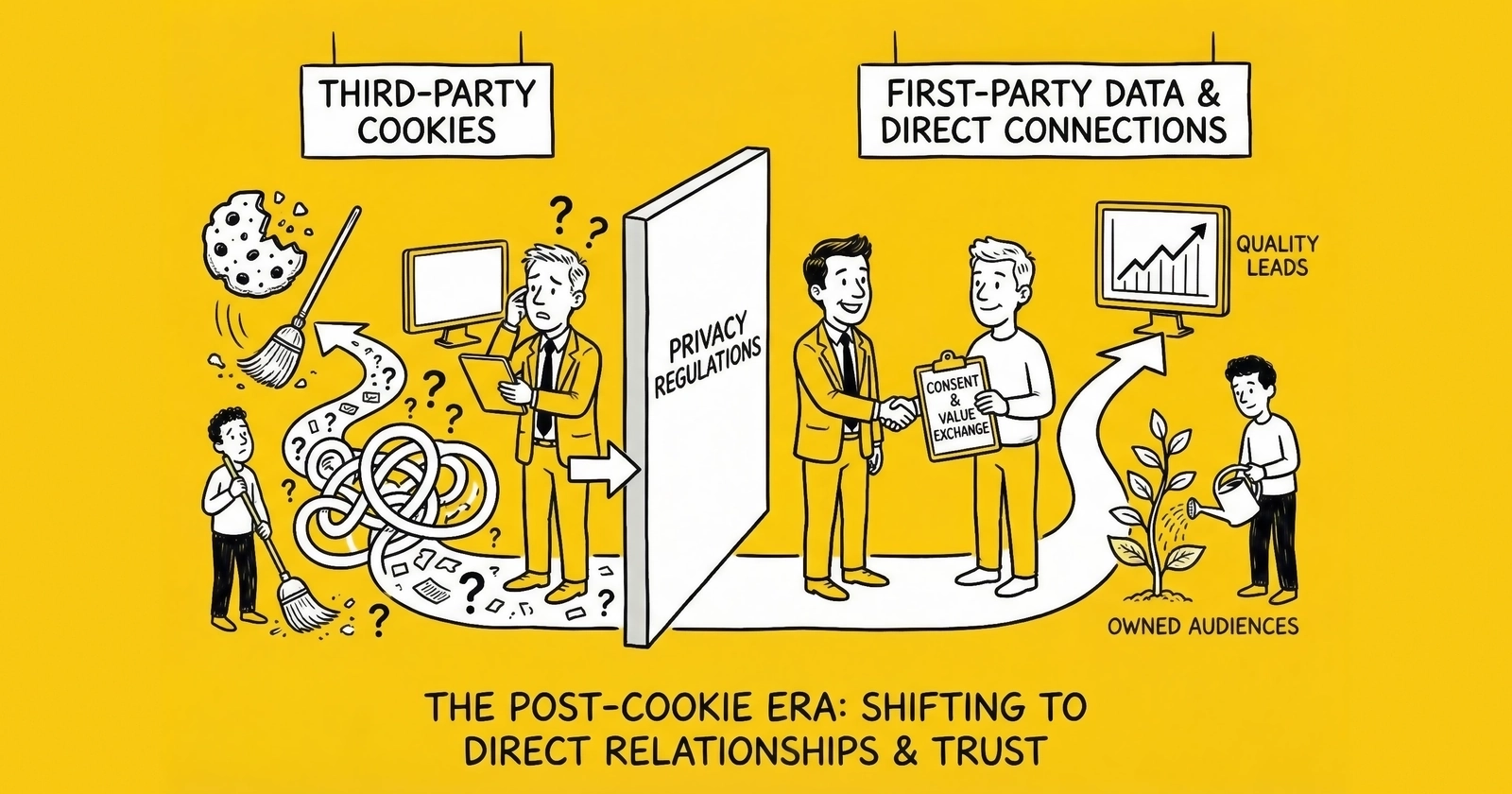
The tracking infrastructure you spent years mastering is being dismantled. Not optimized. Dismantled. Here is what is collapsing and exactly how to rebuild.
The numbers tell the story. Over 30% of your website visitors are invisible to your tracking systems right now. Safari and Firefox block third-party cookies by default. Ad blockers run on 31% of browsers worldwide, rising to 42% among users aged 18-34. iOS users opt out of tracking at rates exceeding 75%. The infrastructure that made modern lead generation possible is eroding beneath you.
This is not a future threat. This is current reality.
For lead generation professionals, the implications are existential. Your attribution models are broken. Your retargeting audiences are shrinking. The traffic arbitrage economics that power your business depend on knowing which sources deliver profitable leads. When 30-40% of conversion signals vanish, you are optimizing toward a distorted picture of reality.
Those who adapt will capture disproportionate value. Those who wait for the crisis to resolve itself will find their competitors have already rebuilt on foundations that survive privacy restrictions.
This guide covers exactly what is happening, how it affects lead generation specifically, and the concrete steps required to recover lost signals and build tracking infrastructure that works in 2025 and beyond.
What Is Actually Happening
The death of third-party cookies is not a single event. It is a multi-year dismantling from multiple directions simultaneously. Understanding each force helps explain why “waiting for Google” was never a strategy.
Safari Intelligent Tracking Prevention
Apple launched Intelligent Tracking Prevention (ITP) in 2017, and each iteration has tightened restrictions further:
ITP 2.1 reduced first-party cookie lifespan to 7 days for cookies set via JavaScript. Your carefully placed tracking cookies now expire within a week, breaking attribution for any conversion that takes longer than seven days.
ITP 2.2 shortened cookie duration to just 24 hours when traffic arrives with link decoration (query parameters like gclid and fbclid) from domains classified as trackers. Google and Meta are on that list. A Safari user who clicks your Google ad on Monday and converts on Wednesday appears as a completely new visitor.
ITP 2.3 extended restrictions to local storage, eliminating the workaround developers had implemented to persist identifiers in localStorage instead of cookies.
Safari represents approximately 18% of US desktop traffic and 27% of mobile traffic. In the iOS ecosystem where high-income consumers skew, that share rises further. These are your highest-value prospects, and they are invisible to cookie-based tracking.
Firefox Enhanced Tracking Protection
Firefox implemented Enhanced Tracking Protection (ETP) in 2019, blocking known tracking domains by default. The feature restricts cookie access, blocks fingerprinting techniques, and prevents cross-site tracking.
Firefox commands only 3-4% market share, but its users tend to be privacy-conscious and technically sophisticated. The same profile that makes them valuable leads makes them resistant to tracking.
Chrome’s Evolving Timeline
Google announced plans to deprecate third-party cookies in Chrome in 2020. The timeline has shifted repeatedly. In July 2024, Google reversed course, choosing to retain third-party cookies but introducing user choice features similar to Apple’s App Tracking Transparency. In April 2025, Google eliminated even the user-choice prompt, keeping Chrome’s current functionality.
The industry exhaled. Crisis averted.
Except it was not averted. Chrome’s decision changed nothing fundamental about the privacy trajectory. The UK Competition and Markets Authority’s June 2025 report revealed that per-impression publisher revenue runs approximately 30% lower under Privacy Sandbox alternatives compared to traditional cookies.
More critically, Chrome represents roughly 67% of global browser share. The remaining 33% is already blocking third-party tracking. Safari, Firefox, Edge, Brave, and DuckDuckGo all restrict cross-site tracking by default. Waiting for Google ignored the reality that a third of your audience was already unreachable.
Privacy Sandbox Retirement (October 2025)
In a major reversal, Google retired its Privacy Sandbox APIs in October 2025, abandoning the multi-year effort to create cookie alternatives. The following APIs were fully retired across Chrome versions 144-150:
| Retired API | Original Purpose |
|---|---|
| Topics API | Interest-based targeting without cross-site tracking |
| Protected Audience API | On-device ad auctions (formerly FLEDGE) |
| Attribution Reporting API | Privacy-preserving conversion measurement |
| Private Aggregation API | Aggregate cross-site data |
| IP Protection | Mask user IP addresses |
| Related Website Sets | Define related domains for cookie access |
What remains in Chrome:
- CHIPS (Cookies Having Independent Partitioned State): Partitioned cookies for third-party embeds
- FedCM (Federated Credential Management): Identity provider integration
- Private State Tokens: Anti-fraud verification
What this means for lead generation: The Privacy Sandbox retirement does not restore the tracking golden age. Third-party cookies remain in Chrome with user choice, but Safari and Firefox (33% of traffic) still block them entirely. The strategic imperative remains unchanged: server-side tracking and first-party data are essential regardless of Chrome’s policy reversals.
30% of Users Already Blocking
Before any browser policy takes effect, user behavior tells the story. Ad blocker usage reached 912 million people globally as of 2024. That figure represents 31% of all internet users. Among ages 18-34, the demographic most likely to be in-market for insurance, solar, financial services, and education products, adoption rises to 42%.
VPN usage has grown significantly, with many services bundling ad-blocking features. Privacy-focused browsers see tens of millions of active users. Younger demographics configure their devices to minimize tracking at rates their parents never considered.
The result: client-side tracking captures only 60-70% of actual conversions in many lead generation scenarios. The 30-40% you are missing is not random. It is systematically biased toward younger, higher-value, privacy-conscious consumers who represent your growth opportunity.
Impact on Lead Generation
The tracking collapse creates specific problems for lead generation economics. Understanding the precise failure modes helps prioritize solutions.
Attribution Challenges
Attribution is the foundation of traffic arbitrage. You buy clicks from Google at $8, sell leads to buyers at $45, and pocket the spread. This model works only if you know which clicks became leads and which sources deliver profitable conversion rates.
When 30-40% of conversion signals disappear, your attribution model does not just lose precision. It becomes systematically wrong.
Consider a simplified example:
Traffic Source A (Google Search): Appears to drive 1,000 leads at $40 CPL = $40,000 spend Traffic Source B (TikTok Video): Appears to drive 500 leads at $80 CPL = $40,000 spend
Based on this data, you double down on Source A and reduce Source B.
But browser restrictions hide 60% of TikTok’s conversions (mobile users, iOS ATT opt-outs, multi-day conversion windows) while Google’s conversions persist better (desktop users, single-session journeys). The actual reality:
Traffic Source A: Actually drives 1,100 leads (10% signal loss) at $36.36 true CPL Traffic Source B: Actually drives 800 leads (60% signal loss) at $50 true CPL
Source B is more efficient. Your budget allocation based on measured performance actively defunds your best source.
The attribution gap is not evenly distributed. It hits upper-funnel channels hardest. Display, video, and social campaigns that reach younger mobile users suffer the most signal loss. Search campaigns that capture already-aware users on desktop retain more of their data. Last-click attribution, the model most lead generators rely on, systematically under-credits awareness while over-crediting capture.
Retargeting Limitations
Retargeting exists to recover the 96-98% of visitors who leave without converting. The economics are compelling: retargeting typically delivers leads at 30-50% lower cost than cold traffic.
Browser privacy features are destroying retargeting audiences.
The mechanisms that made retargeting work depended on third-party cookies. When someone visited your landing page, a tracking pixel dropped a cookie. When they browsed other sites in your ad network’s inventory, that cookie triggered your ads.
Safari blocks this entirely. Firefox blocks this entirely. Chrome users with privacy settings enabled block this. Ad blocker users block this.
The result: lead generation operations report 25-40% smaller retargeting audiences compared to 2019 when using pixel-only tracking. Your highest-intent segment, the visitors who came close to converting, becomes increasingly unreachable.
First-party data retargeting through list uploads bypasses browser restrictions. But this requires capturing email or phone before abandonment, a significant change to form architecture and user experience design.
Audience Building Erosion
Lookalike audiences powered the scaling phase of lead generation campaigns. Upload your converter list. The platform finds similar users. Target them at scale.
The matching that powers lookalike modeling depends on cross-site identity graphs. As tracking fragments, those identity graphs degrade. Match rates decline. Lookalike quality suffers.
Meta reported that iOS 14.5’s App Tracking Transparency changes caused 12-37% signal loss on Facebook Pixel. The modeled conversions that replaced deterministic tracking introduce estimation error. When 75% of iOS users opt out and iOS represents 60% of US smartphone market share, your lookalike audiences are built on increasingly incomplete data.
The audience building problem compounds over time. Each quarter, the identity graphs degrade further. The lookalikes that worked in 2022 perform worse in 2025 not because the strategy changed but because the underlying data quality declined.
Server-Side Tracking: Recovering 20-40% of Lost Signals
Server-side tracking routes conversion data through your own servers before forwarding it to ad platforms. This architectural change bypasses the browser restrictions that cause signal loss.
The principle is simple: when a lead form submits, your server receives the data regardless of browser configuration. Your server then makes direct API calls to Google, Meta, TikTok, and other platforms. These server-to-server connections cannot be intercepted by ad blockers, prevented by browser privacy settings, or affected by ITP restrictions.
How Server-Side Tracking Works
Traditional client-side tracking operates in the user’s browser. JavaScript fires when a conversion happens, sending data directly to ad platform pixels. This request must survive a gauntlet: Safari deleting cookies, Firefox blocking domains, ad blockers preventing scripts from loading.
Server-side tracking restructures the flow:
- User submits lead form on your website
- Your server receives the form data (this works regardless of browser settings)
- Your server retrieves stored click identifiers (gclid, fbclid) from first-party cookies
- Your server fires API calls directly to Google, Meta, and other platforms
- Conversion data reaches ad platforms via server-to-server connection
To the browser, the tracking request looks like a standard form submission to your domain. There is nothing for ad blockers to intercept because the tracking communication never goes to a third-party domain from the client side.
Signal Recovery Rates
Companies implementing server-side tracking report 20-40% more tracked conversions compared to client-side only implementations. The specific recovery depends on your audience composition:
- High mobile/young demographic: 25-35% signal recovery (these audiences have highest blocking rates)
- Mixed desktop/mobile: 15-25% signal recovery
- B2B desktop-heavy: 10-15% signal recovery
One e-commerce implementation documented 18% lower customer acquisition costs and 26% higher new customer growth within a year of server-side implementation. Another company reduced ad spend by 35% while maintaining growth targets because they could finally see which campaigns were actually performing.
Implementation Options
Google Tag Manager Server-Side provides the most accessible entry point. Deploy a server container on Google Cloud Platform, AWS, or a specialized hosting provider. Google Cloud’s Cloud Run costs approximately $120-300 monthly for production environments. Specialized providers like Stape.io offer hosting starting at $20 per month for up to 500,000 requests.
Platform-Specific APIs allow direct integration without the GTM layer. Meta’s Conversions API, Google’s Enhanced Conversions, TikTok Events API, and LinkedIn Conversions API all support server-side event transmission.
Custom Implementation builds server-side tracking directly into your lead management platform. When a form submission processes through your backend, you fire API calls to each relevant ad platform as part of the same transaction. This approach offers maximum control and eliminates additional infrastructure costs.
For most lead generation operations spending over $10,000 monthly on paid traffic, server-side tracking pays for itself within the first month through improved campaign efficiency.
First-Party Data Strategies
First-party data is information consumers provide directly to you through interactions on your owned properties. This data bypasses browser restrictions entirely because no third-party tracking is involved.
The Strategic Shift
For two decades, lead generation relied on third-party data: cookies tracking behavior across sites, device graphs connecting identities, data brokers enriching profiles. That infrastructure is failing.
First-party data reverses the dependency. Instead of tracking what consumers do across the web, you capture data when they interact with your properties. Instead of relying on ad platforms to identify your audience, you identify them yourself and tell platforms who to target.
Email Capture Architecture
Email addresses are the most valuable first-party identifier. They persist indefinitely, match across devices, and provide 60-80% match rates on major advertising platforms.
Capture strategies that work for lead generation:
Progressive form design: Request email in step one of multi-step forms. Even if visitors abandon later steps, you have captured the email. This approach typically increases email capture by 40-60% compared to forms that request email later in the sequence.
Exit-intent capture: Deploy popups that trigger when visitors move to leave the page. Offer quote delivery via email, rate alerts, or educational content in exchange for the address.
Partial form capture: Implement form field tracking that captures data as users type, before submission. If a visitor fills email and phone but abandons before completing, you have those identifiers for retargeting.
Phone Number Capture
Phone numbers provide even higher match rates than email on some platforms. For lead generation verticals where phone contact is the sales mechanism, capturing phone early serves dual purposes: retargeting and sales outreach.
SMS opt-in: Offer quote delivery or status updates via text message. The opt-in captures phone for both communication and advertising.
Click-to-call tracking: Implement dynamic number insertion that captures incoming caller ID. Every inbound call becomes a first-party data point.
Callback requests: Position callback scheduling as a convenience feature. The phone number becomes your identifier.
Building the First-Party Data Asset
Your first-party data becomes a durable competitive asset when maintained properly:
List hygiene: Remove bounced emails immediately. Suppress converted leads from acquisition targeting. Update phone numbers monthly. Poor hygiene wastes impressions and creates compliance risk.
Segmentation: Tag records by source, behavior depth, and conversion status. A visitor who spent 4 minutes on your page and started your form represents different intent than someone who bounced in 3 seconds.
Refresh cadence: Upload updated lists to advertising platforms weekly for dynamic audiences. Stale lists degrade match rates and performance.
Conversion API Implementations
Conversion APIs are the technical mechanism for server-side tracking. Each major ad platform offers its own implementation with specific requirements and capabilities.
Meta Conversions API
Meta’s Conversions API (CAPI) sends conversion events directly from your server, complementing browser-based Pixel tracking. Meta recommends running both together because the Pixel captures real-time browser signals while CAPI ensures conversion events survive when browser-based tracking fails.
Event Match Quality (EMQ) is Meta’s score reflecting how well your customer data matches actual Meta users. EMQ ranges from 0-10. Industry benchmarks show average scores between 4-6, while top-performing campaigns maintain 8-10.
EMQ improvements of 2-3 points typically correlate with 15-25% better ROAS. Poor EMQ can increase customer acquisition costs by 40-60%.
To achieve high EMQ:
- Send hashed email with every event
- Include hashed phone number
- Add first name and last name (hashed)
- Forward Meta’s browser identifiers: the
_fbpcookie and_fbccookie derived from thefbclidURL parameter
Deduplication is critical. When running both Pixel and CAPI, include a consistent event_id parameter in both browser and server events. Without deduplication, conversions get counted twice, inflating metrics and distorting optimization.
Meta’s data shows advertisers using CAPI alongside Pixel achieve 13% lower cost per result and 19% additional attributed events compared to Pixel-only implementations.
Google Enhanced Conversions
Enhanced Conversions supplements standard Google conversion tracking by sending hashed first-party customer data alongside conversion events. Google matches this data against its user database to improve attribution.
Enhanced Conversions for Leads is particularly valuable for lead generation. When a lead eventually converts to a sale (often days or weeks after capture), you upload the conversion with the original lead’s hashed email. Google attributes the sale back to the initial ad click.
Google reports that advertisers using first-party data alongside GCLIDs see a median 10% increase in conversions compared to standard offline conversion imports.
Click ID Persistence
Click identifiers are the keys that unlock attribution. When a user lands on your page from a paid ad, the platform appends a unique identifier: Google’s gclid, Meta’s fbclid, TikTok’s ttclid, Microsoft’s msclkid.
Without these identifiers, ad platforms cannot connect conversions back to the clicks that drove them.
The problem: click IDs exist only in the URL of the landing page. If the user navigates away, submits a form on a different page, or returns days later to convert, the click ID is gone unless you captured and stored it.
Implementation requirements:
- Capture all click identifiers when a user arrives (parse URL parameters)
- Store identifiers in a first-party cookie on your domain
- Pass identifiers into hidden form fields so they persist directly with lead records
- Retrieve identifiers when firing server-side conversion events
iOS 26 preparation: Apple’s Link Tracking Protection strips click identifiers in Private Browsing, Mail, and Messages. Testing suggests this will extend to all browsing. Use custom parameter names (like aclid instead of gclid) that are not on Apple’s known tracking parameter list. Your server container can swap these back to native names before forwarding to ad platforms.
Zero-Party Data Collection
Zero-party data is information consumers proactively share voluntarily. Unlike first-party data captured through observation, zero-party data comes from explicit consumer declaration.
The Value Exchange
Consumers provide zero-party data when the exchange feels fair. They tell you their preferences, needs, and intent in return for personalized value.
For lead generation, zero-party data opportunities include:
Preference centers: Let visitors specify what types of offers interest them, their timeline, budget range, or specific requirements. This data improves lead quality and routing while providing targeting parameters.
Interactive tools: Quote calculators, comparison widgets, and assessment quizzes generate zero-party data through the questions answered. A solar calculator that asks about roof type, energy bill, and financing preferences captures declared intent.
Pre-qualification questions: Add questions that segment leads by value before capture. A mortgage form that asks “When are you looking to purchase?” separates hot prospects from researchers.
Zero-party data carries distinct advantages over behavioral tracking: accuracy (consumers tell you directly), consent (voluntarily provided), and durability (does not expire or get blocked).
Privacy-First Lead Generation
Privacy is not an obstacle to navigate around. It is a competitive advantage for operators who embrace it.
The Consumer Expectation Shift
Consumer tolerance for surveillance-based marketing has collapsed. A survey by Cisco found that 86% of consumers care about data privacy and want more control over how their information is used. Younger demographics show even stronger privacy preferences.
At the same time, consumers still want relevant offers. The paradox: they expect personalization without feeling watched.
Operators who solve this paradox build sustainable advantages. Those who continue extracting data without clear value exchange face increasing friction.
Trust as Competitive Advantage
Transparent collection: Tell visitors exactly what data you collect and how it will be used. Specificity builds trust.
Value-first exchange: Provide something genuinely useful before requesting personal information. Quote comparisons, calculators, and educational content create reciprocity.
Consent documentation: Maintain verifiable records of consent. When regulators or litigators come calling, documented consent is your defense.
Regulatory requirements continue expanding: GDPR, CCPA/CPRA, state privacy laws, and TCPA compliance requirements. Practitioners who build compliance into their foundation avoid reactive scrambles when regulations tighten.
Technology Solutions
The technology stack for privacy-compliant lead generation requires specific components working together.
Consent Management Platforms
A consent management platform (CMP) captures, stores, and enforces consent preferences across your properties. Leading solutions include OneTrust, Cookiebot, TrustArc, and Usercentrics. Ensure your CMP integrates with your form system so consent flows with lead records.
Customer Data Platforms
CDPs unify first-party data from multiple sources into coherent customer profiles. Options by scale: Enterprise (Segment, mParticle, Tealium), Mid-market (RudderStack, Hightouch), SMB (some lead distribution platforms include basic functionality).
Server-Side Tag Management
Host tracking infrastructure on servers you control. Google Tag Manager Server-Side runs on Google Cloud, AWS, or specialized hosts. Stape.io, Addingwell, and Server Side Tagging offer managed infrastructure at $20-100/month.
Data Clean Rooms
Clean rooms enable secure collaboration with partners without sharing raw data. In lead generation, they facilitate matching leads against buyer conversion data and attribution analysis. Snowflake, AWS Clean Rooms, and InfoSum offer this functionality.
Frequently Asked Questions
What percentage of tracking data are lead generators losing?
Lead generation operations typically lose 30-40% of conversion signals through browser restrictions and ad blockers. Upper-funnel channels suffer 40-60% signal loss. Lower-funnel channels may only lose 10-20%.
Does Chrome keeping third-party cookies solve the problem?
No. Chrome represents 67% of browser share. The remaining 33% already blocks third-party cookies. Additionally, ad blocker usage at 31% and iOS ATT opt-outs at 75% create signal loss independent of Chrome’s policy.
How much does server-side tracking cost?
Infrastructure costs range from $20-300 per month depending on traffic volume. Implementation time is typically 20-40 hours. For operations spending over $10,000 monthly on advertising, it pays for itself in the first month.
What is the difference between first-party and zero-party data?
First-party data is collected through observation: pages visited, forms started. Zero-party data is proactively shared: preferences declared, survey responses. First-party shows behavior. Zero-party reveals intent.
How do I capture email before form abandonment?
Design multi-step forms requesting email in step one. Implement form field tracking that captures data as users type. Deploy exit-intent popups. Each approach increases capture by 30-60%.
What is Meta’s Event Match Quality?
EMQ is Meta’s score (0-10) for how well conversion data matches users. Average is 4-6. Top performers hit 8-10. Improvements correlate with 15-25% better ROAS. Poor EMQ increases acquisition costs 40-60%.
Will iOS 26 break my tracking?
iOS 26’s Link Tracking Protection strips click identifiers. Use custom parameter names not on Apple’s list. Server-side tracking with first-party data becomes essential for iOS attribution.
How do I run retargeting without third-party cookies?
Capture email and phone before abandonment. Upload lists to create Custom Audiences (Meta) and Customer Match (Google). List-based audiences achieve 60-80% match rates regardless of browser settings.
What is the minimum spend for server-side tracking?
Server-side tracking pays for itself at around $10,000 monthly advertising spend. Smaller operations should prioritize basic first-party data capture first.
How do I measure if privacy-first changes work?
Track attributed conversion volume, cost per lead by source, retargeting audience size, and Event Match Quality scores. Run incrementality tests to validate recovered signals.
Key Takeaways
-
30-40% of conversion signals are already invisible. Safari and Firefox block cookies. Ad blockers run on 31% of browsers. iOS users opt out at 75% rates. The crisis is now, not future.
-
Attribution distortion is systematic, not random. Upper-funnel channels lose 40-60% of signals. Lower-funnel loses 10-20%. Last-click attribution over-credits capture while under-crediting awareness.
-
Server-side tracking recovers 20-40% of lost signals. Route data through your servers via direct API calls. Server-to-server connections bypass browser restrictions.
-
First-party data is the new foundation. Capture email and phone before abandonment. Upload lists for retargeting and lookalikes. First-party data bypasses all browser privacy features.
-
Event Match Quality determines attribution accuracy. Aim for 8+ by sending complete hashed customer data through Conversions API.
-
Click ID persistence is foundational. Capture gclid, fbclid, ttclid on arrival. Store in cookies and hidden fields. Without these, conversions cannot attribute.
-
Zero-party data provides explicit intent signals. Preference centers and interactive tools capture declared information that does not expire or get blocked.
-
Privacy-first is competitive advantage. Clear data practices differentiate. Trust building improves conversion. Compliance avoids regulatory scramble.
-
Infrastructure investment is minimal. Server-side hosting costs $20-300/month. For operations spending $10,000+ on advertising, ROI is measured in weeks.
-
Prepare for iOS 26 now. Use custom click parameters. Implement server-side translation. First-party data becomes essential for iOS attribution.
The tracking infrastructure that powered lead generation for two decades is being rebuilt from the foundation. Those who adapt capture efficiency gains. Those who wait will optimize against distorted data until margins disappear. For comprehensive frameworks on server-side tracking, first-party data architecture, and privacy-compliant lead generation, see The Lead Economy covering the complete transformation roadmap.