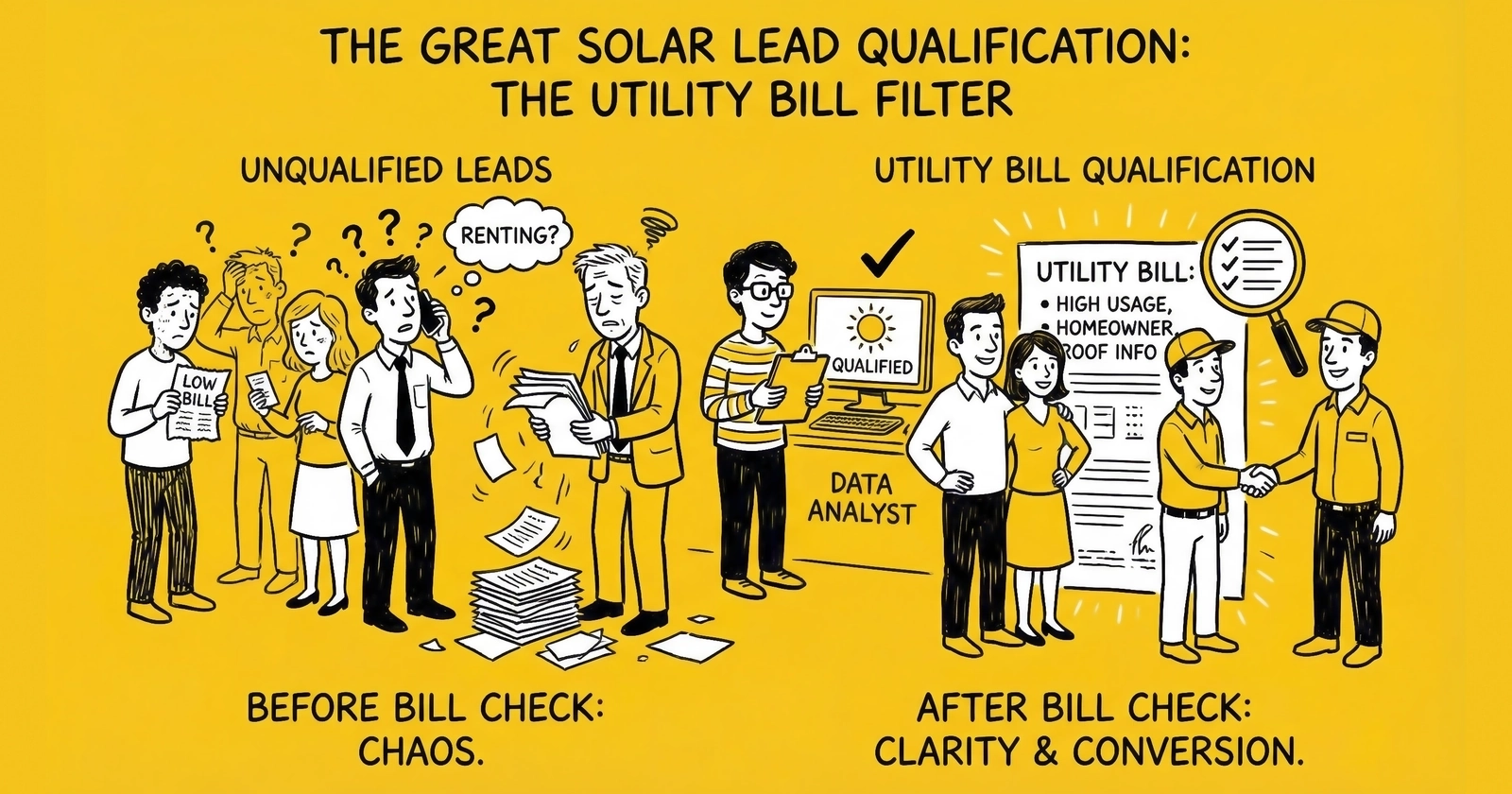
How the electric bill separates viable solar prospects from wasted outreach. Master the qualification thresholds, savings calculations, and automation tools that determine whether a lead converts or costs you money.
The solar lead arrives in your queue: homeowner verified, roof age acceptable, credit self-attested as good. All the filters pass. Your sales team spends 45 minutes building rapport, designing a system, running financing options. Then they learn the homeowner’s electric bill is $78 per month.
The conversation ends there. It had to end there. The economics never worked.
That wasted outreach cost your operation approximately $125 in sales labor, opportunity cost, and operational overhead. Multiply by the 20-30% of solar leads that fail on utility economics alone, and you have identified one of the largest controllable costs in solar lead generation.
Utility bill analysis is the qualification step that separates profitable solar operations from money pits. The electric bill reveals more than consumption. It reveals motivation, savings potential, system size requirements, and the fundamental question that determines every solar sale: does the math work for this homeowner?
This guide provides the complete framework for utility bill qualification in solar leads: minimum thresholds by market, savings calculation methodologies, automation tools, verification techniques, and the operational systems that separate high-converting lead operations from those bleeding money on prospects who were never going to buy.
Why Utility Bills Matter More Than Any Other Qualification Factor
Every solar sale ultimately reduces to one question: will this system save the homeowner money compared to their current utility costs? The electric bill provides the raw data to answer that question before you spend a dollar on outreach.
The Unit Economics of Utility Bill Qualification
Consider the numbers across 1,000 solar leads. Without utility bill qualification, you spend $75,000 on leads at $75 CPL. A 40% contact rate yields 400 conversations, but half of those contacts – 200 leads – fail on utility economics during the conversation itself. That wasted sales time translates to 100 hours at $50 per hour, adding $5,000 in labor cost. The remaining 200 leads move to proposal stage, where a 15% close rate produces 30 sales. Your effective cost per sale: $2,666.
Now apply utility bill qualification with a $150+ threshold. Your 1,000 leads filter down to 600 meeting the threshold. You pay $85 CPL – a premium for verified bills – spending $51,000 total. The same 40% contact rate yields 240 conversations, but only 20 leads (8% of contacts) fail on other factors. The remaining 220 leads move to proposal stage. Higher-quality prospects convert at 18%, producing 40 sales. Your effective cost per sale: $1,275.
The math is unforgiving. Utility bill qualification cuts cost per sale by 52% while increasing total conversions. The premium paid for verified, qualified leads pays for itself many times over.
What the Electric Bill Actually Reveals
The utility bill provides five critical qualification signals, each contributing to the decision of whether a prospect warrants your sales team’s time and attention.
Savings Potential
A $300 monthly electric bill suggests $3,600 annual electricity spend. At current solar economics with 6-8 year payback in most markets, that homeowner can save $25,000-$35,000 over the system lifetime. A $75 monthly bill suggests $900 annual spend – savings that barely justify the sales conversation, let alone the installation complexity.
The savings potential directly correlates with buyer motivation. Homeowners spending $400 monthly on electricity feel the pain every month. They are actively motivated to reduce that expense. Homeowners spending $80 monthly may be intellectually interested in solar but lack the financial urgency that drives purchase decisions.
System Size Requirements
Electric consumption determines the solar system size needed to offset the bill:
| Monthly Bill | Estimated kWh | System Size Needed | Approximate Cost |
|---|---|---|---|
| $100 | 650-800 kWh | 4-5 kW | $12,000-$15,000 |
| $150 | 950-1,200 kWh | 6-7 kW | $18,000-$21,000 |
| $200 | 1,300-1,600 kWh | 8-10 kW | $24,000-$30,000 |
| $300 | 1,900-2,400 kWh | 12-14 kW | $36,000-$42,000 |
| $400+ | 2,600+ kWh | 16+ kW | $48,000+ |
Note: Estimates assume $0.15-$0.16/kWh average rate. Actual sizing varies by location, sun hours, and roof constraints.
Larger systems mean higher revenue per installation. A $48,000 system generates more margin than a $15,000 system, even accounting for the increased installation complexity. Installers prefer prospects with higher consumption because the economics justify their customer acquisition costs.
Utility Rate Exposure
The bill identifies which utility serves the property and, by extension, the rate structure, net metering policy, and time-of-use considerations. A customer on SDG&E’s tiered rate structure in California experiences different economics than one on Duke Energy’s flat rate in North Carolina.
Rate structure matters significantly for solar savings calculations. Tiered rates – where higher consumption triggers higher per-kWh prices – favor solar because production offsets the most expensive usage tiers first. Flat rates provide straightforward savings calculations but less dramatic benefit. Time-of-use rates require battery storage consideration because peak pricing periods often occur when solar production is minimal, meaning the homeowner buys expensive evening power while exporting cheap midday solar.
Historical Consumption Patterns
Annual usage trends reveal seasonal variation, recent changes such as new electric vehicles, pool pumps, or home additions, and baseline consumption stability. Installers prefer consistent usage patterns because they can design systems with predictable production-to-consumption ratios.
Seasonal variation affects system design. A home that uses 2,000 kWh in summer but 800 kWh in winter (common in air-conditioning-heavy markets) requires different sizing than one with consistent 1,200 kWh monthly consumption.
Credit and Payment Behavior
While not a direct qualification factor, bill payment history visible on some utility documents indicates financial responsibility. Late fees and past-due notices correlate with financing approval challenges. Lead generators and installers can factor this signal into qualification scoring.
Qualification Thresholds: The Numbers That Matter
Utility bill thresholds vary by market, installer preference, and economic conditions. These benchmarks reflect 2024-2025 industry standards across major solar markets.
National Baseline Thresholds
The solar industry has converged on general thresholds that separate qualified prospects from marginal ones:
| Threshold Level | Monthly Bill | Qualification Status | Conversion Probability |
|---|---|---|---|
| Premium | $250+ | Highly qualified | 20-25% |
| Standard | $150-$249 | Qualified | 12-18% |
| Marginal | $100-$149 | Potentially qualified | 6-10% |
| Below threshold | Under $100 | Generally unqualified | 2-4% |
Premium prospects ($250+ monthly bills) represent the ideal solar customer. Their high consumption creates compelling savings narratives, justifies larger system sizes, and indicates households with substantial energy needs (often larger homes, pools, home offices, or electric vehicles). Close rates in this segment routinely exceed 20%.
Standard qualified prospects ($150-$249) represent the bread-and-butter of solar sales. The economics work. The savings are meaningful. The conversation can proceed to proposal stage with reasonable conversion expectations.
Marginal prospects ($100-$149) require careful evaluation. In high-rate markets (California, Hawaii, Massachusetts), these prospects may still present viable economics. In low-rate markets (Texas, Georgia, North Carolina), the savings rarely justify the installation complexity. Installers often accept these leads selectively based on other qualification factors.
Below-threshold prospects (under $100) generally fail on economic qualification. Exceptions exist: environmental advocates who prioritize sustainability over savings, battery backup buyers in power-outage-prone areas, or homeowners planning significant consumption increases (EV purchase, home expansion). Without these special circumstances, conversion probability drops below 4%.
Market-Adjusted Thresholds
Electricity rates vary 3-4x across US markets. A $150 bill represents different consumption and savings potential in each region:
| Market | Average Rate ($/kWh) | $150 Bill = kWh | Adjusted Threshold |
|---|---|---|---|
| Hawaii | $0.35-$0.42 | 360-430 kWh | $100+ viable |
| California | $0.25-$0.35 | 430-600 kWh | $125+ viable |
| Massachusetts | $0.24-$0.28 | 535-625 kWh | $125+ viable |
| New York | $0.20-$0.24 | 625-750 kWh | $150+ standard |
| Florida | $0.13-$0.15 | 1,000-1,150 kWh | $175+ recommended |
| Texas | $0.11-$0.14 | 1,070-1,360 kWh | $175+ recommended |
| Georgia | $0.11-$0.13 | 1,150-1,360 kWh | $200+ recommended |
Rate data reflects 2024-2025 averages. Actual rates vary by utility and rate plan.
In high-rate markets like Hawaii and California, lower absolute bill amounts can still indicate substantial consumption. A $125 Hawaii Electric bill represents approximately $0.38/kWh on 330 kWh – expensive electricity that solar directly offsets. The same $125 bill in Georgia might represent 1,000 kWh at $0.125/kWh – cheaper electricity where solar savings are less compelling.
Lead generators operating across multiple markets must adjust qualification thresholds accordingly. Geographic arbitrage strategies can help maximize value across diverse markets. A national lead operation using a blanket $150 threshold will over-qualify in Hawaii (accepting lower-consumption prospects) and under-qualify in Georgia (rejecting viable higher-consumption prospects). Geographic arbitrage strategies can help maximize value across diverse markets.
Installer-Specific Thresholds
Individual installers set thresholds based on their business models, and understanding these preferences determines whether your leads find receptive buyers.
High-volume installers often accept lower thresholds of $125 or more because their operational efficiency allows profitability on smaller systems. Companies like Sunrun and Freedom Forever can install $15,000 systems profitably because their scale drives down per-installation costs. Premium installers targeting higher-margin installations typically require $200+ bills, preferring fewer, larger projects over volume. Their sales processes are designed for $30,000+ installations where the margin justifies their customer acquisition investment.
Lease and PPA providers may accept lower thresholds because they monetize through long-term financing rather than installation margin. The 20-year revenue stream from a smaller system can still be profitable even if the installation margin is minimal.
Lead generators should understand their buyer profiles. Selling $100-bill leads to a premium installer creates returns and damages relationships. Matching lead quality to buyer expectations drives retention and pricing power.
Savings Calculation Methodologies
The core solar sales conversation centers on savings projections. Accurate calculations require understanding the methodology behind the numbers.
Simple Offset Calculation
The basic approach assumes solar production offsets utility consumption dollar-for-dollar: Annual Savings equals Annual Electric Bill multiplied by Offset Percentage.
Consider a homeowner with a $300 monthly electric bill totaling $3,600 annually. A system designed for 90% offset generates $3,240 in annual savings. If the system costs $25,000 after any applicable ITC, the simple payback period equals 7.7 years. Over a 25-year system lifetime, cumulative savings reach $56,000 after subtracting the initial system cost.
This methodology works for quick qualification but oversimplifies real-world economics.
Net Metering Adjusted Calculation
Net metering policies determine how excess solar production is credited, and the calculation must adjust based on policy type.
Under full retail net metering, production receives credit at the full retail rate – $0.15 per kWh produced equals $0.15 credited – making the savings calculation straightforward: kWh offset multiplied by retail rate. Reduced rate net metering, exemplified by California’s NEM 3.0, credits production at avoided cost or wholesale rates. When you receive only $0.05 per kWh credited versus $0.15 per kWh consumed, the savings calculation becomes more complex and battery storage often becomes necessary to capture full value. Markets with no net metering or net billing provide minimal or no credit for excess production, requiring systems sized only for self-consumption with savings limited to production used directly on-site.
California’s NEM 3.0 implementation demonstrates why net metering matters for lead qualification. Pre-NEM 3.0, a $250 monthly bill with 1,600 kWh consumption could expect $200+ monthly savings with appropriately sized solar. Post-NEM 3.0, the same bill without battery storage might achieve only $100-$125 monthly savings as excess production credits drop 75%.
Lead generators targeting California must qualify for battery storage interest alongside solar interest. A solar-only California lead has 30-40% lower conversion rates than a solar-plus-storage lead because the economics require batteries.
Rate Escalation Modeling
Utility rates increase over time, and sophisticated savings calculations factor in future rate increases to present the complete value picture.
Using a conservative estimate of 3% annual increase on $3,000 first-year savings, the numbers compound significantly. By year 10, annual savings grow to $3,914. By year 25, they reach $6,093. Cumulative 25-year savings total approximately $112,000. A moderate estimate using 4% annual increase produces year-25 savings of $7,688 and cumulative 25-year savings approaching $128,000.
Installers commonly project 3-4% annual rate increases, consistent with historical utility rate inflation. The projection makes solar economics more compelling over time – a selling point in consumer conversations.
Total Cost of Ownership Analysis
Comprehensive savings analysis includes all ownership costs across the system lifetime.
Solar system costs begin with equipment and installation ranging from $20,000 to $40,000. The federal ITC, when applicable, reduces this by 30%, bringing net costs to $14,000-$28,000. State incentives vary widely but can subtract an additional $0-$10,000. If the homeowner finances the system, interest adds $5,000-$15,000 over the loan term. Inverter replacement typically occurs between years 12-15, adding $2,000-$4,000, while monitoring and maintenance run $500-$1,000 over the system life.
Without solar, utility costs over 25 years at 3% escalation exceed $112,000, including unavoidable connection fees and fixed charges. The net 25-year benefit equals total utility savings minus total solar ownership costs.
The Federal Investment Tax Credit significantly affects these calculations. Through 2024, the 30% residential ITC reduced out-of-pocket costs substantially. Following the One Big Beautiful Bill Act signed in July 2025, the residential ITC expires for new installations after December 31, 2025. Leads generated after this date face different economics – 30% higher effective system costs extending payback periods by approximately 2-3 years in most markets.
Utility Bill Verification Methods
Self-reported electric bill amounts are notoriously inaccurate. Consumers misremember, estimate, or occasionally exaggerate to appear qualified. Verification separates real prospects from false signals.
Upload Verification (Gold Standard)
The most reliable method requires consumers to upload their actual utility bill. Implementation involves a form step requesting PDF or image upload, followed by OCR technology extracting the account number, consumption, and dollar amounts. Automated validation checks the data against utility databases where available, while manual review queues flag anomalies for human attention.
This approach delivers near-perfect accuracy on consumption data, captures 12-month usage history from many bill formats, identifies the utility and rate plan automatically, and provides documentation for accurate system design. The challenges are equally real: form friction increases 20-30% in abandonment, mobile users struggle with document access, processing requires technology investment, and some consumers lack immediate access to their bills.
The friction-conversion tradeoff is real. Bill upload requirements typically reduce form completion rates 20-30%. However, the leads that do complete provide substantially higher value. Industry data suggests bill-verified leads convert 40-60% higher than self-reported leads, more than compensating for reduced volume.
Third-Party Utility Data Services
Several vendors provide utility account access through consumer authorization, eliminating the need for document uploads entirely.
Arcadia (formerly Urjanet) connects directly to utility accounts with consumer permission, extracting 12-24 months of detailed usage data. The approach requires consumer login credentials, which some prospects resist providing. UtilityAPI provides similar utility data access through Green Button Connect and direct utility integrations, covering approximately 70% of US utility customers. Bid13 aggregates utility data specifically for solar lead qualification, providing instant consumption verification and automated disqualification for below-threshold prospects.
These services add $1-3 per lead in verification costs but dramatically improve data accuracy. The ROI is substantial: paying $2 to verify a $75 lead avoids paying $75 for an unqualified prospect.
Estimated Bill Calculation
When direct verification is unavailable, validated estimation provides reasonable approximation.
The square footage method uses home size, location, and age as inputs, applies regional average consumption per square foot, and outputs estimated monthly consumption:
| Home Size | Estimated Monthly kWh | Estimated Bill ($0.15/kWh) |
|---|---|---|
| 1,500 sq ft | 900-1,100 kWh | $135-$165 |
| 2,000 sq ft | 1,100-1,400 kWh | $165-$210 |
| 2,500 sq ft | 1,300-1,700 kWh | $195-$255 |
| 3,000 sq ft | 1,500-2,000 kWh | $225-$300 |
| 3,500+ sq ft | 1,800-2,500+ kWh | $270-$375+ |
Behavioral signals enhance base estimates. A pool adds $50-100 per month. An electric vehicle adds $30-75 per month. A home office with remote work adds $20-40 per month. Electric heating adds $50-150 per month seasonally, while heavy air conditioning use adds $75-200 per month during summer months.
Combining square footage estimates with behavioral signals provides reasonable accuracy – within 20-25% of actual consumption – when bill verification is not possible.
Manual Verification During Sales
Some operations defer verification to the sales conversation itself.
Early conversation verification opens with: “Before I design your system, I need to understand your current usage. Can you grab a recent electric bill?” This approach delays proposal development until verification completes and adds 24-48 hours to the sales cycle if the consumer needs to locate their bill. Real-time lookup with consumer authorization takes a different approach: the sales rep guides the consumer through their utility website login, captures 12-month usage via screen share, and obtains immediate data for system design.
This approach eliminates form friction but front-loads sales time on potentially unqualified prospects. The strategy works for high-touch sales operations where the conversation itself provides qualification value.
Automation Tools for Utility Bill Qualification
Manual utility bill review does not scale. Automation tools process bills, extract data, calculate savings, and route leads based on qualification status.
Optical Character Recognition (OCR) Solutions
OCR technology extracts text and numbers from uploaded bill images, and several platforms specialize in solar industry applications.
Dedicated solar OCR platforms include SolarMOS, which provides solar-specific bill processing with utility identification, consumption extraction, and rate plan detection. Aurora Solar offers an integrated design platform including bill processing for consumption inputs. Scoop Solar provides end-to-end solar sales platform with document processing capabilities built in.
General OCR platforms require more configuration but offer flexibility. ABBYY FlexiCapture provides enterprise OCR configurable for utility bill templates. Amazon Textract delivers AWS-based document processing but requires custom integration. Google Document AI offers similar cloud-based processing capability.
Implementation typically requires template creation for major utility bill formats, field mapping for key data points, validation rules for extracted data, and exception handling for unrecognized formats. Accuracy rates range from 85-95% depending on bill quality and format coverage. Human review queues handle exceptions and edge cases.
Utility Data API Integrations
Direct utility data access eliminates OCR limitations entirely.
The Arcadia API operates through consumer authorization of utility account access, retrieving 12-24 months of interval data – hourly or 15-minute in some cases – along with rate plan identification and cost per kWh calculations. Coverage extends to 95% or more of US residential customers. UtilityAPI Green Button Connect provides a standardized utility data format supported by California, New York, and other major markets, with hourly consumption data enabling accurate solar matching. Coverage varies by utility participation. Direct utility integrations offer the most complete data but require individual integration per utility, resulting in the highest development cost.
API-based verification provides the highest accuracy with lowest consumer friction. The consumer clicks “authorize,” the system retrieves data, and qualification happens automatically. Processing costs of $1-3 per lookup are offset by dramatic quality improvements.
Lead Routing Automation
Qualification automation feeds directly into lead routing decisions.
Threshold-based routing applies simple logic: leads with $250+ monthly bills route to the premium buyer pool at $150 CPL. Bills between $150-$249 route to the standard buyer pool at $100 CPL. Bills from $100-$149 route to the value buyer pool at $50 CPL. Bills under $100 either reject or route to nurture sequences for future requalification.
Multi-factor routing adds sophistication beyond bill amount. The routing engine considers utility rate level, where high-rate utilities command premium placement. Net metering policy status affects value – full retail credits versus reduced credits change the economics. Battery storage interest indication, home ownership verification status, and credit qualification signals all factor into routing decisions.
Platforms like LeadsPedia, boberdoo, and Phonexa support conditional routing based on utility qualification data. Custom implementations connect verification services to routing logic.
Savings Calculators and Quote Engines
Instant savings estimates enhance lead quality and conversion by giving consumers immediate value from their data submission.
Consumer-facing calculators accept the bill amount or consumption from the lead, then return estimated savings, system size, and payback period. This interaction creates engagement and sets realistic expectations before the sales conversation. EnergySage and Project Sunroof demonstrate this approach effectively. Installer quote engines take the process further: API-delivered consumption data feeds directly into design tools, enabling automated system sizing based on consumption profile and instant financing option calculations. Aurora Solar, OpenSolar, and Scoop exemplify this integrated approach.
Integration between lead capture and quote generation accelerates the sales cycle. A consumer who receives a preliminary savings estimate within seconds of form submission is more engaged and more likely to answer the follow-up call.
Quality Signals Beyond the Bill Amount
While the dollar amount provides the primary qualification signal, additional bill data enhances lead quality assessment and reveals upsell opportunities.
Rate Plan Analysis
The consumer’s current rate plan reveals optimization opportunity beyond simple consumption metrics.
Tiered rate plans charge higher rates per kWh as consumption increases. Solar offsets the highest-rate tiers first, meaning savings often exceed simple calculation based on average rates. Time-of-use plans present more complexity: different rates by time of day create peak rates of $0.30-$0.50 per kWh versus off-peak rates of $0.08-$0.15 per kWh. Solar production often misaligns with peak periods (evening rates highest when solar production is lowest), substantially increasing battery storage value for these customers.
Electric vehicle rates typically feature heavily time-differentiated pricing, and solar plus storage plus EV creates a comprehensive energy solution with higher lifetime value per customer. Some utilities offer solar-specific rates where net billing structures affect savings calculations – important data for accurate projection.
Rate plan data enables more accurate savings calculations and identifies upsell opportunities such as battery storage for TOU customers and EV charger installation for EV owners.
Consumption Pattern Analysis
Twelve-month usage data reveals patterns that affect solar sizing and economics.
Seasonal variation tells the story of a home’s energy profile. High summer usage driven by air conditioning is common in hot climates, while high winter usage driven by heating characterizes cold climate homes. These patterns affect optimal system sizing and may indicate battery storage opportunity for customers who want to capture excess summer production for evening use.
Consumption trends indicate lifestyle changes. Increasing usage suggests lifestyle changes or occupancy increases – new home occupants, work-from-home transitions, or new electrical loads like EVs or pools. Decreasing usage may indicate efficiency improvements already made, reducing the remaining solar savings opportunity. Steady usage provides the most reliable baseline for system sizing.
Peak usage months identify when solar production matters most, affect financing recommendations around peak month payments, and indicate seasonal sales timing opportunities. Leads captured during peak months feel the bill pain most acutely and may be more motivated to act.
Account Status Signals
Bill details beyond consumption provide qualification signals that affect both conversion probability and sales approach.
Payment history visible on some bills reveals financial patterns. Past-due amounts indicate financial stress and correlate with financing approval challenges. These prospects may warrant additional credit qualification before investing proposal development time.
Budget billing enrollment indicates a preference for predictable payments – a signal that solar loan or PPA messaging with fixed monthly payments will resonate. This generally represents a positive qualification signal for financed solar offerings.
Account tenure tells its own story. New accounts may indicate recent moves. Recent movers represent both opportunity (setting up their new home, open to improvements) and risk (may move again before solar payback). Long tenure suggests stable homeownership and lower relocation risk.
Implementation: Building Your Utility Bill Qualification System
Moving from concept to operation requires systematic implementation across your lead generation workflow.
Lead Form Design for Bill Capture
The form must capture utility data without excessive friction. A progressive disclosure approach works best.
The first step collects basic information: name, email, phone, and address along with homeowner confirmation and project timeline. The second step gathers property details including home square footage, roof age and condition, and shade situation. The third step captures utility information: electric utility provider via ZIP-based dropdown, monthly electric bill amount through range selector or direct input, and optionally a bill upload for verification.
The range selector approach balances accuracy with completion rates by offering bands: under $100, $100-$150, $150-$200, $200-$300, $300-$400, and over $400. This format captures qualification data while reducing the precision anxiety that exact dollar inputs create.
Verification Workflow
Post-submission verification improves data accuracy, and three distinct approaches serve different operational models.
The immediate verification path delivers premium quality. The consumer uploads their bill during form submission. OCR processing completes within 30 seconds. Automated validation checks the extracted data against thresholds. Qualified leads route immediately to buyers while unverified or failed leads queue for manual review.
The delayed verification path accepts more uncertainty upfront. Self-reported bill amounts flow through with the lead. The sales call requests bill verification from the consumer. The installer performs verification before investing in proposal development.
The API verification path offers seamless verification with minimum friction. The consumer simply authorizes utility data access. The system retrieves 12-month usage automatically without document uploads. This approach achieves the highest conversion rates due to low consumer friction.
Choose the verification approach based on volume, buyer requirements, and technology investment capacity. Higher-touch verification produces better leads but requires greater operational investment.
Buyer Communication and Pricing
Utility qualification enables differentiated pricing that reflects genuine quality differences.
Transparent tiered pricing communicates value clearly: premium leads with $250+ bills command $125 CPL, standard leads with $150-$249 bills justify $90 CPL, and value leads with $100-$149 bills price at $50 CPL. Quality guarantees reinforce the pricing structure. Bill-verified leads carry guaranteed bill amounts with returns accepted for discrepancies. Self-reported leads carry no bill guarantee, with lower pricing reflecting the uncertainty.
Performance data sharing builds the case for premium pricing. Provide buyers with conversion rates by bill tier, demonstrating the ROI advantage of bill-qualified leads. When installers see 18% conversion on bill-verified $200+ leads versus 8% on unverified leads, they pay premium pricing for the quality difference. The data proves the value.
Return Policy and Quality Assurance
Bill verification ties directly to return policies, creating clear expectations for both parties.
For bill amount returns, verified leads qualify for return if the actual bill differs by 20% or more from the reported amount. Self-reported leads carry no return rights for bill discrepancy – pricing already reflects this uncertainty. Documentation requirements specify that the installer must provide the actual bill showing the discrepancy within a 7-day return window for bill verification issues. No returns apply for the buyer’s inability to reach the consumer.
Clear policies reduce disputes and set expectations. Both generators and buyers benefit from unambiguous terms.
Frequently Asked Questions
What is the minimum electric bill amount for a qualified solar lead?
The industry standard minimum threshold is $150 per month, though this varies by market. In high-electricity-rate markets like Hawaii and California, leads with $100-$125 monthly bills can still represent viable prospects. In lower-rate markets like Texas and Georgia, thresholds of $175-$200 provide better conversion outcomes. The key is matching the threshold to local electricity rates: a $150 bill in California represents approximately 500 kWh at $0.30/kWh, while the same bill in Texas represents approximately 1,250 kWh at $0.12/kWh – substantially different consumption levels and savings opportunities.
How do I verify utility bill information on solar leads?
Three primary verification methods exist. Bill upload verification requires consumers to photograph or PDF-upload their actual utility bill, then OCR technology extracts the consumption and cost data. Utility data API services like Arcadia, UtilityAPI, or Bid13 connect directly to utility accounts with consumer authorization, retrieving 12-24 months of verified usage data. Estimated verification uses home square footage, location, and behavioral signals (pool, EV, electric heating) to calculate expected consumption ranges. Bill upload and API verification provide 90-95% accuracy; estimation methods achieve 75-80% accuracy.
How does NEM 3.0 in California affect utility bill qualification?
California’s NEM 3.0 policy, implemented in April 2023, reduced compensation for excess solar production by approximately 75%. This means solar-only systems now take 14-15 years to pay back versus 5-6 years under NEM 2.0. As a result, California leads now require battery storage interest qualification alongside bill amount. A $250 monthly bill lead without battery interest may convert at 8-10%, while the same lead with battery interest converts at 18-22%. Lead generators targeting California should capture storage interest as a primary qualification factor, not just a supplementary data point.
What utility bill threshold should I use for leads in Texas?
Texas presents unique qualification challenges due to its deregulated electricity market and lower average rates ($0.11-$0.14/kWh). The recommended threshold for Texas solar leads is $175-$200 monthly minimum. This higher threshold reflects the fact that a $150 Texas bill represents approximately 1,200 kWh of consumption – a larger system requirement than the same dollar amount in high-rate markets. Texas also lacks strong net metering policies in most utility territories, making self-consumption ratios and battery storage more important for the economics to work.
How do I calculate solar savings from an electric bill?
The basic calculation multiplies annual electricity cost by the expected offset percentage, then subtracts the solar system cost over time. For a $250 monthly bill ($3,000 annual), a 90% offset system saves approximately $2,700 per year. With a $24,000 system cost (after any applicable tax credits), simple payback equals 8.9 years. Factor in 3-4% annual electricity rate increases for lifetime savings projections. Over 25 years with 3% annual rate escalation, the cumulative savings exceed $100,000 for this example. Tools like EnergySage, Aurora Solar, and OpenSolar automate these calculations with location-specific rate data and production modeling.
Should I reject leads below the utility bill threshold?
Not necessarily reject, but route differently. Leads below threshold (under $100-$125 monthly bills) convert at 2-4% for standard solar installations but may still have value for specific use cases. Battery backup buyers in power-outage-prone areas (Florida, Texas, California wildfire zones) may purchase storage systems regardless of bill economics. Environmental purchasers who prioritize sustainability over financial return represent a small but meaningful segment. Future-planning homeowners anticipating EV purchases or consumption increases may qualify based on projected rather than current usage. Route below-threshold leads to specialized buyers or nurture sequences rather than premium solar installers.
What is the ROI of utility bill verification on solar leads?
Industry data suggests bill-verified leads convert 40-60% higher than self-reported leads. Using average numbers: if self-reported leads cost $75 and convert at 12%, the cost per sale is $625. If bill-verified leads cost $90 (including $15 verification cost) and convert at 18%, cost per sale drops to $500. The 20% improvement in cost per sale more than justifies the verification investment. Additionally, verified leads experience 60-70% lower return rates because the qualification data is accurate, reducing post-sale disputes and operational overhead.
How do seasonal variations in electric bills affect qualification?
Seasonal variation affects both qualification and timing. Summer-peaking markets (air conditioning driven) see highest bills in June-September. Leads captured during peak months show higher bill amounts that may not represent annual averages. Winter-peaking markets (electric heating) see the inverse pattern. Best practice is to request or calculate annual average consumption rather than relying solely on current month bills. Some installers prefer leads captured during peak months because consumers feel the bill pain most acutely and are more motivated to act. Others prefer off-peak timing when installation capacity is more available.
What automation tools work best for utility bill processing?
For OCR-based bill processing, Aurora Solar and Scoop Solar offer integrated solutions within their design platforms. For standalone bill processing, SolarMOS specializes in solar industry utility documents. For API-based utility data access, Arcadia provides the broadest coverage (95%+ of US utilities) with 12-24 month historical data access. UtilityAPI offers strong coverage in markets supporting Green Button Connect standards. For lead routing automation based on bill qualification, LeadsPedia, boberdoo, and Phonexa all support conditional routing based on data fields including utility bill amounts. Most operations combine multiple tools: API verification for maximum accuracy, OCR as fallback for non-supported utilities, and routing automation to direct leads based on qualification status.
Key Takeaways
-
The $150 threshold is industry standard for qualified solar leads in typical markets, but thresholds must adjust for local electricity rates. High-rate markets (Hawaii, California, Massachusetts) can qualify at $100-$125; low-rate markets (Texas, Georgia) require $175-$200 for viable economics.
-
Bill verification cuts cost per sale by 40-60% compared to self-reported data. The premium for verified leads pays for itself through higher conversion rates and lower return rates. Invest in verification technology – OCR, utility APIs, or both.
-
California leads require battery storage qualification following NEM 3.0 implementation. Solar-only California leads underperform dramatically because the economics require storage for reasonable payback periods. Capture storage interest as a primary qualification factor.
-
Utility rate structure affects savings calculations more than most lead generators recognize. Tiered rate customers benefit more from solar than flat-rate customers. Time-of-use customers need battery storage for maximum benefit. Rate data from bills enables accurate savings projections.
-
The ITC expiration after December 2025 changes lead economics by increasing effective system costs 30%. Leads generated post-expiration face longer payback periods and lower conversion rates. Adjust qualification thresholds and pricing expectations accordingly.
-
Automation enables scale in bill qualification. OCR for document processing, utility APIs for seamless data access, and routing automation for qualification-based distribution. Manual bill review does not scale beyond early-stage operations.
-
Below-threshold leads still have niche value for battery backup, environmental, and future-planning buyers. Route rather than reject, matching lead quality to buyer specialization.
-
Transparent tiered pricing builds buyer relationships. Show buyers conversion data by bill tier, price accordingly, and deliver on quality promises. Premium pricing for premium leads is sustainable when the data proves the value difference.
Data reflects 2024-2025 market conditions. Utility rates, net metering policies, and tax credit availability vary by location and change over time. Verify current conditions in your target markets before applying qualification thresholds.