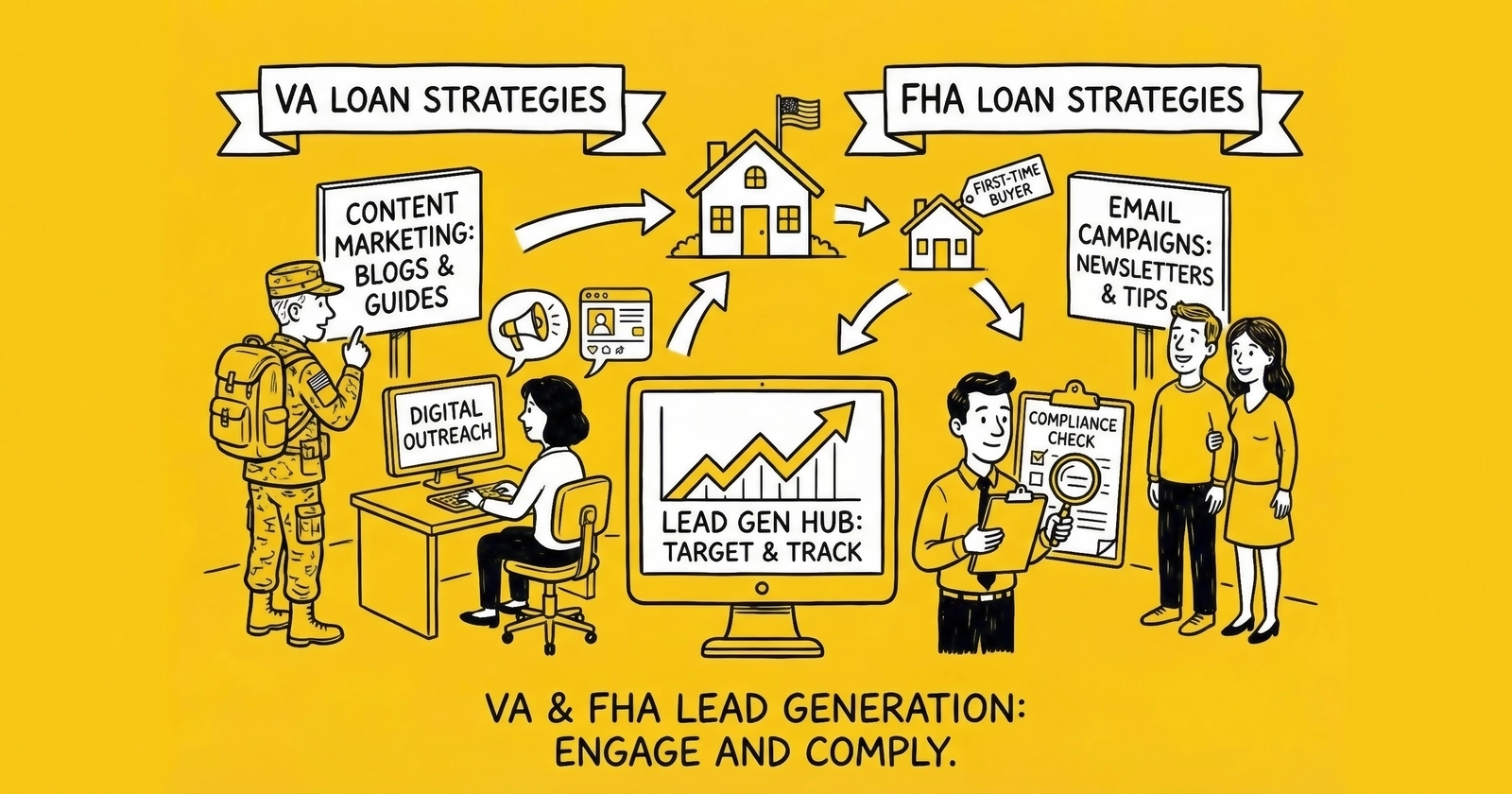
Government-backed loan programs serve buyers that conventional lenders often can’t reach. Here’s how to generate, qualify, and convert VA and FHA mortgage leads in a market where these programs represent 30% of all purchase originations.
The Government-Backed Opportunity Most Lead Generators Overlook
The mortgage lead generation market has fragmented into distinct segments, and VA and FHA loans represent one of the most underserved opportunities in the industry. While most lead generators chase conventional conforming loans, government-backed programs account for approximately 30% of all purchase mortgage originations. For practitioners who understand how to target, qualify, and route these leads, the economics often outperform conventional product lines.
The numbers tell a compelling story. FHA loans represented 17.2% of single-family forward mortgage originations in fiscal year 2024, with 1.18 million endorsements totaling $302 billion in volume. VA loans captured approximately 12% of the purchase market in 2024, representing $270 billion in guaranteed loans across roughly 300,000 purchase transactions. Combined, these programs serve over 1.5 million homebuyers annually who either lack the down payment for conventional loans or carry debt-to-income ratios that conventional underwriting would decline.
For lead generators, this creates a strategic question: should you compete in the crowded conventional lead market, or specialize in government-backed programs where fewer operators understand the targeting requirements, qualification criteria, and compliance nuances? This guide walks through the economics, targeting strategies, and operational requirements for VA and FHA mortgage lead generation. You’ll understand why these programs attract different buyer profiles, how to qualify leads before selling, and what compliance considerations differ from conventional mortgage marketing.
Understanding VA Loan Economics and Buyer Demographics
VA loans exist for a specific population: active-duty military, veterans, and surviving spouses. This creates targeting precision unavailable in any other mortgage segment. Unlike FHA loans, which serve anyone meeting credit and down payment requirements, VA eligibility depends on documented military service. For lead generators, this precision is both constraint and opportunity.
The VA Loan Value Proposition
VA loans offer benefits that conventional products cannot match, making them genuinely attractive to eligible borrowers rather than a last-resort option.
The most powerful benefit is the absence of any down payment requirement. VA loans allow 100% financing on purchase transactions, eliminating the barrier that stops most first-time buyers. The median down payment for conventional loans runs 10-20%, but VA-eligible borrowers can enter homeownership with $0 down if the appraised value supports the purchase price. This alone opens doors that remain firmly closed for most Americans.
VA borrowers also avoid private mortgage insurance entirely. Conventional borrowers putting less than 20% down pay PMI ranging from 0.3% to 1.5% of the loan amount annually. On a $350,000 loan, that translates to $1,050 to $5,250 per year in added costs. VA borrowers sidestep this through the VA funding fee structure, which is typically financed into the loan rather than paid monthly. The long-term savings are substantial.
Interest rates on VA loans historically run 0.25% to 0.5% lower than conventional loans for equivalent credit profiles. That quarter-point advantage might seem modest, but on a $350,000 loan, it translates to approximately $50 per month or $18,000 over a 30-year term. When you combine no down payment, no PMI, and lower rates, the total financial advantage becomes impossible for conventional products to match.
Credit requirements demonstrate similar flexibility. While VA doesn’t set minimum credit scores, most VA lenders require 620 or higher. This remains more forgiving than conventional conforming loans, where 680+ is increasingly the practical minimum for competitive rates. VA’s residual income requirements also allow higher debt-to-income ratios than conventional underwriting typically permits. And for borrowers thinking long-term, VA loans are assumable by qualifying buyers, including non-veterans. In a rising rate environment, a 2021 vintage VA loan at 2.75% becomes an extraordinarily valuable asset.
Who Qualifies for VA Loans
Understanding who qualifies determines your entire targeting strategy. Active-duty military represents approximately 1.3 million potential borrowers currently serving across all branches. These borrowers face unique housing challenges that civilian populations don’t experience – frequent relocations, remote duty stations, deployment-related income interruptions. Your marketing should reflect those realities rather than treating military borrowers like any other segment.
Veterans comprise approximately 17 million Americans who served and separated honorably. But VA loan eligibility requires specific service thresholds: 90 consecutive days during wartime, 181 days during peacetime, or 6 years in the National Guard or Reserves. Not all veterans meet these thresholds, so lead qualification must verify eligibility rather than assuming it. Surviving spouses of service members who died in service or from service-connected disabilities may also qualify for VA loan benefits. This smaller but significant population often doesn’t realize their eligibility and responds well to educational marketing.
Geographic concentration creates targeting opportunities. Military bases cluster in specific regions, creating hotspots for VA-eligible populations. San Diego, Virginia Beach, Colorado Springs, San Antonio, Jacksonville, and Hawaii all have disproportionately high veteran and active-duty populations. Rural areas with VA facilities also show elevated concentrations. Within 50 miles of major bases, veteran populations may run 3-5x higher than national averages.
VA Lead Pricing Dynamics
VA loan leads command pricing that reflects their qualification complexity and lender demand patterns.
| Lead Type | CPL Range | Notes |
|---|---|---|
| Exclusive VA Purchase | $60-$180 | Higher in competitive base-adjacent markets |
| Shared VA Purchase | $25-$70 | Less common than exclusive due to compliance |
| VA Refinance (IRRRL) | $40-$120 | Interest Rate Reduction Refinance Loan leads |
| VA Cash-Out Refinance | $50-$150 | Strong demand when rates decline |
Geographic variation significantly affects these ranges. Leads near major military installations – Fort Liberty (formerly Bragg), Joint Base Lewis-McChord, Camp Pendleton – command premiums because lender competition is intense and borrower concentrations are high. Rural areas with scattered veteran populations often carry lower CPLs despite lower competition because conversion logistics are more challenging.
FHA Loan Economics and Targeting Strategies
FHA loans serve a fundamentally different population than VA. Where VA eligibility depends on military service, FHA eligibility depends on financial qualification – primarily credit score, down payment capacity, and debt-to-income ratios. FHA functions as the gateway for first-time homebuyers and credit-challenged borrowers who can’t qualify for conventional financing.
The FHA Value Proposition
FHA loans fill the gap between renting and conventional homeownership. The low down payment requirement is the headline feature: FHA allows down payments as low as 3.5% for borrowers with credit scores of 580 or higher. For a $300,000 home, that’s $10,500 versus the $60,000 required for a 20% conventional down payment. Borrowers with credit scores between 500-579 can still qualify with 10% down, though fewer lenders work at that tier.
The credit score thresholds open homeownership to borrowers whom conventional lenders decline. FHA’s minimum of 500 (with 10% down) or 580 (with 3.5% down) creates opportunities that don’t exist elsewhere. The majority of FHA borrowers have credit scores between 640-699 – a range where conventional lending options exist but with less favorable terms.
Debt-to-income tolerance is another critical advantage. FHA allows back-end DTI ratios up to 50% or higher in some cases with compensating factors, compared to conventional limits typically around 43-45%. Borrowers carrying student loans, car payments, or other debt that pushes their DTI above conventional thresholds find FHA provides a path forward when other doors close.
The mortgage insurance premium structure requires explanation since it differs from conventional PMI. FHA requires both upfront mortgage insurance premium (UFMIP) of 1.75% financed into the loan and annual mortgage insurance premium (MIP) of 0.55-1.05% depending on loan term and LTV. Unlike conventional PMI that cancels at 80% LTV, FHA MIP typically lasts the life of the loan for borrowers putting less than 10% down. This represents a significant long-term cost but is often the only path to homeownership for qualifying borrowers. Additionally, FHA accepts non-traditional income documentation more readily than conventional programs, benefiting self-employed borrowers, gig workers, and those with non-W2 income streams.
Who Uses FHA Loans
FHA borrower profiles differ substantially from VA and require different targeting approaches. First-time homebuyers represent the core FHA demographic – in fiscal year 2024, first-time buyers comprised 84% of FHA purchase loan endorsements. These borrowers often have limited savings, shorter credit histories, and less housing market experience. Educational marketing performs well with this audience because they’re actively researching the homebuying process and seeking guidance.
Credit repair candidates represent significant untapped opportunity. Borrowers with derogatory credit events – bankruptcies, foreclosures, collections – often assume homeownership is impossible. FHA’s waiting periods after credit events (2 years after bankruptcy, 3 years after foreclosure with exceptions) mean many borrowers become eligible before they realize it. Marketing that addresses credit recovery resonates strongly with people who’ve written off homeownership entirely.
Lower-to-moderate income households align with FHA’s mission and population. FHA’s income limits vary by county, and most FHA borrowers fall below median income levels for their areas. This affects geographic targeting – FHA volume concentrates in areas with affordable housing inventory, not in premium markets where entry-level homes exceed FHA loan limits. Minority and underserved communities show higher FHA utilization rates than majority-white areas, reflecting both economic factors and historical lending patterns. Fair lending considerations apply to targeting strategies, but FHA’s role in expanding homeownership access is explicitly intended to serve these populations.
FHA Lead Pricing Dynamics
FHA leads generally price below VA due to the larger eligible population and more competitive lead generation landscape.
| Lead Type | CPL Range | Notes |
|---|---|---|
| Exclusive FHA Purchase | $45-$150 | Metro-dependent; highest in limited inventory markets |
| Shared FHA Purchase | $20-$55 | Common distribution model for FHA |
| FHA Refinance | $35-$100 | Streamline refinance when rates decline |
| FHA 203(k) Renovation | $60-$180 | Specialized product, fewer buyers |
Geographic and property type factors significantly affect FHA lead economics. FHA loan limits vary by county – $498,257 in most areas for 2024, up to $1,149,825 in high-cost markets. Leads for properties exceeding county loan limits hold no value for FHA lenders. Your form designs should capture expected purchase price or loan amount to enable intelligent routing.
Qualification Strategies: Separating Eligible from Ineligible
The economics of government-backed loan leads depend on accurate pre-qualification. A $75 lead that isn’t VA-eligible or can’t meet FHA thresholds is worthless. Sophisticated lead generators build qualification into the capture process, filtering out ineligible consumers before incurring acquisition costs.
Verifying VA Eligibility
VA loan eligibility isn’t self-evident. Unlike FHA, where anyone meeting credit and down payment requirements qualifies, VA requires documented military service meeting specific thresholds. The essential question set covers military status (active duty, veteran, or surviving spouse), followed by deeper qualification for veterans: approximate years of service, whether they received an honorable discharge, and whether they’ve previously used their VA loan benefit. Prior use doesn’t disqualify borrowers, but it affects remaining entitlement.
These questions don’t provide definitive eligibility determination – only a Certificate of Eligibility (COE) from VA confirms status. But they filter out consumers who clearly don’t qualify, improving lead quality for buyers. Entitlement considerations add complexity for repeat VA borrowers. VA loan entitlement has limits, and borrowers who’ve used entitlement previously may have reduced capacity. A veteran with an existing VA loan using $100,000 of entitlement has remaining entitlement for a smaller second VA loan. Questions about current homeownership and existing VA loans help buyers assess entitlement situations before they commit to a purchase.
Qualifying FHA Leads
FHA qualification depends on financial metrics rather than demographic status. Effective lead qualification captures data points that predict approval likelihood. Credit score ranges represent the most important FHA qualification factor. While FHA theoretically accepts scores as low as 500, most FHA lenders maintain minimums of 580-620 for their overlay requirements. Lead forms should capture stated credit ranges (Excellent 750+, Good 700-749, Fair 650-699, Below Average 580-649, Needs Work Below 580) rather than exact scores. Buyers can then price leads based on credit tier, with premium pricing for higher scores and reduced pricing or rejection for sub-580 leads where lender options are extremely limited.
Down payment capacity directly affects FHA qualification. Borrowers unable to produce 3.5% of purchase price plus closing costs face barriers even with strong credit. Questions about savings, gift funds from family, and down payment assistance program interest help qualify leads. Debt-to-income indicators also predict approval probability. While lead forms can’t calculate precise DTI, questions about income range, major monthly debts (car payments, student loans, credit cards), and current rent payments provide useful signals. A consumer earning $4,000 monthly with $2,500 in existing debt payments has limited capacity for mortgage payment regardless of credit score.
Property type and condition matter more for FHA than conventional. FHA requires properties to meet Minimum Property Standards (MPS), and certain property types – manufactured homes, condos in non-approved projects, investment properties – face additional restrictions or complete ineligibility. Capture intended property use (primary residence, investment, second home) and property type to route appropriately.
Intelligent Routing for Government Loans
Smart distribution requires matching lead characteristics to buyer capabilities. VA-focused lenders exist as specialists who understand VA appraisal requirements, entitlement calculations, and military borrower needs. These lenders pay premiums for qualified VA leads but may decline or return leads from non-veterans. Your routing systems must segregate VA leads to appropriate buyers.
FHA-focused lenders often accept lower credit scores than conventional-focused shops. Some lenders maintain aggressive overlays requiring 640+ minimum scores; others work the full FHA-eligible range down to 580 or below. Credit score data enables intelligent matching that improves conversion for all parties. Geographic licensing matters as much for government loans as conventional – a VA lender licensed only in Texas cannot close a California VA borrower. NMLS verification and state-based routing remain essential. And product specialization affects routing for FHA variants: FHA 203(k) renovation loans require specialized buyers who understand construction lending, while standard FHA buyers often can’t process these. VA construction loans, VA jumbo loans, and other specialized products similarly require buyer matching.
Marketing to Military and First-Time Buyer Audiences
Effective marketing for VA and FHA leads requires messaging that resonates with distinct buyer psychologies. Military audiences respond to different appeals than credit-challenged first-time buyers. Generic “low rates” messaging performs poorly for both.
Reaching Military Audiences
Marketing to military audiences requires authenticity and respect for service. Military consumers are sophisticated – many have seen predatory lenders target bases – and respond poorly to perceived exploitation of their status. The most effective approach leads with the benefit while acknowledging earned status: “You served. Here’s what you’ve earned” performs better than generic “VA loans for veterans.” Frame VA loan benefits as earned entitlements, not charity or special treatment.
Acknowledge military-specific challenges in your messaging. Frequent relocations, deployment considerations, and dual-military household complexity resonate with military audiences. Marketing that demonstrates understanding of military life builds trust that generic content never achieves. Leverage military community connections through testimonials from other military borrowers, partnerships with military-focused organizations, and content addressing military-specific housing situations.
Timing matters significantly for military lead generation. Permanent Change of Station (PCS) orders peak in summer months, creating concentrated demand from military families relocating. Optimize your marketing spend toward spring and summer when PCS orders execute. Geographic targeting around military installations reaches high concentrations of VA-eligible consumers – within 50 miles of major bases, you’re working a fundamentally different market than the national average.
Content marketing opportunities abound for military audiences. Topics that generate engagement include VA loan limits and entitlement calculations, using VA loans for multi-family properties (up to 4 units), VA loan assumption processes, surviving spouse eligibility, and restoring VA entitlement after property sale. This educational content positions you as a resource rather than just another lender competing for attention.
Reaching First-Time Buyers
First-time homebuyer marketing emphasizes education, affordability, and accessibility. These consumers often feel overwhelmed by the homebuying process and respond to guidance that simplifies complexity. Address the down payment barrier directly – “Buy a home with 3.5% down” is more compelling than feature lists. First-time buyers’ primary obstacle is accumulating down payment; messaging that directly addresses this resonates immediately.
Normalize imperfect credit in your marketing. Many potential FHA borrowers exclude themselves because they believe their credit disqualifies them. Messaging like “Credit challenges don’t have to stop you” invites engagement from consumers who might otherwise never inquire. They’ve already decided they can’t qualify; your job is to show them the path forward.
Rent-versus-buy comparisons drive strong engagement with first-time buyers. Many pay rent comparable to mortgage payments but haven’t considered homeownership achievable. Calculator-based content comparing monthly rent to potential mortgage payments makes the opportunity tangible. Down payment assistance awareness expands your reach further – many states and localities offer DPA programs that stack with FHA financing. Marketing that mentions DPA availability attracts consumers for whom 3.5% down remains challenging.
Education-focused content attracts consumers early in their journey. First-time buyer guides, homebuying checklists, and credit improvement tips capture prospects researching options. While they may not convert immediately, they represent future lead opportunities as they progress toward purchase readiness. For markets with diverse populations, Spanish-language and multilingual marketing reaches underserved segments with strong FHA utilization rates.
Traffic Acquisition Channels for Government Loan Leads
Channel selection for VA and FHA leads should reflect audience behaviors and targeting precision requirements. Each channel offers distinct advantages for reaching government loan prospects.
Paid Search Strategies
Google Ads remains the primary paid channel for mortgage leads, with specific considerations for government program targeting. For VA loans, high-intent keywords signal active consideration rather than early research: “va loan requirements,” “va home loan eligibility,” “va loan calculator,” “va loan lenders near me,” and “how to get va loan certificate.” CPCs for VA-specific terms typically run $15-40 depending on geography and competition. Lower-funnel keywords like “va loan application” and “va home loan pre-approval” signal imminent action and warrant aggressive bidding despite higher CPCs.
For FHA loans, the keyword structure follows similar patterns. High-intent terms include “fha loan requirements,” “fha loan calculator,” “fha lenders near me,” “fha loan with 580 credit score,” and “3.5 down payment home loan.” The “580 credit score” and “3.5 down payment” variants attract particularly valuable traffic – these consumers have already self-qualified based on their credit tier or down payment capacity and are seeking FHA specifically.
Negative keywords prevent waste on irrelevant traffic. Exclude “fha loan payment” (existing borrowers, not prospects), “va loan assumption” (buyers, not eligible borrowers), “va loan rates today” (rate shoppers who may already be in process), and geographic areas where you lack buyer coverage.
Social Media Targeting
Facebook and Instagram provide demographic and interest-based targeting suited to government loan audiences. For VA loans, target interests like United States Armed Forces, Military Times, and veteran organizations. Life events such as recently returning from deployment or changing jobs (which correlates with military transition) indicate potential housing needs. Behavior-based military veteran affinity audiences and custom audiences built from veteran organization partnerships round out your targeting options. Lookalike audiences based on converted VA leads can expand reach efficiently.
For FHA loans, interest targeting around first-time homebuyer topics, home buying tips, and rental listings (potential renters seeking ownership) reaches the core demographic. Life events including recently engaged, recently married, or expecting a child trigger housing needs. Age targeting focused on 25-40 captures peak first-time buyer demographics, and income targeting aligned with FHA loan limits refines audience quality.
Video content explaining VA and FHA benefits outperforms static images for educational campaigns. Carousel formats work well for step-by-step process explanations. Lead form ads reduce friction but may produce lower-quality leads than landing page conversions – test both approaches for your specific market.
Content Marketing and SEO
Long-form content captures consumers researching government loan options before they’re ready to apply. These leads require nurturing but often convert at higher rates than paid traffic. VA content opportunities include complete guides to VA loan eligibility requirements, VA loan entitlement calculation explanations, VA appraisal requirements and minimum property standards, state-specific VA loan guides (combining VA benefits with state bonuses), VA loan myth debunking, and VA loan versus conventional comparisons for eligible borrowers.
FHA content opportunities are equally rich: FHA loan requirements by credit score tier, FHA down payment assistance program directories (by state), FHA 203(k) renovation loan guides, FHA loan limits by county (updated annually), credit repair guides for FHA qualification, and comprehensive first-time homebuyer guides. Local SEO matters significantly for mortgage leads. “FHA lenders in [city]” and “VA loan lenders near [base]” searches have high commercial intent. Local landing pages with geographic specificity improve both organic visibility and conversion rates.
Partnership and Referral Channels
Strategic partnerships reach VA and FHA-eligible populations through trusted intermediaries. For VA leads, explore partnerships with veteran service organizations (VFW, American Legion, DAV), military spouse employment organizations, base transition assistance programs (TAP), military-focused financial education providers, and real estate agents specializing in military relocation. For FHA leads, partner with HUD-approved housing counseling agencies, down payment assistance program administrators, first-time homebuyer education providers, credit counseling organizations, and employer housing assistance programs.
Partnership arrangements must comply with RESPA requirements. Referral fees for leads from settlement service providers (including real estate agents) face scrutiny. Structure partnerships around marketing services with compensation reflecting fair market value, not referral volume.
Compliance Considerations for Government Loan Marketing
Government-backed loan marketing operates under the same general compliance frameworks as conventional mortgage leads – RESPA, TCPA, TILA, state licensing – plus additional considerations specific to these programs.
VA-Specific Compliance Issues
Federal law prohibits falsely claiming VA affiliation or endorsement. Marketing must not suggest VA has reviewed, approved, or endorsed your services. Phrases like “VA-approved lender” require accuracy – only lenders meeting VA’s automatic lender standards can use this designation. Language like “Official VA loan” or “VA loan center” may imply government affiliation where none exists.
TILA’s Regulation Z triggering terms apply to VA loans just as they do to conventional. Mentioning specific rates, payment amounts, or loan terms triggers disclosure requirements. Generic “low rates” or “no down payment” language is safer than specific numbers. Some lead generators offer to obtain COE on behalf of veterans. If you’re actually obtaining COE through VA systems, ensure you’re authorized to do so and that veterans understand you’re not VA itself. Misleading COE-related claims have drawn regulatory attention.
FHA-Specific Compliance Issues
Marketing claims about FHA requirements must be accurate. FHA guidelines change annually, and outdated claims (wrong loan limits, incorrect MIP rates, outdated credit requirements) create compliance exposure. Maintain current awareness of FHA program parameters. Credit score claims require particular care – stating “FHA loans available with 500 credit score” is technically accurate per FHA guidelines but potentially misleading since few lenders originate at that level. More accurate messaging: “FHA allows credit scores as low as 580 with 3.5% down” reflects typical lender overlays.
If your marketing references down payment assistance, ensure you understand and accurately represent program requirements. DPA programs have income limits, geographic restrictions, and other requirements. Overpromising DPA availability creates consumer confusion and potential deceptive practice claims.
General Mortgage Compliance for Government Loans
RESPA Section 8 applies to VA and FHA leads exactly as it does to conventional. Referral fee prohibitions, marketing services agreement requirements, and affiliated business arrangement disclosures don’t change based on loan product. NMLS licensing verification remains essential – VA and FHA loans must be originated by properly licensed MLOs. Verify buyer licensing before establishing lead relationships.
Fair lending considerations require particular attention for FHA marketing. FHA explicitly serves underserved populations, and targeting strategies must avoid patterns that could be characterized as steering, redlining, or discriminatory treatment. One-to-one consent under TCPA applies to government loan leads. Though the FCC’s one-to-one consent rule was vacated in January 2025, many sophisticated buyers still require lead-by-lead consent for each specific party contacting the consumer. Consent capture should name specific lenders, not categories of buyers.
Lead Nurturing for Longer Government Loan Cycles
VA and FHA leads often have longer consideration cycles than conventional mortgage leads. First-time FHA buyers may research for months before feeling ready to apply. Military families may explore options during PCS planning 6-12 months before actual relocation. Your nurture strategy must accommodate these extended timelines.
Email Nurturing Sequences
Structured email sequences maintain engagement through extended consideration periods. A typical VA loan sequence might begin with a welcome email covering VA loan benefits summary on Day 0, followed by eligibility requirements and status confirmation on Day 3, entitlement and loan limit explanations on Day 7, VA appraisal process overview on Day 14, VA loan versus conventional comparison on Day 21, next steps call-to-action on Day 30, conditional PCS planning guide on Day 45, and market/rate environment summary on Day 60.
An FHA sequence follows similar logic but addresses different concerns: welcome with FHA benefits for first-time buyers on Day 0, credit score guide on Day 3, down payment options including assistance programs on Day 7, FHA homebuying timeline on Day 14, common FHA myths debunked on Day 21, pre-approval checklist with required documents on Day 30, conditional credit repair tips on Day 45 if initial data indicated credit challenges, and market/inventory update on Day 60.
Multi-Channel Follow-Up
Email alone won’t convert all leads. Text messaging achieves higher open rates than email and suits mobile-first audiences. Brief, value-focused texts work best: “Hi [Name], rates dropped this week. Worth checking if it changes your numbers? Reply YES for a quick update.” Phone follow-up remains essential despite lower connection rates. For FHA first-time buyers especially, phone conversations address questions and concerns that digital channels can’t resolve. Speed-to-call matters less for longer-cycle leads than for conventional mortgage, but regular follow-up attempts over weeks increase eventual connection.
Direct mail works surprisingly well for government loan audiences. Physical mail stands out when email inboxes overflow. For VA leads, mailers acknowledging military service and explaining earned benefits resonate. For FHA leads, comparison mailers showing rent vs. mortgage payments attract attention.
Lead Scoring for Government Loans
Not all leads warrant equal nurture investment. High-priority VA lead indicators include active duty or recently separated status (housing need likely immediate), first-time VA benefit use (full entitlement available), geographic match to strong buyer coverage, property timeline under 90 days, and no current homeownership (purchase rather than refinance intent).
High-priority FHA lead indicators include credit score 640+ (broader lender options), confirmed down payment capacity (3.5%+ available), current renter with rent payment comparable to mortgage capacity, confirmed first-time buyer status, and property timeline under 120 days. Scoring enables focus on leads most likely to convert while maintaining light-touch nurturing for longer-term prospects.
Building a Government Loan Buyer Network
VA and FHA leads require buyers with specific capabilities. Not every mortgage lender wants these products or can execute them efficiently.
Identifying Quality Buyers
When evaluating VA lender capabilities, verify VA automatic lender approval status (faster processing than non-automatic), experience with VA appraisal requirements and tidewater procedures, capacity to handle VA entitlement calculations, understanding of military income (BAH, BAS, variable pay), and willingness to work with active-duty borrowers facing deployment.
For FHA lender capabilities, verify credit overlay requirements (some lenders require 640+; others work to 580), down payment assistance program experience, FHA 203(k) capability if you’re routing renovation leads, condo approval process familiarity, and manual underwriting capability for complex files.
Negotiating Pricing
Government loan lead pricing reflects qualification complexity and conversion economics. VA leads typically command premiums over conventional in areas with high military concentration because qualified VA leads are harder to generate than general mortgage leads. Buyers understand the targeting precision required.
FHA leads may price at or below conventional depending on credit tier. High-credit FHA leads (680+) price similarly to conventional; sub-640 FHA leads command discounts because conversion rates are lower and processing complexity is higher. Pricing structure options include flat per-lead pricing with credit tier adjustments (most common), exclusive pricing premiums of 50-100% over shared distribution, geographic zone pricing reflecting competition and conversion patterns, and product-specific pricing (standard FHA vs. 203(k) vs. streamline refinance).
Managing Return Rates
Government loan leads may have different return patterns than conventional. Common VA lead return reasons include borrower not actually VA-eligible (verification failed), entitlement insufficient for purchase price, property doesn’t meet VA minimum property standards, and geographic licensing mismatch. Common FHA lead return reasons include credit score below lender overlay minimums, DTI exceeds FHA maximums with current debts, property type ineligible (condo in non-approved project, manufactured home issues), and purchase price exceeds county loan limits.
Tracking return reasons by source helps identify qualification gaps that improved form design can address.
Frequently Asked Questions
What is the difference between VA loan leads and FHA loan leads?
VA loan leads target a specific demographic: active-duty military, veterans, and surviving spouses of service members. Eligibility depends on documented military service meeting defined thresholds. FHA loan leads target a financial profile: borrowers who meet credit score and down payment requirements but may not qualify for conventional financing. VA eligibility is binary (you qualify through service or you don’t), while FHA eligibility exists on a spectrum of credit tiers. Lead generation strategies differ accordingly – VA requires military-focused targeting and eligibility verification, while FHA requires financial qualification indicators like credit range and down payment capacity.
How much do VA and FHA loan leads typically cost?
Exclusive VA purchase leads typically range from $60-$180 depending on geography and buyer demand, with markets near major military installations commanding premiums. VA refinance leads (IRRRL or cash-out) run $40-$150. Exclusive FHA purchase leads typically cost $45-$150, with credit tier affecting pricing – higher credit leads (680+) command more than sub-640 leads. FHA refinance leads run $35-$100. Shared lead pricing typically runs 40-60% of exclusive rates. Geographic variation is significant; high-cost metro areas and areas with limited lender competition command different prices than saturated markets.
What qualification questions should I ask to improve VA lead quality?
Essential VA qualification questions include military status (active duty, veteran, or surviving spouse), approximate years of service (to assess eligibility threshold compliance), discharge status (honorable discharge typically required), current homeownership and existing VA loan status (affects entitlement), expected purchase price and location, and timeline for purchase. These questions don’t provide definitive eligibility – only a Certificate of Eligibility confirms status – but they filter clearly ineligible consumers and help buyers assess entitlement situations before purchase.
What credit score do FHA borrowers typically need?
FHA’s official minimum credit score is 500 with 10% down or 580 with 3.5% down. However, lender overlays significantly affect practical minimums. Most FHA lenders require 580-620 minimum credit scores, with some requiring 640+ for their programs. In practice, the sweet spot for FHA lead generation is 580-699 – below this range, lender options become extremely limited; above this range, borrowers may qualify for conventional loans with better long-term economics. Lead forms should capture credit ranges to enable intelligent routing to appropriate buyers.
How do RESPA requirements apply to VA and FHA lead generation?
RESPA applies identically to VA and FHA leads as to conventional mortgage leads. Section 8 prohibits referral fees in connection with settlement service business – lead generators must structure pricing around marketing services value, not referral success. Affiliated business arrangement disclosures apply if you have ownership relationships with lenders or other settlement service providers. The distinction that matters is substance over form: if your pricing structure effectively compensates for referrals rather than marketing services, RESPA risk exists regardless of how contracts characterize the arrangement. Document marketing services actually performed and ensure pricing reflects reasonable market value.
What are the best traffic channels for VA loan lead generation?
Paid search captures high-intent VA borrowers actively researching eligibility and options. Target keywords like “va loan requirements,” “va loan eligibility,” and “va home loan near [base location].” Social media enables precise military audience targeting through interest categories (military organizations, veteran groups) and affinity audiences. Content marketing attracts earlier-stage prospects researching VA benefits – comprehensive guides on entitlement, VA appraisal requirements, and military relocation housing perform well. Partnership channels through veteran service organizations, base transition programs, and military spouse networks reach qualified audiences through trusted intermediaries. Optimize spending around PCS season (spring through summer) when military relocation demand peaks.
How do I verify that my buyers are properly licensed for government loan leads?
NMLS Consumer Access (nmlsconsumeraccess.org) provides public verification of mortgage company and individual MLO licenses. Before selling any leads, verify that the company holds licenses in states where leads originate, that individual loan officers contacting consumers hold valid licenses in appropriate states, and that licenses are current (not expired or revoked). Government loan leads don’t require different licensing than conventional – the same NMLS framework applies. Periodic re-verification catches license lapses that could expose you to liability for facilitating unlicensed origination.
What compliance issues are specific to VA loan marketing?
Federal law prohibits falsely claiming VA affiliation or endorsement. Marketing must not suggest VA has reviewed, approved, or endorsed your services. Only lenders meeting VA automatic lender standards can claim “VA-approved lender” status. Phrases like “Official VA loan center” or implying government connection require accuracy or should be avoided. Claims about COE (Certificate of Eligibility) services must be accurate about what you’re actually providing and who you represent. TILA triggering terms apply – mentioning specific rates or payment amounts requires additional disclosures. Beyond these VA-specific issues, standard TCPA, RESPA, and fair lending requirements apply.
How long should I nurture VA and FHA leads before considering them dead?
Government loan leads often have longer consideration cycles than conventional. First-time FHA buyers may research for 3-6 months before feeling ready to apply. Military families may explore options 6-12 months before PCS relocations. Nurture sequences should extend accordingly: 90-day active nurturing with weekly touchpoints, transitioning to monthly maintenance contact for 6-12 months. Behavioral signals (email opens, website visits, calculator usage) indicate continued interest even without direct engagement. Credit-impaired FHA prospects may need 12-24 months of credit repair before qualifying – light-touch nurturing maintains relationship while they improve their profile. The key is matching nurture intensity to engagement signals rather than applying uniform timelines.
What return rates should I expect for VA and FHA leads compared to conventional?
VA leads may have slightly higher return rates than conventional due to eligibility verification failures. Consumers who believe they’re VA-eligible sometimes aren’t – service threshold requirements, discharge status, or entitlement limitations cause post-sale eligibility failures. Expect 8-15% return rates for VA leads depending on qualification rigor. FHA leads return at rates comparable to conventional (8-12%) when credit tier matches buyer overlays. Sub-620 FHA leads returned to lenders requiring 620+ create unnecessary friction. Matching lead credit characteristics to buyer overlay requirements at routing reduces returns significantly. Track return reasons by source to identify qualification improvements that reduce return rates.
Key Takeaways
VA and FHA loans represent 30% of purchase mortgage originations. This underserved market offers opportunity for lead generators willing to learn program-specific targeting, qualification, and compliance requirements.
VA leads require eligibility verification that FHA leads don’t. Military service status, discharge type, and service duration affect VA eligibility. Build verification into lead capture to filter ineligible consumers before acquisition costs accumulate.
FHA leads require financial qualification indicators. Credit score tier, down payment capacity, and debt-to-income signals predict approval probability. Capture these data points to enable intelligent buyer routing and appropriate pricing.
Geographic targeting for VA concentrates around military installations. Markets within 50 miles of major bases have veteran populations 3-5x higher than national averages. Adjust targeting and pricing to reflect these concentrations.
First-time buyers dominate FHA (84% of purchase volume). Marketing should emphasize education, affordability, and accessibility. Address down payment barriers and normalize imperfect credit to reach consumers who might otherwise never inquire.
Government loan leads often have longer consideration cycles. First-time FHA buyers may research for months; military families plan relocations well in advance. Nurture sequences should extend 90+ days with multi-channel follow-up.
VA-specific compliance requires avoiding false government affiliation claims. Only authorized lenders can claim “VA-approved” status. Marketing must not imply VA endorsement or official government connection.
RESPA applies identically to government and conventional loan leads. Referral fee prohibitions, marketing services agreement requirements, and affiliated business arrangement disclosures don’t change based on loan product.
Credit tier affects FHA lead pricing and routing. High-credit FHA leads (680+) command pricing near conventional; sub-620 leads require discount pricing reflecting limited lender options and lower conversion rates.
Build buyer networks with government loan specialization. Not every lender wants or can efficiently process VA and FHA loans. Identify buyers with appropriate overlays, program experience, and geographic licensing before generating volume.
Market data current as of December 2025. Government loan programs, eligibility requirements, and regulatory frameworks change periodically. Validate current program parameters through official sources (VA, HUD, FHA) before making significant investment decisions. This article provides general information and does not constitute legal, financial, or compliance advice. Consult qualified professionals for specific program and compliance questions.