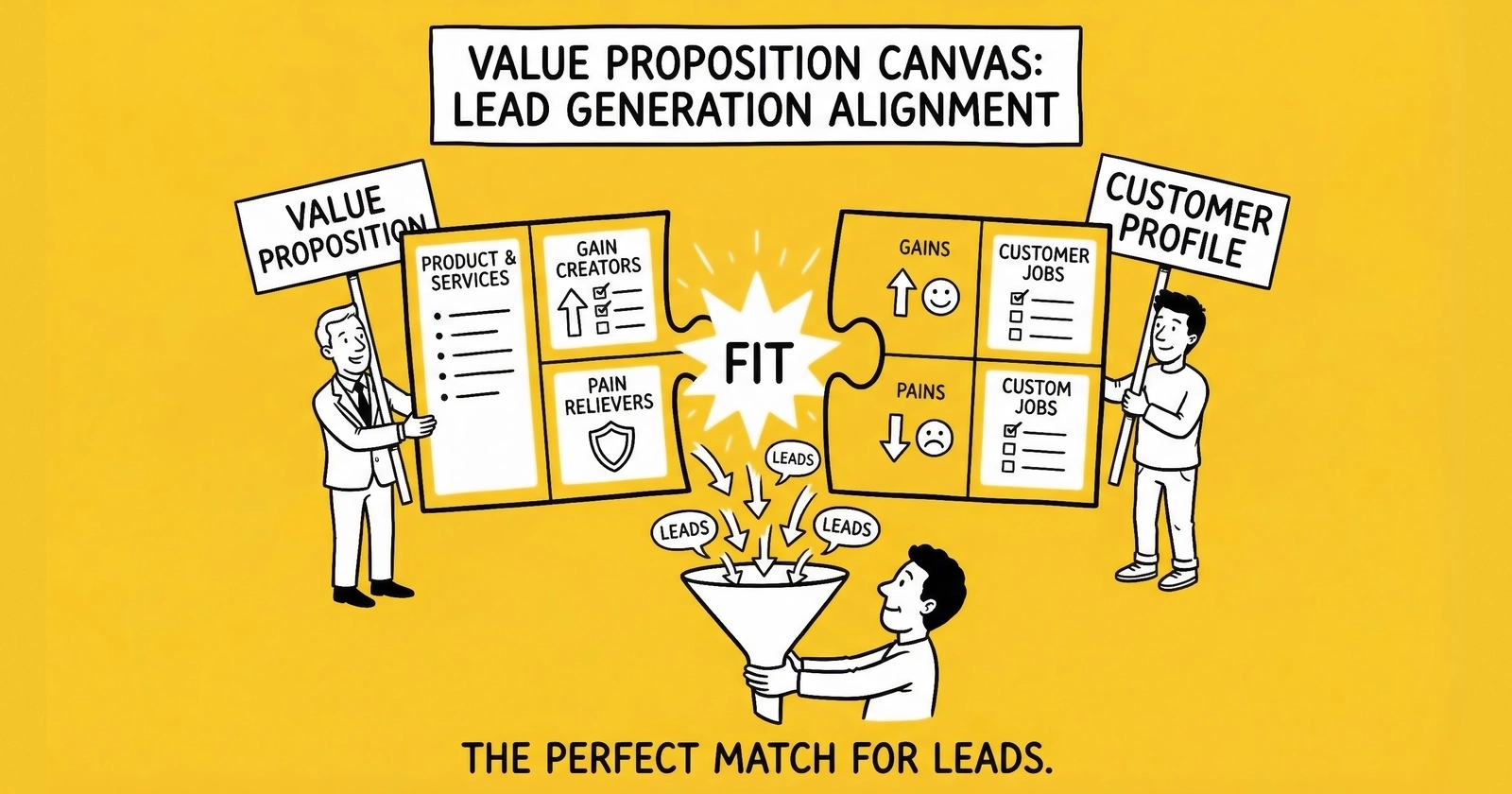
Apply the Strategyzer Value Proposition Canvas to lead generation operations – identify what lead buyers actually need and design offerings that achieve product-market fit.
The Value Proposition Canvas is a deceptively simple tool that solves a common business failure: building products people don’t want. Developed by Alex Osterwalder and his team at Strategyzer as an extension of the Business Model Canvas, the Value Proposition Canvas forces systematic analysis of whether what you’re selling actually matches what customers need.
For lead generation operators, this matters because the industry is full of commoditized offerings that compete on price alone. Most lead sellers offer essentially identical products: form submissions from consumers who expressed interest in a product category. When your offering looks like everyone else’s, price becomes the only differentiator – and price competition destroys margins.
The Value Proposition Canvas provides a structured approach to differentiation. By deeply understanding the jobs your lead buyers are trying to accomplish, the pains they experience, and the gains they desire, you can design offerings that competitors don’t match. The result isn’t just higher prices – it’s customers who choose you because you solve problems others don’t address.
The Value Proposition Canvas Explained
The canvas consists of two halves that must fit together:
The Customer Profile (Right Side)
The Customer Profile describes everything observable about your target customer, independent of your product. It contains three elements:
Customer Jobs: What is your customer trying to get done? Jobs come in three categories:
- Functional jobs: Practical tasks like “generate 50 qualified leads per week” or “fill my sales team’s pipeline”
- Emotional jobs: Internal feelings like “feel confident my marketing spend is working” or “reduce anxiety about lead quality”
- Social jobs: How customers want to be perceived, like “prove to my CEO that our lead gen is effective” or “be seen as a forward-thinking marketer”
Customer Pains: The negative experiences, risks, and obstacles customers face when trying to accomplish their jobs. Pains include frustrations, fears, and problems that prevent success.
Customer Gains: The outcomes and benefits customers desire. Gains go beyond the basic expectation of a job well done – they include moments of delight and unexpected value.
The Value Map (Left Side)
The Value Map describes what you offer and how it addresses the Customer Profile. It contains three elements:
Products and Services: What you actually sell – the core offerings that help customers complete their jobs.
Pain Relievers: How your products and services alleviate specific customer pains. Each pain reliever should map to documented customer pains.
Gain Creators: How your products and services create desired outcomes and deliver value beyond basic expectations.
Achieving Fit
Product-market fit occurs when the Value Map addresses the Customer Profile’s most important elements. The goal isn’t to address every job, pain, and gain – it’s to exceptionally address the ones that matter most.
As Osterwalder explains: “The goal of the Value Proposition Canvas is to assist you in designing great Value Propositions that match your Customer’s needs and jobs-to-be-done and helps them solve their problems.”
The Three-Party Canvas Challenge in Lead Generation
Lead generation isn’t a simple two-party transaction. Most lead operations involve at least three distinct customer types, each requiring separate Value Proposition Canvas analysis:
Canvas 1: The Consumer
Consumers fill out your forms. Their jobs, pains, and gains determine whether they complete submissions and whether those submissions become contactable leads.
Consumer Jobs (example: home insurance shopper):
- Functional: Find affordable home insurance before my policy renews
- Emotional: Feel confident I’m not overpaying for coverage
- Social: Be seen as a responsible homeowner protecting my family
Consumer Pains:
- Too many form fields slow me down
- I don’t know who will contact me or how many calls I’ll receive
- I’m worried about sharing personal information online
Consumer Gains:
- Get multiple quotes without calling each company separately
- Understand my options before talking to salespeople
- Complete the process quickly and on my own schedule
Canvas 2: The Lead Buyer
Lead buyers purchase your leads. Their jobs, pains, and gains determine whether they continue buying and at what price.
Lead Buyer Jobs (example from buyer persona research: insurance agency owner):
- Functional: Fill my agents’ pipelines with contactable prospects
- Emotional: Feel confident my lead investment will generate positive ROI
- Social: Demonstrate to my team and partners that I’m growing the business effectively
Lead Buyer Pains:
- Many leads don’t answer the phone
- I can’t verify leads are exclusive or fresh
- I don’t have time to manage multiple lead vendors
- Compliance requirements are increasingly complex
Lead Buyer Gains:
- Predictable lead flow that matches my sales capacity
- Documentation that protects me in compliance disputes
- Market intelligence about lead pricing and quality trends
- Dedicated support when quality issues arise
Canvas 3: The Publisher (if applicable)
If you aggregate leads from publishers rather than generating directly, publishers are also your customers. Their jobs, pains, and gains determine whether they send you their best traffic.
Publisher Jobs:
- Functional: Monetize my website traffic at the highest possible yield
- Emotional: Work with reliable partners who pay on time
- Social: Build a reputation as a legitimate, compliant traffic source
Publisher Pains:
- Lead aggregators reject leads without clear explanations
- Payment schedules are unpredictable
- Integration requirements are technically complex
Publisher Gains:
- Higher payouts than competing aggregators
- Real-time feedback on lead acceptance rates
- Simple, well-documented integration processes
Each canvas requires separate analysis. A lead seller who optimizes only for lead buyer satisfaction may create forms that frustrate consumers (reducing completion rates) or payment terms that alienate publishers (reducing traffic quality).
Building the Lead Buyer Customer Profile
Since lead buyers are the primary revenue source for most lead generation operations, their canvas deserves deep analysis.
Mapping Lead Buyer Jobs
Start with functional jobs close to your solution, then dig deeper to uncover emotional and social dimensions:
Surface-level functional job: Buy qualified leads for my sales team
Why? (revealing deeper jobs)
- To maintain predictable sales pipeline velocity (functional)
- To ensure my team has enough opportunities to hit quota (functional)
- To feel confident that my acquisition strategy is working (emotional)
- To demonstrate marketing effectiveness to my CEO (social)
- To justify my lead gen budget to finance (social)
- To reduce my dependence on referral-only growth (emotional)
Deeper functional jobs emerge:
- Evaluate lead quality before purchasing
- Verify lead freshness and exclusivity
- Document consent chain for compliance
- Analyze performance across sources to optimize spend
- Train new agents on effective lead handling
Each of these jobs represents an opportunity for differentiation. Most lead sellers address only the surface-level job (“here are leads”). The ones who also address deeper jobs (“here’s documentation proving consent,” “here’s analytics showing source-level performance”) create value that commands premium pricing.
Ranking Lead Buyer Jobs
Not all jobs matter equally. Rank them by importance to determine which your offering must address:
High Priority (must address):
- Get fresh, exclusive leads with verified contact information
- Maintain consistent lead flow matching sales team capacity
- Achieve positive ROI on lead investment
Medium Priority (should address): 4. Document consent chain for compliance protection 5. Analyze performance by source, geography, or segment 6. Resolve quality issues quickly when they arise
Lower Priority (nice to have): 7. Access market intelligence on pricing trends 8. Receive dedicated account management 9. Integrate leads automatically into CRM
The ranking reflects buyer reality: a seller who perfectly addresses priorities 1-3 will win business even without addressing 7-9. But a seller who excels at 7-9 while underdelivering on 1-3 will lose every competitive situation.
Documenting Lead Buyer Pains
Pains describe negative experiences. For lead buyers, common pains include:
-
High-intensity pains (daily frustrations):
- Leads don’t answer the phone
- Leads claim they never requested contact
- Lead quality varies dramatically week to week
- No recourse when leads are clearly bad
-
Medium-intensity pains (periodic problems):
- Difficult to compare performance across vendors
- Vendor reporting doesn’t match my CRM data
- Integration setup is technically complex
- Hard to get support when issues arise
-
Lower-intensity pains (annoyances):
- Dashboard UX is clunky
- Reporting doesn’t export to formats I need
- Contract terms are inflexible
Intensity matters because high-intensity pains justify premium pricing. A lead seller who can demonstrably improve answer rates addresses a high-intensity pain – buyers will pay significantly more for that solution than for better dashboard UX.
Identifying Lead Buyer Gains
Gains go beyond “getting the job done” to include unexpected value and moments of delight:
-
Expected gains (minimum requirements):
- Receive leads that match my target criteria
- Leads include accurate contact information
- Leads arrive when promised
-
Desired gains (competitive differentiators):
- Real-time visibility into lead source performance
- Compliance documentation included with every lead
- Flexibility to pause, increase, or decrease volume
- Dedicated account manager who understands my business
-
Unexpected gains (premium value creators):
- Market intelligence about industry lead pricing trends
- Benchmarking against similar buyers’ performance
- Training resources for optimizing lead handling
- Early access to new lead products or categories
Gains that competitors don’t offer become your differentiation opportunity. If every lead seller provides the expected gains but you also deliver desired gains, you’ve created a reason to choose your offering beyond price.
Building the Lead Seller Value Map
With the Customer Profile complete, design your Value Map to address the most important jobs, relieve the most intense pains, and create the most valued gains.
Products and Services
List your actual offerings, ranked by relevance to target buyer jobs:
-
Core products (address primary jobs):
- Exclusive leads in target verticals and geographies
- Real-time lead delivery via API or platform
- Lead replacement policy for verified bad leads
-
Supporting services (address secondary jobs): 4. Performance analytics dashboard 5. Compliance documentation package (consent certificates, recording links) 6. Dedicated account management
-
Peripheral offerings (address lower-priority jobs): 7. Market research reports on lead pricing trends 8. Lead handling optimization consulting 9. CRM integration support
The ranking determines resource allocation. If your core products don’t excellently address primary buyer jobs, improving peripheral offerings won’t save the business. Fix core products first.
Pain Relievers
Map each pain reliever to specific documented pains:
Pain: Leads don’t answer the phone Pain Reliever: Phone verification at point of capture, contact within 5 minutes guarantee, answer rate SLAs with refund policy
Pain: Leads claim they never requested contact Pain Reliever: TrustedForm certificates with every lead, consent language screenshots, timestamp documentation
Pain: Lead quality varies dramatically Pain Reliever: Source-level performance tracking, automatic source suspension when quality degrades, transparent quality scoring
Pain: No recourse when leads are clearly bad Pain Reliever: Simple dispute process with 48-hour resolution, automatic credits for documented bad leads
Critical principle: Only claim pain relievers you can actually deliver. If your phone verification catches 70% of bad numbers but not 100%, don’t promise to “solve the contact rate problem.” Overpromising creates bigger pains (broken trust) than the original issue.
Gain Creators
Map each gain creator to specific documented gains:
Gain: Real-time visibility into performance Gain Creator: Live dashboard with source-level metrics, conversion tracking integration, daily performance emails
Gain: Compliance documentation included Gain Creator: Consent certificates attached to every lead, monthly compliance audit reports, litigation support guarantee
Gain: Flexibility to adjust volume Gain Creator: Same-day pause capability, no minimum commitments, instant capacity increases when available
Gain: Dedicated account manager Gain Creator: Named contact with direct phone line, quarterly business reviews, proactive optimization recommendations
Checking for Fit
Once both sides are complete, assess fit by asking:
-
Do your products address the highest-priority buyer jobs? If the top 3 jobs are “fresh leads,” “consistent volume,” and “positive ROI,” does your offering directly address all three?
-
Do your pain relievers address the highest-intensity pains? If the biggest pain is “leads don’t answer,” do you have a credible solution?
-
Do your gain creators deliver valued outcomes? If buyers want compliance documentation, do you actually provide it?
If the answer to any question is “no” or “partially,” you’ve identified gaps that competitors may exploit. Either improve your offering or narrow your target to buyers whose profiles you can better address.
The Multi-Stakeholder Complexity
B2B lead transactions often involve multiple people with different roles and priorities. Each stakeholder has a distinct Customer Profile:
The Operations Manager
- Primary jobs: Maintain consistent pipeline, manage lead distribution, resolve quality issues
- Key pains: System downtime, difficult integrations, inconsistent delivery
- Key gains: Automation, reliable support, simple workflows
The operations manager evaluates your offering based on day-to-day usability. Your value proposition to this stakeholder emphasizes reliability, simplicity, and responsive support.
The Finance Decision Maker
- Primary jobs: Control costs, demonstrate ROI, justify budget
- Key pains: Unclear pricing, unexpected charges, inability to prove performance
- Key gains: Predictable costs, clear reporting, positive ROI documentation
The finance stakeholder evaluates your offering based on financial clarity. Your value proposition emphasizes transparent pricing, ROI calculators, and performance-to-spend reporting.
The Compliance Officer
- Primary jobs: Avoid legal exposure, maintain documentation, satisfy auditors
- Key pains: Incomplete consent records, vendor compliance uncertainty, regulatory changes
- Key gains: Comprehensive documentation, proactive compliance updates, litigation support
The compliance stakeholder evaluates your offering based on risk mitigation. Your value proposition emphasizes consent verification, documentation completeness, and regulatory expertise.
Multi-Stakeholder Canvas Strategy
Create separate canvases for each influential stakeholder, then design offerings that address enough of each profile to earn support. A lead seller might win operations management approval with reliable delivery but lose the deal if finance can’t see ROI documentation.
The practical implication: your sales materials, onboarding process, and ongoing communications should speak to different stakeholders differently. Technical documentation for operations, financial reports for finance, compliance packets for legal.
Common Value Proposition Canvas Mistakes
Strategyzer’s guidance on canvas usage identifies several common mistakes that apply directly to lead generation:
Mistake 1: Starting with the Value Map
The most common error is designing your offering first, then fitting a customer profile around it. This approach produces offerings that solve problems you’re capable of solving rather than problems customers actually have.
The fix: Always complete the Customer Profile before touching the Value Map. Document what buyers actually need through research – interviews, surveys, competitive analysis – before designing your solution.
Mistake 2: Listing Features Instead of Jobs
“Our platform has real-time API integration” describes a feature. But what job does it help accomplish? If the buyer’s job is “distribute leads to my agents instantly,” the feature is relevant. If the buyer’s job is “get better-quality leads,” API speed is irrelevant.
The fix: Frame everything in terms of customer jobs. Features matter only when they enable jobs customers are trying to do.
Mistake 3: Confusing Pains and Gains
“Leads don’t answer” is a pain. “Higher answer rates” isn’t a gain – it’s the absence of the pain. Gains should be positive outcomes beyond basic job completion: “market intelligence that helps me optimize spend” or “compliance documentation that protects me in disputes.”
The fix: Ask “what would delight this customer?” not just “what would remove their frustration?” Gains create differentiation; pain relief creates parity.
Mistake 4: Creating a Single Canvas for All Customers
Different customer segments have different jobs, pains, and gains. An insurance agency buying leads has different priorities than a mortgage broker buying leads, even if both purchase “exclusive leads.”
The fix: Create separate canvases for each distinct customer segment. Identify which segments your offering best serves, and focus resources accordingly.
Mistake 5: Setting and Forgetting
Customer needs evolve. The lead buyer canvas from 2022 likely underweights compliance concerns that became paramount in 2024-2025 as consent regulations tightened. An outdated canvas produces outdated offerings.
The fix: Update canvases at least annually, or whenever significant market changes occur. Regulatory shifts, competitive entrants, and technology changes all affect customer profiles.
Applying the Canvas to Lead Gen Pricing
The Value Proposition Canvas informs pricing strategy by identifying which value elements command premium pricing:
Commodity vs. Differentiated Offerings
If your Value Map only addresses expected gains and minimum requirements, you’re selling a commodity. Commodity lead sellers compete on price – whoever offers the same leads cheaper wins.
But if your Value Map addresses desired gains that competitors don’t match, you can charge premiums. The question becomes: how much is this additional value worth?
Example: Compliance documentation
If a lead buyer’s alternative is purchasing leads without consent verification, and they face potential TCPA exposure of $500-$1,500 per violation, comprehensive consent documentation is worth significant premium pricing. A 20% price premium that eliminates regulatory risk is economically rational for the buyer.
Example: Dedicated account management
If a lead buyer’s alternative is self-service support with 48-hour response times, and they frequently encounter quality issues that require immediate resolution, dedicated account management that provides same-day resolution has quantifiable value – measured in avoided lost revenue from delayed issue resolution.
Value-Based Pricing Calculation
For each gain creator and pain reliever, estimate the economic value to the buyer:
- What is the cost of the pain if unsolved? Lost revenue from low answer rates, legal fees from compliance disputes, employee time wasted on manual processes
- What is the value of the gain if achieved? Higher conversion rates, faster sales cycles, reduced management overhead
Price your premium elements at a fraction of the economic value they create. If compliance documentation prevents $50,000 in potential legal exposure, a $5,000 annual premium is easily justified.
Key Takeaways
-
The Value Proposition Canvas (created by Alex Osterwalder and team at Strategyzer) is a strategic tool that maps Customer Profile (jobs, pains, gains) against Value Map (products/services, pain relievers, gain creators) to achieve product-market fit.
-
Lead generation is a three-party market where you must create separate canvases for consumers (who fill out forms), lead buyers (who purchase leads), and sometimes publishers (who generate traffic). Each has distinct jobs, pains, and gains.
-
Customer Jobs in lead gen come in three types: functional (get more leads to contact), emotional (feel confident my marketing is working), and social (prove to stakeholders I’m driving growth). Most operators focus only on functional jobs.
-
The biggest canvas mistake is starting with your product instead of the customer. Lead sellers often design based on what they can deliver, not what buyers actually need – resulting in offerings that miss the highest-priority buyer jobs.
-
Pains must be ranked by intensity, not just listed. A lead buyer who struggles with “leads that don’t answer” (daily frustration) will pay more to solve that pain than one annoyed by “inconsistent dashboard UX” (minor inconvenience).
-
Gains go beyond “more leads” to include unexpected value: real-time performance analytics, dedicated account management, compliance documentation, market intelligence – elements that differentiate premium offerings from commodity suppliers.
-
Pain relievers must honestly address real obstacles. If your platform can’t guarantee 100% answer rates, don’t claim to “solve contact rate problems.” Overpromising destroys trust when reality doesn’t match the canvas.
-
Product-market fit means addressing the most important jobs, not all jobs. A lead seller who perfectly addresses the top 3 buyer jobs beats one who partially addresses 10 jobs.
-
B2B lead transactions involve multiple stakeholders with different canvas profiles: operations managers care about workflow, finance cares about ROI, compliance cares about documentation. Your value proposition must speak to decision-influencing roles.
-
Update your canvas when market conditions change. The 2024-2025 consent regulation tightening dramatically shifted buyer pains toward compliance documentation – canvases created in 2022 miss this critical evolution.
Frequently Asked Questions
What is the Value Proposition Canvas?
The Value Proposition Canvas is a strategic tool created by Alex Osterwalder and team at Strategyzer. It consists of two parts: the Customer Profile (documenting customer jobs, pains, and gains) and the Value Map (documenting your products/services, pain relievers, and gain creators). The goal is achieving product-market fit by ensuring your offerings address what customers actually need.
How does the Value Proposition Canvas differ from the Business Model Canvas?
The Value Proposition Canvas is an extension of the Business Model Canvas, focusing specifically on two elements: Value Propositions and Customer Segments. While the Business Model Canvas provides a high-level view of an entire business model (including channels, revenue streams, key partners, etc.), the Value Proposition Canvas dives deep into the fit between what you offer and what customers need.
Why create separate canvases for lead generation?
Lead generation involves multiple customer types with different needs: consumers (who fill out forms), lead buyers (who purchase leads), and potentially publishers (who generate traffic). Each has distinct jobs, pains, and gains. Creating separate canvases ensures you understand and address each customer type’s needs rather than optimizing for one at the expense of others.
What are the three types of customer jobs?
Customer jobs come in three categories: functional jobs (practical tasks like “generate leads for my sales team”), emotional jobs (internal feelings like “feel confident my marketing spend is working”), and social jobs (how customers want to be perceived, like “demonstrate marketing effectiveness to my CEO”). Most businesses focus only on functional jobs, missing opportunities to address emotional and social dimensions.
How do I rank customer jobs, pains, and gains?
Rank by intensity and importance to the customer, not by your ability to address them. Interview customers to understand which jobs they prioritize, which pains cause the most frustration, and which gains would create the most value. A lead buyer who faces “leads don’t answer” as a daily frustration will value solutions to that pain more than solutions to occasional annoyances.
What’s the difference between pains and gains?
Pains are negative experiences, risks, and obstacles customers face. Gains are positive outcomes and benefits customers desire. Importantly, gains are not simply the absence of pains. “Leads don’t answer” is a pain; “higher answer rates” is pain relief. A gain would be “market intelligence that helps me optimize lead spend” – unexpected value beyond basic job completion.
How do I know if I’ve achieved product-market fit?
Fit occurs when your Value Map addresses the Customer Profile’s most important elements – not necessarily all elements. If your offering excellently addresses the top 3 buyer jobs and relieves the highest-intensity pains, you’ve likely achieved fit even if you don’t address every documented job, pain, and gain. Test fit through customer feedback, retention rates, and willingness to pay premium prices.
Should I create canvases for competitors?
Yes. Creating Value Maps for competitors using the same Customer Profile reveals gaps in their offerings that you can exploit. If competitors don’t address a high-priority buyer pain (like compliance documentation), that becomes your differentiation opportunity. Competitive canvas analysis also identifies where competitors excel – areas where you must match their offerings to remain competitive.
How often should I update the canvas?
Update at least annually, or whenever significant market changes occur. Regulatory shifts (like TCPA one-to-one consent rules), competitive entrants, technology changes, and economic conditions all affect customer profiles. The lead buyer canvas from 2022 likely underweights compliance concerns that became paramount in 2024-2025 – outdated canvases produce outdated offerings.
How do I handle multiple stakeholders in B2B lead sales?
Create separate Customer Profiles for each influential stakeholder (operations manager, finance decision maker, compliance officer, etc.). Your overall value proposition must address enough of each stakeholder’s profile to earn their support. Sales materials, onboarding processes, and ongoing communications should speak to different stakeholders differently based on their distinct jobs, pains, and gains.
Can the canvas inform pricing strategy?
Yes. The canvas identifies which value elements command premium pricing by revealing the economic value of pain relief and gain creation. If compliance documentation prevents $50,000 in potential legal exposure, a premium for that documentation is economically justified. Value-based pricing starts with understanding what customers will pay for, which the canvas documents systematically.
What’s the biggest mistake in canvas creation?
Starting with your Value Map instead of the Customer Profile. Designing your offering first, then fitting a customer profile around it, produces solutions to problems you can solve rather than problems customers actually have. Always complete the Customer Profile through research before designing your solution – even if it reveals that your current offering doesn’t fit the market.
Sources
- Osterwalder, Alex, et al. Value Proposition Design. Wiley, 2014.
- Strategyzer - Value Proposition Canvas
- Interaction Design Foundation - Value Proposition Canvas
- Harvard Business Review - The Elements of Value
- Strategyzer - Business Model Canvas