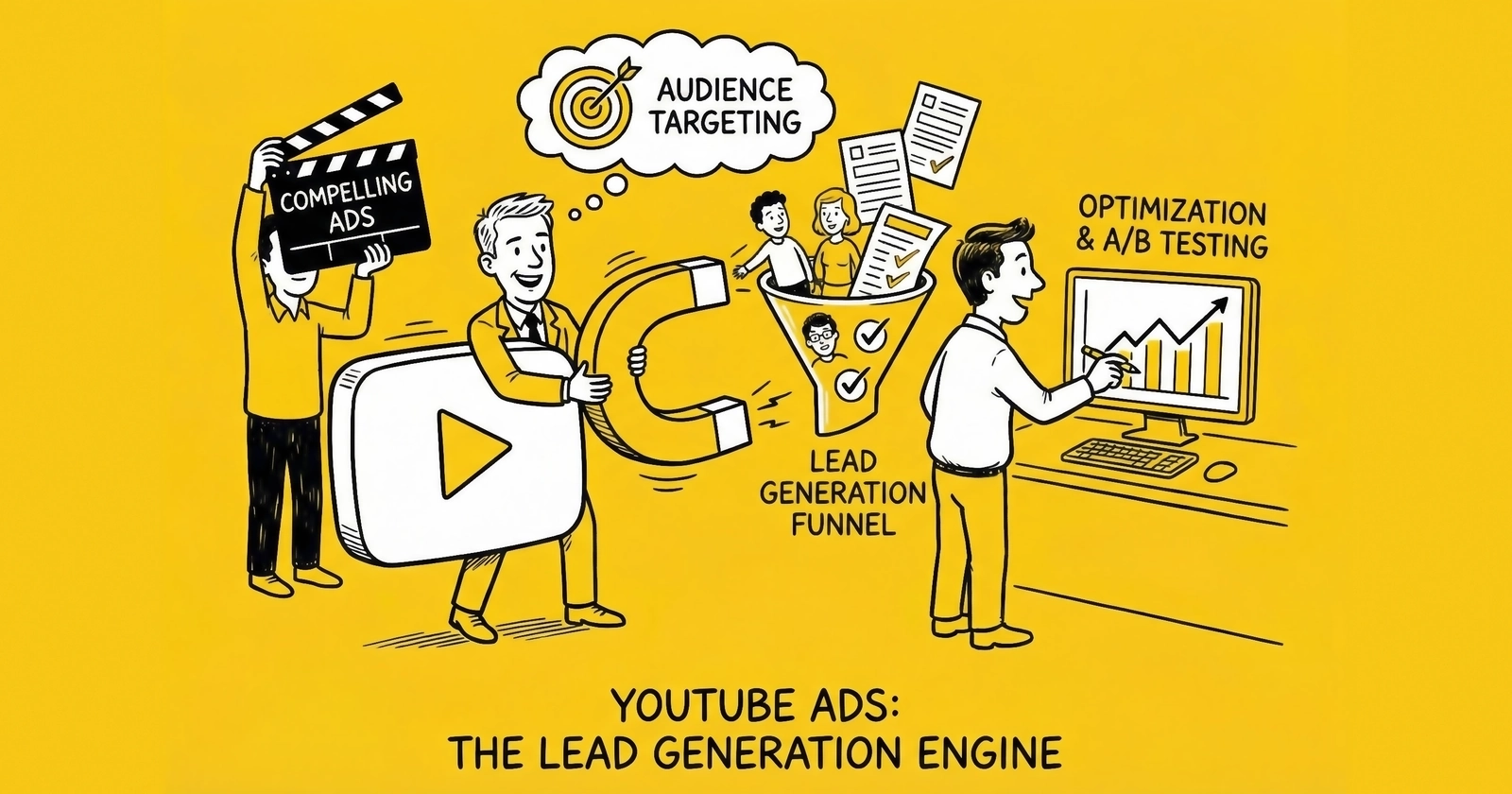
A strategic guide to using YouTube advertising for lead generation, including format selection, targeting, creative requirements, and benchmarks that show when video delivers better ROI than search.
YouTube processes over 3 billion searches monthly. That makes it the second-largest search engine after Google. More than 2.5 billion users log in monthly, watching over 1 billion hours of video daily.
Most lead generators ignore this channel.
They default to Google Search because the intent signal is obvious: someone searching “auto insurance quotes” is ready to buy. They run Facebook because the targeting is sophisticated and the CPMs are manageable. They overlook YouTube because they associate video with brand awareness, not lead capture.
This is a strategic error. YouTube combines search-level intent with display-level scale and Facebook-level targeting precision. When deployed correctly for lead generation – not brand building – YouTube delivers cost per lead that competes with search and conversion rates that exceed display.
This guide covers the complete framework for YouTube lead generation: format selection, targeting architecture, creative requirements, landing page optimization, tracking implementation, and the conditions under which video outperforms every other paid channel.
YouTube Ad Formats for Lead Gen
YouTube offers four primary ad formats. Each serves different strategic purposes for lead generation. Choosing the wrong format burns budget without generating leads.
Skippable In-Stream Ads
Video ads that play before, during, or after YouTube videos. Viewers can skip after 5 seconds. You only pay when viewers watch 30 seconds (or the complete ad if shorter) or engage with an interactive element.
- Length: 15-60 seconds optimal for lead gen
- Payment model: Cost-per-view (CPV) or Target CPA bidding
- Average CPV: $0.10-$0.30 depending on vertical and targeting
- View rate: 15-35% (percentage who watch 30+ seconds)
- Click-through rate: 0.5-2.0%
- Conversion rate from click: 8-20% depending on landing page
This is the primary format for lead generation. The 5-second skip window creates a natural qualification filter – viewers who continue past :05 have demonstrated interest. Use the full video length to explain the value proposition and drive to a lead form.
Best verticals: Insurance (all sub-verticals), mortgage, solar, legal services, home services, education.
Non-Skippable In-Stream Ads
Video ads that must be watched in full before content plays. No skip option.
- Length: 15-20 seconds maximum (Google restricts to 15 seconds in most cases)
- Payment model: CPM (cost per thousand impressions)
- Average CPM: $4-$10 depending on targeting
- Completion rate: 90%+ (forced)
- Click-through rate: 0.3-0.8% (lower than skippable due to viewer frustration)
- Cost efficiency: Generally 20-40% higher CPL than skippable
Limited application for direct lead generation. The forced view creates awareness but can generate negative sentiment. Works better for remarketing audiences who already know your brand, or for high-ticket verticals where impression frequency matters (legal, mortgage).
Bumper Ads
6-second non-skippable ads optimized for reach and frequency.
- Length: 6 seconds maximum
- Payment model: CPM
- Average CPM: $1-$4
- Reach efficiency: Highest of all formats
- Direct response: Near-zero for cold audiences
- Remarketing lift: 10-20% increase in conversion when combined with skippable ads
Not recommended for direct lead generation. Six seconds is insufficient time to communicate a lead generation value proposition. Use bumpers exclusively for remarketing – reinforcing a message to viewers who have already visited your landing page but not converted.
Discovery Ads (formerly In-Display)
Thumbnail ads that appear in YouTube search results, alongside related videos, and on the YouTube homepage. Viewers choose to click and watch.
- Payment model: Cost-per-click (you pay when someone clicks your thumbnail)
- Average CPC: $0.30-$1.00
- Click-through rate: 2-5% (from impression to video start)
- Average watch time: 50-70% of video
- Conversion rate: 5-15% from video to lead
Strong for lead generation when combined with educational content. Discovery ads work like search ads – they appear when users are actively browsing. The viewer has intentionally selected your content, creating higher engagement and conversion potential.
Best for educational content leads (tutorials, guides, comparisons), long-form content that builds trust, and verticals where consideration time is long.
When YouTube Works for Lead Gen
YouTube does not outperform search for every vertical, every audience, or every business model. Understanding where video generates competitive CPL prevents wasted spend on channels that will never deliver.
The YouTube Advantage Conditions
Condition 1: Visual demonstration creates value
Verticals where showing the product or service outcome drives conversion outperform on YouTube. Solar installation, home improvement, automotive, and aesthetic services benefit from visual proof that search ads cannot provide.
Condition 2: Search competition has inflated CPCs beyond profitability
Google Search CPCs in insurance, legal, and mortgage routinely exceed $20-$50 per click. YouTube CPVs in the same verticals run $0.10-$0.30. When search CPL exceeds $150-200 and your target is $75-100, YouTube offers arbitrage.
Condition 3: Your audience watches relevant content
YouTube targeting works by associating your ads with viewer behavior. If your prospects watch content related to their purchase intent – home improvement videos for home services leads, financial education for mortgage leads – you can reach them at scale.
Condition 4: You can produce quality video creative
YouTube requires video. Poor production quality correlates directly with poor performance. If you cannot produce professional-looking video at $500-$3,000 per asset, YouTube will underperform cheaper channels.
Condition 5: Your offer requires explanation
Complex products that require education – solar economics, insurance coverage comparisons, loan options – benefit from video’s explanatory power. Simple commoditized offers perform better on search.
Verticals Where YouTube Outperforms Search
| Vertical | YouTube CPL | Search CPL | Savings |
|---|---|---|---|
| Solar | $45-$120 | $150-$300 | 60-70% |
| Roofing/HVAC | $35-$90 | $100-$200 | 60-65% |
| Legal (Personal Injury) | $80-$200 | $300-$800 | 70-75% |
| Auto Insurance | $25-$65 | $60-$150 | 50-60% |
| Medicare | $40-$85 | $75-$150 | 40-50% |
| Mortgage | $50-$130 | $125-$275 | 50-55% |
| Mass Tort | $60-$180 | $200-$500 | 65-70% |
| Debt Settlement | $35-$90 | $75-$150 | 50-55% |
Why Solar performs well: Visual demonstration of installation, savings calculators shown on screen, neighborhood social proof with “Your neighbors are switching” messaging.
Why Legal performs well: Cost arbitrage is extreme. Attorney face-to-face builds trust. Case type targeting allows precise audience selection.
Where Search Dominates
- Urgent home services (plumber, locksmith, tow truck) - Intent is immediate; video is too slow. YouTube CPL runs 3-5x higher than search.
- B2B software and services - Decision-makers are not watching YouTube for vendor selection. LinkedIn and Google dominate.
- Local services with small radius - YouTube targeting is less precise than Google local. Budget efficiency drops below 5-mile radius.
The Hybrid Strategy
The highest-performing lead generation operations use YouTube and search together. Search captures high-intent, low-funnel prospects actively shopping now. YouTube builds pipeline among prospects earlier in consideration. Remarketing sequences use YouTube video to nurture search visitors who did not convert. Cross-channel attribution reveals the true contribution of each touchpoint.
Operations using both channels typically see 15-25% lower blended CPL than single-channel approaches.
YouTube CPL Benchmarks
The following benchmarks represent performance from well-optimized campaigns with professional creative. New campaigns typically start 30-50% above these ranges before optimization.
Quality Considerations
Lower CPL does not automatically mean better economics. YouTube leads typically require 10-20% more sales effort to convert because the viewer was not actively searching (lower intent baseline), video creates awareness but not urgency, and the consideration cycle from first touch to purchase is longer.
Effective YouTube lead generation operations track not just CPL but cost per qualified lead (CPQL) and cost per acquisition (CPA). A $50 YouTube lead that converts at 3% and a $100 search lead that converts at 6% produce identical CPA of $1,667.
Volume Capacity
YouTube’s scale exceeds Google Search for most verticals. Campaigns that max out at 500 leads/month on search can often scale to 2,000-5,000 leads/month on YouTube before exhausting quality inventory.
| Vertical | Typical Search Ceiling | Typical YouTube Ceiling |
|---|---|---|
| Auto Insurance (state) | 3,000-8,000/month | 15,000-40,000/month |
| Solar (state) | 500-2,000/month | 2,000-8,000/month |
| Roofing (metro) | 200-600/month | 800-2,500/month |
| Legal (injury type) | 300-1,000/month | 1,500-5,000/month |
Creative Requirements: The First 5 Seconds
YouTube advertising lives or dies in the first five seconds. This is the skip window – the only guaranteed exposure before the viewer decides to continue or abandon.
The Five-Second Framework
Every YouTube lead generation ad must accomplish four objectives before the skip button activates.
1. Pattern Interrupt (0:00-0:02)
Break the viewer’s mental state. They were about to watch something else. Your first two seconds must stop them.
Effective pattern interrupts:
- Direct address: “Hey, Arizona homeowners…”
- Surprising visual: Unexpected imagery that demands attention
- Provocative question: “What would you do with an extra $400 a month?”
- Physical movement: Person walking toward camera, unusual action
- Audio contrast: Silence, unexpected sound, or stark tonal shift
2. Relevance Signal (0:02-0:03)
Immediately establish why this viewer should care. Generic messages get skipped. Specific targeting gets watched.
Effective relevance signals:
- Geographic: “Texas homeowners…”
- Demographic: “If you’re turning 65 this year…”
- Situational: “Still paying full price for car insurance?”
- Pain point: “Tired of your energy bill going up every summer?”
3. Value Promise (0:03-0:04)
State the benefit clearly. What does the viewer get?
Effective value promises:
- Savings: “See how much you could save in 60 seconds”
- Access: “Get quotes from 5 carriers in one form”
- Information: “Learn what solar actually costs in your area”
- Speed: “Get a callback within 10 minutes”
4. Soft CTA (0:04-0:05)
Plant the action without demanding it. Hard sells at five seconds feel aggressive.
Effective soft CTAs:
- “Stay with me for 30 seconds…”
- “Watch this short video…”
- “Let me show you…”
- “Here’s how it works…”
Post-Skip Creative Strategy (0:05-1:00)
Viewers who stay past five seconds have qualified themselves. Now deliver on your promise.
0:05-0:15: Problem Amplification - Deepen the pain point. Make the problem feel urgent and personal.
0:15-0:25: Solution Introduction - Present your offer as the answer. Explain what you provide.
0:25-0:40: Proof and Credibility - Customer testimonials, statistics, credentials, social proof.
0:40-0:55: Process Clarity - Explain exactly what happens when they click. Remove ambiguity and fear.
0:55-1:00: Call to Action - Direct, clear instruction. “Click the link below” or “Click the button on your screen.”
Creative Production Requirements
Video quality minimums:
- 1080p resolution minimum (4K preferred)
- Professional audio (no background noise, clear voice)
- Proper lighting (no dark or washed-out footage)
- Stable footage (tripod or gimbal for movement)
Production cost ranges:
- DIY with smartphone + editing: $100-$500
- Freelance videographer: $500-$2,000
- Professional production: $2,000-$10,000
- Agency production: $5,000-$25,000+
Creative testing volume: Effective YouTube operations test 3-5 new creative concepts monthly. Each concept should have 2-3 variations. Expect 60-70% of creatives to underperform.
Common Creative Mistakes
Mistake 1: Brand-first opening - Showing your logo in the first five seconds wastes the hook window.
Mistake 2: Slow build - Television storytelling does not work on YouTube. Get to the point in five seconds.
Mistake 3: Generic messaging - “Save money on insurance” resonates with no one. Specific targeting outperforms generic by 40-60%.
Mistake 4: Weak call to action - “Visit our website” is not a CTA. “Click the button below to get your free quote in 60 seconds” is a CTA.
Mistake 5: Single creative dependency - Running one video until it burns out destroys campaigns. Rotate 3-5 creatives minimum.
Targeting on YouTube
YouTube targeting combines three data types: Google’s search and browsing data, YouTube’s viewing behavior data, and your first-party audience data. Effective lead generation uses all three in layered strategies.
Core Targeting Options
Custom Intent Audiences
Target users based on Google Search behavior. Upload keywords your prospects are searching; YouTube shows your ads to users who have searched those terms.
Best for capturing search intent on a video platform. If someone searched “solar panel installation cost” on Google, you can reach them on YouTube.
Performance: Highest-intent YouTube audience. CPL typically 20-30% lower than other targeting types.
Custom Affinity Audiences
Target users based on browsing behavior and interests. Define interests by URLs, apps, or topics.
Best for reaching prospects during research phase. If prospects visit SolarReviews.com, NerdWallet insurance pages, or competitor sites, you can target that behavior.
Performance: High relevance but broader than custom intent. CPL typically 10-20% higher than custom intent.
In-Market Audiences
Google’s pre-built audiences of users actively researching purchases. Categories include Auto Insurance, Mortgage Loans, Home Services, and more.
Best for quick campaign launch without custom audience building. Google has already identified purchase intent signals.
Performance: Variable by category. Insurance and mortgage in-market audiences perform well; home services categories are less reliable.
Life Events
Target users experiencing major life changes: moving, getting married, starting a business, graduating, retiring.
Best for multi-product lead generation. Someone who just moved needs insurance, home services, and potentially mortgage refinance.
Demographic Targeting
Layer age, gender, parental status, household income, and homeowner status onto other targeting methods.
Essential for CPL efficiency. A Medicare campaign should exclude users under 60. Demographic filtering typically reduces CPL 15-25% by excluding unqualified viewers.
Targeting Layering Strategy
Layer 1: Intent Signal - Custom Intent (searched for relevant terms) OR In-Market (Google identified purchase intent)
Layer 2: Demographic Qualification - Age appropriate for product + Homeowner status (for home services) + Income level (for premium products)
Layer 3: Geographic - State, metro, or radius depending on service area
Layer 4: Exclusions - Exclude existing customers, recent converters, and demographic segments that do not convert
Remarketing Audiences
Website Visitors - Users who visited your site but did not convert. CPL typically 40-60% lower than cold audiences.
Video Viewers - Users who watched your YouTube content. Segment by percentage viewed: 25%, 50%, 75%, or 100%. 75%+ viewers typically convert at 2-3x the rate of 25% viewers.
YouTube Channel Subscribers - Small audience but highest intent. Use for special offers or seasonal pushes.
Landing Page Requirements From Video
Video traffic converts differently than search traffic. Landing pages optimized for Google Ads underperform when receiving YouTube visitors.
The Video-to-Landing Page Gap
Search visitor psychology: “I searched for this. I want to compare options. Show me information.”
Video visitor psychology: “I was watching something else. You interrupted me with a promise. Prove it quickly or I’m leaving.”
Video visitors have lower baseline intent (they were not searching), higher initial skepticism (they were interrupted), shorter attention span (entertainment mode), and better visual expectations (just watched video).
Landing Page Requirements for Video Traffic
1. Message Match - The landing page headline must exactly match the video’s primary promise. If the video promised “See how much you could save on solar in 60 seconds,” the landing page headline should be “See Your Solar Savings in 60 Seconds.” Message match improves conversion rates by 30-50%.
2. Visual Continuity - Use the same visual language: colors, imagery, style, and if possible, the same talent/spokesperson.
3. Form Above the Fold - Video visitors decide within 3-5 seconds whether to engage. The form must be immediately visible without scrolling.
4. Reduced Friction - Video visitors tolerate fewer form fields. Test 3-5 fields for video traffic versus 5-8 for search.
5. Progress Indication - Multi-step forms outperform single-page forms. Show progress bars and step counts (“Step 1 of 3”).
6. Mobile Optimization - 75%+ of YouTube viewing occurs on mobile. Landing pages must be thumb-friendly with large buttons and tap-sized form fields.
7. Speed - Page load time directly impacts conversion. Every additional second of load time costs 7% of conversions. Target under 3 seconds on mobile.
Tracking YouTube Conversions
YouTube conversion tracking presents unique challenges. Cross-device behavior, view-through conversions, and attribution complexity require deliberate tracking architecture.
Conversion Tracking Setup
Google Ads Conversion Tracking - Implement the Google Ads conversion tag on your thank-you page. This captures click-through conversions with accurate attribution.
Enhanced Conversions - Enable enhanced conversions by hashing and sending first-party data (email, phone) with conversion events. Improves measurement accuracy by 10-20%.
View-Through Conversions - YouTube tracks users who saw your ad but did not click, then converted later. Enable with a 30-day window. Analyze separately from click-through.
Offline Conversion Import - For lead generation, the true conversion is often a closed sale. Import sales data back into Google Ads using GCLID matching.
Attribution Challenges and Solutions
| Challenge | Solution |
|---|---|
| Cross-device conversion | Enable Google Signals and cross-device counting |
| View-through attribution | Analyze separately; typical lift is 10-25% above baseline |
| Multi-touch attribution | Use data-driven attribution; YouTube typically receives 15-30% of credit |
| Lead-to-sale tracking | Import sales data with GCLID; optimize for sales, not leads |
YouTube vs. Display vs. Search
Each channel serves different purposes in the lead generation funnel. Understanding comparative strengths prevents misallocation of budget.
| Factor | YouTube | Google Search | Display Network |
|---|---|---|---|
| Intent Level | Medium-High | Highest | Low |
| Scale | Very High | Medium | Very High |
| CPL Range | $25-$150 | $50-$300 | $20-$100 |
| Lead Quality | Medium-High | Highest | Low-Medium |
| Creative Cost | High | Low | Medium |
| Best For | Awareness + Conversion | Active Shoppers | Remarketing + Scale |
Budget Allocation Framework
Conservative (established operations): Search 50-60%, YouTube 25-35%, Display 10-15%
Aggressive (scaling operations): Search 35-45%, YouTube 40-50%, Display 10-15%
Testing (new to YouTube): Search 70-80%, YouTube 15-25%, Display 5-10%
Scale YouTube allocation as performance proves out. Most operations that test YouTube successfully shift 10-20% of search budget to video within 6 months.
Scaling YouTube Campaigns
Scaling YouTube lead generation from $5,000/month to $50,000/month requires systematic expansion of targeting, creative, and bidding strategies.
The Scaling Sequence
Phase 1: Validation ($5,000-$15,000/month)
- Launch with 2-3 targeting audiences (custom intent + in-market + demographics)
- Test 3-5 creative concepts
- Use Target CPA bidding set 20% above your goal
- Run for 2-4 weeks minimum before judging
- Success criteria: CPL within 30% of target
Phase 2: Optimization ($15,000-$30,000/month)
- Expand winning audiences with variations
- Add remarketing campaigns (site visitors, video viewers)
- Implement frequency capping (3-5 impressions/user/week)
- Success criteria: CPL at or below target, 2x volume
Phase 3: Expansion ($30,000-$75,000/month)
- Add new targeting categories and geographic markets
- Diversify creative with new concepts
- Test non-skippable formats for remarketing
- Success criteria: 3-5x volume, stable CPL
Phase 4: Maturity ($75,000+/month)
- Automate creative refresh cycles (every 2-4 weeks)
- Implement offline conversion optimization
- Test value-based bidding (optimize for lead-to-sale value)
- Success criteria: Predictable volume, stable CPL
Scaling Constraints
Budget increases should not exceed 20% per week. Rapid scaling destabilizes machine learning models and causes CPL spikes.
Creative fatigue accelerates with scale. At $5,000/month, a creative can run 4-6 weeks. At $50,000/month, the same creative burns out in 2-3 weeks.
Quality degrades at the margins. The first 1,000 leads from a new campaign are typically higher quality than leads 5,000-10,000. Monitor lead-to-sale rates as you scale.
Frequently Asked Questions
What is the best YouTube ad format for lead generation?
Skippable in-stream ads are the primary format for lead generation. You only pay when viewers watch 30 seconds or engage, which means the 5-second skip window acts as a natural qualification filter. Viewers who continue past the skip have demonstrated interest. Discovery ads work well as a secondary format, particularly for educational content that builds trust before conversion.
How much do YouTube leads cost compared to Google Search?
YouTube leads typically cost 40-70% less than Google Search leads in the same vertical. Auto insurance leads run $25-$65 on YouTube versus $60-$150 on search. Solar leads run $45-$120 on YouTube versus $150-$300 on search. Legal leads show the largest gap: $80-$200 on YouTube versus $300-$800 on search. The trade-off is lead quality – YouTube leads typically convert at 10-20% lower rates, so CPA may be similar despite lower CPL.
What is the minimum budget to test YouTube ads for lead generation?
Allocate $5,000-$10,000 for a meaningful YouTube lead generation test. This budget allows 2-4 weeks of data collection across multiple targeting audiences and creative variations. Smaller budgets produce insufficient data for optimization decisions. Expect to spend 50-70% of your test budget on learning before performance stabilizes.
How long should a YouTube lead generation ad be?
The optimal length for lead generation is 30-60 seconds. The first 5 seconds are critical for hook and qualification. The next 25-55 seconds deliver value proposition, proof, and call to action. Videos under 30 seconds often lack sufficient persuasion time. Videos over 90 seconds experience significant view drop-off.
What makes a good first 5 seconds for a YouTube ad?
Effective first-5-second hooks include direct address to the target audience (“Arizona homeowners…”), provocative questions (“What would you do with an extra $400 a month?”), pattern interrupts through unexpected visuals or audio, and specific relevance signals that tell viewers this ad is for them. Avoid starting with your logo, company name, or generic brand messaging.
Should I use skippable or non-skippable YouTube ads?
Use skippable ads for cold audience lead generation. The skip function qualifies intent – viewers who stay past 5 seconds are genuinely interested. Non-skippable ads work for remarketing audiences who already know your brand, where forced exposure reinforces rather than irritates. Non-skippable ads generate higher completion rates but lower click-through rates and often cost 20-40% more per lead.
How do I track YouTube ad conversions accurately?
Implement Google Ads conversion tracking on your thank-you page, enable enhanced conversions with first-party data (email, phone hash), and import offline conversions using GCLID matching. Track view-through conversions separately from click-through conversions – view-through represents assisted conversions and should be analyzed with lower attribution weight.
What targeting works best for YouTube lead generation?
Custom intent audiences (based on Google Search behavior) typically deliver the lowest CPL because they capture search intent on a video platform. In-market audiences are effective for quick launches. Layer demographic targeting (age, homeowner status, income) to qualify viewers before impression. For remarketing, target website visitors and video viewers who watched 75%+ of previous ads.
How does YouTube lead quality compare to search leads?
YouTube leads are typically 10-25% lower in lead-to-sale conversion rate than search leads. YouTube viewers were not actively searching when they saw your ad, so baseline intent is lower. They require more nurturing and may take longer to close. Track conversion rates by source and adjust pricing expectations accordingly.
When should I scale my YouTube lead generation budget?
Scale when you achieve stable performance for 2-3 consecutive weeks with CPL at or below target and consistent lead quality. Increase budget by no more than 20% per week to maintain algorithm stability. Before scaling significantly, ensure you have creative refresh capacity – budget increases accelerate creative fatigue.
Key Takeaways
-
YouTube is the second-largest search engine and an underused lead generation channel. Over 2.5 billion monthly users and search-level intent signals make YouTube a viable alternative to Google Search.
-
Skippable in-stream ads are the primary format for lead generation. The 5-second skip window creates natural qualification – viewers who stay have demonstrated interest.
-
YouTube CPL runs 40-70% lower than Google Search in most verticals. Solar, legal, and home services show the largest cost arbitrage. The trade-off is 10-20% lower conversion rates.
-
The first 5 seconds determine campaign success. Hook the viewer immediately with pattern interrupt, relevance signal, and value promise. Generic openings get skipped.
-
Landing pages for video traffic require different optimization than search pages. Message match, visual continuity, forms above the fold, and mobile-first design are essential.
-
Custom intent targeting delivers the lowest CPL. Upload keywords your prospects search on Google; YouTube reaches them while they watch video.
-
Scale systematically through four phases. Validate at $5,000-$15,000, optimize at $15,000-$30,000, expand at $30,000-$75,000, and mature at $75,000+.
-
Track beyond lead volume. View-through conversions, lead-to-sale rates, and offline conversion import reveal true YouTube contribution to revenue.
-
Creative refresh is essential at scale. Budget increases accelerate fatigue. Produce 3-5 new concepts monthly when spending above $30,000.
-
YouTube and search work best together. Search captures high-intent shoppers; YouTube builds pipeline. Combined strategies typically reduce blended CPL by 15-25%.
This article provides strategic guidance on YouTube advertising for lead generation. Performance benchmarks are based on aggregated industry data and may vary by vertical, geographic market, and campaign execution quality. Test all strategies in your specific context before scaling budget.