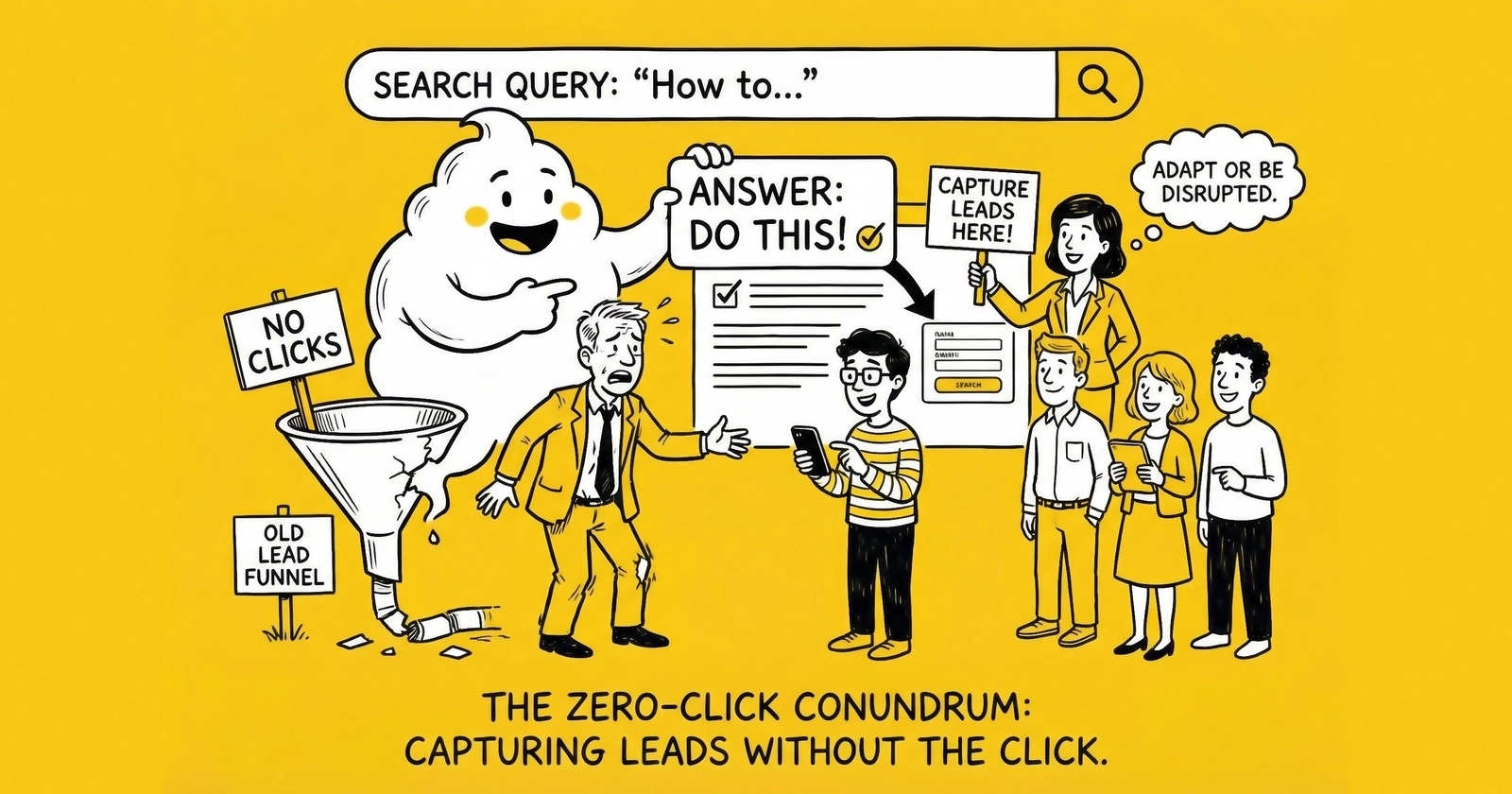
58% of Google searches now end without a single click – up from 25% five years ago. When AI Overviews appear, zero-click rates jump to 83%. The funnel that drove lead generation for two decades is collapsing. The question isn’t whether to adapt, but how fast.
A consumer searches “best auto insurance lead providers for independent agents.” Five years ago, this query would generate clicks to five or six websites. The consumer would visit landing pages, compare options, and eventually fill out contact forms or make calls.
Today, Google displays an AI Overview. The summary lists three recommended providers, explains pricing models, and describes what to look for in a lead vendor. The consumer reads the summary, gets their answer, and moves on – without clicking anything.
Your website might rank position one for this query. You might have invested years building domain authority, thousands of dollars in content creation, and countless hours optimizing conversion paths. None of it matters if the consumer never reaches your site.
This is zero-click search – and it’s reshaping how lead generation companies acquire customers. Understanding how the lead generation industry operates provides essential context for why these visibility changes matter so much.
The 25% Volume Decline Gartner Predicts
In February 2024, Gartner issued a prediction that sent shockwaves through digital marketing: traditional search engine volume will drop 25% by 2026 due to AI chatbots and virtual agents.
The reasoning is straightforward. Generative AI solutions are becoming substitute answer engines, replacing queries that previously went to traditional search. When ChatGPT, Claude, or Perplexity can answer a question directly, users don’t need to search Google and click through to websites.
What “25% Decline” Actually Means for Lead Generators
For lead generation companies, the implications are severe:
Traffic erosion: If your customer acquisition depends on organic search traffic, a 25% volume decline means 25% fewer opportunities to capture leads – unless you adapt your strategy.
Channel diversification pressure: Companies built primarily on search engine traffic face urgent pressure to develop alternative acquisition channels.
AI visibility requirements: Traffic that doesn’t disappear entirely shifts to AI-mediated discovery, requiring fundamentally different optimization approaches.
The decline isn’t uniformly distributed. Some query types and industries face greater exposure:
| Query Type | AI Impact Level | Lead Gen Relevance |
|---|---|---|
| Informational | High (AI answers directly) | Research-phase leads |
| Commercial | Medium-High (AI comparisons) | Evaluation-phase leads |
| Transactional | Medium (AI recommendations) | Purchase-ready leads |
| Navigational | Lower (brand searches) | Existing awareness |
Lead generation companies capturing top-of-funnel informational traffic face the greatest impact. AI systems excel at answering informational queries – precisely the queries that brought research-phase consumers into lead generation funnels.
Traffic Redistribution vs. Traffic Elimination
Some of the predicted decline represents traffic redistribution rather than elimination. Users aren’t searching less – they’re searching differently:
- ChatGPT: 600 million monthly users asking questions that previously went to Google
- Perplexity: Growing share of research queries with citation-based answers
- Google AI Overviews: 1.5 billion monthly users receiving direct answers within Google
Traffic that once clicked through to websites now receives answers from AI interfaces. The demand for information persists; the pathway to satisfying that demand has changed.
For lead generators, this means:
- Total addressable search volume may decline
- Some volume shifts to AI platforms rather than disappearing
- Capturing shifted volume requires AI visibility, not just search rankings
Industry-Specific Impact Analysis
The impact varies significantly by vertical:
High AI Overview penetration (15%+ of queries):
- Science and research queries
- Technology and electronics
- Health and wellness
- Legal information
Low AI Overview penetration (<5% of queries):
- Real estate (0.41% – lowest)
- Shopping and e-commerce
- Arts and entertainment
- Local services
For lead generators, this creates counterintuitive opportunities. Insurance and mortgage information queries face high AI Overview presence. But real estate and local services – also significant lead generation verticals – show lower AI Overview saturation.
Understanding AI Overviews
Google’s AI Overviews represent the most significant change to search results since featured snippets. Understanding how they work reveals both threats and opportunities for lead generators.
AI Overview Growth: 4% to 27% in 10 Months
The expansion of AI Overviews has been dramatic:
| Month | AI Overview Presence | Growth |
|---|---|---|
| January 2025 | 3.93% | Baseline |
| March 2025 | 13.14% | +102% |
| July 2025 | ~25% | Peak |
| November 2025 | 27.43% | 7x from January |
By November 2025, more than one in four Google searches triggered an AI Overview. For informational queries – the type that brings consumers into lead generation funnels – the percentage is even higher.
How AI Overviews Source Information
AI Overviews don’t generate information from nothing. They synthesize content from sources Google’s systems evaluate as authoritative. Understanding the sourcing patterns reveals optimization opportunities:
Source characteristics:
- 82% of citations come from deep, topic-specific pages (not homepages)
- Sources with structured data appear more frequently
- Recent content (updated within current year) receives preference
- Multiple confirming sources increase confidence
Citation patterns:
- AI Overviews typically cite 3-5 sources
- Top-cited URLs often have zero traditional ranking visibility
- Citation and ranking are evaluated through different mechanisms
For lead generators, this means:
- Deep content pages have higher citation potential than homepage optimization
- Structured data (schema markup) increases citation probability
- Content freshness affects AI Overview inclusion
- Traditional rankings don’t guarantee AI Overview citation
For detailed strategies on optimizing for these citation opportunities, see our guides on LLMO for lead generation and GEO optimization.
The 3-5 Citation Limit and What It Means
AI Overviews typically cite 3-5 sources for any given query. This creates winner-take-all dynamics:
If you’re cited: Your brand appears in the AI response, potentially reaching millions of users who never would have clicked through to your site.
If you’re not cited: You’re invisible for that query, regardless of your traditional ranking position.
The narrow citation window increases the stakes of AI visibility. Being among the top 3-5 most authoritative sources for relevant queries becomes critical.
Zero-Click Search Economics
When users get answers without clicking, traditional metrics break down. Understanding zero-click economics reveals how lead generators can capture value from AI-mediated discovery.
When Users Never See Your Website
The statistics are stark:
- 58% of Google searches end without a click (November 2025)
- 83% zero-click rate when AI Overviews are present
- 93% zero-click rate for AI Mode searches
- 61% CTR decline for queries with AI Overviews
For lead generators, these numbers represent a fundamental challenge. If users never reach your website, they never:
- See your value proposition
- Fill out contact forms
- Enter your conversion funnel
- Become leads
The traditional lead generation model – attract traffic, capture information, monetize intent – breaks when the traffic never arrives.
Brand Awareness Without Traffic
Zero-click search doesn’t eliminate value; it transforms how value is captured.
When your brand appears in an AI Overview citation, users see your name associated with authoritative information. They may not click through immediately, but:
- Brand recognition increases
- Trust association builds
- Future searches may include your brand name
- Direct visits may increase as users remember your brand
This creates a attribution challenge. Traditional analytics show declining organic traffic. But brand searches, direct visits, and “dark traffic” may increase from AI Overview exposure that doesn’t generate measurable clicks.
Proxy indicators of AI visibility value:
- Branded search volume trends
- Direct traffic growth
- “How did you hear about us” survey responses mentioning AI assistants
- Mention tracking across AI platforms
The Citation Value Calculation
Not all citations are equal. Citation value depends on:
Query volume: A citation for a query with 10,000 monthly searches delivers more exposure than one with 100 searches.
Query intent: Commercial and transactional queries drive higher-value awareness than purely informational queries.
Citation prominence: Being the first-cited source differs from being the fourth.
Brand mention clarity: Full brand name mentions create more value than vague references.
For lead generators, this suggests prioritizing:
- High-volume commercial queries in your vertical
- Content structured for prominent citation
- Clear brand signals that transfer through AI synthesis
Funnel Redesign for AI-Mediated Discovery
The traditional lead generation funnel assumed traffic as the entry point. AI-mediated discovery requires rethinking funnel architecture.
Information Content vs. Conversion Content
In a zero-click environment, content serves two distinct functions:
Information content: Designed to earn AI citations and build brand awareness. May never generate direct traffic but establishes authority and visibility.
Conversion content: Designed to convert users who arrive through branded searches, direct visits, or downstream awareness from AI visibility.
The separation matters. Information content optimized for AI citation shouldn’t be cluttered with aggressive conversion elements. Conversion content receiving traffic from brand-aware users can focus on conversion without worrying about AI citation.
Information content characteristics:
- Comprehensive topic coverage
- Clear, extractable answers
- Structured for AI synthesis
- Brand mentions embedded naturally
- Minimal friction elements
Conversion content characteristics:
- Strong value propositions
- Clear calls to action
- Conversion-optimized design
- Trust signals for users already aware of brand
- Streamlined form experiences
Hybrid Approaches That Capture Both
Most lead generators can’t completely separate information and conversion content. Hybrid approaches capture AI citation potential while maintaining conversion opportunity:
Structural separation:
- Opening sections optimized for AI extraction
- Deeper sections providing conversion opportunity
- Clear navigation to conversion paths for engaged users
Content layering:
- Initial answers satisfy AI citation requirements
- Expanded content reveals proprietary insights
- “For more detail, contact us” transitions to conversion
Brand integration:
- Company expertise woven into informational content
- Case studies demonstrating capabilities
- Clear paths to engagement for interested readers
When to Optimize for Citation vs. Traffic
Different content types warrant different optimization priorities:
| Content Type | Priority | Rationale |
|---|---|---|
| Beginner guides | Citation | Reaches top-of-funnel; builds awareness |
| Comparison content | Hybrid | Commercial intent; conversion opportunity |
| Pricing/offer pages | Traffic | Transaction-ready users |
| Case studies | Hybrid | Authority building; conversion |
| Compliance guides | Citation | Establishes expertise; trust building |
| Contact pages | Traffic | Direct conversion purpose |
The key insight: not all pages need to rank or earn clicks. Some pages exist to earn citations that build the brand awareness that drives traffic to other pages. For buyers evaluating options, our guide on evaluating lead vendors addresses the questions these AI summaries often answer.
Industry Impact Analysis
Zero-click search affects lead generation verticals differently. Understanding vertical-specific impacts enables targeted responses.
Insurance Leads – High AI Overview Prevalence
Insurance information queries show high AI Overview saturation (17%+ for health-related queries). Consumers searching “how does auto insurance pricing work” or “what coverage do I need” increasingly receive AI-generated answers.
Impact:
- Top-of-funnel informational traffic declining
- Research-phase leads harder to capture through content
- Brand awareness through AI citation becomes critical
Adaptation strategies:
- Focus on commercial-intent queries (“auto insurance quotes near me”)
- Build brand recognition through authoritative citations
- Capture mid-funnel users already brand-aware
Mortgage Leads – Rate-Sensitive Timing
Mortgage queries blend informational and transactional intent. Rate-sensitive queries (“current mortgage rates”) require real-time data that AI Overviews struggle to provide accurately.
Impact:
- Rate-related queries retain click-through value
- Educational content faces AI Overview competition
- Local and personal service differentiation matters
Adaptation strategies:
- Emphasize real-time rate information requiring click-through
- Build authority in complex scenarios AI can’t address
- Focus on geographic and situational specificity
Legal Leads – AI Caution on Advice
AI systems show caution with legal advice, frequently disclaiming limitations and recommending professional consultation. This creates natural click-through opportunity.
Impact:
- AI Overviews often defer to professional consultation
- Complex legal scenarios require human expertise
- Trust signals particularly important
Adaptation strategies:
- Position as the professional consultation AI recommends
- Address complex scenarios AI can’t resolve
- Build E-E-A-T signals that AI systems recognize
Home Services – Local Intent Patterns
Home services queries often include local intent (“plumber near me”) that AI Overviews handle differently than informational queries. Local pack results and business listings retain visibility.
Impact:
- Local queries less affected by AI Overviews
- Google Business Profile optimization remains valuable
- Review and reputation signals matter
Adaptation strategies:
- Prioritize local SEO and Google Business Profile
- Build review volume and quality
- Maintain NAP consistency across platforms
Tactical Responses
Adapting to zero-click search requires tactical changes across content, technical implementation, and measurement.
Content Restructuring for AI Synthesis
Structure content for maximum AI citation probability:
Question-based headers: Instead of “Lead Quality Factors,” use “What Factors Determine Lead Quality?” This matches how users and AI systems phrase queries.
Direct answer openers: Begin each section with a 40-60 word answer to the question posed. This content is most likely to be extracted for AI Overviews.
Structured data integration: Implement FAQ schema, HowTo schema, and Article schema to help AI systems understand content structure.
Citation-worthy specificity: Include specific data, statistics, and examples that AI systems recognize as authoritative. Generic advice doesn’t earn citations.
Branded Search Strategy
As direct organic traffic declines, branded search becomes more valuable:
Brand mention optimization: Ensure your brand name appears naturally in content that earns AI citations. When AI Overviews mention your brand, users may search for you directly.
Brand consistency: Use consistent brand naming across all platforms. Inconsistent naming reduces AI systems’ ability to associate citations with your brand.
Brand authority building: Invest in brand recognition through channels beyond search. Social media, industry events, partnerships, and PR create brand awareness that translates to branded searches.
Multi-Touch Attribution Updates
Traditional last-click attribution fails in a zero-click environment. Users who encounter your brand through AI citations may convert through completely different channels.
Attribution considerations:
- Track branded search trends as AI visibility proxy
- Monitor direct traffic for unexplained growth
- Survey new leads about discovery path
- Implement multi-touch attribution models
Measurement challenges:
- AI citation doesn’t generate trackable clicks
- Brand awareness effects are delayed
- Multiple touchpoints precede conversion
- Traditional analytics undercount AI influence
Key Takeaways
-
Gartner predicts 25% search volume decline by 2026 as users shift to AI assistants. Lead generators built on organic traffic face fundamental channel disruption.
-
AI Overviews grew from 4% to 27% of Google queries in 10 months. More than one in four searches now shows AI-generated summaries.
-
58% of Google searches end without clicks. When AI Overviews appear, zero-click rates jump to 83%. Traditional traffic-based funnels are collapsing.
-
CTR dropped 61% for queries with AI Overviews. Even ranking position one delivers dramatically less traffic when AI summaries appear.
-
Citation replaces ranking as the key visibility metric. Being among the 3-5 sources AI Overviews cite matters more than traditional position.
-
Brand awareness without traffic is the new reality. AI citations build recognition that converts through branded searches and direct visits.
-
Separate information and conversion content. Information content earns citations; conversion content captures users already aware of your brand.
-
Industry impact varies significantly. Insurance and health queries face high AI Overview saturation; real estate and local services face less.
-
Structured content earns citations. Question-based headers, direct answer openers, and schema markup increase AI visibility.
-
Attribution must evolve. Traditional analytics undercount AI influence. Track branded search trends, direct traffic, and survey discovery paths.
Frequently Asked Questions
What is zero-click search and why does it matter for lead generation?
Zero-click search occurs when users get answers directly from search results without clicking through to any website. For lead generation, this matters because traditional models depend on website traffic to capture leads. When 58% of searches end without clicks, lead generators relying on organic traffic face significant acquisition challenges.
How much will search traffic actually decline?
Gartner predicts 25% decline in traditional search engine volume by 2026. However, the decline isn’t uniform. Informational queries face the greatest impact from AI Overviews. Commercial and transactional queries retain more click-through potential. Local and brand-specific queries are less affected.
What percentage of searches trigger AI Overviews?
As of November 2025, AI Overviews appear on 27.43% of Google searches – up from 3.93% in January 2025. This represents nearly 7x growth in 10 months. The percentage is higher for informational queries and varies significantly by industry.
How does zero-click search affect lead generation funnels?
Traditional funnels assumed traffic as the entry point – users arrive at your site, see your value proposition, and convert to leads. Zero-click search breaks this model by providing answers without visits. Lead generators must adapt by building brand awareness through AI citations that convert through alternative paths like branded searches and direct visits.
Can lead generators still capture value from zero-click searches?
Yes, but value capture looks different. When your brand appears in AI Overview citations, you build awareness even without clicks. This awareness translates to branded searches, direct visits, and recognition when users encounter your brand through other channels. The value exists but requires different measurement and attribution.
Which lead generation verticals are most affected?
Insurance, health, and informational verticals face the highest AI Overview saturation (15-17%+ of queries). Real estate (0.41%), shopping, and local services see lower AI Overview presence. Verticals with high informational query volume face greater impact than those with primarily transactional or local intent.
How do AI Overviews decide which sources to cite?
AI Overviews cite 3-5 sources based on authority, relevance, and content structure. 82% of citations come from deep topic pages, not homepages. Sources with structured data, recent updates, and clear expertise signals appear more frequently. Traditional ranking position doesn’t guarantee citation.
What’s the difference between ranking and citation in AI search?
Ranking determines position in traditional search results based on relevance, authority, and technical factors. Citation determines whether AI systems reference your content in generated responses. 25% of ChatGPT’s most-cited URLs have zero Google visibility – demonstrating that these are separate evaluation systems.
How should lead generators restructure content for AI visibility?
Structure content with question-based headers matching user queries, 40-60 word answer openers for each section, structured data markup (FAQ schema, Article schema), and specific data AI systems recognize as authoritative. Separate information content (optimized for citation) from conversion content (optimized for leads).
What metrics should replace traditional traffic measurement?
Beyond organic traffic, track branded search volume trends, direct traffic growth, multi-touch attribution across channels, citation frequency in AI responses (manual testing), and survey responses about discovery paths. Traditional analytics undercount AI influence by missing citation-driven awareness.
Is SEO still relevant in a zero-click environment?
Yes, but the goal shifts from traffic to visibility. Traditional SEO captures direct traffic for transactional and navigational queries. LLMO (Large Language Model Optimization) captures citations that build awareness and authority. Most lead generators should pursue both, recognizing they serve different functions. For comprehensive SEO strategies that still work, see our guide on organic traffic strategies for lead generation.
How quickly should lead generators adapt to zero-click trends?
Adaptation should begin immediately. AI Overview presence grew 7x in 10 months. The companies establishing AI visibility now build citation authority that compounds over time. Waiting for clearer trends means competing against entrenched competitors with established authority.
Can paid advertising offset zero-click organic losses?
Partially. Paid ads still appear above AI Overviews and retain click-through potential. However, paid CTR also declined 68% for queries with AI Overviews. Paid advertising can supplement declining organic traffic but faces its own AI-driven challenges.
What role does brand building play in zero-click adaptation?
Brand building becomes more important as direct organic traffic declines. Users who encounter your brand through AI citations search for you directly rather than clicking through generic results. Strong brands with recognition capture traffic that generic competitors miss entirely.
How do local lead generation businesses adapt differently?
Local businesses face less AI Overview saturation. Google Business Profile optimization, review management, and local SEO retain effectiveness. Local intent queries (“near me”) trigger local pack results alongside or instead of AI Overviews. Local lead generators should prioritize local visibility while monitoring AI Overview expansion.