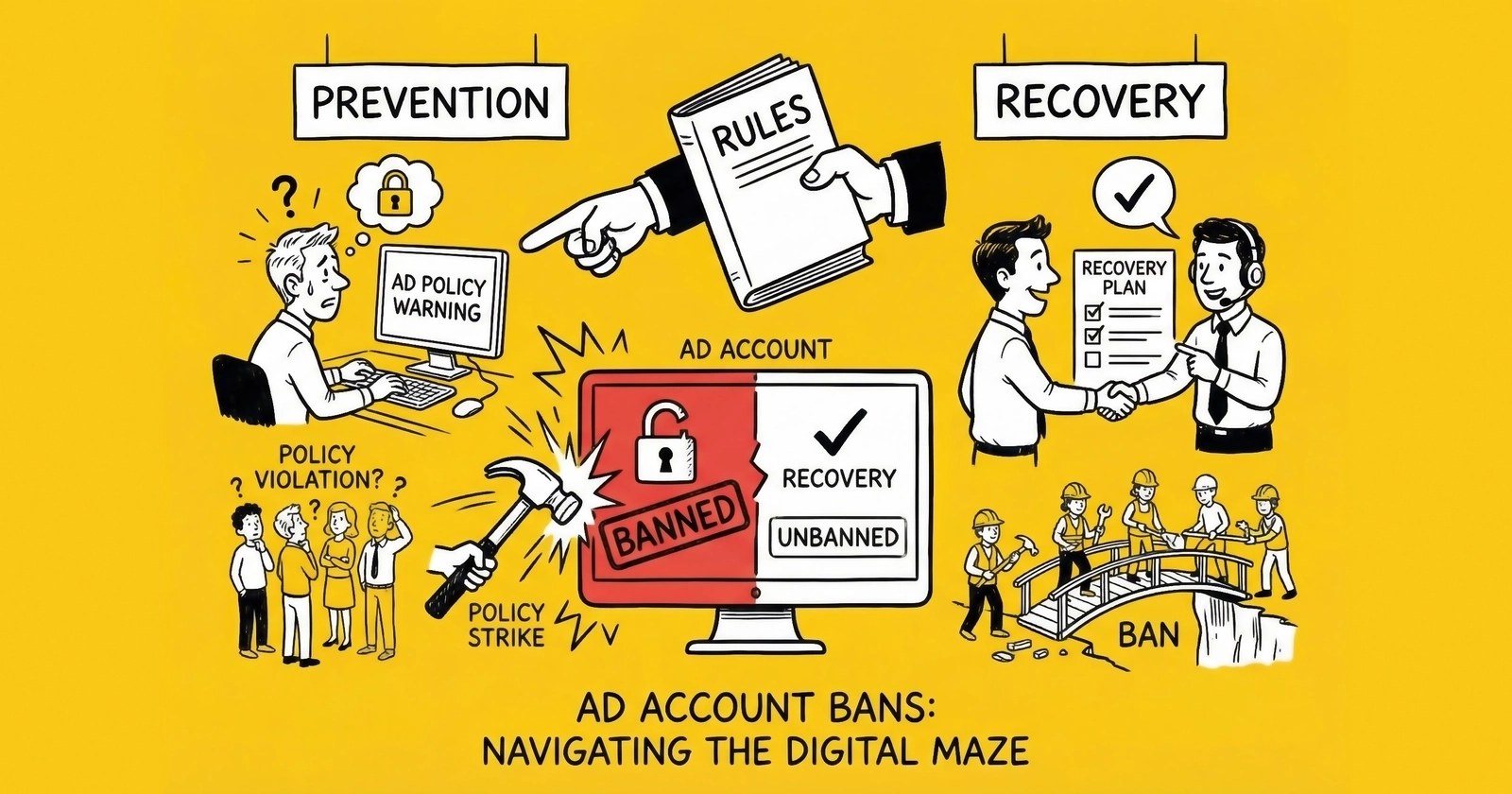
A tactical guide for lead generation professionals who need to protect their advertising infrastructure from suspension while maintaining profitable operations across Google, Meta, TikTok, and other platforms.
The email arrives at 6:47 AM. “Your advertising account has been suspended due to policy violations. You may no longer run ads.”
No warning. No specific violation cited. No path to appeal that generates a human response. And your entire operation – the campaigns that took eighteen months to optimize, the pixel data that feeds your lookalike audiences, the Quality Scores you painstakingly built – goes dark instantly.
This is not hypothetical. This is Tuesday morning for lead generation operators who failed to understand a fundamental truth: your advertising account is not your property. It is a privilege granted by platforms who can revoke it at any moment, for any reason, with recourse options that range from inadequate to nonexistent.
The lead generation industry faces elevated ban risk because our business model – capturing consumer information for transfer to third parties – sits in compliance gray zones that platforms interpret conservatively. What an e-commerce merchant does freely, a lead generator does under scrutiny. The same landing page structure, the same ad creative approach, the same targeting methods carry different risk profiles when the conversion is a lead form rather than a shopping cart.
This guide covers prevention strategies, early warning signals, appeal processes, and recovery frameworks for the major advertising platforms. Not theory about what should work. The actual practices that separate operators who maintain advertising access for years from those who rebuild from zero every six months.
Why Lead Generation Accounts Face Elevated Risk
Understanding why ad platforms scrutinize lead generation operations requires understanding their incentive structure. Platforms optimize for advertiser retention, user experience, and regulatory compliance – in roughly that order.
The Platform Perspective on Lead Generation
Advertising platforms want advertisers who run for years, not months. The cost of acquiring a new advertiser, onboarding their campaigns, and teaching their algorithms exceeds the revenue from short-term operators. When platforms identify advertiser categories with high churn, policy violations, or user complaints, they apply additional scrutiny to protect their long-term revenue.
Lead generation advertising triggers several red flags from this perspective. High complaint rates top the list – consumers who submit lead forms often receive calls they did not anticipate or remember consenting to. These consumers complain to the business, to regulators, and to the platforms that showed them the ad. A single user reporting an ad as misleading carries more weight than ten conversions in the platform’s risk calculus.
Landing page quality concerns compound the issue. Lead generation landing pages optimize for conversion, not information. Minimal content, prominent forms, and aggressive value propositions look different from the content-rich pages that platforms prefer. Automated systems scoring landing page quality often penalize lead generation structures simply because they do not match the patterns platforms associate with legitimate businesses.
Third-party relationships create additional exposure. When you capture a lead and sell it to a buyer who then calls the consumer, the platform cannot observe or control that downstream interaction. If the buyer’s call center violates TCPA, uses aggressive tactics, or simply annoys the consumer, the complaint traces back to the ad the consumer clicked – your ad, on the platform’s property. The platform bears reputational risk for behavior they cannot see or influence.
Regulatory exposure rounds out the concern set. Lead generation intersects with TCPA, state telemarketing laws, FTC disclosure requirements, and industry-specific regulations. Platforms do not want to be named in regulatory actions or class action lawsuits. Suspending advertisers who might create regulatory exposure is easier than defending advertising practices in court.
Understanding Vertical Risk Tiers
While platforms do not publish category-specific suspension rates, industry data and practitioner surveys suggest lead generation accounts face 3-5x higher suspension risk than e-commerce or SaaS advertisers. The differential varies significantly by vertical, creating distinct risk tiers that should inform your operational approach.
The highest-risk verticals require the most conservative practices. Personal injury legal advertising triggers aggressive review because lawsuit advertising attracts regulatory attention. Medicare and health insurance face elevated scrutiny due to CMS regulations and political sensitivity around healthcare advertising, as detailed in our guide to personal injury lead generation. Debt settlement and credit repair operations encounter frequent enforcement because of FTC scrutiny and historically high complaint rates. Home improvement financing triggers review due to TILA disclosure requirements. Payday and short-term lending face outright restrictions on many platforms.
Moderate-risk verticals still require careful attention but allow more operational flexibility. Auto insurance sits in this tier due to competitive intensity and frequent policy updates. Solar leads face scrutiny around incentive claims and geographic restrictions. Home services require attention to licensing verification requirements. Life insurance triggers disclosure requirement reviews but faces less aggressive enforcement than health insurance.
Lower-risk verticals exist within the lead generation context, though they still face more scrutiny than non-lead-generation advertising. B2B lead generation benefits from lower consumer complaint rates – business buyers understand the process better. Education leads face specific regulations but generate fewer user experience complaints. Real estate leads require attention to licensing requirements but see lower overall complaint rates.
The Arbitrage Trap
Some operators view ad account bans as a cost of doing business – burn an account, open another, continue operating. This arbitrage approach creates problems for everyone in the industry, including the operators who practice it.
Platforms have become sophisticated at detecting related accounts. They track device fingerprints, payment methods, pixel data, landing page domains, IP addresses, and behavioral patterns. Opening a “fresh” account that connects to a banned account through any of these signals results in immediate suspension of the new account. The sophistication of detection has increased dramatically, and accounts that seemed safe three years ago would be caught immediately today.
More importantly, this arbitrage behavior poisons the lead generation category for everyone. When platforms observe high ban rates and account cycling within a category, they tighten policies, reduce appeal success rates, and increase automated enforcement – affecting legitimate operators who want to build long-term advertising infrastructure. The sustainable approach is prevention, not arbitrage.
Prevention: The Account Protection Framework
Account protection is not a checklist to complete once. It is an ongoing operational discipline that touches every aspect of your advertising practice.
Building Policy Compliance Infrastructure
Every major platform publishes advertising policies that run to dozens of pages. Reading these policies once during account setup is insufficient. Policies change monthly, sometimes weekly, with minimal notification. Those who maintain clean accounts treat policy monitoring as an ongoing operational function, not a one-time orientation.
Establishing policy monitoring routines requires systematic effort. Subscribe to platform policy update notifications – Google, Meta, and TikTok all offer email alerts for policy changes. Review the Google Ads policy center, Meta Business Help Center, and equivalent resources monthly. Document which of your current practices might be affected by policy changes. This documentation creates accountability and ensures policy awareness extends beyond whoever handles the day-to-day campaign management.
Maintaining a policy compliance checklist for each platform transforms abstract policy documents into operational tools. Before launching any campaign, verify creative, landing page, and targeting against current policy requirements. This takes ten minutes and prevents suspensions that take ten weeks to resolve. The checklist should be platform-specific because policies differ – what Google allows, Meta may prohibit, and vice versa.
Creating internal policy summaries bridges the gap between legal language and operational execution. Platform policies are written for legal precision, not operational clarity. Translate policy requirements into specific rules your team can follow. “Ensure all claims are substantiated with documented evidence accessible within one click of the ad” is more actionable than quoting platform legalese about “misleading content.” These summaries should be reviewed and updated quarterly at minimum.
Landing Page Requirements That Prevent Enforcement
Landing pages cause more account suspensions than ad creative. Platforms evaluate landing page quality through automated systems that scan for specific elements, and lead generation pages often fail these scans because they prioritize conversion over the signals platforms want to see.
Content requirements for compliant landing pages include clear business identification with company name and contact information prominently displayed. Privacy policy and terms of service must be accessible from the form page – not buried in a footer that requires scrolling. Substantive content explaining what the user receives should accompany the form, not replace it but contextualize it. Mobile optimization matters because platforms penalize poor mobile experiences, and most of your traffic likely comes from mobile devices. Load times under 3 seconds prevent quality flags – pages loading slower trigger automated review.
Avoiding problematic content patterns protects your account from automated enforcement. Thin content pages with a form and nothing else look suspicious to platform scanners. Aggressive countdown timers or scarcity claims without basis trigger misleading content flags. Misleading before/after imagery – especially for health or appearance-related offers – violates policies across all major platforms. Unsubstantiated savings or earnings claims require documentation you likely do not have. Pop-ups that interfere with navigation create user experience flags. Auto-playing audio or video generates complaints.
Disclosure requirements carry particular weight for lead generation. Disclose what happens with the information collected. “By submitting this form, you consent to receive calls and texts from [Company Name] and our partners at the number provided” represents the minimum disclosure standard. Failure to disclose downstream contact – especially calling – generates complaints that trigger suspensions. The disclosure must be visible without scrolling on both desktop and mobile. Fine print that users must hunt for does not satisfy platform requirements and creates regulatory exposure that extends beyond advertising account risk. Understanding TCPA compliance requirements is essential for crafting disclosures that satisfy both platforms and regulators.
Ad Creative Guidelines That Protect Accounts
Ad creative violations trigger faster enforcement than landing page issues because they are easier for platforms to detect and because they directly affect user experience. The creative that performs best often pushes closest to policy boundaries, creating tension between optimization and protection.
Copy restrictions common across platforms include prohibitions on absolute claims without qualification. Words like “best,” “guaranteed,” and “always” require either qualification or removal. Claims about specific savings amounts require substantiation you can provide upon request. Mentions of specific medical conditions face restrictions in certain contexts – particularly when paired with targeting or lead generation. Suggestions of guaranteed approval for credit or insurance products violate policies universally. Misleading “official” or “government” implications trigger immediate review and often suspension.
Image and video restrictions prevent specific visual approaches. Before/after imagery for health or appearance-related offers is prohibited across major platforms. Misleading button imagery that looks like platform interface elements – fake play buttons, fake notification badges – triggers automated enforcement. Zoomed or exaggerated body part imagery faces restrictions. Imagery implying results the product cannot deliver crosses into misleading content territory.
Lead generation specific restrictions address the unique characteristics of the business model. Implying that information will remain private if it will be shared constitutes misleading content. Claims about who will contact the user must be accurate – if you sell leads to multiple buyers, your disclosure cannot suggest a single named company will call. Suggestions of immediate callback require operational capacity to deliver within the timeframe implied.
The headline test provides a practical check before running any ad. Ask: “If this claim appeared in a news headline about our advertising practices, would we be comfortable defending it?” The advertisements that generate regulatory action and platform bans typically fail this test obviously. If your marketing team cannot defend the ad in a hypothetical news story, the ad should not run.
Account Structure Best Practices
How you structure your advertising accounts affects both suspension risk and recovery options. The goal is isolation – ensuring that problems in one area do not contaminate everything else.
Separating accounts by vertical creates firewalls within your operation. If you operate in multiple verticals, maintain separate advertising accounts for each. A suspension in your legal leads account should not affect your home services account. This separation requires separate payment methods and clean separation in all tracking infrastructure – if your pixels or audiences connect accounts, the separation provides no protection.
Maintaining backup accounts legitimately prepares you for disruption without creating policy violations. Platforms allow businesses to maintain multiple accounts for legitimate business purposes. Document the business justification for each account – separate product lines, separate business entities, testing environments. Use different business entities where appropriate. Ensure each account operates independently without sharing pixels, audiences, or campaign elements that would suggest they are duplicates created to circumvent enforcement.
Account access management affects risk in ways operators often overlook. Every person with account access increases risk – both from their potential policy violations and from their devices and IP addresses becoming linked to your account. Limit access to necessary personnel only, use proper permission levels, and remove access promptly when personnel leave. A former employee’s compromised device or careless personal advertising activity can contaminate your business accounts.
Payment method hygiene prevents cross-contamination between accounts. Use business credit cards, not personal cards. Maintain separate payment methods for separate accounts. If a payment method is associated with a banned account, any other account using that method faces elevated review. Credit card rewards are not worth the risk of connecting accounts that should remain separate.
Tracking and Pixel Practices
Tracking implementation affects both campaign performance and account risk. Platforms evaluate advertisers partly through the quality and consistency of their conversion data.
First-party data emphasis signals sophistication and legitimacy. As third-party tracking faces restrictions, platforms reward advertisers who implement server-side tracking, customer match, and offline conversion import. These implementations require technical investment but signal sophisticated advertisers who platforms want to retain. The advertisers running basic pixel tracking without server-side validation look less established and face more skeptical review.
Pixel hygiene prevents contamination. Do not share pixels across unrelated properties – each business line should have its own tracking infrastructure. Do not install pixels on properties you do not control, as pixels associated with policy-violating content – even content you do not control – can contaminate your account through association.
Conversion accuracy matters beyond performance optimization. Inflated or inaccurate conversion reporting triggers fraud detection systems. If your reported conversions do not align with downstream reality (verified through platform measurement tools), your account faces elevated scrutiny. The platforms have access to more data than you might expect – discrepancies between your reported conversions and the behaviors they observe create investigation triggers.
Platform-Specific Prevention Strategies
Each platform has distinct policy interpretation, enforcement mechanisms, and appeal processes. What works on Google may fail on Meta, and vice versa.
Google Ads Account Protection
Google Ads represents the highest-intent traffic source for most lead generators and warrants the most rigorous protection practices. The platform’s scale means enforcement is heavily automated, but the appeal process remains more accessible than competitors.
Policy hot spots for lead generation on Google center on several areas. Misleading claims violations require substantiation for specific savings or benefit claims – Google may request documentation at any time. Destination requirements mandate that landing pages provide substantial value beyond data collection. Data collection and use policies require clear disclosure of how information will be used downstream. Personal attributes policy prohibits implying knowledge of user’s specific circumstances – “You have bad credit” violates policy while “Options for those with credit challenges” may not. Circumventing systems violations for repeated policy violations accelerate to account suspension regardless of individual violation severity.
Google typically provides warnings before suspension, creating a three-strike pattern that savvy operators monitor closely. However, each warning creates a strike that remains on the account. Three policy violations within a rolling period – even if each is corrected – can trigger account suspension. Monitor the Policy Manager section of your account for any violations, including those you have already addressed. The history matters as much as the current state.
Verification requirements create both obligation and opportunity. Google has implemented verification requirements for certain advertising categories. Financial services, healthcare, and legal advertising may require documentation of business registration, licensing, and authorization. Proactively completing verification (through Identity Verification and Advertiser Verification programs) reduces suspension risk and accelerates appeal processes if issues arise. Verified advertisers receive the benefit of the doubt that unverified advertisers do not.
Quality Score functions as protection beyond its optimization value. High Quality Scores signal to Google that users find your advertising valuable. Accounts with consistent Quality Scores above 7 across campaigns face lower automated enforcement risk. Invest in Quality Score optimization not just for performance but for account protection – the correlation between quality signals and enforcement forbearance is real. Our guide on Quality Score’s impact on lead CPL explains how to improve these metrics systematically.
Meta Account Protection
Meta’s enforcement has become increasingly automated and aggressive, with limited human review for most suspensions. The platform’s opacity around enforcement makes prevention more important than on any other platform.
Policy hot spots for lead generation on Meta require particular attention. Lead ads disclosure requirements mandate disclosure of all downstream uses of data – not just that information will be shared, but how it will be used and who may contact the user. Personal attributes policy prohibits implying you know user’s health, financial, or demographic status through ad creative or targeting. Low quality or disruptive content flags can trigger from aggressive conversion optimization that creates user experience issues. Circumventing systems violations for account creation after ban are severely penalized – more so than on other platforms. Social issues, elections, and politics designations affect even tangentially related advertising and require authorization.
The feedback score system influences enforcement more directly than most advertisers realize. Meta assigns feedback scores based on user experience surveys after ad clicks. Feedback scores below 2.0 on a 5-point scale trigger account restrictions and potential suspension. Lead generation advertising often receives lower feedback scores because users do not remember consenting to contact or are surprised by downstream calls.
Improving feedback scores requires alignment between ad experience and downstream reality. Setting accurate expectations in ad copy prevents surprise. Delivering the promised value on landing pages builds positive perception. Ensuring downstream buyer behavior aligns with what users expected creates consistency. Monitoring feedback scores weekly provides early warning of potential enforcement – by the time you receive a formal notification, the problem has been developing for weeks.
Business verification should be completed before you need it. Complete Business Verification in Meta Business Suite as soon as possible. Verified businesses receive access to additional features and face less aggressive automated enforcement. Verification requires business documentation (registration, tax ID, utility bills) and takes 2-4 weeks to complete. Starting verification during a crisis wastes time you do not have.
The backup Business Manager strategy provides recovery options for worst-case scenarios. Meta allows businesses to maintain multiple Business Manager accounts for legitimate purposes – separate business lines, agency management, testing environments. Establishing a second Business Manager before you need it provides recovery options if your primary account faces issues. Ensure the second BM has clean separation – different payment methods, different admin users where possible, different connected assets. If the accounts appear connected, the backup provides no protection.
TikTok Account Protection
TikTok’s advertising platform is newer and policies are still evolving. Enforcement tends to be stricter initially as the platform establishes advertiser quality standards, but the relative lack of historical precedent creates both risk and opportunity.
Policy hot spots for lead generation on TikTok differ from established platforms. Advertising authenticity requirements prohibit content that misleads about source or intent – TikTok users expect native content, and advertising that feels like traditional advertising triggers scrutiny. Restricted industries face outright restrictions rather than elevated requirements – many lead generation verticals cannot advertise at all. Landing page requirements mandate substantive content, not form-only pages, with less tolerance for minimalist conversion-focused design. Prohibited content policies scrutinize health and financial claims more aggressively than on other platforms.
The review queue reality differs from competitors. TikTok manually reviews a higher percentage of ads than Google or Meta. This means longer approval times but also more consistent policy interpretation. However, manual review also means less predictability – the same ad may be approved one day and rejected the next depending on the reviewer. Build extra time into launch timelines and expect occasional inconsistency.
Native content requirements affect both performance and compliance. TikTok penalizes advertising that looks like traditional advertising. Ads that perform well and avoid policy issues typically use native content styles – vertical video, authentic production values, creator-style presentation. Polished corporate creative triggers both policy flags and poor performance. The platform rewards authenticity, and attempting to run traditional advertising creative on TikTok creates risk without corresponding reward.
Microsoft Advertising Protection
Microsoft Advertising generally has less aggressive enforcement than Google or Meta but applies similar policy frameworks. The platform’s smaller scale creates opportunities for relationship-based protection.
Key differences from Google include slower policy update cycles – changes take longer to implement, giving you more time to adapt. More human review in enforcement creates more opportunity for explanation and context. A smaller advertiser base makes relationship building more feasible at lower spend levels. However, linked account risk creates cross-platform exposure – Microsoft accounts can link to LinkedIn, and violations on either platform can affect the other.
The LinkedIn connection deserves particular attention for B2B operators. Microsoft owns LinkedIn, and advertising policy violations on either platform can affect the other. If you operate B2B lead generation on LinkedIn, maintain separate Microsoft Advertising accounts from your LinkedIn Campaign Manager to prevent cross-contamination.
Early Warning Signals
Account suspensions rarely arrive without warning for observant operators. The signals below indicate elevated risk that warrants immediate attention.
Recognizing Platform Warning Signals
Increased ad disapprovals often precede account-level action. A sudden increase in ad disapprovals – even for ads that previously ran without issue – indicates your account is under elevated review. When multiple ads are disapproved simultaneously for similar reasons, treat this as a warning that account-level action may follow. The pattern matters more than any individual disapproval.
Policy notifications without active violations serve as advance warning. Platforms sometimes send policy reminder emails to accounts they are reviewing. “Reminder: Our policies on [topic]” emails often precede enforcement actions. Review the identified policy area and audit your account for potential issues even if you believe you are compliant. The platform is telling you they are looking.
Spend throttling indicates algorithmic concern. If your campaigns are not spending their budgets despite competitive bids and broad targeting, algorithmic throttling may indicate quality concerns. Platforms reduce delivery to advertisers they are reviewing rather than immediately suspending. This soft enforcement often precedes harder enforcement.
Unusual verification requests signal active investigation. Unexpected requests to verify identity, business documentation, or advertising authorization indicate the platform is scrutinizing your account. Complete verification requests immediately and accurately – delayed or incomplete responses worsen outcomes. The request itself is the warning.
Support ticket escalation suggests flagged status. If routine support interactions are escalated to policy specialists or receive unusually formal responses, your account may be flagged for review. Normal support interactions do not escalate; escalation indicates elevated concern.
Recognizing Operational Warning Signals
Increased consumer complaints flow back to platform risk. If you receive more complaints about unwanted calls, email unsubscribes, or “how did you get my information” inquiries, your downstream operations are creating risk that flows back to your advertising accounts. The consumers complaining to you are also complaining to the platforms.
Buyer TCPA exposure creates indirect vulnerability. If any of your lead buyers faces TCPA litigation, your advertising accounts face indirect risk. Plaintiffs’ attorneys increasingly subpoena lead sources, and discovery that leads originated from particular advertising accounts can trigger platform review. Your buyers’ compliance is your problem.
Competitor activity can trigger enforcement. In competitive verticals, competitors sometimes report each other’s ads. A sudden increase in disapprovals without changes to your campaigns may indicate competitive reporting. This is frustrating but real – the appropriate response is ensuring your practices are unambiguously compliant.
Platform policy announcements signal coming enforcement. When platforms announce policy changes affecting your category, assume increased enforcement will follow. Proactively audit and adjust your practices before enforcement begins. The announcement timeline typically precedes the enforcement timeline, giving you a window to adapt.
Response Protocol When You See Warning Signals
When you observe warning signals, a systematic response protocol improves outcomes.
Immediate action within 24 hours should include pausing any campaigns with active policy issues, auditing all running campaigns against current platform policies, reviewing landing pages for compliance issues, and documenting your current account state through screenshots and data exports. This documentation serves both appeal preparation and business continuity.
Short-term action within one week should address any identified compliance issues, reduce spend on higher-risk campaigns while you assess, prepare appeal documentation including business registration, policies, and consumer consent evidence, and ensure backup payment methods and account structures are ready for contingencies.
Ongoing elevated alertness should include increasing monitoring frequency from weekly to daily, reducing testing of new creative or landing page approaches until status stabilizes, building relationships with platform representatives if available, and documenting all platform communications. This heightened attention continues until you have seen 30 days without warning signals.
The Appeal Process: Platform-by-Platform Guide
When suspension occurs, the appeal process determines whether you recover your advertising access or start from zero. Understanding each platform’s appeal mechanism, timeline, and success factors improves outcomes.
Google Ads Appeals
Google Ads appeal timeline typically provides initial response within 7-10 business days, with full resolution in 2-4 weeks. Complex cases may extend to 6-8 weeks. The process is more predictable than competitors.
Appeal submission occurs through the Google Ads interface using the “Appeal” option in the account suspension notice. Include specific information about how you have addressed the identified violation. Generic appeals fail; specific appeals succeed.
Success factors for Google appeals include specific acknowledgment of the policy violated – do not dispute the violation if it occurred, as acknowledgment signals good faith. Clear explanation of changes made to address the violation demonstrates remediation. Documentation of compliance measures including privacy policy updates, disclosure language changes, and verification of claims shows operational capability. Business legitimacy evidence including business registration, physical address, and customer service contact establishes credibility.
Approaches that do not work include claiming the suspension was an error without evidence, generic appeals stating “We are committed to compliance” without specifics, disputing platform authority or policies, and submitting multiple appeals before receiving response. These approaches waste your limited appeal opportunities.
Escalation options exist if initial appeal fails. Request human review through the form response. Mention any Google Partners status, significant spend history, or regulatory compliance credentials. For accounts with substantial spend history (generally $50,000+ annually), request dedicated support access.
The re-review strategy applies to denied first appeals. If your initial appeal is denied, wait 30 days, make documented changes to your practices, and submit a new appeal highlighting the specific improvements. Second appeals with demonstrated changes have higher success rates than immediate resubmissions.
Meta Appeals
Meta appeal timeline often provides automated initial response within 24 hours, but human review, if granted, typically takes 2-3 weeks. Many appeals receive no meaningful response, making prevention particularly important.
Appeal submission occurs through Business Suite or Ads Manager using the appeal option. Include a comprehensive documentation package from the start – you may not get a second opportunity.
Success factors for Meta appeals include completing Business Verification before appealing, as verified businesses receive faster review. Specific documentation of compliance through screenshots of updated disclosures and policies demonstrates concrete changes. Evidence of business legitimacy through incorporation documents, utility bills, and business licenses establishes credibility. Clean separation from any previously banned accounts prevents automatic denial.
The support ticket strategy provides alternative pathways when in-app appeals fail. Meta’s support system is fragmented. Submit support tickets through Business Suite with detailed documentation. Use the live chat feature if available. Each contact point may route to different teams with different review authority.
Agency escalation offers advantages for substantial accounts. If you work with a Meta agency partner, they have escalation paths not available to direct advertisers. Consider engaging an agency relationship specifically for appeal escalation if your account has significant spend history.
Realistic expectations matter for Meta. The platform’s appeal success rate for lead generation accounts is lower than Google’s. Many suspensions are effectively permanent. The most successful approach is prevention combined with maintaining backup accounts that remain clean if your primary account is suspended.
TikTok Appeals
TikTok appeal timeline typically provides initial response in 3-5 business days with resolution within 2-3 weeks for most cases.
Appeal submission occurs through TikTok Ads Manager using the appeal function or via support tickets.
Success factors for TikTok appeals include demonstrating that content aligns with platform aesthetics through native-feeling creative, documenting business legitimacy, ensuring compliance with specific TikTok content policies which differ from other platforms, and providing evidence that landing pages deliver value beyond data collection.
TikTok’s unique advantage is specificity. The platform is more likely to provide specific violation details than Google or Meta. Use this specificity to address the exact issue identified rather than making general compliance claims.
Microsoft Advertising Appeals
Microsoft appeal timeline is typically faster than Google or Meta, with initial response within 3-5 business days and resolution within 1-2 weeks.
Appeal submission occurs through Microsoft Advertising support or dedicated account manager if available.
Success factors include detailed explanation addressing the specific policy cited, business documentation, reference to spend history and account tenure, and demonstration of policy awareness.
Microsoft’s advantage for advertisers is its smaller advertiser base, which means more human review and more opportunity for nuanced explanation. If you have an account manager relationship, engage them directly rather than using automated appeal channels. The relationship matters more on Microsoft than on larger platforms.
Recovery: Rebuilding After Suspension
Sometimes prevention fails and appeals are denied. Recovery requires systematic rebuilding that avoids the pitfalls that lead to re-suspension.
The Clean Start Framework
If you must create new advertising accounts after suspension, doing so correctly prevents immediate re-suspension.
Infrastructure separation requires comprehensive changes. A new business entity (LLC or corporation) if possible provides the cleanest separation. New payment methods including cards not associated with previous accounts prevent automated matching. New domains – not just subdomains of previously used domains – eliminate domain-based linking. New tracking infrastructure with fresh pixels and new conversion actions prevents behavioral matching. New device access ensures accounts are not accessed from devices associated with bans.
Understanding what platforms detect helps you avoid triggering their systems. Platform detection includes payment method matching through credit card numbers, PayPal accounts, and bank accounts. Device fingerprinting captures browser configurations and device IDs. IP address patterns especially flag static IPs. Pixel and conversion data connections reveal behavioral links. Landing page domain relationships expose infrastructure connections. Similar ad creative or copy patterns trigger content-based matching. Administrative user connections through email addresses and phone numbers create account linkages.
The 90-day clean period requires conservative operation. New accounts face elevated scrutiny for approximately 90 days. During this period, maintain conservative practices, spend at modest levels, and avoid any policy-adjacent behavior. Once you have established a clean history, you can gradually expand practices – but never return to whatever triggered the original suspension.
Diversification After Suspension
A suspension on one platform signals the need to diversify your traffic sources rather than rebuilding all volume on that platform.
The 40% rule provides operational guidance. No single advertising platform should represent more than 40% of your lead generation capacity. Suspensions are unpredictable. Platform policies change. Algorithm updates affect performance. Diversification is not just a performance strategy – it is risk management for your business.
Diversification priorities after suspension should follow a logical sequence. First, rebuild suspended platform account at modest levels while appeal processes conclude. Second, shift budget to alternative platforms – Google to Meta or the reverse. Third, develop non-platform channels including SEO, content marketing, and partnerships. Fourth, test emerging platforms like TikTok, connected TV, and programmatic display. Fifth, build owned audiences through email lists and remarketing lists on multiple platforms.
Alternative Traffic Development
The most resilient lead generation operations are least dependent on any single advertising platform.
SEO and content marketing provide platform-independent traffic. Organic traffic carries no platform suspension risk. Invest in content assets that generate leads independently of advertising. The timeline is longer – 6-18 months to meaningful volume – but the traffic is defensible. A suspension cannot take away your organic rankings. Our guide to SEO for lead generation covers how to build sustainable organic traffic.
Partnership and referral channels create relationship-based lead flow. Other businesses serving your target audience may refer leads without advertising risk. Develop co-marketing relationships, affiliate structures, and referral programs. These channels often deliver higher quality leads because they come with implicit endorsement.
Direct response alternatives operate outside platform enforcement. Connected TV, podcast advertising, direct mail, and other channels operate outside digital platform policy enforcement. Consider allocating 10-20% of budget to testing channels that cannot be suspended. The CPL may be higher, but the stability has value.
Owned data assets represent advertising-independent capacity. First-party data – email lists, SMS subscribers, customer databases – represents lead generation capacity you control completely. Every lead you generate through advertising should also become an owned contact you can market to without platform permission. Understanding the difference between first-party and third-party leads helps you build sustainable owned assets.
The Financial Impact of Account Bans
Account suspensions carry costs beyond the immediate revenue loss. Understanding the full financial impact emphasizes the importance of prevention.
Direct Costs of Suspension
Lost revenue during suspension represents the obvious impact. If your ad account generates $50,000 monthly in leads and suspension lasts 30 days, you lose $50,000 in direct revenue – assuming you cannot shift to alternative channels immediately. Most practitioners cannot shift instantly, making direct revenue loss the floor rather than the ceiling of impact.
Campaign data loss compounds the revenue impact. Advertising platforms accumulate optimization data over time. Pixel conversion history, audience learning, Quality Score development, and algorithm optimization represent months of investment. New accounts start from zero, with higher CPL during the learning period.
Quantifying learning period costs reveals hidden expense. Industry data suggests new advertising accounts typically run 20-40% higher CPL during the first 60-90 days compared to optimized accounts. For an operation spending $30,000 monthly, the learning period cost on a new account is $6,000-$12,000 per month in reduced efficiency – $18,000-$36,000 over a typical stabilization period.
Indirect Costs of Suspension
Buyer relationship damage extends beyond immediate revenue. Buyers who receive consistent lead flow develop sales processes around that flow. Suspension disrupts their operations, potentially damaging relationships you spent years building. Some buyers will source alternatives during your disruption and may not return when you recover.
Team disruption affects operational capability. Campaign managers, media buyers, and optimization specialists face uncertain workloads during suspensions. Key personnel may leave for more stable opportunities – and replacing experienced media buyers takes months.
Opportunity cost delays growth. Resources devoted to appeals, account rebuilding, and recovery are resources not devoted to optimization, expansion, and growth. A suspension does not just cost what you lose; it costs what you would have built.
Case Study: The True Cost of a Meta Suspension
A mid-size lead generation operation experienced a 45-day Meta account suspension that illustrates comprehensive impact. Revenue loss over 45 days at $3,500 per day totaled $157,500. Learning period efficiency loss over 90 days at 25% premium on $2,000 daily spend added $45,000. Legal and compliance consulting for appeal preparation cost $8,500. Staff overtime for recovery efforts cost $12,000. Buyer concessions to maintain relationships including volume guarantees and pricing adjustments required $15,000.
Total quantifiable cost reached $238,000 for a 45-day suspension.
Unquantifiable costs included loss of one key buyer who moved to a competitor during the disruption and departure of a senior media buyer who did not want to rebuild from scratch. This operator’s annual revenue was approximately $1.2 million. The suspension represented 20% of annual revenue in direct impact, plus ongoing efficiency losses that persisted for six months.
Building Resilient Advertising Infrastructure
Those who thrive long-term in lead generation treat advertising accounts as critical infrastructure requiring the same protection as physical assets.
The Advertising Portfolio Approach
Maintaining advertising capacity across multiple platforms with independent structures provides resilience against unpredictable enforcement.
Minimum diversification for operational stability requires at least two major platforms active (Google plus Meta, or alternatives), at least one platform where you could rebuild if your primary platform suspended you, and at least one non-platform traffic channel with meaningful volume. This minimum provides survival capability.
Optimal diversification for competitive advantage includes three or more platforms active with no platform exceeding 40% of lead volume, SEO and content generating 15% or more of leads, and partnership or referral channels established. This configuration provides both resilience and optionality.
Documentation and Audit Practices
Maintaining compliance documentation creates defense capability. Keep records of consent language, privacy policies, disclosure updates, and compliance decisions. If suspension occurs, this documentation supports appeals and demonstrates good faith. Practitioners who can produce documentation on demand receive more favorable review than those who must create it during crisis.
Conducting quarterly compliance audits identifies issues proactively. Review all active campaigns, landing pages, and creative against current platform policies. Identify and address potential issues before platforms identify them. The audit should be documented – a checklist that you can produce showing regular review strengthens your position.
Documenting platform communications creates an evidence trail. Save all policy notifications, warning emails, and support correspondence. This creates a record that can support appeals and demonstrates your responsiveness to platform guidance. The communication history shows whether you were engaged or negligent.
Relationship Building
Platform representatives provide advantages unavailable through automated channels. Where available, establish relationships with platform account managers. Large spend accounts – typically $50,000 or more monthly – often qualify for dedicated support. These relationships provide early warning of issues and advocacy during appeals.
Industry networks share intelligence. Connect with other lead generation operators through industry associations and events. Shared intelligence about policy changes, enforcement patterns, and appeal strategies improves everyone’s outcomes. The lead generation community is small enough that reputation matters.
Legal and compliance resources should be established before crisis. Establish relationships with attorneys and compliance consultants who specialize in advertising regulation before you need them. Understanding what you can and cannot do – and documenting that you sought guidance – strengthens your position if issues arise. Waiting until suspension to find qualified counsel wastes critical time.
Frequently Asked Questions
How long do ad account bans typically last?
Account bans vary significantly by platform and violation type. Google Ads suspensions often have appeal windows of 7-30 days, with successful appeals resolving in 2-4 weeks. Meta suspensions are frequently permanent for policy violations, though some accounts recover in 2-6 weeks with proper appeals. TikTok typically resolves appeals within 2-3 weeks. Microsoft Advertising often has the fastest resolution at 1-2 weeks. However, severe violations – circumventing systems, repeated policy violations, fraudulent activity – may result in permanent bans across all platforms.
Can I create a new account after my ad account is banned?
Creating a new account after a ban risks immediate suspension of the new account and may constitute “circumventing systems” – a violation that leads to permanent platform exclusion. If you create a new account, it must be genuinely separate: different business entity, payment methods, devices, domains, and tracking infrastructure. Even with genuine separation, new accounts face elevated scrutiny for 90 or more days. The safest approach is exhausting appeal options before considering new account creation.
What percentage of ad account appeals are successful?
Success rates vary by platform, violation type, and appeal quality. Google Ads appeals for first-time violations with clear corrective action succeed in 40-60% of cases. Meta appeals have lower success rates, estimated at 20-35% for policy violations. TikTok falls between these ranges at approximately 30-45%. Success rates drop significantly for repeat violations, circumvention attempts, or appeals without documented corrective action. Appeals with specific acknowledgment of violations and clear remediation documentation have 2-3x higher success rates than generic appeals.
How do I prevent my ad account from getting suspended?
Prevention requires systematic practices: maintain policy compliance checklists for each platform, audit campaigns monthly against current policies, use clear disclosures on landing pages, avoid aggressive claims in ad creative, complete all available verification programs, monitor warning signals including ad disapprovals, spend throttling, and policy notifications, and diversify traffic sources so no single platform represents more than 40% of volume. Prevention also requires downstream compliance – your buyers’ calling practices, consent handling, and consumer experience affect your advertising account risk.
Does high ad spend protect accounts from suspension?
High ad spend does not prevent suspension but may affect appeal outcomes and enforcement timing. Platforms apply policies consistently regardless of spend level, and large spenders sometimes face more aggressive enforcement due to greater impact scale. However, accounts with substantial spend history ($50,000 or more annually) often have access to dedicated support representatives who can provide guidance and advocacy. High spenders also have more leverage in appeal processes, as platforms prefer to retain revenue-generating advertisers when possible.
What should I document before launching lead generation campaigns?
Document your business legitimacy (registration, licensing, physical address), consent mechanisms (exact language consumers see, timestamp and method of consent capture), privacy and disclosure policies, substantiation for any claims in advertising, downstream partner agreements and compliance commitments, and platform policy acknowledgment. Maintain screenshots of landing pages as they appear to users. Document your compliance review process. This documentation supports appeal processes and demonstrates good faith if violations are alleged.
How quickly should I respond to ad account warnings?
Respond to warnings within 24-48 hours. Warnings typically precede suspensions, and prompt response demonstrates responsiveness that platforms consider during enforcement decisions. Immediately pause any campaigns or creative specifically cited in warnings. Document changes made in response to warnings. If you dispute the warning, request clarification rather than ignoring it – platforms interpret silence as indifference to compliance.
Can I recover data from a suspended ad account?
Data recovery depends on suspension type and platform. Google Ads typically allows limited data export even from suspended accounts – attempt to download campaign data, conversion history, and audience lists before they become inaccessible. Meta often restricts access to all data upon suspension, making pre-suspension backups essential. Pixel data and conversion history are generally not recoverable from suspended accounts. Maintain independent records of key metrics, audience definitions, and campaign configurations to facilitate rebuilding if necessary.
What is the most common reason lead generation accounts get banned?
The most common reasons are landing page policy violations including insufficient content, unclear disclosures, and misleading claims. Ad creative violations including unsubstantiated claims, personal attributes violations, and misleading imagery rank second. User experience complaints – consumers reporting unwanted contact or misleading advertising – round out the top causes. For lead generation specifically, failure to disclose downstream data use and calling practices generates complaints that trigger enforcement. Repeat violations that accumulate strikes are also common – even minor issues, if repeated, escalate to account suspension.
Should I use an agency to manage advertising accounts to reduce ban risk?
Agency management can reduce ban risk if the agency has established platform relationships, compliance expertise, and clean account histories. Some agencies have elevated support access and appeal pathways not available to direct advertisers. However, agency relationships do not eliminate risk – you remain responsible for landing page compliance, downstream partner behavior, and business practices that affect advertising quality. Agency management also creates dependency on a third party for business-critical infrastructure. Consider agency relationships for expertise access and escalation capability rather than as risk elimination.
Key Takeaways
Lead generation accounts face 3-5x higher suspension risk than other advertising categories. The combination of data collection practices, downstream contact, regulatory exposure, and complaint potential elevates scrutiny across all major platforms. Prevention requires systematic practices, not reactive compliance.
Prevention beats recovery by orders of magnitude. A 45-day suspension can cost $150,000-$250,000 in direct and indirect costs for a mid-size operation. Investment in compliance infrastructure, policy monitoring, and diversification costs a fraction of a single suspension.
Warning signals precede most suspensions. Increased ad disapprovals, policy notifications, spend throttling, and verification requests indicate elevated review. Practitioners who respond to warning signals within 24-48 hours often avoid suspension entirely.
Appeals require specific acknowledgment and documented remediation. Generic appeals fail. Successful appeals acknowledge the specific violation, document corrective action taken, provide evidence of business legitimacy, and demonstrate understanding of ongoing compliance requirements.
Platform diversification is risk management, not just optimization. No single platform should exceed 40% of lead generation volume. Develop traffic capacity across multiple platforms and non-platform channels including SEO, partnerships, and owned audiences to ensure operational continuity.
Recovery from suspension requires genuine separation. New accounts connected to banned accounts through payment methods, devices, domains, or tracking infrastructure face immediate suspension. Clean rebuilding requires new business infrastructure, conservative practices for 90 or more days, and acceptance that learning period costs add 20-40% to CPL.
The sustainable approach is prevention, not arbitrage. Practitioners who treat account bans as a cost of business – burning accounts and opening new ones – face escalating enforcement, platform exclusion, and contribute to stricter industry-wide policies that affect legitimate operators.
Sources
-
Meta Transparency Center: Ad Standards - Official Meta/Facebook advertising policies including prohibited content, restricted categories, and enforcement guidelines for lead generation advertisers.
-
Google Ads Help Center - Google’s official documentation on advertising policies, account suspension procedures, and appeal processes for advertisers facing enforcement actions.
-
TikTok Ads Help Center - TikTok’s advertising policy documentation covering account requirements, content restrictions, and compliance standards for lead generation campaigns.
-
SBA: Marketing and Sales Guide - U.S. Small Business Administration guidance on compliant digital marketing practices and business legitimacy documentation.
The advertising platforms that power lead generation are not neutral utilities. They are privately controlled environments where access is a privilege, not a right. Those who build durable lead generation businesses treat that access as the critical infrastructure it is – protecting it systematically, monitoring it continuously, and diversifying away from dependency on any single platform’s continued tolerance. Account bans happen. To every operator who runs long enough, something goes wrong. The question is whether you built the resilience to survive it – or whether one suspension ends your operation entirely.
This article reflects advertising platform policies and enforcement patterns as of late 2024/early 2025. Platform policies change frequently. Consult current platform documentation and qualified legal counsel for specific compliance requirements.