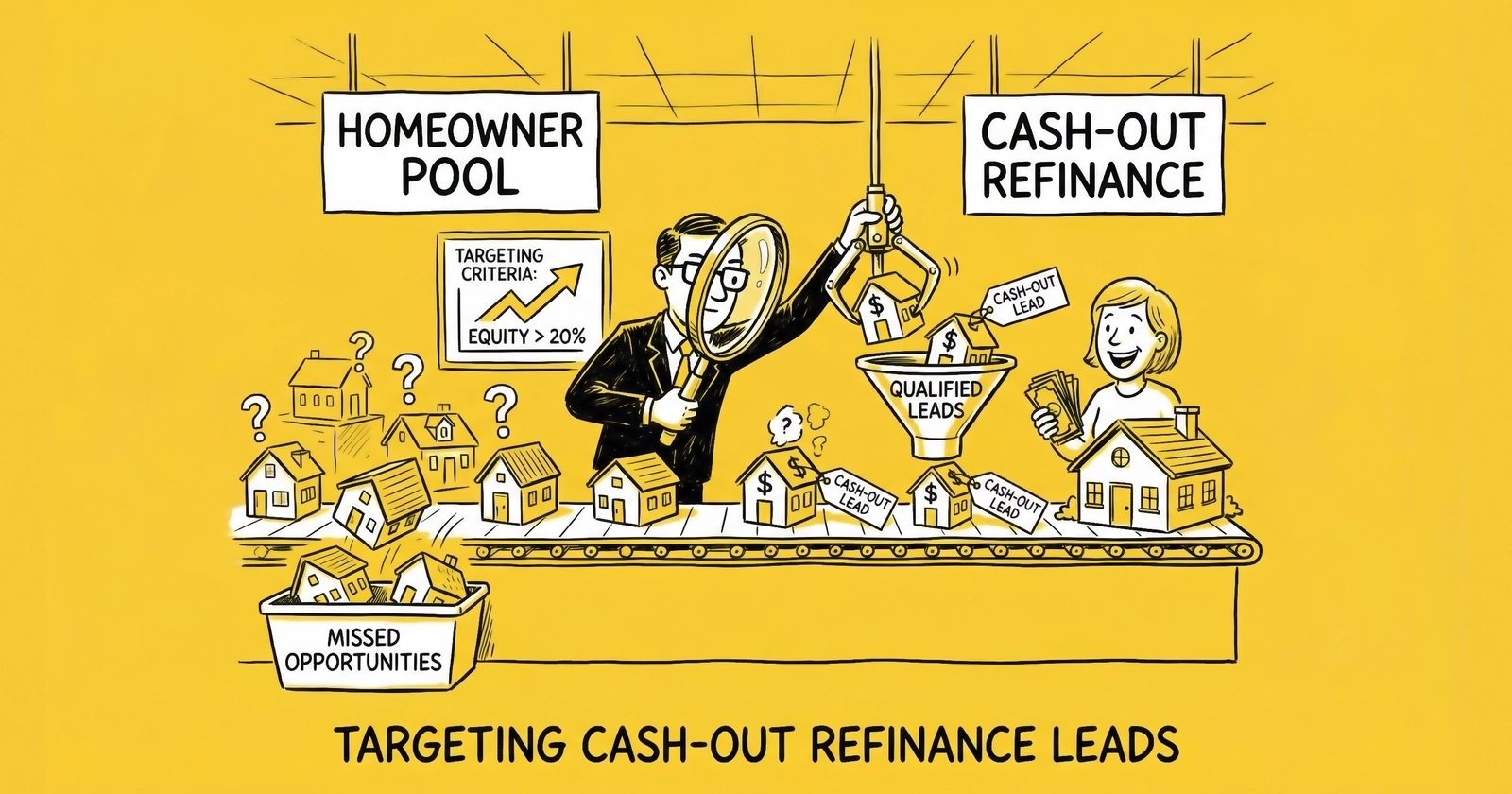
The cash-out refinance market requires precision targeting that most lead generators get wrong. Here is how to identify homeowners with actionable equity, craft messaging that converts in high-rate environments, and build sustainable lead operations when traditional refinance economics break down.
The Cash-Out Opportunity in a Rate-Locked Market
American homeowners are sitting on approximately $17.6 trillion in home equity as of Q3 2024, with tappable equity – the amount available while maintaining a healthy 20% cushion – exceeding $11 trillion. This represents the largest concentration of accessible household wealth in history. Yet most of this equity remains untouched, trapped by the “golden handcuffs” of historically low mortgage rates that homeowners refuse to surrender.
This creates a paradox for lead generators. Traditional rate-and-term refinance has collapsed – down 70% from 2021 peaks – because the 30 million homeowners with sub-4% mortgages will not refinance into 6.5-7% rates under any reasonable marketing scenario. But cash-out refinance operates on different logic. Homeowners who need capital for debt consolidation, home improvements, education funding, or business investments may accept higher rates when the alternative is credit card debt at 20%+ or personal loans at 12-15%.
The cash-out refinance market generated approximately $48.6 billion in origination volume in Q3 2024, representing 26% of all refinance activity. This share has grown steadily as rate-and-term volume contracted, because cash-out serves needs that exist independently of rate environment. ICE Mortgage Technology data shows cash-out refinances averaging $63,400 in equity extraction – substantial transactions that justify meaningful lead acquisition costs. For a broader view of how mortgage lead economics work, see our mortgage lead generation guide.
For lead generators, the opportunity is significant but demands different targeting, different messaging, and different operational approaches than traditional refinance. You are not selling lower payments. You are selling liquidity – access to capital that homeowners have but cannot otherwise tap. Understanding this distinction determines whether your cash-out campaigns generate sustainable returns or burn through budget chasing prospects who will never convert.
Understanding Cash-Out Refinance Economics
Before building lead generation strategy, you need to understand the economics that drive – and limit – cash-out refinance demand. These economics determine who will convert, what motivates them, and how to position your offer against alternatives.
The Rate Environment and Its Impact on Demand
As of late 2025, 30-year fixed mortgage rates trade in the 6.3-6.9% range, with periodic dips toward 6.0% and spikes toward 7.2% based on economic data and Federal Reserve policy signals. This rate environment creates specific dynamics that shape every cash-out refinance conversation.
The “rate lock-in” effect constrains supply dramatically. Approximately 60% of outstanding mortgages carry rates below 4%, with another 20% between 4-5%. These homeowners face payment shock of $500-$1,500 per month if they refinance their entire balance at current rates. Most will not do this voluntarily, regardless of how much equity they have. This single factor eliminates the majority of the homeowner population from your viable prospect pool.
Cash-out economics differ fundamentally from rate-and-term refinance. A homeowner extracting $80,000 from their equity is evaluating the cost of that $80,000 – the incremental interest expense – against alternative financing options. Consider a homeowner with a $250,000 mortgage at 3.5% who refinances to $330,000 at 6.75%. Their payment increases from approximately $1,122 to $2,140 – an additional $1,018 monthly. But that same $80,000 on credit cards at 22% would cost $1,467 monthly in interest alone. The cash-out refinance, while painful, may still make mathematical sense for the right borrower.
Home equity alternatives compete directly with cash-out refinance, and this competition is intensifying. HELOCs and home equity loans let homeowners tap equity without disturbing their first mortgage. HELOC rates currently range from 8-10%, while home equity loans run 8-9%. For many homeowners, an $80,000 HELOC at 9% ($600/month interest-only) preserves their 3.5% first mortgage while still accessing capital – often a better solution than cash-out refinance. This reality shapes your first targeting principle: cash-out refinance leads are most viable from homeowners whose existing mortgage rates are already elevated (5.5%+) or whose equity needs exceed comfortable HELOC limits (typically $100,000+).
Who Actually Converts: The Viable Candidate Profile
Understanding which homeowners represent realistic cash-out candidates helps focus acquisition spend on prospects who can actually convert rather than those who will inquire but never close.
Recent-vintage purchasers from 2022-2023 represent your most accessible prospect pool. Homeowners who purchased at 6.5-7.5% rates during that peak period have minimal rate lock-in pain. Refinancing from 7% to 6.75% while extracting equity creates almost no payment impact on the original balance while providing substantial liquidity. This cohort represents approximately 8-10 million mortgages and should form a cornerstone of your targeting strategy.
Long-term homeowners with minimal existing debt present a different but equally valuable opportunity. Those who purchased 15+ years ago and have paid down significant principal often carry small remaining balances relative to their property values. A $75,000 remaining mortgage at any rate, refinanced to $200,000 at 6.75%, provides $125,000 in accessible capital with a payment of approximately $1,298 – potentially lower than original payments on larger balances. The math works because the new loan amount remains modest relative to income.
High-equity homeowners with substantial capital needs justify cash-out refinance regardless of rate considerations. Borrowers seeking $150,000+ in cash often find HELOCs inadequate (many lenders cap at $100,000) or unavailable at those amounts due to combined loan-to-value restrictions. Major renovations, business investments, or debt consolidation involving significant balances may require cash-out refinance as the only viable option.
Credit-challenged homeowners who don’t qualify for competitive HELOC rates (typically requiring 700+ credit scores) may find cash-out refinance more accessible. FHA cash-out refinance allows credit scores as low as 580, with streamlined documentation requirements in some cases. This segment converts differently but can represent sustainable volume at appropriate pricing.
The Numbers That Determine Conversion
Lead generators need to understand the financial thresholds that determine conversion viability. These benchmarks should inform your targeting criteria and qualification questions.
| Factor | Threshold | Impact on Viability |
|---|---|---|
| Current mortgage rate | Below 4.5% | Low viability unless massive equity extraction |
| Current mortgage rate | 4.5-5.5% | Moderate viability for significant needs |
| Current mortgage rate | Above 5.5% | High viability – minimal rate pain |
| Equity extraction amount | Below $50,000 | HELOC likely better option |
| Equity extraction amount | $50,000-$100,000 | Either product viable |
| Equity extraction amount | Above $100,000 | Cash-out often necessary |
| Credit score | Below 620 | FHA cash-out primary option |
| Credit score | 620-700 | Standard options with rate premium |
| Credit score | Above 700 | Full product range available |
Cash-out refinance leads converting at 2-3% represent sustainable economics when lead costs stay below $80-120. Understanding mortgage lead quality indicators helps you identify the most convertible prospects. Leads converting at 1% or below – common when targeting the wrong homeowner profiles – require sub-$40 CPLs to work, which limits scale and quality simultaneously.
Identifying Cash-Out Candidates Through Equity Triggers
Effective cash-out refinance targeting requires identifying homeowners experiencing specific triggers that create capital needs. Broadcasting generic refinance messaging to all homeowners wastes budget on audiences without actionable intent. Trigger-based targeting concentrates spend on prospects actively seeking solutions.
Debt Consolidation as the Primary Driver
Homeowners with high credit card utilization, multiple revolving accounts, or recent credit inquiries often seek consolidation solutions that home equity can provide. Credit bureau data (where accessible through compliant data providers) can identify households with $30,000+ in unsecured debt – prime candidates for cash-out consolidation messaging. The math is compelling: converting 22% credit card debt to 6.75% mortgage debt can save $500+ monthly on $40,000 consolidated.
Reaching these prospects requires meeting them where they are already seeking solutions. Contextual advertising on debt consolidation content captures attention at the moment of highest intent. Keyword campaigns around “consolidate debt,” “pay off credit cards,” and “high-interest debt” connect with active searchers. Financial comparison site placements position cash-out as an alternative to personal loans and balance transfers. Direct mail to households with elevated debt-to-income indicators brings the solution to those who haven’t yet started searching.
Home Improvement Intent and Renovation Financing
Major renovation projects create capital needs that often exceed emergency savings or comfortable HELOC limits. Kitchen remodels typically run $30,000-$75,000, additions cost $80,000-$200,000, and ADU construction ranges from $100,000-$300,000. Homeowners actively researching renovation costs represent high-intent cash-out candidates because they have already committed mentally to the project and are now focused on financing.
The targeting opportunities mirror where these prospects spend their research time. Partnerships with home improvement retailers and contractors create referral pathways. Content marketing around renovation financing captures organic search traffic from project planners. Contextual advertising on home improvement sites and content reaches prospects in planning mode. Keyword campaigns around “renovation financing,” “home addition cost,” and “remodel loan” intercept specific queries. Geographic targeting in markets with high renovation activity concentrates spend where demand clusters.
Life Events and Major Expenses
Divorce settlements, estate distributions, business startups, college tuition, and medical expenses create capital needs that exceed normal cash flow. These triggers often coincide with increased financial stress and active solution-seeking behavior, making prospects more receptive to cash-out messaging.
Life event targeting through programmatic platforms enables reaching these prospects based on behavioral signals. Keywords around specific triggers (“divorce buyout,” “college tuition financing”) capture explicit searches. Contextual placement on relevant content reaches prospects researching their situations. Demographic targeting (families with college-age children, recent empty-nesters) identifies populations likely to face these needs.
Investment opportunities drive a different but equally valuable prospect segment. Real estate investors, small business owners, and entrepreneurs frequently tap home equity for capital deployment. These borrowers evaluate cash-out refinance as a funding source competing with business loans, private lending, and equity investment – and home equity often wins on rate. Real estate investor forums and communities, small business financing content, keyword campaigns around “investment property funding,” and B2B targeting for self-employed homeowners all reach this audience effectively.
Secondary Indicators and Data Sources
Beyond primary triggers, secondary indicators help prioritize prospects within targeted audiences. Loan-to-value headroom matters – homeowners whose current LTV allows substantial cash extraction (65% or lower) have room to access capital, while those already at 80%+ LTV have limited extraction opportunity. Property appreciation in markets with 20%+ gains since purchase creates equity that didn’t exist at closing. Length of ownership correlates with lower remaining balance and more accumulated equity. Property type affects product availability, with single-family homes and low-density properties typically supporting higher LTVs and more predictable appraisals than condos or multi-family.
Effective equity trigger targeting requires data sources that identify prospects matching these criteria. Property data providers like CoreLogic, Black Knight, and ATTOM offer homeowner databases with estimated equity, mortgage vintage, and property characteristics. Credit bureau data identifies households with debt consolidation potential, recent credit seeking, or financial stress indicators. Behavioral data captures intent signals – searches for renovation contractors, visits to debt consolidation sites, engagement with financial content. Programmatic targeting through DSPs enables combining homeowner status with behavioral and contextual signals for layered targeting that improves precision substantially.
Messaging Strategies for High-Rate Environments
Cash-out refinance messaging in elevated rate environments cannot rely on traditional “lower your payment” appeals. When rates are 6.5%+, most cash-out refinances increase payments substantially. Effective messaging reframes the conversation around capital access, financial optimization, and alternative cost comparison.
The Alternative Cost Framework
The most effective cash-out messaging positions the refinance against more expensive alternatives rather than against the homeowner’s current payment. This reframing changes the psychological calculation entirely.
Credit card comparison anchors the value proposition clearly: “Access your equity at 6.75% instead of carrying credit card debt at 22%.” This reframes the conversation from “your mortgage rate is going up” to “your debt servicing cost is going down.” Specific messaging angles include “Your home equity costs 6.75%. Your credit cards charge 22%. Which should you use?” and “Consolidate $40,000 in debt and save $450 monthly in interest charges.”
Personal loan comparison works similarly for different prospect segments: “Home equity at 6.75% vs. personal loans at 12-15%.” For borrowers considering personal loans for major expenses, cash-out refinance offers rate advantages that justify the complexity. Angles like “Personal loans charge 12%+. Your equity is available at half that rate” and “Fund your renovation at mortgage rates, not personal loan rates” resonate with this audience.
HELOC comparison targets appropriate candidates whose existing mortgage rates are already elevated or whose equity needs exceed comfortable HELOC limits. “Lock your equity rate permanently instead of floating with HELOC uncertainty” appeals to rate-sensitive borrowers, while “Extract $150,000+ without multiple credit lines or blended rates” speaks to those with substantial capital needs.
Purpose-Driven Messaging That Converts
Generic “tap your equity” messaging underperforms purpose-specific appeals that speak directly to borrower motivations. Each purpose category requires distinct messaging and landing page alignment.
Debt consolidation messaging focuses on simplification and relief: “One payment. One rate. One path to debt freedom.” The emotional appeal connects with the stress of multiple payments: “Your home can eliminate $40,000 in high-interest debt – and cut your monthly payments by $600.” The practical appeal addresses operational complexity: “Stop juggling credit card payments. Consolidate into one manageable mortgage.”
Home improvement messaging ties equity to dreams: “Your dream kitchen is already paid for – it’s in your equity.” The financial angle emphasizes smart funding: “Fund your renovation at mortgage rates, not contractor financing.” The value creation message positions cash-out as investment: “Add value to your home using the value already there.”
Investment and business messaging speaks to sophisticated borrowers who think in returns: “Your next investment property is sitting in your current home’s equity.” The arbitrage angle resonates with financially literate prospects: “Smart investors use 6.75% capital to generate 12%+ returns.” The growth message connects equity to ambition: “Fund your business expansion with the most affordable capital available.”
Family and education messaging carries emotional weight: “Four years of tuition without student loan interest rates.” The planning angle positions cash-out as responsible financial management: “Your home equity today funds their future tomorrow.”
Acknowledging Rate Realities
Sophisticated messaging acknowledges rate realities rather than ignoring them. Prospects know rates are elevated – pretending otherwise damages credibility.
Reframing the conversation directly addresses the objection: “Yes, rates are higher than 2021. They’re still lower than every other capital source you have.” Putting rates in context helps prospects think clearly: “Mortgage rates are elevated. Credit card rates are at 30-year highs. Your equity remains your cheapest capital.”
Emphasizing stability appeals to risk-averse borrowers: “Lock your rate today before further increases.” The certainty message reduces anxiety: “Fixed-rate cash-out means your payment never changes, no matter what happens to rates.”
Targeting rate-appropriate candidates with explicit messaging improves conversion: “If you bought in 2022-2023, today’s rates may actually improve your situation.” Direct qualification messaging filters effectively: “Homeowners with 5.5%+ mortgages: refinancing with cash-out could work better than you think.”
Testing Framework for Message Optimization
Cash-out messaging requires systematic testing to optimize conversion. Test variables should include the primary appeal (payment savings vs. alternative cost comparison), specificity level (generic equity access vs. specific use case), rate framing (ignoring rates vs. acknowledging and reframing), call-to-action language (“Get quote” vs. “See how much you save”), and urgency presence (none vs. “Before rates rise again”). Each test should track both CPL and conversion to funded loan, as improving one metric while degrading the other produces no net benefit.
Landing Page Optimization for Cash-Out
Cash-out refinance landing pages require different optimization approaches than traditional mortgage pages. The visitor arrived seeking capital solutions, not rate shopping. Page structure should reflect this intent hierarchy.
Information Architecture That Converts
Lead with the solution, not the product. Open with equity access and capital availability, not mortgage terminology. Effective headline patterns include “Access $50,000-$250,000 in Home Equity,” “Your Home’s Value Can Fund [Purpose],” and “Turn Home Equity into Available Capital.” Avoid product-focused language like “Cash-Out Refinance Rates” or “Mortgage Refinancing Options” that misses user intent.
Establish credibility immediately because cash-out refinance involves significant financial decisions. Trust signals matter: lender partnerships or marketplace affiliations, NMLS disclosure and licensing information, security and privacy assurances, and client testimonials or review aggregations. Without these elements, form completion rates suffer dramatically.
Address rate concerns proactively rather than hiding the rate environment. Display current mortgage rates (6.5-7.0%), compare them to credit card rates (20-25%), and reinforce the value proposition: “Your equity remains your most affordable capital source.” Transparency builds trust and pre-qualifies prospects who understand the trade-offs.
Form Design That Balances Qualification and Completion
Cash-out forms require specific fields to qualify leads effectively while maintaining completion rates. The tension between these goals shapes optimal form design.
Essential fields include property address (for equity estimation), estimated property value or confidence in valuation, current mortgage balance, desired cash-out amount, use of funds (critical for routing and messaging), and contact information. These fields enable basic qualification and buyer routing without excessive friction.
Valuable qualifiers like current mortgage rate, credit score range, employment status, and timeline for funding needs improve lead quality substantially but increase abandonment. Consider multi-step reveal where these appear after initial commitment.
Multi-step forms typically outperform single-page forms for cash-out leads by 25-40%. Breaking the form into logical sections – property information, current mortgage, funding needs, contact details – reduces perceived complexity while capturing comprehensive data. Progress indicators (“Step 2 of 4”) improve completion by 15-20%. Real-time equity estimates displayed during form completion increase engagement and conversion by showing prospects immediate value for their information investment.
Use of funds selection should appear early in the form flow. This field qualifies intent and urgency, enables messaging personalization in subsequent steps, supports buyer routing by product specialty, and filters prospects by conversion probability. The information it provides justifies its placement despite adding friction.
Compliance Elements for Cash-Out Pages
Cash-out landing pages require specific compliance elements that cannot be compromised for conversion optimization. TCPA consent language must be clear, conspicuous, and specific about who will contact the prospect. Though the FCC’s one-to-one consent rule was vacated in January 2025, many sophisticated lender buyers require seller-specific consent, meaning generic “partners” language may be insufficient for buyer acceptance. Rate disclosure is required if any rate information appears on the page, with state regulations varying on advertising requirements. Privacy policy and data usage disclosure address financial services prospects who expect clear data handling information. NMLS disclosure applies if operated by or affiliated with licensed mortgage entities. Equal Housing Lender logo is required if applicable to affiliated lenders.
Traffic Sources and Channel Strategy
Cash-out refinance lead generation spans multiple traffic channels, each with distinct economics, audience characteristics, and optimization requirements. Diversification across channels protects against single-source dependency while enabling scale.
Paid Search as the Highest-Intent Channel
Google Ads remains the highest-intent traffic source for cash-out leads, though competition is intense and costs reflect that intensity.
Primary keyword categories span explicit cash-out terms, purpose-driven queries, and comparison shopping. Cash-out specific keywords like “cash-out refinance” ($15-25 CPC), “cash-out refi rates” ($12-20 CPC), “tap home equity” ($8-15 CPC), and “refinance and get cash” ($10-18 CPC) capture prospects with formed intent. Purpose-driven keywords like “pay off credit cards with home equity” ($6-12 CPC), “finance home renovation” ($5-10 CPC), “home equity for debt consolidation” ($8-14 CPC), and “renovation loan options” ($4-8 CPC) reach prospects earlier in their journey at lower costs. Alternative financing seekers searching “HELOC vs cash-out refinance” ($10-18 CPC), “best way to access home equity” ($6-12 CPC), and “home equity loan options” ($8-15 CPC) are actively comparing options and can be influenced.
Campaign structure should separate campaigns by intent category to optimize bidding and messaging independently. Geographic bid modifiers for markets with high equity concentrations improve efficiency. Audience layering – homeowner audiences, financial intent audiences, life event audiences – improves targeting precision. Daypart bidding optimization recognizes that mortgage leads typically convert better during business hours when consumers expect to receive calls.
Landing page alignment must be precise. Each keyword category should route to purpose-matched landing pages: cash-out explicit keywords to rate and equity-focused pages, debt consolidation keywords to consolidation-focused pages, renovation keywords to home improvement financing pages. This alignment improves Quality Score, reduces CPC, and increases conversion by matching user intent to page content.
Social Media Targeting for Cash-Out
Facebook and Instagram offer targeting capabilities that enable equity trigger identification at scale.
Homeowner targeting combined with interest and behavioral signals creates precise audiences. Interest in home improvement captures renovation intent. Financial services interest identifies optimization seekers. Life event targeting (new parents, recent movers, approaching retirement) captures prospects facing capital needs. Lookalike audiences from converted cash-out leads find similar prospects efficiently.
Social creative must stop scroll while communicating value proposition quickly. Lead with specific dollar amounts (“Access $75,000-$200,000”). Show the outcome, not the product (renovated kitchen, debt-free celebration). Use video for complex value propositions that require more explanation. Test carousel formats for multi-benefit messaging that covers multiple use cases.
Native lead forms (Facebook Lead Ads) reduce friction but typically generate lower-quality leads than landing page conversions. For cash-out refinance, where qualification matters significantly, landing page routing often outperforms native forms despite higher CPL. If using native forms, add qualifying questions including estimated home value, current mortgage balance, desired cash-out amount, and timeline for funds.
Programmatic Display and Content Marketing
Programmatic channels enable layered targeting combining homeowner data with behavioral signals. Effective targeting combinations include homeowner data plus debt consolidation content engagement, homeowner data plus home improvement content engagement, homeowner data plus recent credit seeking indicators, and high-equity markets plus financial services interest.
Display creative must work harder than search to capture attention and communicate relevance. Include clear equity dollar amounts, strong value propositions (rate comparison, consolidation savings), urgency elements where appropriate, and retargeting sequences for non-converters. Publisher selection matters – financial services publishers (NerdWallet, Bankrate, The Motley Fool) offer higher-intent contexts than general news or entertainment inventory. Home improvement publishers (This Old House, HGTV, Houzz) align with renovation-motivated cash-out seekers.
Organic content provides sustainable lead flow at lower marginal costs but requires significant investment timeline. High-value content topics include “Cash-Out Refinance vs. HELOC: Which Is Right for You?”, “How Much Equity Can I Cash Out? Calculator and Guide,” “Cash-Out Refinance for [Debt Consolidation/Home Improvement/etc.],” “Cash-Out Refinance Requirements: Complete 2025 Guide,” and “When Does Cash-Out Refinance Make Sense in a High-Rate Environment?” New content requires 6-12 months to achieve significant organic visibility, so content marketing represents investment in future lead flow, not immediate volume.
Lead Quality and Buyer Relationship Management
Cash-out refinance leads require specific qualification standards and buyer relationship structures to support sustainable economics. Quality determines buyer satisfaction, pricing power, and long-term viability.
Quality Indicators That Predict Conversion
High-quality cash-out leads demonstrate specific characteristics that predict conversion probability.
Equity verification matters fundamentally. Leads from homeowners with verifiable equity (property data validation of value minus mortgage balance) outperform unverified leads significantly because the basic transaction requirement is confirmed. Purpose specificity indicates intent strength – leads with defined use of funds convert at higher rates than generic “cash access” inquiries, with debt consolidation and home improvement purposes typically outperforming undefined needs. Current rate information enables buyer pricing and routing decisions, since homeowners at 5.5%+ rates represent stronger candidates than those at 3.5%. Timeline indicators separate active buyers from researchers – leads with defined funding timelines (30-60 days) convert at higher rates than indefinite inquiries. Credit indicators through self-reported credit score ranges help buyers assess product fit and pricing feasibility.
| Metric | Target Range | Significance |
|---|---|---|
| Contact rate | 45-55% | Reflects data quality and timing |
| Application rate | 15-25% of contacts | Reflects lead qualification |
| Funding rate | 30-40% of applications | Reflects overall quality |
| Return rate | Below 12% | Reflects buyer satisfaction |
| Speed to contact | Under 5 minutes | Critical for conversion |
Buyer Categories and Pricing Structures
Cash-out refinance leads flow to several buyer categories, each with distinct requirements and economics.
Retail mortgage lenders purchase leads for their own origination operations. These buyers typically pay premium prices ($60-120 for exclusive leads) but demand high quality and low return rates. They have direct control over conversion and can optimize their contact processes. Mortgage brokers distribute leads across lender relationships, selecting products based on borrower characteristics. Broker buyers often accept broader lead profiles but may pay lower per-lead prices due to their additional margin requirements. Correspondent lenders originate loans for sale to investors, so their pricing and product requirements depend on current investor appetite. Aggregators and lead marketplaces purchase leads for redistribution, typically at lower per-lead prices but higher volume capacity.
Exclusive cash-out leads typically command $50-100 depending on market, equity amount, and qualification depth. Shared leads (sold to 3-5 buyers) price at $20-40 with correspondingly lower conversion expectations per buyer. Live transfer cash-out leads can exceed $150 when fully qualified (verified homeowner, confirmed equity, defined purpose, immediate availability).
Managing Returns Effectively
Cash-out leads generate returns for specific reasons that differ from traditional mortgage and require distinct handling.
Insufficient equity occurs when property values or mortgage balances differ from consumer estimates, leaving inadequate cash-out capacity. Credit disqualification happens when actual credit scores fall below minimums for available programs. Rate sensitivity means the consumer declines to proceed when actual rates exceed expectations. Purpose misalignment occurs when the consumer’s intended use of funds doesn’t align with lender policies (some lenders restrict cash-out for certain purposes). Timing mismatch means the consumer’s timeline doesn’t align with origination capacity.
Return policies should address these specific failure modes with clear definitions and reasonable windows – typically 5-10 days for qualification returns, 30-60 days for funding-related returns.
Compliance Requirements for Cash-Out Lead Generation
Cash-out refinance lead generation operates under the same regulatory frameworks as traditional mortgage leads, with additional considerations given the consumer protection sensitivities around equity extraction.
TCPA, Consent, and Documentation
TCPA requirements for mortgage leads apply fully to cash-out refinance. Prior Express Written Consent (PEWC) is required before autodialed or prerecorded calls to consumers. Consent language must be clear and conspicuous, and must identify specific parties authorized to call. One-to-one consent requirements (depending on current regulatory status and implementation timing) may require consent specific to each seller rather than broad partner authorizations.
Consent documentation through TrustedForm, Jornaya, or equivalent certification provides evidence of consent capture for compliance defense. This documentation is not optional – without it, regulatory exposure increases dramatically. Do Not Call compliance requires scrubbing against the National Do Not Call Registry and honoring internal suppression requests.
RESPA and Licensing Considerations
RESPA Section 8 prohibitions on kickbacks for referrals apply to cash-out refinance lead generation and require careful attention.
Lead purchases from marketing services (comparison sites, lead aggregators, direct advertising) generally qualify as legitimate marketing expense rather than prohibited referral fees. Arrangements with settlement service providers (real estate agents, title companies) require careful structuring to ensure compensation reflects fair market value for actual services, not referral volume. Marketing Services Agreements require documentation of services performed and fair market value compensation, with no expectation of exclusive referral relationships.
NMLS licensing requirements apply to entities engaged in mortgage origination activities. Lead generators selling to licensed originators generally do not require NMLS registration for pure lead generation. Lead generators employing licensed originators to contact consumers and take applications require company and individual licensing. Buyer verification should confirm buyer licensing status through NMLS Consumer Access before establishing lead supply relationships. Geographic filtering must validate buyer licensing against lead geography before distribution.
Fair Lending and Targeting Practices
Cash-out refinance raises particular fair lending sensitivities that require documented attention.
Targeting practices should not result in disparate impact on protected classes. Exclusions or emphasis by geography should have documented business justification. Pricing practices should be consistent and not vary based on protected characteristics. Marketing representations should accurately reflect product terms and availability. Documentation of targeting rationale provides protection if questions arise.
Seasonal Patterns and Market Timing
Cash-out refinance demand follows seasonal patterns that affect lead generation strategy and pricing. Understanding these patterns enables smarter budget allocation and realistic volume expectations.
Annual Seasonality Across Quarters
Q1 (January-March) brings moderate to strong demand as tax season prompts debt consolidation consideration. Homeowners receiving tax refunds may use them as down payments on renovation projects, while post-holiday credit card balances peak and create consolidation urgency. Home improvement planning for spring/summer creates renovation-focused demand.
Q2 (April-June) represents the peak demand period. Home improvement season drives renovation-motivated cash-out as projects commence. Housing market activity peaks, creating purchase and refinance momentum across the mortgage industry. Credit card balances remain elevated from holiday spending.
Q3 (July-September) shows moderate demand. Home improvement projects continue from spring starts. Back-to-school expenses create family financial pressure. However, summer slowdown in housing activity moderates overall mortgage demand.
Q4 (October-December) typically sees declining demand. Holiday distractions reduce consumer focus on major financial decisions. Year-end tax planning creates some debt optimization activity. Lenders may reduce marketing as annual targets are met or exceeded.
Rate-Driven Volatility Overlays
Seasonal patterns overlay on rate-driven demand shifts that can overwhelm calendar effects.
Rate declines trigger surge demand regardless of season as homeowners previously on the sidelines become viable candidates. The 60% of homeowners with sub-4% rates remain locked in, but marginal prospects at 4.5-5.5% may convert when current rates drop below certain thresholds. Rate increases suppress demand beyond seasonal patterns as marginal candidates exit the market entirely. The viable prospect pool contracts when refinance economics worsen. Volatility itself affects consumer behavior – uncertain rate environment may accelerate decisions (“lock before rates rise further”) or delay them (“wait for rate stabilization”).
These dynamics suggest budget allocation strategies: weight spending toward Q1-Q2 when demand and conversion rates peak, maintain base-level presence in Q3-Q4 to capture consistent demand, reserve budget flexibility for rate-driven opportunities, and monitor leading indicators (Fed policy, Treasury yields) for cycle positioning.
Frequently Asked Questions
What is the average cost of a cash-out refinance lead in 2025?
Cash-out refinance leads typically cost $40-100 for exclusive leads and $15-35 for shared leads, depending on geographic targeting, qualification depth, and market conditions. Live transfer leads with verified homeowner status and confirmed equity can exceed $150. Pricing varies significantly by market – coastal metros command premiums while rural markets may trade at 50-60% of national averages. Leads with specific use-of-funds qualification (debt consolidation, home improvement) typically command 15-25% premiums over unqualified equity access leads.
How do cash-out refinance leads differ from traditional refinance leads?
Cash-out refinance leads target homeowners seeking equity extraction, not rate reduction. This fundamental difference affects targeting (focus on capital needs rather than rate shopping), messaging (alternative cost comparison rather than payment savings), qualification (equity verification rather than rate comparison), and conversion patterns (purpose-driven decision rather than rate-driven timing). Cash-out leads require different landing pages, different buyer routing, and different conversion expectations than rate-and-term refinance leads.
What conversion rate should I expect from cash-out refinance leads?
Quality cash-out refinance leads convert at 2-4% from lead to funded loan, with significant variation based on lead source, qualification depth, and buyer execution. Contact rates typically range from 45-55% for fresh leads. Application rates from contacted leads range from 15-25%. Pull-through from application to funding runs 35-45% for cash-out specifically – slightly lower than purchase mortgages due to equity verification requirements and purpose qualification. Speed-to-contact remains critical: leads contacted within five minutes convert at rates 3-5x higher than those contacted after 30 minutes.
How do I target homeowners with significant equity for cash-out campaigns?
Effective equity targeting combines property data, behavioral signals, and geographic focus. Property data providers (CoreLogic, ATTOM, Black Knight) offer homeowner lists segmented by estimated equity, mortgage vintage, and LTV. Behavioral targeting captures intent signals – searches for debt consolidation, engagement with home improvement content, financial services comparison activity. Geographic targeting focuses on markets with strong appreciation since 2019 and high concentrations of long-term homeowners. Combining these layers improves targeting precision and conversion rates.
Should I focus on debt consolidation or home improvement messaging for cash-out leads?
Both messaging approaches work, but for different audiences with different economics. Debt consolidation messaging targets homeowners with high unsecured debt who seek immediate payment relief – these leads often convert faster but may face credit challenges. Home improvement messaging targets homeowners planning major projects – these leads may have longer decision timelines but typically stronger credit profiles. Test both approaches and develop segmented campaigns rather than choosing one focus. Many successful operations run parallel campaigns with purpose-specific landing pages and buyer routing.
How do elevated interest rates affect cash-out refinance lead economics?
Elevated rates (6.5%+) compress cash-out refinance demand but don’t eliminate it. The key is targeting homeowners whose existing rates are already elevated (5.5%+) or whose capital needs make rate comparison favorable against alternatives (credit cards at 20%+, personal loans at 12%+). Messaging must reframe the conversation from rate comparison to alternative cost comparison. Expect lower overall volume than low-rate environments but viable economics when targeting and messaging align with elevated-rate realities.
What compliance requirements apply specifically to cash-out refinance leads?
Cash-out refinance leads operate under standard mortgage lead compliance frameworks: TCPA consent requirements for calling, RESPA Section 8 prohibitions on referral kickbacks, state licensing requirements through NMLS, and fair lending obligations. Additional sensitivity applies because cash-out refinance involves equity extraction – regulators pay particular attention to marketing representations about rates, terms, and equity access. Ensure consent documentation is robust, rate representations are accurate, and targeting practices have documented business justification.
How do I structure buyer relationships for cash-out refinance leads?
Cash-out refinance buyers include retail mortgage lenders, mortgage brokers, correspondent lenders, and lead aggregators. Exclusive arrangements with direct lenders typically command $50-100 per lead but require consistent quality and low return rates. Broker and aggregator relationships offer volume flexibility but often at lower per-lead prices. Structure return policies with clear definitions – separate equity verification failures from credit declines from consumer-side cancellations. Build relationships across buyer types to maintain distribution options as market conditions shift.
What is the best traffic source for cash-out refinance leads?
Paid search delivers highest intent but also highest competition and cost, with average CPC for cash-out keywords running $15-25 for primary terms. Paid social (Facebook, Instagram) offers targeting flexibility at lower costs but requires stronger creative to capture attention. Programmatic display enables layered targeting (homeowner data plus behavioral signals) at scale. Content marketing provides long-term lead flow at lower marginal cost but requires 6-12 month investment timeline. Most successful operations diversify across channels rather than depending on a single source.
How should I price cash-out refinance leads to buyers?
Lead pricing should reflect acquisition cost, qualification depth, and market conditions. Exclusive cash-out leads with verified homeowner status, confirmed equity range, and defined purpose typically command $60-100. Shared leads at comparable quality price at $20-40. Add premiums for live transfer ($80-150), high-equity markets (20-30% premium), and enhanced qualification (credit verified, purpose confirmed). Build return policies that protect buyer economics while maintaining lead generator viability – typically 5-10 day qualification windows with defined return categories.
Key Takeaways
American homeowners hold $17.6 trillion in home equity, with over $11 trillion tappable – but elevated mortgage rates create targeting challenges that require precision rather than volume-based approaches. Success in this market depends on understanding why cash-out refinance operates on different economics than rate-and-term refinance. Homeowners seek capital access, not payment reduction, so targeting must focus on equity triggers like debt consolidation needs, renovation plans, and major expenses rather than rate shopping behavior.
The viable candidate profile centers on recent-vintage purchasers (2022-2023 at 6.5%+ rates), long-term homeowners with substantial equity, and borrowers with capital needs exceeding HELOC limits. Targeting the 60% of homeowners with sub-4% mortgages wastes acquisition budget on prospects who will not convert under any realistic scenario.
Messaging must reframe the rate conversation around alternative costs. Credit cards at 22%, personal loans at 12-15%, and HELOC uncertainty at 8-10% make 6.75% fixed-rate cash-out attractive despite elevated absolute rates. Purpose-specific messaging outperforms generic equity access appeals – debt consolidation, home improvement, and investment-focused campaigns with dedicated landing pages convert 25-40% better than one-size-fits-all approaches.
Exclusive cash-out leads trade at $50-100, shared leads at $20-40, and live transfers at $100-150+. Pricing reflects qualification depth, geographic market, and current rate environment. Conversion benchmarks of 45-55% contact rates, 15-25% application rates from contacts, and 35-45% pull-through to funding mean overall lead-to-funding conversion of 2-4% represents sustainable economics at appropriate CPL ranges.
Speed-to-contact remains critical in this market. Leads contacted within five minutes convert at 3-5x the rate of 30-minute contacts, so technology infrastructure must support sub-minute response to capture competitive advantage. Compliance requirements mirror traditional mortgage with additional sensitivity around equity extraction marketing – document consent thoroughly, verify buyer licensing, and ensure targeting practices have business justification. Seasonal patterns favor Q1-Q2 for peak demand, with rate-driven volatility overlaying seasonal trends throughout the year.
Sources
-
Federal Reserve: Financial Accounts of the United States (Z.1) - Primary source for aggregate household equity data, supporting the $17.6 trillion home equity figure referenced in this article.
-
FRED: 30-Year Fixed Rate Mortgage Average - Federal Reserve Economic Data tracking current mortgage rate environment and historical trends that drive cash-out refinance economics.
-
Fannie Mae Research and Insights - Industry data on mortgage origination volumes, refinance activity, and cash-out refinance market share.
-
Consumer Financial Protection Bureau: Cash-Out Refinance Overview - Regulatory perspective on cash-out refinance products and consumer protection considerations.
-
TrustedForm - Consent verification platform referenced in mortgage lead compliance discussions.
Market data and regulatory information current as of December 2025. Mortgage rates, lead pricing, and equity conditions change continuously. Validate current conditions through industry sources before making significant investment decisions. This article provides general information and does not constitute legal or financial advice. Consult qualified professionals for specific compliance questions.