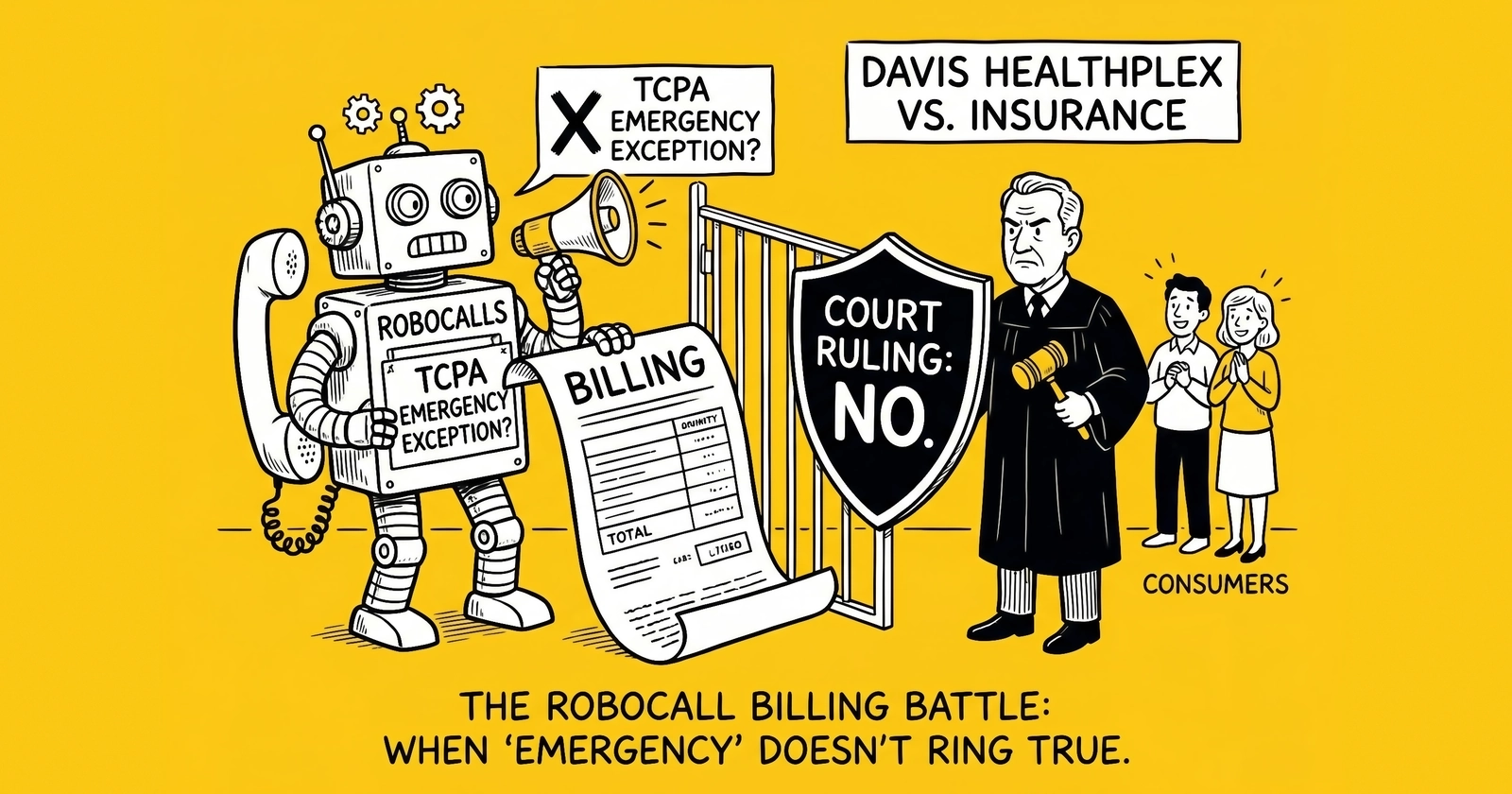
A federal court in the Northern District of New York just told a putative TCPA class that a dental benefits administrator’s prerecorded calls about claim approvals and denials – including calls that reached a wrong number – fell within the statute’s emergency-purposes exception and required no prior express consent. The ruling is real, the doctrinal opening is narrow, and the implications for lead-gen vendors who warm-transfer insurance shoppers are not what most operators are reading them to be.
A Pleading-Stage Dismissal That Re-Maps the Insurance Compliance Surface
On April 14, 2026, Senior District Judge Mae A. D’Agostino of the Northern District of New York dismissed Davis v. Healthplex, Inc., No. 1:25-cv-01682, at the pleading stage. The plaintiff had alleged that Healthplex, a dental benefits administrator, placed prerecorded voice messages to her cellular telephone without prior express consent, in violation of 47 U.S.C. § 227(b)(1)(A)(iii). The calls in question concerned dental claim status – specifically, approvals and denials of submitted claims under a benefits plan administered by Healthplex on behalf of a covered employer. The plaintiff was not the covered enrollee. The number Healthplex dialed had been associated with the enrollee at some prior point and had since been reassigned or otherwise misdirected. The plaintiff received the prerecorded messages despite having no relationship with Healthplex, the enrollee, or the underlying benefits plan.
Under the framework most TCPA practitioners would have applied to those facts as recently as a year ago, the case would have proceeded past the motion to dismiss, gathered discovery, and either settled in the mid-six figures or graduated to class certification. Wrong-number prerecorded-call cases were the bread-and-butter inventory of the TCPA plaintiffs’ bar throughout the post-2015 period. The Reassigned Numbers Database, operational since late 2021, narrowed but did not eliminate exposure. The doctrinal expectation was that a non-consenting recipient of a prerecorded message had a viable claim for $500 per call, trebled to $1,500 for willful or knowing violations.
Judge D’Agostino’s opinion went a different direction. Applying the TCPA’s emergency-purposes exception under § 227(b)(1)(A) – the statutory carve-out that exempts calls “made for emergency purposes” from the prerecorded-call consent requirement – the court held that prerecorded messages concerning the approval or denial of a dental services request bore directly on the recipient’s ability to obtain medical treatment. That nexus, in the court’s reading, brought the calls within the exception’s scope. The fact that the number had been misdirected to a non-enrollee did not change the analysis. The exception, the court reasoned, attaches to the purpose of the call rather than to the relationship between caller and recipient.
For insurance carriers and benefits administrators running post-bind servicing call programs, the holding is meaningful. It articulates a doctrinal pathway that bypasses prior express consent for a category of calls – claim status, eligibility verification, treatment authorization – that carriers had been routing through expensive consent-management infrastructure for the better part of a decade. For lead-gen vendors operating in adjacent space – Medicare Advantage prospecting, dental marketplace warm transfers, ACA enrollment funnels – the holding is also meaningful, but in a precisely opposite direction. It clarifies a boundary that lead-gen operators have been walking around for years without recognizing how distinct it is from the carrier-side servicing pathway.
This analysis covers what the court actually held, why the doctrinal pathway is narrower than the trade-press headlines suggest, how it interacts with the FCC’s existing emergency-purposes guidance and CMS’s TPMO marketing rules, and what compliance officers at lead-gen vendors should be auditing in their prerecorded-message scripts before the next class action lands. The framing throughout is the one that matters operationally: not whether a category is exempt in the abstract, but which specific call types qualify for the exception and which still carry the full $500-to-$1,500 per-call exposure.
The Davis Holding, Read Closely
The full opinion is short – twenty-three pages, including the procedural recitation. But three passages in the legal-analysis section do most of the doctrinal work, and each of them deserves careful reading by insurance and lead-gen compliance teams.
The first concerns the statutory framing. Section 227(b)(1)(A) of Title 47 prohibits, with limited exceptions, prerecorded or artificial-voice calls to wireless telephones unless made with the prior express consent of the called party. The two principal exceptions are calls “made for emergency purposes” and calls “made with the prior express consent of the called party.” The emergency-purposes exception has been on the books since the original 1991 enactment of the TCPA. The FCC has, over the intervening decades, issued only a handful of declaratory rulings interpreting its scope – most notably the 2020 ruling that addressed COVID-19 public-health communications. Outside that pandemic-era guidance, the term “emergency purposes” has been construed by federal courts on a case-by-case basis, with most courts reading it narrowly to cover communications about immediate threats to health or safety.
The Davis court began from that narrow-construction baseline but reached a result that materially extends what counts as health-affecting. The opinion emphasized that “the approval or denial of a dental services request bears on the patient’s ability to obtain medical treatment” and that prerecorded notifications about claim status are therefore “informational communications affecting the recipient’s access to care.” The court drew a line between (a) communications about the underlying benefits relationship, which the court treated as commercial and outside the exception, and (b) communications about specific treatment-authorization events, which the court treated as health-affecting and within the exception.
The second key passage addresses the wrong-number issue. The plaintiff argued that even if claim-status calls might qualify as emergency-purposes communications when delivered to the actual enrollee, they could not retain that character when delivered to a non-enrollee whose number was misdirected. The court rejected the argument. The exception, in the court’s view, attaches to the purpose for which the call was made, not to the relationship between caller and recipient. A prerecorded message that was placed for the purpose of conveying treatment-authorization information remains an emergency-purposes call regardless of who answers the phone. The misdirection produces no liability because the statutory bar does not apply in the first place.
That move is the doctrinal innovation that has the trade press’s attention. The traditional reading of TCPA exemptions tied them to the relationship between the parties: prior express consent is consent of the called party, and the called party in a wrong-number scenario is the recipient, not the intended enrollee. The Davis court refused to import that relationship-tied logic into the emergency-purposes exception. The court read the statute’s text – “made for emergency purposes” – as a purpose-based clause and applied it accordingly.
The third key passage concerns the pleading-stage posture. The court dismissed at the motion-to-dismiss stage rather than allowing discovery on the question of whether the calls were in fact made for emergency purposes. The opinion treated the emergency-purposes character of the calls as evident from the face of the complaint, which had pled enough about the call content to establish that the prerecorded messages addressed claim status and treatment authorization. This procedural choice matters: it means that defendants in similar cases can move to dismiss without first incurring discovery costs, provided they can point to call-script evidence on the face of the complaint or in incorporated documents.
For carriers and benefits administrators, the cumulative effect of the three passages is a usable defense framework: prerecorded calls about specific treatment-authorization events, claim status, or eligibility for care are presumptively within the emergency-purposes exception, the wrong-number issue is not a basis for liability when the exception applies, and the defense is available at the pleading stage. The framework is bounded – it does not reach commercial communications about the benefits relationship as such – but it is meaningfully broader than the pre-Davis defense surface for this class of calls.
The Boundary the Headlines Are Missing: Purpose Versus Relationship
The trade-press coverage of Davis – including the National Law Review piece and the Bubeck Law PrivacySpeak analysis that surfaced within forty-eight hours of the ruling – has emphasized the wrong-number aspect of the holding. That framing is correct as far as it goes, but it obscures the more consequential point. The wrong-number protection is a derivative of the underlying purpose-based reading of the exception. If the call’s purpose qualifies as emergency, the wrong number does not matter. If the call’s purpose does not qualify, the wrong number still does not matter – the call is exposed regardless of whether the recipient is the intended party or a misdirected one.
That symmetry is what compliance officers at lead-gen vendors need to internalize. Davis did not announce a new safe harbor for “calls about insurance.” It announced a safe harbor for calls whose purpose is communicating treatment-authorization information to a benefits enrollee. The carrier-side servicing pathway runs through that safe harbor. The lead-gen prospecting pathway runs nowhere near it.
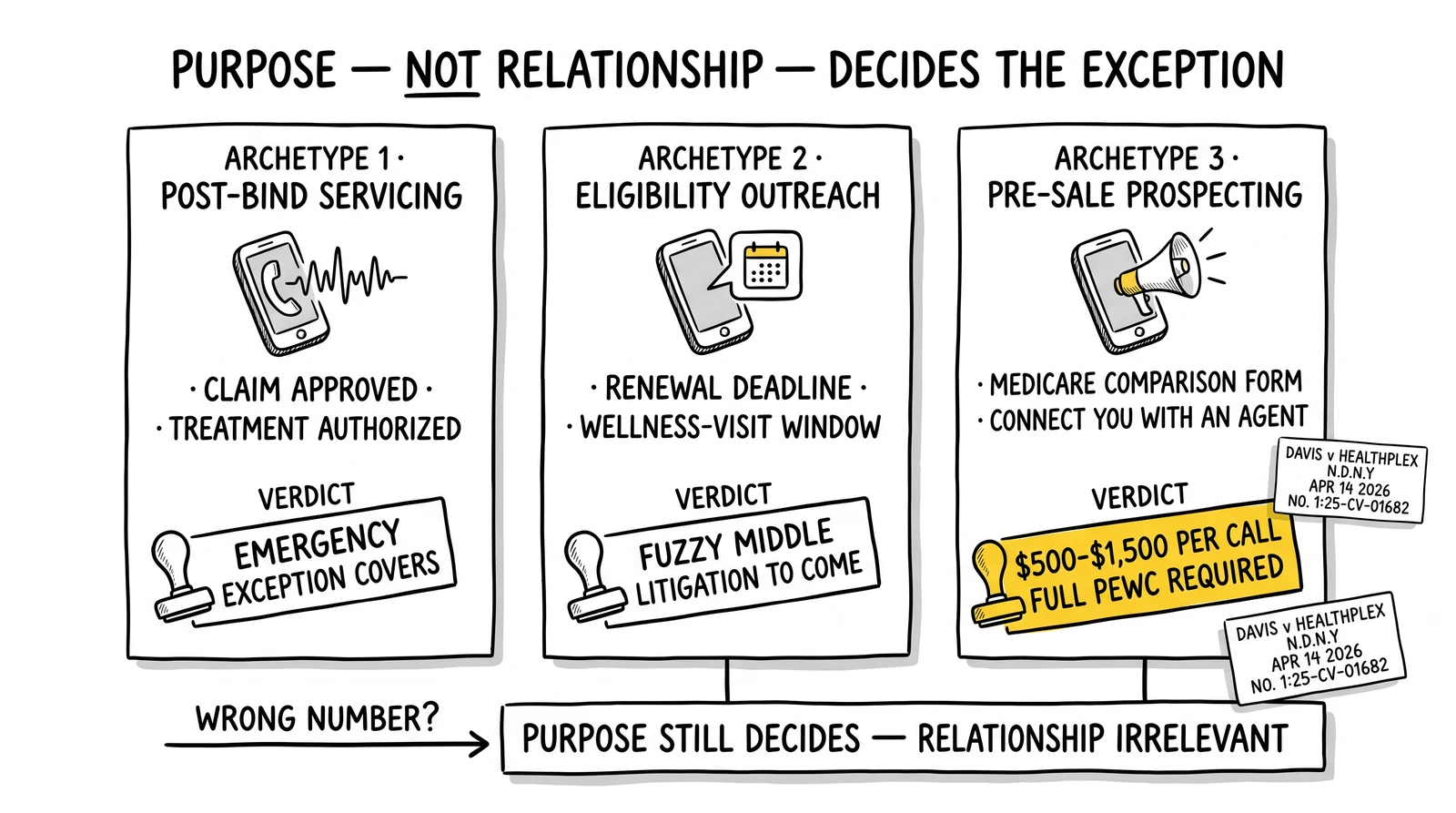
Consider the operational distinction with three call-script archetypes:
Archetype one – post-bind servicing: A dental benefits administrator places a prerecorded call to an enrollee’s number on file to communicate that the enrollee’s claim for a covered procedure has been approved or denied. The script identifies the caller, the enrollee, and the specific claim. The call’s purpose is to convey treatment-authorization information that bears on the enrollee’s ability to obtain care. Davis covers this call. The wrong-number variant – the same call reaching a misdirected number – is also covered.
Archetype two – eligibility outreach: A Medicare Advantage carrier places a prerecorded call to a current member to remind them of an upcoming benefit renewal deadline or a wellness-visit eligibility window. The script identifies the carrier, the member, and the specific deadline. The call’s purpose is informational and tied to ongoing benefits. The Davis framework probably reaches this call, though the reasoning is less direct than in archetype one because the link to immediate treatment-authorization is attenuated. Carriers running these scripts should expect a ruling-by-ruling battle as plaintiffs test the boundary.
Archetype three – pre-sale prospecting: A Medicare lead-gen vendor places a prerecorded call to a consumer who filled out a Medicare comparison form on a third-party website. The script identifies the vendor, references the consumer’s interest in Medicare options, and offers to connect the consumer with a licensed agent. The call’s purpose is commercial – to initiate a sales relationship that does not yet exist. Davis does not cover this call. The full prior-express-written-consent regime applies. Wrong-number variants carry the same $500-to-$1,500 per-call exposure they did before Davis.
The boundary between archetypes one and three is straightforward when the cases are clean. The boundary becomes operationally fraught when a single vendor handles both – for example, when a Medicare TPMO contracts with a carrier to handle both pre-sale prospecting and post-bind member-servicing calls under a single SOW. In that arrangement, the prospecting calls remain fully exposed under § 227(b), the servicing calls are potentially exempt under Davis, and the consent flow that the vendor has bundled together for operational simplicity does not match the legal architecture.
That mismatch is the audit target this ruling creates. Compliance officers at TPMOs, lead-gen vendors, and call-center operators serving the insurance space should be running their existing prerecorded-message inventory through a sort that distinguishes purpose-of-the-call categories. Calls in category one (post-bind, treatment-authorization) get one consent and disclosure architecture. Calls in category three (pre-sale prospecting) get the full PEWC architecture under the existing TCPA consent rules. Calls in the fuzzy middle – eligibility reminders, plan-change notifications, renewal outreach – get a separate review track that may need to be litigated forward over the next eighteen months as additional courts construe the Davis framework.
How Davis Sits in the Existing Emergency-Purposes Doctrine
The emergency-purposes exception predates the modern TCPA jurisprudence. The 1991 statute included it, and the FCC’s 1992 implementing rules defined “emergency purposes” as calls “made necessary in any situation affecting the health and safety of consumers.” That definition remained essentially unchanged for nearly three decades, with the FCC issuing only narrow case-specific rulings – a 2002 ruling addressing certain school-safety communications, a 2012 ruling addressing certain healthcare-provider notifications, and the 2020 declaratory ruling on COVID-19 public-health communications.
The 2020 pandemic ruling is the most relevant precursor to Davis. In that ruling, the FCC held that calls from healthcare providers, hospitals, and government health agencies about COVID-19 public-health information – testing availability, vaccination clinics, treatment-protocol updates – qualified as emergency-purposes calls and could be made without prior express consent. The ruling was carefully bounded to public-health communications during a declared emergency and explicitly excluded commercial communications about insurance products or healthcare services more generally.
Davis extends the framework in two ways the 2020 ruling did not. First, it applies the exception outside a declared public-health emergency context to ordinary-course benefits-administration communications. The court did not require any showing that the dental claims at issue involved emergency dental procedures or time-critical treatment decisions. The general category – benefits-claim notifications – was sufficient. Second, it disconnects the exception from the relationship between caller and recipient, applying purpose-based reasoning to wrong-number scenarios that the 2020 ruling did not address.
The doctrinal lineage that Davis most clearly continues is the small line of district-court cases reading the exception to cover provider-to-patient communications about appointment scheduling, prescription notifications, and prior-authorization decisions. Those cases – scattered across several circuits and not reduced to a controlling appellate decision – have generally treated communications about specific treatment events as emergency-purposes calls, while treating commercial communications about provider services or insurance products as outside the exception. Davis slots cleanly into that line, and the trade-press attention reflects the fact that it is the highest-profile pleading-stage dismissal in the line to date.
What Davis does not do is overturn the contrary authority. Several federal courts have read the exception more narrowly, requiring a showing of immediate threat to health or safety before the exception applies. The Bell line of cases – addressing survey and informational calls – established that purely informational calls about non-time-critical matters do not qualify. The Sixth Circuit’s Lindenbaum decision, which addressed a different exemption issue, contains dicta cautioning against expansive readings of TCPA exceptions generally. Davis exists in tension with that contrary authority, and the inevitable next round of litigation will test whether the Davis framing survives appellate review.
For lead-gen and TPMO compliance officers, the practical takeaway is to treat Davis as a non-controlling but persuasive authority that creates defense optionality for a specific category of post-bind servicing calls, while not changing the underlying analysis for pre-sale prospecting calls. The optionality is real, but it is bounded by both the limits of the Davis reasoning and the contrary authority that has not gone away.
The CMS TPMO Layer: Where Insurance Lead Gen Already Runs a Different Playbook
The Medicare Advantage and Part D ecosystem operates under a regulatory layer that Davis does not address but that compliance officers in the space cannot ignore. The Centers for Medicare & Medicaid Services finalized expanded third-party marketing organization rules in the 2023 Medicare Advantage and Part D rulemaking, which became effective for the 2024 plan year and have been progressively tightened in subsequent rules through 2026. The TPMO framework imposes call-recording requirements, scripted disclosure requirements, and a one-to-one consent rule for lead generation that operates on top of the TCPA framework rather than replacing it.
For a Medicare lead-gen vendor, the operational reality is that compliance is a layered exercise. The TCPA layer governs whether a prerecorded call can be made at all without consent, and at what consent level. The CMS TPMO layer governs what the call must say once it begins, what disclosures must be on the recording, and how the resulting lead can be sold or transferred. Both layers must be satisfied. Davis moves the TCPA layer slightly for post-bind servicing calls, but it does not move the CMS layer at all, and the CMS layer is the binding constraint for most pre-sale Medicare communications anyway.
This is why the Davis ruling is not a usable defense for the bulk of insurance lead-gen call inventory. A Medicare TPMO’s outbound prospecting call to a consumer who filled out a comparison form is governed by the TCPA’s PEWC requirement (because the call is commercial) and by the CMS TPMO call-recording and disclosure requirements (because the call is in the Medicare marketing channel). The emergency-purposes exception is irrelevant because the call’s purpose is commercial, not treatment-authorization. The fact that Davis clarifies the wrong-number protection for treatment-authorization calls does not help.
The dental and vision verticals have a parallel structure with less prescriptive federal regulation but state-level analogs. Dental benefits marketing is regulated under each state’s insurance code, with several states (California, Florida, Texas) imposing call-recording and disclosure requirements that mirror or extend the CMS TPMO model. Vision benefits marketing operates under a similar patchwork. In each case, the regulatory architecture distinguishes between post-bind servicing calls (which are typically allowed under the underlying benefits contract and any consent obtained at enrollment) and pre-sale marketing calls (which are governed by the full state and federal consent regime). Davis moves the federal layer for the former; it leaves the latter unchanged.
For a lead-gen operator with a Medicare AEP call-center program, the compliance audit triggered by Davis is not whether the emergency-purposes exception can now cover prospecting calls – the answer is no. The audit asks whether the operator currently bundles servicing and prospecting under a single consent flow, and if so, whether the operation is creating asymmetric exposure by treating both categories the same when the legal architecture treats them differently. Most operators bundle the flows for operational simplicity. The post-Davis environment makes that bundling more expensive in expected-value terms, because the servicing side has gained an additional defense pathway that the prospecting side cannot share.
The Operational Audit Davis Triggers
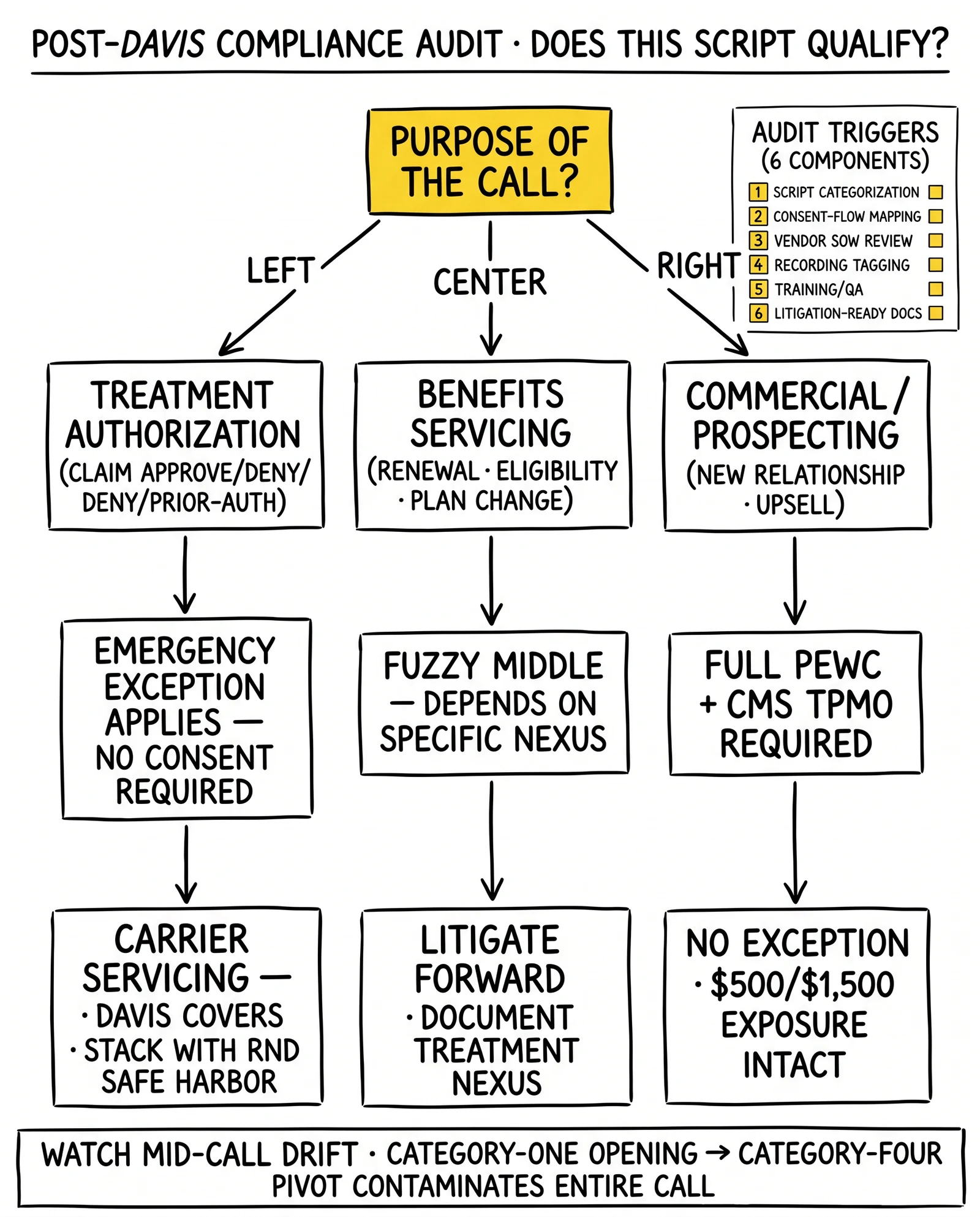
The compliance officer’s Monday-morning move after a ruling like Davis is to run an internal audit that maps the current prerecorded-call inventory to the doctrinal categories the ruling clarifies. The audit has six distinct components, each of which produces a different operational output.
Component one: script categorization
Every prerecorded-message script in the operator’s inventory should be categorized by the purpose of the call. The categories that matter for Davis analysis are post-bind treatment-authorization (claim approvals, denials, prior-authorization notifications), post-bind benefits servicing (eligibility reminders, plan-change notifications, renewal outreach), pre-sale prospecting (lead-generation calls to consumers without an existing relationship), and post-bind retention or upsell (cross-sell calls to existing enrollees). The categorization should be done at the script level, with a written record of the basis for each categorization that can be produced if challenged.
Operators routinely discover at this stage that scripts they had treated as a single category in fact contain mixed purposes. A “claim status” script that begins with the claim-status notification and pivots to a cross-sell of supplementary coverage is not a category-one script. It is a category-one opening followed by a category-four pivot, and the pivot probably contaminates the entire call for emergency-purposes analysis. Splitting such scripts into purpose-pure variants is a common output of this audit step.
Component two: consent-flow mapping
Once the scripts are categorized, the operator should map each script to the consent flow that governs it. Most TPMOs and benefits administrators run a small number of consent flows – typically one or two – and apply them across all script categories. A Davis-aware compliance posture distinguishes between consent flows for category-three (pre-sale prospecting) calls, which require full prior express written consent, and consent flows for category-one (treatment-authorization) calls, which may not require any consent if the emergency-purposes exception applies.
The mapping exercise frequently surfaces orphaned scripts – scripts that have been running on a consent flow that does not match the script’s purpose. A category-three prospecting script running on a category-one consent assumption is an exposure. A category-one servicing script running on a category-three consent assumption is unnecessary friction. Both patterns are common and both are correctable once identified.
Component three: vendor SOW review
For carriers that contract their call operations to TPMOs or other vendors, the SOW that governs the relationship should be reviewed for whether it bundles call categories that the legal architecture now treats differently. Many SOWs were written in 2022-2023 when the doctrinal landscape was simpler, and they treat all carrier-related prerecorded calls as a single deliverable governed by a single consent and disclosure framework. Davis makes that bundling more costly because it creates a defensible servicing-call category that the SOW does not separately recognize and bill for.
The SOW review should produce one of three outcomes per contract: no change (the SOW already separates categories appropriately), amendment (the SOW needs language separating the categories with different consent and pricing terms), or termination and rebid (the SOW is sufficiently outdated that a fresh contract is the better path). Operators with twenty to fifty active SOWs across vendors will typically see a mix of all three outcomes.
Component four: call-recording configuration
CMS TPMO rules require recording of all Medicare marketing calls, and several state insurance regulators impose parallel requirements for non-Medicare lines. The recording configuration should be reviewed to ensure that calls in different categories are tagged in the recording infrastructure with their category designation. Without category tagging, the operator cannot efficiently produce category-segmented recordings in response to a regulator inquiry or a litigation discovery request, and cannot run quality-assurance review against category-specific scripting standards.
The tagging build is a system-integration project rather than a script change, and it typically takes thirty to sixty days for operators with mature recording infrastructure. Operators with legacy or fragmented recording infrastructure will take longer. The investment is non-optional in a post-Davis environment because the value of category-tagged recordings scales with the doctrinal sophistication of the analysis the operator wants to defend.
Component five: training and quality assurance
Front-line agents and supervisors should be retrained on the category framework, with explicit guidance on what they can and cannot say within each category and what to do when a call drifts across categories mid-conversation. The training should produce a written QA standard that audits a percentage of calls against category compliance, flags drift events for supervisor review, and tracks the drift rate as an ongoing operational metric.
For call-center operations serving insurance lead conversion, the category boundary is the most important live coaching topic in the post-Davis environment. Operators who skip the training step typically see drift rates of fifteen to twenty-five percent on category-pure scripts within ninety days of deployment. Operators who invest in training and QA see drift rates in the three-to-five-percent range and stable. The difference is the difference between a defensible compliance posture and a paper compliance posture.
Component six: litigation-readiness documentation
The audit should produce a written documentation package that an outside counsel can use to defend the operator’s compliance posture if a class action is filed. The package should include the script categorization, the consent-flow mapping, the SOW review outputs, the recording-tagging configuration, the training and QA metrics, and a periodic-review schedule for keeping all of the above current. The documentation should be reviewed annually at minimum and updated whenever a new script, consent flow, vendor relationship, or doctrinal development arrives.
Litigation-readiness documentation is not a defense by itself – the substantive compliance is what defends the operator – but it materially compresses the cost of defending against a class action by making the substantive compliance demonstrable on a motion to dismiss timeline rather than after a year of discovery. Operators with mature documentation packages settle TCPA cases for less than operators without them, and the differential is typically larger than the cost of producing the documentation.
The full audit is not a one-week project. For a mid-sized operator running thirty to sixty active scripts across ten to twenty consent flows, the audit is a six-to-ten-week engagement involving compliance, legal, operations, and engineering resources. The output justifies the investment because the post-Davis environment is one in which the operators with category-pure compliance architectures can defend at the pleading stage, while the operators with bundled architectures must defend through discovery – and the cost differential between those two postures is typically a factor of five to ten on litigation expense.
The Lead-Gen Prospecting Reality: Davis Helps Carriers, Not Vendors
The headline framing of Davis – “wrong-number robocalls about insurance now legal” – is not just imprecise; it is operationally misleading for the lead-gen ecosystem. The ruling helps insurance carriers and benefits administrators conducting post-bind servicing communications. It does nothing for lead-gen vendors conducting pre-sale prospecting communications. And the operational gap between those two activities is much wider than the trade-press framing suggests.
A pre-sale prospecting call is, by its purpose, a commercial communication. It exists to initiate a customer relationship that does not yet exist. It is not informational about an existing benefits relationship. It is not treatment-authorizing. It is sales. The TCPA distinguishes sharply between informational calls and marketing calls, and the emergency-purposes exception has never reached marketing calls in any FCC ruling or court interpretation, including Davis. The exception’s textual hook – “made for emergency purposes” – does not stretch to a sales call that is “about” an emergency-adjacent topic such as health insurance.
This is the boundary that lead-gen vendors most often misread. A prospecting call about Medicare Advantage is not an emergency-purposes call simply because Medicare is healthcare. The call’s purpose determines its classification, and a sales call’s purpose is to sell. The fact that the product being sold is healthcare-related does not change the purpose. Vendors who pitch their compliance counsel on a “Medicare emergency-purposes” theory after Davis will be told the theory does not work, and counsel who advises otherwise is providing legal advice that is unlikely to survive a motion to dismiss adverse to the defendant.
The corollary is that the lead-gen prospecting layer of the insurance ecosystem remains fully exposed to the same TCPA architecture it has been operating under since 2015. Prior express written consent is still required for prerecorded marketing calls. The Reassigned Numbers Database safe harbor is still the principal protection against wrong-number exposure on consented calls. Statutory damages remain $500 per violation and $1,500 for willful or knowing violations. Class actions in this space continue to be filed at a high rate, and settlement values continue to track the size of the affected class and the documented willfulness profile of the defendant.
What lead-gen vendors should take from Davis is not a new defense theory but a clearer understanding of where the doctrinal protections sit and where they do not. The protections sit on the carrier-servicing side. The exposures sit on the vendor-prospecting side. Vendors who operate in both spaces (TPMOs that run both prospecting and member-servicing call programs for the same carrier) need to keep the two operations distinct in their consent architectures, recording configurations, and SOW pricing. Vendors who operate only on the prospecting side (most aggregators, most performance-marketing-driven lead generators) should treat Davis as informationally interesting but operationally irrelevant.
The exception to that “operationally irrelevant” framing is in vendor-to-buyer SOWs. Lead-gen vendors that sell leads to insurance carriers should expect their carrier-buyers to begin asking about the vendor’s category-purity posture. A carrier that has just been told by its outside counsel that Davis creates a defensible safe harbor for servicing calls will not want to mix its servicing call inventory with a vendor’s prospecting call inventory in ways that contaminate the servicing inventory’s defense profile. This will produce contractual demands for stricter separation, more granular consent reporting, and clearer attribution of which calls in any given month came from prospecting and which from servicing. Vendors who can satisfy those demands will be priced as premium inventory. Vendors who cannot will face increasing pricing pressure and potentially loss of carrier accounts.
The strategic implication for the auto and health insurance lead-gen sub-verticals is that Davis creates a flight-to-quality dynamic on the supply side. The pricing implications track the insurance-vertical CPL benchmarks that vendors and carriers use to size their procurement, with a likely premium tier emerging for vendors who can deliver category-pure prospecting inventory with documented compliance separation from any servicing call programs. Carriers that previously accepted bundled lead inventory will move toward more selective sourcing with stricter compliance representations. Vendors with mature compliance architectures will benefit. Vendors with paper-compliance postures will be progressively excluded from the higher-value carrier accounts. The transition will play out over the next twelve to eighteen months, with the early movers among carrier procurement teams driving the pace.
Cross-Vertical Reach: Dental, Vision, Medicare, ACA
The Davis fact pattern is dental, but the doctrinal reasoning extends to other carrier-administered benefits programs. A clear-eyed read of the ruling identifies which adjacent verticals are within the reasoning’s natural scope and which sit outside it.
The dental vertical is the easiest fit. The ruling itself addresses dental benefits, and the reasoning – that claim approvals and denials bear on the recipient’s ability to obtain treatment – applies straightforwardly to dental. Carriers and benefits administrators in the dental space can rely on Davis as direct authority for their post-bind servicing call programs.
The vision vertical sits one step removed but within the natural scope. Vision benefits operate similarly to dental: claim approvals and denials gate the enrollee’s access to specific services (exam coverage, frame and lens benefits, contact-lens fitting authorization). The reasoning that applies to dental claim status applies to vision claim status with no obvious doctrinal stretch. Vision carriers should treat Davis as persuasive though not directly controlling authority and should expect courts to follow it absent a circuit split.
The Medicare Advantage and Part D vertical is more complex. Post-bind servicing calls in this space – claim status, prior-authorization decisions, formulary updates affecting a specific prescription – fit the Davis framework. Pre-sale calls (the bulk of Medicare lead-gen activity) do not. The complication is that CMS’s TPMO marketing rules govern much of the Medicare communication space, and those rules impose their own consent and disclosure requirements that operate on top of the TCPA framework. A Medicare carrier that wants to rely on Davis for post-bind servicing calls will need to demonstrate compliance with both layers – TCPA emergency-purposes alignment and CMS TPMO compliance – and the documentation burden is heavier than in dental or vision.
The ACA exchange vertical sits between the Medicare and dental categories. Post-bind servicing calls – premium tax credit redetermination notices, plan-change notifications tied to special enrollment periods, claim status – probably fit the Davis framework. Pre-sale calls about marketplace shopping during open enrollment do not. State exchange operators (in states running their own exchanges rather than the federal HealthCare.gov platform) should review Davis against their state-specific call-program requirements and expect the analysis to track Medicare more closely than dental in terms of regulatory complexity.
Other adjacent verticals have weaker fit. Pure life insurance servicing calls – premium reminders, beneficiary updates, lapse notifications – are commercial and informational but not health-affecting. The Davis reasoning does not extend cleanly because the treatment-authorization nexus is absent. Auto insurance, homeowner’s insurance, and other property-casualty lines have no health-affecting nexus at all. Operators in these spaces should not rely on Davis for any defense of prerecorded-call programs.
The pattern across the verticals: the Davis framework is strongest where the call’s content directly authorizes or denies access to specific medical or quasi-medical services, and weakens as the content moves toward general account servicing or commercial communications. Compliance officers in mixed portfolios – for instance, agencies with both health-insurance and life-insurance books – need to apply the framework selectively and resist the temptation to extend it across product lines that lack the underlying nexus.
The Statutory Damages Math: Why $500 Per Call Still Concentrates Minds
The TCPA’s per-call statutory damages framework is what gives the consent question its operational weight. Section 227(b)(3) provides for $500 per violation and treble damages – $1,500 per violation – for willful or knowing violations. Class actions aggregate the damages across the affected class, with the result that a one-million-call campaign with a five-percent wrong-number rate (50,000 wrong-number recipients) carries a base statutory exposure of $25 million and a treble exposure of $75 million.
Those numbers explain why the TCPA plaintiffs’ bar has remained one of the most active categories of consumer class action practice for the past decade. They also explain why a ruling like Davis has the trade-press attention it does: a viable pleading-stage dismissal pathway compresses the expected litigation cost dramatically, because most TCPA cases that survive a motion to dismiss settle before discovery completes, and the settlement value scales with the discovery cost the defendant faces.
For lead-gen and TPMO operators on the still-exposed side of the Davis line, the statutory-damages math is unchanged. A prerecorded marketing call placed without prior express written consent carries the same per-call exposure it always has, and the wrong-number variant – calls to recipients whose numbers were misdirected – remains the highest-frequency exposure surface in this space.
The principal protection against wrong-number exposure on the prospecting side has been the FCC’s Reassigned Numbers Database, operational since November 2021. The RND allows callers to query whether a given number has been reassigned since a stated date and provides a safe harbor against TCPA liability for calls placed in reliance on a clean RND query within the safe-harbor parameters. The safe harbor is meaningful but not absolute, and it requires operational integration that many lead-gen vendors implement at varying levels of rigor. A vendor with mature RND integration and disciplined query timing will see meaningfully lower wrong-number exposure than a vendor without it. The exposure differential is not eliminated, but it is materially reduced.
The interaction between the RND safe harbor and the Davis emergency-purposes pathway is worth noting. The safe harbor protects against liability when the consent question is in dispute (because the called party turned out not to be the consenting party). The emergency-purposes pathway protects against liability when consent is not required at all (because the call falls within the exception). Carrier-side operators running post-bind servicing calls can rely on both protections in tandem: the call’s emergency-purposes character means consent was not required, and the RND query means the operator was not on notice of the reassignment in any event. The double protection gives carrier-side servicing programs a notably stronger defensive posture than pre-Davis.
Pre-sale prospecting programs cannot stack the defenses in the same way. The emergency-purposes pathway is unavailable. The RND safe harbor is the only protection, and its scope is bounded by its operational integration and by the specific safe-harbor parameters in the FCC’s rules. Operators in this space should be running their RND integration audits in parallel with their Davis category audits, because the RND is the principal protection that remains available for the unprotected call categories.
The federal Do Not Call registry framework operates in parallel with the TCPA prerecorded-call rules and adds a separate layer of liability for marketing calls to registered numbers, which is unaffected by Davis because the DNC framework reaches commercial communications that fall outside the emergency-purposes scope by definition.
Beyond statutory damages, the class-action versus individual-claim posture of TCPA litigation has been evolving through the post-2020 period. Some plaintiffs have moved away from class certification toward individual claims with negotiated settlements, particularly in scenarios where Article III standing or class commonality is contested. The shift has compressed average per-claim resolution amounts but has not reduced the aggregate exposure for high-volume operators, who simply face a larger volume of individual claims rather than fewer but larger class actions. Davis affects this dynamic on the carrier-servicing side by making more cases dismissible on the pleadings, which removes both class actions and individual claims from the litigation pipeline before they reach discovery.
Frequently Asked Questions
What did the Davis v. Healthplex court actually decide?
The Northern District of New York dismissed a putative TCPA class action at the pleading stage on April 14, 2026. The plaintiff alleged that Healthplex placed prerecorded voice messages to her cellular telephone without prior express consent, in violation of 47 U.S.C. § 227(b)(1)(A)(iii). The calls communicated dental claim approvals and denials. The court held that the calls fell within the TCPA’s emergency-purposes exception because the approval or denial of a dental services request bore on the recipient’s ability to obtain medical treatment, and that the exception applied regardless of the wrong-number issue because the exception attaches to the purpose of the call rather than to the relationship between caller and recipient. The dismissal was at the pleading stage, meaning the court did not require discovery before ruling.
Does Davis mean insurance carriers can now make any prerecorded call without consent?
No. The ruling is narrow and bounded. It covers prerecorded calls whose purpose is to communicate specific treatment-authorization information – claim approvals, denials, prior-authorization decisions, and similar communications that bear directly on the recipient’s access to care. It does not cover commercial communications, marketing communications, retention or upsell calls, or general account-servicing calls that lack a treatment-authorization nexus. Carriers attempting to extend the ruling beyond its purpose-based scope will run into the contrary authority that has narrowly construed the emergency-purposes exception in other contexts.
Can lead-gen vendors use Davis as a defense for prospecting calls?
No. Pre-sale prospecting calls are commercial communications by purpose. They exist to initiate a customer relationship that does not yet exist, and their purpose is to sell. The TCPA’s emergency-purposes exception has never reached marketing calls in any FCC ruling or court interpretation, including Davis. The fact that a prospecting call is “about” insurance does not convert its purpose into an emergency-purposes purpose. Vendors should continue to treat pre-sale prospecting under the full prior-express-written-consent regime that has governed the category since 2015.
What is the boundary between a covered servicing call and an uncovered prospecting call?
The boundary is purpose-based. A covered call is one whose purpose is to communicate information about an existing benefits relationship or specific treatment-authorization event. An uncovered call is one whose purpose is to initiate a new commercial relationship or to market additional products. The clearest examples on the covered side are claim approvals, denials, prior-authorization decisions, and eligibility verification. The clearest examples on the uncovered side are outbound prospecting calls to consumers who have filled out comparison forms but have not yet entered a relationship with the carrier. Mixed-purpose calls – for instance, a claim-status call that pivots to a cross-sell – are likely to be analyzed as their dominant purpose and probably fall on the uncovered side once the marketing pivot occurs.
How does Davis interact with the FCC’s 2020 COVID-19 emergency-purposes ruling?
The 2020 ruling addressed public-health communications during a declared emergency – calls from healthcare providers, hospitals, and government health agencies about COVID-19 testing, vaccination, and treatment-protocol information. Davis extends the framework outside the declared-emergency context to ordinary-course benefits-administration communications. The court did not require the dental claims to involve emergency dental procedures or time-critical treatment decisions; the general category – benefits-claim notifications – was sufficient. Davis also disconnects the exception from the relationship between caller and recipient by applying purpose-based reasoning to wrong-number scenarios that the 2020 ruling did not address. The 2020 ruling remains good law and authoritative within its public-health scope; Davis extends adjacent ground.
What does Davis mean for Medicare TPMOs operating under CMS marketing rules?
The CMS TPMO framework imposes call-recording, scripted-disclosure, and one-to-one consent requirements that operate on top of the TCPA framework rather than replacing it. Davis moves the TCPA layer slightly for post-bind member-servicing calls but does not move the CMS layer at all. For pre-sale Medicare prospecting calls, both layers continue to apply and Davis is irrelevant because the call’s purpose is commercial. For post-bind member-servicing calls, Davis may provide an additional defensive pathway, but the carrier or TPMO must still satisfy the CMS recording and disclosure requirements. The practical compliance burden for TPMOs is unchanged on the prospecting side and modestly relaxed on the servicing side, with the relaxation conditional on continued CMS-layer compliance.
How should compliance officers audit existing prerecorded-message scripts after Davis?
The audit should categorize each script by the purpose of the call: post-bind treatment-authorization, post-bind benefits servicing, pre-sale prospecting, or post-bind retention or upsell. Each script should be mapped to the consent flow that governs it, with attention to mismatches where a script’s purpose does not align with the consent assumption underlying its current consent flow. Vendor SOWs should be reviewed for whether they bundle call categories that the legal architecture now treats differently. Call-recording infrastructure should be configured to tag calls by category for downstream quality assurance and litigation discovery. Front-line agents should be retrained on the category framework, with particular attention to drift events where calls cross category boundaries mid-conversation.
What is the wrong-number exposure profile after Davis?
For post-bind treatment-authorization calls covered by the Davis framework, wrong-number exposure is materially reduced because the emergency-purposes exception applies regardless of who answers the phone. The court’s purpose-based reasoning means that misdirection of the call to a non-enrollee does not strip the call of its emergency-purposes character. For pre-sale prospecting calls outside the Davis framework, wrong-number exposure is unchanged. The Reassigned Numbers Database safe harbor remains the principal protection, and operators with mature RND integration will continue to see meaningfully lower wrong-number exposure than operators without it. The two protections – emergency-purposes for covered calls, RND for uncovered calls – operate on different doctrinal grounds and do not substitute for one another.
Is Davis binding authority outside the Northern District of New York?
No. The decision is from a federal district court and is not binding on other district courts or on any circuit court of appeals. It is persuasive authority that other courts considering similar facts may follow or distinguish. The doctrinal reasoning fits within an existing line of district-court decisions reading the emergency-purposes exception to cover provider-to-patient communications about specific treatment events, and the cumulative weight of that line is what makes Davis operationally significant. Until an appellate court addresses the framework – which could take twelve to twenty-four months depending on appeals from this case or parallel cases – Davis will sit as the highest-profile pleading-stage dismissal in the line but not as controlling authority.
What are the statutory damages for a TCPA violation that is not covered by Davis?
Section 227(b)(3) provides for $500 per violation and $1,500 per violation for willful or knowing violations. Class actions aggregate the damages across the affected class. A one-million-call campaign with a five-percent wrong-number rate carries a base statutory exposure of $25 million and a treble exposure of $75 million. The damages framework has been unchanged since the 1991 enactment of the TCPA, and the per-call structure is what gives wrong-number class actions their settlement value. Operators on the still-exposed side of the Davis line should continue to model their compliance investments against these damages numbers.
How does the Reassigned Numbers Database safe harbor interact with Davis?
The RND safe harbor protects callers against TCPA liability for calls placed in reliance on a clean RND query within the safe-harbor parameters. The safe harbor addresses the consent question – specifically, whether the called party who answered is the party who consented – and provides a defense when the answer is no due to reassignment. Davis addresses a different question: whether consent was required at all. For calls within the Davis framework, consent was not required because of the emergency-purposes exception, and the RND question is moot. For calls outside the framework, the RND safe harbor remains the principal protection. Carrier-side operators running post-bind servicing calls can stack both protections; pre-sale prospecting operators have only the RND.
What should lead-gen vendors and TPMOs do in the next ninety days?
The action items cluster into three workstreams. First, run a script categorization audit that maps every prerecorded-message script in the inventory to its purpose category, with written documentation of the basis for each categorization. Second, review vendor-to-buyer SOWs and carrier-to-vendor SOWs for whether they bundle call categories that the legal architecture now treats differently, and amend or rebid contracts where the bundling creates asymmetric exposure. Third, update consent flows, recording configurations, and training programs to reflect the category framework, with emphasis on preventing mid-call drift between categories that contaminates the legal posture of the call. The full audit and remediation cycle is a six-to-ten-week engagement for a mid-sized operator and is the principal Monday-morning move that Davis creates.
Sources
Tier 1: Primary Legal and Regulatory Sources
- Davis v. Healthplex, Inc., No. 1:25-cv-01682, 2026 WL 1002120 (N.D.N.Y. April 14, 2026) – Memorandum-Decision and Order, Senior District Judge Mae A. D’Agostino.
1a. PACER Monitor, Davis v. Healthplex, Inc., docket No. 1:25-cv-01682 (N.D.N.Y.), Memorandum-Decision and Order PDF, accessed April 2026 – https://www.pacermonitor.com/public/filings/DD2PWFZA/Davis_v_Healthplex_Inc__nyndce-25-01682__0017.0.pdf
-
47 U.S.C. § 227 – Restrictions on use of telephone equipment, Telephone Consumer Protection Act of 1991 – https://www.law.cornell.edu/uscode/text/47/227
-
47 C.F.R. § 64.1200 – Federal Communications Commission TCPA implementing regulations – https://www.ecfr.gov/current/title-47/chapter-I/subchapter-B/part-64/subpart-L
-
Federal Communications Commission, “Declaratory Ruling on COVID-19 Calls,” DA 20-318, March 20, 2020 – https://docs.fcc.gov/public/attachments/DA-20-318A1.pdf
-
Federal Communications Commission, “Reassigned Numbers Database Order,” FCC 18-177, December 2018, with implementation effective November 2021 – https://www.fcc.gov/document/fcc-establishes-reassigned-numbers-database
-
Centers for Medicare & Medicaid Services, “Medicare Communications and Marketing Guidelines,” Chapter 3 of the Medicare Managed Care Manual, accessed April 28, 2026 – https://www.cms.gov/Medicare/Health-Plans/ManagedCareMarketing
-
CMS, “Contract Year 2024 Medicare Advantage and Part D Final Rule,” 88 Fed. Reg. 22120 (April 12, 2023) – Third-Party Marketing Organization provisions.
Tier 2: Trade-Press Coverage and Practitioner Analysis
-
National Law Review, “Court Holds Wrong-Number Robocalls Regarding Dental Insurance Were ‘Emergency Purposes,’” April 2026 – https://natlawreview.com/article/emergency-court-holds-wrong-number-robocalls-regarding-dental-insurance-were
-
Bubeck Law PrivacySpeak, “Wrong Number, No Liability: Court Applies TCPA Emergency Exception to Dental Plan Calls,” April 2026 – https://www.bubecklaw.com/privacyspeak/wrong-number-no-liability-court-applies-tcpa-emergency-exception-to-dental-plan-calls
-
Federal Communications Bar Association, TCPA Subcommittee, “Recent Developments in the Emergency-Purposes Exception,” 2026 quarterly update.
-
Practising Law Institute, “TCPA Compliance and Litigation 2026,” course handbook – chapters on emergency-purposes exception, prior express written consent, and Reassigned Numbers Database safe harbor.
Tier 3: Doctrinal Lineage and Comparative Authority
-
Bell v. Survey Sampling International, LLC, No. 3:15-CV-1666, 2017 WL 1013294 (D. Conn. Mar. 15, 2017) – informational survey calls outside emergency-purposes exception.
-
Lindenbaum v. Realgy, LLC, 13 F.4th 524 (6th Cir. 2021) – TCPA constitutionality and exemption-construction principles.
-
Roberts v. PayPal, Inc., 621 F. App’x 478 (9th Cir. 2015) – informational versus marketing distinction in TCPA consent analysis.
-
Wick v. Twilio Inc., No. C16-00914 RAJ, 2016 WL 6818594 (W.D. Wash. Nov. 18, 2016) – provider-to-patient communications and emergency-purposes scope.
Tier 4: Industry Context and Market Data
-
Insurance Information Institute, “Auto and Health Insurance Marketing Communications Compliance Trends,” 2026 industry report.
-
National Association of Insurance Commissioners, “Model Regulation on Insurance Marketing Communications,” 2025 update with state-by-state adoption status.
-
Medicare Rights Center, “Medicare Plan Marketing and Consumer Protection Annual Report,” 2026 edition.
-
Direct Marketing Association, “Outbound Calling Compliance Survey,” 2025-2026 annual report.
-
Internal industry data on TCPA class-action filings, settlement values, and per-call exposure modeling, 2020-2026 series, compiled from public court records and law-firm settlement databases.
Closing
Davis v. Healthplex will be cited frequently in TCPA defense briefs over the next eighteen months, and most of those citations will be appropriate. The ruling articulates a usable doctrinal framework for post-bind treatment-authorization calls, defends the framework against the wrong-number challenge that has historically defeated it, and does the analytical work at the pleading stage rather than reserving it for summary judgment. For carriers and benefits administrators in dental, vision, Medicare Advantage, and ACA exchange spaces, the ruling adds a meaningful defensive tool to the compliance architecture. For lead-gen vendors and TPMOs operating in the same vertical space but on the prospecting side of the line, the ruling does something subtler and arguably more important: it clarifies a boundary that the trade press has been blurring for years. The boundary is purpose, not relationship. Carrier-servicing call programs benefit. Vendor-prospecting call programs do not. Operators who treat the ruling as a generalized “insurance robocall” defense will be wrong about the scope, and the wrongness will become expensive when the next class action lands and the defense theory does not work. The compliance officer’s correct read is the narrow one: audit your scripts, separate your categories, fix the SOWs that bundle them, and let Davis protect the calls it actually protects while the rest of the inventory continues to live under the consent regime that has governed it since the prior decade. The next ninety days are the audit window. The next one hundred and eighty days are the remediation window. By the time the appellate courts begin construing Davis in late 2026 or early 2027, the operators who used the window well will be in a defensible posture. The operators who did not will still be defending the calls they should have categorized differently from the start.
Legal developments, regulatory guidance, and case interpretations reflect publicly reported conditions through April 28, 2026. TCPA jurisprudence, FCC declaratory rulings, and CMS marketing guidance change continuously; verify current authority through primary sources before making operational decisions. This article provides general industry analysis and does not constitute legal advice. Consult qualified TCPA counsel for specific compliance questions related to prerecorded-message programs, consent flow architecture, vendor SOW review, and post-Davis litigation-readiness documentation.