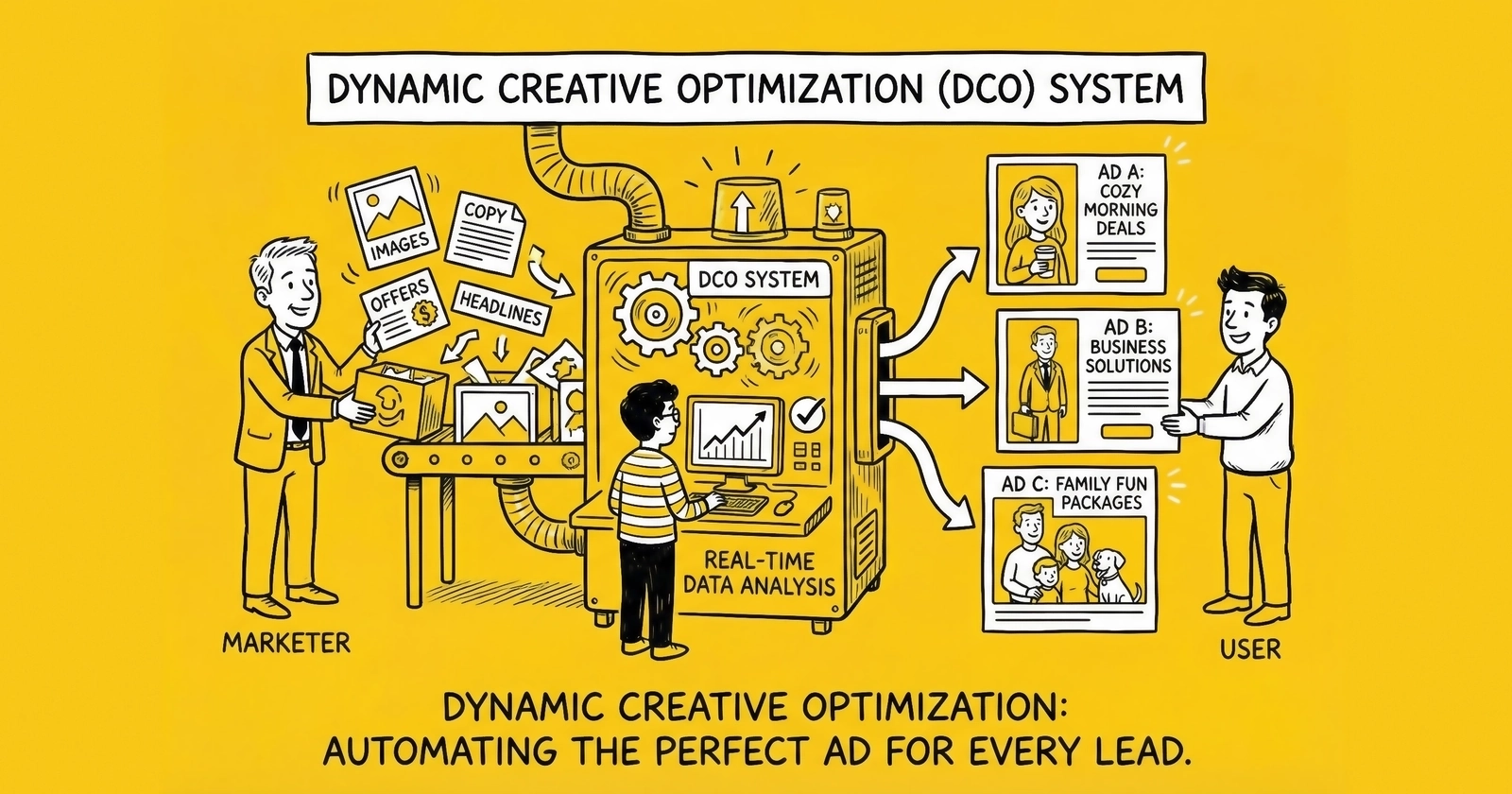
Stop serving the same ad to every visitor. DCO transforms static campaigns into personalized experiences that increase conversions by 30-58% while reducing cost per lead.
Dynamic creative optimization (DCO) has moved from enterprise luxury to operational necessity. The lead generation operations achieving the lowest cost per acquisition in 2025 are not simply buying better traffic – they are serving personalized creative combinations that match each prospect’s context, intent, and stage of consideration.
The numbers support the investment. Campaigns using DCO achieve up to 58% improvement in return on ad spend and 30% reduction in cost per acquisition compared to static creative approaches. The DCO market reached $760 million in 2024 and is projected to exceed $1.8 billion by 2033, growing at a compound annual rate of 10.2%. A 2024 study found that 82% of advertisers now use DCO as part of their digital advertising strategy, up from 60% in 2015.
For lead generators, DCO represents one of the highest-leverage investments available. Unlike additional traffic spend – which delivers linear returns – DCO improvements compound across your entire traffic portfolio. A 20% conversion rate improvement from personalized creative is equivalent to a 20% reduction in customer acquisition cost without spending another dollar on media.
This guide covers everything you need to implement DCO effectively: what it is and how it works, when DCO makes sense for your operation, the platforms and tools available, which creative elements to test, measurement and optimization approaches, and common implementation mistakes to avoid.
What Is Dynamic Creative Optimization?
Dynamic creative optimization is a technology that assembles ads in real-time from component parts – headlines, images, calls-to-action, body copy, offers – selecting the optimal combination for each individual impression based on available data signals about that user.
Instead of creating one ad and showing it to everyone, you create a library of modular elements. The DCO platform analyzes user data in milliseconds – demographics, location, browsing behavior, time of day, device type – then assembles a custom ad from your creative library. The assembled ad serves to the user, performance data feeds back into the system, and the algorithm improves over time.
The process happens between the moment a user loads a page and the moment the ad renders. A decision that would take a human hours to analyze happens in under 100 milliseconds.
The Technical Flow
Understanding the underlying mechanics helps you design better creative libraries and set realistic expectations.
Step 1: Signal Collection. When an ad request initiates, the platform ingests available data about the specific user. This might include geographic location (city, state, or zip code level), device and browser information, time of day and day of week, first-party data from your CRM or customer data platform, retargeting status and funnel stage, third-party data segments (if available), and contextual signals about the page content.
Step 2: Algorithm Evaluation. The DCO engine evaluates which combination of creative elements is most likely to drive your desired outcome for this specific user profile. The algorithm considers historical performance of each element, performance patterns for similar user profiles, and statistical confidence in predictions.
Step 3: Ad Assembly. The platform combines the selected elements into a complete ad unit. This happens dynamically – the ad that serves may never have existed as a static asset. It was assembled specifically for this impression.
Step 4: Delivery and Learning. The assembled ad renders for the user. Whether they click, convert, or ignore becomes training data. The algorithm updates its models, and future impressions benefit from this new information.
The feedback loop is what makes DCO powerful. Static creative never learns. DCO learns continuously.
DCO vs. A/B Testing vs. Multivariate Testing
DCO often gets confused with other optimization methods. Understanding the distinctions helps you choose the right approach.
A/B testing compares two complete creative variations to determine which performs better. You might test headline A versus headline B, serving each to half your audience until you reach statistical significance. A/B testing provides clear answers but takes time – you can only test one element at a time without confounding variables.
Multivariate testing examines multiple elements simultaneously. You might test three headlines, three images, and two CTAs – 18 total combinations served to your audience. Multivariate testing reveals interactions between elements but requires substantial traffic to achieve significance for each combination.
DCO goes beyond testing to optimization. Rather than simply identifying winners, DCO serves the best-performing combination to each user based on their specific profile. A headline that wins overall might lose for users in certain demographics or geographies. DCO captures these nuances automatically.
The practical difference: A/B testing tells you headline A beats headline B by 12%. DCO tells you headline A beats headline B by 12% on average, but headline B outperforms for mobile users in the Northeast viewing ads after 6 PM. And DCO acts on that information automatically.
When DCO Makes Sense for Lead Generation
DCO is not appropriate for every operation. The technology requires investment – platform costs, creative production, data integration, ongoing management. Before committing, evaluate whether your situation meets the requirements for successful implementation.
Volume Requirements
DCO algorithms need data to optimize. Without sufficient impression and conversion volume, the system cannot learn which combinations work for which audiences. You end up with random assembly rather than intelligent optimization.
Minimum thresholds for effective DCO:
- At least 50,000 monthly ad impressions per campaign
- At least 500-1,000 monthly conversions (form submissions) per campaign
- At least 60-90 days of historical performance data for calibration
Operations below these thresholds may see inconsistent results. The algorithm lacks sufficient signal to identify patterns and may overfit to random variation.
That said, you can work around volume limitations by consolidating campaigns (one DCO campaign serving multiple geographies rather than separate campaigns per state), using longer optimization windows (14-day or 30-day instead of 7-day), and starting with fewer creative variations (5 headlines rather than 15) to concentrate learning.
Audience Segmentation Opportunity
DCO delivers value when your audience segments respond differently to different messages. If everyone responds identically to the same creative, personalization provides no advantage.
Signs DCO will deliver value:
- Your vertical serves diverse buyer personas (homeowners vs. renters, young drivers vs. experienced drivers)
- Geographic differences affect messaging (state-specific regulations, regional preferences)
- Multiple value propositions resonate with different segments (price-focused vs. service-focused vs. convenience-focused)
- Funnel stage influences effective messaging (cold prospects vs. retargeting)
- Seasonal or time-based factors affect conversion (weekday vs. weekend, morning vs. evening)
Signs DCO may not be worth the investment:
- Homogeneous audience with similar motivations
- Single value proposition that works universally
- Very narrow targeting already (you’ve already segmented manually)
- Low volume making algorithmic learning impractical
Creative Production Capacity
DCO requires a library of modular creative elements. You need multiple headlines, multiple images, multiple CTAs, multiple body copy variations – all designed to work in any combination.
Production requirements:
- Initial creative development: 15-30 modular elements across categories
- Ongoing refresh: 5-10 new elements monthly to combat creative fatigue
- Design discipline: every headline must work with every image, every CTA must fit every body copy
If your creative production capacity is already stretched producing single static ads, adding DCO complexity may be premature. Consider whether you have in-house creative resources or budget for agency support, a process for rapid creative iteration, and clear brand guidelines that enable consistent modular production.
Budget Considerations
DCO platforms range from free (native platform tools) to expensive (enterprise solutions). Your budget threshold determines which tier makes sense.
Under $25,000 monthly ad spend: Focus on native platform DCO tools (Meta’s Dynamic Creative, Google’s Responsive Display Ads). These are included in platform costs and provide meaningful optimization without additional expense.
$25,000-$100,000 monthly ad spend: Consider mid-tier DCO platforms or enhanced use of native tools with custom data integration. Budget $1,000-3,000 monthly for technology and creative production.
Over $100,000 monthly ad spend: Enterprise DCO platforms become cost-effective. The efficiency gains justify $3,000-10,000 monthly platform costs. At this scale, even small percentage improvements represent substantial dollar impact.
DCO Platforms and Tools
The DCO landscape includes native platform tools, standalone DCO platforms, and enterprise creative management solutions. Your choice depends on budget, technical resources, and channel mix.
Native Platform Tools
Every major advertising platform now offers built-in DCO capabilities. These tools are free (included in platform costs), easy to implement, and deliver meaningful optimization for most lead generation operations.
Meta Advantage+ Creative (formerly Dynamic Creative)
Meta’s DCO offering tests combinations of images, videos, headlines, descriptions, and CTAs within a single ad set. The algorithm optimizes toward your selected objective, learning which combinations perform best for different audience segments.
Key features for lead generation:
- Supports both link ads and native lead form ads
- Tests up to 10 images/videos, 5 headlines, 5 primary text variations, and 5 descriptions per ad
- Integrates with Meta’s Advantage+ audience optimization
- Provides breakdown reporting by asset combination
Limitations:
- Less transparency into which specific combinations performed best
- Limited cross-campaign learning (each ad set optimizes independently)
- No integration with off-platform data signals
Best for: Lead generators spending $5,000-100,000 monthly on Meta platforms who want meaningful optimization without additional technology investment.
Google Responsive Display Ads
Google’s responsive display ads automatically adjust size, format, and content to fit available ad space across the Google Display Network. You provide multiple headlines, descriptions, images, and logos. The system tests combinations and optimizes based on performance.
Key features for lead generation:
- Up to 5 headlines, 5 descriptions, 15 images per ad
- Automatic format optimization across inventory
- Integration with Google’s audience signals
- Native support for Customer Match and similar audiences
Limitations:
- Less control over final ad appearance
- Display network quality varies significantly
- Limited to display inventory (not search or YouTube)
Google Responsive Search Ads
For search campaigns, responsive search ads test combinations of up to 15 headlines and 4 descriptions, serving the best-performing combinations for each search query.
For lead generation search campaigns, RSAs have become the default format – Google actively encourages migration from traditional expanded text ads.
LinkedIn Dynamic Ads
LinkedIn offers dynamic ads that personalize content using member profile data – name, photo, job title, company. For B2B lead generation, seeing their own information reflected in the ad creates pattern interruption and higher engagement.
Best for: B2B lead generators where professional context matters.
Standalone DCO Platforms
For operations requiring more sophisticated personalization, standalone DCO platforms offer capabilities beyond native tools.
Celtra
Celtra’s Creative Automation platform enables dynamic creative across display, video, and social channels. Key differentiator: creative production tools that simplify building modular element libraries at scale.
Pricing: Enterprise pricing, typically $3,000-15,000 monthly depending on volume.
Best for: High-volume operations needing cross-channel DCO with sophisticated creative management.
Flashtalking (Mediaocean)
Flashtalking offers DCO alongside ad serving and cross-channel measurement. Strong integration with measurement and attribution systems.
Pricing: Enterprise pricing, typically $5,000-20,000 monthly.
Best for: Operations prioritizing measurement integration and cross-channel consistency.
Clinch
Clinch focuses on personalization powered by AI, with strong video DCO capabilities. Proprietary optimization algorithms claim to outperform native platform tools.
Pricing: Mid-market to enterprise, typically $2,000-10,000 monthly.
Best for: Video-heavy campaigns requiring sophisticated personalization.
Jivox
Jivox emphasizes e-commerce and lead generation use cases with pre-built integrations for common CRM and marketing automation platforms.
Pricing: Mid-market, typically $2,000-8,000 monthly.
Best for: Lead generators wanting CRM integration without custom development.
Enterprise Creative Management
For large-scale operations, enterprise creative management platforms combine DCO with broader creative production, asset management, and workflow capabilities.
Adobe Advertising Cloud
Adobe’s platform integrates DCO with its broader Creative Cloud and Experience Cloud ecosystem. Strong for organizations already invested in Adobe tools.
Google Marketing Platform (Studio/Campaign Manager)
Google’s enterprise solution offers DCO within its integrated ad serving and measurement platform. Direct integration with Google Ads data.
Sizmek (Amazon)
Now part of Amazon, Sizmek offers DCO alongside Amazon’s advertising capabilities. Strong for operations with significant Amazon advertising presence.
Platform Selection Criteria
Choosing the right DCO platform requires evaluating multiple factors:
Channel Coverage: Does the platform support all channels where you advertise? Native tools are channel-specific. Standalone platforms may support some channels but not others.
Data Integration: Can you feed first-party data (CRM, website behavior, offline conversion data) into the system? Better data enables better personalization.
Creative Production: Does the platform include tools for building modular creative, or does it assume you arrive with elements already produced? Production capabilities matter if your team lacks design resources.
Reporting Transparency: Can you see which combinations performed best for which segments? Some platforms provide detailed breakdowns; others offer only aggregate performance.
Learning and Support: DCO requires ongoing optimization. What training, support, and strategic guidance does the vendor provide?
Cost Structure: Fixed monthly fees, per-impression pricing, or hybrid models? Your volume determines which structure is most economical.
For most lead generation operations, start with native platform tools. They deliver meaningful optimization with minimal investment. Graduate to standalone platforms only when you have demonstrated that personalization drives measurable improvement and your volume justifies platform costs.
Creative Elements to Test with DCO
Effective DCO requires a thoughtfully designed library of modular creative elements. Not all elements are equally worth testing. Prioritize those with highest impact potential.
Headlines and Value Propositions
Headlines drive the most performance variation in lead generation advertising. Test different approaches to see which resonates with different audience segments.
Value proposition framing:
- Savings-focused: “Drivers Save $400+ Switching to Our Partners”
- Speed-focused: “Compare Rates in Under 60 Seconds”
- Quantity-focused: “Compare Quotes from 20+ Top Carriers”
- Trust-focused: “500,000 Families Protected Since 2019”
Tone variations:
- Urgent: “Rates Increasing – Lock in Today’s Price”
- Reassuring: “No Obligation Quote – Cancel Anytime”
- Direct: “Get Your Free Quote Now”
- Consultative: “Find the Right Coverage for Your Needs”
Personalization elements:
- Geographic: “Texas Homeowners Save Big”
- Demographic: “Rates for Drivers Over 50”
- Situational: “New Homeowner? Start Here”
- Seasonal: “Open Enrollment Ends December 7”
Plan for 5-10 headline variations that represent meaningfully different approaches. Headlines that are too similar (“Get Your Quote” vs. “Get a Quote”) waste testing capacity.
Images and Visual Elements
Visual elements create first impressions and emotional responses. Different audiences respond to different imagery.
Subject matter variations:
- People vs. products vs. abstract concepts
- Families vs. individuals
- Young vs. older subjects
- Diverse representation
Stylistic variations:
- Professional photography vs. lifestyle imagery
- Bright and energetic vs. calm and trustworthy
- Illustration vs. photography
- Text overlays vs. clean images
Contextual variations:
- Home exterior (solar, roofing, home services)
- Family moments (insurance, financial services)
- Problem scenarios (legal, restoration services)
- Solution outcomes (before/after, success states)
For lead generation, authentic-looking images typically outperform obvious stock photography. Test real customer photos, team photos, or illustration styles that differentiate from competitor creative.
Calls-to-Action
CTAs determine whether interest converts to action. Test different approaches to find what drives clicks and form completions.
Action verb variations:
- “Get Your Quote” vs. “Compare Rates” vs. “Start Comparing”
- “See My Savings” vs. “Calculate Savings” vs. “Show Me Rates”
- “Request Consultation” vs. “Talk to an Expert” vs. “Schedule Call”
Commitment level:
- Low commitment: “Learn More”
- Medium commitment: “See Options”
- High commitment: “Apply Now”
Urgency elements:
- Time-based: “Get Today’s Rates”
- Quantity-based: “Limited Quotes Available”
- None: “Compare at Your Pace”
Match CTA commitment level to funnel stage. Cold traffic may respond better to low-commitment CTAs. Retargeting audiences who have already engaged may respond to higher-commitment language.
Body Copy and Descriptions
Secondary copy provides supporting information and addresses objections. Test different emphases.
Information types:
- Process explanation: “Answer 3 questions, compare rates instantly”
- Social proof: “Join 500,000 satisfied customers”
- Credibility: “A+ BBB rating, licensed in all 50 states”
- Objection handling: “No spam calls – we respect your privacy”
Length variations:
- Minimal: 1-2 sentences focusing on single benefit
- Moderate: 3-4 sentences covering multiple angles
- Extended: Full paragraph with detailed explanation
For lead generation advertising, shorter copy typically outperforms longer copy in social and display formats. Save detailed explanations for landing pages.
Offers and Incentives
If your lead generation includes incentive offers, test variations to find optimal balance between conversion lift and lead quality.
Offer types:
- Gift cards: “$50 Amazon card after consultation”
- Discounts: “First month free when you switch”
- Information: “Free guide to choosing coverage”
- Convenience: “We handle the paperwork”
Offer presentation:
- Prominent (headline-level emphasis)
- Supporting (secondary element)
- Subtle (footnote mention)
Aggressive offers increase conversion rates but may attract lower-quality leads motivated by the incentive rather than genuine interest. Monitor lead quality metrics by offer variation.
Design Principles for Modular Creative
Building effective DCO libraries requires discipline in creative production.
Every element must work with every other element. If headline A only makes sense with image B, you have created a dependency that limits optimization. Design elements to be truly interchangeable.
Maintain brand consistency across variations. Modular elements should feel like they come from the same brand. Consistent colors, typography, and visual style ensure assembled ads look professional regardless of combination.
Design for worst-case assembly. What happens if the longest headline appears with the smallest image in the narrowest ad format? Test extreme combinations to ensure nothing breaks.
Create sufficient variation. Two headlines are not a DCO program. Five headlines representing genuinely different approaches give the algorithm meaningful options to test.
Plan for refresh cycles. Creative fatigue affects DCO campaigns just like static campaigns. Build processes for adding new elements monthly. Remove underperformers to improve average quality.
Implementing DCO: A Practical Framework
Implementation requires structured planning. Follow this framework to avoid common mistakes.
Phase 1: Audit and Preparation (Weeks 1-2)
Assess current creative performance. Review your existing campaigns to understand what works. Which headlines drive highest CTR? Which images generate most engagement? Which CTAs produce most conversions? This historical data informs your initial DCO creative library.
Define audience segments. Identify the distinct audience segments you want to personalize for. Common segmentation approaches include geographic (state or regional), demographic (age, gender, household), behavioral (new vs. returning, funnel stage), and intent (search query themes, content engagement).
Establish measurement infrastructure. DCO optimization requires accurate conversion tracking. Verify that your pixel implementations are correct, server-side tracking is operational if applicable, conversion events are properly defined, and attribution windows are configured appropriately.
Set clear objectives and KPIs. Define what success looks like. Typical DCO objectives for lead generation include cost per lead (CPL) reduction, conversion rate improvement, lead quality improvement (as measured by downstream metrics), and return on ad spend (ROAS) improvement.
Phase 2: Creative Development (Weeks 2-4)
Build your element library. Create modular elements across all categories:
- 5-10 headlines representing different value propositions
- 5-10 images representing different styles and subjects
- 3-5 CTAs with varying commitment levels
- 3-5 body copy variations with different emphases
Test element compatibility. Manually review combinations to ensure nothing conflicts. Does headline about “seniors” make sense paired with image of young family? Flag incompatible combinations for exclusion rules if your platform supports them.
Prepare for all formats. Different placements require different formats. Ensure your elements work across feed, stories, display, video, and other relevant formats for your channel mix.
Phase 3: Campaign Setup (Week 4)
Configure platform integration. Set up your DCO platform or native tool configuration. Connect data sources, configure audience segments, and establish conversion tracking.
Upload creative elements. Add your modular elements to the platform. Apply any exclusion rules for incompatible combinations. Configure format requirements.
Set optimization objectives. Tell the algorithm what to optimize for. For lead generation, optimize for form completions (conversions) rather than clicks. Optimizing for clicks attracts curiosity-driven traffic that may not convert.
Establish testing parameters. Configure learning phase duration, statistical confidence requirements, and element performance thresholds for automatic deactivation.
Phase 4: Launch and Initial Learning (Weeks 5-8)
Start with limited budget. Launch with controlled spend while the algorithm learns. Budget should be sufficient to generate statistically significant data within 2-4 weeks.
Monitor early signals. Watch for concerning patterns: unusually high CPL, dramatic performance variation by element, tracking discrepancies. Address issues before scaling.
Allow sufficient learning time. Resist the urge to intervene during the learning phase. Algorithms need time to test combinations and identify patterns. Premature changes reset learning.
Document baseline performance. Capture performance metrics at the end of learning phase. These baselines will measure DCO impact over time.
Phase 5: Optimization and Scaling (Ongoing)
Review element performance. Identify top and bottom performers across all element categories. Remove persistent underperformers. Add new variations to replace them.
Analyze segment patterns. Examine which combinations work for which audiences. Use these insights to inform future creative development.
Scale successful approaches. Increase budget behind validated DCO campaigns. Apply learnings to new campaigns and channels.
Maintain refresh cadence. Add new creative elements monthly. Update existing elements for seasonal relevance. Combat creative fatigue through continuous refresh.
Measuring DCO Performance
Accurate measurement is essential. Without clear performance data, you cannot determine whether DCO investment is paying off or optimize toward better results.
Core Metrics for DCO Campaigns
Cost per lead (CPL): The fundamental metric for lead generation. Track CPL at campaign level, element level (which headlines drive lowest CPL?), and segment level (how does CPL vary by audience?).
Conversion rate: Percentage of clicks that become leads. DCO should improve conversion rate by serving more relevant creative to each prospect.
Click-through rate (CTR): Early indicator of creative resonance. Higher CTR suggests better element-audience matching. But CTR without conversion improvement is vanity – you want qualified clicks, not curiosity clicks.
Creative element performance: Individual metrics for each element in your library. Identify which headlines, images, and CTAs drive best results.
Segment performance: How does performance vary across audience segments? DCO should show improvement versus static creative, particularly for segments where personalization provides relevant variation.
Lead Quality Metrics
Volume metrics alone are insufficient. DCO that increases lead volume while degrading quality is not a success.
Buyer acceptance rate: What percentage of leads generated are accepted by your buyers versus rejected? DCO should maintain or improve acceptance rates.
Return rate: What percentage of leads are returned for quality issues? High-performing DCO should not increase return rates.
Contact rate: For leads requiring outbound contact, what percentage result in successful connection? Personalized creative should attract more engaged prospects.
Downstream conversion: What percentage of leads ultimately convert to customers? This is the ultimate quality signal, though the feedback loop is longer.
Track these quality metrics by DCO campaign versus non-DCO campaigns, and by creative element where possible.
Attribution Considerations
DCO complicates attribution because the “creative” that drove a conversion may never have existed as a static asset. Attribution systems may struggle to credit specific creative combinations.
Element-level attribution: Most platforms can attribute conversions to the specific combination served. Use this data to understand which headlines, images, and CTAs contribute to conversion.
Multi-touch attribution: For prospects who see multiple DCO combinations across their journey, understand that credit may distribute across touchpoints. A prospect might see headline A on first impression and headline B on converting impression – both contributed.
Incrementality measurement: The gold standard is measuring whether DCO actually improves results versus what would have happened with static creative. Run holdout tests where a percentage of traffic receives static creative while the majority receives DCO. Compare conversion rates between groups.
Reporting Cadence
Daily monitoring: Check for anomalies – dramatic CPL spikes, conversion tracking issues, budget pacing problems. Daily checks catch issues before they become expensive.
Weekly analysis: Review element performance, segment trends, and overall campaign health. Make tactical adjustments based on emerging patterns.
Monthly strategic review: Assess DCO program performance against objectives. Decide which elements to add, remove, or modify. Evaluate whether to expand DCO to additional campaigns or channels.
Quarterly business review: Calculate true ROI of DCO investment including platform costs, creative production, and management time. Determine whether to increase or decrease DCO investment.
Common DCO Mistakes and How to Avoid Them
DCO implementations fail for predictable reasons. Avoid these common mistakes.
Insufficient Creative Variation
The mistake: Launching DCO with two or three headlines that are minor variations of each other. “Get Your Quote” vs. “Get a Quote” vs. “Start Your Quote” gives the algorithm nothing meaningful to test.
The solution: Create elements representing genuinely different approaches. Price-focused vs. speed-focused vs. trust-focused headlines give the algorithm real alternatives to test.
Optimizing for the Wrong Objective
The mistake: Setting DCO to optimize for clicks rather than conversions. The algorithm learns to show creative that attracts clicks – but those clicks may not be from prospects likely to convert.
The solution: Always optimize for your true objective. For lead generation, that typically means form completions or qualified leads. Accept that this requires more data for optimization but produces better business outcomes.
Premature Optimization
The mistake: Making changes before the algorithm has sufficient data. Seeing early results where headline A outperforms headline B and immediately pausing headline B – even though the difference may be random variation.
The solution: Set minimum learning thresholds before making element decisions. Require at least 1,000 impressions and 10-20 conversions per element before drawing conclusions. Use statistical significance calculations rather than gut reactions.
Ignoring Lead Quality
The mistake: Celebrating CPL reduction while ignoring that return rates have increased, buyer acceptance has dropped, or downstream conversion has declined.
The solution: Integrate quality metrics into your DCO evaluation framework. A configuration that generates leads 20% cheaper but with 30% lower quality is not an improvement.
Creative Fatigue Neglect
The mistake: Launching DCO with a strong creative library, then never refreshing elements. Over months, performance degrades as audiences see the same combinations repeatedly.
The solution: Establish a monthly creative refresh cadence. Add 3-5 new elements per month. Remove the bottom 20% of performers. Treat creative refresh as an ongoing operational requirement, not a one-time launch activity.
Incompatible Element Combinations
The mistake: Building elements that only make sense in certain combinations. A headline referencing “your photo” paired with an image showing generic stock photography creates a confusing disconnect.
The solution: Design truly modular elements that work in any combination. Test edge cases during production. Use exclusion rules if your platform supports them to prevent incompatible combinations.
Data Silos
The mistake: Running DCO without connecting your most valuable data signals. The platform optimizes based only on basic demographic data when you have rich first-party data about prospect intent and behavior.
The solution: Invest in data integration. Connect CRM data, website behavior, purchase history, and other first-party signals to your DCO platform. Better data enables better personalization.
Single-Channel Thinking
The mistake: Optimizing DCO on one platform without considering how prospects move across channels. Lessons learned on Meta are never applied to Google. Messaging is inconsistent across touchpoints.
The solution: Think about DCO as a cross-channel capability. Apply learnings from one platform to others. Maintain message consistency while adapting format. Consider platforms that enable cross-channel DCO for unified optimization.
DCO and the Privacy Landscape
The data signals that power DCO personalization face increasing constraints from privacy regulations and platform policies. Understanding these constraints helps you build sustainable DCO programs.
Cookie Deprecation and Signal Loss
Third-party cookies – historically a primary signal for DCO personalization – face ongoing deprecation. Safari and Firefox block third-party cookies by default. Chrome’s approach has shifted multiple times, but the direction is toward reduced third-party tracking.
Impact on DCO: Reduced visibility into cross-site behavior limits personalization based on browsing history and interest signals.
Mitigation strategies:
- Invest in first-party data collection (email, phone, behavior on your properties)
- Implement server-side tracking to recover 15-35% of lost signals
- Rely more heavily on contextual signals (page content, device, time) that do not require cross-site tracking
- Use platform first-party data (Meta knows user interests from platform behavior)
Data Privacy Regulations
GDPR, CCPA, and similar regulations require user consent for personalization based on personal data. Increasingly, opt-out rates reduce the audience available for data-driven personalization.
Impact on DCO: Smaller audiences available for personalized targeting. More reliance on contextual rather than behavioral personalization.
Compliance requirements:
- Ensure proper consent collection for data used in personalization
- Provide transparency about how data informs advertising
- Honor opt-out requests promptly
- Document data usage for regulatory compliance
Platform Policy Changes
Advertising platforms continuously adjust what data can be used for targeting and personalization. Facebook significantly reduced detailed targeting options for sensitive categories. Google restricted personalization in housing, employment, and financial advertising.
Impact on DCO: Some personalization approaches that worked previously are no longer permitted. Audience targeting options have contracted.
Adaptation strategies:
- Stay current with platform policy changes
- Reduce reliance on demographic targeting in favor of behavioral signals
- Test broad audience approaches that rely on algorithmic optimization rather than explicit targeting
Future-Proofing Your DCO Program
Build DCO programs that remain effective as privacy constraints tighten.
Prioritize first-party data: Data you collect directly from customers – email addresses, purchase history, stated preferences – remains fully usable regardless of third-party restrictions.
Invest in contextual personalization: Personalizing based on page content, time of day, geography, and device works without tracking individual users across sites.
Test broad audience approaches: Platform algorithms can optimize toward conversions without explicit targeting. Test DCO with minimal audience restrictions, letting the algorithm find converters.
Build consent-based relationships: Email, SMS, and authenticated experiences where users have explicitly opted in provide stable foundations for personalization.
Frequently Asked Questions
What budget level makes DCO worthwhile for lead generation?
DCO can deliver value at almost any budget level when using native platform tools (Meta Advantage+ Creative, Google Responsive Ads), which are included in platform costs. For standalone DCO platforms costing $2,000-10,000 monthly, you typically need at least $25,000-50,000 monthly ad spend to justify the investment. The efficiency gains from DCO – typically 20-30% CPL improvement – need to exceed platform costs to make business sense. A 25% improvement on $50,000 monthly spend saves $12,500, easily justifying a $3,000 platform cost.
How many creative variations do I need for effective DCO?
Start with 5-10 variations per element category: 5-10 headlines, 5-10 images, 3-5 CTAs, 3-5 body copy options. This creates sufficient variety for meaningful optimization without overwhelming your production capacity. With 7 headlines, 7 images, 4 CTAs, and 4 body copy variations, you have 784 possible combinations – plenty for the algorithm to explore. Too few variations (2-3 per category) limit optimization potential. Too many (20+ per category) may spread data too thin for learning.
How long does it take to see results from DCO?
Expect 4-8 weeks before drawing meaningful conclusions. The first 2-4 weeks are learning phase, where the algorithm tests combinations and builds understanding of what works for which audiences. Weeks 5-8 show stabilized performance that reflects actual DCO optimization. Avoid making major changes or declaring success/failure during the learning phase. Volume affects timeline – higher-volume campaigns learn faster than lower-volume campaigns.
Should I optimize DCO for clicks or conversions?
Always optimize for conversions (form completions) in lead generation campaigns. Click optimization teaches the algorithm to show creative that attracts curiosity – but curiosity clickers rarely become leads. Conversion optimization focuses on prospects who complete your desired action. The tradeoff: conversion optimization requires more data before the algorithm can optimize effectively. Accept this slower learning in exchange for better business outcomes.
How does DCO impact lead quality?
Well-implemented DCO should maintain or improve lead quality. Personalized creative attracts prospects whose interests align with the specific message served – they are more qualified because the ad addressed their actual situation. However, monitor quality metrics closely during DCO implementation. CPL improvement that comes with quality degradation is not a win. Track buyer acceptance rates, return rates, contact rates, and downstream conversion alongside CPL.
Can I use DCO for retargeting campaigns?
Absolutely – retargeting is an excellent use case for DCO. Personalize based on funnel stage (visited homepage vs. started form vs. viewed pricing), recency (last visited 2 days ago vs. 2 weeks ago), and content engagement (which pages they viewed, which topics they explored). A visitor who abandoned mid-form might respond to objection-handling messaging (“No spam calls – we respect your privacy”) while a new visitor needs benefit-focused messaging (“Compare rates from 20+ carriers”).
How do I prevent creative fatigue in DCO campaigns?
Establish a monthly refresh cadence. Add 3-5 new elements per category each month. Remove the bottom 20% of performers to improve average quality. Monitor frequency metrics – if prospects see the same combinations repeatedly, fatigue sets in regardless of DCO. Set frequency caps at the campaign level. Track performance trends over time; declining conversion rates often signal creative fatigue even when you cannot identify the specific fatigued elements.
What first-party data signals work best for DCO personalization?
The most valuable first-party signals for lead generation DCO include form completion history (have they submitted forms before?), content engagement (which pages did they visit, which topics interest them?), purchase history (existing customers get different messaging than prospects), geographic location (derived from IP or explicitly provided), device behavior (mobile vs. desktop patterns), and CRM segments (lead score, lifecycle stage, persona classification). Connect your CRM and analytics platforms to your DCO system to leverage these signals.
How does DCO work across different advertising platforms?
Native DCO tools are platform-specific – Meta Advantage+ only works on Meta platforms, Google Responsive Ads only work on Google properties. Standalone DCO platforms like Celtra, Flashtalking, and Clinch can serve DCO creative across multiple platforms, providing cross-channel consistency and unified optimization. If you advertise heavily on multiple platforms, evaluate whether a cross-channel DCO solution makes sense. If most spend concentrates on one platform, native tools may be sufficient.
Should I use DCO for new campaigns or only established ones?
DCO works best when you have historical data about what performs with your audience. For entirely new campaigns with no performance history, consider launching with static creative to establish baselines, then migrating to DCO after 30-60 days. However, native platform DCO (Advantage+, Responsive Ads) can work from launch because the platform has its own historical data about what works for similar advertisers and audiences.
Key Takeaways
-
DCO delivers 30-58% improvement in ROAS and 20-30% reduction in CPL when implemented correctly – these gains compound across your entire traffic portfolio without additional media investment.
-
Start with native platform tools (Meta Advantage+ Creative, Google Responsive Ads) before investing in standalone DCO platforms. Native tools are free, easy to implement, and deliver meaningful optimization for most operations.
-
Build modular creative libraries with 5-10 variations per element category. Every headline must work with every image, every CTA must fit every body copy. Design for true interchangeability.
-
Optimize for conversions (form completions), not clicks. Click optimization attracts curiosity; conversion optimization attracts qualified prospects. Accept slower learning in exchange for better business outcomes.
-
Allow 4-8 weeks for learning before drawing conclusions. Premature changes reset algorithmic learning and produce unreliable results. Set minimum thresholds (1,000+ impressions, 10+ conversions per element) before making decisions.
-
Monitor lead quality alongside volume metrics. CPL reduction that comes with increased return rates or reduced buyer acceptance is not an improvement. Track downstream metrics to ensure DCO improves actual business outcomes.
-
Establish monthly creative refresh cadences. Add 3-5 new elements, remove bottom performers, and maintain element freshness to combat creative fatigue.
-
Invest in first-party data integration. The richer your data signals, the more effective your personalization. Connect CRM, website behavior, and customer data platforms to your DCO system.
-
Future-proof against privacy constraints by prioritizing first-party data, contextual personalization, and consent-based relationships. Build DCO programs that work as third-party signals continue to degrade.
Sources
- Grand View Research: Dynamic Creative Optimization Market - Market size data and growth projections for the DCO industry
- Precedence Research: DCO Market Analysis - Market valuation reaching $760M in 2024 and 10.2% CAGR projections
- Meta Business Help: Advantage+ Creative - Official documentation for Meta’s DCO capabilities and features
- LinkedIn Marketing Solutions: Dynamic Ads - B2B personalization using member profile data
- Celtra Creative Automation Platform - Enterprise DCO platform for cross-channel dynamic creative
- Clinch Personalized Advertising - AI-powered video DCO and personalization platform
- IAB (Interactive Advertising Bureau) - Industry standards and guidelines for digital advertising technology
Statistics and platform information current as of late 2025. DCO capabilities and platform features evolve continuously – verify current specifications before implementation decisions.