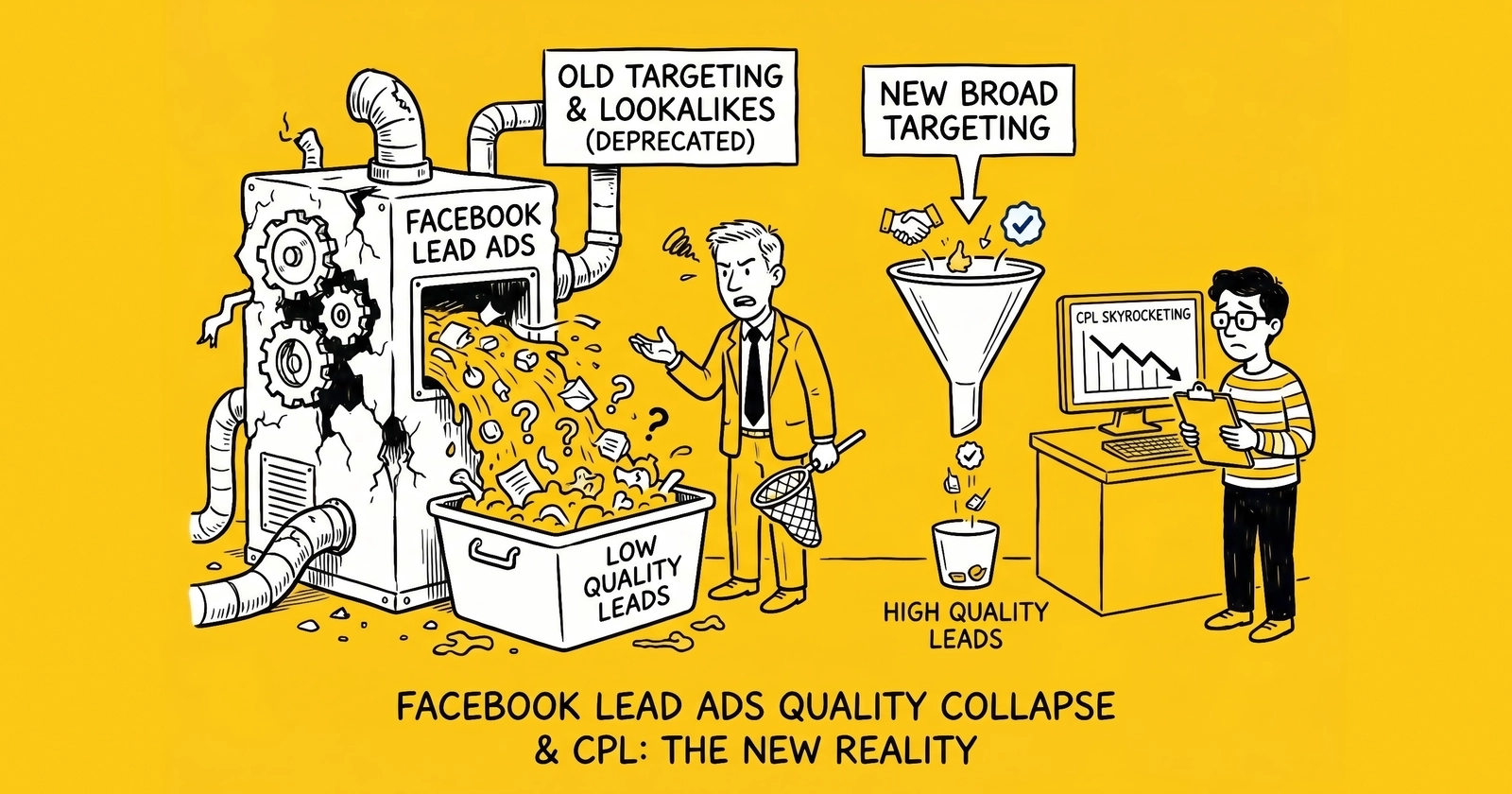
The lead-objective optimizer rewarded the cheapest form fill rather than the most qualified buyer, and through 2025 the math caught up with everyone running it.
The 2025-2026 Benchmark Deterioration Nobody Wanted to Name
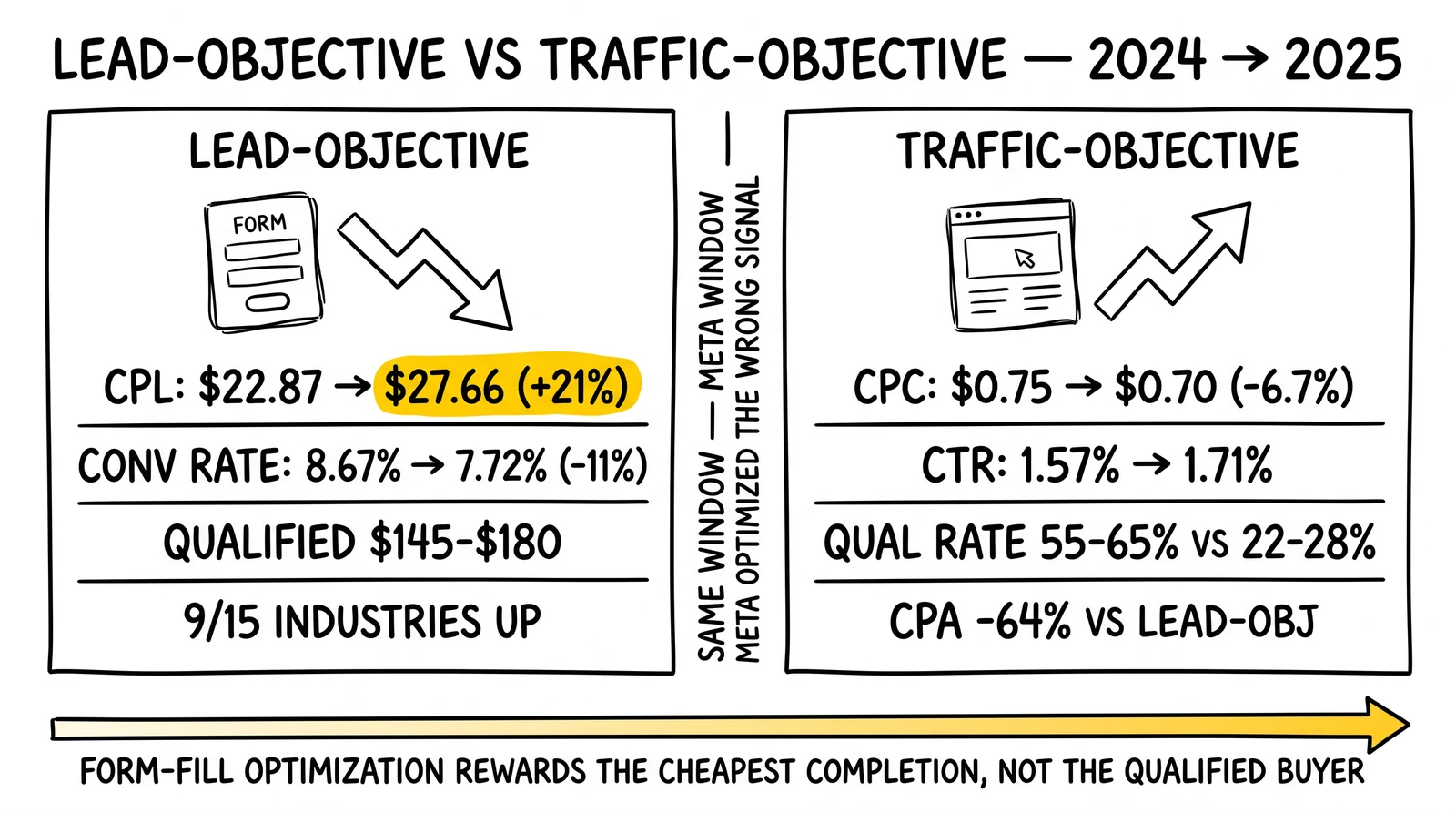
Facebook Lead Ads spent 2025 quietly hollowing out. The headline number – drawn from WordStream LocaliQ’s September 2025 benchmark panel covering April 2024 through June 2025, with PPC.land synthesis layered on top – was a 20.94% jump in cost per lead, from a $22.87 baseline to $27.66 across more than 1,000 lead-objective campaigns. That number traveled. What did not travel, despite being more important, was the conversion-rate drop underneath it: form-completion rate fell from 8.67% to 7.72%, an 11% relative decline, and the leads passing through the funnel were also less likely to convert to revenue at the next stage. The compound effect on cost per qualified opportunity was substantially larger than the headline CPL move suggested. The benchmark window is April 2024 through June 2025; Q1 2026 references throughout this analysis are current operator commentary layered on the older panel, not a confirmed Q1 2026 dataset.
Across the same window, Meta’s traffic-objective campaigns improved on every metric an operator tracks. Click-through rate climbed to 1.71% from 1.57%. Cost per click fell 6.7% to $0.70. Visible Factors’ 2026 benchmark synthesis pegged lead-objective CPC at $1.92 – nearly three times the traffic-objective figure – while landing-page conversion rates on well-optimized lead-gen funnels tracked between 4% and 8% depending on vertical, producing effective per-lead costs that beat native form completions on qualified pipeline despite higher raw click prices.
The pattern was not subtle. Lead-objective optimization, the campaign type Meta had spent four years pushing as the default for B2B and considered-purchase B2C, was getting worse on the metric it claimed to optimize. Traffic objective, the campaign type Meta had spent four years deprioritizing in its UX, was getting better on the metric it had never claimed to optimize.
This analysis dissects what broke inside Meta’s lead-objective optimizer, why the Conversions API closed-loop pattern is now load-bearing rather than nice-to-have, how the April 2026 Pixel and CAPI updates change the calculus for smaller advertisers, and the 60-day operator playbook for rebuilding paid-social lead economics on traffic-objective plus CRM-feedback infrastructure. It is not a defense of Facebook as a lead source. It is an account of what works in 2026 for operators who still need it to.
The 21% CPL Spike – What the Data Actually Says
The PPC.land synthesis of WordStream LocaliQ’s data, published September 8, 2025 and updated through Q1 2026, covered more than 1,000 campaigns spanning April 2024 through June 2025. The headline metrics, when stripped of vertical noise, formed a coherent picture: Facebook lead-campaign CPL rose 20.94% year-over-year to $27.66, conversion rates fell from 8.67% to 7.72%, and 9 of 15 tracked industries (60% of the panel) saw CPL increases.
The vertical breakdown told a sharper story than the average. Dentists and dental services hit $76.71 CPL – Facebook’s highest-cost vertical and a category where the platform now charges roughly what mid-tier B2B publications charged for editorial sponsorships in 2018. Health and fitness landed at $52.98, beauty and personal care at $51.42, and legal services in the $40-$50 range depending on geography. At the other end, restaurants and food held at $3.16, real estate at $16.61, and career and employment at $17.64. The verticals where lead quality matters most – where a wrong-fit lead burns expensive sales-rep time – were the verticals where CPL rose fastest.
| Vertical | 2024 CPL | 2025 CPL | YoY Change | Realistic Qualification Rate | Qualified-Lead Cost |
|---|---|---|---|---|---|
| Dentists & Dental | $63.40 | $76.71 | +21.0% | 35% | $219.17 |
| Health & Fitness | $43.50 | $52.98 | +21.8% | 40% | $132.45 |
| Beauty & Personal Care | $42.20 | $51.42 | +21.8% | 50% | $102.84 |
| Legal Services | $36.10 | $43.62 | +20.8% | 28% | $155.79 |
| Home Services | $28.90 | $34.70 | +20.1% | 45% | $77.11 |
| Real Estate | $13.75 | $16.61 | +20.8% | 30% | $55.37 |
| Career & Employment | $14.55 | $17.64 | +21.2% | 60% | $29.40 |
| Restaurants & Food | $2.62 | $3.16 | +20.6% | 70% | $4.51 |
| Cross-vertical mean | $22.87 | $27.66 | +20.94% | 42% | $65.86 |
Sources: PPC.land synthesis of WordStream LocaliQ panel (September 2025); Visible Factors 2026 benchmarks; qualification-rate ranges from operator-reported data and Smarketing Cloud lead-quality analyses (2025).
The qualified-lead column is the column that matters for budget decisions, and it is the column the headline CPL number obscures. When a $27.66 form fill carries a 42% chance of being a real prospect, the marketing-cost-per-qualified-lead is $65.86 – a 138% premium over the raw CPL. In dental, that premium runs to $219 per qualified dental patient inquiry, and in legal services the qualified-lead cost approaches $156. These figures sit alongside Google search-lead benchmarks of $70.11 average CPL – and Google leads typically arrive with intent signals that push qualification rates 15-25 percentage points higher than Facebook lead-form completions.
That is the comparison Facebook’s pricing was supposed to win. Through 2024 it won. By the close of the WordStream LocaliQ benchmark window (June 2025) it had stopped winning at the raw level and was actively losing at the qualified level for considered-purchase verticals; current 2026 operator commentary is consistent with continued deterioration on the same axis. The raw CPL gap closed by attrition: Facebook prices rose 21% over the benchmark window while Google prices stayed roughly flat. The qualified-lead gap inverted entirely for verticals where intent matters more than volume.
What did not appear in the headline data, but did appear in operator-side reconciliations across the same window, was a drop in lead-to-customer conversion rates among the leads that did make it past initial qualification. Multiple agency-side analyses pegged the secondary fall-off at 8-15% relative deterioration on closed-won rate among qualified leads – meaning the leads passing the first filter were also softer on the metrics that determined whether they bought. That second-order decline is what made the cost-per-customer math break for operators who only watched the first-order CPL number.
Why Lead-Objective Optimizes for the Wrong Thing
Meta’s lead-generation campaign objective tells the delivery system to find the cheapest form fill. That is a precise statement of what the optimizer does, and it is also the source of the failure mode. The system does not know which leads will qualify. It does not know which leads will close. It knows which user segments completed forms most cheaply over the prior optimization window, and it bids to deliver more impressions to people who look like those segments. When form completion is the only signal available, the optimizer hill-climbs toward whatever pre-fill behavior, audience pattern, or psychographic cluster produces the highest form-completion-to-impression ratio at the lowest cost. None of those characteristics correlate strongly with intent to buy.
Through 2020-2022, this failure mode stayed manageable because Pixel-side intent signals – page views, time on site, scroll depth, add-to-cart proxies – gave the optimizer enough downstream context to weight form fills by probable quality. Apple’s App Tracking Transparency rollout in 2021 broke that signal pipeline. WebKit ITP and the third-party-cookie deprecation cycle finished the job through 2023-2025. By the time the 2025 benchmarks arrived, lead-objective campaigns were running on form-completion signal alone, and the optimizer was hill-climbing toward audiences who would fill in any pre-filled form for any reason – not audiences who would actually engage with the underlying offer.
Smarketing Cloud’s mid-2025 analysis of inconsistent lead quality from Meta Lead Ads framed the problem precisely: Meta’s algorithm was optimizing for “lead form completions, not lead quality,” and the absence of downstream conversion signal meant the system had no way to learn that some completions were valuable and others were noise. The agency’s recommended fix – pipe CRM-side qualified-lead and closed-won events back into Meta via the Conversions API – was the same fix that had been quietly working for sophisticated B2B advertisers for two years. The 2025 benchmarks made clear what the analysis had been arguing all along: the operators not running CRM-CAPI feedback were paying the algorithm’s tuition, and the bill was now 21% larger than it had been the prior year.
The lead-objective failure compounds in two further ways that do not show up in CPL averages. First, native lead forms pre-fill name, email, and phone from the user’s Facebook profile, which removes friction but also removes the self-selection step that filters out tire-kickers on landing-page funnels. A user can complete a lead form in three taps without reading the offer; whether they remember filling it out an hour later is a separate question. Smarketing Cloud and operator-side data both pegged the share of pre-filled lead-form respondents who did not recognize the brand on first sales-rep contact at 25-40% – a category of “leads” who fundamentally never opted into being contacted in the way the buying business assumed they had. Second, lead-objective bidding tends to deliver against the cheapest available inventory, which by 2025 meant Audience Network placements and Reels mid-roll slots where lead-form completion correlates poorly with deliberate engagement. Operators who excluded those placements often saw CPL rise another 15-25%, which then tipped the lead-objective math fully out of competitiveness against the traffic-objective hybrid alternative.
Traffic Objective Plus Landing Page – The Hybrid Math
The case for traffic-objective campaigns is not that they collect leads more cheaply at the form-fill level. They do not – landing-page conversion rates of 4-8% applied to a $0.70 CPC produce raw lead costs of $9-$18, which is competitive with cheap-vertical Facebook Lead Ads CPLs but well above them on absolute units in the cheapest verticals. The case is that the leads collected through landing pages have already self-selected for intent in three ways the optimizer can use as training signal: they clicked through, they read enough of the page to reach a form, and they typed information that was not pre-filled.
The friction is the feature. A user who read a 600-word landing page, scrolled through three benefit sections, and manually entered an email and phone number has demonstrated meaningfully more intent than a user who tapped a pre-filled lead form in a Reels mid-roll. The downstream qualification rates reflect that. Operator-side data from Smarketing Cloud, multiple paid-social agencies, and our own reconciliation of vertical-by-vertical lead-quality patterns put landing-page leads at 50-70% qualification rates against 22-35% for native lead forms in considered-purchase categories. The qualified-lead cost math reverses accordingly.
| Metric | Lead-Objective | Traffic-Objective + Landing Page | Delta |
|---|---|---|---|
| Raw CPL (cross-vertical mean) | $27.66 | $14.50 | -47% |
| Qualification rate | 28% | 58% | +30 pp |
| Qualified-lead cost | $98.79 | $25.00 | -75% |
| Closed-won rate (qualified leads) | 6.5% | 11.0% | +4.5 pp |
| Cost per closed-won customer | $1,520 | $227 | -85% |
| Optimizer training signal | Form fill | Pageview + form fill + CRM events | Substantially richer |
| Time to optimizer convergence | 7-14 days | 21-45 days | Slower start, better steady state |
Sources: Visible Factors 2026 benchmarks; Smarketing Cloud lead-quality analyses (2025); operator-reported data across paid-social agencies; PPC.land synthesis. Closed-won rates assume CRM-CAPI feedback loop is active for both objectives.
The traffic-objective math wins on every cost line that is downstream of the form fill. It loses on time-to-first-result, because the optimizer needs a longer window to identify pageview-and-form-fill audiences than to identify form-fill audiences alone, and it loses on absolute volume – landing-page funnels generate fewer raw leads at equal spend. Operators who chase volume metrics get punished for the switch in the first three weeks. Operators who track cost per qualified opportunity rather than cost per lead see the inflection by week 4 and the steady-state advantage by week 6.
The hybrid pattern that emerged in late 2025 across paid-social agencies handling B2B and high-ticket B2C accounts was not pure traffic-objective. It was traffic-objective for the primary qualification path, paired with a smaller lead-objective campaign at the top of funnel for awareness retargeting, and CRM-CAPI feedback firing on every qualified-lead, schedule, and closed-won event from both paths. The lead-objective component supplied volume signal to seed lookalike audiences. The traffic-objective component supplied quality signal to train the optimizer. The CRM-CAPI loop supplied truth signal to reweight both. The composite produced lower qualified-lead costs than any single-objective configuration, with the trade-off that account complexity rose substantially.
CRM-to-CAPI Feedback Loops – The Closed-Loop Pattern
The Conversions API was originally pitched, when Meta launched it in 2020, as a way to recover signal lost to browser-side tracking restrictions. That pitch undersold what it became. By 2026 the API is not a tracking-recovery tool; it is the channel through which CRM systems retrain Meta’s ad delivery on real business outcomes. Operators who treat it as the former pay 2024 prices and accept 2025 quality. Operators who treat it as the latter pay 2025 prices and produce 2026 quality.
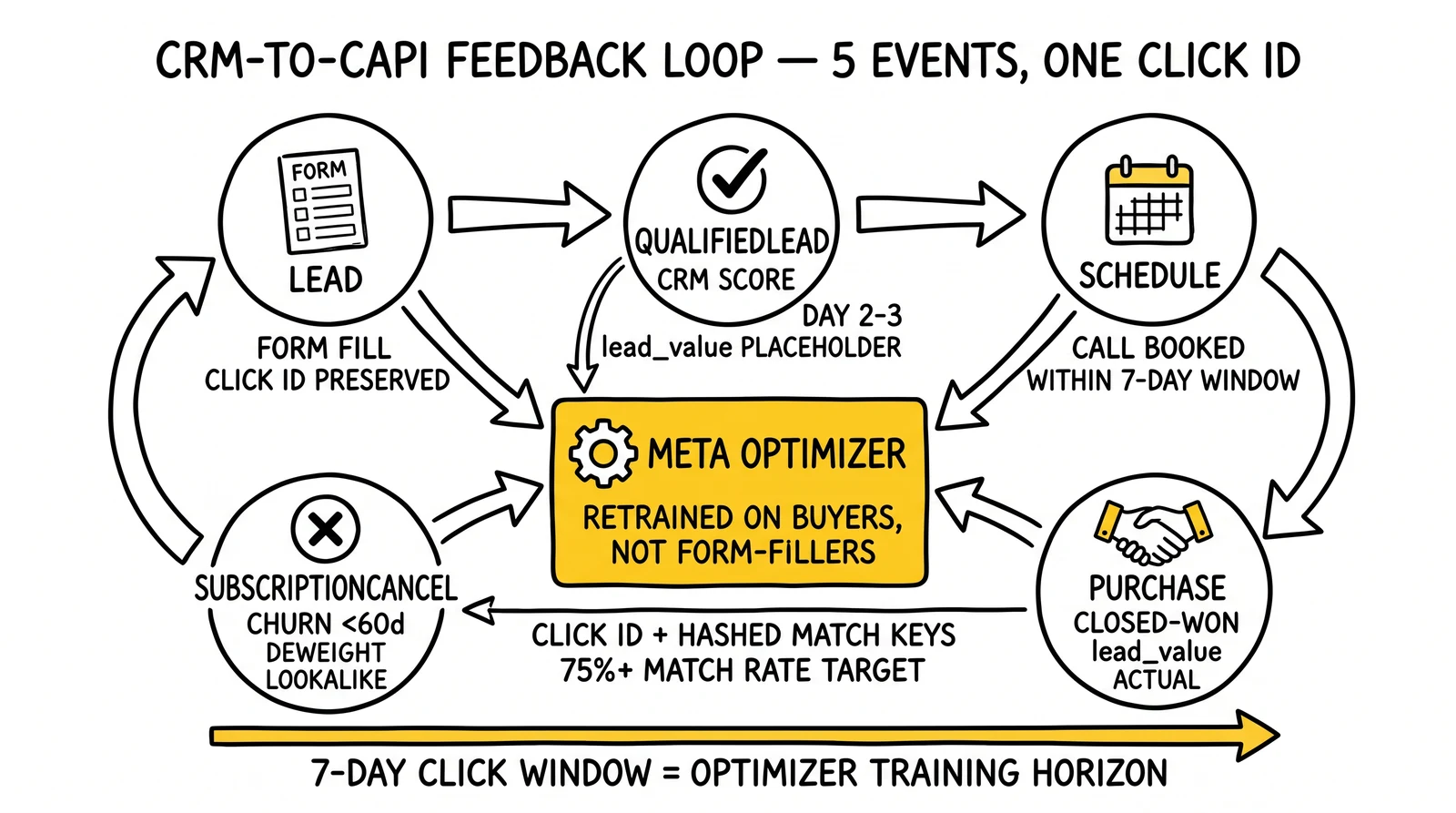
The closed-loop pattern is mechanically straightforward. When a lead enters the CRM, fire a server-side QualifiedLead event tagged with the original Meta click ID and hashed match keys. When a lead books a discovery call or demo, fire a Schedule event. When a lead becomes a customer, fire a Purchase or PurchaseSubscription event with the contract value as lead_value. When a customer churns within 60 days, fire a SubscriptionCancel event so Meta’s optimizer can deweight the lookalike pattern of churners rather than just including the pattern of buyers. Every event carries the original click ID as the load-bearing identifier through the entire chain.
| Event | Source | Optimizer Use | Match Keys | Required for Lead Gen |
|---|---|---|---|---|
| Lead | Form completion | Volume seed for lookalikes | Click ID, em (hashed), ph (hashed) | Always |
| QualifiedLead | CRM scoring threshold | Quality signal for delivery | Click ID, em, ph, lead_value (placeholder) | B2B, high-ticket B2C |
| Schedule | Booked call/demo | Mid-funnel intent signal | Click ID, em, ph | B2B services |
| Purchase | Closed-won | Buyer lookalike anchor | Click ID, em, ph, lead_value (contract $) | All considered-purchase |
| PurchaseSubscription | Recurring close | LTV-weighted optimization | Click ID, em, ph, lead_value, subscription_id | SaaS, services |
| SubscriptionCancel | Churn within 60d | Negative signal to deweight | Click ID, em, ph, churn_reason | SaaS, recurring services |
| TrialStart | Free-trial activation | Top-of-mid-funnel signal | Click ID, em, ph | Product-led growth |
Source: Meta Conversions API documentation (2024-2026), MarTech reporting on Meta lead-gen Q5 product upgrades, operator-reported event taxonomies from B2B SaaS and services accounts.
Three implementation details determine whether the closed loop produces 15-30% qualified-CPL improvement or produces no measurable effect at all. The first is event timing. Events fired more than 7 days after the click do not affect optimizer bid decisions on that click attribution, so qualified-lead and schedule events should fire as quickly as CRM scoring permits – typically within hours of the form fill, not days. Closed-won events for B2B sales cycles longer than 7 days still improve modeling and lookalike audience construction, but the bid-time effect on the original click is lost. The second is match-key fidelity. Hashed email and phone alone produce match rates of 35-50%; click ID added pushes match rates to 75-90%. Operators who lose the click ID through CRM round-trips lose half the value of the loop. The third is event volume. Below roughly 50 qualified events per week per ad set, Meta’s optimizer cannot detect statistical signal from CRM-side events and treats the campaign as form-fill-only. Below this threshold, operators should consolidate ad sets rather than fragment them across campaigns that individually undershoot optimizer learning thresholds.
The April 2026 Meta announcements made all of this materially easier for advertisers without engineering teams. Per Segwise’s analysis of the Pixel and CAPI updates, Meta released a one-click Conversions API setup that the company hosts and maintains, removing the developer-deployment requirement that had kept smaller advertisers out of server-side tracking through 2024. PPC.land’s reporting on the same update confirmed Meta’s claim of 17.8% lower cost per result for advertisers using the managed CAPI versus Pixel-only configurations. MarTech’s coverage of Meta’s Q5 (the company’s term for the holiday-extension period) lead-gen product upgrades added that beginning November 2025, advertisers using Salesforce Sales Cloud could send lead events directly from their CRM via Conversions API, and HubSpot was added as a click-through CRM partner shortly after. Zapier integration covered the long tail with up to 100,000 free lead events per month – enough to take all but the largest mid-market accounts out of the engineering-dependency category entirely.
Advantage+ Leads – When Full Automation Breaks B2B (and When It Works)
Meta’s Advantage+ campaign type now activates by default when an advertiser enables Advantage+ placements, opts into Advantage+ audience, and uses Advantage Campaign Budget – a configuration that, per Marketing Brew’s April 2026 reporting on Meta’s AI push, accounts for 60-70% of some agencies’ Meta spending. The platform reports up to 32% lower CPA for advertisers who fully consolidate fragmented campaign structures into Advantage+, and 22% higher ROAS on average versus manually managed campaigns. Those numbers are real for the use case Advantage+ optimizes against. They are misleading for lead generation when treated as a generic claim.
Advantage+ works most reliably for direct-response e-commerce because purchase events provide unambiguous training signal. The optimizer knows exactly what a converted user looks like, exactly when the conversion happened, and exactly what the conversion was worth. Lead-form completions provide none of those signals at the depth purchase events do. A lead-form completion has no contract value, no fulfillment, no clear quality threshold, and no certainty that the user will accept a follow-up call. When Advantage+ runs against form-fill events without CRM-CAPI downstream signal, it accelerates the same hill-climb that produced the 21% lead-objective CPL spike – only faster and with less operator visibility into the audience patterns the system is converging on.
Operators reporting positive Advantage+ Leads results in 2026 share a consistent profile: they run a CRM-CAPI feedback loop firing qualified-lead, schedule, and closed-won events; they have at least 40-50 closed-won events per month flowing through CAPI for the optimizer to anchor lookalikes against; and they treat the Advantage+ “creative variation” automation as a hypothesis-generation tool rather than a production system, manually promoting AI-generated variants that test well rather than letting the system auto-rotate them indefinitely. Marketing Brew’s reporting on marketer pushback against Meta’s creative AI tools – including the company’s acknowledgment that big brands remain “skittish” on AI-generated creative – reflects the practical reality that creative quality at the brand level is a constraint Advantage+ does not yet honor.
The decision rule that emerged across paid-social agencies through Q1 2026 was specific: Advantage+ Leads is appropriate when CRM-CAPI is firing 4+ event types at sufficient volume, the brand can tolerate AI-generated creative variants in market without case-by-case review, and the account has 90+ days of clean closed-won attribution data for the optimizer to seed against. Outside that envelope – particularly for B2B accounts with longer sales cycles, brand-sensitive creative requirements, or sub-50-events-per-month volume – manual Sales-objective campaigns with traffic destinations and CRM-CAPI feedback continue to outperform Advantage+ on cost per qualified opportunity by 18-35%, even after the platform reports better cost per lead.
Event Naming Taxonomy for 7-Day Attribution Windows
Meta’s lead-objective optimizer trains on the 7-day click attribution window regardless of which window the advertiser uses for reporting. That fact dictates the entire event-firing taxonomy for B2B lead-gen advertisers whose sales cycles run longer than seven days. Events that fire outside the 7-day click window improve audience modeling and lookalike construction but do not affect bid decisions on the original click. Events that fire inside the 7-day window do both. The implication, for any account where qualified-lead determination takes more than seven days, is that early-funnel events must carry as much downstream signal as possible because late-funnel events arrive too late to optimize against.
The practical event sequence runs like this. A user clicks a Facebook ad on day zero and lands on the qualifying landing page; a server-side PageView event fires with the Meta click ID. The user completes the form on day one or two; a server-side Lead event fires carrying the click ID and hashed match keys. CRM scoring on day two or three either accepts or rejects the lead – accepted leads trigger a server-side QualifiedLead event with a placeholder lead_value (typical convention is the average closed-won value times the historical qualified-to-closed conversion rate, so the event carries a probability-weighted value rather than zero). If the prospect books a discovery call on day four through six, a Schedule event fires before the 7-day window closes. Beyond day seven, the Purchase or SubscriptionCancel events fire when they occur, but the optimizer treats them as audience-modeling input rather than bid-decision input.
Operators who design their sales process around this mechanic – moving CRM scoring, SDR outreach, and discovery-call booking into the first seven days – capture meaningfully more optimizer signal than operators who let qualification and booking trail the click by 10-21 days. The B2B sales-process redesign required to compress qualification into the 7-day window is non-trivial, but it is the single highest-leverage intervention available for improving Meta lead-gen optimization in 2026, and it remains substantially less expensive than the alternative of paying the CPL premium that lead-objective campaigns extract from operators running long-cycle qualification.
The lead_value field is the second-most-load-bearing convention in the taxonomy. Meta uses lead_value to weight the optimizer’s preference among qualified leads – a $50,000 contract-value lead pulls more delivery weight than a $5,000 contract-value lead, even when both qualify. Operators who fire QualifiedLead and Purchase events without lead_value, or who fire all events with lead_value of 1.0, lose the value-weighting entirely and revert the optimizer to volume mode. Filling in realistic placeholder values at qualified-lead time, then correcting to actuals at closed-won time, is the standard pattern across mature CRM-CAPI implementations.
The $40 Raw Lead to $180 Qualified Lead Transformation
The headline benchmark numbers in the trade press cover the raw form-fill price. Operators pay the qualified-lead price. The difference between those two numbers is where the 21% CPL spike actually compounds, and where the traffic-objective and CRM-CAPI hybrid actually wins. Working through the math with concrete numbers makes the case clearer than benchmark averages do.
Consider a B2B services account running Facebook Lead Ads in early 2026 against a $40 raw CPL – slightly above the cross-vertical mean but below the considered-purchase verticals. Lead-objective qualification rates for B2B services across operator data sit at 22-28% in the absence of CRM-CAPI feedback. Applied to a $40 raw lead, that produces a qualified-lead cost of $145 to $180 before any sales effort. SDR cost to qualify each form-fill – typically 7-12 minutes per lead at fully-loaded SDR cost of $0.85-$1.20 per minute – adds another $6 to $14, pushing the all-in cost-per-qualified-lead toward $190. Closed-won rates on those qualified leads sit at 5-8% for typical B2B services, producing a cost-per-customer in the $2,400-$3,800 range against contract values that need to clear roughly 5x of that to make the channel pencil at the unit-economic level.
The traffic-objective and CRM-CAPI alternative replaces every line of that calculation. Raw CPL rises to $58 – a 45% premium over the lead-objective figure that benchmark averages would treat as a worse outcome. Qualification rates rise to 55-65% because the landing-page friction self-selected for intent, producing a qualified-lead cost of $90 to $105 before sales effort. SDR effort to qualify drops because the leads arrive with clearer intent context – 4-7 minutes per lead, adding $3 to $8 to the all-in. Closed-won rates on qualified leads run 9-13%, partly because the lead arrives more qualified and partly because the CRM-CAPI loop has trained the optimizer to deliver against people who look like prior customers rather than people who fill in forms. Cost-per-customer lands in the $850-$1,200 range – a 65-70% improvement against the lead-objective baseline.
| Line Item | Lead-Objective | Traffic + CRM-CAPI | Improvement |
|---|---|---|---|
| Raw CPL | $40.00 | $58.00 | -45% (worse) |
| Qualification rate | 25% | 60% | +35 pp |
| Cost-per-qualified-lead (pre-SDR) | $160.00 | $96.67 | -40% |
| SDR qualification cost | $10.00 | $5.50 | -45% |
| All-in cost-per-qualified-lead | $170.00 | $102.17 | -40% |
| Closed-won rate (qualified) | 6.5% | 11.0% | +4.5 pp |
| Cost-per-customer | $2,615 | $929 | -64% |
| Required contract value (5x) | $13,075 | $4,645 | -64% |
Sources: Operator-reported reconciliations across B2B services accounts (2025-2026); Smarketing Cloud lead-quality analyses; Visible Factors 2026 benchmarks; Meta Conversions API documentation and PPC.land coverage of April 2026 updates.
The 45% CPL premium is what operators willingly pay for the 64% reduction in cost-per-customer. Benchmark averages, which report on raw CPL alone, will continue to flag the traffic-objective campaign as the more expensive option, and operators reporting on raw CPL alone will continue to be punished by their CFOs for “letting CPL drift up.” The accounting-vs-economics gap between those two views of the same data is the gap that destroyed lead-objective economics for considered-purchase verticals through 2025, and it is the gap the multi-touch attribution discipline was specifically designed to close.
The 60-Day Operator Playbook
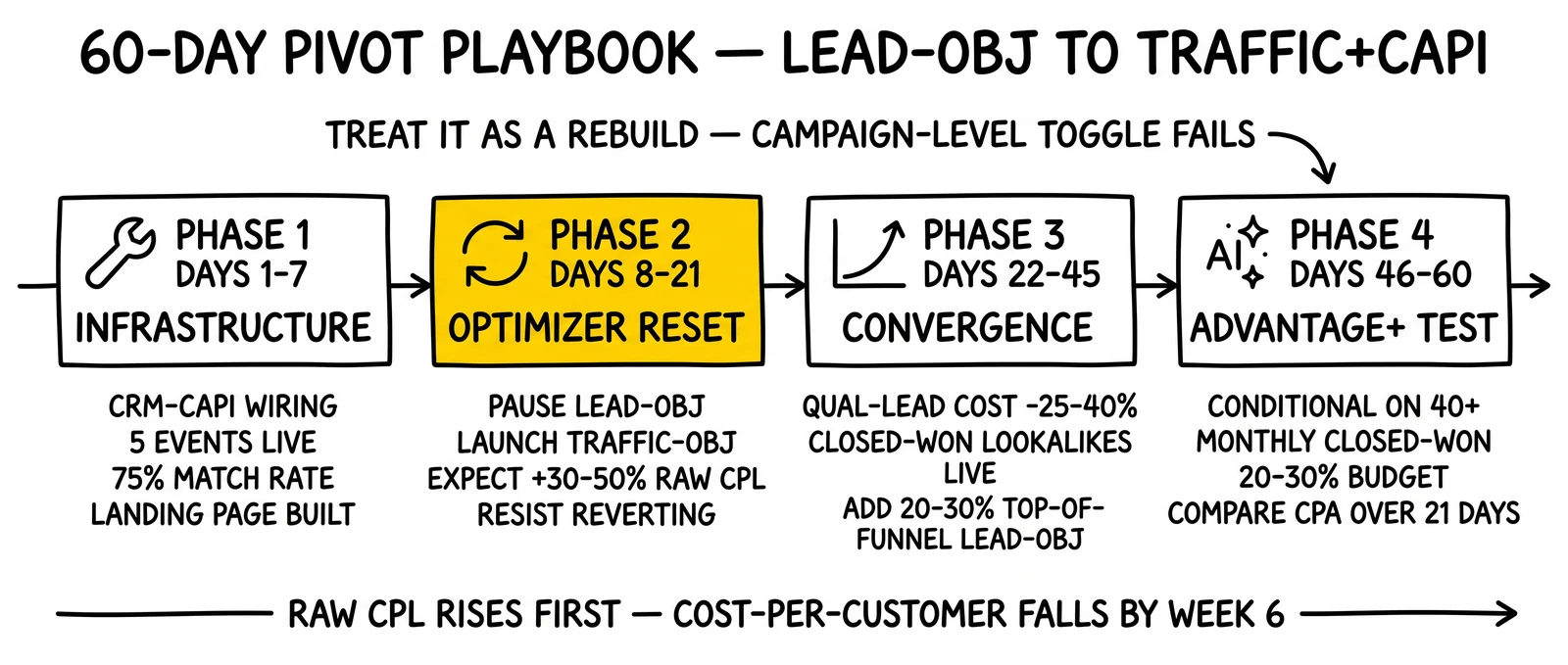
The pivot from lead-objective to traffic-objective plus CRM-CAPI is not a campaign-level change. It is a sales-and-marketing-operations change that touches CRM event taxonomy, landing-page infrastructure, SDR workflow, attribution reporting, and optimizer training cycles. Operators who treat it as a campaign-level switch – duplicate the campaign, change the objective, watch the metrics – produce the worst-case outcome: higher CPLs, no quality improvement, and a recommendation to revert. The operators who treat it as a 60-day rebuild produce the qualified-lead-cost reduction the math promises.
Days 1-7 are infrastructure. Wire up the CRM-CAPI integration – Salesforce, HubSpot, or Zapier as the implementation path – and confirm that QualifiedLead, Schedule, Purchase, and Cancel events are firing with click ID, hashed email, and hashed phone match keys. Confirm match rates against Meta’s Events Manager diagnostics: targets are 75%+ on click ID and 50%+ on email/phone. Below those thresholds, the loop is producing decoration rather than optimization. Build or reuse a qualifying landing page with a 600-800 word above-fold offer, three benefit sections, and a form below the fold that collects email, phone, company, and 2-3 BANT or qualification questions. Mobile-first design is non-negotiable; 70%+ of Facebook click traffic resolves on mobile.
Days 8-21 are the optimizer reset. Pause existing lead-objective campaigns rather than copying them – copying carries audience-history baggage that contaminates the new optimizer. Launch traffic-objective campaigns with broad audiences (no detailed targeting at first), Advantage+ placements enabled, and CAPI events firing from day one. Expect raw CPL to rise 30-50% in the first 14 days as the optimizer searches for the new pageview-and-form-fill audience pattern. Resist the temptation to revert. Watch qualified-lead-cost and closed-won-rate, not raw CPL, on the new campaigns.
Days 22-45 are the convergence window. The CRM-CAPI loop has now fed 2-4 weeks of qualified-lead and closed-won signal into the optimizer, and lookalike audiences seeded against closed-won lists begin pulling delivery toward higher-intent users. Qualified-lead cost should be tracking 25-40% below the lead-objective baseline by day 35; closed-won rate on qualified leads should be tracking 30-50% above. Layer in selective lead-objective campaigns at the top of funnel for awareness retargeting, but keep them at 20-30% of total spend rather than the dominant share they occupied pre-pivot.
Days 46-60 are the Advantage+ test, conditional on the prior phases working. If CRM-CAPI is firing 4+ event types, closed-won volume is at 40+ per month, and the brand can tolerate AI-generated creative variants in market, run an Advantage+ Leads test against 20-30% of the budget with the existing qualifying landing page as the destination and the full CAPI event taxonomy active. Compare cost per closed-won customer over a 21-day window. If Advantage+ wins, expand its budget share over the following month. If it does not, revert to manual Sales-objective campaigns with traffic destinations and treat the test as a calibration data point.
The 60-day timeline is approximate. Accounts with stronger pre-existing CAPI infrastructure compress it to 30-45 days. Accounts starting from Pixel-only with no CRM integration extend it to 90 days. The single most common failure mode across operator implementations is treating the CRM-CAPI loop as optional or partial – firing only Lead events, omitting Schedule and Purchase events, or running the loop for two weeks and reverting because raw CPL was higher than the prior lead-objective baseline. The math does not work without the closed loop running fully. Operators who shortcut the implementation produce shortcut results.
Key Takeaways
-
Facebook lead-objective CPL rose 20.94% to $27.66 across 2025, with form-completion conversion dropping from 8.67% to 7.72% – a compound effect that hit cost per qualified opportunity substantially harder than the headline CPL number alone, particularly in considered-purchase verticals like dental ($76.71), health and fitness ($52.98), and legal services.
-
Lead-objective optimization rewards form fills, not buyers, and the post-iOS-14 collapse of Pixel-side intent signals removed the downstream context that previously kept the optimizer from hill-climbing toward audiences who would fill in any pre-filled form for any reason. Native Lead Ads pre-fill the friction out of the funnel and the qualification out of the lead.
-
Traffic-objective campaigns improved on every metric over the same window – CPC fell 6.7% to $0.70 and CTR climbed to 1.71% – because landing-page friction self-selects for intent and gives the optimizer richer signal to train against. The 45% CPL premium operators pay for traffic-objective leads typically produces a 60-70% reduction in cost-per-customer.
-
The CRM-to-CAPI feedback loop is now load-bearing rather than optional, firing QualifiedLead, Schedule, Purchase, and SubscriptionCancel events with click ID and hashed match keys to retrain Meta’s optimizer on real business outcomes. Operators running this loop consistently report 15-30% lower effective CPL on qualified pipeline.
-
April 2026 Meta updates removed the developer-dependency barrier with one-click Conversions API setup and AI Pixel event enrichment, claiming 17.8% lower cost per result. HubSpot, Salesforce Sales Cloud, and Zapier integrations now cover the long tail of CRM-CAPI implementation without engineering involvement.
-
Advantage+ Leads works only when CRM-CAPI is feeding 4+ event types at sufficient volume (40+ closed-won events per month minimum) and the brand can tolerate AI-generated creative in market. Outside that envelope, manual Sales-objective campaigns with traffic destinations and CRM-CAPI feedback outperform Advantage+ by 18-35% on cost per qualified opportunity.
-
The 7-day click window is the optimizer’s training horizon, which means B2B sales processes must compress qualification, SDR outreach, and discovery-call booking inside that window to capture optimizer signal. Events firing beyond day seven improve audience modeling but do not affect bid decisions on the original click attribution.
-
The 60-day operator playbook is a rebuild, not a switch: week one infrastructure, weeks two-three optimizer reset, weeks four-six convergence, weeks seven-nine selective Advantage+ test. Operators who treat it as a campaign-level toggle revert in two weeks and conclude that traffic objective does not work, when the actual finding is that partial implementation does not work.
-
The accounting-versus-economics gap destroys decisions when CMOs report raw CPL to CFOs rather than cost per qualified opportunity or cost per customer. The metric the optimizer extracts from operators is exactly the metric operators report to their finance teams, which is why the 21% spike persisted: nobody whose compensation depended on raw CPL had the political room to let it rise 45% in service of 64% lower cost-per-customer.
Frequently Asked Questions
How much did Facebook lead-campaign CPL rise in 2025?
Facebook lead-objective campaigns saw cost per lead climb 20.94% to $27.66 across the WordStream LocaliQ panel of more than 1,000 campaigns, while form-completion conversion rate fell from 8.67% to 7.72% – an 11% relative drop. The compound effect on cost per qualified opportunity was substantially larger than the headline CPL number, because the leads passing through the funnel were also less likely to convert to revenue. Vertical-by-vertical, the CPL increase concentrated in considered-purchase categories: dental at $76.71, health and fitness at $52.98, beauty and personal care at $51.42.
Why did lead-objective campaigns get worse while traffic campaigns improved?
Lead-objective optimization rewards the cheapest form fill, not the most qualified buyer, and Meta’s signal-loss-induced reliance on engagement proxies amplified that bias through 2024 and 2025. Traffic-objective campaigns improved over the same window – CPC fell 6.7% to $0.70 and CTR climbed to 1.71% – because landing-page friction self-selects more committed prospects and gives the algorithm cleaner downstream signal to optimize against. The friction is the feature: a user who reads a 600-word landing page and types contact information into an unfilled form has demonstrated meaningfully more intent than a user who taps a pre-filled form in a Reels mid-roll.
What is the CRM-to-CAPI feedback loop and why does it matter?
The CRM-to-CAPI feedback loop pipes Salesforce, HubSpot, or equivalent qualified-lead and closed-won events back into Meta’s Conversions API tagged with the original lead’s match keys. That gives the optimizer a downstream truth signal – buyers, not form-fillers – to retrain on. Operators running this loop consistently report 15-30% lower effective CPL on qualified pipeline because Meta begins delivering toward people who look like customers rather than people who fill in forms. The April 2026 Meta updates added one-click HubSpot and Zapier integration paths, removing the engineering-dependency barrier that had kept smaller advertisers out of the closed-loop pattern.
Should B2B advertisers still use the Facebook lead form objective?
B2B advertisers should default to traffic-objective with a qualifying landing page and CRM-CAPI closed-loop, then test lead-objective only as a top-of-funnel layer for awareness retargeting at 20-30% of total budget. Native Facebook lead forms produce volume but historically convert to closed-won at roughly half the rate of landing-page traffic for considered-purchase B2B categories. The closed-won feedback loop transforms Meta from a form-fill optimizer into a buyer-finder, which is the only way the lead-objective math works in 2026 outside of pure-volume verticals like restaurants or career and employment.
What changed in Meta’s April 2026 Pixel and CAPI updates?
On April 15, 2026, Meta announced AI event enrichment for the Pixel and a one-click Conversions API setup that Meta itself hosts and maintains. The company reported 17.8% lower cost per result for advertisers using the new managed CAPI versus Pixel-only setups. Operators interpret the move as Meta acknowledging signal loss has reached a point where smaller advertisers cannot compete without server-side infrastructure, and the platform now provisions that infrastructure rather than waiting for advertisers to build it. HubSpot was added as a click-through CRM partner alongside the existing Salesforce integration and the Zapier path covering up to 100,000 free lead events per month.
Does Meta Advantage+ full automation work for lead generation?
Advantage+ full automation works for direct-response e-commerce more reliably than for lead generation because purchase events provide unambiguous training signal that form fills do not. For lead campaigns, Advantage+ should be tested only after a CRM-CAPI closed-loop is feeding qualified-opportunity, schedule, and closed-won events back to the optimizer at 40+ closed-won events per month. Without that downstream signal the system optimizes for the cheapest form fill, which is the exact failure mode that produced the 21% CPL spike. Marketing Brew’s April 2026 reporting noted that 60-70% of some agencies’ Meta spending now runs through Advantage+, but the agencies seeing positive lead-gen results all share a CRM-CAPI infrastructure profile.
How long does the lead-objective to traffic-objective pivot take to show results?
Operators report measurable lead-quality improvement in 14-21 days and full optimizer convergence in 45-60 days, assuming a CRM-CAPI feedback loop is firing qualified-lead and closed-won events from the start. The first two weeks typically show CPL increases as the algorithm exits the form-fill optimization regime; weeks 3-6 stabilize cost per qualified opportunity; weeks 7-9 deliver the closed-won lookalike effects that compound for the remaining campaign life. Operators who pause the pivot in the first two weeks because raw CPL rose 30-50% are abandoning the rebuild before the optimizer has converged on the new audience pattern.
What attribution window should lead-gen advertisers use in 2026?
B2C lead-gen campaigns should use 7-day click and 1-day view; B2B campaigns with 30-90 day sales cycles need 7-day click paired with offline conversion uploads tagged to the original click ID. Meta’s optimizer trains on the 7-day click window regardless of the report view, so closed-won events fired beyond that window improve audience modeling without affecting bid decisions on the click attribution. Operators preserve the original Meta click ID through the CRM as the load-bearing identifier for the entire chain, and they design SDR and discovery-call workflows to compress qualification inside the 7-day window where possible.
How does the $40 raw lead become a $180 qualified lead?
The $40 raw form-fill price reflects only Meta’s bid for the cheapest completion, not the marketing-cost-per-qualified-lead the business actually pays. After applying typical lead-objective qualification rates of 22-28%, a $40 raw form fill becomes a $145-$180 qualified lead before sales effort, and SDR qualification time at fully-loaded cost adds another $6-$14. The traffic-objective and CRM-CAPI hybrid reverses the math: a $58 raw lead with 55-65% qualification rates produces a $90-$105 qualified lead, with SDR cost dropping because leads arrive with clearer intent context. Operators willingly pay a 45% raw CPL premium for the resulting 60-70% reduction in cost-per-customer.
What event taxonomy should advertisers send to Meta CAPI?
A minimum 2026 event taxonomy includes Lead (form completion), QualifiedLead (passes CRM scoring or BANT thresholds), Schedule (booked discovery call or demo), Purchase or PurchaseSubscription (closed-won), and SubscriptionCancel (churn within 60 days). Each event carries the original Meta click ID, hashed email, hashed phone, and lead_value in dollars – typically a probability-weighted placeholder at qualified-lead time, corrected to actuals at closed-won time. Cancellation events are critical for B2B because they allow the optimizer to deweight the lookalike pattern of churners, not just include the pattern of buyers. TrialStart events serve product-led growth motions where free-trial activation is the meaningful mid-funnel signal.
The companies that emerge from this period of paid-social repricing are not the ones with the largest budgets or the most sophisticated AI tooling. They are the operators who recognized that Meta’s lead-objective optimizer had been running on impoverished signal since 2021, that the 21% CPL spike of 2025 was the platform finishing the work of pricing that impoverishment in, and that the closed-loop CRM-CAPI pattern is now the price of admission rather than a competitive edge. The operators who rebuild the loop pay 2025 prices and produce 2026 quality. The operators who keep optimizing against form fills pay every subsequent CPL increase Meta extracts, until the channel stops penciling and the budget moves to whichever channel has not yet been priced to its signal limit.
Sources
-
Visible Factors, “Facebook Ads Benchmarks: Performance Analysis 2026”
-
Segwise, “Meta Pixel and Conversions API: April 2026 AI Updates,” April 2026
-
Marketing Brew, “How Meta’s AI push is changing ad creation,” April 7, 2026
-
MarTech, “Meta announces lead gen product upgrades for Q5,” 2025
-
Search Engine Land, “Facebook ad costs jump 21% in 2025, but still beat Google,” 2025
-
Social Media Today, “Meta Phases Out Automated Ads in Favor of Advantage+,” 2026
-
Meta for Business, “Meta Advantage+: Optimize Facebook & Instagram Ads with AI”