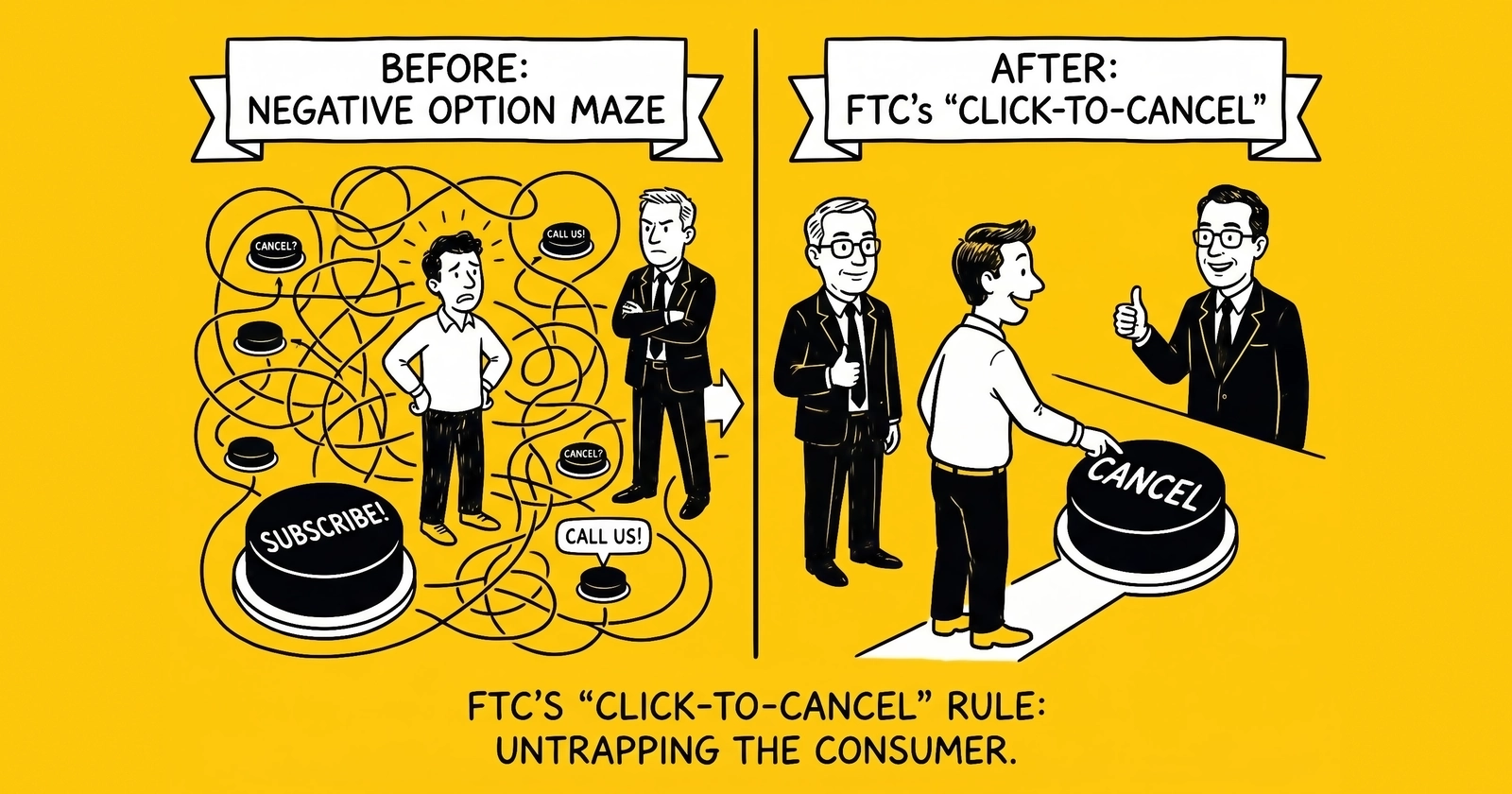
The Federal Trade Commission’s Advance Notice of Proposed Rulemaking on negative-option marketing closed for public comment on April 13, 2026. ROSCA continues to apply. The pre-2024 Negative Option Rule is back in force. Every lead-generation funnel that converts a free trial, free-plus-shipping offer, or lead magnet into recurring billing is operating under a regulatory framework that has changed three times in nine months – and is about to change again.
A Comment Period Closes, the Compliance Question Stays Open
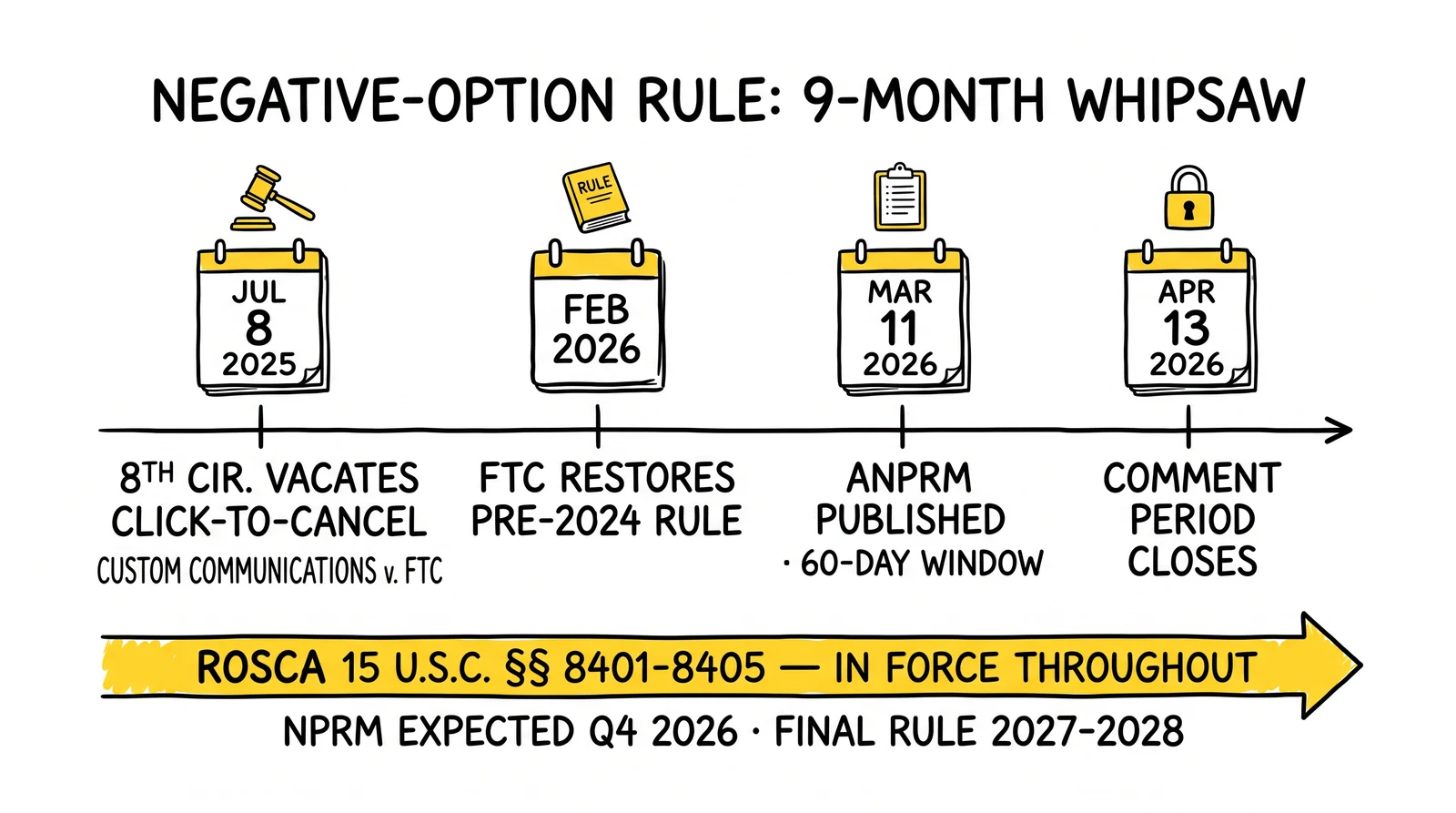
On March 11, 2026, the Federal Trade Commission published an Advance Notice of Proposed Rulemaking that asked the public a deceptively narrow question: should the agency once again amend its Negative Option Rule, and if so, how. The comment window ran sixty days and closed on April 13. The trade press treated the filing as procedural housekeeping after the Eighth Circuit’s July 2025 vacatur of the original Click-to-Cancel rule. For most subscription operators, the news read as a deferral. The aggressive 2024 amendments were gone. The narrower pre-2024 rule had been formally restored in February 2026. The next set of substantive obligations was at least one rulemaking cycle away.
That reading misreads the moment. ROSCA – codified at 15 U.S.C. §§ 8401-8405 – continues to apply, in full, during every interim hour of the rulemaking. The FTC has prosecuted ROSCA actions throughout 2025-2026 against operators whose disclosure, consent, and cancellation practices fell short, often pairing ROSCA counts with Section 5 unfair-or-deceptive-acts allegations. State frameworks operate in parallel and are unaffected by the federal procedural reset. And the next FTC notice in this docket, an NPRM expected in late 2026, will land on operators who either spent the interim auditing their consent flows against the restored pre-2024 standard or did not.
For lead-generation operators, the question is therefore not whether to wait for the rule to settle. It is whether the funnel architecture being run today survives a ROSCA-shaped enforcement action filed any time in the next twenty-four months. This analysis covers what changed on March 11, why the procedural vacatur did not weaken ROSCA, where the still-binding pre-2024 rule sits relative to operator practice, what the comment-period window allows, and what a Monday-morning audit of a typical lead-magnet-to-subscription funnel should produce.
What Changed on March 11 – and Why the Procedural History Is the Point
The headline event was the ANPRM. The actual regulatory posture is the layered consequence of three preceding events.
The first is the Eighth Circuit’s July 8, 2025 decision in Custom Communications, Inc. v. FTC. The court vacated the 2024 Click-to-Cancel amendments – the rule that would have required simple cancellation parity (“as easy to cancel as it was to sign up”), express informed consent before any negative-option enrollment, and pre-billing reminders for annual subscriptions – on procedural rather than substantive grounds. The court found that the FTC had failed to issue a separate preliminary regulatory analysis once the rule’s projected economic impact exceeded $100 million, a step required under Section 22 of the FTC Act. The substance of the rule was not held to be unauthorized. The procedure was held to be defective. That distinction has carried significant weight in everything the agency has done since.
The second is the FTC’s February 2026 formal action restoring the pre-2024 Negative Option Rule. Following the vacatur, an ambiguity persisted about whether any version of the Negative Option Rule remained on the books. The agency resolved that ambiguity by formally codifying the pre-2024 framework – a narrower set of obligations focused on prenotification negative-option plans (book-of-the-month-club style arrangements) rather than the broader sweep of all negative-option marketing the 2024 amendments would have captured. Crowell & Moring’s client alert characterized the restoration as the agency “clicking all the right boxes” to give itself a procedurally clean platform from which to restart. Gibson Dunn’s coverage emphasized that the restored rule, while narrower, is fully in force and enforceable.
The third is the March 11, 2026 ANPRM itself. The notice did not propose specific rule text. Instead, it solicited public comment on whether the Negative Option Rule should once again be amended, what form the amendments should take, and how the agency should address the procedural deficiencies the Eighth Circuit identified. The sixty-day comment window – closing April 13 – was deliberately structured to allow the agency to compile a record that would support a subsequent Notice of Proposed Rulemaking later in 2026 and a final rule potentially in 2027. Goodwin’s analysis flagged that this two-step process is itself a procedural hedge: by issuing an ANPRM before an NPRM, the agency builds a record that any future court reviewing the eventual rule will struggle to dismiss as procedurally rushed.
The combined effect of these three events is a regulatory environment in which the substantive direction of FTC negative-option policy has not reversed but the specific obligations binding on operators today are narrower than they were eighteen months ago. ROSCA’s three-prong statutory framework – clear and conspicuous disclosure, express informed consent, simple mechanism to stop recurring charges – has never been disturbed. The pre-2024 Negative Option Rule is in force. The 2024 Click-to-Cancel amendments are not. The next set of amendments is being drafted now.
Why the procedural history matters for funnel auditing
Operators evaluating the current state often conclude that the vacatur reduces their compliance burden. That conclusion is half-correct and the wrong half to act on. The 2024 amendments imposed obligations – pre-billing reminders, annual reconfirmation, specific cancellation-mechanism requirements – that are not currently binding. But the underlying ROSCA obligations that gave rise to those amendments are unchanged. An operator whose disclosure flow was weak under the 2024 rule was almost certainly weak under ROSCA’s “clear and conspicuous disclosure” requirement before the 2024 rule existed. The vacatur removed an additional rule layer; it did not remove the statutory baseline.
This is why the FTC has continued enforcement throughout 2025-2026 without missing a beat. ROSCA cases filed since the vacatur have not relied on the 2024 amendments. They have relied on ROSCA’s express statutory text and on the FTC Act’s Section 5 prohibition on unfair or deceptive acts. The audit obligation has not narrowed; it has shifted reference frameworks. An operator who built architecture against the 2024 Click-to-Cancel checklist now needs to re-anchor against the older but still-binding ROSCA-plus-pre-2024-rule combination.
The Three Layers of the Negative-Option Stack Operators Run Funnels Through
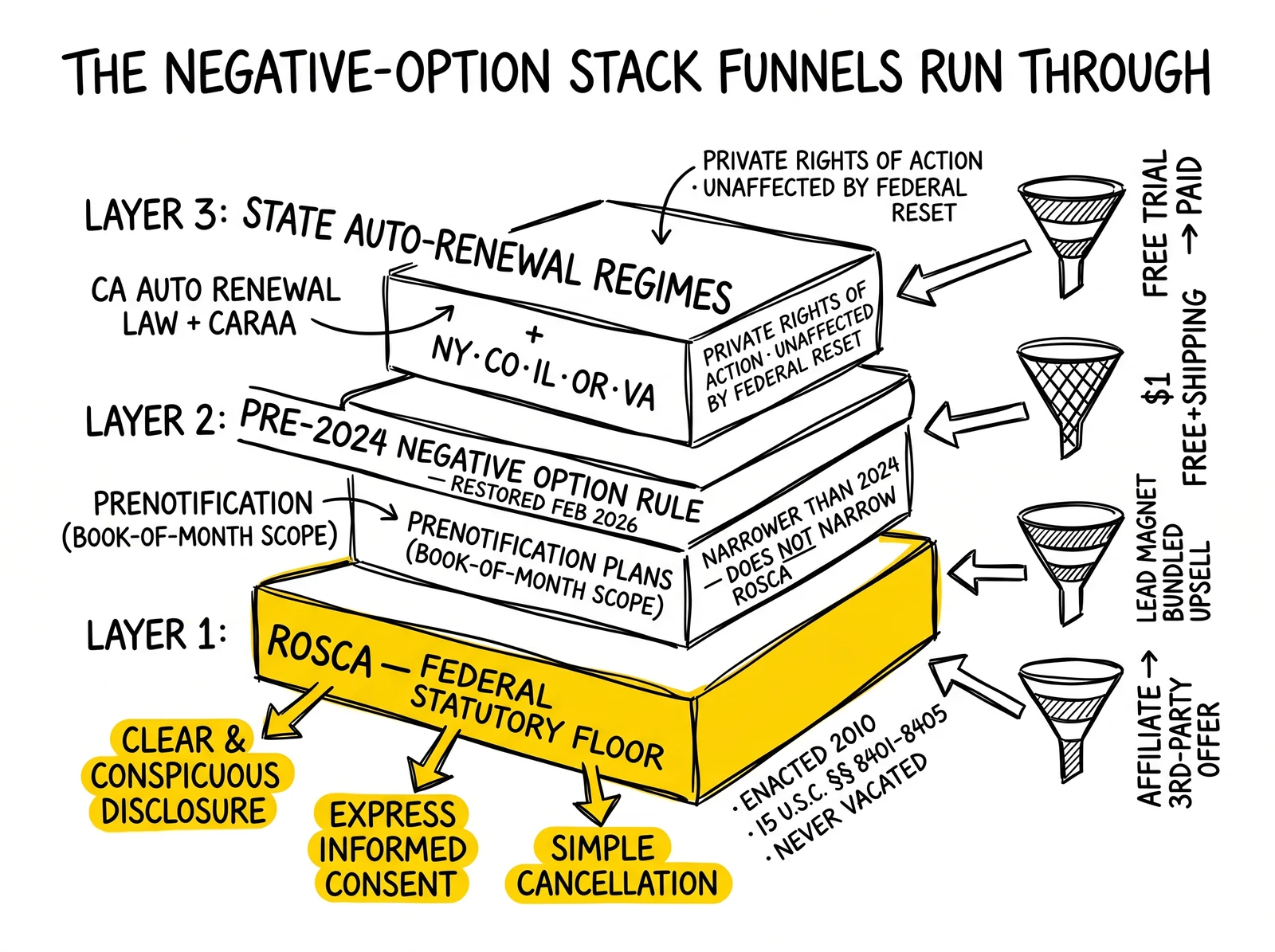
Beneath the surface of the rulemaking sit three distinct compliance layers, each of which independently affects whether a lead-generation funnel is operating cleanly. Operators who treat negative-option compliance as a single regime miss the layered structure.
Layer one: ROSCA and the federal statutory floor
The Restore Online Shoppers’ Confidence Act, enacted in 2010, governs every “negative-option feature” sold “through the Internet.” The statute imposes three obligations that have not changed since enactment: clearly and conspicuously disclose all material terms before obtaining billing information, obtain express informed consent before charging the consumer’s account, and provide simple mechanisms to stop recurring charges. ROSCA violations are treated as violations of an FTC trade rule, which permits civil penalty recovery, and the agency’s Section 19 redress authority means cases produce both injunctive and monetary outcomes.
For a lead-generation operator running, say, a $1 free-plus-shipping trial that converts to a $79 monthly subscription on day fifteen, every line of the funnel has to satisfy ROSCA’s three obligations. The disclosure that the trial converts has to be clear and conspicuous before payment is captured. Consent to the recurring charge – separate from any consent to the trial – has to be express. The cancellation pathway has to be simple in the statute’s plain-language sense, not buried behind retention queues or required phone calls.
Layer two: the pre-2024 Negative Option Rule as currently restored
The pre-2024 Negative Option Rule – restored by the FTC in February 2026 – sits on top of ROSCA but is narrower in scope than the 2024 amendments would have been. The pre-2024 rule was historically directed at “prenotification negative option plans” of the kind associated with traditional book-of-the-month or record-of-the-month clubs: arrangements in which a seller periodically sends a notice describing a specific upcoming shipment and treats the consumer’s silence as authorization to send and bill for that shipment.
That historical scope is narrower than the way many modern subscription operators use negative-option mechanics. A monthly software subscription that auto-renews without an item-by-item notice does not fit cleanly into the pre-2024 rule’s prenotification framework. A free-plus-shipping trial that converts to a recurring physical-goods subscription may or may not fit, depending on how the conversion is structured. The 2024 Click-to-Cancel amendments would have explicitly broadened the rule to capture all of these arrangements; the vacatur of those amendments returned the rule to its narrower historical reach.
Two implications follow. First, operators cannot rely on the pre-2024 rule’s narrowness as a shield. Most modern subscription mechanics that fall outside the pre-2024 rule’s prenotification scope are still squarely captured by ROSCA. The narrower rule does not narrow ROSCA. Second, the operative regulatory question for many funnels is not “does the pre-2024 rule apply” but “do ROSCA’s express requirements apply, and are they being met.” For lead-generation funnels, the answer to the second question is almost always yes.
Layer three: state auto-renewal regimes operating in parallel
The third layer is the patchwork of state auto-renewal statutes that has expanded substantially since 2018. California’s Auto Renewal Law – recently expanded by what industry observers have called the Combatting Auto Renewal Abuse Act amendments – imposes disclosure, consent, and cancellation requirements that in some respects exceed the 2024 Click-to-Cancel amendments. New York, Colorado, Illinois, Oregon, Virginia, and others have enacted similar regimes. Several authorize private rights of action and class-action recovery.
Critically, the state regimes are unaffected by the federal procedural reset. The vacatur did nothing to weaken California’s Auto Renewal Law. The FTC’s restoration of the pre-2024 rule is irrelevant to New York’s framework. State enforcement and state class-action exposure remain the larger practical risk for many subscription operators.
For lead-generation operators selling to subscription buyers who operate in California or New York, the state-layer obligation is effectively passed through. A lead generated in California for a subscription product is governed by California’s framework regardless of where the lead generator sits, because the consumer transaction the lead initiates is the regulated event. This is the layer most negative-option lead-gen audits underweight, and where practical exposure for an operator’s consent documentation and retention practices is most likely to surface in litigation.
What the ANPRM Comment Period Just Did – and What It Did Not Do
The April 13 comment-period close did three concrete things and did not do several others that the press coverage occasionally implied.
It compiled a regulatory record. Comments filed with the FTC in response to an ANPRM enter the agency’s docket and become part of the administrative record supporting any subsequent NPRM. Industry trade associations, individual operators, consumer-advocacy groups, state attorneys general, and academic researchers all filed. That record will frame the issues the next NPRM addresses, the alternatives the agency considers, and the cost-benefit analysis the agency conducts. An operator with material exposure who did not read the docket has missed the most concrete signal about what the next rule will look like.
It opened a lobbying window that has now formally closed. The sixty-day comment period was the structured opportunity for industry to influence the next rulemaking. Trade associations representing subscription commerce, performance marketing, affiliate networks, and direct-response operators filed comments arguing for narrower scope, specific safe harbors, and procedural protections. Consumer groups filed for the opposite. The window for new substantive influence will not reopen until the NPRM itself is issued and a new comment period begins.
It signaled the agency’s substantive intent. ANPRMs are not neutral. The questions an agency asks are typically the questions it has already begun forming preliminary answers to. The March 11 ANPRM asked whether the rule should require “simple cancellation parity,” whether pre-billing reminders should be mandated for long-term subscriptions, and whether specific consent-flow characteristics should be standardized. Operators reading the ANPRM as a clean restart, rather than as a procedurally hardened version of the 2024 amendments, are likely underestimating the substantive direction.
What the comment-period close did not do is just as important. It did not pause ROSCA. It did not weaken the FTC’s Section 5 enforcement authority. It did not affect any state auto-renewal regime. It did not extend any deadline for operator compliance work. The timeline pressure is now greater, because the next NPRM will land on operators who have either used the interim productively or have not.
The likely shape of the late-2026 NPRM
Drawing inferences from the ANPRM text, the FTC’s enforcement record, and the Eighth Circuit’s procedural feedback, several characteristics of the expected NPRM are reasonably predictable.
The next NPRM will almost certainly retain the core 2024 framework – simple cancellation parity, express informed consent, disclosure obligations – while adding the procedural hardening the Eighth Circuit found missing: a separately published preliminary regulatory analysis with a thoroughly documented economic-impact assessment, and a clearer paper trail any reviewing court will struggle to dismiss as rushed.
The NPRM is likely to address substantive ambiguities that contributed to the 2024 rule’s vulnerability. The scope question – which categories of negative-option marketing the rule reaches – is likely to receive more specific definitional treatment. The cancellation-parity question is likely to receive more granular guidance. The pre-billing-reminder requirement is likely to be retained, perhaps narrowed to specific categories or duration thresholds.
NPRM timing is likely Q4 2026 or Q1 2027, with a thirty- or sixty-day comment period following, and a final rule realistically not arriving before late 2027 or 2028. That timeline is the operator’s planning window – and the deadline against which audit work has to be completed.
The Lead-Generation Funnel Layer: Where Negative-Option Risk Actually Lives
The discussion to this point has focused on the regulatory framework. The operational question for lead-generation operators is narrower: which funnel patterns generate the most negative-option exposure, and how should those patterns be audited.
Pattern one: free trial converts to paid recurring
The classic free-trial funnel – fourteen-day or thirty-day free access that automatically converts to monthly billing if not canceled – is the canonical negative-option pattern and the one the FTC has prosecuted most often under ROSCA. The ROSCA-relevant questions are sharp. Does the landing page disclose, clearly and conspicuously, before payment capture, that the trial converts to a recurring charge of a specified amount on a specified date? Does the consent step capture express informed consent specifically to the recurring charge, separate from any consent to the trial itself? Does the post-enrollment confirmation describe the recurring obligation, conversion date, and cancellation pathway? Is the cancellation pathway accessible from the same authenticated session, without retention queues or required phone calls?
For lead-generation operators delivering trial-funnel leads on behalf of subscription product owners, every one of these questions is partially their responsibility and partially the buyer’s. An operator running the landing page is responsible for the disclosure and consent steps that occur before the lead is delivered. An operator delivering raw lead data to a buyer who then runs the conversion flow inherits less direct exposure but still faces practical risk if the buyer’s flow is non-compliant and the regulator looks upstream. Operators with experience in managing lead quality disputes with vendors know how quickly compliance gaps in one part of a chain become commercial disputes in another.
Pattern two: free-plus-shipping converts to recurring physical-goods subscription
The free-plus-shipping pattern – “$1 trial, just pay shipping” – has been a direct-response workhorse for two decades and is the single most-prosecuted pattern in ROSCA enforcement. The FTC has obtained substantial settlements against operators whose free-plus-shipping flows obscured the recurring conversion, buried the cancellation pathway, or used consent architecture that did not satisfy ROSCA’s express-consent requirement.
The pattern is structurally vulnerable because the up-front offer is small – a dollar plus shipping, often under $10 total – and the recurring conversion is comparatively large, often $50-$120 monthly. The disclosure requirement to communicate that asymmetry clearly is what operators most often miss. A landing page that emphasizes the $1 offer in 48-point type and discloses the recurring conversion in 8-point type at the bottom of a paragraph is, almost definitionally, not making the disclosure clearly and conspicuously.
Operators running high-converting lead forms on free-plus-shipping flows face a real tension: the disclosure that satisfies ROSCA reduces conversion. The choice between a conversion-optimized flow that may be ROSCA-vulnerable and a ROSCA-clean flow that converts lower has been wrong often enough, in cases the FTC has prosecuted, that it should be made consciously rather than by default.
Pattern three: lead magnet enrolls consumer in recurring email or product list
The lead-magnet pattern – “download the free guide” – generates a contact record for ongoing marketing. In its purest form this is not a negative-option arrangement. But many operators bundle the lead-magnet step with an upsell that converts to recurring product, and the bundled flow can fall into negative-option territory.
A flow that captures lead-magnet consent and upsell consent in the same checkbox or submission action is structurally suspect. ROSCA’s express-informed-consent requirement is not satisfied by bundled consent; the consumer must affirmatively consent to the recurring charge specifically. Pre-checked boxes for recurring upsells are squarely problematic and have been targeted in enforcement.
For lead-gen operators using AIDA copywriting on lead forms and landing pages to maximize conversion, the architectural question is whether conversion optimization has crossed the consent-bundling line. A persuasive landing page is not, by itself, a ROSCA problem. A persuasive landing page that converts a single click into express consent to a recurring charge the consumer was not affirmatively informed about is.
Pattern four: affiliate-driven traffic to third-party negative-option offer
The affiliate pattern – partner drives traffic to an offer page operated by a separate merchant, on a revenue-share or CPA basis – is the pattern with the most fragmented compliance accountability. The FTC has historically looked through the contractual structure to the actual operational reality, holding affiliates liable when their marketing materials made the misrepresentation, holding merchants liable when the merchant’s flow was non-compliant, and in some cases holding both jointly liable.
Both parties – the affiliate driving the traffic and the merchant running the conversion – need to be operating compliantly, and both need to be able to document that they are. An affiliate whose marketing creative misrepresents the offer cannot insulate itself by pointing to a compliant merchant landing page. The chain has to be clean end-to-end, with documentation retained at every stage.
What the Operator Audit Should Actually Cover
The previous section identified the funnel patterns where exposure lives. The audit work is the process of evaluating each pattern in operation against the still-binding regulatory layers. A complete audit covers six areas.
Area one: disclosure architecture before payment-information capture
The audit asks: at the moment the consumer enters payment information, has the consumer been clearly and conspicuously informed of every material term – recurring nature, amount, timing of the first charge, and cancellation mechanism? The answer should be documentable from the page architecture itself: a captured page version, a specific element identifier containing the disclosure text, and a confirmation that the disclosure renders above the payment-capture form rather than below it or in a collapsed accordion.
Audit failures here are the most common ROSCA enforcement basis. The fix is also the most disruptive to conversion economics, because clear-and-conspicuous disclosure of recurring charges almost always reduces trial-conversion rates. Operators face a real choice between the conversion impact of a fix and the regulatory exposure of leaving the gap.
Area two: express informed consent specific to the recurring charge
The audit asks: is consent to the recurring charge captured separately from consent to terms of service, the trial offer, or marketing? Does the consent moment include affirmative action (a clicked checkbox, a button that specifically references the recurring charge) rather than implied consent through completion of a different action? Is the consent moment timestamped, logged, and retained in a manner that permits reconstruction?
ROSCA’s express-informed-consent requirement is text-specific. The agency has prosecuted operators whose consent flows captured a single checkbox covering multiple unrelated consents, operators using pre-checked boxes, and operators interpreting a button click as consent to terms the button did not reference. The remediation is architectural: separate consent moments, affirmative action for each, contemporaneous logging.
Area three: post-enrollment confirmation and reminder cadence
The audit asks: after enrollment, does the consumer receive a confirmation that clearly describes the recurring obligation, conversion date, recurring amount, and cancellation pathway? Does it arrive in time to permit action before the first recurring charge?
The 2024 rule would have required pre-billing reminders for long-term subscriptions. That obligation is not currently binding, but the underlying ROSCA disclosure obligation is. Operators who built reminder infrastructure for the 2024 rule should keep it in place; the next NPRM is likely to require it again, and reminders reduce chargeback exposure and complaint volume in the interim.
Area four: cancellation pathway architecture
The audit asks: can a consumer who enrolled online cancel through the same authenticated session, without being routed to a phone number, without a retention queue that materially extends cancellation time, and without additional friction-only steps? Is the mechanism documented and tested? Does cancellation, when completed, actually stop subsequent charges within a reasonable time?
This is the most-litigated question in negative-option enforcement. The FTC has prosecuted operators whose cancellation flows required phone calls during business hours that did not match enrollment availability, retention queues exceeding twenty minutes, and “canceled” subscriptions that continued generating charges. The pre-2024 rule does not require parity in explicit terms, but ROSCA’s “simple mechanism” requirement has been read by the agency to imply substantial parity.
Area five: consent retention and reconstruction capacity
The audit asks: if the FTC, a state attorney general, or a class-action plaintiff requested documentation of a specific consumer’s consent to a specific recurring charge, could the operator produce it? In what timeframe? With what supporting metadata?
Operators frequently believe their consent records are complete and reconstructable until they are asked to actually reconstruct one, at which point the gaps become visible. Operators with mature consent documentation and retention practices for TCPA purposes can typically extend that infrastructure to cover negative-option consent at moderate marginal cost.
Area six: state-layer exposure mapping
The audit asks: for the consumer geographies the funnel serves, what state auto-renewal frameworks apply, and is the funnel compliant with each? Does the architecture distinguish California consumers and apply appropriate disclosure and cancellation requirements? Is the state-by-state compliance posture documented for state-regulator response?
State-layer compliance is the area where lead-generation operators most often discover that 2018-2020 architectural decisions have not aged well. California’s expanded framework imposes obligations many funnels do not satisfy out of the box.
The Approaches That Will Underperform This Cycle
Three responses to the March 11 ANPRM are visible in industry chatter. Each will produce worse outcomes than its proponents expect.
The first is the wait-for-the-NPRM posture. The argument runs that until the FTC issues the next substantive proposal, operators do not know what to comply with, and audit work conducted now risks being misaligned. The argument fails on two grounds. ROSCA is in force now, and the audit work most operators need is ROSCA-grounded rather than rule-grounded. The next NPRM will require ninety to one hundred and eighty days of operator implementation work; operators who arrive at NPRM-publication date with their ROSCA baseline already audited will use that window for incremental conformance, while those who arrive uncertain will use it for foundational work they should have completed in 2026.
The second is the rule-was-vacated posture, which holds that the Eighth Circuit’s ruling reduced obligations and justifies scaling back compliance investment. It is wrong on the facts. The vacatur removed an additional rule layer; it did not remove ROSCA, the pre-2024 Negative Option Rule, state-layer obligations, or the FTC’s Section 5 enforcement authority. Operators who scaled back disclosure or consent infrastructure based on the vacatur are typically operating below the ROSCA floor that has applied throughout.
The third is the offshore-merchant posture, which holds that funnel architecture run from a non-U.S. merchant entity reduces FTC exposure. It has been wrong since the agency’s earliest international enforcement actions. The FTC has reached non-U.S. operators whose negative-option marketing targeted U.S. consumers, has obtained foreign asset freezes, and has worked with cooperating authorities to obtain redress. The offshore posture additionally creates payment-processor risk: U.S. card networks have substantially tightened negative-option merchant rules, and offshore operators with U.S. consumer flows face MATCH-list and processor-termination risk that compounds with regulatory risk.
The common pattern across these three approaches: each treats a procedural reset as a substantive narrowing of the obligation set. The obligation set is narrower than it would have been under the 2024 amendments. It is not narrower than it has been under the pre-existing federal-statutory framework, and it is not narrower than it is under state regimes.
The Strategic Reframe: Three Principles for the Interim Period
The right operator response starts from a different premise. The interim between April 13 and the next NPRM is the planning window, not the deferral window. Three principles flow from that premise.
Principle one: anchor the audit on ROSCA, not on the latest rulemaking
Operators who audit against ROSCA’s three statutory obligations – clear and conspicuous disclosure, express informed consent, simple cancellation – produce outputs that survive every subsequent rulemaking iteration. Operators who audited against the 2024 Click-to-Cancel rule produced outputs that became partially obsolete with the vacatur. Only the ROSCA-anchored audit is durable across cycles. Each funnel pattern’s disclosure, consent, and cancellation architecture is documented, evaluated against the ROSCA statutory text and the FTC’s consent-decree record (the most reliable source of operational guidance on what the agency considers compliant), and remediated where the gap is material.
Principle two: treat the next NPRM as a known-shape future obligation, not an unknown future risk
The shape of the next NPRM is reasonably predictable: cancellation parity, express informed consent, disclosure obligations, possibly pre-billing reminders, with procedural hardening that survives Eighth Circuit-style review. Operators who design current architecture against that predictable shape – even without precise rule text – will require minimal incremental work when the rule lands. The cost of building infrastructure now is roughly equal to the cost of building it under NPRM deadline pressure, but the operational disruption is materially lower.
Principle three: integrate negative-option compliance with adjacent work streams
The operator’s negative-option compliance work overlaps substantially with adjacent compliance work – TCPA consent for outbound communications, Telemarketing Sales Rule and DNC requirements for telephone-based outreach, state privacy and data-deletion frameworks, payment-card-network rules for recurring billing. Operators who run these as separate work streams duplicate effort and introduce inconsistencies. Operators who integrate them – building a single consent record satisfying TCPA, ROSCA, and applicable state requirements; applying DNC compliance and negative-option compliance against a single architectural baseline – produce more durable compliance and lower aggregate cost.
Evidence and Early Movers: Subscription Operators Already Auditing
Several subscription-economy patterns from late 2025 and early 2026 give early evidence about how the market is repricing compliance.
Direct-to-consumer subscription operators have visibly tightened their consent flows in the wake of FTC enforcement against peers. The pattern observed in publicly accessible flows: separation of trial-enrollment consent from recurring-charge consent through distinct affirmative-action steps; explicit recurring-charge disclosures above payment capture rather than below; and shortening of cancellation flows to in-session digital cancellation with the same number of clicks as enrollment. These changes typically reduce trial conversion by ten to thirty percent in A/B testing and are still being adopted by operators who calculate the regulatory exposure outweighs the conversion impact.
Affiliate networks have not loosened their compliance terms following the vacatur. Major performance-marketing networks have retained or expanded the contractual provisions requiring affiliates to maintain ROSCA-compliant practices, on the theory that continued FTC enforcement under ROSCA is the binding risk regardless of rule status.
Payment processors have continued tightening recurring-billing merchant requirements. Card networks’ negative-option merchant programs – Visa’s enhanced disclosure requirements, Mastercard’s recurring-billing rules – remain in force, are unaffected by the FTC rulemaking status, and are routinely a sharper practical constraint on flow design than the federal-rule layer. Operators whose flows pass FTC review but fail card-network review face merchant-account termination risk that is operationally fatal.
State regulators have continued bringing cases. California’s attorney general, the New York State Department of Financial Services, and other state regulators have filed negative-option-related actions throughout 2025-2026 that did not depend on federal rule status. For lead-generation operators routing leads to buyers in California or other active-enforcement states, the California Delete Act and adjacent state-privacy obligations compound with the auto-renewal-statute layer to create an enforcement environment materially more aggressive than the federal-rule layer.
The compliance-cost reality most operators understate
Industry chatter often frames negative-option compliance investment as a cost center to be minimized. The unit economics tell a different story. Operators running compliant funnels with clear disclosures and clean consent capture experience materially lower chargeback rates, lower regulatory inquiry rates, and lower payment-processor risk. The conversion-rate impact of clear disclosure is real but is partially offset by reductions in churn, chargebacks, and regulatory cost. Operators modeling unit economics on conversion-rate impact alone underestimate the cost of non-compliance.
Implementation Reality: What It Actually Takes to Close a Negative-Option Audit
The strategic reframe is straightforward. The implementation is not.
Resource requirements
Closing a negative-option audit at production-funnel scale requires three types of investment most lead-generation operators have not budgeted for. The first is legal review and architectural redesign. A complete audit of a multi-funnel subscription-lead operation typically requires one hundred to two hundred hours of qualified counsel time, comparable internal compliance time, and a remediation backlog whose execution extends three to six months. External counsel fees alone commonly run $75,000-$200,000.
The second is platform redesign. ROSCA-anchored audits typically require platform-level architectural changes – separation of consent moments, disclosure elements above payment capture, cancellation-flow simplification – that are not configuration changes in most lead-distribution and subscription-management platforms. For an operator running ten to thirty funnel variants, engineering load is forty to one hundred and twenty days plus QA cycles.
The third is operational process change. Remediation has to be executed against existing product roadmaps, paid-media commitments, and buyer relationships. Holding paid-media spend for two weeks while a landing-page disclosure is updated, or pausing a buyer relationship for a month while consent capture is restructured, carries commercial costs that compound through the affected period.
Timeline expectations
A realistic implementation timeline for a mid-sized negative-option-funnel operator:
| Phase | Duration | Key Activities |
|---|---|---|
| Audit scoping and counsel engagement | 14-30 days | Define funnel inventory; engage counsel; align on regulatory framework |
| Disclosure and consent architecture review | 30-60 days | Page-by-page audit; consent-flow mapping; gap identification |
| Cancellation-pathway audit | 14-30 days | Flow testing; retention-queue review; documentation |
| State-layer exposure mapping | 14-30 days | Geography-by-geography review; state-framework gap analysis |
| Remediation engineering | 40-120 days | Platform changes; A/B testing of compliant flows; rollout |
| Consent retention infrastructure | 21-45 days | Logging, retention policy, reconstruction-test exercises |
| Buyer-side communication and contract update | 30-60 days | Update buyer terms; communicate funnel changes; renegotiate where needed |
| Total elapsed time | 4-7 months | Conservative estimate for a multi-funnel operator without prior audit |
Source: Composite of counsel guidance and observed industry remediation timelines following 2024-2026 FTC enforcement actions
Common obstacles
Three obstacles consistently slow these implementations. The first is inventory completeness. Operators frequently discover during the audit that they were running more funnel variants than they tracked – affiliate-driven landing pages, partner co-branded flows, regional or campaign-specific variants that diverged from the canonical flow. Each discovered variant extends the audit.
The second is the conversion-impact negotiation. The audit will identify changes that reduce trial-conversion rates. Operators who pre-empt the negotiation by setting ROSCA-anchored compliance as a non-negotiable baseline avoid losing weeks to internal debate; operators who treat each recommendation as separately negotiable extend the remediation by months.
The third is the consent retention build. Retention infrastructure that reconstructs a specific consumer’s consent moment, complete with page version and timestamped affirmative action, is a non-trivial engineering project. Operators who underscope the build deliver a system that satisfies the audit’s nominal requirement but fails when actually exercised in regulatory inquiry. The fix is to test with adversarial reconstruction exercises during the build, not after.
Operators who complete the implementation before the next NPRM lands will run a six-to-twelve-month structural compliance advantage. Operators who do not will be remediating under deadline pressure during a period of focused enforcement attention.
Future Implications: The 2027 Rule Landscape and What Follows
The April 13 comment-period close is the first event in a multi-year sequence whose shape is reasonably predictable.
In the next six to nine months, the FTC will draft and publish the next NPRM. The notice will retain most of the 2024 framework’s substance with procedural hardening. A second comment period will run, with industry filing substantive comments on specific rule text rather than the broad questions of the ANPRM.
In the next twelve to eighteen months, a final rule will likely issue. The rule will face challenge, but the challenge will more likely succeed only on narrower issues than the original 2024 challenge did, because the agency will have anticipated the procedural objections and addressed them in the rulemaking record. The substantive direction – toward stronger disclosure, stronger consent, simpler cancellation – will hold.
In the next twenty-four to thirty-six months, state regimes will continue expanding. California’s framework is likely to be extended further. Several states currently without auto-renewal frameworks will likely enact them. The state-layer obligation set will grow even if the federal-layer set stalls.
The longer-term shift is structurally important. The procedural lessons from the 2024 vacatur are not specific to negative-option marketing. The agency will issue ANPRMs more often before NPRMs and publish preliminary regulatory analyses earlier in the process. Operators in adjacent areas – telemarketing, lead generation, advertising disclosure – should expect the same procedural hardening across FTC rulemakings.
For lead-generation operators, the strategic implication is the same as for the immediate work: build infrastructure flexibility around ROSCA-grounded baselines, treat the procedural-restart era as a planning window, and design current architecture against the predictable substantive direction of the next rule. Operators with experience integrating compliance into credit and payment terms in lead transactions have the foundational pieces; the work is extending those frameworks to the negative-option layer.
Key Takeaways
The March 11, 2026 ANPRM and the April 13 comment-period close mark the regulatory inflection point for negative-option lead generation. Treating the procedural reset as a deferral of obligations underestimates what is happening.
ROSCA continues to apply during the entire interim. The Eighth Circuit’s July 2025 vacatur was procedural, not substantive. The FTC has prosecuted ROSCA cases throughout 2025-2026 and will continue. State frameworks are unaffected by the federal reset. The pre-2024 Negative Option Rule has been formally restored. The 2024 Click-to-Cancel amendments are not. The next NPRM is expected in late 2026, with a final rule realistically in 2027 or 2028.
Funnel patterns generating the most exposure remain the canonical ones: free-trial-to-paid conversion, free-plus-shipping conversion, lead magnets bundled with recurring upsells, and affiliate-driven traffic to third-party negative-option offers. ROSCA’s three express obligations – clear and conspicuous disclosure, express informed consent, simple cancellation – are the durable audit baseline.
A complete audit covers six areas: pre-payment-capture disclosure, recurring-charge-specific consent, post-enrollment confirmation, cancellation-pathway design, consent retention and reconstruction, and state-layer exposure mapping.
Three approaches will underperform: the wait-for-the-NPRM posture (defers ROSCA work that should already be complete), the rule-was-vacated posture (treats a procedural ruling as substantive permission), and the offshore-merchant posture (underestimates FTC international reach and payment-processor risk).
A mid-sized negative-option-funnel operator should plan four to seven months of engineering, compliance, and buyer-negotiation work, with audit scoping, disclosure-and-consent architecture review, cancellation-pathway audit, state-layer mapping, remediation engineering, and consent-retention infrastructure as the critical-path items.
For operators currently running funnels under unaudited assumptions, the next ninety days are the planning window and the next one hundred and eighty days are the build window. The next NPRM lands on the operators who used the interim productively and on the operators who did not. The first group spends 2027 conforming incrementally; the second spends 2027 doing foundational work under enforcement attention.
Frequently Asked Questions
What did the FTC actually do on March 11, 2026?
The Federal Trade Commission published an Advance Notice of Proposed Rulemaking on the Negative Option Rule, opening a sixty-day public comment window that closed on April 13, 2026. The ANPRM solicited input on whether and how to amend the rule following the Eighth Circuit’s July 2025 vacatur of the 2024 Click-to-Cancel amendments. It did not propose specific rule text. It compiled the procedural record that supports a subsequent NPRM expected later in 2026, which will include proposed rule text and another comment period before any final rule.
What did the Eighth Circuit’s July 2025 vacatur actually decide?
In Custom Communications, Inc. v. FTC, the Eighth Circuit vacated the 2024 Click-to-Cancel rule on procedural grounds, finding the FTC had failed to issue a separate preliminary regulatory analysis once the projected economic impact crossed the $100 million threshold required by Section 22 of the FTC Act. The court did not hold that the substance was beyond the agency’s authority. The vacatur removed the 2024 amendments specifically. It did not vacate ROSCA, did not vacate the pre-2024 Negative Option Rule, and did not affect the FTC’s Section 5 enforcement authority.
Does ROSCA still apply during the FTC rulemaking process?
Yes, fully and without interruption. The Restore Online Shoppers’ Confidence Act, codified at 15 U.S.C. §§ 8401-8405, is a federal statute that operates independent of any FTC rule. Its three core obligations – clear and conspicuous disclosure, express informed consent, simple mechanisms to stop recurring charges – apply to every internet-based negative-option transaction throughout the rulemaking sequence. The FTC has prosecuted ROSCA cases continuously during 2025-2026, including cases brought after the vacatur, on the basis of the statute alone.
What is the difference between the pre-2024 Negative Option Rule and the 2024 Click-to-Cancel amendments?
The pre-2024 rule, formally restored by the FTC in February 2026, applies primarily to “prenotification negative option plans” of the kind associated with traditional book-of-the-month-club arrangements. The 2024 amendments would have substantially broadened the rule’s scope to capture all negative-option marketing, while adding specific requirements for cancellation parity, express informed consent, and pre-billing reminders. The vacatur returned the rule to the narrower pre-2024 scope. ROSCA’s broader statutory obligations apply regardless of which version of the rule is in effect.
What is an ANPRM and how does it differ from an NPRM?
An ANPRM is a preliminary document used to gather public input on whether a rule should be amended; it typically does not contain proposed rule text. An NPRM contains specific proposed rule text and is the document on which the agency formally seeks comment before issuing a final rule. The FTC’s use of an ANPRM before the next NPRM is a deliberate procedural hardening: by compiling a record through an additional preliminary step, the agency builds documentation that any future court will struggle to dismiss as procedurally rushed. The ANPRM is essentially the agency’s response to the procedural objections in Custom Communications.
Which lead-generation funnel patterns generate the most negative-option exposure?
Four patterns generate disproportionate exposure. Free-trial-to-paid conversion funnels are the most-prosecuted pattern under ROSCA. Free-plus-shipping funnels – “$1 trial, just pay shipping” – are the second-most-prosecuted. Lead-magnet flows that bundle the lead-magnet consent with a recurring-product upsell consent in a single submission step are structurally vulnerable to ROSCA’s express-informed-consent requirement. Affiliate-driven traffic to third-party offers creates fragmented compliance accountability where both the affiliate and the merchant can be held jointly liable when the chain is non-compliant.
What does “simple cancellation parity” mean in practice and is it currently required?
Simple cancellation parity is the principle that canceling a subscription should be as easy as enrolling in it – same channel, comparable steps, similar time investment. The 2024 amendments would have required parity explicitly; the vacatur removed that explicit requirement. ROSCA’s “simple mechanism” provision has been read by the FTC to imply substantial parity, and the agency has prosecuted operators whose cancellation flows required phone calls during business hours that did not match enrollment availability or whose retention queues materially extended cancellation time. State frameworks – California in particular – impose their own parity-adjacent requirements.
How do state auto-renewal regimes interact with the federal framework?
State auto-renewal statutes – California’s Auto Renewal Law and recent expansions, New York’s framework, and similar regimes in Colorado, Illinois, Oregon, Virginia, and others – operate in parallel with the federal framework. Some state regimes impose specific requirements that exceed the 2024 amendments, including renewal-reminder timing, particular cancellation mechanisms, and private rights of action with class-action recovery. State enforcement and state class-action exposure have been, and remain, the larger practical risk for many subscription operators. The vacatur and the federal procedural reset did not affect any state regime.
What should an operator’s audit of consent retention actually deliver?
The audit should deliver, for any specific consumer, a reconstructable record of the consent moment for every recurring charge: the page version the consumer saw, the timestamp of the affirmative consent action, the specific element clicked, the IP address and session identifier, and the disclosure text as rendered. Reconstruction should be possible within a defined timeframe – typically seventy-two hours for regulatory inquiries – and should hold up under adversarial review. Operators with mature TCPA retention infrastructure can typically extend it to negative-option consent at moderate marginal cost; operators starting from scratch face four to eight weeks of engineering plus retention-policy documentation.
What is the realistic timeline for closing a negative-option compliance audit at a mid-sized operator?
A typical implementation runs four to seven months end-to-end. Audit scoping runs two to four weeks. Disclosure and consent architecture review runs four to eight weeks. Cancellation-pathway audit and state-layer mapping each run two to four weeks. Remediation engineering runs six to seventeen weeks depending on platform complexity. Consent retention infrastructure runs three to seven weeks. Buyer-side communication runs four to eight weeks. The critical path is typically remediation engineering plus buyer-side renegotiation. Operators starting in Q2 2026 can expect to be substantially complete by Q4 2026 or early Q1 2027 – the timing most likely to align with the next NPRM.
What about operators who deliver negative-option leads to subscription buyers rather than running the conversion themselves?
Lead-generation operators delivering to subscription buyers face a subset of the full compliance load. The disclosure and consent steps on the lead-gen operator’s landing page – the front end of a trial or free-plus-shipping flow – are the lead-gen operator’s direct ROSCA responsibility. The buyer’s conversion flow is the buyer’s, but if the buyer’s flow is non-compliant the FTC has historically looked upstream. Mitigation is contractual representations and warranties from buyers about their conversion-flow compliance, paired with periodic operator-side audits where the operator’s brand is implicated. Operators with mature credit and payment terms practices for lead transactions can extend that contractual infrastructure to negative-option representations.
How does the CARS Rule fit into the negative-option compliance picture?
The FTC’s Combating Auto Retail Scams Rule, finalized in 2023, addresses negative-option-adjacent practices in the auto-dealer context and faced its own appellate challenges resulting in vacatur on similar procedural grounds. The CARS Rule and the Negative Option Rule are separate rulemakings on parallel trajectories. Both reflect the FTC’s broader substantive direction on disclosure, consent, and add-on charge practices. The procedural lessons the agency draws from both – earlier ANPRMs, more thorough preliminary regulatory analyses, stronger procedural records – will likely characterize FTC rulemakings across multiple subject areas. Operators in auto-finance lead generation should track the CARS Rule restart on a similar timeline.
Sources
Tier 1: Primary Government and Regulatory Sources
-
Federal Trade Commission, “Negative Option Rule: Advance Notice of Proposed Rulemaking,” Federal Register notice, March 11, 2026 – https://www.ftc.gov/legal-library/browse/federal-register-notices
-
Federal Trade Commission, “Restore Online Shoppers’ Confidence Act,” 15 U.S.C. §§ 8401-8405 – https://www.ftc.gov/legal-library/browse/statutes/restore-online-shoppers-confidence-act
-
Federal Trade Commission, “Negative Option Rule (16 CFR Part 425),” restored framework following Eighth Circuit vacatur, formally codified February 2026 – https://www.ftc.gov/legal-library/browse/rules/negative-option-rule
-
United States Court of Appeals for the Eighth Circuit, Custom Communications, Inc. v. Federal Trade Commission, decision vacating the 2024 Click-to-Cancel rule on procedural grounds, July 8, 2025 – https://www.ca8.uscourts.gov/
-
Federal Trade Commission, “Click-to-Cancel: A Final Rule on Negative Option Marketing,” 2024 final rule (vacated July 2025) – https://www.ftc.gov/business-guidance/blog/2024/10/click-cancel-final-rule
Tier 2: Established Industry Research and Trade Press
-
Crowell & Moring, “Clicking All the Right Boxes: FTC Moves to Revive Click-to-Cancel Rule Following Eighth Circuit Vacatur,” client alert, 2026 – https://www.crowell.com/en/insights/client-alerts/clicking-all-the-right-boxes-ftc-moves-to-revive-click-to-cancel-rule-following-eighth-circuit-vacatur
-
Gibson Dunn, “FTC Restarts Negative Option Rulemaking After Eighth Circuit Vacatur – Enforcement Under ROSCA Continues,” 2026 – https://www.gibsondunn.com/ftc-restarts-negative-option-rulemaking-after-eighth-circuit-vacatur-enforcement-under-rosca-continues/
-
Goodwin Procter, “FTC’s Click-to-Cancel Rule Gets New Life,” February 2026 – https://www.goodwinlaw.com/en/insights/publications/2026/02/alerts-practices-ba-ftcs-click-to-cancel-rule-gets-new-life
-
Subscription Insider, “FTC Restarts Negative Option Rulemaking After Click-to-Cancel Vacatur, Signaling Subscription Rules Are Back in Play,” 2026 – https://www.subscriptioninsider.com/article-type/news/ftc-restarts-negative-option-rulemaking-after-click-to-cancel-vacatur-signaling-subscription-rules-are-back-in-play
-
National Law Review, “Eighth Circuit Vacates FTC Click-to-Cancel Rule on Procedural Grounds,” 2025 – https://natlawreview.com/
-
JD Supra, “FTC Negative Option Rulemaking Restart: What Subscription Operators Should Be Doing Now,” 2026 – https://www.jdsupra.com/
-
Law360, “FTC Issues ANPRM on Negative Option Rule Following Vacatur,” March 2026 – https://www.law360.com/
Tier 3: Industry and Vendor Statements
-
Internet Association / Chamber of Progress, industry comment filings on the FTC ANPRM, April 2026 – accessible through FTC docket regulations.gov
-
Subscription Trade Association, Comment on FTC ANPRM on Negative Option Rule, April 2026 – accessible through FTC docket regulations.gov
-
Performance Marketing Association, Comment on FTC ANPRM, April 2026 – accessible through FTC docket regulations.gov
-
Visa USA, “Recurring Billing Merchant Requirements,” current operating regulations – https://usa.visa.com/
-
Mastercard, “Recurring Payments Merchant Rules,” current operating regulations – https://www.mastercard.us/
Tier 4: Supporting Industry Commentary
-
National Consumer Law Center, public comments and analysis on negative-option marketing enforcement, 2025-2026 – https://www.nclc.org/
-
State of California Office of the Attorney General, “Auto Renewal Law Enforcement Resources,” 2025-2026 – https://oag.ca.gov/
-
New York State Department of Financial Services, “Subscription and Auto-Renewal Compliance Guidance,” 2025-2026 – https://www.dfs.ny.gov/
-
Federal Trade Commission, ROSCA enforcement actions and settlements, 2024-2026, accessible through FTC press release archive – https://www.ftc.gov/news-events/news/press-releases
-
American Bar Association, Antitrust and Consumer Protection Section, analysis on FTC rulemaking procedural standards post-Custom Communications, 2025-2026 – https://www.americanbar.org/
-
Better Business Bureau, “Subscription and Auto-Renewal Complaint Trends,” annual reports 2024-2025 – https://www.bbb.org/
-
Consumer Reports, “Negative Option Marketing and Subscription Trap Investigations,” 2024-2026 – https://www.consumerreports.org/
Closing
The March 11, 2026 ANPRM and the April 13 comment-period close will be remembered for the wrong reason. Trade-press coverage treated the filing as procedural housekeeping – the FTC tidying its paperwork after a setback in the Eighth Circuit. That framing misses what actually happened. The substantive direction of negative-option enforcement has not reversed. ROSCA continues to apply in full. The pre-2024 rule has been formally restored. State auto-renewal regimes continue expanding. The next NPRM is being drafted now and will land on operators who either used the interim productively or did not. Operators who treat the procedural reset as a deferral will spend 2027 doing under enforcement pressure the work they could have done in 2026 under planning conditions. Operators who treat it as a planning window – anchoring audits on ROSCA’s three durable obligations, building consent-retention infrastructure that serves the next rule as readily as the current one, integrating negative-option work with adjacent TCPA and state-privacy streams – will absorb the next rule incrementally. The decision is being made now, in the next ninety days of audit work and the next one hundred and eighty days of remediation. There is no comfortable third option.
Regulatory developments, enforcement actions, and rulemaking timelines reflect publicly reported conditions through April 28, 2026. The FTC rulemaking process, ROSCA enforcement priorities, and state auto-renewal frameworks change continuously; verify current obligations through primary sources and qualified counsel before making operational decisions. This article provides general industry analysis and does not constitute legal advice. Consult qualified counsel for specific compliance questions related to negative-option marketing, ROSCA, the Negative Option Rule, state auto-renewal statutes, and applicable disclosure, consent, and cancellation requirements.