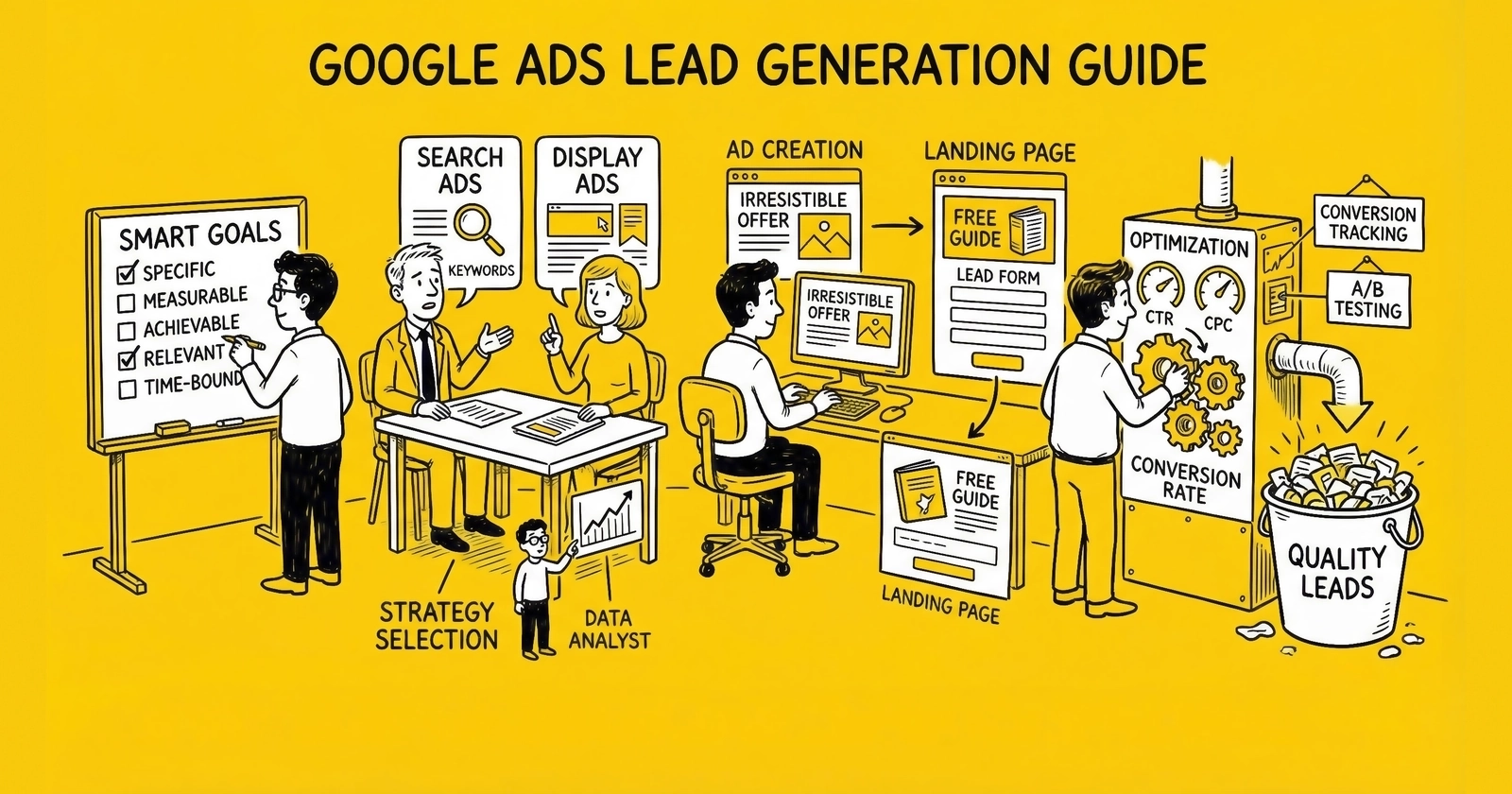
Master the highest-intent traffic source for lead generation with current benchmarks, proven campaign structures, and optimization strategies that transform ad spend into profitable lead flow.
A consumer types “auto insurance quotes” into Google. In the 0.3 seconds before results appear, an auction occurs – dozens of advertisers submit bids, Quality Scores are calculated, ad positions are determined. By the time the consumer clicks, that lead’s cost has been established in a marketplace more efficient than most stock exchanges.
Google Ads remains the dominant high-intent channel for lead generation in 2026. Despite rising costs and increasing complexity, no other platform captures consumer intent as directly. When someone searches “compare mortgage rates” or “solar installers near me,” they’re telling you exactly what they want. The challenge is capturing that intent efficiently against competitors who want the same leads.
This guide covers everything you need to run profitable Google Ads campaigns for lead generation: campaign types, current benchmarks, keyword strategy, landing page requirements, bidding approaches, Quality Score optimization, tracking setup, common mistakes, and scaling strategies.
Why Google Ads for Lead Generation?
Google Ads commands premium pricing because it delivers something other channels struggle to match: explicit intent signals.
The Intent Advantage
Social media advertising reaches people based on who they are – demographics, interests, behaviors. Native advertising reaches people based on what content they consume. Google Ads reaches people based on what they’re actively seeking in that moment.
This distinction matters for lead generation economics. A consumer who typed “get home insurance quote” has moved past awareness, past consideration, into active shopping mode. They’ve already decided they need the product. Your job is simply to be present when they’re ready to act.
The data supports this positioning:
- Search converts at 6.96% on average across industries, compared to 0.46% for display advertising
- 391% higher conversion rates when responding to search leads within one minute
- 78% of consumers purchase from the first responder – not the cheapest, not the best-reviewed, but whoever responds first
When Google Ads Makes Sense
Google Ads is the right channel when:
- Your vertical has consumers who actively search for solutions (insurance, mortgage, legal, home services)
- Your landing pages can convert visitors at 5%+ (lower rates make the math difficult)
- You have budget sufficient for competitive bidding ($3,000+ monthly for most verticals)
- You can respond to leads within minutes, not hours
Google Ads is the wrong channel when consumers do not search for your product category, your conversion rate falls below 3%, your budget cannot sustain competitive CPCs for testing, or lead response time exceeds 30 minutes.
Campaign Types for Lead Generation
Google Ads offers multiple campaign types, each suited to different lead generation objectives. Understanding when to use each type prevents wasted spend and maximizes return.
Search Campaigns
Search campaigns show text ads when users search relevant keywords on Google. They deliver the highest intent because a search for “compare car insurance rates” signals direct purchase intent.
How they work: You bid on keywords relevant to your offer. When users search those keywords, your ad enters an auction. If you win, your ad appears above or below organic results. You pay when users click.
Best practices for lead generation:
- Structure campaigns by keyword theme, not by landing page
- Separate campaigns by match type for bid control
- Use responsive search ads with 10-15 headline variations
- Implement negative keywords aggressively from day one
- Create dedicated ad groups for your highest-value keywords
Key metrics: Average CPL runs $66.69-$70.11 depending on vertical. Conversion rates average 6.96%. Finance and insurance verticals typically run higher at $75-90 CPL.
Display Campaigns
Display campaigns show visual ads across Google’s Display Network – millions of websites, apps, and YouTube placements.
The reality for lead generation: Display performs poorly for cold acquisition. Conversion rates average 0.46% compared to 6.96% for search. However, display excels for remarketing – reaching users who previously visited your landing page but did not convert.
Best practices: Use display primarily for remarketing. Exclude mobile app placements (accidental clicks). Create remarketing lists by funnel stage. Set frequency caps (3-5 impressions per day).
Key metrics: CPCs run 50-70% lower than search, but conversion rates are 90% lower.
Performance Max Campaigns
Performance Max campaigns are fully automated, serving ads across all Google inventory – Search, Display, YouTube, Discover, Gmail, and Maps.
Why they appeal: They find converting audiences you would miss with traditional targeting. Performance Max discovers new keyword opportunities and audience segments without manual configuration.
The caution: Performance Max lacks transparency into placement and audience composition. Many lead generators find they generate volume but lower quality – leads that look good on paper but do not convert to sales.
Best practices: Run alongside traditional search campaigns, not instead of them. Monitor downstream conversion rates. Compare lead quality versus traditional campaigns.
Key metrics: CPL often runs 10-20% lower than search alone, but lead quality may decrease proportionally.
YouTube Campaigns
YouTube campaigns show video ads before, during, or after content. Strong for solar, home improvement, legal, and insurance where visual storytelling matters.
Best practices: Front-load your value proposition – most viewers skip after 5 seconds. Create multiple video lengths. Target based on keywords users search on YouTube.
Key metrics: CPV runs $0.10-$0.30. CPL is typically higher than search but can deliver qualified leads for visual-heavy verticals.
2026 Benchmark Data
Understanding current benchmarks allows you to evaluate your performance against industry standards. These numbers change quarterly – use them as directional guidance, not absolute targets.
Overall Google Ads Benchmarks (2024-2026)
| Metric | 2024 Average | 2026 Average | YoY Change |
|---|---|---|---|
| Average CPC | $4.22 | $4.66 | +10.4% |
| Average CPL | $66.69 | $70.11 | +5.1% |
| Conversion Rate | 7.04% | 6.96% | -1.1% |
| Quality Score (avg) | 5.5 | 5.4 | -1.8% |
Cost Per Lead by Vertical
| Vertical | 2026 CPL Range | Notes |
|---|---|---|
| Auto Insurance | $50-80 | Highly competitive, seasonal spikes |
| Home Insurance | $65-95 | Seasonal variation around home buying |
| Medicare | $40-65 | AEP spikes October-December |
| Mortgage | $85-160 | Rate sensitive, volatile market |
| Solar | $110-220 | Geographic variance significant |
| Legal (PI) | $160-320 | Highest CPCs in lead gen |
| Home Services | $55-130 | Local focus, service-specific |
| Financial Services | $80-120 | B2B typically higher than B2C |
Conversion Rate by Vertical
| Vertical | Search Conversion Rate | Display Conversion Rate |
|---|---|---|
| Insurance | 4.5-6.5% | 0.3-0.5% |
| Mortgage | 3.5-5.0% | 0.2-0.4% |
| Solar | 5.0-8.0% | 0.4-0.6% |
| Legal | 4.0-6.0% | 0.3-0.5% |
| Home Services | 6.5-9.0% | 0.5-0.8% |
| Education | 5.5-8.0% | 0.4-0.6% |
Quality Score Impact on Cost
Quality Score directly affects what you pay per click. This relationship is not linear – the cost difference between Quality Score 5 and Quality Score 8 is substantial.
| Quality Score | CPC Adjustment | Effective CPC at $5 Base |
|---|---|---|
| 10 | -30% | $3.50 |
| 9 | -25% | $3.75 |
| 8 | -20% | $4.00 |
| 7 | -10% | $4.50 |
| 6 | 0% | $5.00 |
| 5 | +10% | $5.50 |
| 4 | +25% | $6.25 |
| 3 | +67% | $8.35 |
A Quality Score of 8 pays roughly 37% less per click than Quality Score 5 for the same position. This single factor can determine campaign profitability.
Keyword Strategy for Lead Gen
Keyword selection in competitive lead generation verticals requires precision. Generic head terms drain budget while highly qualified long-tail terms convert.
Intent Hierarchy
Not all searches signal equal buying intent. Structure your keyword strategy around intent levels:
Informational Intent (Low Value)
- “What is term life insurance”
- “How does solar power work”
- “Mortgage rates explained”
- Action: Avoid for paid ads. Use for SEO content.
Comparison Intent (Medium-High Value)
- “Best auto insurance companies”
- “Compare solar panel costs”
- “Cheapest home insurance”
- Action: Target with comparison landing pages. Moderate CPCs, good volume.
Commercial Intent (High Value)
- “Auto insurance quotes online”
- “Get mortgage rate estimate”
- “Solar installation quote”
- Action: Primary targets. Higher CPCs but strong conversion rates.
Transaction Intent (Highest Value)
- “Apply for car insurance now”
- “Buy solar panels today”
- “Start mortgage application”
- Action: Highest priority despite premium CPCs. These users are ready to act.
Long-Tail Focus
Generic head terms like “insurance” are too expensive and too broad. The math favors specificity:
| Keyword Type | Example | CPC | Conversion Rate | Effective CPL |
|---|---|---|---|---|
| Head term | ”car insurance” | $15 | 2% | $750 |
| Mid-tail | ”car insurance quotes” | $8 | 5% | $160 |
| Long-tail | ”cheap car insurance for new drivers” | $6 | 8% | $75 |
Long-tail keywords cost less per click and convert at higher rates because they capture more qualified intent. The user searching “cheap car insurance for new drivers in Texas” knows exactly what they want.
Negative Keyword Strategy
This is where most accounts leak budget. Build comprehensive negative keyword lists from day one.
Essential categories: informational modifiers (how to, what is, wiki), job-related (jobs, careers, salary), DIY modifiers (free, template), irrelevant geographies, and products you do not offer.
Weekly routine: Review search query reports every Monday. Add irrelevant queries as negatives. A well-maintained list reduces wasted spend by 20-30%.
Match Type Strategy
Modern Google Ads has simplified match types, but strategy still matters:
Exact Match ([keyword]): Use for proven converting keywords. Highest control, lowest volume. Set higher bids than other match types.
Phrase Match (“keyword”): Captures intent variations. Good for discovering new keyword ideas. Monitor for irrelevant matches.
Broad Match (keyword): Use cautiously with automated bidding only. Requires robust negative keyword lists. Can discover valuable queries but also wastes budget.
Recommended structure: Start with exact and phrase match. Add broad match only after you have conversion data feeding automated bidding strategies.
Landing Page Requirements
Your landing page determines whether expensive clicks become leads. A perfectly structured campaign sending traffic to a poor landing page wastes every dollar spent.
Speed Requirements
Page load time directly impacts both conversion rate and Quality Score.
- Target: Under 3 seconds for full page load
- Mobile: Under 2.5 seconds (mobile users have less patience)
- Core Web Vitals: LCP under 2.5s, FID under 100ms, CLS under 0.1
Every additional second of load time reduces conversions by approximately 7%. A 5-second load time can cut conversion rates in half.
Mobile Optimization
Over 60% of search traffic comes from mobile devices. Your landing page must work perfectly on small screens.
Requirements:
- Touch-friendly form fields (minimum 48px tap targets)
- Click-to-call functionality for phone numbers
- Vertical scrolling only (no horizontal scroll)
- Form fields visible without scrolling
- Auto-fill enabled for standard fields
Message Match
The landing page must deliver exactly what the ad promised. If your ad says “Get Auto Insurance Quotes in 60 Seconds,” the landing page headline should echo this promise.
Message match checklist:
- Headline includes the primary keyword from the ad
- Value proposition matches ad copy
- Visual elements support the message
- Call-to-action matches ad promise
Mismatched messages confuse users and tank conversion rates. They also reduce Quality Score, increasing your costs.
Form Design
For lead generation, the form is everything. Optimize ruthlessly.
| Form Length | Typical Conversion Rate |
|---|---|
| 3-4 fields | 25%+ |
| 5-6 fields | 15-20% |
| 7-8 fields | 8-12% |
| 9+ fields | Under 5% |
Essential fields only: Name, phone or email (one, not both initially), and one qualifying question. Multi-step forms with progress indicators can maintain conversion while capturing more data. Users who complete step one are more likely to complete step three than users who see all fields at once.
Trust Elements
Lead generation pages ask users to share personal information. Trust signals reduce friction: SSL certificate, privacy policy link, trust badges (BBB, industry associations), security seals, customer testimonials, and clear company identification.
Dedicated Landing Pages
Generic website pages underperform dedicated landing pages by 2-3x. Create specific pages for each major keyword theme with relevant headlines, images, and value propositions.
Bidding Strategies That Work
The 2026 Google Ads landscape is dominated by automated bidding, but smart practitioners maintain control where it matters.
When to Use Each Strategy
Target CPA (Cost Per Acquisition): Best for campaigns with consistent conversion values. Requires 30+ conversions per month per campaign. Optimizes bids to achieve your target cost per conversion. May reduce volume to hit targets.
Target ROAS (Return on Ad Spend): Best for campaigns where conversion values vary. Requires 50+ conversions per month. Optimizes for revenue per dollar spent. Needs accurate conversion value data.
Maximize Conversions: Best for new campaigns gathering conversion data. Spends full budget to get as many conversions as possible. Use with strict daily budget caps.
Manual CPC: Best for brand campaigns, new campaigns without conversion history, or when you need granular control. Time-intensive but gives you direct bid control.
Bid Strategy Progression
For new campaigns, follow this progression:
- Week 1-2: Manual CPC or Maximize Clicks with budget caps. Gather data.
- Week 3-4: Switch to Maximize Conversions once you have 15+ conversions.
- Week 5+: Move to Target CPA once you have 30+ conversions and understand your baseline CPL.
- Mature campaigns: Consider Target ROAS if lead values vary significantly.
Budget Allocation
- 70%: Proven performers (exact match, high-converting keywords)
- 20%: Testing and expansion (phrase match, new keyword themes)
- 10%: Remarketing campaigns
Set daily budgets at least 2-3x your target CPA to give automated bidding room to optimize.
Quality Score Optimization
Quality Score is Google’s rating of your ads’ relevance. It directly impacts your cost per click and ad position. Improving Quality Score is one of the highest-leverage activities in Google Ads optimization.
The Three Components
Expected CTR: Google predicts how likely users are to click your ad. Influenced by historical CTR of your account and keywords. Improve with compelling ad copy and relevant headlines.
Ad Relevance: How closely your ad matches the user’s search intent. Requires keyword inclusion in headlines and descriptions. Improve with tightly themed ad groups.
Landing Page Experience: How useful your landing page is to visitors. Factors include load speed, mobile optimization, relevance, and trustworthiness. Improve with dedicated landing pages that match search intent.
Optimization Actions
For Expected CTR: Test 10+ headline variations. Use dynamic keyword insertion. Include numbers and specific claims.
For Ad Relevance: Include primary keyword in Headline 1. Create tightly themed ad groups (5-15 related keywords).
For Landing Page Experience: Achieve sub-3-second load times. Create keyword-specific landing pages. Ensure mobile responsiveness.
Focus on high-volume keywords with Quality Scores below 7. Moving from QS 5 to QS 8 reduces CPC by 37%.
Tracking and Attribution Setup
Without accurate tracking, you are optimizing blind. The 2026 tracking landscape requires server-side implementation to maintain measurement integrity.
Essential Tracking Setup
Google Ads Conversion Tracking: Install the global site tag on all pages. Create conversion actions for form submissions. Set 30-day conversion windows. Enable Enhanced Conversions.
Google Analytics 4: Link GA4 and Google Ads accounts. Import GA4 conversions. Set up micro-conversion events. Configure remarketing audiences.
Server-Side Tracking
Browser-based tracking faces increasing restrictions. Safari’s Intelligent Tracking Prevention and ad blockers can eliminate 20-40% of conversion data.
Server-side tracking deploys Google Tag Manager Server on your own infrastructure. It sends conversion data directly to Google from your server, bypassing browser restrictions and ad blockers. It recovers 85-95% of previously lost conversions.
The investment in server-side infrastructure is no longer optional for serious lead generators. Expect $200-500 monthly in hosting costs plus implementation investment.
Offline Conversion Import
The lead you capture is not the end of the funnel. The lead that becomes a customer is what matters.
Setup process:
- Capture Google Click ID (GCLID) on form submission
- Store GCLID with lead record in your CRM
- When lead converts to customer, mark the conversion
- Upload conversion data back to Google Ads (manual or automated)
This allows Google’s algorithms to optimize for leads that become customers, not just leads that submit forms. The improvement in lead quality typically justifies the implementation complexity.
Common Google Ads Mistakes
Fifteen years of running lead generation campaigns reveals consistent patterns of failure. Avoid these mistakes to reach profitability faster.
Mistake 1: Too Many Keywords Per Ad Group Creating ad groups with 50+ keywords makes it impossible to write relevant ad copy. Quality Score suffers. CPCs increase. Fix: Limit ad groups to 5-15 closely related keywords.
Mistake 2: Ignoring Negative Keywords Without negative keywords, you pay for irrelevant searches. Fix: Add negative keywords before launching. Review search terms weekly.
Mistake 3: Same Landing Page for All Keywords A generic landing page handling auto, home, and life insurance queries performs poorly for all three. Fix: Create dedicated landing pages for each major keyword theme.
Mistake 4: Not Testing Ad Variations Running a single ad variation means you never find what works best. Fix: Run at least 3 ad variations per ad group. Use responsive search ads with 10+ headlines.
Mistake 5: Broad Match Without Controls Broad match without automated bidding or robust negatives drains budget. Fix: Use broad match only with automated bidding and comprehensive negatives.
Mistake 6: Ignoring Quality Score QS 4 costs 25% more per click than QS 6. Fix: Check Quality Score weekly. Prioritize high-volume keywords below 7.
Mistake 7: Setting and Forgetting Google Ads requires ongoing optimization. Fix: Dedicate 2-3 hours weekly.
Mistake 8: Not Tracking Down-Funnel Conversions Optimizing for form submissions misses what matters. Fix: Implement offline conversion tracking.
Mistake 9: Insufficient Budget Small budgets produce unreliable data. Fix: Budget minimum $3,000-5,000 monthly per vertical.
Mistake 10: Poor Mobile Experience 60%+ of traffic comes from mobile. Fix: Test all landing pages on actual mobile devices.
Scaling Google Ads Profitably
Once you have established profitable campaigns, scaling requires careful expansion that maintains efficiency.
Scaling Framework
Phase 1 (Month 1-2): Optimize current campaigns. Improve Quality Score. Reduce wasted spend. Test landing pages. Goal: Establish profitable baseline CPL.
Phase 2 (Month 3-4): Expand keywords. Add phrase match versions of winners. Explore adjacent themes. Goal: Increase volume without increasing CPL.
Phase 3 (Month 5-6): Increase budget incrementally (20-30% per change). Monitor impression share. Goal: Maximize profit from proven campaigns.
Phase 4 (Month 7+): Expand geographies or audiences. Test Performance Max and YouTube. Goal: Find new profitable segments.
Budget Scaling Rules
Never increase budget by more than 50% at once. Large increases disrupt algorithm learning and often spike CPL temporarily.
Recommended approach: If current CPL is at target, increase budget 20%. Wait 2 weeks for data. If CPL remains at target, increase budget 20% again. Repeat until impression share reaches 85%+.
Frequently Asked Questions
What is a good cost per lead for Google Ads?
A “good” CPL depends on your vertical, conversion rates, and customer lifetime value. Insurance leads typically run $50-100. Mortgage leads cost $85-160. Solar leads range $110-220. Legal leads often exceed $160-320. The key metric is not absolute CPL but whether your cost per acquisition allows profitable customer economics.
How much should I budget for Google Ads lead generation?
Budget minimum $3,000-5,000 monthly per vertical to achieve statistical significance. At $5,000-25,000 monthly, you can run meaningful tests across 2-3 campaign types. Above $25,000, multi-channel strategies become viable. Scale budgets based on proven CPL performance.
How long until Google Ads becomes profitable?
Expect 4-8 weeks to reach initial profitability for simple verticals with good landing pages. Complex verticals or competitive markets may require 3-6 months. Plan for 60-90 days of testing before expecting sustainable returns.
Should I use automated bidding or manual bidding?
Start with manual CPC or Maximize Clicks for new campaigns until you have conversion data. Switch to Target CPA once you have 30+ conversions monthly per campaign. Automated bidding generally outperforms manual bidding at scale, but it requires sufficient conversion volume.
What is better: Google Ads or Facebook Ads for lead generation?
Google Ads captures higher intent at higher cost. Google Ads average CPL runs $66-70 compared to Facebook’s $21-28. But Google converts at 6.96% versus Facebook’s 1-3%. Use Google for high-intent searches where consumers are actively shopping. Use Facebook for awareness and remarketing. Most mature lead generators use both.
How do I improve my Quality Score?
Improve Expected CTR with compelling ad copy and multiple headline variations. Improve Ad Relevance by including keywords in headlines and using tightly themed ad groups. Improve Landing Page Experience with fast load times, mobile optimization, and message match. Moving from QS 5 to QS 8 reduces CPC by 37%.
What conversion rate should I target for my landing page?
Target 5-8% conversion rate for high-intent search traffic. Below 5%, your economics become difficult. Above 10% is excellent. Conversion rates vary by form length – 3-4 field forms convert at 25%+, while 9+ field forms convert under 5%.
How do I track lead quality from Google Ads?
Capture the Google Click ID (GCLID) on form submission and store it with each lead record. When leads convert to customers, import this data back to Google Ads as offline conversions. This allows algorithms to optimize for leads that become customers.
Should I use Performance Max for lead generation?
Test Performance Max alongside traditional search campaigns, not instead of them. Performance Max can find converting audiences you would miss with traditional targeting, but it lacks transparency. Many lead generators find it generates volume but lower quality. Monitor downstream conversion rates carefully before scaling.
How do I prevent click fraud in Google Ads?
Enable Google’s built-in invalid click protection. Monitor for unusual click patterns – sudden spikes in clicks without corresponding conversions. Use IP exclusions for known bad actors. Consider third-party click fraud protection tools for high-spend accounts.
Key Takeaways
-
Google Ads is the highest-intent channel for lead generation. Consumers who search “get insurance quote” have already decided to buy. Your job is to be present and convert efficiently. No other platform matches this level of explicit purchase intent. For a detailed comparison with social advertising, see our Google vs Facebook lead generation analysis.
-
Current benchmarks: $4.66 average CPC, $70.11 average CPL, 6.96% conversion rate. These numbers vary significantly by vertical. Insurance and financial services run $75-90 CPL. Legal exceeds $160-320. Know your vertical benchmarks before evaluating performance.
-
Quality Score determines profitability. A Quality Score of 8 pays 37% less per click than a Quality Score of 5. Improving Quality Score through relevant ad copy, dedicated landing pages, and fast load times provides compound returns.
-
Start with search campaigns, add other types later. Search captures highest intent. Display works for remarketing. Performance Max can add incremental volume but requires careful quality monitoring. YouTube suits visual-heavy verticals. Master search before expanding.
-
Server-side tracking is no longer optional. Browser restrictions and ad blockers eliminate 20-40% of conversion data. Server-side implementation recovers this signal, enabling accurate optimization. The $200-500 monthly investment pays for itself.
-
Import offline conversions to optimize for customers, not leads. Form submissions are not revenue. Import sales data back to Google Ads so algorithms optimize for leads that convert to customers. This single change can improve lead quality by 20-30%.
-
Scale incrementally: 20-30% budget increases maximum. Large budget increases disrupt algorithm learning and spike CPL. Scale winners slowly while continuously testing new keywords and audiences.
Sources
- Google Ads - Official Google Ads platform and advertising solutions
- Google Ads: SEO vs PPC - Google’s comparison of search engine optimization and pay-per-click advertising
- Google Core Web Vitals Documentation - Official specifications for LCP, FID, and CLS performance metrics
- web.dev Core Web Vitals - Google’s guidance on measuring and optimizing Core Web Vitals performance
- GA4 Server-Side Tagging - Server-side tracking implementation documentation
- Google Tag Manager Documentation - Official GTM implementation and best practices
This guide reflects Google Ads benchmarks and best practices current as of late 2024/early 2025. Platform features, costs, and algorithms change continuously. Verify current data and test extensively before making significant budget commitments.