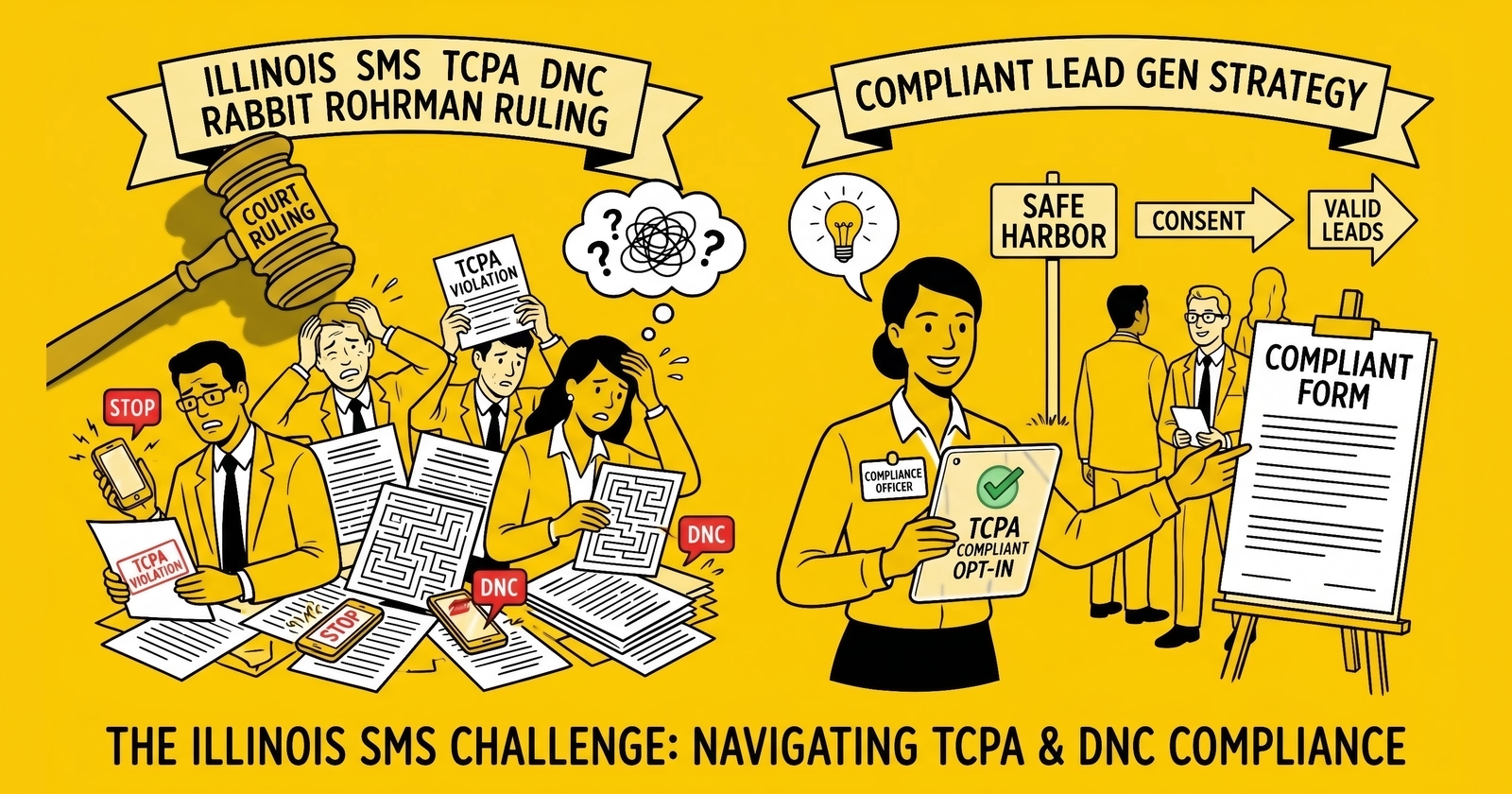
An Illinois federal judge just rewrote the SMS marketing playbook by holding that text messages are calls subject to the TCPA’s Do Not Call rules – and most operators are sending into a registry they have never scrubbed against.
Introduction: The Ruling That Rewrote SMS Compliance Overnight
On March 27, 2026, the U.S. District Court for the Northern District of Illinois held in Rabbitt v. Rohrman Midwest Motors, 2026 WL 851279, that SMS marketing messages qualify as “calls” subject to the Telephone Consumer Protection Act’s Do Not Call provisions at 47 U.S.C. § 227(c) and 47 C.F.R. § 64.1200(c). The holding sounds technical. Its operational consequence is not. Every marketing text sent to a number on the National Do Not Call Registry without documented prior express written consent or an established business relationship now carries the same $500-per-violation statutory exposure that has powered TCPA voice litigation for two decades.
TCPAWorld covered the ruling on March 30, 2026, headlining its analysis “Rabbit Hole” and noting that the court adopted the Federal Communications Commission’s long-standing 2003 interpretation treating text messages as calls within the meaning of the statute. Ten days later, on April 9, 2026, TCPAWorld followed with a second alert covering a related SMS class settlement in which individual claimants received $3,787 each – a recovery figure that has now reset plaintiff-firm settlement anchors across the bar.
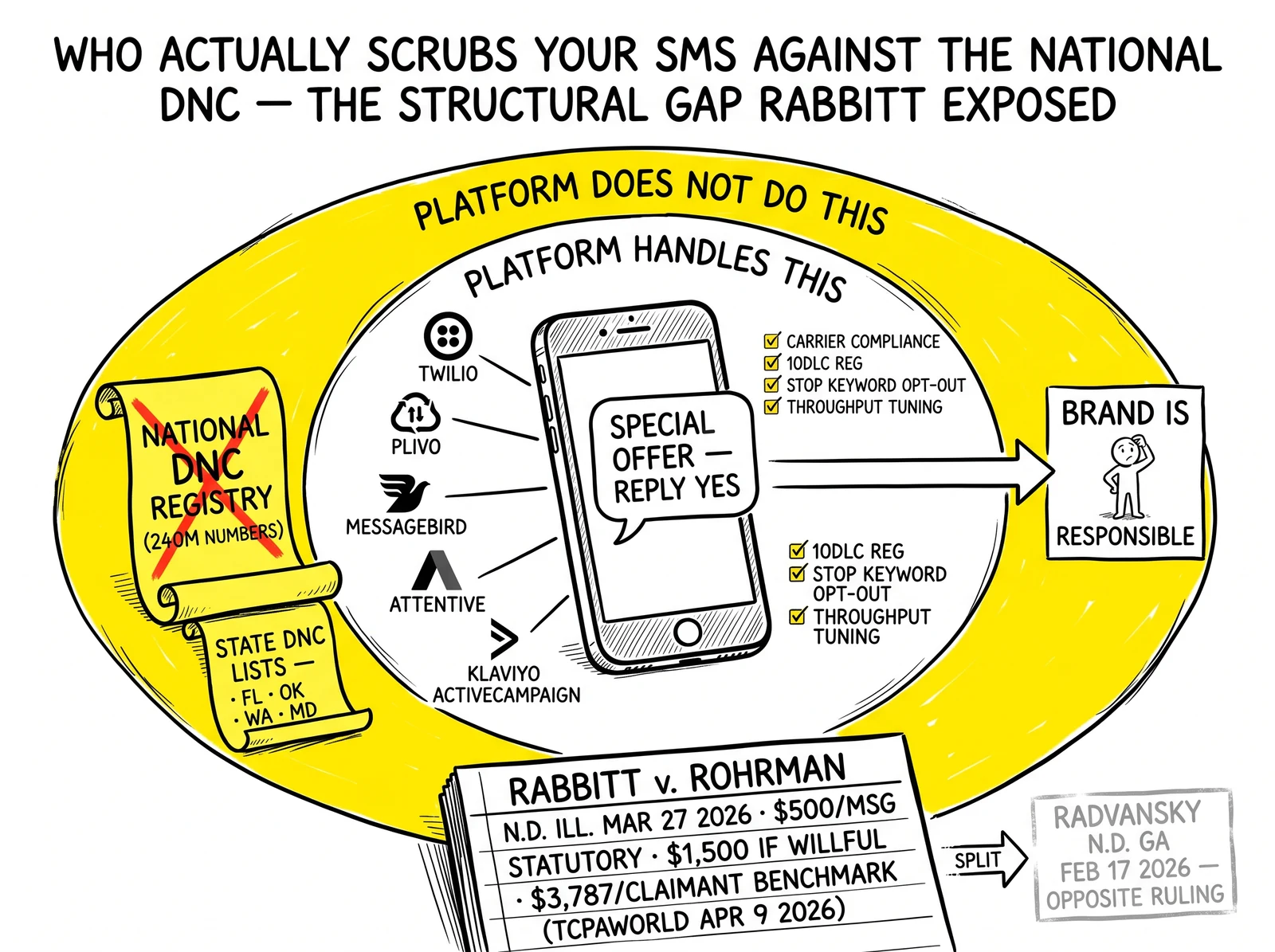
The Illinois SMS DNC TCPA exposure is structural, not theoretical. Most marketing platforms – Twilio, Plivo, MessageBird, Attentive, Klaviyo, ActiveCampaign – do not natively scrub against the National DNC Registry before SMS sends. Compliance has historically been the brand’s responsibility, executed through external integrations that many growth teams treat as optional infrastructure. Rabbitt v. Rohrman converts that optionality into open litigation runway – at least in jurisdictions that follow the Northern District of Illinois rather than the contrary line of authority developing in Atlanta and elsewhere.
This analysis walks through the exact holding, the FCC interpretive history that makes the ruling unsurprising, the genuine circuit split that has emerged as multiple federal courts reach opposite conclusions, the $3,787 benchmark that plaintiff firms are already using to anchor demands, the vendor-by-vendor scrubbing reality across major SMS platforms, a comparison of compliance vendors that fill the gap, a 30-day operator retrofit checklist, the state-law overlay where Florida and Oklahoma already required this, the records operators must preserve to defend cases, and the appeal and FCC trajectory most likely over the next 18 months.
The March 27, 2026 Holding – What the Court Actually Said
The plaintiff in Rabbitt v. Rohrman Midwest Motors alleged that the defendant – an automotive dealership group – sent SMS marketing messages to phone numbers on the National Do Not Call Registry without prior express invitation or permission. The defendant moved to dismiss on the ground that the DNC subsection of the TCPA applies to “calls” and SMS is not a call. Judge Robert W. Gettleman of the Northern District of Illinois rejected that argument and denied the motion in a March 27, 2026 opinion now reported at 2026 WL 851279. TCPAWorld’s “Rabbit Hole” coverage followed three days later, on March 30, 2026.
The court’s reasoning follows three steps. First, the TCPA’s text at 47 U.S.C. § 227(c) authorizes the FCC to promulgate rules protecting subscribers from “telephone solicitations” and treats violations of those rules as actionable through the private right of action at § 227(c)(5). Second, the FCC’s 2003 Order implementing the TCPA expressly stated that the agency’s rules apply to text messages directed to wireless numbers, treating SMS as a form of call within the statutory framework. Third, every major appellate court to address the question – beginning with the Ninth Circuit in Satterfield v. Simon & Schuster (2009) – has accepted that SMS qualifies as a call for TCPA purposes, at least under the autodialer subsection at § 227(b).
Judge Gettleman extended that reasoning to the DNC subsection at § 227(c). The opinion observed that the FCC’s interpretive position has not distinguished between subsections, that Congress has had multiple opportunities to legislate a contrary interpretation and has not done so, and that the structural purpose of the DNC registry – protecting subscribers from unwanted solicitations regardless of medium – is undermined by a reading that exempts the dominant marketing channel of the 2020s from coverage.
The practical holding: an SMS sent to a number registered on the National DNC list, without prior express invitation or permission documented in writing and absent an established business relationship, violates 47 C.F.R. § 64.1200(c). The recipient may sue under § 227(c)(5) for $500 per violation, trebled to $1,500 for willful or knowing violations, with no statutory cap.
The case citation – Rabbitt v. Rohrman Midwest Motors, 2026 WL 851279 (N.D. Ill. Mar. 27, 2026) – and Judge Gettleman’s stature as one of the more influential trial judges in the Seventh Circuit matter for how quickly the ruling propagates. The substantive holding is what matters for operators: the legal question that some defense counsel argued was open in the Seventh Circuit is now closed at the trial-court level for this district, and the path to circuit review runs through interlocutory appeal or final judgment.
What the FCC Actually Said in 2003 – and Why Courts Split Anyway
The Illinois ruling did not invent a new rule. It applied an FCC interpretation that has been on the books since 2003. The disconnect between that interpretation and operator practice traces to a 22-year ambiguity in how the agency’s view interacted with the autodialer-versus-DNC subsection structure of the statute.
The FCC’s 2003 Report and Order – the foundational rulemaking implementing the 1991 TCPA – addressed text messages directly. The Commission stated that “calls” within the meaning of the statute include text messages directed to wireless telephone numbers. The reasoning rested on the practical observation that wireless subscribers pay for incoming texts (then more commonly, now less so under unlimited plans) and that excluding SMS would create a substantial loophole as text marketing grew.
That 2003 position was challenged repeatedly in the autodialer-subsection context (§ 227(b)) and consistently upheld. The Ninth Circuit’s 2009 Satterfield decision was the first appellate ruling to apply the FCC interpretation to SMS in a private TCPA suit. Subsequent decisions across the Sixth, Seventh, and Eleventh Circuits aligned around the proposition that SMS to wireless numbers using regulated equipment violates § 227(b)(1)(A)(iii) when sent without consent.
The DNC subsection (§ 227(c)) is a different beast structurally. It governs solicitations to numbers on the National DNC Registry rather than the equipment used to make the call. Defendants argued that even if SMS is a “call” for autodialer purposes, the DNC subsection’s focus on “telephone solicitations” – historically synonymous with voice calls in popular and regulatory usage – should not extend to text. Multiple district court decisions before and after Rabbitt have accepted this argument, including Judge Thrash’s February 2026 Radvansky opinion in the Northern District of Georgia, leaving the question genuinely open across most of the country.
That ambiguity allowed compliance teams to argue, with at least colorable support, that SMS DNC scrubbing was a best practice rather than a strict legal requirement. Rabbitt v. Rohrman eliminates that argument in the Northern District of Illinois and provides persuasive authority for plaintiff firms litigating the same theory elsewhere. The FCC’s 2024 revocation rulemaking – which explicitly addressed text-message opt-outs and any-reasonable-method revocation – implicitly confirmed that the agency views the entire TCPA framework, including the DNC subsection, as covering SMS. The 2024 ruling did not formally extend the DNC rule to text messages, but its operational assumptions did exactly that.
The combined weight of the 2003 Order, 22 years of consistent FCC practice, the Ninth Circuit’s Satterfield line, and the 2024 revocation rulemaking made the Rabbitt outcome predictable in plaintiff-friendly forums. The contrary outcomes in Atlanta and elsewhere reflect a textualist counter-current that reads § 227(c)(5)‘s “telephone calls” language strictly. Operators cannot count on either line to control nationally until the question reaches the Supreme Court or the FCC issues a formal declaratory ruling.
The Genuine Circuit Split – Where Courts Have Reached Opposite Conclusions
Rabbitt v. Rohrman is one half of a developing split, not a settled answer. Multiple federal courts have held the opposite – that SMS messages are not subject to TCPA’s DNC rules – in 2025 and 2026. The most consequential contrary ruling came on February 17, 2026, when Judge Thomas W. Thrash of the Northern District of Georgia issued Radvansky v. 1-800-Flowers.com, holding that the statutory text of § 227(c)(5) is clear that only telephone “calls” are actionable and that Congress’s 2019 amendment adding “text message” to a neighboring provision (§ 227(e)(8)(C)) – while leaving § 227(c)(5) unamended – confirms the exclusion. TCPAWorld dubbed the Radvansky opinion a “Sea Change.”
The Atlanta ruling sits alongside other contrary 2025 decisions, including a separate Northern District of Georgia opinion (Greenspoon Marder coverage) and at least one district court that certified the question for interlocutory appellate review in December 2025. On the same day in July 2025 that the District of Oregon (Wilson v. Skopos Financial) ruled SMS messages are calls subject to DNC rules, a different district reached the opposite result – TCPAWorld covered that “Chaos Chaos” outcome contemporaneously. Polsinelli, Burr & Forman, and other defense-side commentators have catalogued the divergence.
The operational takeaway is that Rabbitt governs in the Northern District of Illinois and provides persuasive authority elsewhere, but operators in jurisdictions covered by contrary rulings face genuine doctrinal uncertainty rather than clear guidance. The split itself accelerates the path to circuit-level review, since contradictory district outcomes create the conflict that justifies appellate consolidation. Until then, the safest assumption is that the litigation cost of relying on the contrary line – even when it controls a particular district – exceeds the compliance cost of treating SMS DNC scrubbing as required nationally.
Why This Ruling Will Spread – Forum-Shopping and Plaintiff-Firm Calculus
A district court ruling binds only that district. But the speed at which a single favorable ruling propagates through the plaintiff bar is governed by economics, not formal precedential weight. Three factors will drive Rabbitt’s spread.
First, the plaintiff-firm filing economics. TCPA class action filings reached 507 in Q1 2025, a 112% increase over Q1 2024 according to TCPA tracking data cited across compliance literature. Filing volume of that scale requires a stable supply of cases that survive motion to dismiss. Rabbitt delivers a fresh theory – SMS-as-DNC-call – that converts existing carrier complaint logs and TCPAWorld-style consumer reports into filed cases. Plaintiff firms with established docket pipelines can recycle filings drafted for voice-DNC cases simply by swapping facts.
Second, forum availability. The Northern District of Illinois is a top-five federal district for TCPA filings by volume. Plaintiff firms based in Chicago – including several that specialize in consumer-protection class work – gain home-court advantage from the ruling. Cases that would otherwise have been filed elsewhere migrate into N.D. Ill. for the duration of the favorable doctrinal window. Defendants whose only Illinois nexus is a website that accepts Illinois consumers face venue risk they previously discounted.
Third, the bar’s appetite for novel theories. Defense counsel surveying the post-Rabbitt landscape will note that the ruling extends an existing FCC interpretation rather than creating new law. That framing makes the holding easier for other district judges to adopt without departing from established practice – though the contrary line led by Judge Thrash in Atlanta demonstrates that the question remains genuinely contested at the trial-court level. A circuit-court resolution, when it comes, will lock in one direction or the other across the Seventh Circuit’s three-state footprint. Plaintiff firms reading these signals will accelerate filings to capture the doctrinal window before defendants restructure SMS practices.
The historical playbook for similar rulings – the Facebook v. Duguid autodialer line, the FTSA expansion in Florida, the FCC’s one-to-one consent rule – shows propagation curves of 60 to 180 days from initial ruling to widespread filing activity. Operators with 60-day windows have two months to either bring SMS pipelines into DNC compliance or accept that they are running open exposure on every campaign sent into Illinois and the surrounding circuits. The reading suggested by the serial TCPA litigators ecosystem is that professional plaintiffs are already collecting evidence for the first wave of follow-on cases.
The $3,787 Settlement Benchmark – What Plaintiff Firms Now Ask For
On April 9, 2026, TCPAWorld published a follow-up alert headlined “Jackpot: TCPA Settlement Claimants to Receive $3,787 Each in Telemarketing Text Message Case.” The number is unusual. Most TCPA class settlements distribute $50 to $200 per claimant after attorney fees, claim-rate dilution, and cy-pres carve-outs. A figure approaching $3,800 reflects a deliberate departure from the cy-pres pattern toward statutory-damages-aligned settlements.
The mechanics of the $3,787 figure, as reconstructed from TCPAWorld’s coverage and standard class-settlement math, are straightforward. A smaller, defined class – likely in the low thousands of identified recipients rather than the hundreds of thousands typical of mass-blast cases – combined with a settlement fund sized to approximate the $500 statutory minimum after fees produces per-claimant recoveries that converge toward statutory damages. When the fund is structured as a non-reversionary common fund and claim rates are high (as they are when notice is targeted), the per-claimant payout can approach or exceed the statutory floor.
Plaintiff firms have not historically pursued this structure aggressively because cy-pres distributions and lower per-claimant payouts allowed larger headline settlement values that supported larger attorney fees under percentage-of-fund frameworks. The shift toward higher per-claimant recovery suggests three things. First, judges are scrutinizing cy-pres distributions more skeptically post-Frank v. Gaos and adjacent jurisprudence. Second, defense pressure to identify and notice actual class members has increased, raising claim rates. Third, plaintiff firms have realized that statutory-damages-aligned settlements produce larger total fund values when class size is moderate and damages are uncapped.
The operator-facing implication is that the floor of meaningful TCPA settlement values has moved. A class of 5,000 SMS recipients at $3,787 per claimant produces a $19 million fund. A class of 50,000 at the same rate produces a $189 million fund. Plaintiff firms now cite the $3,787 figure in opening demand letters, signaling that nuisance-value settlements ($25 to $50 per claimant) are off the table. Defense counsel who anchored on older settlement comparables are recalibrating in real time.
The interaction with Rabbitt matters. SMS class size in DNC-only theories is bounded by the National DNC Registry’s 240 million registered numbers cross-referenced against the defendant’s send list. For operators sending hundreds of thousands of SMS per campaign, the DNC-registered subset typically runs 25 to 40 percent of the total – the registry’s penetration rate among U.S. consumers. A 100,000-message campaign produces 25,000 to 40,000 potential class members in the DNC-registered cohort alone, before multipliers for repeat sends or willful-violation trebling.
The CRM and SMS Platform Reality – Who Scrubs, Who Doesn’t
The structural compliance problem Rabbitt exposes is that the SMS marketing stack does not perform DNC scrubbing as a default service. Brand operators relying on platform defaults for compliance discovered, often only at discovery, that the platforms expected the brand to handle DNC. This pattern is consistent across the major vendors.
Twilio’s Trust Hub and compliance documentation place the obligation to comply with applicable telemarketing laws on the sender. Twilio publishes carrier-relationship metadata (10DLC registration, brand verification, campaign approval) but does not scrub message recipients against the National DNC Registry as a pre-send check. The platform’s Compliance Center directs users to integrate third-party DNC services through Twilio Functions or external API calls before submitting messages to the Programmable Messaging API.
Plivo, MessageBird, and Sinch follow substantially similar models. Each platform handles carrier compliance, throughput optimization, and opt-out keyword processing (STOP, UNSUBSCRIBE, etc.) but does not scrub against the National DNC list. Each places the regulatory obligation on the sender in its terms of service.
Attentive – the dominant SMS marketing platform in U.S. retail and direct-to-consumer – provides robust opt-in collection tooling (two-tap mobile flows, email capture, post-purchase capture) and processes opt-outs at the keyword level. The platform does not scrub against the National DNC Registry as a default service. Attentive’s compliance documentation states that brands are responsible for ensuring their lists comply with applicable DNC rules.
Klaviyo’s SMS product, which rolled out broadly in 2020 and now serves tens of thousands of e-commerce brands, takes the same posture. Subscribers who consent through Klaviyo’s branded forms are presumed to be consent-eligible; the platform does not perform DNC scrubbing on imported lists or on subscribers acquired through third-party flows. ActiveCampaign’s SMS module, similarly, performs no DNC scrub.
The enterprise outliers – Salesforce Marketing Cloud’s MobileConnect, Oracle Responsys, and Adobe Campaign – offer DNC scrubbing as configured services for enterprise customers willing to license additional compliance modules or integrate via API. Even there, scrubbing is opt-in rather than default.
The compliance gap is therefore platform-wide and structural. Operators who assumed their SMS platform handled DNC compliance because the platform handled opt-out processing have been operating on a misunderstanding that Rabbitt now monetizes for plaintiff firms. The retrofit work is the same regardless of which platform an operator runs: integrate DNC scrubbing as a pre-send step, log the scrub result, and route around DNC-flagged numbers unless documented consent overrides DNC registration.
DNC Scrubbing Infrastructure – Vendor Comparison
Four vendors dominate the National DNC scrubbing market for SMS-ready integrations. Each takes a different commercial posture and serves different operator profiles.
| Vendor | Pricing Model | SMS-Ready API | Real-Time Scrub Latency | Best Fit |
|---|---|---|---|---|
| PossibleNOW | Annual subscription tiered by record volume; enterprise $50K-$250K typical | Yes, REST API and batch | <200ms per number | Mid-market and enterprise consent-management programs |
| Gryphon.ai | Per-record or subscription; pricing on application | Yes, real-time API designed for call centers and SMS | <100ms per number | High-volume call centers extending into SMS |
| Contact Center Compliance (DNC.com) | Per-record metered pricing or annual subscription | Yes, batch and API | <500ms batch, <300ms API | Mid-market and SMB operators with episodic campaigns |
| DNCScrub | Per-record pricing starting around $0.005 to $0.02 per number scrubbed | Yes, batch upload and API | Batch-oriented; API premium tier | Cost-sensitive operators with predictable volumes |
The selection criteria that matter beyond price are integration depth, real-time versus batch architecture, and the breadth of registries covered. National DNC scrubbing alone is insufficient if the operator sends into Florida, Oklahoma, Maryland, Pennsylvania, or other states with separate registries. PossibleNOW and Gryphon.ai offer integrated multi-state scrubbing. Contact Center Compliance covers state lists as add-on services. DNCScrub is primarily federal-registry focused with state coverage available at additional cost.
PossibleNOW’s strength is deep enterprise integration with consent-management platforms, including bidirectional sync with TrustedForm, Jornaya, and major CDPs. The vendor’s typical enterprise contract bundles DNC scrubbing with consent-record management, DSAR fulfillment, and litigation-defense reporting. Operators running comprehensive TCPA consent capture infrastructure often consolidate on PossibleNOW for that reason.
Gryphon.ai grew up serving call centers with real-time DNC enforcement at the dialer level. The same infrastructure now serves SMS senders that need pre-send scrubbing within a 100-millisecond budget. Gryphon’s pricing is opaque on the public site but generally lands above DNCScrub and below PossibleNOW for comparable volumes.
Contact Center Compliance – operating the consumer-facing DNC.com property – sits in the middle of the price-feature curve. The vendor’s batch tooling is mature; the real-time API is functional but less performant than Gryphon.ai’s. Operators sending periodic batch campaigns rather than triggered transactional SMS find the cost-feature tradeoff favorable.
DNCScrub serves the long tail of small and mid-sized operators that need credible DNC scrubbing without enterprise-scale spend. Per-record pricing starting in the half-cent range allows operators sending 500,000 messages per month to bring DNC scrubbing in for $2,500 to $10,000 monthly depending on volume tier. The integration work is comparable to other vendors.
The vendor decision is downstream of architecture. Operators sending real-time triggered SMS need <200ms scrubs through API; operators sending scheduled batch campaigns can amortize batch-scrub latency; operators with active state-mini-TCPA exposure need integrated state coverage. The wrong vendor decision creates friction; no vendor decision creates uncapped statutory exposure.
The 30-Day Operator Retrofit Checklist
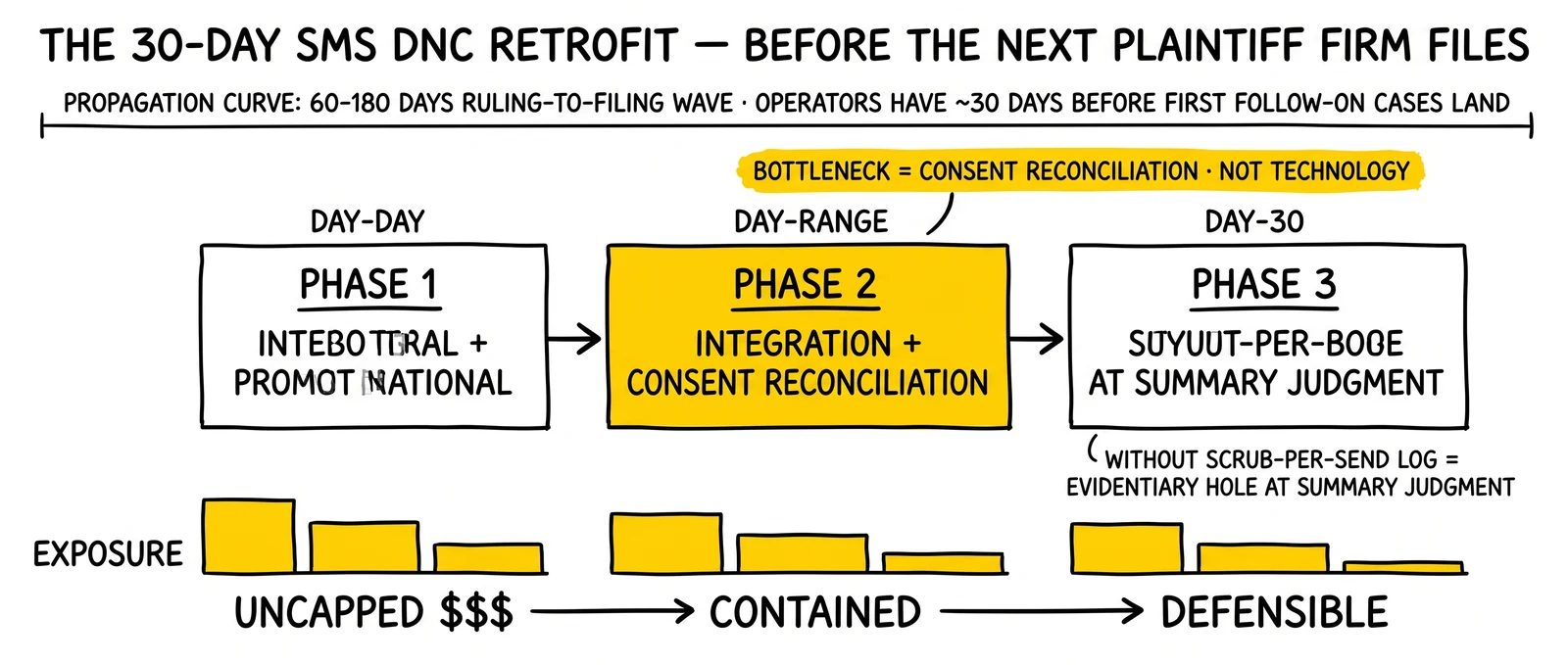
A 30-day SMS DNC retrofit is achievable for operators with modest engineering capacity. The work decomposes into three phases, each with measurable artifacts.
Phase 1 – Vendor selection and contracting (days 1 to 7). Identify campaign volume, real-time vs. batch needs, and state registry coverage requirements. Issue an RFP or direct outreach to two or three vendors from the matrix above. Negotiate pricing, SLAs (target 99.9% API availability, <200ms median scrub latency for real-time use), and data-handling terms (records retention, breach notification, audit rights). Execute master services agreement and data processing agreement. Provision API credentials in staging.
Phase 2 – Integration and consent reconciliation (days 8 to 21). Wire the DNC scrub API into the SMS pre-send pipeline. The integration point is between list segmentation and message submission to the SMS platform’s API. Every recipient number must be scrubbed and logged before the platform sees it. Build a consent-overlay logic layer: numbers that scrub as DNC-registered but carry documented prior express written consent (with preserved capture artifact and disclosure language) can proceed; numbers that scrub as DNC-registered without consent must be suppressed for the campaign and routed to an internal review queue. Reconcile the existing consent database against TrustedForm, Jornaya, or equivalent capture records to identify the consent-supported subset of the list.
Phase 3 – Pre-send deployment, logging, and monitoring (days 22 to 30). Deploy the scrub-and-overlay pipeline behind a feature flag for one or two pilot campaigns. Validate that scrub results are logged with timestamps, vendor response codes, and the recipient hash. Confirm that DNC-flagged numbers without consent are correctly suppressed. Roll out to all SMS campaigns with a five-day observation window. Stand up monitoring dashboards covering scrub volume, suppression rate, scrub latency, and vendor error rate. Document the procedure in writing for internal DNC list management and litigation-defense purposes.
The bottleneck in most retrofits is consent reconciliation. Operators with disciplined TrustedForm/Jornaya capture and intact CRM linkage complete reconciliation in days. Operators with fragmented consent records – multiple historical capture sources, partial documentation, missing disclosure-language version tracking – face longer timelines because the consent overlay logic depends on records that do not exist or cannot be authenticated. Those operators face a strategic choice: invest in retroactive consent rebuild, suppress all DNC-flagged numbers without overlay logic, or accept higher suppression rates as the cost of incomplete records.
The 30-day target assumes a single-platform SMS environment with engineering capacity. Multi-platform environments – operators running Twilio for transactional, Attentive for retail marketing, and Klaviyo for ecommerce reactivation – multiply integration work proportionally. The same vendor (PossibleNOW or Gryphon.ai) can serve all three pipelines, but each integration is a discrete engineering project.
State-Law Overlay – Florida, Oklahoma, Washington, Maryland Already Required This
The Rabbitt ruling brings federal law into alignment with what several state mini-TCPA frameworks have required for two to four years. Operators already running multi-state SMS programs likely have partial scrubbing infrastructure that can be extended to the National DNC list rather than built from scratch.
| State | Statute | SMS Coverage | DNC Scrub Required | Private Right of Action | Per-Violation Damages |
|---|---|---|---|---|---|
| Florida | FTSA (Fla. Stat. § 501.059) | Explicitly | Yes – state DNC | Yes | $500-$1,500 |
| Oklahoma | OTSA (15 O.S. § 775C.1) | Explicitly | Yes – state DNC | Yes | $500-$1,500 |
| Washington | CEMA (RCW 19.190) | Yes via interpretive expansion | Practical yes | Yes | $500 plus actual damages |
| Maryland | MTCPA | Yes | Yes | Yes | $500-$1,500 |
| Illinois (post-Rabbitt) | TCPA (federal) | Yes | Yes – National DNC | Yes | $500-$1,500 |
Florida’s FTSA, enacted in 2021 and refined in 2023, was the modern catalyst for state-level SMS expansion. The statute applies expressly to text messages, authorizes private rights of action with statutory damages of $500 to $1,500 per violation, and produced an immediate wave of class filings. Operators sending into Florida have therefore had an SMS DNC compliance imperative since 2021. The infrastructure built for Florida – typically multi-state DNC scrubbing through PossibleNOW, Gryphon.ai, or Contact Center Compliance – extends to the National DNC Registry with minimal incremental cost.
Oklahoma’s OTSA, effective November 2022, mirrors the FTSA framework. Maryland’s mini-TCPA includes both call and text coverage. Washington’s CEMA, while focused on commercial electronic messages, has been interpreted to cover SMS in several private actions. The cumulative effect is that operators serving any of these state markets have already absorbed the SMS DNC scrubbing cost. The Rabbitt delta for those operators is procedural – extending an existing scrub to the National Registry – rather than infrastructural.
Operators that have avoided Florida and Oklahoma exposure by geofencing campaigns face a harder retrofit. Geofencing logic must be inverted: instead of suppressing FL and OK numbers from sends, operators must now suppress National DNC numbers across all states unless consent overlay applies. The architectural inversion is straightforward but requires re-tooling segmentation logic and consent-record queries.
The cross-reference to existing state mini-TCPA laws infrastructure is the fastest path to Rabbitt compliance. Operators with FTSA programs already in production can extend coverage in days rather than weeks.
Litigation Defense Readiness – Records Operators Must Preserve
A Rabbitt-era SMS program survives litigation on the strength of its records. Plaintiff firms filing under § 227(c)(5) need to establish three elements: that the recipient’s number was on the National DNC Registry at the time of the SMS, that the defendant sent the SMS, and that the SMS qualified as a telephone solicitation. Defenses turn on consent (overriding DNC), established business relationship, and procedural challenges to standing and class certification. Each defense requires contemporaneous records that operators must preserve from the moment of consent capture through the statute of limitations.
The minimum defensible record set for each SMS sent includes the original consent capture artifact, the disclosure language version active at capture time, the timestamp and IP address of consent capture, the DNC scrub timestamp and vendor response, the consent-overlay logic applied (if any), the message content, the send timestamp, and the delivery confirmation from the SMS platform. The records must be linked by a stable identifier (typically the recipient number hash plus campaign ID) and stored in a system that produces tamper-evident exports on demand.
The TrustedForm and Jornaya certificate ecosystems provide the gold-standard consent capture records. A TrustedForm certificate captures the lead’s interaction with the consent form including IP, timestamp, consent disclosure text rendered, and form-completion behavior. The certificate is independently verifiable through the issuing vendor and admissible in court. Operators relying on home-grown consent capture without third-party certification face evidentiary challenges that named-vendor certification eliminates.
The DNC scrub record is equally important. The scrub vendor’s response – typically a JSON payload with the recipient number, scrub timestamp, registry source, and result code – must be preserved for each send. Operators that scrub once per week and assume the result holds for subsequent sends face a compliance gap when numbers are added to the registry between scrubs. The defensible practice is scrub-per-send, with the scrub timestamp logged within minutes of the SMS dispatch.
Records retention runs at least five years to cover the federal four-year statute of limitations under § 227(c)(5) plus a one-year discovery margin. State mini-TCPA limitations periods vary; Florida’s FTSA carries a four-year statute while Oklahoma’s OTSA matches federal. Operators sending into multiple state markets should default to seven-year retention to cover edge cases.
The consent documentation retention practices already required for voice TCPA compliance translate directly to SMS. Operators with mature voice-compliance records architecture have a head start; operators that built SMS programs as separate stacks face dual-system reconciliation work.
What’s Next – Seventh Circuit Appeal and FCC Action Probability
Two doctrinal questions hang over the post-Rabbitt environment: whether the Seventh Circuit affirms on appeal (and how it harmonizes with the contrary line from Atlanta), and whether the FCC issues a formal declaratory ruling extending the DNC subsection to SMS. Both outcomes matter, neither is imminent.
A Seventh Circuit appeal requires either interlocutory certification (rare in TCPA dismissal denials) or final judgment after the case proceeds to summary judgment or trial. The realistic timeline runs 18 to 30 months from the March 27, 2026 ruling to a Seventh Circuit decision. The defendant’s incentive to appeal depends on settlement economics: cases that settle in the trial court never produce circuit precedent, and Rabbitt-aligned cases will likely settle as plaintiff firms accept consolidated payouts that approach the $3,787-per-claimant benchmark. Eleventh Circuit review of the contrary Atlanta line is on a parallel track. Operators hoping for circuit-level resolution should plan for at least 24 months of split district-court doctrine governing practice in the meantime.
The FCC pathway is structurally slower. A formal declaratory ruling extending § 64.1200(c) to SMS would require either a petition from an industry group (CTIA, ANA, AAFRC) or commission-initiated rulemaking. Petition-driven rulings typically run 12 to 18 months from filing to decision. The current FCC has not signaled a near-term TCPA agenda beyond the 2024 revocation rules and the still-pending one-to-one consent implementation. The probability of an FCC ruling within 24 months that codifies Rabbitt (extending the DNC subsection to SMS expressly) is materially higher than the probability of one that adopts the textualist reading from Atlanta, but either outcome requires petition activity.
The likely 18-month path: continued plaintiff-firm filing acceleration in N.D. Ill. and adjacent districts; counter-pressure from defense forums in the Northern District of Georgia and adjacent splits; settlement values trending toward the $3,787 anchor where Rabbitt’s reasoning controls; insurance coverage tightening further as carriers reprice TCPA risk; FCC silence punctuated by occasional informal commissioner statements; operator infrastructure investment in DNC scrubbing accelerating from optional to baseline. The structural shift is roughly 12 months from completion regardless of how the split eventually resolves.
The strategic implication for operators: do not wait. The combination of district-court ruling, the $3,787 settlement benchmark, the platform-wide compliance gap in SMS infrastructure, and the FCC’s evident comfort with the SMS-as-calls position means the defensible posture is full DNC compliance now. The $250,000 to $1 million annual cost of comprehensive SMS compliance infrastructure is a fraction of the realistic exposure on a single uncovered campaign. The math has changed.
Key Takeaways
-
Judge Robert W. Gettleman of the Northern District of Illinois held on March 27, 2026 that SMS messages are calls subject to TCPA Do Not Call rules at 47 U.S.C. § 227(c) and 47 C.F.R. § 64.1200(c), exposing every unscrubbed marketing text to $500-per-violation statutory damages. The ruling – Rabbitt v. Rohrman Midwest Motors, 2026 WL 851279 – adopts the FCC’s 2003 interpretation and aligns the federal DNC subsection with the Ninth Circuit’s Satterfield line. TCPAWorld covered the opinion on March 30, 2026.
-
The federal courts are genuinely split. Judge Thomas W. Thrash’s February 17, 2026 Radvansky v. 1-800-Flowers.com opinion in the Northern District of Georgia held the opposite – that SMS messages are not telephone calls actionable under § 227(c)(5) – and at least one other 2025 decision certified the question for appellate review. Operators in jurisdictions covered by the contrary line face uncertainty, not clear guidance, until circuit-level resolution arrives.
-
The compliance gap is structural across the SMS platform layer. Twilio, Plivo, MessageBird, Attentive, Klaviyo, and ActiveCampaign do not natively scrub against the National DNC Registry. Brands that assumed platform compliance covered DNC scrubbing have been operating exposed for as long as they have been sending – the Rabbitt ruling now monetizes that exposure for plaintiff firms in jurisdictions that follow it.
-
The April 9, 2026 TCPAWorld report on a $3,787-per-claimant settlement reset plaintiff-firm anchors. Settlement values are converging toward statutory damages rather than nominal cy-pres distributions. Class sizes of 5,000 to 50,000 SMS recipients now produce fund values of $19 million to $189 million, well above older TCPA settlement comparables.
-
A 30-day operator retrofit is achievable through vendor selection and contracting (days 1-7), API integration and consent reconciliation (days 8-21), and pre-send deployment with logging (days 22-30). The bottleneck is consent reconciliation, not technology integration. Operators with intact TrustedForm/Jornaya records complete the work fastest.
-
Florida (FTSA), Oklahoma (OTSA), Maryland (MTCPA), and Washington (CEMA) already required SMS DNC scrubbing. Operators with multi-state programs have partial infrastructure; the Rabbitt delta is extending state-registry scrubbing to the National DNC Registry rather than building from scratch.
-
Litigation-defense records require contemporaneous capture of consent artifact, disclosure language version, IP and timestamp, DNC scrub result, scrub timestamp, and message content. TrustedForm and Jornaya certificates provide independently verifiable consent records. Records retention should run at least five years to cover the federal four-year statute of limitations plus discovery margin.
-
The Seventh Circuit is unlikely to reverse on a 24-month horizon and may never reach the merits if cases settle in the trial court. FCC action codifying the SMS DNC extension is plausible within 18 to 24 months but requires petition activity that has not yet been initiated. Operators should plan for district-court doctrine governing practice for at least two years.
-
The $250,000 to $1 million annual cost of comprehensive SMS DNC compliance is a fraction of realistic single-campaign exposure. A 100,000-SMS campaign sent to a list with 30% DNC penetration creates 30,000 potential class members at the $500 statutory minimum – $15 million theoretical exposure before willful trebling. Insurance coverage for TCPA claims has tightened materially since 2023 and rarely covers statutory damages.
Sources
- TCPAWorld, “Rabbit Hole: Illinois Federal Judge Holds SMS Messages Are Calls Subject to the TCPA’s DNC Rules,” March 30, 2026. https://tcpaworld.com/2026/03/30/rabbit-hole-illinois-federal-judge-holds-sms-messages-are-calls-subject-to-the-tcpas-dnc-rules-and-tumbling-down-we-go/
- TCPAWorld, “Jackpot: TCPA Settlement Claimants to Receive $3,787 Each in Telemarketing Text Message Case,” April 9, 2026. https://tcpaworld.com/2026/04/09/jackpot-tcpa-settlement-claimants-to-receive-3787-each-in-telemarketing-text-message-case-and-what-is-going-on-here/amp/
- TCPAWorld, “Sea Change: Influential Atlanta Federal Judge Holds SMS Messages Are Not ‘Telephone Calls’ Under the TCPA’s DNC Rules” (Radvansky v. 1-800-Flowers.com), February 19, 2026. https://tcpaworld.com/2026/02/19/sea-change-influential-atlanta-federal-judge-holds-sms-messages-are-not-telephone-calls-under-the-tcpas-dnc-rules/
- Polsinelli, “Federal Court Finds Text Messages Not Subject to TCPA’s DNC Requirements.” https://www.polsinelli.com/publications/federal-court-tcpa-text-decision
- ACA International, “Rabbitt v. Rohrman Midwest Motors, Inc.: Court Rules TCPA DNC Provisions Apply to Text Messages.” https://www.acainternational.org/daily-decision/rabbitt-rohrman-midwest-motors-tcpa-northern-district-illinois/
- 47 U.S.C. § 227, Telephone Consumer Protection Act, Cornell Legal Information Institute. https://www.law.cornell.edu/uscode/text/47/227
- 47 C.F.R. § 64.1200, FCC Telemarketing Rules, Electronic Code of Federal Regulations. https://www.ecfr.gov/current/title-47/chapter-I/subchapter-B/part-64/subpart-L/section-64.1200
- Federal Communications Commission, “Rules and Regulations Implementing the Telephone Consumer Protection Act of 1991,” 2003 Report and Order. https://www.fcc.gov/document/rules-and-regulations-implementing-telephone-consumer-protection-act-1991
- Federal Communications Commission, “FCC Adopts Rules on One-to-One Consent and Revocation of Consent,” December 2024 Declaratory Ruling. https://www.fcc.gov/document/fcc-adopts-rules-one-one-consent-and-revocation-consent
- Satterfield v. Simon & Schuster, Inc., 569 F.3d 946 (9th Cir. 2009). https://law.justia.com/cases/federal/appellate-courts/ca9/07-16356/07-16356-2011-03-09.html
- Florida Telephone Solicitation Act, Fla. Stat. § 501.059. https://www.flsenate.gov/Laws/Statutes/2023/501.059
- Oklahoma Telephone Solicitation Act of 2022, 15 O.S. § 775C.1. https://www.oscn.net/applications/oscn/DeliverDocument.asp?CiteID=489614
- Federal Trade Commission, National Do Not Call Registry. https://www.donotcall.gov/
- Wiley Rein LLP, TCPA Compliance and Litigation Resource Center. https://www.wiley.law/practices-Telephone-Consumer-Protection-Act-TCPA-Litigation-and-Compliance
- Manatt, Phelps & Phillips LLP, Privacy and Data Security Insights. https://www.manatt.com/insights
The companies that survive the Rabbitt v. Rohrman era will be those that recognized a doctrinal shift not as a litigation event but as an infrastructure mandate. SMS marketing has been the highest-yielding direct channel of the past five years precisely because it operated in a compliance gray zone that the platform layer never closed. That gap is now closed at the trial-court level and will close at the appellate and regulatory levels within 24 months. Operators investing now in DNC scrubbing, consent reconciliation, and litigation-defense records architecture will continue running profitable SMS programs in 2027 and beyond. Operators waiting for clarity will discover that clarity arrives in the form of a class action complaint.