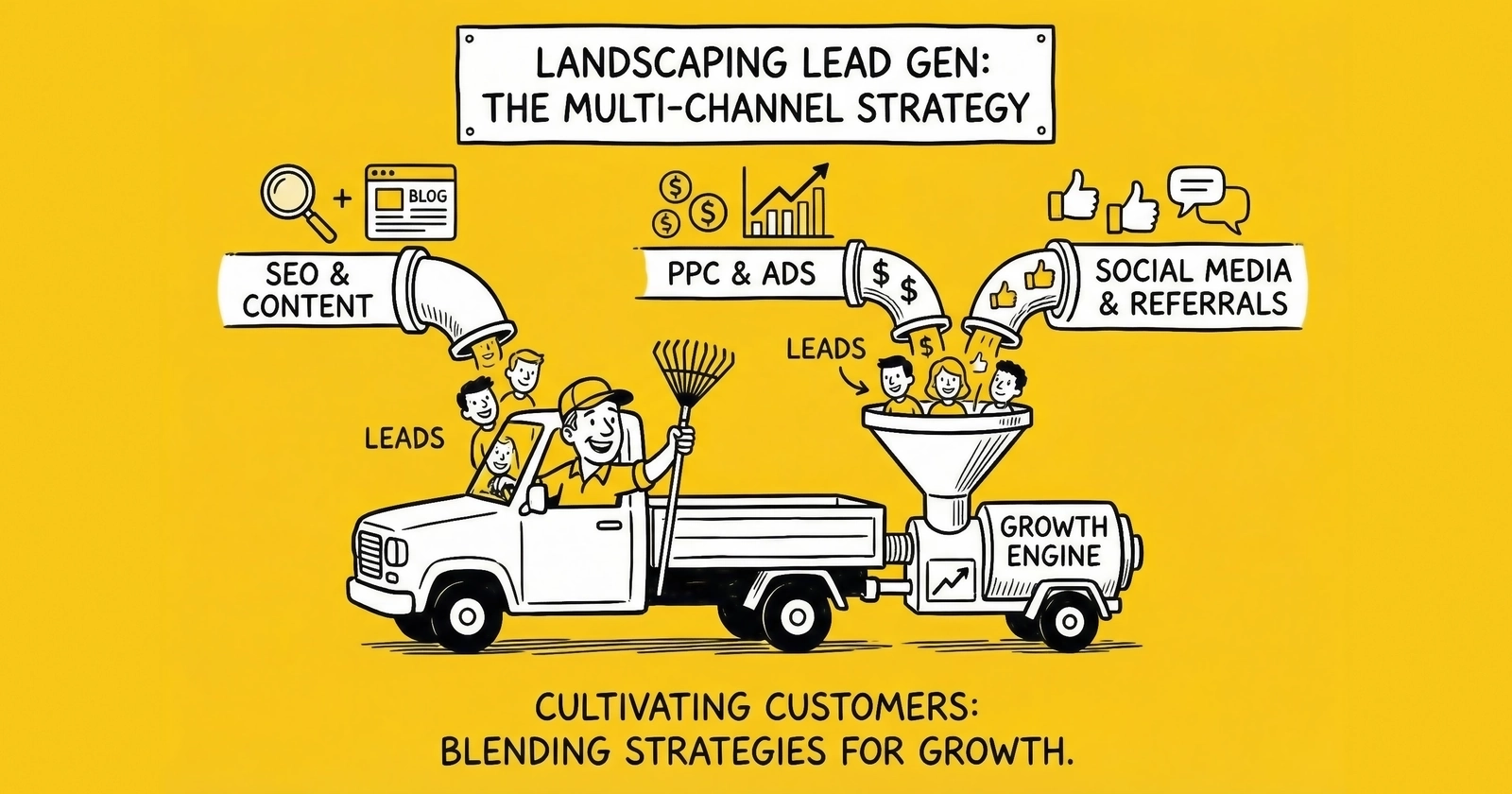
Seasonality, recurring revenue models, and the qualification strategies that separate profitable landscaping operations from those chasing unprofitable one-time jobs. Everything you need to know about generating and converting landscaping leads in a fragmented market.
The landscaping and lawn care lead market operates on a principle that most practitioners miss entirely: the real money is not in the one-time project leads that flood the market each spring. It is in building recurring maintenance contracts that compound customer lifetime value over years, not seasons. Understanding the seasonal trends across lead generation verticals helps operators plan for these predictable demand cycles.
The U.S. landscaping services market reached approximately $176 billion in 2024, with projections indicating continued growth to over $200 billion by 2028. More than 650,000 landscaping businesses operate across the country, ranging from solo operators with a truck and mower to national franchises with hundreds of crews. This fragmentation creates both opportunity and challenge for lead generators.
The challenge is intense local competition and thin margins on commodity services. The opportunity is that most landscaping businesses lack sophisticated marketing capabilities, creating consistent demand for quality leads that convert to paying customers.
This comprehensive guide provides the complete framework for landscaping and lawn care lead generation: market segmentation, seasonal demand patterns, lead type economics, qualification requirements, local marketing strategies, recurring revenue optimization, and the platform dynamics that determine profitability. Every recommendation comes from operational reality in a market where speed, local relevance, and service differentiation determine who wins.
Landscaping Market Overview: Understanding the 2024-2026 Landscape
The landscaping industry encompasses multiple distinct service categories, each with different lead economics, seasonal patterns, and buyer behaviors. Understanding this segmentation is essential before building lead generation strategies.
Market Size and Structure
The landscaping services industry generates approximately $176 billion in annual revenue in the United States, with residential services representing roughly 50% of that total. Commercial and institutional landscaping (corporate campuses, municipal properties, HOAs) accounts for the remaining half.
The market structure is notably fragmented. The top 100 landscaping companies control less than 10% of total market revenue. BrightView, the largest U.S. landscaping company, generated approximately $2.77 billion in fiscal 2024 revenue, representing less than 2% of the total market. This fragmentation means local and regional companies dominate most markets, creating opportunities for lead generators who understand local dynamics.
Employment in landscaping and groundskeeping exceeds one million workers, making it one of the largest employment categories in the trades. Labor availability and cost significantly affect contractor capacity, particularly in regions with competitive labor markets or stringent immigration enforcement.
Service Category Segmentation
Landscaping encompasses distinct service categories with dramatically different lead economics. Understanding which service category your leads represent directly affects pricing strategy and contractor relationships. A lead for weekly mowing has fundamentally different economics than a lead for a $50,000 landscape renovation project.
Lawn Maintenance and Mowing
Lawn maintenance represents the volume play in landscaping lead generation. These services include weekly or biweekly mowing, basic fertilization and weed control, edge trimming, and leaf cleanup. The average annual contract value for residential customers ranges from $1,200 to $3,600, making these leads attractive for contractors building route density.
Landscape Design and Installation
Design and installation commands premium pricing but requires different contractor capabilities. Custom landscape design, planting, hardscaping, and water features fall into this category. Project-based pricing ranges from $5,000 to over $100,000 for estate properties. The sales cycle is longer than maintenance services, typically requiring multiple consultations before closing.
Lawn Care and Treatment
Lawn care programs offer reliable recurring revenue through fertilization programs of four to eight applications annually, weed control and pest management, and aeration and overseeding. Average annual program value ranges from $400 to $1,200, often stacking with maintenance contracts for enhanced customer lifetime value.
Tree and Shrub Services
Tree services encompass pruning and trimming, tree removal, and disease treatment. Average job tickets range from $200 to $2,000 depending on scope. These leads often require specialized contractors with arborist credentials and equipment for larger jobs.
Seasonal Services
Seasonal services concentrate demand into predictable windows. Spring cleanup generates the highest lead volume period of the year. Fall cleanup and leaf removal create a secondary peak. Snow removal applies in northern markets, and holiday lighting installation creates a niche opportunity in November and December.
Irrigation and Sprinkler Services
Irrigation services require specialized contractors with technical expertise. Sprinkler system installation, repair and maintenance, winterization, and spring startup fall into this category. Average installation costs range from $2,500 to $6,000, with ongoing maintenance creating recurring revenue opportunity.
Current Lead Pricing Benchmarks
Landscaping lead pricing varies significantly by service type, geographic market, and lead quality. These benchmarks reflect 2024-2026 market conditions:
| Lead Type | Price Range | Typical Conversion Rate |
|---|---|---|
| Lawn mowing (exclusive) | $15-$40 | 15-25% |
| Lawn care program (exclusive) | $25-$60 | 12-20% |
| Landscape design/install | $50-$150 | 8-15% |
| Tree service | $20-$50 | 12-22% |
| Irrigation | $30-$70 | 10-18% |
| Spring cleanup | $15-$35 | 18-28% |
| Shared leads (all types) | $8-$25 | 6-12% |
The math illustrates why contractors pay these prices. A weekly mowing contract at $40 per visit over 26 weeks generates $1,040 in annual revenue. At a 20% conversion rate, a $25 exclusive lead yields an effective cost per acquisition of $125 against $1,040 in year-one revenue, plus renewal potential in subsequent years. With typical gross margins of 40-50% on mowing services, the customer acquisition cost represents 24% of first-year gross profit, with subsequent years generating profit without acquisition cost.
Major Market Players
Understanding the competitive landscape helps lead generators position their operations effectively.
Angi (formerly Angie’s List and HomeAdvisor) dominates the home services lead marketplace, including landscaping. Following the 2021 merger, Angi reaches over 35 million monthly unique visitors. Landscaping leads typically cost $15-$50 depending on service type and geographic competition. Leads are generally shared with 3-4 contractors.
Thumbtack operates on a quote-request model where homeowners describe their project and contractors pay to submit quotes. Landscaping contractors report lead costs of $10-$35 depending on project complexity. The platform works well for project-based work but less effectively for recurring service contracts.
Yelp for Business provides both organic visibility and paid lead generation for landscaping companies. The platform skews toward urban and suburban markets with higher review density. Cost per lead typically ranges from $15-$40.
Google Local Services Ads (LSA) has become a significant landscaping lead source. The “Google Guaranteed” badge provides trust signals for local service businesses. Landscaping leads typically cost $15-$45 through LSA, with pay-per-lead pricing rather than pay-per-click.
LawnStarter and similar marketplace platforms operate as intermediary marketplaces that match homeowners with landscaping providers. These platforms typically take a percentage of job revenue (15-25%) rather than charging per lead, creating different unit economics than traditional lead generation.
Direct lead generators include affiliate networks and independent lead generation companies that generate leads through paid search, content marketing, and local SEO, then sell to contractors at wholesale rates for distribution or direct prices for exclusive delivery.
Seasonal Demand Patterns: The Annual Landscaping Calendar
Landscaping exhibits the most pronounced seasonality of any home services vertical. Understanding the complete annual cycle, not just the spring peak, determines lead generation profitability.
Spring Peak Season (March-May)
Spring represents the highest-volume period for landscaping leads in most U.S. markets. The combination of winter-deferred demand, aesthetic motivation, and favorable weather creates concentrated buying activity.
Demand Dynamics
Lead volume increases 200-400% compared to winter baseline during peak spring weeks. Spring cleanup requests dominate early season from March through April as homeowners address winter damage and debris. New lawn care program inquiries peak in April and May as customers commit to seasonal service. Landscape design consultations concentrate in this period as homeowners plan major projects. Competition for both leads and contractor attention intensifies dramatically.
Pricing Considerations
CPL increases 30-50% above baseline during peak weeks as demand outstrips supply. Shared leads become more common as platforms prioritize volume over exclusivity. Premium pricing remains achievable for exclusive, qualified leads that convert reliably. Contractor capacity constraints limit purchase volume by late April, creating opportunity for lead generators who established relationships during the off-season.
Geographic Variation
Southern markets peak earlier, typically February through March, as warmer weather arrives sooner. Northern markets peak later, from April through May, following the last frost. Transition zones see extended but lower peak intensity spread across multiple months. West Coast markets have earlier spring startup due to mild winters. This variation creates opportunity for lead generators serving multiple geographies to extend their peak season.
Operational Considerations
Build contractor relationships during winter for spring allocation when capacity becomes constrained. Pre-negotiate capacity commitments before season begins to secure premium placement. Expect increased return rates as contractors become overwhelmed and response times slip. Quality differentiation matters more when supply floods the market, making validation and qualification essential competitive advantages.
Summer Maintenance Season (June-August)
Summer shifts from acquisition mode to maintenance mode. Lead volume decreases from spring peak but remains substantial for operators who understand the opportunity.
Demand Dynamics
Recurring service delivery dominates contractor schedules as they service existing accounts. New customer acquisition slows as contractors focus on fulfillment rather than sales. Irrigation and drought-stress services increase during heat waves, creating surge opportunities. Project work continues but with longer scheduling windows as contractors prioritize maintenance routes.
Pricing Dynamics
CPL decreases 15-25% from spring peak as demand moderates. Contractor appetite for new leads varies significantly by capacity utilization. Premium pricing applies for irrigation-related leads during drought conditions when urgency increases. Lead generators have better negotiating position with contractors seeking to fill crew hours.
Strategic Opportunity
Summer is the ideal period for building recurring contracts that start immediately. Customers unhappy with current providers actively seek alternatives mid-season after experiencing service failures. Lower competition for new customer attention means higher conversion rates per lead. Quality leads convert at higher rates due to reduced noise from spring’s volume flood.
Fall Transition Season (September-November)
Fall creates a secondary demand spike driven by end-of-season cleanup, lawn renovation, and pre-winter preparation.
Demand Dynamics
Fall cleanup and leaf removal services peak from October through November depending on regional climate. Overseeding and lawn renovation services peak in early fall when soil temperatures are optimal. Final mowing services and bed winterization create additional lead demand. Snow removal contract discussions begin in northern markets, creating an entirely separate lead category.
Pricing Dynamics
CPL returns to near-spring levels in October and November as demand concentrates. Fall cleanup leads command premium due to time sensitivity before snow arrives. Pre-season snow removal contracts have distinct value as a separate product category. Geographic variation reflects leaf density and snow expectations by region.
Strategic Opportunity
Fall leads for recurring services capture customers before they commit to competitors for the following spring. Snow removal cross-selling extends customer relationships through winter when landscaping services pause. Many competitors reduce marketing spend assuming the season is ending, creating lower acquisition costs for those who stay active.
Winter Dormant Season (December-February)
Winter represents the lowest-volume period for most landscaping leads, but opportunities exist for prepared operators who look beyond the obvious.
Demand Dynamics
Snow removal dominates in applicable markets, representing an entirely different service vertical. Southern markets continue operations year-round, creating geographic arbitrage opportunity. Planning-stage leads for spring projects begin generating in January as homeowners consider upcoming work. Holiday lighting installation creates a niche opportunity in November and December.
Pricing Dynamics
CPL drops 30-50% from peak season as demand decreases dramatically in northern markets. Lead volume decreases significantly, but competition decreases even more. Southern market opportunity exists as northern operators reduce spend and ignore these geographies. Low competition creates relationship-building opportunities with contractors preparing for spring.
Strategic Opportunity
Build contractor relationships during slow season when they have time for conversations. Capture planning-stage customers before spring competition drives prices higher. Develop content marketing assets for spring deployment when you have bandwidth. Test new traffic sources at lower risk when mistakes cost less.
Annual Calendar Strategy
Month-by-month guidance for landscaping lead generation budget allocation helps operators maximize returns across the full year.
January-February is pre-season preparation. Allocate 40-60% of average monthly budget. Focus on southern markets, planning-stage content, and relationship building with contractors who will need capacity in spring.
March-April begins spring ramp-up. Allocate 120-150% of average monthly budget. Capture early spring cleanup demand before competition intensifies. Begin scaling for peak season.
May is peak season. Allocate 150-180% of average monthly budget. Maximum lead volume opportunity occurs now. Monitor contractor capacity closely to avoid overwhelming partners.
June-July transitions to maintenance. Allocate 80-100% of average monthly budget. Focus on recurring service contracts and irrigation leads that convert well during heat.
August-September is late summer opportunity. Allocate 100-120% of average monthly budget. Capture lawn renovation and fall preparation leads before the fall rush.
October-November is fall peak. Allocate 120-140% of average monthly budget. Fall cleanup demand creates the secondary annual peak. Pre-season snow contracts begin.
December is off-season. Allocate 30-50% of average monthly budget. Holiday lighting, snow removal, and planning stage for next year represent available opportunities.
Lead Type Economics: Recurring Revenue vs. One-Time Projects
The fundamental strategic decision in landscaping lead generation is the balance between recurring service leads and one-time project leads. Each has distinct economics that affect long-term profitability.
Recurring Service Lead Economics
Recurring service leads generate ongoing revenue streams that compound customer lifetime value over multiple years.
Lawn Maintenance Contracts
Average annual value ranges from $1,500 to $3,500 for residential customers depending on lot size and service frequency. Typical retention rates run 75-85% annually when service quality remains consistent. Average customer lifetime spans 3-5 years before moving, switching providers, or changing circumstances. Total lifetime value reaches $4,500-$14,000 when calculated across the full customer relationship.
Lawn Care Treatment Programs
Average annual value ranges from $500 to $1,200 depending on lot size and program comprehensiveness. Typical retention rates run 70-80% annually, slightly lower than maintenance due to less frequent interaction. Average customer lifetime spans 2-4 years. Total lifetime value reaches $1,200-$4,000 for standalone programs, higher when combined with maintenance contracts.
The Compounding Effect
A lead that costs $30 and converts at 20% yields a $150 effective CPA. If the customer generates $1,500 in year-one revenue at 45% gross margin, first-year gross profit is $675 minus $150 CPA, leaving $525 net contribution. In year two, with 80% retention, expected value is $540 in gross profit with no acquisition cost. Over three years, the same customer generates $1,500+ in cumulative gross profit from a $150 acquisition cost.
Why Recurring Leads Command Premium Pricing
Contractors pay more for recurring service leads because they deliver predictable revenue that supports business planning. Lower ongoing marketing costs follow from retained customers. Higher lifetime value per customer justifies upfront acquisition investment. Referral potential from satisfied customers generates additional value beyond the direct relationship. Reduced seasonality in contractor cash flow enables better business management.
One-Time Project Lead Economics
Project leads generate immediate revenue but require continuous lead acquisition to maintain sales volume.
Landscape Installation Projects
Average project value ranges from $5,000 to $25,000 for residential work, with estate properties reaching $100,000 or more. Each project is a single transaction with no recurring revenue unless converted to maintenance. Higher gross margin potential of 35-50% partially compensates for the lack of recurring revenue. Longer sales cycles of 2-8 weeks require more contractor effort per closed deal.
Spring Cleanup and Seasonal Services
Average job value ranges from $150 to $500 depending on property size and condition. Single transaction revenue occurs annually at most. Lower margins result from intense competition during peak season. However, 20-30% of seasonal service customers convert to recurring relationships, creating pipeline value.
The Volume Treadmill
A project lead that costs $75 and converts at 12% yields a $625 effective CPA. A $10,000 project at 40% gross margin generates $4,000 in gross profit minus $625 CPA, leaving $3,375 net contribution. However, the contractor must continuously acquire new project leads to maintain revenue. A company targeting $500,000 in annual project revenue at $10,000 average project size needs 50 closed projects, requiring over 400 leads annually at 12% conversion.
Why Project Leads Still Matter
Project leads deliver higher individual transaction margins that support different business models. Brand building occurs through visible work that neighbors and passersby observe. Cross-sell opportunity to recurring services creates lifetime value enhancement. Diversification of revenue streams reduces dependence on recurring contract retention. Lower ongoing service delivery complexity appeals to some contractor business models.
Balancing Your Portfolio
The optimal landscaping lead generation operation includes both lead types with strategic emphasis on recurring revenue.
Recommended Portfolio Allocation
Allocate 60-70% of lead volume to recurring service leads including mowing, lawn care, and maintenance. Reserve 30-40% for project and seasonal leads including installation, cleanup, and tree service. This balance captures the lifetime value benefits of recurring revenue while maintaining project capability for margin and diversification.
Seasonal Adjustment
Spring warrants higher project and seasonal lead emphasis of 50-60% when installation demand peaks. Summer should shift to recurring service dominance of 70-80% when maintenance customers actively seek providers. Fall returns to mixed emphasis around 50-50 while pre-selling for next season. Winter focuses on planning-stage project leads and relationship building for spring.
Cross-Sell Strategy
The highest-value lead generation programs capture project leads and convert them to recurring service customers. A landscape installation customer who becomes a maintenance contract customer has lifetime value 5-10x higher than the project lead alone. Design lead capture and contractor handoff to facilitate this conversion. Ask about ongoing service interest during initial qualification. Share this information with contractors to maximize conversion opportunity.
Lead Qualification: What Separates Valuable Leads from Waste
Landscaping leads face specific qualification challenges that affect conversion rates and buyer satisfaction. Systematic qualification at point of capture improves lead quality and enables premium pricing.
Property Qualification
The property itself determines service scope, pricing, and contractor interest.
Lot Size Verification
Lot size directly affects service pricing and contractor interest. Small lots under 5,000 square feet offer limited service revenue that may not justify drive time. Standard residential properties of 5,000-15,000 square feet represent the sweet spot for residential contractors building route density. Large residential properties of 15,000-40,000 square feet command premium pricing but require specialized equipment. Estate properties over one acre require different contractor capabilities and pricing models entirely.
Self-reported lot size is notoriously inaccurate. Homeowners frequently underestimate or misremember property dimensions. Integrating property data lookups using ATTOM, CoreLogic, or county assessor data improves accuracy significantly and prevents mismatched leads.
Property Type Considerations
Single-family homes represent the primary market with standard pricing models. Townhomes and condos often have HOA-maintained common areas, limiting opportunity to private spaces. Multi-family properties require commercial pricing and involve different buyer relationships with property managers rather than owners. Commercial properties represent a separate market with distinct economics requiring different contractor capabilities.
Existing Landscape Conditions
Established lawns present maintenance opportunity with standard pricing. New construction creates installation opportunity with higher initial revenue. Neglected properties may require remediation before regular service begins, affecting pricing and contractor interest. Mature landscapes with established trees and shrubs create additional tree and shrub maintenance opportunities.
Service Intent Qualification
Understanding what the customer actually needs prevents mismatched leads and return requests.
Service Type Identification
Capture specific service intent rather than generic landscaping interest. Categories include regular mowing and maintenance, one-time cleanup or project work, lawn care treatment programs, landscape design and installation, tree and shrub services, and irrigation and drainage. Each category routes to different contractor specialties.
Urgency Assessment
Determine timing expectations to match leads with available contractor capacity. Immediate need within 1-2 weeks commands premium pricing but requires available contractors. Planning stage customers looking at next month have more flexibility. Information gathering contacts with no timeline may not represent sales-ready leads. Seasonal preparation for future seasons represents early-stage pipeline.
Budget Qualification
Unlike many home services where price sensitivity varies widely, landscaping customers often have anchored expectations based on prior service experience or neighbor recommendations. Pre-qualification questions about current spending or budget expectations help match leads to appropriate contractors.
Budget under $50/week for mowing suggests a price-sensitive customer who may require value-tier contractors. Budget of $50-$100/week indicates standard residential service expectations. Budget over $100/week suggests larger property or premium service expectations that justify higher-capability contractors.
Geographic Qualification
Landscaping is intensely local. Contractors have defined service areas based on drive time, equipment logistics, and crew routing efficiency.
ZIP Code Targeting
Most contractors serve a 10-25 mile radius from their base location. Dense urban areas require tighter radius due to traffic congestion affecting route efficiency. Rural areas can support wider radius with larger properties justifying drive time. Route density matters significantly because isolated leads may not be profitable even within nominal service area.
Service Area Verification
Capture full address rather than just ZIP code to enable precise routing. Verify address exists and is residential or commercial as appropriate for the contractor network. Match leads to contractor service territories before distribution to prevent returns. Consider drive time rather than just distance, as traffic patterns affect actual accessibility.
Local Market Knowledge
Understanding which neighborhoods command premium pricing helps match leads to appropriate contractors. Knowing which areas have difficult access (gated communities, narrow streets, steep terrain) prevents mismatches. Awareness of community HOA restrictions that affect landscaping services (approved plant lists, height restrictions, maintenance requirements) improves lead-to-contractor fit.
Homeownership Verification
Unlike emergency services where renters may have authority to hire contractors, landscaping services typically require property owner decision-making.
Verification Approaches
Property database matching through services like ATTOM or CoreLogic verifies owner name against property address at $0.50-$2.00 per lookup. Self-attestation questions about property ownership and authority to hire contractors provide basic screening without lookup costs. For rental properties, clarify who makes landscaping decisions and has authority to contract. HOA properties may have restrictions affecting service scope that should be disclosed upfront.
Rental Property Considerations
Property managers make decisions for rental properties and represent a different buyer profile. Landlords may authorize tenants to hire services in some arrangements. Multi-family properties have different buyer dynamics requiring commercial qualification. Commercial leases often include landscaping responsibilities that affect who can authorize services.
Local Marketing Strategies: Winning in Fragmented Markets
Landscaping success depends on local market dominance. National campaigns rarely work effectively for inherently local services. Understanding local marketing dynamics determines lead generation effectiveness.
Google Business Profile Optimization
Google Business Profile (GBP) is the primary discovery mechanism for local landscaping contractors. Local Pack visibility drives significant lead volume that costs nothing per lead once established.
Profile Completion Requirements
Google rewards complete profiles with better visibility. Complete every field available, including business name (legal name without keyword stuffing), verified address required for Local Pack visibility, trackable phone number for attribution, website linking to a landing page optimized for local search, hours of operation, geographic service area for targeting, categories (primary: Landscaping; secondary: Lawn Care, Tree Service, etc.), attributes (free estimates, eco-friendly, licensed and insured), and products/services list with descriptions.
Visual Content Requirements
Landscaping is a visual business where results speak clearly. Before-and-after project photos demonstrate capability better than words. Seasonal service examples showing spring cleanup and fall leaf removal establish year-round expertise. Team and equipment photos build credibility and trust. Customer property transformations serve as proof of value. Update photos regularly to show recent work and active engagement.
Posts and Updates
Regular posting signals active engagement to Google’s ranking algorithms. Weekly seasonal tips and service reminders keep the profile fresh. Project showcase posts with photos demonstrate ongoing work. Seasonal promotion announcements attract timely interest. Community involvement mentions build local credibility.
Review Generation and Management
Reviews are the primary trust signal for local landscaping services. A contractor with 150 reviews averaging 4.7 stars captures more leads than a competitor with 25 reviews at 5.0 stars. Volume and velocity matter alongside rating.
Systematic Request Process
Every completed service should trigger a review request through established workflow. Send post-service email or SMS within 24 hours while the experience is fresh. Include direct link to Google review page to reduce friction. Follow up if no review within 48 hours with a gentle reminder. Include review requests in seasonal thank-you communications to existing customers.
Timing Optimization
Request reviews when customer satisfaction peaks for maximum positive response. After first service when lawn looks noticeably better captures the transformation moment. After project completion when visual transformation is visible maximizes impact. After resolving a service issue turns potential detractors into advocates. End of season with “thank you for your business” framing captures appreciation.
Response Requirements
Respond to all reviews to demonstrate engagement. Thank positive reviewers specifically for their time and mention specific aspects of the work when possible. Address negative reviews professionally with resolution offers rather than defensive responses. Response time signals engagement to potential customers reading reviews.
Review Velocity Targets
For competitive landscaping markets, maintain minimum 8-15 new reviews monthly during peak season. Keep rolling average above 4.5 stars through service quality and issue resolution. Recent reviews from the last 90 days carry more weight in rankings than older reviews.
Local Landing Page Strategy
Service area landing pages optimized for local search capture geographic-specific demand that generic pages miss.
Page Structure Requirements
Include city or neighborhood in title tag and H1 for geographic relevance. Identify service type clearly (lawn care, landscaping, tree service) for intent matching. Add local content mentioning specific neighborhoods and local climate conditions. Include local trust signals through reviews and project photos from the area. Provide clear call to action with phone number and form. Implement schema markup for local business to help search engines understand the page.
Content Differentiation
Create unique content for each location page rather than templated text with city name swapped. Address local growing conditions and lawn care challenges specific to the region. Mention regional plant species and landscaping styles that resonate with local customers. Reference local water restrictions and environmental considerations that affect service recommendations. Include community involvement and local customer testimonials for authenticity.
Neighborhood Marketing Tactics
Landscaping has unique local marketing opportunities due to the visual nature of the service.
Yard Signs and Door Hangers
Physical presence in neighborhoods drives awareness and credibility. Place yard signs at active job sites with customer permission to capture neighbor attention. Run door hanger campaigns in target neighborhoods surrounding current customers. Use “We’re working in your neighborhood” messaging to create relevance. Include QR codes linking to lead capture forms for immediate action.
Route Density Marketing
Concentrate marketing in existing service areas to maximize operational efficiency. Reducing drive time increases margin by clustering customers geographically. Offer neighbor referral incentives for adjacent properties to build density. Develop HOA relationships for community-wide contracts that deliver multiple customers through single sales efforts.
Seasonal Trigger Marketing
React to environmental triggers that create immediate demand. Launch post-storm cleanup outreach within 24-48 hours when fallen branches and debris create urgent need. Run first-mow-of-season campaigns in spring when customers realize they need service. Deploy pre-drought lawn care messaging during dry periods when irrigation and treatment become priorities. Send end-of-season contract renewals and winter service upsells before customers become unreachable.
Marketplace Platforms: Angi, Thumbtack, and Alternatives
Lead marketplace platforms provide access to homeowner demand without requiring contractors to build marketing infrastructure. Understanding platform economics and optimization strategies determines ROI.
Angi/HomeAdvisor Platform Economics
Angi dominates the home services lead marketplace, including landscaping. Understanding the platform dynamics helps optimize participation.
Pricing Model
Contractors pay per lead rather than per job, transferring conversion risk to the contractor. Landscaping leads typically cost $15-$50 depending on service type, with installation leads commanding higher prices than maintenance. Geographic competition affects pricing as denser markets see higher costs. Premium pricing applies for higher-value services like landscape installation.
Lead Characteristics
Leads are typically shared with 3-4 contractors, creating competitive dynamics. Homeowners expect multiple quotes, which affects closing strategy. Response time is critical because speed-to-lead gives first-to-call contractors significant advantage. Lead quality varies, with some contacts price-shopping only rather than ready to buy.
Conversion Benchmarks
Shared lead booking rates typically run 8-15% depending on service type and contractor execution. First-responder advantage delivers 2-3x higher conversion than delayed response. Quality of follow-up affects conversion significantly beyond initial contact.
Optimization Strategies
Response within 5 minutes dramatically improves conversion compared to hourly response. Personalized responses referencing specific project details from the lead demonstrate attention. Clear differentiation beyond price through warranties, guarantees, and reviews helps close competitive situations. Systematic follow-up sequences capture additional conversions from initially non-responsive contacts.
Thumbtack Platform Dynamics
Thumbtack’s quote-based model works differently than Angi’s lead delivery model, creating different optimization strategies.
Pricing Model
Contractors pay to send quotes rather than receiving leads. Cost per quote ranges from $10-$35 for landscaping depending on project scope. Homeowners may receive 4-5 quotes per request. Contractors only pay for quotes they choose to send, enabling selective participation.
Strategic Considerations
Selective quoting based on project fit preserves budget for high-probability opportunities. Profile optimization affects credibility and selection rates. Response speed still matters for competitive positioning. Photography and reviews influence which quotes homeowners select for follow-up.
When Thumbtack Works Well
The platform performs best for project-based work with clear scope that homeowners can describe accurately. Contractors with strong profiles and extensive reviews outperform new participants. Practitioners who can respond quickly capture opportunities before competitors. Markets with less competition see better economics per quote.
Google Local Services Ads
Google LSA has become a primary landscaping lead source, offering pay-per-lead pricing with strong trust signals.
Pricing Model
Pay-per-lead pricing rather than pay-per-click eliminates click waste. Landscaping leads typically cost $15-$45 depending on service type and market. Background check and licensing verification is required for participation. The “Google Guaranteed” badge builds consumer trust.
Advantages
Premium placement at the top of search results increases visibility. The trust badge provides competitive advantage over organic results. Pay-per-lead eliminates click waste from non-converting traffic. Lead dispute process enables credits for invalid contacts.
Optimization Requirements
Complete background check and verification process before launching. Build strong reviews on Google Business Profile since they affect LSA ranking. Respond to leads promptly because responsiveness affects algorithm placement. Configure accurate service area and category settings to receive relevant leads.
Platform Strategy: Diversification and Tracking
The optimal approach uses multiple platforms while tracking performance rigorously.
Diversification Benefits
Multiple platforms reduce dependence on any single lead source that might change policies or pricing. Different platforms capture different customer segments with varying intent and budget. Fallback sources provide continuity during platform policy changes or account issues. Comparison testing reveals true performance by source.
Tracking Requirements
Assign unique tracking numbers for each platform to enable attribution. Integrate CRM for lead-to-customer attribution beyond initial contact. Track revenue by source for true ROI calculation rather than just cost per lead. Conduct regular performance review and budget reallocation based on results.
Budget Allocation Guidance
Allocate more budget to higher-performing platforms based on cost per acquired customer. Maintain minimum presence on secondary platforms for diversification and testing. Adjust allocation seasonally as platform performance varies with demand. Test new platforms with limited budgets before scaling commitment.
Recurring Revenue Optimization: Building Customer Lifetime Value
The strategic differentiator in landscaping lead generation is the ability to generate leads that convert to recurring service relationships rather than one-time transactions.
Contract Structure and Pricing
Recurring service contracts require specific lead qualification and contractor handoff to maximize conversion.
Contract Types
Annual contracts with monthly or seasonal billing provide predictable revenue and customer commitment. Month-to-month agreements with cancellation terms offer flexibility that appeals to cautious customers. Prepaid seasonal packages covering spring-fall provide upfront cash flow. Multi-year agreements with loyalty pricing reward commitment with better rates.
Pricing Structures
Per-visit pricing offers simplicity and transparency that customers understand easily. Monthly flat rate provides predictable budgeting for customers who prefer consistent payments. Annual contract with payment terms creates commitment and reduces churn. Tiered service levels (basic, standard, premium) enable customers to self-select based on needs and budget.
Lead Qualification for Recurring
Verify intent for ongoing service rather than one-time cleanup since recurring contracts require different commitment. Confirm decision-making authority because owners can commit to multi-year relationships while renters typically cannot. Assess property characteristics for service scope to ensure realistic pricing. Understand current service situation because new customers and switching customers have different needs and objections.
Upsell and Cross-Sell Opportunities
Initial leads often represent entry points to broader service relationships that multiply lifetime value.
Service Expansion Path
Mowing leads expand naturally by adding fertilization programs for lawn health. Lawn care leads expand by adding mowing and maintenance for comprehensive service. Spring cleanup leads convert to seasonal contracts by demonstrating value. Landscape installation leads convert to ongoing maintenance contracts by establishing relationships.
Cross-Sell Timing
End of first season provides natural opportunity to introduce additional services based on observed needs. Contract renewal timing enables bundling additional services with commitment incentives. Problem identification during service delivery creates opportunity to offer solutions like irrigation and drainage. Seasonal transitions create natural moments to add seasonal services.
Lead Capture Design for Expansion
Capture broad service interest during initial lead generation, not just immediate need. Ask about current service dissatisfaction to identify additional opportunities. Inquire about future projects in design and installation to build pipeline. Collect permission for follow-up marketing to enable ongoing relationship development.
Customer Retention Through Lead Generation
Lead generation extends beyond new customer acquisition to retention of existing customers.
Re-engagement Campaigns
Target customers who cancelled or did not renew with win-back offers. Reach customers from previous seasons who may need reactivation. Follow up with customers who requested quotes but did not convert when timing may have changed. Track customers who moved to new properties since they may need service at new locations.
Retention-Focused Lead Programs
Offer early renewal incentives for existing customers to lock in relationships before competition emerges. Run win-back campaigns for lapsed customers who may reconsider. Build referral programs that generate leads from satisfied customers while rewarding loyalty. Deploy seasonal reminder campaigns that prompt contract renewal before customers forget.
Building Contractor Relationships: The Foundation of Sustainable Lead Generation
For lead generators working with landscaping contractors, relationship quality determines long-term success. The landscaping industry’s fragmentation means working with many smaller companies who require different relationship management than large corporate buyers. Our guide on building buyer relationships covers the fundamentals of these partnerships in depth.
Contractor Selection Criteria
Not all landscaping contractors make good lead buyers. Selection criteria protect reputation and ensure sustainable relationships.
Operational Requirements
Evaluate adequate crew capacity for additional customers without overwhelming existing service levels. Confirm reliable scheduling and customer communication since poor service reflects on lead quality. Require CRM or lead management system, even simple ones, to ensure leads are worked systematically. Look for customer service orientation that converts leads rather than wasting them.
Financial Stability
Prefer established businesses with 2+ years of operation demonstrating viability. Verify consistent payment history through references or industry connections. Confirm adequate cash flow for lead purchasing without straining operations. Investigate any history of payment disputes that might indicate future problems.
Reputation Indicators
Require positive Google reviews with 4.0+ average and 30+ reviews demonstrating customer satisfaction. Verify proper licensing and insurance appropriate for the service area. Check for significant complaint patterns through BBB and other sources. Assess professional presentation and communication quality.
Relationship Management
Ongoing relationship management sustains performance over seasonal cycles.
Regular Communication
Conduct weekly check-ins during peak season when capacity and quality issues emerge quickly. Shift to monthly reviews during shoulder seasons when volume decreases. Hold quarterly business reviews with performance data to align on goals. Schedule pre-season capacity planning discussions before spring rush.
Performance Transparency
Share lead quality metrics including contact rates and conversion rates to build trust. Discuss return patterns and reasons to identify improvement opportunities. Provide competitive benchmarking using anonymized data to help contractors improve. Collaborate on optimization rather than defending positions.
Capacity Monitoring
Track response time trends since slowing response suggests capacity stress. Monitor return rate changes because increasing returns suggest oversupply. Adjust lead volume before contractor requests changes to demonstrate proactive partnership. Build trust through proactive management rather than reactive response to complaints.
Pricing and Terms
Lead pricing structures should align contractor and generator incentives for sustainable relationships.
Pricing Models
Per-lead pricing offers simplicity and remains most common. Performance tiers with lower base price and bonus for high conversion reward quality. Seasonal pricing with higher rates during peak and lower during slow periods reflects market realities. Volume commitments with discounts for guaranteed purchase volume provide predictability.
Term Considerations
Exclusivity arrangements with territory protection reward contractor commitment. Return policies clarifying what qualifies for credit prevent disputes. Payment terms (prepaid, net 15, net 30) should match contractor cash flow. Seasonal commitments and minimum volumes provide planning certainty for both parties.
Frequently Asked Questions
What is the average cost per lead for landscaping services?
Landscaping lead costs vary significantly by service type and lead quality. Exclusive mowing leads typically range from $15-$40, while landscape design and installation leads command $50-$150 due to higher project values. Shared leads across platforms like Angi cost $8-$25 per lead but convert at lower rates due to competition. For broader context, see our cost per lead benchmarks by industry. The relevant metric is cost per acquired customer, not cost per lead. A $30 exclusive lead with a 20% conversion rate yields a $150 effective customer acquisition cost, which should be evaluated against customer lifetime value, not just the first transaction.
How does seasonality affect landscaping lead generation?
Landscaping exhibits the most pronounced seasonality of any home services vertical. Spring (March-May) generates the highest lead volume, with demand increasing 200-400% above winter baseline. Lead costs increase 30-50% during peak spring weeks as competition intensifies. Summer maintains moderate demand focused on maintenance services. Fall creates a secondary peak with cleanup and pre-winter preparation. Winter represents the lowest-volume period in northern markets but offers opportunity in southern regions where services continue year-round. Budget allocation should follow seasonal patterns: 150-180% of average during spring peak, 80-100% during summer, 120-140% during fall peak, and 30-50% during winter dormancy.
Should I focus on recurring service leads or project leads for landscaping?
The optimal strategy emphasizes recurring service leads while maintaining project lead capability. Recurring service leads (mowing, lawn care programs, maintenance) generate compounding customer lifetime value over multiple years. A mowing customer retained for three years at $1,500 annually generates $4,500 in revenue from a single acquisition cost. Project leads generate immediate revenue but require continuous acquisition to maintain sales volume. The recommended portfolio allocation is 60-70% recurring service leads and 30-40% project and seasonal leads, with seasonal adjustments during spring when project demand peaks.
Which platforms work best for landscaping leads: Angi, Google LSA, or Thumbtack?
Each platform has distinct characteristics. Angi provides high volume but shared leads, making speed-to-contact critical for conversion. Google Local Services Ads offer pay-per-lead pricing with the trusted “Google Guaranteed” badge, typically at $15-$45 per landscaping lead. Thumbtack works well for project-based work with its quote-based model. The optimal strategy uses multiple platforms, tracking performance rigorously and allocating budget toward highest-performing sources. Most successful operators maintain presence on three to four platforms while building direct marketing capabilities for long-term competitive advantage. Track effective cost per acquired customer by platform, not just cost per lead.
What qualification data should landscaping lead forms capture?
Essential fields include property address (for lot size estimation and service area verification), property type (single-family, townhome, commercial), service type requested (mowing, lawn care, installation, cleanup), frequency preference (weekly, biweekly, one-time), current service situation (new customer, switching providers, returning after break), and preferred contact method. Highly valuable additional fields include lot size estimate, current spending on landscaping services, timeline for service start, and specific problem areas or project descriptions. For recurring service leads, confirming homeownership status is essential since renters typically cannot authorize ongoing service contracts.
How do I verify that landscaping leads are property owners?
Property ownership verification prevents wasted contractor effort on leads without decision-making authority. Three approaches work effectively: property database matching through services like ATTOM or CoreLogic verifies owner name against property address ($0.50-$2.00 per lookup). Self-attestation questions about property ownership and authority to hire contractors provide basic screening. For commercial properties, verify the contact has authority to contract for services. For rental properties, clarify whether the landlord or tenant is responsible for landscaping. Ownership verification is particularly important for recurring service leads where contracts extend over months or years.
What conversion rate should landscaping contractors expect from purchased leads?
Conversion rates vary by lead type and contractor execution. Shared leads typically convert at 6-12% to booked services. Exclusive leads convert at 15-25% when contractors respond quickly and follow up systematically. Project leads (landscape installation) convert at 8-15% due to longer consideration cycles and higher price sensitivity. Spring cleanup leads during peak season can convert at 18-28% due to urgent demand. However, contractor execution matters more than industry averages. Response within five minutes increases conversion 2-3x compared to response within an hour. Systematic follow-up sequences capture additional conversions from initially non-responsive leads.
How important is Google Business Profile for landscaping lead generation?
Google Business Profile is essential for local landscaping lead generation. Local Pack visibility (map results for local searches) drives significant organic lead volume. Complete profile optimization, regular photo updates, weekly posts, and systematic review generation improve visibility. Contractors with strong GBP profiles report that organic leads from Google Maps and local search represent 25-40% of total lead volume, essentially free leads that reduce overall customer acquisition costs. For lead generators, understanding which contractors have strong local presence helps identify partners who can convert leads effectively.
How do weather patterns affect landscaping lead generation?
Weather directly drives landscaping demand. Extended dry periods increase irrigation and lawn recovery leads. Storms generate cleanup and tree service demand within 24-48 hours. Early springs accelerate seasonal demand in northern markets. Drought conditions reduce maintenance demand but increase irrigation service needs. Practitioners who monitor weather forecasts gain 48-72 hours of lead time before demand changes. Strategic responses include adjusting paid search bids before weather events, preparing landing pages with weather-relevant messaging, and pre-coordinating contractor capacity for surge periods.
What is the lifetime value of a landscaping customer and how should it affect lead pricing?
Landscaping customer lifetime value extends well beyond the initial service. A recurring mowing customer at $1,500 annually retained for four years generates $6,000 in revenue with gross margin of approximately $2,700 over the relationship. Adding lawn care treatment programs increases annual revenue by $500-$1,200. Cross-selling occasional project work adds incremental revenue. Total lifetime value for a fully developed customer relationship can reach $8,000-$15,000 over a multi-year relationship. This lifetime value justifies customer acquisition costs of $150-$400, which supports lead costs of $25-$100 depending on conversion rates. Contractors who only consider the first service when evaluating lead economics systematically underinvest in customer acquisition.
How do I handle lead quality issues with landscaping leads?
Lead quality issues require systematic tracking and resolution. Define quality criteria clearly: valid contact information, confirmed service need, property within service area, appropriate property type, and homeowner or authorized decision-maker. Track quality metrics by source to identify problem suppliers. Implement validation at point of capture: phone verification, address standardization, and basic qualification questions. Establish clear return policies with lead sources for invalid contacts, wrong service areas, or rental properties for recurring service leads. Quality issues exceeding 15-20% of volume indicate source problems requiring renegotiation or termination. Document quality issues with specific examples to support discussions with lead vendors.
Key Takeaways
-
The landscaping market is a $176 billion industry with extreme fragmentation. The top 100 companies control less than 10% of revenue, meaning local and regional companies dominate. Lead generation success depends on understanding local market dynamics, seasonal patterns, and contractor capabilities rather than national strategies.
-
Recurring service leads generate dramatically higher lifetime value than project leads. A mowing customer retained for three years generates $4,500+ in revenue from a single acquisition cost. Portfolio allocation should emphasize recurring service leads (60-70%) while maintaining project lead capability (30-40%) for revenue diversification and cross-sell opportunities.
-
Seasonality is more pronounced than any other home services vertical. Spring demand increases 200-400% above winter baseline. Budget allocation should follow: 150-180% during spring peak, 80-100% during summer, 120-140% during fall peak, and 30-50% during winter. Practitioners who scale linearly across the year overpay for low-converting winter leads and miss spring opportunity.
-
Lead qualification determines profitability more than lead volume. Property verification (lot size, ownership, service area), service intent clarity (recurring vs. one-time), and decision-maker confirmation prevent wasted contractor effort and reduce return rates. Invest in validation upfront to enable premium pricing.
-
Google Business Profile is essential for local visibility. Landscaping is inherently local, and GBP drives 25-40% of organic lead volume for optimized contractors. Review velocity (8-15 new reviews monthly during peak season) and profile completeness directly affect Local Pack visibility.
-
Platform diversification reduces risk while enabling optimization. Use multiple platforms (Angi, Google LSA, Thumbtack, direct generation) while tracking cost per acquired customer by source. Allocate budget toward highest-performing platforms while maintaining presence on secondary sources for diversification.
-
Cross-selling transforms lead economics. Project leads that convert to recurring service relationships have lifetime value 5-10x higher than the project alone. Design lead capture and contractor handoff to facilitate conversion from one-time projects to ongoing service contracts.
-
Contractor relationships are the foundation of sustainable lead generation. In a fragmented market with many smaller companies, relationship quality determines pricing power, return rate tolerance, and long-term partnership stability. Select contractors with operational capacity and customer service orientation, not just lead appetite.
Understanding landscaping lead generation requires recognizing that the visible spring rush is not where sustainable profitability lives. Those who win are those who build recurring revenue relationships, maintain contractor partnerships through seasonal cycles, and capture the compounding value of customers retained over years rather than seasons.