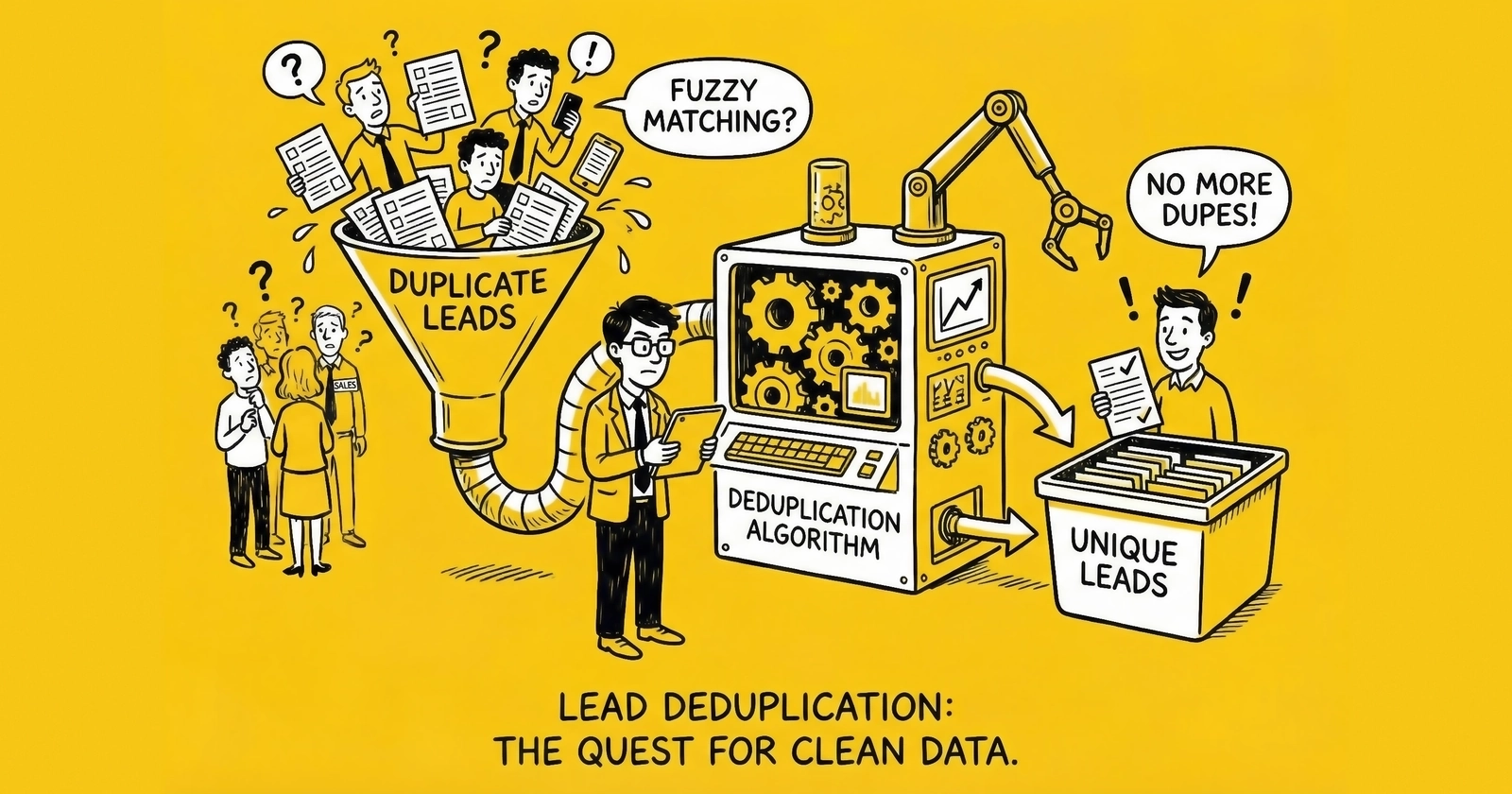
Master the technical and operational aspects of lead deduplication to eliminate duplicate costs, improve buyer relationships, and protect your margins in a multi-source lead generation environment.
You are paying for the same lead twice. Maybe three times.
If you aggregate leads from multiple sources, run traffic across multiple campaigns, or operate a lead distribution platform, duplicate leads are silently draining your margins. The consumer who fills out a form on Site A at 9:00 AM and Site B at 9:15 AM appears twice in your system. You pay for both. You sell one. The buyer returns the other as a duplicate. You eat the loss.
The industry data is clear: without systematic deduplication, 5-15% of third-party lead volume represents duplicates. At $30 CPL and 10,000 monthly leads, that is $15,000-$45,000 in wasted spend before you count buyer returns, reputation damage, and operational overhead.
Lead deduplication is the process of identifying and eliminating duplicate records from your lead flow. It sounds simple. The execution is not. A consumer’s phone number appears in six different formats across submissions. Email addresses contain typos, aliases, and intentional variations. Names get misspelled. Addresses use inconsistent abbreviations. The same person looks like six different people in your database.
This guide covers the complete deduplication landscape: matching algorithms from exact to fuzzy, implementation timing decisions, performance benchmarks, and operational best practices that protect your margins while preserving legitimate leads.
The True Cost of Duplicate Leads
Before diving into solutions, understand what duplication actually costs. The math extends far beyond the obvious double payment.
Direct Financial Loss
The surface-level calculation is straightforward. With duplicate rates running 5-15% of third-party lead volume and average CPLs ranging from $25-$50 depending on vertical, a 10,000-lead monthly operation faces $12,500-$75,000 in duplicate waste. But this assumes you only pay for duplicates. In reality, you often pay for the lead, attempt to sell it, and then process a return when the buyer identifies it as a duplicate to their existing inventory.
Buyer Relationship Damage
Buyers track duplicate rates obsessively, as we explore in our guide to building buyer relationships. When they receive leads already in their CRM, or receive the same lead from multiple vendors, trust erodes. The conversation escalates from “please reduce duplicates” to “we’re cutting your allocation” to “we’re terminating the relationship.”
Industry surveys consistently show that duplicate delivery is among the top three complaints buyers raise with lead vendors, alongside contact rate issues and compliance concerns. A buyer who experiences persistent duplicate problems does not simply reduce spend. They question whether your entire operation is worth the management overhead.
Operational Overhead
Every duplicate creates downstream work. Your team spends hours processing return requests, analyzing whether disputed duplicates are legitimate, investigating which supplier sent the problem lead, managing chargebacks and credit adjustments, and reconciling reports for returned volume. At scale, a 10% duplicate rate requiring manual return processing consumes a full-time equivalent in operational capacity. That is salary, benefits, and opportunity cost that should be deployed on growth rather than cleanup.
Hidden Costs
Beyond direct and operational costs, duplicates create invisible damage throughout your business. Your conversion rates look worse when duplicates never had conversion opportunity in the first place. Multi-touch attribution breaks when the same consumer appears as different records. Leads that should be suppressed – existing customers, past complaints – slip through as variations. And contacting the same consumer repeatedly violates reasonable contact frequency expectations, creating compliance exposure.
Understanding Deduplication: Core Concepts
Deduplication identifies records that represent the same entity despite variations in how that entity’s information appears. The technical challenge is distinguishing legitimate duplicates from different people who happen to share some characteristics.
The Deduplication Pipeline
Effective deduplication operates as a pipeline with distinct stages, each building on the previous.
Normalization
Raw data arrives in inconsistent formats. Before matching, normalize fields to standard representations. Phone numbers need formatting stripped, country codes removed, and extensions eliminated to produce clean 10-digit formats. Email addresses should be lowercased with dots removed from Gmail addresses (john.doe@gmail.com becomes johndoe@gmail.com). Names require standardized case, removal of titles like Mr. or Dr., and consistent handling of suffixes like Jr. or III. Addresses need USPS standardization with consistent abbreviation patterns.
Normalization ensures that “John Smith” at “(555) 123-4567” matches “JOHN SMITH” at “555-123-4567” before algorithmic comparison begins.
Candidate Selection
Comparing every record to every other record scales poorly. With 100,000 records, full comparison requires 5 billion operations. Candidate selection – also called blocking – identifies subsets likely to contain duplicates, dramatically reducing comparison scope.
Common blocking strategies use the first three characters of last name combined with ZIP code, phone number prefixes, email domains, or submission date ranges. Blocking reduces comparison volume by 99% or more while preserving most duplicate detection capability.
Advanced Blocking Strategies
Basic blocking sometimes groups records too coarsely (producing excessive candidates) or too finely (missing duplicates). Advanced strategies address these limitations.
Sorted Neighborhood Method. Sort records by a blocking key, then compare records within a sliding window. A window size of 5 compares each record to the 4 records immediately before and after in sorted order. This approach catches near-matches that differ slightly in the blocking key while maintaining O(n) comparison complexity.
Canopy Clustering. Create overlapping clusters using loose similarity thresholds. Records within the same canopy become comparison candidates. Unlike traditional blocking, canopies allow overlap, catching duplicates that would be separated by hard blocking boundaries.
Locality-Sensitive Hashing (LSH). Hash records using functions that produce identical outputs for similar inputs with high probability. MinHash for set similarity and SimHash for cosine similarity enable sub-linear candidate identification. LSH transforms O(n²) all-pairs comparison to O(n) for approximate nearest neighbor search.
Learned Blocking. Train machine learning models to predict whether record pairs are candidates worth comparing. The blocking model runs fast (linear in record count) while the full matching model runs only on candidates. This approach learns blocking rules from data rather than requiring manual specification.
Multi-Pass Blocking. Run multiple blocking passes with different keys, then union the candidate sets. First pass blocks on phone number prefix, second pass on last name plus ZIP, third pass on email domain. Multiple passes catch duplicates that any single blocking strategy might miss while keeping total comparisons manageable.
Field Comparison
For each candidate pair, compare individual fields using appropriate matching algorithms. Phone numbers work best with exact matching after normalization. Names benefit from fuzzy matching algorithms. Addresses need similarity scoring approaches. Each field comparison produces a similarity score, typically ranging from 0 to 100.
Scoring and Decision
Combine field-level scores into an overall match confidence, then apply business rules to determine action. Scores above 95 indicate definite duplicates that should be rejected automatically. The 85-94 range suggests probable duplicates worth flagging for review. Scores from 70-84 represent possible duplicates that can be accepted with a warning attached. Anything below 70 indicates different records that should be accepted without concern.
Thresholds vary by field importance, business model, and your tolerance for false positives versus false negatives.
Matching Key Selection
The matching key is the primary field used to identify potential duplicates. Key selection involves critical trade-offs that shape your entire deduplication strategy.
Phone Number as Primary Key
Phone numbers are the most reliable matching key in consumer lead generation. They are unique to individuals (with exceptions for family plans and business lines), relatively stable over time, and difficult to fabricate at scale. For more on validation approaches, see our guide to lead validation for phone, email, and address. Most lead distribution platforms use phone number as the primary deduplication key.
The advantages are compelling. Phone numbers offer high uniqueness among consumer records, standardize easily after normalization, and can be verified through lookup services. However, limitations exist. VoIP numbers allow easy creation of variations. Family members may share phone numbers. Ported numbers can create confusion. And when phone numbers are missing or invalid, leads bypass dedupe entirely.
Email Address as Primary Key
Email addresses serve as effective secondary or alternative matching keys. However, consumers maintain multiple email addresses, easily create new ones, and use aliases (plus addressing like john+leadgen@gmail.com).
Email offers universal presence in web lead forms, consistent format (user@domain), and reveals intent through domain patterns. The limitations matter though. Consumers control multiple addresses, disposable email services enable fraud, alias variations complicate matching, and email addresses prove less stable than phone numbers over time.
Composite Keys
Sophisticated systems use composite keys combining multiple fields: phone plus last name, email plus ZIP code, or last name plus address plus ZIP. Composite keys reduce both false positives (rejecting different people) and false negatives (accepting duplicates), but require more complex matching logic.
Deduplication Algorithms: From Exact to Fuzzy
Matching algorithms exist on a spectrum from exact (binary match/no-match) to fuzzy (probabilistic similarity scoring). Your algorithm selection depends on field characteristics and duplicate tolerance.
Exact Matching
Exact matching is binary: two values are identical or they are not. After normalization, exact matching works well for structured fields with limited variation. Phone numbers, email addresses, dates of birth, and ZIP codes all suit exact matching approaches.
The implementation is straightforward. Hash the normalized field value and compare hashes. Hashing provides O(1) lookup performance and privacy protection – you can compare hashes without storing raw PII.
normalized_phone = strip_non_digits(phone)
phone_hash = sha256(normalized_phone)
if phone_hash in seen_hashes:
    flag_duplicate()
Exact matching is fast and deterministic but misses duplicates with any variation, including typos, abbreviations, or formatting differences the normalization step did not address.
Soundex and Phonetic Algorithms
Phonetic algorithms encode words by their pronunciation, matching names that sound alike despite spelling differences. The Soundex algorithm, patented by Robert Russell and Margaret King Odell between 1918-1922 and later applied to US Census records, encodes names into a letter followed by three digits representing consonant sounds.
The process retains the first letter, replaces consonants with digits (B/F/P/V become 1, C/G/J/K/Q/S/X/Z become 2, and so on), removes duplicates and vowels, then pads or truncates to four characters. The result: “Smith,” “Smythe,” and “Smyth” all encode to S530.
Phonetic matching excels at name matching across spelling variations and catching phonetic similarities from data entry errors. The limitations are real though. Soundex was designed for English names and performs poorly on other languages. Different names can produce identical codes (“Smith” and “Smote” both equal S530). And the algorithm does not handle transposition errors well.
Modern alternatives like Metaphone and Double Metaphone improve on Soundex with better handling of name origins and pronunciation rules. Double Metaphone produces two encodings per name to handle ambiguous pronunciations.
Levenshtein Distance (Edit Distance)
Levenshtein distance measures the minimum number of single-character edits – insertions, deletions, or substitutions – required to transform one string into another. “Smith” to “Smyth” requires one edit (substitute i for y). “Johnson” to “Johnsen” also requires one edit (substitute o for e). “Michael” to “Micheal” requires two edits (swap e and a positions).
Levenshtein distance converts to a similarity score using a simple formula: subtract the distance divided by the maximum string length from 1. This approach excels at catching typos and data entry errors, matching names with minor variations, and comparing address strings.
The limitations matter for production systems. The algorithm is computationally expensive for long strings with O(m*n) complexity. It treats all character positions equally, weighting first character errors the same as middle characters. And it does not understand word semantics – “St.” and “Street” have high edit distance despite meaning the same thing.
Jaro-Winkler Similarity
Jaro-Winkler similarity weighs matching characters and transpositions, with a preference for strings matching from the beginning. This makes it particularly suitable for names, where the first few characters are often more reliable than endings.
The formula incorporates three components: the count of matching characters within a window based on string length, the number of transpositions (matching characters in different order), and a prefix bonus for up to four characters matching at the start.
Jaro-Winkler produces scores from 0 to 1, where 1 is an exact match. Typical duplicate thresholds range from 0.85 to 0.95. For example, “John Smith” versus “Jon Smith” scores 0.96. “John Smith” versus “Smith John” scores 0.82. “John Smith” versus “Jane Smith” scores 0.78.
This algorithm works best for person name matching, short strings where prefix matters, and cross-cultural name variations. It performs less effectively for long strings with variations throughout, and prefix weighting can over-match names with common beginnings.
Token-Based Matching
Token-based algorithms split strings into tokens (words) and compare token sets rather than character sequences. This handles reordering and partial matches well.
Token Set Ratio measures intersection between token sets. “John Michael Smith” versus “Michael J Smith” compares {John, Michael, Smith} versus {Michael, J, Smith}, yielding 66% overlap. Token Sort Ratio sorts tokens alphabetically before comparison, so both “John Smith” and “Smith John” become “John Smith” for a 100% match.
These approaches work best for address matching where order varies (“123 Main Street” versus “Main Street 123”), full name fields with inconsistent ordering, and fields with optional components.
Machine Learning Approaches
Modern deduplication systems increasingly use machine learning to combine multiple signals and learn from labeled examples.
Record linkage classification trains a classifier on pairs of records labeled as duplicate or non-duplicate. Features include similarity scores from each algorithm above, field-specific characteristics like phone carrier and email domain, and metadata such as submission time difference and source similarity. The classifier learns optimal feature weights and decision boundaries from your specific data distribution.
Entity resolution with deep learning represents the cutting edge. Advanced systems use neural networks to create dense vector representations (embeddings) of records. Similar records cluster in embedding space. This approach handles subtle patterns that rule-based systems miss but requires substantial training data and computational resources.
Machine learning approaches make sense when high volume justifies development investment, simple rules produce excessive false positives or negatives, data patterns are complex and evolving, and labeled training data is available.
Advanced Fuzzy Matching: The Technical Deep Dive
Beyond basic implementations, production fuzzy matching systems require sophisticated techniques that balance accuracy with computational efficiency.
N-Gram Similarity
N-gram matching decomposes strings into overlapping character sequences of length n, then compares the resulting sets. For name matching, character bi-grams (n=2) or tri-grams (n=3) often outperform word-level tokenization.
The process works as follows: “John Smith” becomes bi-grams {Jo, oh, hn, n_, S, Sm, mi, it, th}. “Jon Smith” becomes {Jo, on, n, _S, Sm, mi, it, th}. Jaccard similarity equals intersection divided by union: 7/10 = 0.70.
N-gram matching tolerates character insertions and deletions better than edit distance for certain error patterns. It excels at catching phonetic misspellings that sound similar but have different character structures.
Cosine Similarity with TF-IDF Weighting
For address and longer text matching, cosine similarity with TF-IDF weighting adjusts for term importance. Common terms like “Street” or “Apartment” contribute less to similarity than distinguishing terms like unique street names.
The approach converts each field to a TF-IDF vector where term frequency is weighted by inverse document frequency across your lead corpus. Cosine similarity between vectors measures angular distance, ranging from 0 (orthogonal) to 1 (identical direction).
This method works especially well for address matching where standard abbreviations and common components should not dominate similarity scores. “123 Main Street Apt 4” and “123 Main St Apartment 4” score higher than naive string comparison suggests because the distinguishing elements (123, Main, 4) receive higher weight than common elements.
Hybrid Ensemble Approaches
Production systems rarely rely on a single algorithm. Ensemble approaches combine multiple matching signals for superior accuracy.
Weighted Combination. Assign weights to each algorithm based on empirical accuracy on your data. For name matching, a typical ensemble weights Jaro-Winkler at 40%, phonetic matching at 30%, and edit distance at 30%. The combined score often outperforms any individual algorithm.
Algorithm Selection by Field. Different fields suit different algorithms. Use exact hashing for phone numbers after normalization, Jaro-Winkler for names, token-based matching for addresses, and domain-aware matching for emails. The system routes each field to its optimal algorithm rather than applying one approach universally.
Confidence-Based Cascading. Apply fast, simple algorithms first. Only when results fall in ambiguous ranges do more sophisticated (and slower) algorithms run. Exact hash match with 100% confidence requires no fuzzy analysis. High-confidence fuzzy match (above 95%) proceeds without additional verification. Only medium-confidence matches (75-95%) trigger the full algorithm ensemble.
Machine Learning Architectures for Deduplication
Moving beyond simple classifiers, modern ML-based deduplication employs specialized architectures designed for record linkage tasks.
Siamese Neural Networks
Siamese networks process pairs of records through identical neural network branches, producing embeddings that can be compared for similarity. The architecture learns to map similar records to nearby points in embedding space while pushing dissimilar records apart.
Architecture Details. Each branch typically consists of an embedding layer (for categorical features), fully connected layers with ReLU activation, and batch normalization. The branches share weights, ensuring consistent embedding for identical inputs regardless of which branch processes them.
Training Approach. Train on labeled pairs with contrastive loss or triplet loss. Contrastive loss minimizes distance between duplicate pairs and maximizes distance between non-duplicate pairs. Triplet loss uses anchor-positive-negative triplets, training the network to make the anchor closer to its positive pair than to any negative.
Inference Optimization. At inference time, pre-compute embeddings for existing records and store in a vector database. New records compute embeddings once, then nearest-neighbor search identifies candidate duplicates efficiently. This approach scales to millions of records with sub-second latency.
Transformer-Based Entity Matching
The Ditto framework and similar transformer-based approaches apply language model techniques to entity matching. These models understand semantic similarity, catching duplicates that character-level algorithms miss.
How It Works. Records serialize to text representations: “Name: John Smith, Phone: 555-123-4567, Email: jsmith@email.com”. A fine-tuned transformer model (typically BERT or DistilBERT) processes record pairs and outputs a duplicate probability.
Advantages. Transformers capture semantic relationships. They understand that “Dr. John Smith” and “John Smith MD” likely refer to the same person even though string similarity is moderate. They handle abbreviations, synonyms, and format variations that confuse rule-based systems.
Resource Requirements. Transformer models require GPU inference for acceptable latency. Fine-tuning requires several thousand labeled pairs. Deployment complexity exceeds rule-based systems substantially. The investment makes sense for high-value use cases where accuracy improvements justify infrastructure costs.
Active Learning for Continuous Improvement
Active learning reduces labeling burden by intelligently selecting which record pairs need human review.
Uncertainty Sampling. The model identifies pairs where it is least confident. A duplicate probability of 0.48 indicates high uncertainty; the model cannot decide. Human review of uncertain cases provides maximum information per labeled pair.
Committee Disagreement. Train multiple models on the same data. When models disagree about a pair’s duplicate status, flag for human review. Committee disagreement identifies edge cases where current training data is insufficient.
Integration with Operations. Route uncertain pairs to operations staff for review as part of normal workflow. Their decisions become training data, continuously improving model accuracy. Over time, fewer pairs require manual review as the model learns from accumulated decisions.
Probabilistic Matching Frameworks
Beyond simple threshold-based decisions, probabilistic matching provides nuanced duplicate scores that enable sophisticated business logic.
Fellegi-Sunter Framework
The foundational framework for probabilistic record linkage, developed in 1969 and still widely used, computes match and non-match likelihoods for each field comparison.
Core Concept. For each field, estimate two probabilities: m (probability that field values agree given records are duplicates) and u (probability that field values agree given records are not duplicates). The ratio m/u produces a likelihood ratio indicating how much more likely agreement is if records are duplicates.
Weight Calculation. Convert likelihood ratios to weights using log transformation. Positive weights indicate fields where agreement supports duplicate status. Negative weights (rare in practice) indicate fields where agreement is more common among non-duplicates.
Threshold Setting. Sum field weights to produce an overall match score. Set upper threshold for automatic duplicate classification, lower threshold for automatic non-duplicate classification, and manual review range between thresholds. Proper threshold setting balances false positive and false negative rates for your specific use case.
Expectation-Maximization for Parameter Estimation
When labeled training data is unavailable, EM algorithms estimate m and u parameters from unlabeled data.
The Process. Initialize with reasonable parameter guesses. E-step: given current parameters, compute expected duplicate probability for each pair. M-step: given expected probabilities, re-estimate m and u parameters. Iterate until convergence, typically 10-50 iterations.
Practical Benefits. EM enables probabilistic matching without manual labeling, making sophisticated deduplication accessible to operations without data science resources. Many commercial deduplication tools use EM internally.
Limitations. EM assumes field comparisons are conditionally independent given duplicate status – an assumption violated when fields correlate (first name and last name often do). More advanced methods like mixture models address this limitation.
Implementation Timing: Real-Time vs. Batch
When deduplication occurs in your lead flow significantly impacts both effectiveness and operational complexity.
Real-Time Deduplication
Real-time deduplication checks each incoming lead against the existing database before accepting it. This is the gold standard for preventing duplicate purchases.
The architecture flows sequentially: lead arrives via API or form submission, matching fields normalize, the system queries the dedupe index for potential matches, matching algorithms apply to candidates, and the system accepts, rejects, or flags based on confidence. Accepted leads add to the dedupe index for future checks.
The entire process must complete within your lead routing timeout, typically 100-500 milliseconds. This constrains algorithm complexity. Use pre-computed hashes for exact matching, limit fuzzy comparison to blocked candidates, and maintain in-memory indices for low-latency lookup.
The technology stack typically includes Redis or Memcached for in-memory key-value stores handling hash lookups, Elasticsearch for fuzzy search with phonetic analysis, or purpose-built dedupe services like Dedupe.io.
Real-time deduplication prevents purchasing duplicates, provides immediate feedback to sources, eliminates cleanup processing, and ensures consistent data from ingestion. The trade-offs include added latency to lead processing, high-availability infrastructure requirements, algorithm complexity limits from speed requirements, and occasional misses when duplicates arrive simultaneously.
Batch Deduplication
Batch deduplication processes accumulated leads periodically – hourly, daily, or on-demand – identifying duplicates after initial acceptance.
The process accepts all leads without dedupe checks, stores them with timestamps and source identifiers, runs batch dedupe jobs on schedule, applies sophisticated algorithms without latency constraints, flags or removes identified duplicates, generates source-level duplicate reports, and processes chargebacks to sources.
Batch processing offers no latency impact on lead acceptance, supports complex algorithms, allows re-processing with improved algorithms, and handles historical data comparison. The downsides are significant though. Duplicates enter your system. They may already be sold before detection. Returns and chargebacks become necessary. Source relationships strain from after-the-fact penalties.
Hybrid Approaches
Most sophisticated operations combine real-time and batch deduplication.
Tiered real-time applies different levels of scrutiny based on match results. Exact match on phone hash takes milliseconds and runs always. Fuzzy match on name plus ZIP runs only when exact match fails. The full fuzzy suite reserves for high-value leads where the investment pays off.
Real-time plus batch catches obvious duplicates immediately through real-time processing. Batch processes catch sophisticated variations overnight. Weekly deep analysis identifies cross-source patterns that neither approach catches alone.
This layered approach balances latency constraints with detection thoroughness.
Deduplication Windows and Scope
Two critical configuration decisions determine deduplication behavior: time windows and matching scope.
Time Windows
The dedupe window defines how far back the system looks for matches. A 24-hour window checks if this phone number appeared in the last day. A 90-day window checks the last quarter.
Consumer behavior patterns should drive window selection. In mortgage, rate-driven shopping occurs in clusters – a consumer might submit five forms in two days, then disappear for months before rate changes trigger another round. In home services, a homeowner seeking HVAC repair has immediate need and is unlikely to resubmit weeks later.
Buyer expectations matter too. If buyers reject leads matching their internal database from the past 30 days, your window should at minimum match theirs. Storage and performance considerations also apply. Longer windows require more storage and slower lookups. A 90-day window with 100,000 daily leads means checking against 9 million records.
Industry benchmarks provide useful starting points:
| Vertical | Typical Window | Rationale |
|---|---|---|
| Insurance | 30-90 days | Shopping cycles, rate comparisons |
| Mortgage | 60-90 days | Rate-driven activity, long process |
| Solar | 30-60 days | Considered purchase, limited resubmission |
| Legal | 7-30 days | Immediate need, case-specific |
| Home Services | 7-14 days | Urgent need, unlikely to resubmit |
Matching Scope
Scope determines which leads are compared for duplicates.
Source-level dedupe checks only within leads from the same source. This catches a publisher sending you the same lead twice but misses the same consumer submitting to multiple publishers you aggregate.
Network-level dedupe checks across all sources in your network. This catches cross-source duplicates but requires more sophisticated infrastructure and may create source attribution disputes.
Buyer-level dedupe checks against each buyer’s existing database. This prevents sending leads already in their CRM but requires integration with buyer systems or regular suppression list exchanges.
Your business model should guide scope selection. Lead aggregators and brokers need network-level dedupe as essential protection – you are paying multiple sources for the same consumer. Lead exchanges and marketplaces should implement source-level as baseline, with optional network-level as a premium service that buyers will pay for. Publishers with owned and operated properties typically find source-level sufficient since they control lead creation and cross-source duplication is unlikely.
Performance Benchmarks and Optimization
Deduplication systems must balance detection accuracy against performance requirements. Here are the metrics that matter and targets to aim for.
Key Metrics
True Positive Rate (Sensitivity) measures the percentage of actual duplicates correctly identified. Target 95% or higher for exact matches and 85% or higher for fuzzy matches.
False Positive Rate measures the percentage of unique leads incorrectly flagged as duplicates. Target under 2%. False positives cost you legitimate leads – money walking out the door.
Processing Latency tracks time to complete dedupe checks. Target under 50ms for real-time, with batch completion within SLA windows.
Throughput measures leads processed per second. Must exceed peak ingest rates with headroom for growth.
Optimization Techniques
Indexing strategies make or break performance. Hash indices on normalized phone and email provide O(1) exact lookup. B-tree indices on blocking keys enable efficient range queries. Inverted indices on name tokens support fuzzy candidate selection.
Caching keeps frequently accessed data fast. Store recent leads in memory for fastest access, use LRU eviction for older records, and warm the cache on startup from persistent storage.
Parallel processing scales horizontally. Partition leads by blocking key across workers, process independently with final merge, and scale out as volume grows.
Algorithm optimization eliminates waste. Precompute phonetic codes at ingestion. Short-circuit on exact match (skip fuzzy if hash matches). Limit fuzzy comparison to top candidates from blocking.
Benchmarking Your System
Run these tests to validate deduplication performance.
For known duplicate injection, insert 1,000 leads then resubmit 100 exact duplicates. Detection rate should be 100%.
For fuzzy duplicate injection, insert 1,000 leads then resubmit 100 with typos and variations. Detection rate should be 85% or higher.
For false positive assessment, insert 1,000 leads with common names and similar data, then verify no false duplicate flags. False positive rate should stay under 2%.
For latency under load, simulate peak traffic at 2-3x average and measure 95th percentile response time. Target under 100ms at peak.
Buyer Suppression Integration
Beyond internal deduplication, leads must be checked against buyer suppression lists. Sending a lead to a buyer who already has that consumer in their CRM wastes the lead and damages the relationship.
Suppression List Types
Existing customer lists identify the buyer’s current customers who should not receive sales outreach. Previous lead purchase lists track leads the buyer already purchased from you or other vendors. Do Not Contact lists flag consumers who have opted out, complained, or been flagged for other reasons. Competitor suppression lists – in data-sharing arrangements – identify customers of competitors the buyer wants excluded.
Integration Patterns
Batch list exchange has the buyer provide suppression lists daily or weekly. You check leads against the list before delivery. This is simple to implement but data grows stale between updates.
Real-time API checks query the buyer’s API with lead identifiers and receive accept/reject decisions before delivery. This provides current data but adds latency and creates dependency on buyer systems.
Hashed list matching exchanges hashed identifiers for privacy. You compare hashes without exposing raw PII. This balances privacy with matching accuracy.
Implementation Best Practices
Security demands attention. Suppression lists are buyer PII. Encrypt at rest and in transit. Limit access. Audit usage.
Refresh frequency should match lead volume and buyer tolerance. High-volume verticals need daily updates while lower volume can use weekly cycles.
Matching criteria alignment prevents friction. Ensure your matching approach matches the buyer’s. If they suppress on phone plus email but you only check phone, you will miss matches they consider duplicates.
Feedback loops close the gap. When buyers reject leads as duplicates that passed your suppression check, investigate. Either their list is incomplete or your matching is failing.
Handling Edge Cases
Real-world deduplication encounters scenarios that simple matching rules do not anticipate. Building robust systems requires explicit handling of these edge cases.
Same Household, Different People
A husband and wife at the same address with the same last name are not duplicates. A father and son sharing a phone on a family plan are not duplicates. Deduplication must distinguish between shared attributes and same-person indicators.
The solution requires multiple matching fields rather than single-field triggers. Weight first name mismatches as strong non-duplicate signals. Include date of birth when available. Flag ambiguous cases for manual review rather than auto-reject.
Legitimate Re-engagement
A consumer who submitted for mortgage quotes six months ago has legitimate reason to re-engage when rates change. Auto-rejecting as duplicate loses a valid lead with renewed intent.
Address this through time-decay duplicate scoring that weights older matches less heavily. Set different windows for hard reject versus warning. Allow source-level re-engagement where the same consumer from the same publisher equals duplicate but from a new publisher equals valid. Consider intent signals like new life events or rate changes.
Data Correction Submissions
A consumer who submits with a typo and immediately resubmits with correction should not be rejected as duplicate. The second submission is the valid one.
Build short-window tolerance – measured in minutes – from the same IP or device. Accept the correction and suppress the original. For high-value leads, flag both for manual reconciliation.
Intentional Variation (Fraud)
Fraudsters intentionally vary data to bypass deduplication: slightly different names, multiple phone numbers, email variations. Your system must catch deliberate circumvention.
Layer multiple detection methods. As detailed in our fraud detection and prevention guide, device fingerprinting operates independent of form data. Velocity limits cap submissions from the same IP or device. Cross-field consistency checks flag suspicious patterns (if phone is identical but name differs, something is wrong). Behavioral analysis identifies unnatural submission patterns.
Multi-Party Leads
Some leads legitimately involve multiple people: co-applicants on loans, multiple decision-makers in a household. Deduplicating on one party might miss that the other party is a duplicate.
Dedupe on all parties independently. Build composite keys including both parties. Follow buyer-specific rules since some buyers want unique primary applicants while others want unique on either party.
Vendor Solutions and Build vs. Buy
Deduplication capability can be built in-house, purchased as a service, or implemented through lead distribution platforms with native dedupe features.
Lead Distribution Platforms with Native Dedupe
Major lead distribution platforms include deduplication as a core feature. Boberdoo offers configurable dedupe on any field combination, with time windows and source/network scope options as part of the core platform at no additional per-lead cost. LeadConduit from ActiveProspect provides filter-based dedupe with exact and fuzzy matching, integrating with their broader lead flow management and included in platform pricing. Phonexa builds in duplicate detection with configurable windows and matching rules, included in enterprise pricing. LeadsPedia offers real-time deduplication with historical lookups, configurable by campaign and buyer as a standard platform feature.
These platforms handle the infrastructure, scaling, and maintenance, trading flexibility for convenience.
Specialized Dedupe Services
Dedupe.io offers purpose-built deduplication API with ML-powered matching at pay-per-lookup pricing, typically $0.001-$0.01 depending on volume and matching depth. Data Ladder provides enterprise-grade data matching and deduplication with configurable ML models and enterprise pricing. Melissa offers a comprehensive data quality suite including deduplication with global coverage and multiple matching approaches at volume-based pricing.
Building In-House
Building deduplication in-house makes sense when volume justifies development investment (typically 100,000 or more leads monthly), unique matching requirements exist that commercial tools do not address, integration with proprietary systems requires custom development, or cost at scale exceeds platform and service pricing.
A minimum viable implementation normalizes phone and email at ingestion, hashes normalized values, stores in Redis with TTL matching the dedupe window, checks hashes on new leads, and rejects exact matches while accepting others. This captures 80% or more of duplicates with minimal development. Add fuzzy matching as a second phase based on false negative rates.
The technology recommendations for in-house builds include Redis for in-memory hash storage with TTL support, PostgreSQL with pg_trgm for trigram-based fuzzy matching, Elasticsearch for phonetic analysis and fuzzy search, and the Python dedupe library for open-source probabilistic record linkage.
Operational Best Practices
Technical implementation is necessary but not sufficient. Operational practices determine whether deduplication delivers value or creates problems.
Source Communication
Communicate dedupe policies clearly to lead sources. Publish your dedupe window and scope. Explain rejection reason codes. Provide source-level duplicate reports. Distinguish between network duplicates (not their fault) and source duplicates (their quality issue). Sources who understand your policies can optimize their own dedupe before sending, reducing friction for everyone.
Dispute Resolution
Establish clear processes for duplicate disputes. Define what evidence is required to contest a duplicate rejection. Designate who reviews disputed cases. Commit to response time expectations. Specify what remedies are available if rejection was incorrect. Document these processes and train your operations team. Unclear dispute handling damages source relationships.
Monitoring and Alerting
Track dedupe metrics continuously. Monitor duplicate rate by source since rising rates indicate quality issues. Watch duplicate rate by time period since spikes indicate systematic problems. Track false positive indicators when sources report valid leads rejected. Measure system performance including latency, throughput, and error rates.
Set alerts for anomalies. A sudden drop in duplicate detection might indicate system failure. A sudden spike might indicate fraud or source problems.
Regular Audits
Quarterly audits verify dedupe effectiveness. Sample rejected leads for false positive review. Sample accepted leads that later returned as duplicates to assess false negatives. Compare buyer-reported duplicate rates to internal detection rates. Validate matching algorithm accuracy against known duplicates.
Audit findings should drive algorithm tuning and threshold adjustments.
Documentation
Maintain comprehensive documentation covering matching algorithm specifications, configuration settings and rationale, integration specifications for buyer suppression, incident history and resolutions, and performance benchmarks and trends. Documentation enables troubleshooting, onboarding, and continuous improvement.
Future Trends: AI and Cross-Platform Identity
Deduplication technology continues to evolve. Understanding emerging trends helps you prepare for what is coming.
AI-Powered Entity Resolution
Machine learning increasingly powers deduplication, moving beyond rule-based matching to learned patterns. Transfer learning adapts models trained on large entity resolution datasets to your specific data. Active learning requests human review of uncertain cases to improve continuously. Graph-based approaches model relationships between records to infer identity. Cross-modal matching combines behavioral, device, and declared data for holistic identity.
These approaches improve accuracy on difficult cases but require data science capability and computational resources.
Cross-Platform Identity Resolution
The same consumer interacts across your website, email, paid media, and offline channels. Cross-platform identity resolution connects these touchpoints to a unified profile through first-party identity graphs built from logged-in behavior, probabilistic matching across anonymous touchpoints, integration with identity resolution partners like LiveRamp and Experian, and privacy-compliant approaches using clean rooms and differential privacy.
For lead generators, cross-platform identity enables better attribution, frequency capping, and personalization without relying on deprecated third-party cookies.
Privacy-Preserving Matching
Regulations (GDPR, CCPA, state privacy laws) and technical changes (cookie deprecation, email privacy features) constrain identity matching. Emerging approaches balance utility with privacy. Hashed identifier matching compares hashes without exposing raw data. Private set intersection uses cryptographic protocols to find overlap without revealing non-overlapping records. Synthetic data trains matching models on privacy-preserving synthetic datasets. Federated learning trains models across parties without centralizing data.
These approaches enable deduplication in privacy-constrained environments but add complexity.
Frequently Asked Questions
What is lead deduplication and why does it matter?
Lead deduplication is the process of identifying and eliminating duplicate records from your lead flow. It matters because without systematic deduplication, 5-15% of third-party leads are duplicates that you pay for but cannot monetize. At scale, this represents tens of thousands of dollars in monthly waste, plus buyer relationship damage from duplicate deliveries.
What is the best matching key for lead deduplication?
Phone number is the most reliable primary matching key for consumer leads. Phone numbers are unique to individuals, relatively stable over time, and standardize easily. Email serves as a strong secondary key. For highest accuracy, use composite keys combining phone plus email plus name variations.
Should I implement real-time or batch deduplication?
Real-time deduplication is preferred because it prevents purchasing duplicates in the first place. However, real-time requires low-latency infrastructure (under 50ms response) and limits algorithm complexity. Most operations use hybrid approaches: real-time exact matching with batch fuzzy analysis for difficult cases.
What duplicate rate should I target?
After effective deduplication, your delivered duplicate rate to buyers should be under 3%. Buyer tolerance varies, but rates above 5% trigger complaints and relationship strain. Rates above 10% typically result in allocation cuts or termination. Track buyer-reported duplicate rates, not just your internal detection rates.
How do I handle fuzzy matching without too many false positives?
Tune fuzzy matching thresholds conservatively. Start with high thresholds (95%+ similarity) that reject only obvious duplicates. Monitor false negative rates (duplicates that slip through) and gradually lower thresholds. Use tiered actions: auto-reject at 98%+, flag for review at 90-97%, accept with warning at 85-89%.
What dedupe window should I use?
Dedupe windows vary by vertical. Insurance and mortgage typically use 30-90 day windows due to shopping behavior. Home services and legal use 7-30 day windows due to immediate intent. Match your window to buyer expectations and consumer behavior patterns in your vertical.
How do I integrate buyer suppression lists?
Request suppression lists from buyers in hashed format for privacy. Check leads against suppression lists before delivery. For real-time accuracy, implement API-based suppression checks. Refresh batch lists at least weekly for high-volume verticals. Align matching criteria with buyer expectations.
What causes false positives in deduplication?
Common false positive causes include: family members at same address, common names with similar data, legitimate re-engagement after window expiration, and overly aggressive fuzzy matching thresholds. Require multiple matching fields rather than single-field matches. Review rejected leads periodically to identify systematic false positive patterns.
How do I measure deduplication effectiveness?
Track four metrics: detection rate (duplicates caught / actual duplicates), false positive rate (valid leads rejected), processing latency, and buyer-reported duplicate rate. Compare your internal detection to buyer feedback. If buyers report higher duplicate rates than you detect, your system is missing duplicates.
Should I build or buy deduplication capability?
Buy if your lead distribution platform includes adequate dedupe features or if specialized services meet your needs cost-effectively. Build if you have unique matching requirements, volume that justifies development (100,000+ monthly leads), or cost at scale exceeds service pricing. Most operations start with platform features and build custom capability as they scale.
Key Takeaways
-
Duplicates cost more than the lead price. Beyond direct waste, duplicates damage buyer relationships, create operational overhead, and distort analytics. A 10% duplicate rate at scale represents a full-time equivalent in cleanup costs alone.
-
Phone number is your primary matching key. After normalization, phone numbers provide the most reliable deduplication signal for consumer leads. Use email and name as secondary matching criteria.
-
Layer exact and fuzzy matching. Exact hash matching catches obvious duplicates in milliseconds. Fuzzy algorithms (Jaro-Winkler, Levenshtein, phonetic) catch variations but require careful threshold tuning to avoid false positives.
-
Real-time dedupe prevents waste; batch catches what slips through. Implement real-time exact matching at minimum. Add batch fuzzy processing to catch sophisticated duplicates that bypass real-time checks.
-
Configure windows and scope to match your business model. Dedupe windows should reflect vertical-specific shopping behavior. Network-scope dedupe is essential for aggregators; source-scope may suffice for publishers.
-
Integrate buyer suppression to prevent relationship damage. Checking leads against buyer existing-customer lists is as important as internal deduplication. Align matching criteria and refresh frequency with buyer expectations.
-
Handle edge cases explicitly. Same-household different people, legitimate re-engagement, and intentional fraud variation all require specific handling. Build rules for these scenarios rather than hoping generic matching addresses them.
-
Monitor, audit, and iterate. Track duplicate rates by source and time period. Audit false positive and false negative samples quarterly. Tune thresholds based on data, not intuition.