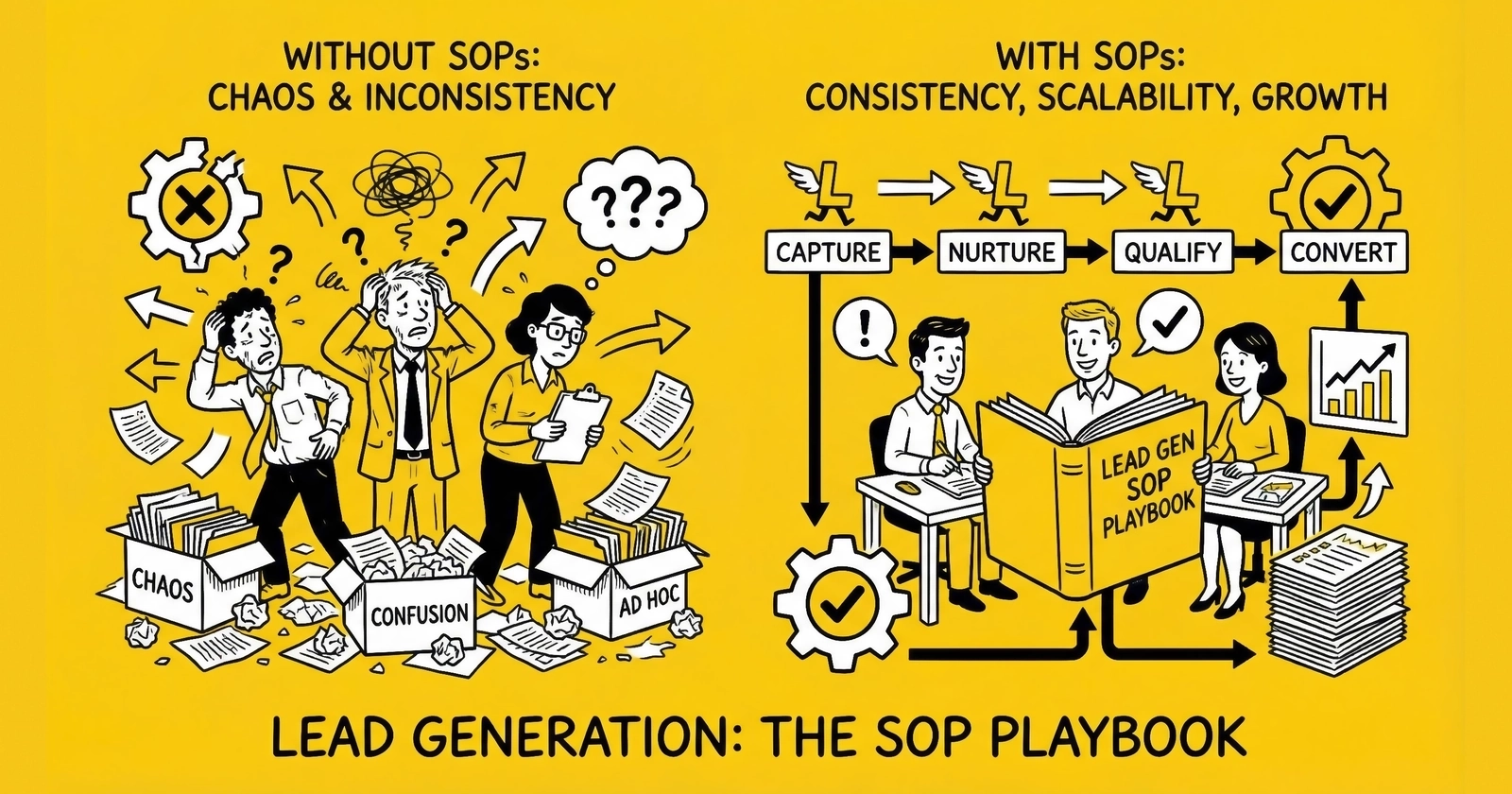
Build documented processes that let your lead generation business run without you in the room. Learn how to create SOPs that maintain quality, ensure compliance, and enable growth from 10,000 to 100,000 leads monthly.
The difference between a lead generation business that scales and one that stalls at the founder’s capacity is documentation. Specifically, Standard Operating Procedures (SOPs) that codify every repeatable process into written playbooks anyone can follow.
I have watched operators hit $50,000 monthly revenue and plateau for years because they could not transfer what lived in their heads to their teams. Everything required their involvement: approving new traffic sources, troubleshooting buyer rejections, handling compliance reviews. They had built jobs, not businesses.
Those who break through that ceiling share a common trait: they document obsessively. When a problem gets solved, it becomes a procedure. When a process works, it becomes a playbook. Their companies run on systems, not heroics.
This guide shows you exactly how to build those systems. You will learn which processes require SOPs first, how to structure them for actual use, and how to maintain living documentation that evolves with your operation. By the end, you will have a framework for building operational playbooks that let your business scale beyond your personal capacity.
Why SOPs Matter in Lead Generation
Lead generation operates at the intersection of marketing technology, sales operations, compliance regulation, and financial management. Each domain has dozens of repeatable processes. Without documentation, knowledge stays locked in individual heads. When that person is unavailable, the process stops.
Consider what happens without SOPs. A media buyer leaves and takes all knowledge of your winning campaigns, bid strategies, and optimization patterns. Your compliance manager is sick during a TCPA audit request, and no one knows where consent certificates are stored. A key buyer relationship manager quits, and you have no record of that buyer’s preferences, escalation contacts, or pricing history. Your lead developer goes on vacation and a critical API integration breaks with no documentation on how to fix it.
Each scenario represents real revenue loss. The first costs you months rebuilding institutional knowledge. The second costs potential legal exposure. The third costs buyer relationships. The fourth costs operational continuity. All of them are preventable through documentation.
The Scale Threshold
Most lead generation businesses hit operational friction between 5,000 and 15,000 leads monthly. Below that threshold, a small team can manage through memory and informal communication. Above it, complexity overwhelms individual capacity.
The math is straightforward. At 10,000 leads monthly with 10% requiring some form of manual intervention – quality review, buyer dispute, return processing, compliance verification – you have 1,000 tasks requiring human attention per month. Without documented processes, each task requires real-time problem-solving. With SOPs, most tasks become execution of known procedures. The difference is the difference between fighting fires and running a machine.
Compliance Non-Negotiables
Lead generation operates under intense regulatory scrutiny. TCPA violations carry $500-$1,500 per call statutory damages. A single lawsuit can generate seven-figure liability. Class actions average $6.6 million in settlements.
Compliance is not optional, and compliance cannot depend on memory. You need written procedures for consent capture and certificate storage, DNC (Do Not Call) list maintenance and scrubbing, state-specific calling time restrictions, consent revocation processing, and record retention spanning a minimum 4 years for TCPA (the federal statute of limitations), though 5+ years is recommended for additional protection.
When regulators or plaintiff attorneys request documentation of your compliance practices, “we have informal processes” is not an acceptable answer. Written SOPs demonstrate due diligence and systematic compliance investment. They show that violations, if they occur, happened despite your reasonable efforts rather than because of willful disregard.
The Core SOP Categories
Lead generation operations require documented procedures across seven functional domains. Each domain contains dozens of specific processes. Start with the highest-impact procedures in each category before building comprehensive documentation.
Traffic Acquisition SOPs
Traffic acquisition SOPs govern how you create leads from paid and organic sources. These procedures ensure consistent execution of proven strategies and prevent costly mistakes when launching new campaigns.
Your new campaign launch checklist should provide step-by-step procedures for launching campaigns on each platform, including naming conventions, tracking parameter setup, pixel verification, and initial bid settings. The creative testing protocol documents how to structure A/B tests, specifies minimum sample sizes before declaring winners (typically 100+ conversions per variant), and establishes creative rotation schedules. Bid adjustment procedures define when and how to adjust bids based on performance data, including daily, weekly, and monthly optimization cadences.
Beyond campaign execution, you need a platform policy compliance review – a pre-launch checklist for ad policy compliance on each platform that reduces account suspension risk. Traffic source onboarding procedures document how to evaluate and integrate new traffic sources, including initial test budgets, quality monitoring periods, and scale triggers.
Every traffic acquisition SOP should follow a consistent template structure. Include a purpose statement explaining what the procedure accomplishes, scope defining when it applies, prerequisites listing what must be in place before starting, numbered step-by-step procedure instructions, quality checks verifying correct completion, escalation guidance specifying when to escalate and to whom, links to related SOPs, and version history tracking updates.
Lead Quality Management SOPs
Quality management SOPs ensure consistent lead validation and prevent defective leads from reaching buyers. These procedures directly impact return rates, buyer satisfaction, and compliance exposure.
The real-time validation flow documents procedures for phone verification, email validation, address standardization, and duplicate detection before lead acceptance. Your manual quality review process specifies when leads require human review, what reviewers check, and disposition criteria. Source quality monitoring establishes daily and weekly review of quality metrics by traffic source, including return rate thresholds that trigger source review or suspension.
Fraud pattern documentation details how to identify, document, and respond to emerging fraud patterns including bots, click farms, and form spammers. Quality dispute investigation procedures outline how to investigate buyer quality complaints, including evidence gathering and resolution timeline.
The quality escalation matrix provides clear thresholds for action. Return rates under 5% warrant standard monitoring with weekly review. Rates between 5-10% require enhanced monitoring with daily review and pattern investigation. Rates between 10-15% trigger a source review meeting within 48 hours with an action plan required. Rates between 15-20% mean immediate source pause with remediation required to resume. Rates above 20% result in immediate source termination and documentation for the exclusion list.
Distribution and Routing SOPs
Distribution SOPs govern how leads flow from capture to buyers. These procedures ensure leads route correctly, buyers receive appropriate inventory, and exceptions are handled consistently.
Your buyer onboarding procedure should document the complete workflow for adding new buyers, including contract execution, filter configuration, API integration testing, and initial volume ramp. The buyer filter modification process specifies how to request, document, and implement changes to buyer targeting criteria. Cap management protocol covers monitoring buyer caps, pre-emptive notifications before caps are reached, and overflow routing.
Ping timeout handling documents what happens when buyers fail to respond within timeout windows, including retry logic and fallback routing. Unsold lead disposition specifies procedures for handling leads that exhaust all routing options, whether that means queueing for aged lead sales, issuing source credit, or logging for analysis.
A comprehensive buyer onboarding checklist ensures nothing falls through the cracks: contract fully executed with required terms, credit application completed and approved, payment terms documented (Net 15/30/45), API credentials generated and tested, geographic filters configured and verified, attribute filters configured and verified, daily/weekly/monthly caps set, pricing confirmed and loaded, test leads delivered and accepted, acceptance confirmation received, and buyer added to active rotation.
Compliance SOPs
Compliance SOPs protect your business from regulatory and litigation exposure. These are non-negotiable procedures that must be followed exactly, documented completely, and audited regularly.
Consent certificate processing documents how TrustedForm or Jornaya certificates are captured, validated, stored, and retrieved for compliance requests. DNC list maintenance covers downloading, updating, and applying federal and state DNC lists to lead scrubbing. Internal DNC processing specifies how to receive, document, and implement consumer opt-out requests within required timeframes – typically 24-48 hours.
Consent revocation handling provides step-by-step procedures for when consumers revoke consent, including cross-system suppression and confirmation. Compliance audit response documents procedures for responding to regulatory inquiries or litigation discovery requests, including who is authorized to respond and evidence gathering protocols. State calling time verification details how to verify and document that calls occur only within permitted hours for each state.
For each lead, your systems should capture and retain specific TCPA compliance evidence: the complete consent language displayed to the consumer, the consumer’s affirmative action (checkbox, click, signature), the timestamp of consent with timezone, the IP address at time of consent, the TrustedForm or Jornaya certificate URL, the certificate claim timestamp, the page URL where consent was captured, and the consumer’s provided phone numbers. The retention period is a minimum 5 years from the last contact attempt.
Financial Operations SOPs
Financial SOPs ensure accurate invoicing, timely collections, and proper accounting for lead transactions. These procedures become critical as transaction volume grows and cash flow complexity increases.
Invoice generation process documents when and how buyer invoices are generated, including lead reconciliation, pricing verification, and delivery confirmation. Payment collection procedure establishes follow-up cadence for outstanding invoices, escalation triggers, and collection actions by aging bucket. Publisher/source payment process specifies procedures for calculating, verifying, and executing payments to lead sources on agreed schedules.
Return and credit processing documents how to handle buyer returns, issue credits, and adjust source payments for returned leads. Revenue recognition guidelines define when revenue is recorded, how returns affect recognition, and month-end close procedures. Float management protocol covers monitoring working capital requirements, triggering alerts when float exceeds thresholds, and managing payment timing.
The collection escalation timeline should be clearly defined: days 1-7 trigger automated payment reminders, days 8-14 require personal follow-up calls or emails, days 15-21 escalate to the account manager, days 22-30 involve executive contact and payment plan discussion, days 31-45 result in a hold on new lead delivery, and day 45 and beyond initiates the collections process.
Technology and Integration SOPs
Technology SOPs ensure consistent system configuration, reliable integrations, and rapid incident response. These procedures prevent configuration drift and reduce resolution time when issues occur.
API integration testing protocol documents procedures for testing buyer and source integrations before going live, including test lead validation, error handling verification, and performance baseline establishment. Monitoring and alerting configuration specifies how monitoring thresholds are set, who receives alerts, and response expectations by severity.
The incident response playbook provides step-by-step procedures for responding to system outages, including communication protocols, escalation paths, and post-incident review requirements. Change management process documents how changes to production systems are requested, tested, approved, and deployed. Backup and recovery procedures specify what is backed up, how frequently, where backups are stored, and how to restore.
The incident severity matrix provides clear response expectations. Critical severity – where all lead processing has stopped – requires 15-minute response time; examples include platform down or database failure. High severity – significant degradation – requires 1-hour response; examples include major buyer integration failure or ping/post delays. Medium severity – partial impact – requires 4-hour response; examples include single source or buyer issues or reporting delays. Low severity – minor issues – allows 24-hour response for things like UI bugs or non-critical feature issues.
People and Training SOPs
People SOPs ensure consistent onboarding, training, and performance management. These procedures maintain operational quality as your team grows and enable new hires to become productive quickly.
The new hire onboarding checklist provides complete procedures for bringing new team members up to speed, including system access, training modules, and competency verification. Role-specific training paths document the curriculum for each operational role – media buyer, account manager, compliance analyst, and so forth.
Performance review process specifies how and when performance is evaluated, what metrics matter for each role, and feedback procedures. The escalation authority matrix documents who can make which decisions at what thresholds, ensuring appropriate approval without bottlenecks. Departure procedure provides a checklist for when team members leave, including knowledge transfer, access revocation, and documentation handover.
How to Structure Effective SOPs
A written SOP is worthless if no one uses it. Effective SOPs share structural elements that make them accessible, actionable, and maintainable.
The Anatomy of a Usable SOP
The header section establishes the basics: a clear and specific procedure name as the title, a unique SOP ID for reference, the current version number, the date of most recent revision, the owner responsible for maintaining the SOP, and the approver who authorized the procedure.
The purpose section provides one to two sentences explaining why this procedure exists and what problem it solves. This context helps users understand when the SOP applies. The scope section defines when this procedure applies and when it does not, preventing misapplication and identifying where other SOPs take over. Prerequisites document what must be true before starting, including required access, prior completed steps, and necessary information.
The procedure section contains numbered steps in sequence, with each step representing a single action. Complex steps that require judgment include decision trees or criteria tables. The verification section explains how to confirm the procedure was completed correctly, including quality checks, validation steps, and expected outcomes. Exception handling documents what to do when the standard procedure does not fit, including escalation triggers and alternative paths. Related documents provide links to connected SOPs, policies, and reference materials.
Writing for Actual Use
The test of an SOP is whether someone unfamiliar with the process can follow it successfully. Active voice and direct commands are essential. Write “Click the Submit button” not “The Submit button should be clicked.” Write “Verify the phone number is valid” not “Phone number validity should be verified.”
Keep to one action per step. Avoid compound instructions like “Log into the system, navigate to Reports, and export the daily summary.” Break this into three steps: “1. Log into the distribution platform. 2. Navigate to Reports > Daily Summary. 3. Click Export CSV.”
Include visual aids wherever they help: screenshots with annotations for system procedures, flowcharts for decision processes, tables for criteria and thresholds, and checklists for multi-step verifications. Specify exact locations rather than vague directions. Instead of “Go to the settings page and update the configuration,” write “Navigate to Settings > Integration > Buyer API Configuration.”
Define jargon and abbreviations on first use and maintain a glossary for technical terms specific to your operation. New team members should not need to guess what acronyms mean.
Document Storage and Access
SOPs only work if people can find them. Implement a documentation system with centralized location – all SOPs live in one place, whether that is a wiki (Confluence, Notion, Slite), a shared drive with clear folder structure, or dedicated documentation software (Guru, Trainual).
Organization should be consistent, structured by function (Traffic, Quality, Distribution, Compliance, Finance, Technology, People) with clear naming conventions. Search functionality is essential; users must be able to search across all documentation with title keywords and content indexing.
Version control tracks changes over time so you know who changed what and when, enabling rollback to previous versions if needed. Access control restricts sensitive information (compliance procedures, financial controls) to appropriate users while keeping operational SOPs broadly available.
Building SOPs That Actually Get Used
Writing SOPs is the easy part. Getting your team to actually use them is where most documentation initiatives fail.
The Documentation Adoption Problem
I have seen operations invest weeks in comprehensive documentation that gathers dust within months. The pattern is predictable: leadership mandates documentation, team members write SOPs to check the box, no one references them in daily work, procedures drift from documentation, and the gap between documented and actual process makes SOPs worthless.
Breaking this pattern requires integrating SOP usage into daily operations, not treating documentation as a separate project.
Integration Strategies
Embedding SOPs in tools is the most effective adoption strategy. Link directly from the systems where work happens. Your distribution platform should link to the buyer onboarding SOP from the “Add New Buyer” screen. Your ticketing system should link to the incident response playbook when creating a severity ticket.
Make SOPs the training curriculum. New hire training should consist primarily of working through relevant SOPs with supervision. This validates documentation accuracy while building procedural competence. When answering questions, reference SOPs rather than just providing answers. Link to the relevant SOP instead of explaining verbally. This trains the team to check documentation first and identifies gaps when SOPs do not exist.
Audit SOP compliance periodically to verify that actual procedures match documentation. When discrepancies emerge, determine whether the documentation or the practice needs updating. Usually, the practice has evolved for good reasons, and documentation needs to catch up.
Maintenance Discipline
SOPs decay without active maintenance. Processes change, systems update, regulations evolve. Documentation that was accurate six months ago may now be wrong.
Assign ownership so every SOP has a designated owner responsible for accuracy. Ownership is a named individual, not a team or role. Schedule reviews with appropriate frequency: critical SOPs (compliance, incident response) review quarterly, operational SOPs review semi-annually, and all SOPs review annually at minimum.
Major changes trigger immediate SOP review. When a system updates, relevant SOPs update. When a process changes, documentation changes simultaneously. Create a channel for users to report documentation issues and make it easy to flag outdated, unclear, or missing procedures. Respond to feedback visibly to encourage ongoing participation.
Essential SOPs for Each Growth Stage
Your SOP priorities shift as you scale. A 1,000-lead-per-month operation needs different documentation than a 100,000-lead-per-month enterprise.
Early Stage: 1,000-10,000 Leads Monthly
At this stage, you are likely running with a small team or solo. Documentation serves two purposes: codifying what works so you can repeat it, and preparing for your first hires.
Priority SOPs include traffic source onboarding – how you evaluate and integrate new traffic sources, documented while it is fresh. The lead quality checklist captures your criteria for lead acceptance and becomes the foundation for automated validation rules. Buyer setup process documents how you add new buyers, including contract terms, integration requirements, and pricing logic. The daily operations checklist captures the sequence of tasks you perform each day and becomes your first employee’s training curriculum. Compliance basics cover consent capture requirements, DNC scrubbing process, and record retention locations.
At this stage, SOPs can be simple checklists in a shared document. Perfection is not the goal; documentation existence is.
Growth Stage: 10,000-50,000 Leads Monthly
You have hired your first operational team members. SOPs become essential for consistent execution across multiple people and shifts.
Priority SOPs expand significantly. Complete traffic acquisition playbooks document campaign launch, optimization, scaling, and shutdown procedures for each platform you use. The full quality management system covers real-time validation procedures, manual review protocols, source quality monitoring, and dispute resolution. Buyer relationship SOPs document onboarding, filter management, performance review, escalation procedures, and renewal processes. The incident response playbook specifies how to respond to system issues, including severity classification, communication protocols, and post-incident review. Financial close procedures cover monthly reconciliation, invoice generation, collection follow-up, and source payment processing.
At this stage, invest in proper documentation infrastructure. Move from shared documents to a wiki or documentation platform with search, version control, and access management.
Scale Stage: 50,000-200,000 Leads Monthly
You have multiple teams, possibly multiple offices or remote workers. SOPs must enable consistent operations across organizational complexity.
Priority SOPs become comprehensive. A compliance manual documents every compliance-related procedure, indexed and regularly audited – this is your litigation defense and regulatory evidence. The technology operations runbook provides complete procedures for every system, integration, and infrastructure component so anyone with appropriate access can maintain operations. Cross-functional workflows document procedures spanning multiple teams (such as new buyer onboarding involving sales, operations, technology, and finance) with clear handoff points and responsibilities. Exception processing protocols document how to handle the long tail of unusual situations that arise at scale, including decision trees, escalation paths, and authority matrices. Vendor management SOPs cover procedures for managing third-party relationships with performance review and issue escalation.
At this stage, consider dedicated documentation roles. Someone owns documentation quality, manages review schedules, and drives adoption.
Enterprise Stage: 200,000+ Leads Monthly
At enterprise scale, SOPs become a competitive advantage. Your ability to maintain consistent quality across massive volume differentiates you from smaller competitors.
Priority SOPs reach full maturity. The process optimization framework documents how to identify, test, and implement process improvements systematically – continuous improvement becomes procedural. Audit and compliance management covers procedures for internal audits, external audit preparation, and regulatory examination response. Business continuity plans provide comprehensive procedures for maintaining operations during disasters, including failover processes, communication plans, and recovery procedures. M&A integration playbooks document procedures for integrating acquired operations into your platform when acquisition is part of growth strategy. The knowledge management system provides meta-procedures for how documentation is created, maintained, and retired across the organization.
Measuring SOP Effectiveness
You invest significant effort in documentation. Measure whether that investment delivers returns.
Operational Metrics
Time to competency measures how long new hires take to reach full productivity. With effective SOPs, this timeframe should decrease as documentation quality improves. Error rates by process track mistakes in documented procedures. Decreasing error rates indicate effective documentation; persistent errors indicate documentation gaps or training issues.
Escalation frequency tracks how often frontline team members escalate issues that should be resolvable via documented procedures. High escalation rates suggest unclear or incomplete SOPs. Procedure completion time measures how long documented procedures take to execute. Consistent completion times indicate well-structured SOPs; high variance indicates unclear steps or missing decision criteria.
Documentation Health Metrics
SOP coverage measures what percentage of repeatable processes have documented SOPs. Track by function and prioritize gaps in critical areas. Documentation currency measures what percentage of SOPs are current – reviewed within their scheduled timeframe. Stale documentation undermines trust in the entire system.
Feedback volume tracks documentation improvement suggestions received. High volume can indicate engaged users and imperfect documentation; zero volume can indicate documentation nobody uses. Search success rate tracks whether users find what they need when searching. Monitor search queries that return no results to identify documentation gaps.
Real-World SOP Examples
Abstract principles become concrete through examples. Here are simplified versions of SOPs from actual lead generation operations.
Example: New Buyer Onboarding SOP
Purpose: Ensure consistent, complete onboarding of new lead buyers from contract signature through first successful lead delivery.
Scope: Applies to all new buyer relationships. Does not apply to reactivation of previously terminated buyers (see SOP-BUYER-005: Buyer Reactivation).
Owner: Director of Buyer Relationships
Prerequisites:
- Signed Master Services Agreement
- Completed credit application
- Designated buyer technical contact
- Pricing schedule approved by Director or above
Procedure:
-
Create buyer record in distribution platform
- Navigate to Admin > Buyers > Add New
- Enter legal entity name, DBA, and billing address
- Assign unique buyer code following format: [STATE]-[VERTICAL]-[SEQUENTIAL]
-
Configure payment terms
- Select payment terms per contract (Net 15/30/45)
- Set credit limit per credit approval
- Configure invoice frequency (weekly/bi-weekly/monthly)
-
Generate API credentials
- Navigate to buyer record > Integrations
- Generate API key and secret
- Send credentials to technical contact via secure channel
-
Configure geographic filters
- Input licensed states/territories per contract
- Configure zip code exclusions if applicable
- Verify filter logic with buyer before going live
-
Configure attribute filters
- Input lead type requirements per contract
- Configure credit tier, loan amount, or vertical-specific filters
- Document any non-standard filter logic
-
Set volume caps
- Configure daily, weekly, and monthly caps per contract
- Set cap notification threshold at 80%
- Configure overflow routing if applicable
-
Configure pricing
- Input base pricing per lead type
- Configure any geographic or attribute modifiers
- Verify total pricing matches contract
-
Execute integration test
- Send minimum 5 test leads across different filter scenarios
- Verify successful delivery via buyer confirmation
- Document any integration issues and resolution
-
Activate buyer
- Set buyer status to Active
- Add to appropriate routing tier
- Document go-live date and initial cap settings
-
Complete onboarding notification
- Send onboarding confirmation to buyer
- Notify account manager of activation
- Schedule 7-day performance review
Quality Checks:
- All configuration matches signed contract
- Test leads successfully delivered and acknowledged
- Buyer confirms integration is working
- Internal stakeholders notified
Escalation:
- Integration issues unresolved after 3 business days: escalate to VP Operations
- Credit or contract disputes: escalate to Finance Director
- Pricing or terms questions: escalate to Sales Director
Version History:
- v3.1 (2024-06-15): Added cap notification threshold step
- v3.0 (2024-01-10): Restructured for new platform interface
- v2.4 (2023-08-22): Added secure credential transmission requirement
Example: TCPA Consent Revocation SOP
Purpose: Ensure all consent revocations are processed within regulatory timeframes and propagated across all systems to prevent unauthorized contact.
Scope: Applies to all channels through which consumers may revoke consent (phone, email, web form, text message, verbal during call).
Owner: Compliance Manager
Prerequisites:
- Access to suppression management system
- Access to all active calling/messaging platforms
- Understanding of consent revocation requirements
Procedure:
-
Receive revocation request
- Document timestamp of request receipt
- Document channel through which request received
- Document exact consumer identifier (phone, email)
- Document exact language of request
-
Verify consumer identity
- Confirm phone number or email matches records
- If ambiguous, add all potentially matching records to suppression
-
Add to internal suppression list
- Navigate to Compliance > Suppression List
- Add all consumer phone numbers to suppression
- Add all consumer email addresses to suppression
- Set suppression reason: “Consumer Revocation”
- Set suppression date: timestamp of request
-
Propagate to calling platforms
- Export suppression to each active dialer
- Verify import confirmation from each platform
- Document propagation completion time
-
Propagate to messaging platforms
- Add to SMS suppression in each messaging platform
- Add to email suppression in each email platform
- Document propagation completion time
-
Notify upstream sources
- If lead originated from third-party source, send suppression notification
- Document notification sent date
-
Generate consumer confirmation
- Send written confirmation to consumer via original channel
- Template: “We have received your request and removed you from our contact list. Please allow 24-48 hours for full processing.”
-
Log completion
- Record completion timestamp
- Calculate elapsed time (must be under 24 hours for phone, may vary by channel)
- Flag any processing that exceeded threshold
Quality Checks:
- Consumer phone/email returns no results in calling/messaging platforms
- Suppression record exists with correct date and reason
- Consumer confirmation was sent
- Processing completed within required timeframe
Escalation:
- Processing exceeds 24-hour threshold: immediate escalation to Compliance Director
- Unable to propagate to all platforms: escalate to Technology Director
- Pattern of delayed processing: escalate for process review
Frequently Asked Questions
What is an SOP in lead generation?
A Standard Operating Procedure in lead generation is a documented step-by-step process for completing a specific operational task. SOPs cover everything from launching advertising campaigns and onboarding new buyers to processing compliance requests and handling billing disputes. They ensure consistent execution regardless of who performs the task, enable training of new team members, and provide evidence of systematic processes for compliance purposes. Effective SOPs transform individual knowledge into organizational capability, allowing businesses to scale beyond founder capacity.
How many SOPs does a lead generation business need?
The number depends on operational scale and complexity. Early-stage operations under 10,000 leads monthly need 10-15 core SOPs covering traffic acquisition basics, quality management, buyer onboarding, daily operations, and compliance essentials. Growth-stage operations between 10,000 and 50,000 leads typically maintain 40-60 SOPs across all operational functions. Enterprise operations above 200,000 leads may have 150-300 documented procedures including detailed exception handling, cross-functional workflows, and specialized processes. Start with the highest-impact procedures and expand documentation as the operation grows.
Who should write SOPs for a lead generation company?
The person who performs the process should write the first draft. They have the detailed knowledge of actual steps, common issues, and necessary context. A documentation owner or manager should then review for clarity, consistency, and completeness. Critical SOPs – especially compliance procedures – should receive review from legal counsel. For smaller operations, founders often write initial SOPs as they establish processes, then hand ownership to team members as roles specialize.
How often should lead generation SOPs be updated?
Critical SOPs covering compliance, incident response, and financial controls require quarterly review to ensure accuracy with current regulations and systems. Operational SOPs benefit from semi-annual review. All SOPs should be reviewed at least annually. Beyond scheduled reviews, SOPs must update immediately when underlying processes, systems, or regulations change. Assign clear ownership so updates have accountability, and track last-reviewed dates to flag SOPs exceeding their review schedule.
What is the difference between SOPs and policies?
Policies define what must happen and why – rules, requirements, and standards. SOPs define how things happen – specific steps, procedures, and instructions. A policy might state “All leads must have valid TrustedForm consent certificates before sale.” The corresponding SOP documents exactly how to verify certificate validity, what to do when verification fails, and how to document the verification. Policies set the standard; SOPs enable meeting that standard.
How do SOPs help with TCPA compliance?
SOPs are essential TCPA compliance evidence. Documented procedures for consent capture, DNC list management, consent revocation processing, and record retention demonstrate systematic compliance investment. When facing regulatory inquiry or litigation, written SOPs show you had processes designed to prevent violations. More practically, SOPs ensure your team follows compliant procedures consistently, reducing violation risk. Courts and regulators distinguish between operators with documented compliance programs and those winging it.
What tools should I use to manage lead generation SOPs?
For early-stage operations, shared Google Docs or Notion pages with clear organization are sufficient. As you scale, consider dedicated documentation platforms. Confluence offers robust version control and search for teams already using Atlassian products. Notion provides flexible documentation with database capabilities. Guru integrates documentation into browser workflows. Trainual focuses on training curriculum organization. The best tool is the one your team actually uses. Prioritize searchability, version control, and access management over feature depth.
How do I get my team to actually use SOPs?
Integration is key. Link SOPs from the tools where work happens rather than expecting users to search. Make SOPs the foundation of training so new hires learn processes via documentation. Reference SOPs when answering questions rather than providing verbal answers. Audit whether actual practices match documentation and address gaps. Make documentation feedback easy and respond visibly. The goal is embedding documentation into daily workflow rather than treating it as a separate system to consult.
What are the most critical SOPs for a new lead generation business?
For a new operation, prioritize five areas. First, traffic source evaluation and launch procedures so you can repeat what works. Second, lead quality acceptance criteria so you know what to sell. Third, buyer setup and integration so you can onboard buyers consistently. Fourth, compliance basics including consent capture, DNC scrubbing, and record retention to avoid legal exposure. Fifth, a daily operations checklist covering everything that happens each day. These five areas cover the core revenue cycle and protect against major risks. Expand from this foundation as you identify additional repeatable processes.
How do SOPs enable scaling a lead generation business?
SOPs transform personal capacity into organizational capacity. Without documentation, scaling requires finding people who already know your processes (rare) or having founders personally train every new hire and supervise every decision (bottleneck). With SOPs, new team members can learn processes independently. Decisions have documented criteria rather than requiring founder judgment. Quality remains consistent as volume grows because everyone follows the same procedures. Operations can run across shifts, locations, and time zones. The business operates on systems rather than heroics, breaking the founder capacity ceiling.
Key Takeaways
-
SOPs are the difference between a job and a business. Operations that scale run on documented systems. Without SOPs, growth stalls at the founder’s personal capacity. Every repeatable process should exist in writing.
-
Start with high-impact procedures, not comprehensive documentation. You need SOPs for traffic acquisition, quality management, distribution, compliance, financial operations, technology, and people. But start with the 10-15 most critical procedures and expand from there.
-
Effective SOPs are usable, not just written. Structure documentation for actual use: clear purpose, specific steps, quality checks, and escalation paths. One action per step. Active voice. Visual aids. Exact locations.
-
Compliance SOPs are non-negotiable. TCPA violations carry $500-$1,500 per call. Class actions average $6.6 million. Written compliance procedures demonstrate due diligence and enable systematic regulatory adherence.
-
SOPs only work if people use them. Embed documentation in tools. Make SOPs the training curriculum. Reference procedures when answering questions. Audit compliance with documented processes.
-
Maintenance is continuous. Assign ownership. Schedule reviews. Trigger updates when processes change. Track feedback. Stale documentation undermines trust in the entire system.
-
SOP priorities shift with scale. Early stage needs basic documentation to enable first hires. Growth stage needs comprehensive operational procedures. Enterprise stage needs process optimization frameworks and business continuity plans.
-
Measure documentation effectiveness. Track time to competency, error rates, escalation frequency, and documentation health metrics. Improve what you measure.
This article is adapted from “The Lead Economy” by industry professionals with over 15 years of operational experience across lead generation business models. The operational frameworks and SOP templates presented here are based on practices used by successful lead generation companies processing 10,000 to 500,000+ leads monthly.