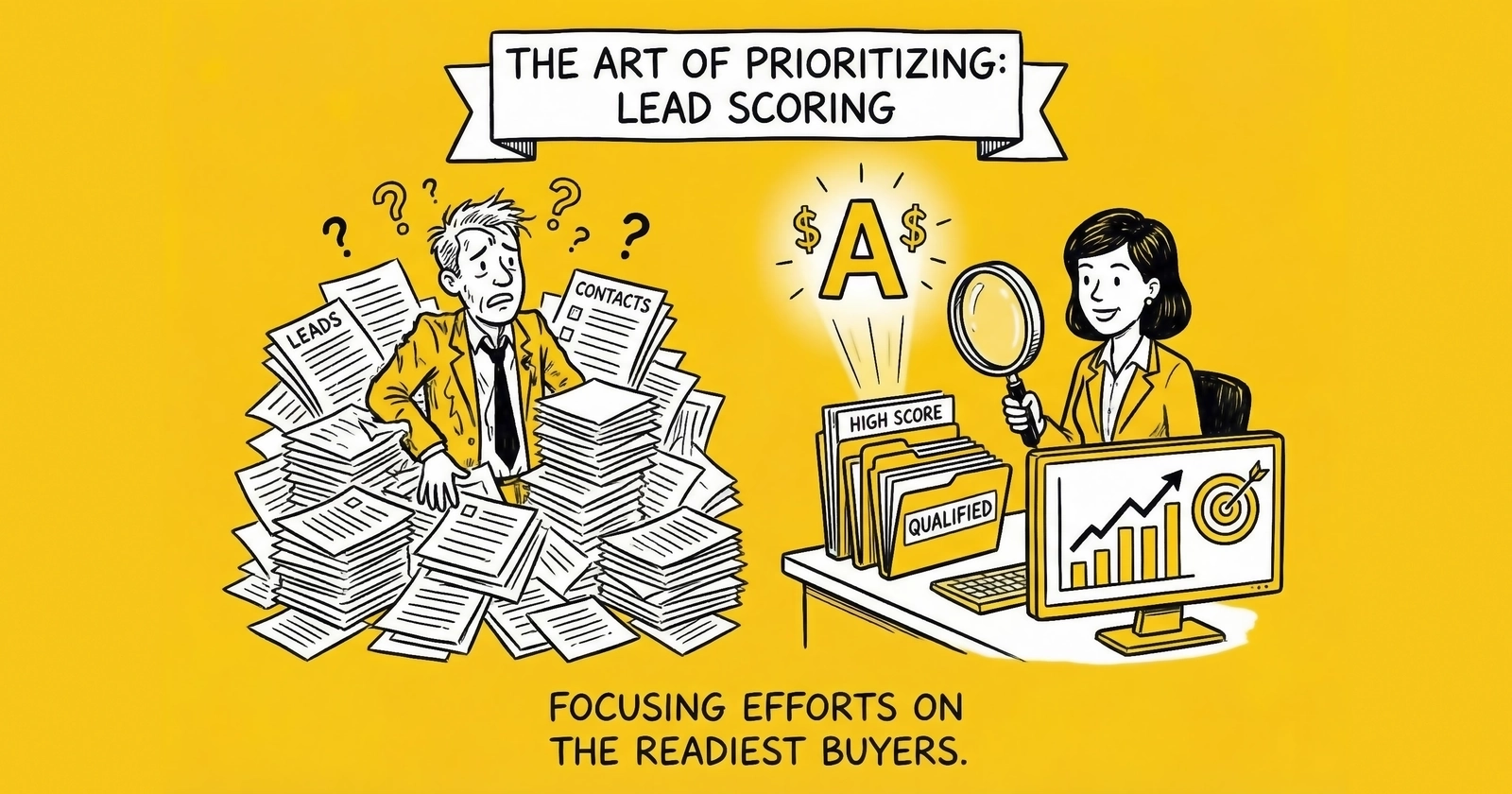
A comprehensive guide to building and implementing lead scoring systems that identify high-value opportunities, optimize sales resources, and maximize conversion rates.
You purchase 500 leads this month at $45 each. Your sales team works them all with equal intensity, investing the same number of calls, the same follow-up sequences, the same attention. At month’s end, you converted 30 customers at a cost per acquisition of $750.
What if 80% of those conversions came from just 25% of your leads? What if your sales team spent the same effort on the 375 leads that never had a realistic chance of converting as they did on the 125 that represented genuine opportunities?
This is not a hypothetical scenario. It is the operational reality for lead buyers who lack systematic scoring and prioritization. They treat all leads as equal when the data proves they are anything but equal. The result: wasted sales capacity, frustrated teams, and acquisition costs that could be cut by half or more.
Lead scoring transforms this reality. It replaces intuition with prediction, equal treatment with strategic prioritization, and hope with data-driven resource allocation. Companies using AI-powered lead scoring see conversion rate increases averaging 25%, with some reporting improvements of 45% or higher. Sales cycles shorten by approximately 28% when teams focus on high-quality leads rather than working through undifferentiated queues.
Yet only about 44% of companies use lead scoring systems to qualify their leads in 2025. The majority continue treating all leads the same, wasting time on low-potential contacts while high-intent prospects go cold waiting for attention.
This article provides the complete framework for implementing lead scoring as a buyer. You will learn the foundational concepts, the specific metrics that predict conversion, implementation approaches from simple to sophisticated, and the operational changes required to translate scores into results.
What Lead Scoring Actually Means for Buyers
Lead scoring assigns numerical values to leads based on their predicted likelihood to convert. A lead with a score of 85 represents significantly higher conversion probability than a lead scoring 40. The score synthesizes multiple data points into a single actionable signal: prioritize this lead, or deprioritize it.
For lead buyers specifically, scoring serves three interconnected purposes.
First, scoring enables resource optimization. Your sales team has finite capacity. Every minute spent on a lead that will never convert is a minute not spent on one that might. Scoring identifies which leads deserve immediate attention and which can wait or receive lighter-touch engagement.
Second, scoring justifies pricing decisions. If you can demonstrate that leads from Source A convert at 3x the rate of leads from Source B, you have evidence to pay premium prices for Source A while negotiating discounts on Source B. Scoring provides the data that transforms vendor negotiations from opinion battles into fact-based discussions.
Third, scoring reveals systematic patterns. Why do leads from certain traffic sources convert better? Why do leads arriving at certain times outperform others? Scoring models surface these patterns, enabling you to request specific lead attributes and filter out characteristics that predict failure.
The conceptual distinction matters: validation confirms a lead is real, while scoring predicts whether it will convert. A validated lead has accurate contact information, proper consent documentation, and meets your basic filter criteria. But validation alone does not predict whether the consumer will answer the phone, engage in conversation, or ultimately purchase. Scoring layers conversion probability on top of validation.
The Core Metrics That Predict Conversion
Effective lead scoring requires understanding which data points actually correlate with conversion. Not all information is equally predictive. Some attributes have strong statistical relationships with outcomes; others are noise.
Behavioral Indicators
Behavioral data captures what the consumer did before and during the lead submission process. These signals often outweigh demographic data in predictive power because they reflect actual intent rather than assumed characteristics.
Form completion patterns reveal engagement level. A consumer who takes three minutes to carefully complete a ten-field form demonstrates more commitment than one who rushes through in 45 seconds. Field-by-field completion time, corrections made, and return visits to earlier fields all signal engagement intensity.
Source intent signals differentiate traffic quality. A lead from a search query like “best auto insurance rates near me compare quotes” carries higher intent than one from a display ad impression. Search traffic typically outperforms social traffic for conversion because search reflects active information-seeking behavior.
Time of submission correlates with conversion in most verticals. Leads submitted during business hours often convert better than those submitted at 2 AM, though this varies by vertical and consumer demographic. Morning leads may catch consumers during active research windows; late-night leads may indicate impulse behavior less likely to convert.
Device and session characteristics provide context. Mobile submissions from short sessions may indicate casual browsing. Desktop submissions following multi-page site engagement suggest more deliberate research. Neither is definitively better, but the patterns differ by vertical and should be tested.
Pre-submission page engagement measures interest depth. Did the consumer read your content pages before submitting? Did they review pricing information or comparison tools? Engagement with substantive content before submission predicts higher conversion than leads who landed directly on a form and submitted immediately.
Demographic and Firmographic Data
For consumer verticals, demographic data provides qualification signals. For B2B operations, firmographic data performs the same function.
Geographic indicators affect conversion for multiple reasons. Local leads may convert better for service businesses because of proximity. Certain states or regions may have regulatory environments that affect product availability. Property values and income levels vary geographically and correlate with product fit.
Credit tier signals matter enormously in financial services. A mortgage lead with a stated credit score of 740+ converts at dramatically different rates than one at 620. Insurance leads with clean driving histories outperform those with violations. These qualification factors directly predict underwriting success and product eligibility.
Property and asset data indicates product fit. For solar leads, property ownership and roof characteristics predict installation feasibility. For home improvement, home value and age suggest project probability. For mortgage refinance, current loan-to-value ratio determines eligibility.
Company size and industry drive B2B scoring. A lead from a 500-employee technology company in growth mode represents different opportunity than one from a 10-person professional services firm. Revenue, employee count, technology stack, and funding status all correlate with conversion probability and deal size.
Historical Pattern Data
The most powerful scoring inputs come from your own historical conversion data. What actually happened with previous leads sharing similar characteristics?
Source performance history predicts future performance. If leads from Vendor X have converted at 8% over the past quarter while leads from Vendor Y converted at 3%, new leads from these sources carry those historical expectations. Source-level scoring adjustments reflect demonstrated reality rather than promised performance.
Attribute combination analysis reveals non-obvious patterns. Perhaps leads from a specific state, arriving from search traffic, with stated income above a threshold, convert at 3x your average. No single attribute explains this; the combination creates predictive power. Machine learning models excel at discovering these multi-variable patterns.
Seasonal and timing effects impact scoring accuracy. Mortgage leads perform differently when rates are rising versus falling. Insurance leads spike around renewal periods. Solar leads follow seasonal installation patterns. Scoring models that incorporate timing context outperform static models.
Day-of-week and hour-of-day patterns deserve separate treatment. Leads arriving when your sales team is fully staffed and engaged may convert better than those arriving during off-hours, even if lead quality is identical, because speed-to-contact affects outcomes. Some operators adjust scores based on delivery timing relative to their operational capacity.
Rules-Based Scoring: The Starting Point
If you have never implemented lead scoring, start with rules-based approaches. They require less data, less technical capability, and provide immediate value while building the foundation for more sophisticated methods.
Building a Basic Scoring Model
Rules-based scoring assigns point values to lead characteristics based on assumed or observed importance. The process is straightforward:
Identify the attributes available in your leads. Review your typical lead record: geographic data, demographic fields, qualification answers, source identifiers, consent timestamps. List every field you receive.
Assign point values based on importance. If leads from California historically convert at 150% of your average, assign +15 points for California leads. If leads with credit scores below 620 convert at 50% of average, assign -25 points.
Weight categories appropriately. If source quality matters more than geography, ensure source-related points have larger magnitude than geographic adjustments. The relative weighting reflects your understanding of what drives conversion.
Set threshold tiers. Leads scoring above 80 are A-tier priority. Leads from 60-79 are B-tier. Leads below 60 are C-tier. These tiers drive routing and prioritization decisions.
A simple example for an insurance buyer:
| Attribute | Value | Points |
|---|---|---|
| Source quality | Premium sources | +20 |
| Source quality | Standard sources | +0 |
| Source quality | Budget sources | -15 |
| Credit tier | Excellent (750+) | +15 |
| Credit tier | Good (700-749) | +10 |
| Credit tier | Fair (650-699) | +0 |
| Credit tier | Poor (below 650) | -10 |
| Currently insured | Yes | +10 |
| Currently insured | No | -5 |
| Renewal timing | Within 30 days | +15 |
| Renewal timing | 30-60 days | +5 |
| Renewal timing | Over 60 days | +0 |
| Bundle interest | Multi-policy | +10 |
| Bundle interest | Single policy | +0 |
A lead from a premium source, with excellent credit, currently insured, renewing in 25 days, interested in bundling, would score: 20 + 15 + 10 + 15 + 10 = 70 points. That is an A-tier lead deserving immediate attention.
Limitations of Rules-Based Approaches
Rules-based scoring works but has inherent constraints.
Point assignments are subjective estimates. You may believe California leads deserve +15 points, but the actual conversion difference might justify +8 or +22. Without rigorous testing, point values represent guesses rather than empirical measurements.
Simple rules miss interactions. What if California leads from premium sources convert exceptionally well, but California leads from budget sources convert poorly? Single-variable rules cannot capture this interaction; the California adjustment would be wrong for one segment or the other.
Static models degrade over time. Market conditions change. Consumer behavior shifts. Source quality evolves. A scoring model calibrated in January may misallocate resources by June if not updated.
Manual maintenance is required. Every adjustment requires human analysis and decision. As you add more attributes and refine point values, complexity compounds until the model becomes difficult to maintain consistently.
Despite these limitations, rules-based scoring dramatically outperforms no scoring. Start here, learn from results, and evolve toward predictive approaches as data and capability permit.
Predictive Lead Scoring: Machine Learning Applications
Predictive lead scoring replaces human-assigned point values with statistically derived weights. Instead of guessing that California deserves +15 points, the model analyzes thousands of historical leads and calculates the precise contribution of each attribute to conversion probability.
How Predictive Scoring Works
The process begins with historical data. You need leads with known outcomes: which converted, which did not, and ideally, how valuable those conversions were. The more leads in your training dataset, the more reliable the model.
Feature engineering transforms raw data into model inputs. This includes the lead attributes themselves, derived calculations (like time between form start and submit), and contextual additions (like day of week or source-level historical performance). Feature engineering often determines model quality as much as algorithm selection.
Model training applies machine learning algorithms to identify patterns. Common approaches include:
Logistic regression provides interpretable coefficients showing each variable’s contribution. It is straightforward to implement and explain but may miss complex interactions.
Random forests combine many decision trees to capture non-linear relationships and variable interactions. They handle diverse data types well and resist overfitting.
Gradient boosting (XGBoost, LightGBM) often achieves highest predictive accuracy through iterative error correction. These models require more tuning but excel at finding subtle patterns.
Neural networks can model extremely complex relationships but require substantial data and are difficult to interpret. They are overkill for most lead scoring applications.
The trained model produces conversion probability estimates for new leads. A lead might receive a 0.12 probability (12% expected conversion rate), which translates to whatever scoring scale you prefer: a 1-100 score, letter grades, or tier classifications.
Continuous learning keeps the model current. As new leads convert or fail to convert, that data feeds back into model retraining. The model adapts to market changes automatically rather than requiring manual adjustment.
The Performance Advantage
The evidence for predictive scoring is substantial. Research indicates:
Companies using AI-powered lead scoring see 25% average conversion rate increases. Some organizations report even higher improvements, with claims of up to 3x increases in reply rates and 45% conversion improvements.
Sales cycles shorten by approximately 28% when teams focus on high-quality leads. The time savings come from reduced effort on low-probability opportunities and faster progression with high-probability ones.
Approximately 75% of businesses using AI-powered lead qualification report significant improvement in sales conversion rates.
Machine learning models improve conversion rates by up to 85% through multi-dimensional analysis across hundreds of variables, according to some implementations.
The gap between predictive and rules-based approaches widens as data volume and complexity increase. With ten attributes and a thousand leads, rules-based may perform reasonably. With fifty attributes and ten thousand leads, predictive approaches capture patterns no human would identify.
Implementation Requirements
Predictive scoring demands more infrastructure than rules-based approaches:
Data volume: You need sufficient historical leads with outcome data. Minimum viable training sets typically require 1,000-2,000 leads with conversion tracking, though more data produces more reliable models.
Data quality: Garbage in, garbage out. If your historical data contains errors, inconsistent attribute capture, or missing outcomes, the model will learn those patterns. Data cleaning is often the most time-consuming implementation step.
Technical capability: Building and maintaining predictive models requires data science skills. Options include hiring data scientists, contracting with specialized vendors, or using platform-based scoring tools that embed these capabilities.
Integration infrastructure: Real-time scoring requires models deployed into your lead processing pipeline. The model must score incoming leads in milliseconds, not minutes, to enable immediate prioritization.
Monitoring systems: Models degrade over time as patterns shift. You need ongoing performance monitoring to detect when retraining is needed and to validate that model predictions match actual outcomes.
Intent Data: The Premium Enhancement
Intent data represents the frontier of lead scoring enhancement. While behavioral and demographic signals indicate who the lead is and what they did, intent data reveals what they want before they even submitted a form.
Understanding Intent Signals
Intent data platforms track online behavior across thousands of websites, identifying patterns that indicate purchase interest. These signals include:
Content consumption patterns: Is the lead researching your product category across multiple sites? Reading comparison articles, vendor reviews, or how-to guides?
Competitor research: Are they visiting competitor websites, pricing pages, or product documentation? Active competitor evaluation suggests imminent purchase decision.
Technology research: Are they searching for solutions to problems your product solves? Reading about implementation approaches or best practices?
Hiring and growth signals: Are they hiring roles that would use your product? Receiving funding that enables new purchases? Expanding into markets where your solution applies?
Review site engagement: Are they reading customer reviews, case studies, or testimonials? This behavior indicates active evaluation rather than casual browsing.
The Intent Data Advantage
The statistics on intent data effectiveness are compelling:
93% of B2B marketers using intent data report increased conversion rates. The signal quality from intent data directly improves targeting and prioritization.
65% say intent signals have improved pipeline forecasting accuracy. Knowing which accounts are actively researching enables more accurate sales projections.
91% use intent scoring in account-based marketing to prioritize accounts. Intent data identifies which accounts deserve immediate attention versus which can wait.
95% of respondents link intent data to positive sales outcomes, according to industry surveys.
Yet only about 25% of B2B businesses currently leverage intent data and monitoring tools. Large corporations have adopted it widely (99% of large enterprises use intent data in some form), but mid-market and smaller buyers remain largely underserved.
This adoption gap creates temporary competitive advantage. Buyers who incorporate intent data into their scoring models can identify high-probability opportunities that competitors miss. The window for this advantage narrows as awareness spreads.
Intent Data Application
For lead buyers, intent data works best when layered onto incoming leads rather than used as a standalone acquisition method. The workflow:
Receive leads through normal channels with standard attributes.
Enrich those leads with intent data from platforms like Bombora, G2, TrustRadius, or ZoomInfo. The enrichment identifies whether the lead’s company has shown research activity related to your products.
Adjust scores based on intent signals. A lead from a company actively researching your category receives a significant score boost. A lead from a company showing no research activity receives no adjustment or a slight decrease.
Prioritize accordingly. Leads combining strong traditional attributes with high intent signals become absolute priorities. Leads with weak attributes but high intent may deserve elevated attention. Leads with low intent may be deprioritized regardless of other characteristics.
The intent data premium is real: intent-enriched leads command higher prices from vendors because they demonstrably perform better. As a buyer, either pay for intent-enhanced leads or invest in your own intent data enrichment capability.
Source-Level Scoring: Evaluating Your Vendors
Lead scoring applies not only to individual leads but to lead sources themselves. Systematic source-level scoring enables informed purchasing decisions and vendor negotiations.
Tracking Source Performance
Every lead source should be evaluated on core performance metrics:
Contact rate: What percentage of leads from this source do you successfully reach? Low contact rates indicate data quality problems, stale leads, or leads captured from low-intent traffic.
Conversion rate: Of contacted leads, what percentage convert to customers? This is the ultimate quality measure.
Return rate: What percentage of leads do you return to the vendor for refund? High return rates signal systematic quality problems.
Time to close: How quickly do leads from this source convert? Faster closes indicate higher intent and better qualification.
Average deal value: Do leads from this source produce smaller or larger transactions? Two sources might have identical conversion rates but very different revenue per customer.
Calculate each metric by source, then compare across your vendor portfolio. The source scoring matrix might look like:
| Source | Contact Rate | Conversion Rate | Return Rate | Avg Deal Value | Score |
|---|---|---|---|---|---|
| Vendor A | 72% | 8.5% | 4% | $1,850 | 85 |
| Vendor B | 58% | 6.2% | 11% | $2,100 | 62 |
| Vendor C | 81% | 9.1% | 3% | $1,650 | 89 |
| Vendor D | 44% | 3.8% | 18% | $1,400 | 35 |
This data immediately reveals that Vendor D represents poor value regardless of lead price. Vendor C delivers exceptional performance. Vendor B has upside (high deal values) but quality issues (high returns) worth addressing.
Using Source Scores Strategically
Source-level scoring informs multiple decisions:
Volume allocation: Shift purchasing toward high-scoring sources. If Vendor C consistently outperforms, increase their volume allocation. Reduce or eliminate volume from Vendor D.
Pricing negotiations: Source scores justify pricing conversations. Tell Vendor B: “Your returns are running 11%, nearly triple Vendor C. Either reduce pricing by 15% or demonstrate quality improvement within 30 days.”
Filter refinement: If certain segments within a source perform well while others perform poorly, negotiate adjusted filters. Perhaps Vendor A’s California leads convert at 12% while their Texas leads convert at 4%. Request geographic targeting.
Exit criteria: Define thresholds below which you terminate a source. If conversion rate falls below 4% for two consecutive months, the source is terminated. Apply criteria consistently to maintain quality standards.
Test allocation: Reserve 10-15% of volume for testing new sources. Score new sources rigorously during test periods before committing significant volume.
Operationalizing Lead Scores: From Number to Action
A scoring model is worthless if it does not change behavior. The final and most important implementation step is translating scores into operational changes.
Speed-to-Contact by Score Tier
The highest-scored leads deserve fastest response. Implement tiered response time targets:
| Score Tier | Target Response Time | Escalation Trigger |
|---|---|---|
| A (80+) | Under 2 minutes | Alert if not contacted in 5 minutes |
| B (60-79) | Under 15 minutes | Alert if not contacted in 30 minutes |
| C (40-59) | Under 2 hours | Review daily for contact status |
| D (below 40) | Within 24 hours | May be handled by junior reps or automation |
Research consistently shows 391% higher conversion when responding within one minute. For high-scored leads, speed is the primary lever.
Rep Assignment Optimization
Not all sales representatives perform equally across lead types. Analyze which reps convert which lead profiles, then route accordingly:
Senior reps receive A-tier leads where their experience and skill maximize conversion probability.
Mid-level reps receive B-tier leads that have potential but require competent handling rather than elite talent.
Junior reps or BDRs receive C and D-tier leads for practice and volume handling. Their lower conversion rates matter less on leads with lower probability regardless of who works them.
This is not permanent pigeonholing. Reps who consistently convert their assigned tier can graduate to higher-tier leads. The routing reflects current capability, not lifetime assignment.
Contact Cadence Differentiation
Lead score should drive how persistently you pursue each lead:
| Score Tier | Contact Attempts | Cadence Duration | Channels |
|---|---|---|---|
| A (80+) | 12-15 attempts | 14 days | Phone, email, SMS, direct mail |
| B (60-79) | 8-10 attempts | 10 days | Phone, email, SMS |
| C (40-59) | 5-7 attempts | 7 days | Phone, email |
| D (below 40) | 3-4 attempts | 5 days | Email, automation |
High-scored leads justify aggressive, multi-channel persistence. Low-scored leads receive minimal investment before moving to nurturing or archive.
Automation for Low-Score Leads
Leads scoring below your threshold may still have long-term value. Rather than discarding them, implement automated nurturing:
Enroll low-scored leads in email drip sequences that provide value and maintain awareness.
Re-score leads after nurturing periods. A lead that engages with nurturing content may warrant elevated status.
Trigger re-engagement based on behavioral signals. If a low-scored lead returns to your website or clicks through an email, automatically elevate their score and route to active pursuit.
This approach extracts residual value from low-priority leads without consuming sales capacity.
Queue Management and Workload Balancing
Real-time queue visibility prevents bottlenecks. When high-scored leads accumulate faster than your A-team can handle, overflow logic should route excess to B-team reps rather than allowing leads to age.
Monitor queue depth by score tier continuously. If A-tier queue exceeds your target maximum (perhaps 3 leads per rep), implement redistribution. The goal is zero high-scored leads waiting more than five minutes for first contact.
Balance workload across available capacity. A rep with a full queue should not receive new leads while a colleague sits idle. Routing logic must consider both lead score and rep availability.
Measuring Scoring Effectiveness
Lead scoring requires ongoing validation. You must confirm that high-scored leads actually convert at higher rates, and that operational changes driven by scores improve overall performance.
Score-to-Outcome Correlation
Track conversion rates by score band to validate model accuracy:
| Score Band | Lead Count | Conversions | Conversion Rate |
|---|---|---|---|
| 90-100 | 125 | 24 | 19.2% |
| 80-89 | 287 | 41 | 14.3% |
| 70-79 | 412 | 37 | 9.0% |
| 60-69 | 389 | 23 | 5.9% |
| 50-59 | 298 | 12 | 4.0% |
| Below 50 | 489 | 8 | 1.6% |
This data confirms the model works: conversion rates decline monotonically as scores decrease. If mid-scored leads converted at higher rates than high-scored leads, the model would require investigation and recalibration.
Calculate the lift achieved through scoring. In the example above, the highest band converts at 12x the rate of the lowest band. Focusing resources on the top three bands (accounting for roughly 40% of leads) would capture over 70% of conversions.
Model Drift Detection
Models degrade as market conditions change. Monitor for drift:
Compare predicted conversion rates against actual outcomes. If your model predicts 15% conversion for a score band but actual conversion is 9%, something has shifted.
Track feature importance over time. If the variables driving scores change significantly without corresponding business changes, investigate why.
Monitor score distributions. If average scores trend higher or lower over time without sourcing changes, the model may need recalibration.
Establish retraining triggers. When prediction accuracy falls below a threshold (perhaps 80% of expected), initiate model retraining with recent data.
ROI Calculation
Quantify the financial impact of lead scoring:
Before scoring: All leads treated equally. Average conversion rate 5.0%. Cost per acquisition $900.
After scoring: High-scored leads prioritized. High-tier conversion rate 12%, mid-tier 6%, low-tier 2%. Weighted average improves because resources concentrate on higher-probability opportunities. Cost per acquisition drops to $650.
The $250 reduction in CPA across your lead volume represents scoring ROI. If you process 1,000 leads monthly, scoring delivers $250,000 annual savings.
Factor in implementation costs: platform fees, data science resources, integration development, and ongoing maintenance. For most operations, scoring ROI exceeds costs within the first quarter.
Common Scoring Implementation Mistakes
Learn from others’ expensive lessons rather than paying tuition yourself.
Scoring Without Outcome Data
Operators sometimes implement scoring based on assumed importance rather than proven correlation. They assign points to attributes that feel relevant but may not predict conversion.
The fix: Wait until you have conversion data before implementing predictive scoring. Rules-based scoring can proceed with assumptions, but those assumptions must be tested and adjusted based on outcomes. Never treat initial point values as final; they are hypotheses requiring validation.
Ignoring Score Changes Over Time
Lead scores should not remain static after initial assignment. A lead that engages with your content, returns to your website, or responds to outreach has demonstrated additional interest warranting score adjustment.
The fix: Implement dynamic scoring that updates based on lead behavior post-capture. Email opens, link clicks, return visits, and content downloads should all contribute to score recalculation. The lead that sat dormant at score 55 but then engaged heavily might warrant elevation to 75.
Failing to Operationalize Scores
The most common failure is building sophisticated scoring models that produce accurate predictions, then failing to translate those predictions into operational changes. Sales teams continue working leads in the order they arrive rather than by score priority.
The fix: Integrate scores directly into your CRM and phone system. Make score the primary sort field in lead queues. Automate routing based on score thresholds. Remove the friction between score generation and score-driven action.
Over-Fitting to Historical Patterns
Models trained on historical data optimize for past patterns that may not persist. If your historical high-converters were predominantly from one source, the model may overweight that source even if conditions have changed.
The fix: Regularly retrain models with recent data. Hold out recent periods from training to validate that models generalize beyond training data. Monitor for degradation and be prepared to intervene when predictions diverge from outcomes.
Treating All Score Components Equally
Not all scoring inputs deserve equal weight. Behavioral signals typically outpredict demographic signals. Intent data often outweighs both. Treating all inputs as equivalent reduces model effectiveness.
The fix: Use proper feature importance analysis to weight inputs appropriately. If form completion time predicts conversion better than geographic location, ensure the model reflects that reality. Periodically re-evaluate feature weights as patterns evolve.
Frequently Asked Questions
What is lead scoring and why does it matter for lead buyers?
Lead scoring assigns numerical values to leads based on their predicted likelihood to convert into customers. For lead buyers, it matters because scoring enables strategic resource allocation, putting your best sales talent on leads most likely to close. Without scoring, you treat all leads equally when they demonstrably are not equal, wasting effort on low-probability opportunities while high-intent leads go cold. Companies using lead scoring see conversion rate improvements averaging 25%, with sales cycles shortening by approximately 28%.
How many leads do I need before implementing predictive lead scoring?
For rules-based scoring, you can start immediately with assumptions based on industry knowledge and your understanding of what drives conversion in your vertical. For predictive machine learning models, you need sufficient historical data with conversion outcomes. Minimum viable datasets typically require 1,000-2,000 leads with complete outcome tracking, though more data produces more reliable models. If you have fewer than 1,000 leads with conversion data, start with rules-based scoring while accumulating the history needed for predictive approaches.
What is the difference between lead scoring and lead validation?
Lead validation confirms that data is accurate and meets basic criteria. A validated lead has a working phone number, deliverable email address, and proper consent documentation. Validation answers the question: is this lead real? Lead scoring predicts whether a validated lead will convert. It answers the question: is this lead likely to become a customer? A lead can pass validation with flying colors but score poorly because the consumer shows low intent or poor fit with your product. Both validation and scoring matter, but they serve different purposes.
How do I score leads when I buy from multiple vendors with different data fields?
Normalize lead data to a common schema before scoring. Map each vendor’s field names to your standard fields. Where vendors provide different data points, score based on available data. A lead missing credit score data might receive a neutral adjustment for that factor rather than being penalized or excluded. Build scoring models that handle missing data gracefully. Some machine learning approaches handle missing values automatically; for rules-based scoring, define explicit handling for each potential gap.
Should I use lead scores to set different prices for different lead vendors?
Source-level scoring absolutely should inform pricing negotiations. If Vendor A delivers leads that convert at 8% and Vendor B delivers leads that convert at 3%, paying the same price for both makes no economic sense. Use your source performance data to negotiate price adjustments. Tell underperforming vendors: “Your conversion rate is 40% below our best source. Either improve quality or reduce price to reflect actual value.” Source scoring gives you the evidence to negotiate from facts rather than opinions.
How often should I recalibrate my lead scoring model?
For rules-based models, review and adjust quarterly at minimum, or immediately when you observe significant prediction failures. For predictive models, monitor performance weekly and retrain when accuracy degrades below acceptable thresholds. Many organizations retrain monthly to capture recent patterns. Market conditions, seasonal factors, and source quality all shift over time. A model perfectly calibrated in January may misdirect resources by April if not updated. Build retraining into your operational cadence rather than treating it as an occasional maintenance task.
What role does speed-to-contact play in a scoring-based operation?
Speed-to-contact remains critical regardless of scoring sophistication. Research shows 391% higher conversion when responding within one minute. Scoring determines prioritization, not whether speed matters. High-scored leads deserve fastest response because their high conversion probability multiplies the speed advantage. A 15% conversion probability lead contacted in one minute may close at 18%; that same lead contacted at thirty minutes may close at 8%. Build score-based speed targets: A-tier leads get sub-two-minute response; lower tiers can accept longer response windows.
Can lead scoring work for small sales teams with limited capacity?
Lead scoring may be more valuable for small teams than large ones. When you have three salespeople handling 500 leads monthly, prioritization is essential. You cannot possibly give equal attention to all leads. Scoring ensures your limited capacity focuses on highest-probability opportunities. Start with simple rules-based scoring that requires no technical infrastructure: rank leads by source quality, qualification answers, and timing. Even basic prioritization dramatically outperforms first-in-first-out queue processing.
How do I get started with lead scoring if I have no data science capability?
Several paths exist for organizations without in-house data science resources. First, many CRM platforms include native lead scoring features that can be configured without coding. Salesforce, HubSpot, and others offer scoring tools accessible to non-technical users. Second, lead distribution platforms often provide scoring functionality as part of their service. Third, specialized scoring vendors offer platforms that handle model building and maintenance for a fee. Fourth, begin with rules-based scoring that requires no statistical modeling. Assign points based on your understanding of what drives conversion, validate with outcome data, and iterate. Rules-based scoring done well often matches predictive model performance for organizations with limited data.
What should I do with leads that score below my priority threshold?
Low-scored leads still have potential value and should not be discarded. Implement automated nurturing sequences that keep low-scored leads engaged without consuming sales capacity. Email drips, content offers, and periodic re-engagement attempts can warm leads over time. Importantly, re-score leads based on their engagement with nurturing. A lead that opens every email and clicks through to content has demonstrated interest that may not have been visible at initial scoring. Build triggers that elevate leads showing engagement signals, moving them from automated nurturing back into active sales pursuit.
Key Takeaways
Lead scoring transforms undifferentiated lead queues into prioritized opportunity pipelines. The core insight is simple: not all leads are equal, and treating them equally wastes resources. Scoring replaces equal treatment with strategic prioritization based on predicted conversion probability.
Start with rules-based scoring if you lack the data or capability for predictive approaches. Assign points based on attributes you believe drive conversion, then validate and adjust those assumptions based on outcomes. Rules-based scoring dramatically outperforms no scoring even if point values are imperfect.
Graduate to predictive scoring when you have sufficient outcome data and either in-house data science capability or access to vendor platforms. Predictive models identify patterns no human would discover and automatically adapt to changing market conditions. Companies using AI-powered scoring see 25% or greater conversion improvements.
Layer intent data for maximum advantage. Intent signals reveal which leads are actively researching solutions, enabling prioritization beyond what form submission data provides. The 93% of B2B marketers reporting increased conversion from intent data demonstrates the enhancement value.
Score vendors as rigorously as individual leads. Source-level performance tracking enables informed purchasing decisions and evidence-based pricing negotiations. The source delivering 8% conversion deserves premium pricing; the source delivering 3% deserves either improvement or termination.
Operationalize scores or waste the investment. Scoring models are worthless if they do not change behavior. Build scores into routing logic, queue prioritization, rep assignment, and contact cadence. Remove friction between score generation and score-driven action.
Monitor and maintain continuously. Models degrade as conditions shift. Track score-to-outcome correlation, detect drift, and retrain when accuracy falls below thresholds. Lead scoring is not a project with an end date; it is an ongoing capability requiring ongoing attention.
The majority of companies still do not use lead scoring. That creates competitive advantage for those who do. When your competitors work leads in arrival order while you prioritize by conversion probability, you win more business from the same lead population. When you negotiate pricing based on source performance data while competitors negotiate based on opinion, you pay fair prices while they overpay.
Lead scoring is not optional sophistication for advanced operations. It is foundational capability that belongs in every serious lead buying operation from day one.
This article is part of The Lead Economy book blog. For comprehensive coverage of lead generation, distribution, and performance optimization, explore our complete guide to building profitable lead operations.