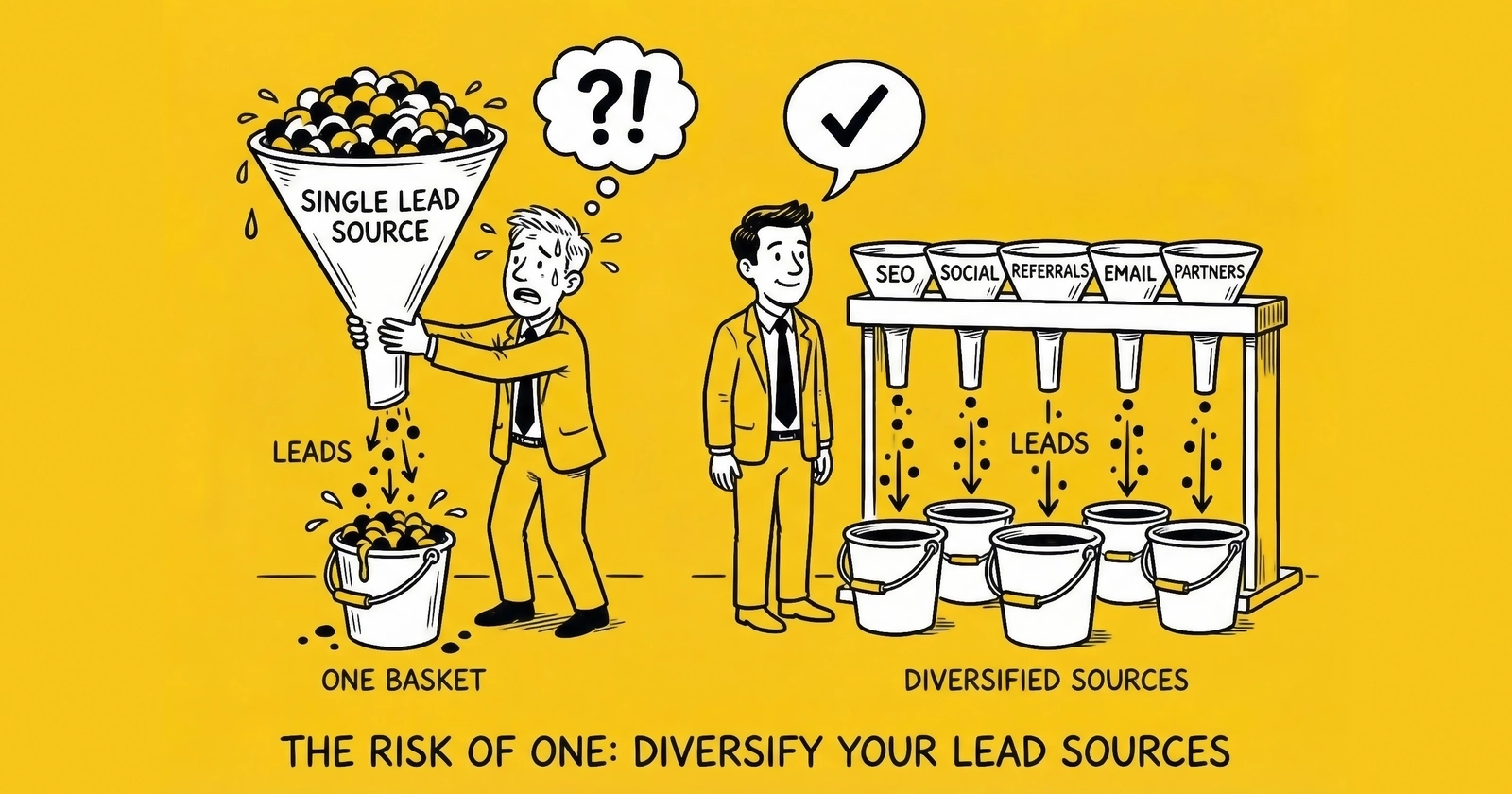
A comprehensive guide to building resilient traffic portfolios, avoiding concentration risk, and protecting your lead generation business from the platform changes that destroy single-source operations overnight.
In January 2024, a lead generation operation processing 15,000 mortgage leads monthly discovered their entire business model had a single point of failure. Their primary traffic source – representing 72% of total volume – suspended their account following a policy update. Within 48 hours, daily lead production dropped from 500 to 140. Buyer relationships built over three years began unraveling. The float that had seemed comfortable suddenly felt catastrophic. Six months later, the company had laid off half its team and was still rebuilding.
This is not an unusual story. It is the predictable outcome of an entirely avoidable strategic failure: single-source dependency.
The lead generation industry offers remarkable opportunities for operators who understand its mechanics. But it also punishes those who violate its fundamental laws. Among these laws, none is more consequential than the requirement for source diversification. A business built on one traffic channel, one buyer relationship, or one vertical is not a business – it is a speculation that will eventually fail.
This article examines why concentration kills lead businesses, how to build diversified traffic portfolios, and the specific metrics that separate resilient operations from those waiting for their reckoning.
The Mathematics of Concentration Risk
Concentration risk in lead generation operates like any other business dependency – it creates fragility that compounds over time. The challenge is that this fragility remains invisible until the moment of failure.
Consider the probability model. If you depend on a single traffic source with a 5% annual probability of significant disruption (account suspension, major policy change, algorithm adjustment), you have a 95% chance of surviving any given year. That sounds comfortable. Over five years, however, your cumulative probability of avoiding disruption drops to approximately 77%. Over ten years, it falls to 60%. Given enough time, single-source dependency will catch you.
The actual disruption probabilities are likely higher than 5%. Major advertising platforms update policies continuously. Google made 4,725 changes to its search algorithms in 2022 alone – an average of 13 per day. Facebook’s advertising policies shift quarterly. TikTok’s regulatory status remains uncertain in multiple markets. Each change creates potential for account restrictions, cost increases, or conversion rate declines that can devastate concentrated operations.
What Concentration Actually Costs
The financial impact of source concentration manifests in several ways beyond the obvious risk of sudden volume loss.
Reduced negotiating leverage: When a single buyer or supplier represents a disproportionate share of your business, they know it. A buyer who accounts for 50% of your revenue understands that you cannot walk away from the relationship. Strong buyer relationships require diversification. This power asymmetry enables gradual terms erosion – longer return windows, slower payment terms, lower prices – that compounds into significant margin degradation over time.
Operational fragility: Concentrated operations optimize around their primary source’s requirements. When that source changes or disappears, the optimization becomes a liability. Staff trained on one platform’s interface struggle with others. Creative assets designed for one channel underperform elsewhere. Technology integrations built for one buyer require reconstruction.
Hidden opportunity cost: Perhaps most insidiously, concentration prevents learning. Operators focused on a single channel never develop the cross-platform expertise that separates sophisticated operations from beginners. When forced to diversify during crisis, they face learning curves that competitors mastered years earlier.
The industry data supports these observations. Analysis of lead generation business failures consistently shows concentration as a primary contributing factor. The operations that survive industry cycles are those that maintained diversified portfolios before disruption arrived.
The Source Diversification Framework
Effective diversification requires systematic attention to three distinct dimensions: traffic channels, buyer relationships, and geographic or vertical markets. Each dimension carries its own concentration risks and requires specific diversification strategies.
Traffic Channel Diversification
Traffic channel diversification means ensuring no single advertising platform or acquisition method represents an unsustainable share of your lead volume. The specific threshold varies by operation, but a widely-cited industry guideline suggests no single channel should exceed 30-40% of total volume.
The rationale is straightforward. Major platforms demonstrate that policy enforcement can remove advertisers with minimal warning or explanation. Google Ads suspends approximately 5.6 billion ads annually. Meta removes millions of advertisers for policy violations. Even compliant advertisers face sudden cost increases when platforms adjust auction dynamics or targeting capabilities.
Primary channel categories to consider:
Paid search remains the backbone of high-intent lead generation. Google Ads and Microsoft Bing together capture the majority of commercial search intent. The 2025 benchmarks show average cost per lead around $70 across industries, with significant vertical variation – legal services exceed $130 CPL while home services average closer to $30-40. Paid search’s strength is intent clarity; its weakness is cost and competitive saturation.
Paid social offers volume at lower costs but with different intent signals. Meta platforms (Facebook and Instagram) deliver average CPLs approximately 60% below Google, currently averaging around $27 for lead campaigns. TikTok provides even lower CPMs but highly variable conversion efficiency. LinkedIn serves B2B verticals at premium pricing ($50-350 CPL) justified by superior lead quality for appropriate use cases.
Native advertising through platforms like Taboola and Outbrain offers scale beyond search volume constraints. CPCs typically range from $0.20-0.60 with conversion rates of 1.5-5% depending on creative quality and publisher placement. Native requires content-forward approaches and aggressive placement management to maintain quality.
Organic channels – SEO, content marketing, and owned media – provide the most defensible traffic when executed well. Organic traffic generates leads at effective CPLs of $5-15 once sites mature, compared to $75-150 for paid channels in similar verticals. The investment is front-loaded (12-18 months to meaningful volume) but the compounding returns create genuine competitive moats.
Email marketing serves nurture and reactivation purposes, maintaining engagement with leads that did not convert initially and reactivating aged leads when circumstances change. Average email marketing ROI reaches $36 per dollar spent, making it essential for maximizing lead portfolio value.
Recommended channel allocation for established operations:
A diversified portfolio might allocate traffic budget as follows: paid search 30-40%, paid social 25-35%, native advertising 10-20%, with 5-10% reserved for testing emerging channels. Simultaneously, operators should be building organic assets that will eventually provide 20-30% or more of total volume without ongoing media spend.
New operations cannot achieve this diversification immediately. The practical path starts with proving unit economics on one or two channels, then systematically expanding once baseline profitability is established. Attempting to master five channels simultaneously typically results in mediocre performance across all of them.
Buyer Diversification
Buyer concentration creates the same fragility as traffic concentration, often with faster-moving consequences. A single buyer representing 50% or more of revenue transforms a lead generation business into an outsourced marketing department without employment protections.
The risks compound across multiple dimensions:
Payment timing risk: If your largest buyer delays payment – whether due to their own cash flow challenges, administrative issues, or strategic decisions – the cash flow impact cascades through your entire operation. The 60-day float rule makes this vulnerability especially dangerous. You cannot pay suppliers, cannot fund traffic, cannot maintain operations. One buyer’s treasury decision becomes your business crisis.
Terms erosion: Buyers who understand their importance to your revenue can systematically degrade terms. Price reductions, longer return windows, faster delivery requirements, and more generous dispute resolution all become negotiating points where concentration eliminates your leverage.
Strategic dependency: Over time, your product development, operational processes, and team structure optimize around your largest buyer’s requirements. When that buyer changes strategy, churns, or gets acquired, you discover your entire operation was built around assumptions that no longer apply.
The guideline for buyer concentration is more conservative than for traffic channels: no single buyer should exceed 20-25% of revenue. Some operators set the threshold at 15% for additional protection.
Achieving this diversification requires proactive pipeline development even when current buyer relationships are performing well. The time to develop backup buyers is when you have capacity constraints and leverage – not when you are desperate for demand because a major relationship has failed.
Build buyer relationships across categories, not just individual companies. If you sell auto insurance leads, cultivate relationships across national carriers, regional players, and independent agents; across exclusive, shared, and aged lead models; across steady-volume buyers and burst purchasers. This category diversification provides resilience against industry shifts that might affect entire buyer segments.
Geographic and Vertical Diversification
The third diversification dimension addresses market concentration. Operators focused on a single vertical or geographic market face risks from regulatory changes, economic conditions, and competitive dynamics specific to that market.
Vertical-specific risks are substantial. Mortgage lead generation volume correlates directly with interest rate movements – a rate spike can collapse demand industry-wide regardless of your operational excellence. Insurance lead markets shift with carrier profitability cycles. Solar lead economics vary dramatically by state policy incentive changes. Legal lead generation faces bar association advertising rules that differ by jurisdiction.
Geographic concentration creates similar exposure. A solar lead operation focused entirely on California benefits from that state’s excellent incentives – until policy changes alter the economics. Regional economic conditions, local competitive dynamics, and state-specific regulations all create risks that geographic diversification mitigates.
The practical approach varies by operation size. Smaller operations may not have the resources for true multi-vertical operations but can still diversify within their primary vertical across geographic markets. Larger operations benefit from maintaining meaningful presence in multiple verticals, accepting that expertise development takes time.
Building a Diversified Traffic Portfolio: The Practical Approach
Diversification as a concept is simple. Executing diversification while maintaining profitability and operational coherence is considerably more complex. The following framework provides a structured approach to building diversified traffic portfolios.
Phase 1: Establish Core Profitability (Months 1-4)
Before diversifying, you need a foundation of proven unit economics. Attempting diversification without established profitability typically results in losing money across multiple channels simultaneously rather than one.
Focus initial efforts on one or two channels where you have existing expertise or where the learning curve is shortest for your vertical. For most lead generation operations, this means paid search (Google Ads primarily) combined with either Meta advertising or native placement.
Establish baseline metrics that must be achieved before expanding:
- Cost per lead within 20% of target sustainably
- Return rates acceptable to buyer relationships
- Positive unit economics after all costs
- Operational processes that can handle current volume reliably
Document everything. The systems, creative approaches, and optimization tactics that work on your initial channels provide the foundation for expansion. Poor documentation forces you to re-learn lessons on each new channel.
Phase 2: Validate Secondary Channels (Months 5-8)
With core profitability established, begin testing additional channels with structured experiments. Allocate 10-20% of traffic budget to testing, with clear hypotheses, minimum spend requirements for statistical significance, and defined success criteria.
Minimum viable test parameters:
- Paid search tests: $1,000-2,000 and 30+ conversions
- Meta tests: $2,000-3,000 and 50+ conversions
- Native tests: $3,000-5,000 and 50+ conversions
- New channel tests: Target 100+ conversions before declaring results
Each test should run long enough to account for day-of-week and time-of-day variation – typically 2-3 weeks minimum for sufficient data.
Evaluate tests on true cost per lead (including all variable costs), downstream quality metrics (return rates, conversion rates where available), and scalability potential. A channel that works at $2,000 monthly spend may not work at $20,000 – scaling often degrades performance as algorithms reach beyond core audiences.
Phase 3: Scale and Rebalance (Months 9-12)
Validated channels graduate from testing to core allocation. Scale gradually – 20-30% budget increases week-over-week rather than dramatic jumps. Rapid scaling overwhelms your ability to detect performance degradation before significant damage accumulates.
Continuously monitor concentration metrics. Your dashboard should display channel concentration daily. When any channel approaches 40% of volume, pause scaling until diversification catches up. This may mean leaving money on the table from your best-performing channel – that is the cost of maintaining strategic resilience.
Ongoing: Continuous Testing and Rebalancing
Diversification is not a destination – it is an ongoing discipline. Markets shift, platforms evolve, and channels that worked last quarter may underperform next quarter.
Maintain a permanent testing allocation of 5-10% of budget. Emerging channels (connected TV, podcast advertising, influencer partnerships) deserve evaluation even when current channels perform well. Today’s test channel may become tomorrow’s core performer.
Rebalance quarterly based on performance data. Channels that consistently underperform should be reduced; channels demonstrating improving economics should be expanded. The goal is not equal allocation but rather intentional allocation that balances performance with diversification requirements.
Building Owned Traffic Assets: The Ultimate Diversification
Paid traffic channels, regardless of how diversified, share a common vulnerability: they are rented. The moment you stop paying, traffic stops arriving. Platform policy changes affect all paid advertisers simultaneously.
Owned traffic assets – content websites, email lists, comparison tools, communities – represent the most defensible form of diversification. Once built, they generate leads without ongoing media spend. Platform changes affect competitors while your owned assets continue producing.
Content Site Development
A content website built around commercial-intent keywords represents the highest-leverage owned asset for lead generation. The investment timeline is substantial – 12-18 months to meaningful organic traffic – but the economics are transformational.
Paid traffic for mortgage leads costs $75-150 per lead. Organic traffic from a mature mortgage content site produces leads at effective CPL of $5-15. That cost advantage compounds indefinitely, creating margins that paid-only competitors cannot match.
Building effective content sites requires understanding what Google (and increasingly, AI systems) want to rank:
- Content written by or reviewed by genuine subject matter experts
- Clear attribution and credentials demonstrating expertise
- Factual accuracy with source citations
- Comprehensive coverage that genuinely serves user needs
The content must target commercial-intent keywords where your lead forms provide a natural next step. “Compare Medicare supplement plans” attracts buyers; “what is Medicare” attracts researchers. Both have value, but commercial intent converts dramatically better.
Email List Development
Your email list is the owned asset that most directly converts to lead revenue. Unlike social followers who see content only when algorithms permit, email subscribers receive your messages directly. Unlike website visitors who may never return, email subscribers represent ongoing relationships.
Email marketing delivers average ROI of $36 per dollar spent. Automated sequences – welcome series, nurture tracks, re-engagement campaigns – generate disproportionate revenue relative to send volume. The marketing automation platforms that power these sequences have become essential infrastructure.
List building requires creating legitimate value exchanges. Nobody provides their email because you asked nicely. They provide it because you offer something they want – exclusive content, personalized tools, early access to information. The leads you generate through your primary business can become email subscribers for ongoing nurture if you structure consent properly.
First-Party Data Infrastructure
The third-party data ecosystem is fragmenting. Cookie deprecation, privacy regulation, and platform restrictions are systematically eliminating the infrastructure that powered targeted advertising for two decades. First-party data – information you collect directly from your audience with their consent – represents the sustainable alternative.
Match rates for first-party data reach approximately 90%, compared to 50-60% for third-party sources. Research indicates 61% of marketers are increasing first-party data budgets. Companies effectively using first-party data report up to 15% revenue increases while reducing marketing spend by 20%.
Building first-party data capabilities requires creating value exchanges that motivate users to share information, implementing progressive profiling across multiple interactions, and developing infrastructure to activate that data across channels.
Measuring Diversification: Key Performance Indicators
What gets measured gets managed. The following metrics provide visibility into concentration risk and diversification progress.
Traffic Source Concentration Metrics
Herfindahl-Hirschman Index (HHI) for Traffic: This index, commonly used for measuring market concentration, applies equally to traffic portfolio concentration. Calculate by squaring the percentage share of each channel and summing the results. An HHI below 1,500 indicates reasonable diversification; above 2,500 signals dangerous concentration.
Single-Source Maximum Percentage: The percentage of total lead volume from your largest single traffic source. Target below 40%; alarm threshold at 50%.
Organic Traffic Percentage: The share of leads generated from non-paid sources (SEO, direct, referral, email). Target 20-30% for mature operations; this provides baseline resilience against paid channel disruption.
Buyer Concentration Metrics
Top Buyer Revenue Percentage: Revenue from your largest single buyer divided by total revenue. Target below 25%; alarm threshold at 35%.
Top Three Buyers Percentage: Combined revenue from three largest buyers. Target below 60%; alarm threshold at 75%.
Buyer Count by Category: Track active buyer relationships across segments – carrier types, purchase models, size categories. Diversification across categories provides resilience beyond simple buyer counts.
Portfolio Health Metrics
Ninety-Day Channel Survival Rate: Percentage of channels generating profitable leads for three consecutive months. Healthy portfolios maintain 80%+ survival rates; lower rates suggest over-testing or poor optimization.
New Channel Contribution: Percentage of volume from channels added in the past twelve months. Target 10-20%; lower suggests insufficient testing, higher suggests over-reliance on unproven sources.
Recovery Time Estimate: Model how quickly you could replace volume if your largest source failed entirely. Healthy operations can recover 80% of volume within 30-60 days through scaling existing channels and activating tested alternatives.
Case Studies: Diversification Failures and Successes
Case Study 1: The Facebook-Dependent Operation
A solar lead generator built a profitable operation generating 8,000 leads monthly with 65% of volume from Facebook advertising. Unit economics were strong, buyer relationships stable, and the team celebrated consistent growth.
In late 2023, Facebook implemented stricter housing and financial advertising restrictions that affected solar advertising. The operation’s account faced restrictions, creative approval rates dropped, and CPLs increased 40% within six weeks.
Without diversified alternatives, the team scrambled to launch Google Ads campaigns they had never seriously tested. The learning curve was steep – their first two months of Google campaigns lost money. By the time they achieved profitability on Google, three buyer relationships had churned due to volume inconsistency. Total recovery time: eight months. Estimated cost: $400,000 in lost revenue and recovery investment.
Lesson: Channel expertise takes time. The moment of platform crisis is the worst time to learn a new channel.
Case Study 2: The Single-Buyer Collapse
An insurance lead broker developed an excellent relationship with a regional carrier that became their dominant buyer over three years. At peak, this relationship represented 58% of revenue. The buyer’s volume demands exceeded what other buyers could absorb, so the broker invested in traffic capacity to serve them.
When the carrier was acquired by a national company with an existing lead vendor relationship, the new ownership declined to renew the contract. The broker lost more than half their revenue with 60 days’ notice.
The aftermath was devastating. The traffic capacity they had built to serve this buyer generated leads they could not sell at acceptable prices. Selling distressed inventory to secondary buyers at discounted prices damaged relationships with other buyers who questioned why they were paying premium rates. Full recovery required fourteen months and significant capital.
Lesson: Large buyers actively cultivate dependency. What looks like partnership is often lock-in.
Case Study 3: The Diversified Operator
A mortgage lead operation maintained strict concentration limits from launch: no channel above 35% of volume, no buyer above 20% of revenue. This discipline cost them opportunities – several times they declined volume from buyers who wanted exclusive arrangements, and they invested in content assets that would not pay off for years.
When interest rates spiked in 2022 and mortgage lead demand collapsed industry-wide, they weathered the storm better than competitors. Their diversified buyer base included lenders focused on different products (refinance, purchase, home equity) with different demand profiles. Their organic traffic assets continued generating leads at low cost even as paid traffic economics deteriorated. Their email list provided reactivation opportunities as rates stabilized.
While concentrated competitors failed or contracted dramatically, this operation maintained profitability through the cycle. They emerged with improved market position when demand recovered, hiring talent from failed competitors and acquiring distressed assets at attractive prices.
Lesson: Diversification costs less than recovery.
Common Diversification Mistakes
Mistake 1: Diversifying Before Proving Core Economics
Some operators attempt diversification before establishing profitability anywhere. This typically results in mediocre performance across multiple channels, never developing the expertise to excel at any of them. Master one or two channels first; diversify from strength rather than weakness.
Mistake 2: Treating Diversification as a One-Time Project
Diversification requires ongoing attention, not a single initiative. Markets shift, channels evolve, and yesterday’s diversified portfolio may be tomorrow’s concentrated exposure. Build diversification monitoring into your regular reporting and review cycles.
Mistake 3: Diversifying for Diversification’s Sake
Not all diversification adds value. Expanding into channels where your vertical performs poorly, or adding buyers whose economics do not work for your operation, creates cost without benefit. Evaluate each diversification opportunity on its own merits, not simply to check a diversification box.
Mistake 4: Ignoring Correlated Risks
Channels that appear diversified may share underlying risk factors. Google Ads and Microsoft Bing are both paid search channels; a search algorithm change affects both. Facebook and Instagram are both Meta platforms; a Meta policy change affects both. True diversification requires channels with genuinely independent risk profiles – paid media alongside owned assets, different platform families, and different acquisition mechanics.
Mistake 5: Failing to Document What Works
When you discover successful approaches on one channel, document them thoroughly. Creative strategies, landing page frameworks, and targeting approaches often translate across channels. Poor documentation forces you to re-learn lessons repeatedly, slowing diversification progress.
Frequently Asked Questions
What percentage of leads should come from my largest traffic source?
No single traffic source should exceed 40% of total lead volume, with 30% as a more conservative target. When any source approaches these thresholds, pause scaling on that source until other channels catch up. This may mean leaving money on the table from a high-performing channel, but the resilience value justifies the opportunity cost.
How quickly should I diversify a new lead generation business?
New operations should focus on proving unit economics on one or two channels before diversifying. Attempting to master multiple channels simultaneously typically results in mediocre performance across all of them. A reasonable timeline: establish core profitability in months 1-4, validate secondary channels in months 5-8, then scale and rebalance through month 12 and beyond.
What is the right buyer concentration limit?
No single buyer should represent more than 20-25% of revenue. Some operators set more conservative thresholds at 15%. The top three buyers combined should represent less than 60% of total revenue. These limits should be treated as hard constraints that shape sales strategy, not targets to approach.
How do I diversify without losing money on new channels?
Allocate 5-10% of traffic budget specifically for testing. Structure tests with clear hypotheses, minimum spend requirements for statistical significance, and defined success criteria. Accept that test channels will underperform initially – that learning cost is the investment in future resilience. Graduate channels to core allocation only after demonstrating sustainable economics.
Should I prioritize organic traffic over paid diversification?
Both matter, but they serve different purposes. Organic traffic (SEO, content, email) provides the most defensible long-term advantage but requires 12-18 months to build meaningful volume. Paid channel diversification provides faster resilience against platform-specific risks. The optimal approach is building organic assets while maintaining diversified paid acquisition – organic eventually reduces paid dependency.
How do I measure buyer quality when diversifying buyer relationships?
Track multiple metrics by buyer: return rates, payment timing, communication responsiveness, and (where available) downstream conversion rates. A buyer with 8% returns and NET-15 payment is worth significantly more than one with 18% returns and NET-45 payment, even at identical CPLs. Price diversification into your economics – accepting lower prices from reliable buyers may provide better net economics than higher prices from problematic ones.
What role does geographic diversification play?
Geographic diversification protects against regional regulatory changes, local economic conditions, and market-specific competitive dynamics. This matters most in verticals with significant geographic variation – solar economics differ dramatically between California and North Dakota, for example. Even operations focused on a single vertical can diversify across geographic markets within that vertical.
How often should I rebalance my traffic portfolio?
Review concentration metrics weekly and rebalance quarterly based on performance data. Weekly monitoring catches emerging concentration before it becomes problematic. Quarterly rebalancing provides sufficient data for meaningful performance comparison while maintaining strategic flexibility.
What are the warning signs that I am too concentrated?
Key warning signs include: any single source exceeding 40% of volume, any single buyer exceeding 25% of revenue, organic traffic below 15% of total, test budget allocation below 5%, and inability to model recovery scenarios if your largest source failed. If multiple warning signs apply, diversification should become an immediate priority.
How do I convince stakeholders that diversification is worth the cost?
Frame diversification as insurance with calculable value. Model the probability of source disruption, the potential revenue impact, and the recovery timeline and cost. Compare this expected loss against the opportunity cost of diversification limits. The math typically favors diversification strongly. Additionally, document industry examples of concentrated operations that failed – these case studies make abstract risk tangible.
Key Takeaways
The lead generation operators who survive industry cycles share a common characteristic: they build diversified portfolios before disruption arrives, not after.
On traffic diversification: No single traffic channel should exceed 40% of total lead volume. Build proficiency across paid search, paid social, native advertising, and organic channels. Maintain 5-10% of budget for continuous testing of emerging channels.
On buyer diversification: No single buyer should represent more than 20-25% of revenue. Build relationships across buyer categories, not just individual companies. The time to develop backup buyers is when you have leverage, not when you are desperate.
On owned assets: Paid traffic channels, however diversified, remain rented infrastructure. Content sites, email lists, and first-party data provide the most defensible form of diversification, generating leads without ongoing media spend and providing stability when paid channels falter.
On measurement: What gets measured gets managed. Track traffic source concentration, buyer concentration, and portfolio health metrics weekly. Review and rebalance quarterly. Build diversification monitoring into your standard operating procedures.
On timing: Diversification costs less than recovery. Those who build diversified portfolios during stable periods weather disruption that devastates concentrated competitors. Start now – waiting until you need diversification is waiting too long.
The lead economy rewards operators who understand its fundamental laws. Among these laws, source diversification stands as perhaps the most consequential. Build your operation accordingly, and you will be positioned to capture opportunities that destroy your less-prepared competitors.
This article is adapted from The Lead Economy, a comprehensive guide to building, operating, and scaling lead generation businesses. Statistics and benchmarks current as of late 2025. Traffic costs, conversion rates, and platform policies shift continuously; validate current conditions before making significant investment decisions.