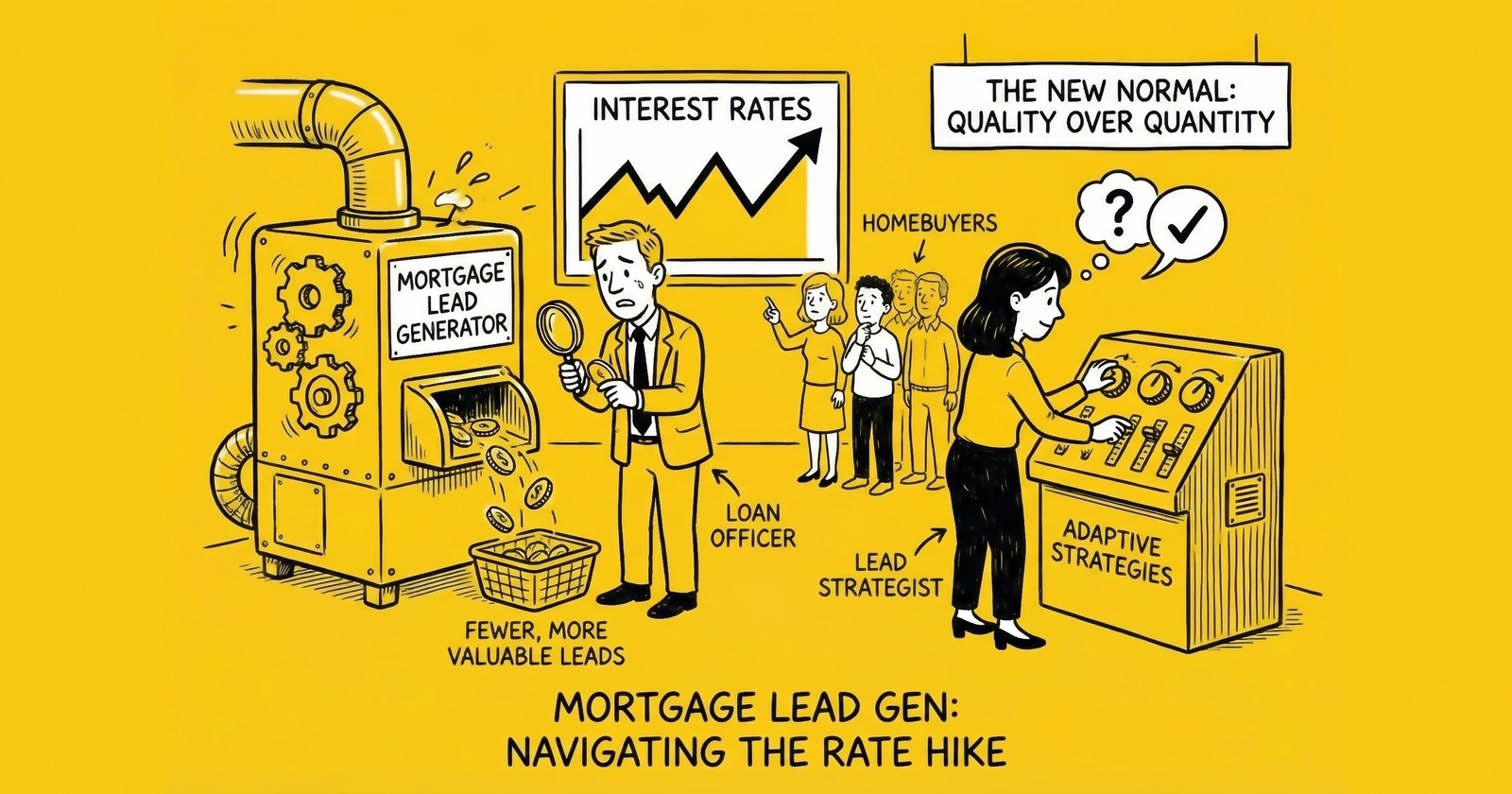
When the 30-year fixed rate moves 50 basis points, mortgage lead generators face a fundamentally different business. Here is how to read rate signals, adapt messaging, time markets, and build operations that survive the cycles you cannot predict.
The Defining Characteristic of Mortgage Lead Economics
Every lead generation vertical has its primary variable. Insurance leads respond to carrier appetite and regulatory changes. Solar leads track equipment costs and incentive policies. Home services leads follow seasonal patterns and housing market activity. But mortgage leads are different in a fundamental way that shapes everything about how you build and operate in this space. They respond to one number above all others: the prevailing interest rate.
This single variable – the 30-year fixed mortgage rate – determines whether your lead generation business thrives or struggles. It shapes consumer behavior in ways that no amount of marketing creativity can overcome. It dictates buyer capacity, pricing power, and margin potential. And it moves unpredictably based on Federal Reserve policy, bond market dynamics, and macroeconomic forces beyond anyone’s control. You cannot wish rates lower, negotiate them down, or market your way around their effects. You can only understand them deeply and build operations that adapt to wherever rates go.
The mortgage lead market represents approximately $5.6 billion in annual transaction value. But that figure obscures the volatility within it. In 2021, with 30-year fixed rates hovering near 3%, originators processed $4.51 trillion in mortgages – the highest annual volume ever recorded. By 2023, with rates cresting above 7%, that figure collapsed to $1.50 trillion. Same lenders. Same forms. Same buildings. Two-thirds of the volume vanished because a single number changed. For lead generators, understanding rate sensitivity is not optional expertise – it is the foundational knowledge upon which sustainable mortgage lead operations are built.
How Interest Rates Drive Consumer Behavior
The relationship between mortgage rates and consumer behavior follows predictable patterns, but the magnitude and timing of responses vary in ways that reward careful observation. Understanding the psychology behind rate sensitivity lets you anticipate shifts before they fully manifest in your lead flow, giving you precious days or weeks to position ahead of competitors who only react after the fact.
The Psychology of Rate Shopping
Mortgage consumers are intensely rate-aware in ways that insurance or home services consumers simply are not. A homeowner might accept a 15% increase in auto insurance premiums with minimal shopping behavior – frustrating, perhaps, but not enough to trigger hours of research and comparison. The same homeowner will research, compare, and negotiate obsessively over a 0.25% difference in mortgage rates. The reason is pure mathematics: on a $400,000 loan over 30 years, that quarter-point represents roughly $20,000 in additional interest payments. Consumers understand this intuitively even if they cannot calculate the exact figure, and it drives behavior that every lead generator must understand.
When rates appear stable, consumers shop passively – browsing rate tables, using online calculators, but not submitting inquiries with any particular urgency. They are gathering information, not ready to transact. When rates appear to be moving – either declining (creating opportunity to lock favorable terms) or rising (creating urgency before rates climb further) – consumers shift to active shopping mode. Lead volume responds accordingly, sometimes dramatically within a 48-hour window. The transition from passive to active shopping is where opportunity lives, and operators who recognize the signals can capture volume that others miss entirely.
Consumers also evaluate current rates against mental anchors based on what they have heard rates “should” be. In late 2024 and 2025, many consumers remained anchored to the sub-4% rates of 2020-2021, perceiving 6%+ rates as abnormally high even though historical averages run closer to 7-8%. This anchoring affects both purchase and refinance behavior in ways that can frustrate lead generators. Consumers delay purchases hoping for rate declines that may not materialize. Refinance candidates wait for rates to return to levels that economic conditions simply do not support. Working with anchored consumers requires messaging that acknowledges their expectations while reframing current conditions as actionable rather than waiting for a return to “normal” that may be years away.
Certain rate levels trigger behavioral shifts that exceed what pure mathematics would predict. When rates cross below perceived thresholds – 6.0%, 5.5%, 5.0% – consumer activity increases disproportionately. These thresholds are psychological rather than purely mathematical. The difference between 6.05% and 5.95% is negligible in terms of monthly payment impact, but the “5-handle” versus “6-handle” distinction drives real behavioral change. Consumer rate awareness also increases during periods of heavy financial media coverage. Federal Reserve meetings, inflation reports, and employment data releases generate news coverage that reminds consumers about rate conditions. Lead volume often spikes in the 24-48 hours following significant rate-related news events, even when the actual rate movement is minimal.
Purchase Market Rate Sensitivity
Purchase mortgage decisions involve life circumstances – job changes, family growth, relocations – that operate somewhat independently of rate conditions. People still need housing regardless of financing costs, which provides purchase lead generators with a stability that their refinance-focused counterparts lack. However, rates affect purchase behavior through affordability mechanics that can meaningfully shift the shape and size of your lead flow.
When rates rise, monthly payments on a given purchase price increase substantially. A $400,000 home at 6.5% requires monthly principal and interest of approximately $2,528. At 7.5%, that payment climbs to $2,797 – an increase of $269 per month or more than $3,200 annually. For many buyers, this payment increase either disqualifies them from loans they would otherwise obtain or forces them to reduce purchase price targets. The result is nuanced: rising rates do not eliminate purchase demand, but they compress the qualified buyer pool and reduce transaction sizes. Lead generators see this as maintained volume with declining lead quality scores (lower loan amounts, tighter credit profiles) or reduced volume of high-value leads. Either manifestation affects your economics in ways you must anticipate.
Falling rates produce the inverse effect. Payment affordability improves, more buyers qualify for target home prices, and transaction sizes can increase. Lead quality metrics typically improve as rates decline. The Mortgage Bankers Association reported purchase applications rising 15% year-over-year in Q2 2025 as rates moderated from 2024 peaks. Understanding the economics of purchase versus refinance leads helps operators allocate resources appropriately. This represents steady but not explosive demand – life events continue driving purchases, but rate conditions influence pace and intensity. For purchase-focused lead generators, this moderate rate sensitivity is actually a feature rather than a bug. You can build sustainable operations on purchase demand that does not evaporate overnight when rates move adversely.
Refinance Market Rate Sensitivity
If purchase leads show moderate rate sensitivity, refinance leads show extreme sensitivity that can feel almost binary in its intensity. The decision to refinance is almost entirely rate-driven: homeowners refinance when current rates fall meaningfully below their existing mortgage rate, typically requiring at least 50-75 basis points of improvement to justify closing costs. Without that spread, the math simply does not work, and no amount of creative marketing will convince a rational consumer to refinance into a higher rate.
This creates a market dynamic unlike anything else in lead generation. Either significant pools of homeowners are “in the money” – holding mortgages at rates meaningfully above current rates – or they are not. When they are, refinance lead volume explodes. Call centers cannot keep up, buyers bid aggressively for every lead, and generators who maintained capacity print money. When they are not, refinance lead volume approaches zero regardless of marketing intensity. You can have the most optimized funnel in the industry, the most compelling creative, the most sophisticated targeting – and generate essentially nothing because the fundamental economic proposition does not exist.
The 2025 refinance market illustrates this dynamic perfectly. Rates ranging from 6.35% to 7.04% mean that borrowers who locked sub-4% rates in 2020-2021 remain completely out of the money. No marketing message will convince someone paying 3.25% to refinance into 6.5% – you would literally be asking them to accept worse terms while paying closing costs for the privilege. However, borrowers who financed at 2022-2023 peak rates above 7% now find savings opportunities. A borrower at 7.5% can meaningfully benefit from refinancing to 6.5%. The refinance-eligible pool is therefore smaller than historical norms but not zero. Industry projections suggest refinance volume will grow 38% in 2025 versus 2024, but this growth starts from a depressed base. The refinance share of total originations reached 26% by late 2024 – the highest since early 2022 – but remains far below the 60%+ share seen during refinance booms.
Home Equity Rate Dynamics
Home equity products have emerged as a rate-cycle-resilient segment with distinct dynamics that every mortgage lead generator should understand. Homeowners with sub-4% first mortgages who need cash face a choice that the current rate environment makes obvious: refinance the entire mortgage at current rates (losing their favorable rate) or access equity through a second mortgage or home equity line of credit (HELOC) while preserving the low-rate first mortgage. The mathematics favor home equity for most borrowers in ways that create sustained demand regardless of where primary mortgage rates sit.
Consider a homeowner with a $300,000 first mortgage at 3.5% who needs $50,000 cash for home improvement, debt consolidation, or other purposes. Refinancing to a $350,000 mortgage at 6.5% would face $12,600 in additional annual interest – the three-percentage-point rate increase applied to the entire balance, including the $300,000 they already have at a favorable rate. Alternatively, a $50,000 HELOC at 9% adds only $4,500 in annual interest. The HELOC saves roughly $8,000 per year despite its higher rate because the principal balance is smaller. This math is not subtle, and consumers increasingly understand it.
LendingTree’s home equity revenue grew 35-38% year-over-year during 2024-2025, demonstrating sustained demand even in challenging rate environments where traditional refinance volume collapsed. Home equity leads represent a resilient vertical that complements primary mortgage operations. For lead generators, home equity leads provide portfolio diversification that maintains revenue when traditional refinance evaporates. Think of home equity capacity as insurance against rate volatility – you may not need it during boom periods, but it keeps the lights on during droughts.
Rate Cycle Phases and Operational Implications
Mortgage lead operations must adapt to different rate cycle phases, each with distinct characteristics and optimal strategies. Treating all market conditions the same is a recipe for either missed opportunity or operational distress, depending on which direction you misjudge. Understanding where you are in the cycle – and positioning for what comes next – separates sustainable operations from those that thrive briefly and then disappear.
Phase 1: Rising Rate Environment
When rates are rising – as occurred from early 2022 through late 2023 – mortgage lead generators face challenging conditions that require specific adaptations. The psychology of rising rates works against you: consumers who might have acted at last month’s rate now hope to wait for a reversal, while those who do act face tighter affordability constraints. Volume declines are inevitable, but how you manage through them determines whether you emerge positioned for eventual recovery.
Refinance demand collapses as fewer borrowers find economic benefit from refinancing into higher rates. Purchase demand contracts as affordability declines and buyers delay decisions hoping for rate stabilization. Overall lead volume typically declines 30-60% from peak levels, with refinance declines more severe than purchase since purchase at least retains the life-event driver. The absolute numbers can be startling if you are unprepared, but understanding the pattern helps you plan rather than panic.
Counterintuitively, lead prices often remain elevated or even increase during rising rate periods. Buyers who remain active in the market face reduced lead supply and compete more intensely for available volume. Cost per lead for exclusive purchase may rise from $75 to $150+ as supply tightens and originators scramble to maintain pipeline. Lead quality often improves during rising rate periods as well – casual browsers exit the market, leaving only motivated consumers with genuine intent. Contact rates and application rates may improve even as raw volume declines, which partially offsets the volume reduction in buyer economics.
Operational adaptations for rising rate environments require discipline and clear-eyed assessment. Shift emphasis from refinance to purchase and home equity where demand remains. Reduce fixed costs and maintain flexible capacity that can scale down without existential consequences. Focus on geographic markets with stronger housing fundamentals where purchase activity remains more resilient. Strengthen relationships with remaining active buyers – you will want their capacity when conditions improve, and loyalty built during difficult periods creates lasting partnerships. Most importantly, build cash reserves for cycle transition rather than spending through the downturn hoping for imminent recovery.
Phase 2: Peak Rate Plateau
Periods of sustained high rates – such as much of 2024 – create a different operational context that rewards patience and discipline. The initial shock has passed. Consumers have stopped expecting rates to reverse quickly. A new equilibrium emerges that you can build around, even if it is less profitable than boom conditions.
Volume stabilizes at reduced levels during plateau periods. The initial shock of rising rates has passed, and consumers adapt to the new environment. Purchase volume reflects ongoing life-event-driven demand – people still get married, have children, change jobs, and need to move. Refinance volume approaches minimal levels as almost no borrowers remain in the money. This is not the exciting environment that attracts new entrants to the space, but it is a sustainable one for operators who size correctly.
Lead prices typically moderate from rising-rate peaks as supply and demand reach new equilibrium. Buyers have adjusted budgets to current conditions, and the frenzy for limited supply subsides. Quality remains strong as only genuinely motivated consumers generate inquiries. However, overall conversion economics may remain challenging if buyers themselves face constrained capacity – originators dealing with compressed margins may push harder on lead pricing and quality standards.
During plateau periods, right-size operations for sustainable plateau volume rather than clinging to capacity built for different conditions. Develop home equity and purchase specializations that serve the products with actual demand. Invest in nurture infrastructure for extended sales cycles, since consumers who inquire during plateaus may not be ready to transact for months. Maintain relationships for eventual cycle turn – the buyers you keep close during plateaus become your capacity when volume returns. Above all, avoid volume commitments that assume rate declines. Hope is not a strategy, and signing up for volume you cannot deliver destroys relationships.
Phase 3: Rate Decline Initiation
When rates begin declining – as occurred in late 2024 and into 2025 – opportunities emerge that reward prepared operators. This is the moment everything you built during the downturn and plateau pays off, or the moment you realize you should have maintained more capacity. Speed matters enormously here, and operators who position proactively capture volume that slower competitors never see.
Refinance inquiries increase as more borrowers enter the money. Purchase volume benefits from improved affordability. The pool of recent-vintage borrowers (those who financed at peak rates) becomes refinance-eligible. Overall volume begins recovering in ways that can feel sudden after months or years of drought. The challenge is that everyone sees this simultaneously, and competitive intensity increases just as opportunity does.
Lead prices may initially decline as supply increases faster than buyer capacity expands. Competition among generators intensifies as operators who reduced capacity during the plateau scramble to capture resurgent demand. Quality may initially decline as marginal consumers enter the market. Some inquiries come from consumers testing whether rates have declined enough to act, not from those ready to transact immediately. Your validation and qualification processes become more important, not less, even though the temptation is to relax standards to chase volume.
Scale infrastructure ahead of full demand recovery rather than waiting for proof that the turn is real. Re-engage buyers who reduced spend during plateau – they need volume and will remember who reached out first. Develop refinance-specific lead products and channels that you may have neglected during the drought. Prepare for rapid volume increases that can overwhelm systems built for plateau conditions. Maintain quality standards despite volume pressure, because the short-term gain from relaxed standards creates long-term relationship damage.
Phase 4: Low Rate Environment
Extended low-rate periods – such as 2020-2021 – create boom conditions with distinct challenges that differ from the survival mode of other phases. This is when you make the money that carries you through the next cycle, but it is also when the seeds of future distress get planted through overexpansion and quality erosion.
Refinance volume explodes as massive borrower pools enter the money. Purchase volume benefits from exceptional affordability. Total market volume can exceed sustainable industry capacity, creating the unusual situation where you have more opportunity than you can possibly capture. The question becomes not how to find leads but how to service the leads you can generate.
Lead prices often decline despite high volume because generator capacity expands and competition intensifies. Buyers may become more selective on quality as volume exceeds their processing capacity. Fraud attempts increase during boom periods as bad actors enter the space. Buyers become more aggressive about returns and quality enforcement because they can afford to be selective. Quality pressure increases as generators chase volume, and the temptation to relax standards is enormous.
Scale capacity rapidly to capture volume opportunity – this is what you prepared for during leaner times. Maintain quality standards despite temptation to chase quantity, because reputation damage during booms haunts you through subsequent cycles. Diversify buyer base to avoid capacity constraints that prevent you from capturing available opportunity. Build reserves knowing booms do not last – the operators who spent everything during 2020-2021 found themselves undercapitalized when 2022-2023 arrived. Plan for eventual cycle turn even while you are making money, because the turn always comes.
Messaging Strategy Across Rate Environments
Consumer messaging must adapt to rate conditions in ways that go beyond swapping out rate numbers in your copy. Messages that drive response in one environment may fall flat or even alienate consumers in another. The psychological context of rate conditions shapes how consumers interpret every word you write, and tone-deaf messaging can undermine campaigns that would otherwise perform well.
Rising Rate Messaging
When rates are rising, consumers experience anxiety and uncertainty. They know rates were lower recently. They wonder if they missed their window. They hope for reversal while fearing continued increases. Effective messaging addresses these emotions while creating urgency without feeling manipulative.
Lock urgency messaging works because it aligns with consumer psychology rather than fighting it. Copy like “Rates have increased three times this month. Today’s rate may be tomorrow’s memory. See your personalized rate before the next move” acknowledges reality, validates consumer concern, and provides a reason to act now rather than continuing to wait and hope. Similarly, affordability preservation messaging helps consumers think constructively: “Rising rates mean higher payments on the same home. Find out your maximum budget at current rates before they climb further.”
The critical mistakes to avoid during rising rate periods involve pretense and promises. Do not pretend rates are not rising – consumers know, and pretending otherwise destroys credibility. Do not promise rates will drop – you cannot know, and making promises you cannot keep creates lasting reputation damage. Do not use fear tactics that feel manipulative – consumers are already anxious, and piling on creates resistance rather than action. The goal is to channel existing emotion toward constructive action, not to create new anxiety.
Plateau Rate Messaging
When rates have stabilized at elevated levels, consumers have adjusted expectations even if they remain disappointed. Messaging should focus on value and opportunity within current conditions rather than longing for different conditions or promising imminent change.
Normalization messaging helps consumers accept current reality. Copy like “Today’s rates are the reality. Smart buyers are finding opportunities while others wait. Get your personalized rate and see what’s possible now” reframes the situation from “rates are bad” to “rates are what they are, and action is possible.” Comparative advantage messaging emphasizes what consumers can control: “Compare rates from multiple lenders in minutes. The rate you accept depends on where you look.” Education-focused messaging helps first-time buyers who have no anchor to previous rates: “First-time buyer? Higher rates don’t mean homeownership is out of reach. See how today’s buyers are making it work.”
Avoid promising imminent rate declines – you do not know, and even if you did, it would not help consumers who need to act now. Do not ignore rate reality; acknowledge it directly and then pivot to what is possible. Do not use 2020-2021 rate references as benchmarks, because comparing current conditions to a historical anomaly just reminds consumers of what they missed.
Declining Rate Messaging
When rates are falling, consumer optimism returns. People who were waiting feel vindicated. People who acted at higher rates feel motivated to capture improvement through refinancing. Messaging should capture opportunity while managing expectations about how far and fast declines will go.
Opportunity messaging highlights the improvement with specific, actionable framing: “Rates have dropped for three consecutive weeks. Homeowners who bought at 7%+ may save hundreds monthly. Check your refinance savings.” This is factual, specific, and action-oriented. Urgency without panic acknowledges that conditions are favorable without promising they will last forever: “Rate declines don’t last forever. See today’s rates and compare your options while conditions favor borrowers.” Purchase enablement messaging helps buyers understand what declining rates mean for them: “Lower rates mean more buying power. The home that was out of reach last month may be affordable today. Get your updated pre-approval.”
The mistakes to avoid involve overpromising on trajectory. Do not guarantee continued declines – rate movements are unpredictable, and consumers who act based on your promises will remember if those promises prove wrong. Do not create unrealistic rate expectations – if you imply rates are heading to 4%, you create consumers who wait rather than act at 5.5%. Do not ignore that rates remain elevated versus historical lows – context matters, and pretending 5.5% is low when consumers remember 3% creates credibility problems.
Product-Specific Messaging Across Cycles
Different products require different messaging emphases depending on rate conditions. Purchase messaging shifts from “Lock your rate before payments climb higher” during rising rate periods to “Today’s rates are tomorrow’s baseline. Buy now, refinance later if rates improve” during plateaus to “Lower rates mean more home for your budget. See your updated buying power” during declines. Each message aligns with where consumers are psychologically in relation to current conditions.
Refinance messaging requires particular care because the product availability varies so dramatically across the cycle. During rising rate periods, minimize emphasis and focus resources elsewhere – you cannot create refinance demand when the economics do not exist. During plateaus, target the specific population that can benefit: “Bought at peak rates? Even modest declines may save you money. Check your break-even.” During declining rate periods, go aggressive: “Rates are falling. Homeowners at 7%+ could save $300+/month. See your savings in 60 seconds.”
Home equity messaging remains relatively stable across cycles because the product value proposition – accessing equity without disturbing a favorable first mortgage – persists regardless of rate direction. During rising rate periods: “Access cash without disturbing your low-rate first mortgage. Compare HELOC rates.” During plateaus: “Need home equity? A second mortgage preserves your existing rate. See your options.” During declines, acknowledge that home equity remains relevant for many consumers: “Still the smart choice for homeowners with sub-4% first mortgages. Compare home equity rates.”
Market Timing and Anticipation Strategies
While no one can predict rate movements with certainty, operators can position for likely scenarios and respond quickly to emerging conditions. The goal is not to guess correctly every time – no one does – but to maintain awareness that enables faster response than competitors and to preserve optionality across multiple scenarios.
Leading Indicators to Monitor
Certain data points provide advance signals of mortgage market shifts that reward daily monitoring. Federal Reserve communications – FOMC meeting statements, press conferences, and “dot plots” (rate projections) – signal likely Fed policy direction. While mortgage rates do not directly follow the fed funds rate, Fed policy influences expectations that move bond markets and mortgage rates. The 10-year Treasury yield correlates more closely with mortgage rates than with short-term Fed rates, and daily Treasury movements provide real-time signals of mortgage rate direction. Real-time analytics capabilities help operators respond faster to market shifts. Checking 10-year yields should be part of your morning routine.
Inflation data through CPI and PCE reports influences both Fed policy expectations and bond market pricing. Inflation surprises can move rates significantly, and releases are scheduled well in advance so you can prepare for potential volatility. Employment data serves as another signal – strong employment data typically signals higher-for-longer rate policy, while weak employment data signals potential rate cuts that would benefit mortgage volumes.
Industry-specific data provides more direct signals. The Mortgage Bankers Association publishes weekly application indices for purchase and refinance that provide real-time demand signals before volume flows through your lead operation. Some industry services provide rate lock volume data that signals originator demand before it translates to lead purchasing behavior. Building a monitoring dashboard that aggregates these signals gives you information advantage over competitors who react only to what they see in their own lead flow.
Positioning Strategies
Based on market signals, operators can position proactively rather than reactively. When indicators suggest rates may decline, build refinance lead capacity before demand surges, re-engage dormant buyer relationships, develop refinance-focused landing pages and creatives, prepare messaging for declining rate environment, and secure traffic sources that can scale quickly. The work you do before the turn positions you to capture opportunity that slower competitors miss.
When indicators suggest rates may rise, shift emphasis to purchase and home equity, reduce fixed costs and long-term commitments, focus on geographic markets with strong fundamentals, build cash reserves, and strengthen relationships with buyers likely to remain active. The work you do before deterioration protects you from distress that unprepared competitors experience.
When direction is unclear – which is often the case – maintain balanced product mix, keep cost structures flexible, avoid long-term volume commitments, build scenario playbooks for different outcomes, and preserve optionality above all. The mistake is betting heavily on a single scenario when uncertainty is high. Those who survive long-term are those who maintain the ability to pivot regardless of which way conditions break.
Response Time Optimization
When rate conditions shift, speed of response matters enormously. Practitioners who adapt messaging, channel emphasis, and capacity within days capture opportunity. Those who take weeks to respond miss the window while competitors establish positions. Building organizational capabilities that enable rapid adaptation is not about working faster in the moment – it is about doing preparation work that makes fast response possible.
Pre-built creative assets make all the difference. Develop landing pages, ad creatives, and email sequences for different rate scenarios before you need them. When conditions shift, you deploy rather than develop. Flexible media buying relationships and accounts across multiple traffic sources prevent exclusive commitments that would constrain rapid channel shifting. Documented playbooks specifying operational changes for different scenarios mean that when conditions shift, you execute the playbook rather than deliberating from scratch.
Daily monitoring routines – checking rate movements, application indices, and competitor activity – enable early signal detection that drives early response. Buyer communication protocols that enable rapid updates on market conditions and capacity changes keep your distribution partners informed and ready to absorb volume changes. Those who appear to have preternatural timing are usually those who simply pay closer attention and move faster with better preparation.
Volume and Pricing Impact Quantification
Understanding the magnitude of rate impacts helps operators plan and set appropriate expectations. Vague notions of “volume goes up when rates drop” do not support serious business planning. Quantified expectations, while necessarily ranges rather than precise predictions, enable meaningful scenario modeling and decision-making.
Volume Response to Rate Movements
Historical patterns suggest specific volume response ranges to rate changes that operators should understand for planning purposes. For refinance volume, a 100 basis point decline from peak produces 40-60% volume increase. A 200 basis point decline produces 150-250% volume increase. Return to historical lows (sub-4%) would produce 300-500% volume increase from elevated-rate baseline as the massive pool of 2020-2021 borrowers finally enters the money.
For purchase volume, the response is more muted due to the life-event driver that operates independent of rates. A 100 basis point decline produces 10-20% volume increase, while a 200 basis point decline produces 20-35% volume increase. Rate effects on purchase are somewhat muted by housing inventory constraints that limit how many transactions can occur regardless of financing conditions.
Home equity volume is relatively rate-insensitive, correlating more with housing values and consumer cash needs than with rate movements. Home equity may actually decline if rates drop enough to make primary refinance attractive again, as the consumers who chose home equity to preserve favorable first mortgages might switch to cash-out refinancing if rate conditions improve sufficiently. These ranges represent industry averages, and individual operator experience varies based on geographic focus, traffic sources, and buyer relationships.
Pricing Response to Rate Movements
Lead pricing follows supply and demand dynamics that rate movements influence in sometimes counterintuitive ways. Rising rates typically produce increased purchase lead CPL as supply declines faster than demand – generators exit or scale down while originators still need pipeline. Refinance lead CPL becomes volatile during rising rates because supply crashes but so does buyer demand; the direction of pricing depends on which side adjusts faster. Home equity lead CPL remains stable to increasing as demand shifts to home equity from refinance consumers seeking alternatives.
Declining rates typically produce decreased purchase lead CPL short-term as supply increases with demand, though this effect moderates as the market finds new equilibrium. Refinance lead CPL decreases as supply expands rapidly and competition among generators intensifies. Home equity lead CPL remains stable initially, then may decline as primary refinance becomes attractive again for some consumers.
Current market pricing benchmarks in late 2025 show exclusive purchase leads ranging from $50-$200 with moderate rate sensitivity, shared purchase leads from $20-$60 with moderate rate sensitivity, exclusive refinance leads from $75-$200 with extreme rate sensitivity, home equity leads from $30-$100 with low rate sensitivity, and aged leads (30-180 days) from $12-$25 with low rate sensitivity. Geographic variation compounds these ranges significantly. California coastal markets command premiums that would be inappropriate for Midwest markets. A $150 purchase lead in San Francisco may represent reasonable economics given local transaction sizes; the same price for a $180,000 home in Ohio produces unsustainable buyer economics.
Margin Impact Calculations
Rate changes affect margins through both pricing and conversion impacts, and operators must think beyond per-lead metrics to understand the full picture. Consider a rising rate environment margin compression scenario. Pre-rate-increase, you generate at $75 CPL and sell at $120, producing $45 gross margin (37.5%). Post-rate-increase, volume declines 40%, CPL rises to $110 (supply scarcity), and sell price rises to $145 (buyer competition for limited supply). Gross margin per lead drops to $35 (24%). But total margin dollars decline 44% due to volume reduction, which is the number that actually matters for your business.
Now consider a declining rate environment for refinance leads. Pre-rate-decline, you generate 100 leads per day at $100 CPL and sell at $150, producing $50 margin per lead and $5,000 per day in gross margin. Post-rate-decline, volume triples to 300 leads per day, but CPL drops to $60 (increased competition among generators) and sell price drops to $100 (buyers have more options). Margin per lead declines to $40, but total daily margin increases to $12,000 – a 140% increase in what matters despite the per-lead margin decline.
These examples illustrate why operators must think in terms of total margin dollars and ROI rather than per-lead margins in isolation. Rate cycle management is about capturing the right volume at sustainable margins – not optimizing any single metric. Accept that per-lead margins may compress during volume surges if total margin dollars increase. Accept reduced volume during challenging periods if per-lead quality and margins remain sustainable. Those who focus on total returns across conditions outperform those who obsess over any single metric.
Building Rate-Resilient Operations
Sustainable mortgage lead operations are built to survive and thrive across rate cycles rather than optimizing for any single environment. The temptation is always to maximize performance in current conditions, but the operators who last are those who sacrifice some upside during booms to preserve downside protection during busts.
Structural Diversification
Product diversification across purchase, refinance, and home equity products ensures revenue streams regardless of rate conditions. Operations focused exclusively on single products face revenue cliffs when that product’s market conditions deteriorate. The refinance-only operator thrives during booms and then faces existential crisis when rates rise. The purchase-only operator misses enormous opportunity during refinance surges. The balanced operator captures opportunity across conditions while maintaining baseline revenue regardless of environment.
Recommended portfolio allocation targets purchase at 40-50% of capacity (stable across cycles), refinance at 20-30% of capacity (scale up during opportunities), and home equity at 20-30% of capacity (resilient floor). These percentages represent capacity allocation, not necessarily current volume distribution. You maintain the capability to serve these product mixes even if current conditions favor particular products.
Geographic diversification protects against regional housing market weakness. Markets respond differently to rate changes – Sunbelt markets that boomed during pandemic migrations show different dynamics than Midwest markets that never overheated. National reach enables emphasis shifts toward resilient markets when particular regions face challenges. Buyer diversification reduces concentration risk that can be catastrophic. A lead generator selling exclusively to three large originators faces potential ruin if one exits or cuts spending. Broader buyer bases – while requiring more relationship management – provide resilience. Channel diversification prevents traffic source dependency. Operators dependent on a single platform face risk from algorithm changes, policy updates, or competitive dynamics. Maintain presence across multiple traffic sources even if one currently dominates performance.
Financial Structure for Cycle Survival
Cash reserves of 6-12 months operating expenses provide runway through difficult periods. Rate cycle transitions can be sudden and prolonged. Operations that reinvest all profits during good times find themselves undercapitalized when conditions tighten, forced to make desperate decisions that compound their problems. The reserves feel like idle capital during booms, but they are what let you survive busts and emerge positioned to capture the next opportunity.
Flexible cost structures treat current conditions as potentially temporary. Avoid long-term leases, multi-year vendor contracts, or staffing levels that assume permanent volume. Variable cost models – paying for performance rather than capacity – preserve optionality even if they sacrifice some efficiency during stable periods. Conservative debt levels ensure survival when revenue declines. Practitioners who lever up during boom periods to capture more volume face margin calls when volume drops. Equity-funded operations survive cycles that eliminate leveraged competitors.
Buyer contract structure affects cycle resilience in ways operators often overlook. Minimum volume commitments made during favorable conditions become painful obligations when markets turn. Flexible agreements that allow both parties to adjust with market conditions may sacrifice some upside during booms but preserve downside protection. The buyer who insists on minimum commitments during good times may be the buyer you cannot afford to serve during bad times.
Operational Capabilities
Scalable infrastructure that can expand and contract with volume prevents both missed opportunity and excess capacity costs. Cloud-based systems, variable-rate vendor relationships, and flexible staffing models enable right-sizing across conditions. Rapid messaging deployment allows quick adaptation to changing conditions – pre-built creative assets, templated landing pages, and documented approval processes enable same-day response to rate movements rather than weeks of development delay.
Real-time monitoring of rates, competitor activity, and internal performance metrics enables early detection of shifts. Practitioners who notice changes first respond first, capturing positioning advantages that persist through the adjustment period. Seasonal patterns also interact with rate sensitivity in ways that affect capacity planning. Relationship maintenance with buyers across the cycle preserves capacity for recovery periods. Buyers who feel abandoned during difficult periods may not return when conditions improve. Stay in communication even when volume is reduced – share market intelligence, provide early notice of changes, and demonstrate that you value the relationship beyond current transactions.
Frequently Asked Questions
How quickly do mortgage lead volumes respond to rate changes?
Volume response to rate changes typically begins within 48-72 hours for refinance leads as rate-sensitive consumers immediately respond to favorable movements. Purchase lead response develops over 2-4 weeks as affordability changes work through buyer decision processes. The full volume impact of a sustained rate movement takes 4-8 weeks to materialize as consumer awareness spreads and behavioral patterns adjust. Operators should monitor leading indicators daily but set realistic expectations for when volume shifts will fully manifest in their operations.
What rate decline would trigger a major refinance surge?
The refinance threshold depends on the existing mortgage rate distribution. Currently, the massive pool of 2020-2021 borrowers holds rates below 4%, meaning they will not refinance until rates drop to approximately 3.25-3.5% – a scenario not in any mainstream forecast through 2026. However, borrowers who financed at 2022-2023 peak rates (7%+) become refinance candidates at current rates of 6.0-6.5%. A decline to 5.5% would significantly expand the in-the-money pool. A decline to 5.0% would trigger meaningful refinance volume growth. Return to 4% or below would create boom conditions as the 2020-2021 cohort finally becomes refinance-eligible.
Should I maintain refinance lead capacity during periods when the product is essentially dead?
Maintaining some refinance capacity during drought periods positions you for rapid scaling when conditions improve. The recommended approach involves reducing but not eliminating refinance infrastructure, keeping 10-20% of peak capacity operational. This preserves institutional knowledge, buyer relationships, and technical systems. When rates decline, operators with maintained capability capture early volume while competitors scramble to rebuild. The cost of maintaining reduced capacity is typically far less than the opportunity cost of slow response to rate declines.
How do I price leads when rate conditions are changing rapidly?
Dynamic pricing based on real-time supply and demand is ideal but operationally complex. Practical approaches include weekly price adjustments based on observed volume and buyer demand, tiered pricing structures that automatically adjust based on conversion rates, and revenue share models that align generator and buyer economics across conditions. Avoid locking in fixed pricing for periods longer than 30 days during volatile rate environments. Build price adjustment clauses into buyer agreements that allow both parties to respond to material market changes.
What is the impact of Federal Reserve announcements on mortgage lead volume?
FOMC announcements typically produce 15-25% volume spikes in the 24-48 hours following rate-related news, even when the actual policy impact on mortgage rates is modest. This volume spike reflects increased consumer awareness and rate-checking behavior rather than fundamental demand changes. Prepared operators capture this surge with available capacity and responsive messaging. The spike typically normalizes within 3-5 business days unless the announcement triggers sustained rate movements that create lasting volume changes.
How do I adapt messaging when rates are moving in unexpected directions?
Rate surprises require rapid messaging adaptation. Acknowledge reality directly rather than hoping consumers have not noticed. Reframe conditions constructively without making false promises about future movements. Emphasize aspects within consumer control such as comparison shopping, credit optimization, and down payment strategies. Avoid messaging that will appear tone-deaf if rate direction continues. Pre-built messaging variants for different scenarios enable same-day adaptation. Test new messaging on small traffic segments before broad deployment.
What seasonal patterns interact with rate sensitivity?
Mortgage volume follows seasonal patterns that interact with rate effects. Spring (March-May) and fall (September-October) represent peak purchase seasons due to school-year timing and weather. These seasonal peaks amplify rate-driven volume increases during declining rate periods and partially offset rate-driven declines during rising rate periods. Refinance volume is less seasonal, responding primarily to rate conditions. Home equity volume shows modest seasonality, with peaks in spring for home improvement projects. Operators should plan capacity and campaigns considering both rate conditions and seasonal factors.
How do I maintain buyer relationships during extended low-volume periods?
Buyer relationship maintenance during droughts requires intentional communication and value delivery. Regular check-in calls even without transactions demonstrate ongoing commitment. Share market intelligence and competitive analysis that provides value beyond lead transactions. Provide first-look access when volume returns. Offer flexible pricing during recovery periods that acknowledges the relationship investment. Maintain data quality standards that justify ongoing relationship investment. Buyers appreciate suppliers who stay engaged during difficult periods rather than disappearing. These relationships become competitive advantages when volume returns.
What technology investments provide the best return across rate cycles?
Technology investments that provide value across rate cycles include CRM systems that enable long-term nurture and re-engagement (consumers who inquire during high-rate periods become candidates when rates decline), analytics platforms that enable rapid detection of market shifts, flexible routing systems that can quickly adjust product emphasis and buyer prioritization, and infrastructure that scales efficiently both up and down. Avoid heavy investment in rate-environment-specific capabilities that become stranded assets when conditions change.
How do I balance speed of response with lead quality during volume surges?
Volume surges during rate declines create pressure to capture maximum volume, often at the expense of quality standards. Resist this temptation. Maintain quality thresholds even when volume opportunities exist – the buyers you serve will eventually enforce quality through returns and relationship consequences. Automate quality checks that operate regardless of volume. Set maximum volume caps that prevent overwhelming capacity. Prioritize existing buyer relationships over marginal new buyers. Accept that some volume opportunity will be missed. Quality maintenance during boom periods protects relationships and margins for the inevitable cycle turn.
Key Takeaways
Rate sensitivity defines mortgage lead economics in ways that no other vertical experiences. When the 30-year fixed rate moved from 3% to 7%, two-thirds of origination volume vanished. This single variable determines whether your business thrives or struggles, and it moves based on forces beyond anyone’s control. Understanding this fundamental truth is the starting point for building sustainable operations.
Purchase and refinance respond to rates with dramatically different intensity. Purchase leads maintain relatively stable demand driven by life circumstances, with moderate rate sensitivity affecting affordability and transaction sizes. Refinance leads respond with extreme sensitivity – when borrowers are in the money, volume explodes; when they are not, volume approaches zero regardless of marketing effort. Building operations that can serve both products positions you for opportunity across conditions.
Home equity products provide rate-cycle resilience that every mortgage lead generator should cultivate. Borrowers with low-rate first mortgages increasingly tap equity rather than refinance at current rates, creating demand that persists when traditional refinance collapses. Maintain home equity capacity as portfolio insurance against rate volatility.
Each rate cycle phase requires distinct strategies. Rising rates demand cost reduction and product emphasis shifts. Plateau periods require right-sizing for sustainable volume. Declining rates require rapid capacity scaling and messaging adaptation. Low-rate periods require quality discipline despite volume pressure. Those who apply the same approach across all conditions underperform those who adapt to each phase.
Messaging must adapt to rate reality. Consumers know what rates are doing. Messaging that ignores rate conditions or makes unrealistic promises undermines credibility. Acknowledge reality, reframe constructively, and emphasize aspects within consumer control.
Leading indicators enable proactive positioning that creates competitive advantage. Federal Reserve communications, 10-year Treasury movements, inflation and employment data, and MBA application indices provide advance signals. Practitioners who monitor daily and position proactively capture opportunity before competitors react.
Build for both seasons rather than optimizing for current conditions alone. Sustainable operations maintain capabilities across products, geographies, and buyer relationships even when current conditions favor specific segments. Those who stopped waiting for “normal” to return and sized for current conditions position themselves to survive transitions and capture opportunity when cycles turn.
Financial structure determines cycle survival. Maintain 6-12 months cash reserves, flexible cost structures, conservative debt levels, and adaptable buyer contracts. Operations built for one environment fail when conditions shift. The sixty-day float rule becomes particularly important during transitions when cash flow timing can make or break survival.
Speed of adaptation creates competitive advantage that compounds over time. When rate conditions change, operators who adapt messaging, channel emphasis, and capacity within days capture opportunity. Those who take weeks to respond miss the window. Pre-build assets, document playbooks, monitor daily, and maintain relationships that enable rapid execution.
Per-lead margins matter less than total margin dollars across the cycle. Rate cycle management optimizes total returns across conditions rather than any single metric. Accept that per-lead margins may compress during volume surges if total margin dollars increase. Accept reduced volume during challenging periods if per-lead quality and margins remain sustainable.
Rate data and market conditions current as of late 2025. Mortgage rates, consumer behavior, and lead economics change continuously based on macroeconomic conditions, Federal Reserve policy, and market dynamics. Monitor current conditions through industry sources before making significant operational decisions. This article provides general information about rate sensitivity in mortgage lead generation and does not constitute financial, investment, or legal advice.