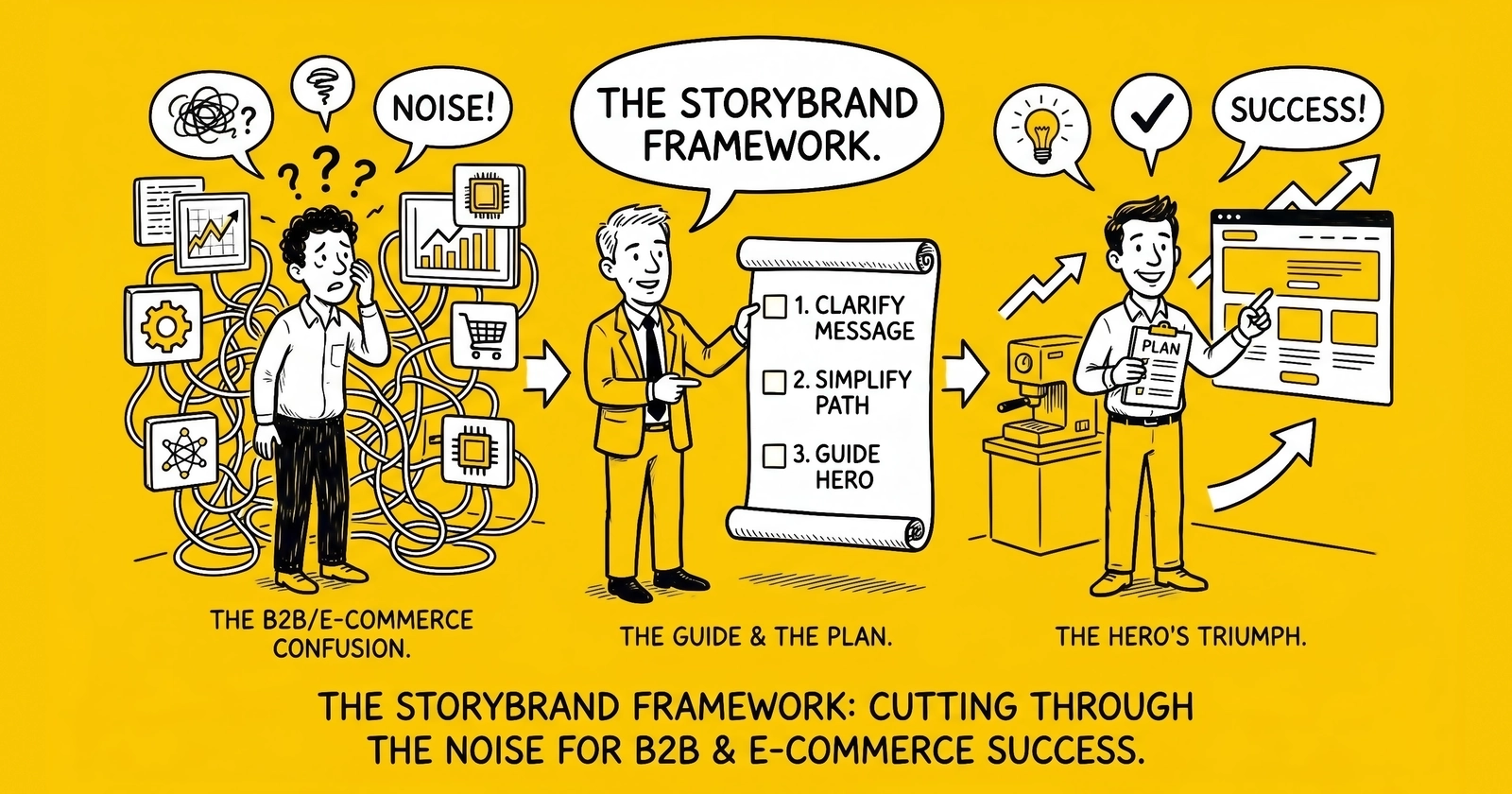
A clear story beats a clever pitch every time customers scan a page in five seconds and decide whether to keep reading.
Why StoryBrand Matters
Marketing teams spend the majority of their copywriting hours describing what a product does. The buyer, scanning a page in roughly five to seven seconds before deciding whether to keep reading, spends that time looking for one signal: does this brand understand the problem the buyer woke up with this morning. The gap between those two activities – what marketers write about and what buyers scan for – is the gap Donald Miller’s StoryBrand framework was built to close.
Miller published Building a StoryBrand: Clarify Your Message So Customers Will Listen in 2017. The first edition has shipped more than one million copies, and HarperCollins Leadership released Building a StoryBrand 2.0 on January 7, 2025, with revised exercises and updated case material. The seven-element model – abbreviated SB7 – has anchored a certification program that now lists more than 450 active marketing professionals, recently rebranded from StoryBrand Certified Guide to StoryBrand Certified Coach as the program folded into the broader CoachBuilder organization. The book sits on most B2B marketing leaders’ shelves, and the BrandScript worksheet shows up taped to the walls of agency conference rooms across the United States.
The framework’s claim is narrow but consequential. Marketing copy that follows the structure of a story – character, problem, guide, plan, call to action, failure stakes, success vision – converts better than copy that catalogs features because human cognition processes narrative more efficiently than lists. Miller draws explicitly on Joseph Campbell’s monomyth, Robert McKee’s screenwriting principles, and the cognitive economy literature that explains why scanned content beats read content in the modern attention environment. The argument is not that storytelling is morally superior to spec sheets. The argument is that storytelling is computationally cheaper for the buyer’s brain, and pages that respect that constraint convert at materially higher rates than pages that do not.
What makes StoryBrand consequential for lead-generation operators specifically is the reframe at the center of the model. The customer is the hero of the story. The brand is not. The brand occupies the guide slot – the Yoda, the Gandalf, the Haymitch – and the product becomes the plan the guide hands the hero. This sounds obvious until a marketer audits the homepage and realizes the headline announces the company’s mission, the second section describes the founders, and the call to action says “Learn More About Us.” Brand-as-hero copy is the default state of corporate websites, and StoryBrand exists primarily to interrupt that default.
The framework’s reach into regulated lead-generation verticals – insurance, mortgage, solar, legal, Medicare – has been uneven. Compliance teams worry that emotional storytelling drifts into deceptive comparison or unsubstantiated promise territory under FTC Section 5 and state mini-FTC statutes. The discipline the framework imposes, however, actually tightens compliance posture when applied carefully. Naming a specific buyer problem in the buyer’s own words is not deception – it is plain language. Showing a three-step plan (“get a quote, compare carriers, switch in 10 minutes”) is not a guarantee – it is a process disclosure. Operators who treat StoryBrand as a clarity exercise rather than a hype exercise tend to ship landing pages their compliance teams approve faster than the legal-bullet-list pages they replaced.
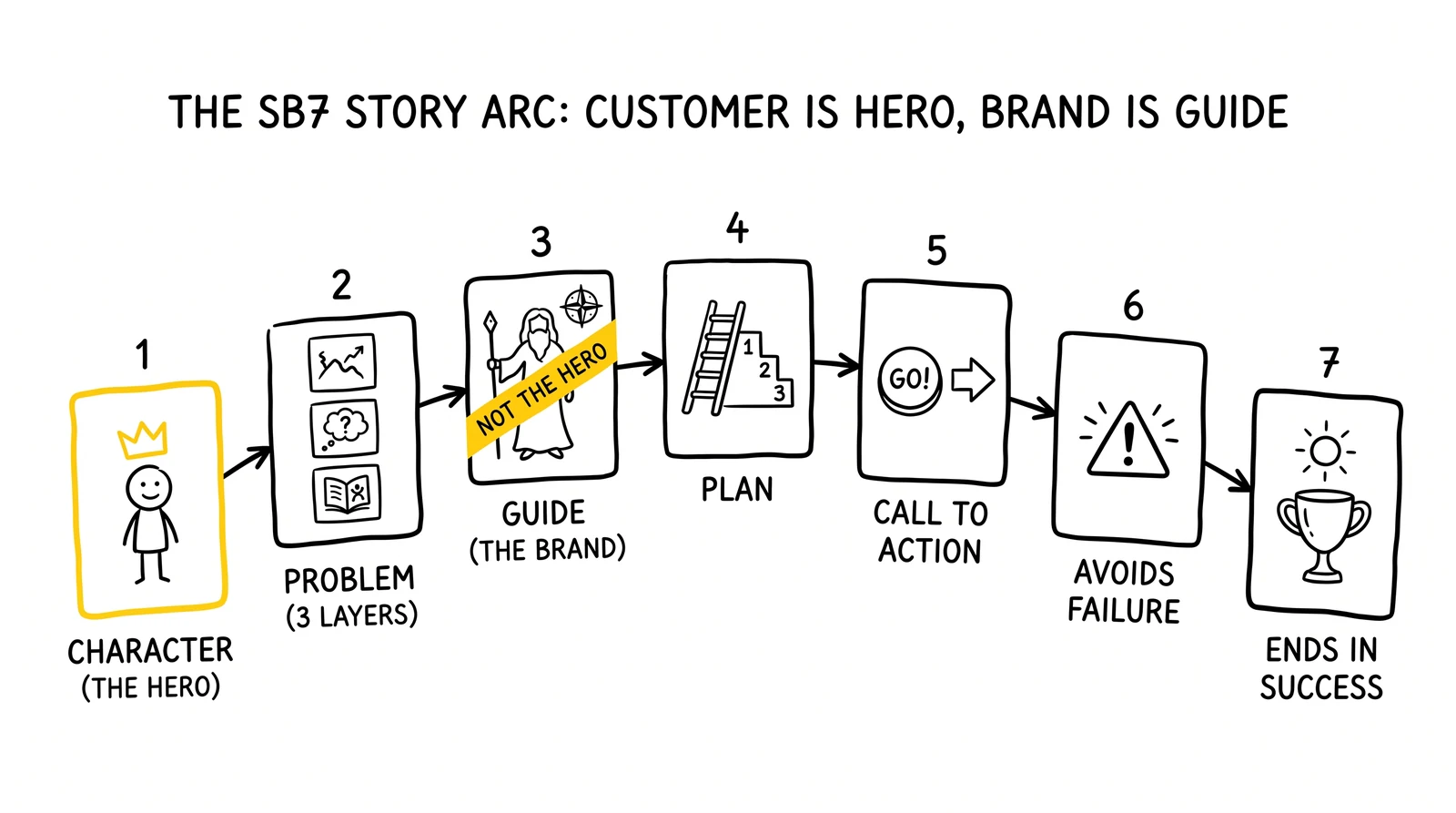
SB7 – Seven Elements Walked
The framework’s logic is sequential. Each element answers a specific question the buyer is asking silently, and each element has to land before the buyer is willing to engage with the next. Skipping ahead – a common mistake when operators try to compress the model onto a single hero section – produces copy that feels rushed even when every individual sentence is well-crafted.
| SB7 Element | The Question Buyers Ask Silently | What the Copy Must Do |
|---|---|---|
| 1. Character | ”Is this for me?” | Name the customer specifically; reflect their identity in the headline |
| 2. Problem | ”Do they understand my situation?” | State the external, internal, and philosophical pain in plain language |
| 3. Guide | ”Why should I trust them?” | Combine empathy (“we get it”) with authority (proof, credentials, scale) |
| 4. Plan | ”What do I have to do?” | Offer three to four steps that lower perceived friction |
| 5. Call to Action | ”What’s the next move?” | Direct CTA (buy, book) plus transitional CTA (download, watch) |
| 6. Avoiding Failure | ”What happens if I don’t act?” | Name the cost of inaction without scaremongering |
| 7. Achieving Success | ”What does life look like if I do?” | Concrete vision of the post-purchase state, ideally with imagery |
The character slot is where operators most often start strong. A good character statement names the buyer’s role, context, and sometimes industry – “homeowners over 55 who want to lock in a fixed mortgage payment before retirement,” “DTC founders shipping 5,000 to 50,000 orders a month,” “solo practitioners running a personal-injury caseload.” Generic openings like “Welcome to our website” fail this slot by refusing to identify the hero at all. The brand should be able to recite, on demand, who the page is for in one sentence. If marketing cannot, neither can the buyer.
The problem slot is where Miller’s framework adds the most value over earlier models like AIDA. Problems exist on three layers. The external problem is the practical issue – “my mortgage rate is 7.5% and I want it lower.” The internal problem is the emotional weight – “I feel anxious every time I open my mortgage statement.” The philosophical problem is the moral or worldview layer – “homeowners shouldn’t be punished by rate cycles they didn’t cause.” Strong copy names all three. Most pages name only the external problem and wonder why the internal monologue of the buyer never seems to be addressed. The AIDA copywriting model on lead forms handles attention well but lacks the three-layer problem decomposition that gives StoryBrand its emotional precision.
The guide slot demands two ingredients in tension: empathy and authority. Empathy without authority feels like a sympathetic friend who cannot help. Authority without empathy feels like a hostile expert. The phrase “we know how stressful refinancing feels – and we’ve helped 47,000 homeowners close in under 21 days” combines both in one sentence. Authority comes from proof – case counts, named clients, regulator approvals, certifications, named team credentials, dollar volumes. Empathy comes from language that mirrors the buyer’s actual words, often pulled directly from customer interviews and review-mining exercises.
The plan slot exists to lower the buyer’s perceived friction. A three-step plan – “fill out a 60-second form, talk to a licensed agent, lock your rate” – does not promise anything but reduces the cognitive cost of starting. Plans should match the actual product flow. Plans that describe what the brand will do are weaker than plans that describe what the buyer will do, because the buyer is the hero and plans belong to heroes.
The call to action splits into direct and transitional. Direct CTAs ask for the conversion: “Get my quote.” Transitional CTAs accept that the buyer is not ready and offer a smaller commitment: “Download the rate-lock checklist.” Pages that show only direct CTAs leak the unconvinced majority. Pages that show only transitional CTAs leak the buyers who were ready to convert. Both belong on the page, with the direct CTA in the dominant position.
The failure and success slots bracket the decision with stakes. Failure copy names what happens if the buyer does nothing – “stay locked into your current rate while inflation erodes your savings.” Success copy paints the post-conversion state in concrete terms – “lower monthly payment, faster amortization, sleep better at night.” Both slots tend to be underused because writers worry about sounding pushy. Done well, the slots feel honest, not manipulative, because they describe outcomes the buyer is already privately weighing.
The Brand-as-Hero Trap
The most common StoryBrand failure is not skipping an element. It is silently swapping the brand into the hero slot and demoting the customer to a supporting role. Operators do this without noticing because corporate communication has trained them to.
Brand-as-hero copy reads like the company is the protagonist of an origin story. The headline announces a mission. The next section describes the founder’s epiphany. The product description leads with proprietary technology. The about page is the longest page on the site. Customer testimonials, when they appear, function as decoration rather than evidence. The buyer reads the page and learns a great deal about the company, while learning very little about whether the company can solve the buyer’s problem.
The trap is seductive because brand-as-hero copy is what executives instinctively write. Founders are proud of their companies. Marketing leaders want to honor the founder’s vision. Designers prefer hero sections that feature product imagery rather than buyer imagery. The result is a homepage that reads like a corporate biography and a landing page that reads like a sales deck. Both convert below the rate the same traffic would convert at if the page led with the buyer’s problem.
The fix is mechanical, not philosophical. Audit the homepage hero section. Underline every word that refers to the brand and every word that refers to the buyer. If the brand-words outnumber the buyer-words by more than two to one, rewrite. The replacement headline should describe the buyer’s problem or aspiration in the buyer’s language. The supporting paragraph should demonstrate the brand understands the problem. The CTA should describe what the buyer will get, not what the brand offers.
Apple is the canonical recovery story. By 1996, under Gil Amelio’s tenure, the company’s marketing had drifted into a sprawling, feature-heavy product line that buyers struggled to navigate – Apple’s mid-1990s communication leaned on technical specifications and a confused product matrix while sales and stock both hit multi-year lows. When Steve Jobs returned through the NeXT acquisition in late 1996 and assumed interim CEO in 1997, the “Think Different” campaign that followed reduced Apple’s identity to two words printed on billboards. The shift was not from product copy to slogan copy. The shift was from company-as-hero to customer-as-hero, where the hero was a creative person who refused to settle for ordinary tools. Tesla operates on the same logic at the philosophical-problem layer. Elon Musk’s narrative does not lead with battery chemistry or motor torque. It leads with “your choice of car ought to save the environment,” recasting the buyer as a participant in planetary stewardship. Both companies sell premium products at premium prices, and both rely on customer-as-hero positioning to make the price feel like a worthwhile cost of identity rather than an unjustified markup.
Most operators will not match Apple or Tesla on narrative. They do not need to. They need to match the bar of “buyer can identify themselves in the headline within five seconds.” That bar is low and most homepages still miss it.
Lead-Generation Application
Regulated lead-generation verticals impose constraints that change how SB7 ships. Compliance teams scrutinize emotional language for unsubstantiated promises. State attorneys general read insurance landing pages for misleading rate claims. The FCC and state mini-TCPA regulators read consent disclosures and the language immediately surrounding them. Solar operators face FTC and state-level scrutiny on savings claims that StoryBrand-style success copy can stumble into if written carelessly.
The framework still applies. It just has to be applied with the awareness that the success and failure slots are the highest-risk slots, and the problem and guide slots are the highest-leverage slots. Naming the buyer’s problem precisely is rarely a compliance issue. Promising the buyer a specific outcome – “save $5,000 a year on your mortgage” – almost always is, unless the operator has the substantiation files to defend it under a Section 5 inquiry.
| Vertical | Hero (Character) | Primary Problem | Guide Authority Signals | Direct CTA | Transitional CTA |
|---|---|---|---|---|---|
| Auto insurance | ”Drivers paying more than $1,800 a year” | Rate spike at renewal | A.M. Best ratings, carrier count, NAIC complaint ratio | ”Compare quotes in 90 seconds" | "Get the renewal-shock checklist” |
| Refi mortgage | ”Homeowners with rates above 6.5%“ | Locked into rate cycle | NMLS ID, closed-loan volume, average days-to-close | ”See my rate options" | "Download the refi break-even calculator” |
| Residential solar | ”Homeowners with summer bills over $250” | Utility bill volatility | NABCEP certification, install count, BBB rating | ”Get my custom proposal" | "Estimate my savings” |
| Personal injury | ”Crash victims still in treatment” | Bills mounting, insurer pushing settlement | Bar admission, case results, AVVO rating | ”Free case review" | "Read the settlement-timeline guide” |
| Medicare advantage | ”Adults turning 65 in the next 6 months” | IEP confusion, plan overload | Licensed agent count, carrier appointments, CMS compliance | ”Compare 2026 plans" | "Download the IEP checklist” |
The pattern across verticals is consistent. Hero specificity matters more than hero breadth – “drivers paying more than $1,800 a year” outperforms “anyone looking for cheaper insurance” because the buyer either is or is not in the bucket, and the bucket is recognizable in a five-second scan. Guide authority signals must be verifiable, dated, and ideally regulator-issued; warm-fuzzy phrases like “trusted by thousands” without a number underperform exact counts.
The plan slot interlocks tightly with the form design – see multi-step forms and conversion optimization – because the plan promised in the copy (“fill out a 60-second form”) has to match the form the buyer hits next. Promised plans that exceed the form’s actual duration produce abandonment rates that no headline rewrite can recover. The same logic applies upstream from the form: a landing page funnel optimized for SB7 tends to lift the upper-funnel CVR while leaving the form CVR intact, which compounds across the funnel even when individual lifts look modest.
The compliance layer maps onto SB7 cleanly when operators ship the framework with three rules. First, success copy must name an experience, not a number, unless substantiation exists (“sleep better knowing your rate is locked” rather than “save $4,800”). Second, failure copy must describe a real risk the buyer is already weighing, not a manufactured threat (“rates have moved 75 basis points in the last 90 days” rather than “act now or lose forever”). Third, the consent language adjacent to the CTA must remain regulator-readable, which means SB7-flavored hype cannot leak into the disclosure block. Operators who treat SB7 as a clarity discipline rather than a persuasion discipline ship pages that pass compliance review on the first pass.
Ecommerce Application
DTC ecommerce uses StoryBrand differently because the product page, not the homepage, is where most conversion decisions land. The framework applies, but the seven elements compress and the success slot does most of the heavy lifting.
The character slot on a product page is partly self-selecting. A buyer who searched “best non-toxic mascara for sensitive eyes” has already declared their identity. The product page’s job is to confirm – “for sensitive-eyed makeup wearers who refuse to compromise” – rather than introduce. Pages that try to re-introduce the hero waste scarce attention budget on a question the buyer has already answered.
The problem slot in DTC tends to skew internal and philosophical because external problems are usually solved by competitor products too. Allbirds did not invent comfortable shoes – they sold the philosophical problem of footwear made from carbon-intensive materials. Casper did not invent comfortable mattresses – they sold the internal problem of buying-a-mattress dread, the dehumanizing showroom experience, the financing pressure. Warby Parker did not invent affordable glasses – they sold the philosophical problem of optical-industry monopoly pricing and the internal problem of having to choose blind. In every case the external problem is table stakes, and the internal-philosophical problem is the lever.
The guide slot in ecommerce relies heavily on social proof. Review counts, star ratings, named press citations, founder transparency. The “guide demonstrates empathy” half of the slot tends to come through founder-letter copy and unboxing imagery that signals the product was made by people who actually use it. The “guide demonstrates authority” half tends to come through certifications (B Corp, Leaping Bunny, USDA Organic, GOTS) and named third-party validation. Pages that show 4.7-star ratings without a review count underperform pages that show 4.7 stars across 14,332 reviews because the latter is verifiable.
The plan slot in DTC is usually the unboxing-to-use sequence. “Order today, ships in 24 hours, arrives in 3 days, easy return if it’s not right.” The plan reduces the perceived risk of buying online, and pages that compress the plan into one line (“free shipping and returns”) leave value on the table by skipping the sequence the buyer actually wants visualized.
The call to action in DTC splits cleanly. Direct CTA is “Add to cart.” Transitional CTA is “Try a sample,” “Take the quiz,” “Email me when restocked,” or “Subscribe and save 15%.” High-consideration categories – mattresses, supplements, premium skincare – benefit from prominent transitional CTAs because the buyer often needs more than one session to convert. Low-consideration categories – basics, replenishment – can run direct-only.
The success slot is where DTC StoryBrand pages usually compete. Concrete imagery of the post-purchase state – the made bed, the finished face, the feet in the shoes – does what success copy cannot. The pairing of imagery with one-line success captions (“Wake up rested. Stay rested.”) tends to outperform either element alone. Failure slots in DTC are usually understated, because consumer e-commerce buyers respond poorly to fear messaging. A soft failure framing (“don’t keep settling for stiff fabric”) tends to outperform a hard failure framing (“synthetic fibers are slowly poisoning your skin”).
Brand archetype work and StoryBrand sit adjacent. The archetype tells the brand who it is. The BrandScript tells the brand how to talk about the customer. Operators who run both exercises tend to ship copy with consistent voice across the entire customer journey – from ad to landing page to email sequence to retention campaign – because the two frameworks answer different questions and stack rather than collide.
B2B SaaS Application
B2B SaaS imposes the opposite constraint of DTC. Buyers research over weeks, evaluate in committees, and read more pages per visitor than any other category. The StoryBrand homepage still has to pass the five-second scan, but the funnel that follows has to support a multi-week evaluation that the framework does not, on its own, address.
B2B SaaS landing pages average 2 to 5% conversion to demo or trial, with top performers in the 8 to 15% range, according to recurring benchmark studies from agencies that publish their data. The differentiators are intent-matched pages, five-second clarity, objection-handling copy, and form design that respects the buyer’s time. SB7 pressure-tests the first two and partially the third.
The character slot on a SaaS homepage names the role and the company size – “for revenue operations leaders at 50-to-500-person SaaS companies” – and resists the temptation to claim everyone. Horizontal SaaS companies that try to address every persona in the hero section end up addressing none. The pattern that wins is a vertical or role-specific homepage with category, comparison, and pricing pages that speak to specific buyer concerns downstream.
The problem slot in SaaS is usually external (a workflow gap), internal (the emotional cost of cobbling tools), and philosophical (the modern stack should not require this much glue). Pages that name only the external workflow gap – “manage your pipeline” – leave the emotional and philosophical layers on the table, and the emotional and philosophical layers are where champions inside the buying account actually fall in love with the product.
The guide slot in SaaS leans heavily on customer logos, named case studies with quantified outcomes, analyst recognition (Gartner, Forrester, G2), and security-and-compliance signals (SOC 2, ISO 27001, HIPAA). Empathy comes through founder-and-team content that signals the team has lived the buyer’s pain. Authority comes through the badges. Pages that show only badges feel cold. Pages that show only founder content feel unproven. Both belong.
The plan slot in SaaS becomes the implementation roadmap. “Sign up, connect your CRM in 12 minutes, see your first dashboard in 24 hours, full team rollout in 2 weeks.” Plans that promise 2-week rollouts when the actual rollout is 6 weeks corrode trust during onboarding and produce churn within the first 90 days. Plans should match what the customer success team can actually deliver.
The CTA structure in SaaS is the most heavily tested element of the page. Direct CTAs typically split between “Start free trial” (PLG motion) and “Book a demo” (sales-led motion). Transitional CTAs include “Watch a 5-minute product tour,” “See pricing,” “Read the comparison,” and “Download the buyer’s guide.” Comparison and pricing pages – historically separated from the homepage – perform unusually well as transitional CTAs in StoryBrand-structured funnels because they resolve the two objections most buyers carry into the demo conversation.
Failure slots in B2B work when they describe the specific pain of inaction in the buyer’s vocabulary – “another quarter of pipeline forecasts your CRO does not trust” – and fail when they invoke generic corporate fears. Success slots work when they describe a specific operational state – “weekly forecast accuracy above 90%, time-to-value on new reps under 30 days” – and fail when they retreat to generic outcomes like “drive growth.”
The B2B SaaS BrandScript also has to anticipate the committee. Champions need internal-problem language to sell the project up the chain. Economic buyers need failure-and-success language to justify the budget. Technical buyers need plan-and-guide-authority language to validate implementation feasibility. A single homepage cannot serve all three, but a StoryBrand-anchored funnel can route each persona to the page that addresses their primary slot, with the BrandScript ensuring voice consistency across the routes.
The BrandScript Template
The BrandScript is the operational artifact that makes StoryBrand teachable across teams. It is a single page, available as a free PDF and as an editable web template at mystorybrand.com, that captures the company’s answers to each of the seven SB7 prompts. Once filled, it functions as the source document for headlines, hero sections, ad copy, email sequences, sales call scripts, and retention messaging across the entire customer journey.
The mechanics are simple. The character section asks who the customer is in one sentence. The problem section asks for the external, internal, and philosophical problems on three lines. The guide section asks for one empathy statement and one authority statement. The plan section asks for three to four steps. The call-to-action section asks for one direct and one transitional CTA. The failure section asks for three to four specific things the customer wants to avoid. The success section asks for three to four specific outcomes the customer wants to achieve.
The discipline the template imposes is what makes it valuable. Most companies discover, mid-exercise, that they cannot describe their customer in one sentence without arguing among themselves. They discover that the founder’s articulation of the customer’s problem differs from the sales team’s, which differs from the customer success team’s, which differs from what customers actually say in interviews. They discover that the empathy statement they have been using on the homepage is generic to the point of being interchangeable with a competitor’s. The BrandScript exercise surfaces these gaps, and the gaps are the work.
The exercise should be run with three inputs. First, customer interviews – eight to twelve recorded conversations with current customers, prospects who chose competitors, and prospects who chose to do nothing. Second, review and ticket mining – the actual language customers use in support tickets, NPS comments, and third-party reviews. Third, sales call recordings – the words customers use when describing their pain to a salesperson, before the salesperson reframes them. The BrandScript should be filled with phrases pulled from these three sources, not phrases the marketing team invented in a conference room.
The output is a single page. Companies that ship the BrandScript as a 12-slide deck have missed the point. The constraint is the value. A sales rep who needs to prep for a call should be able to read the BrandScript in 90 seconds and walk into the call with the customer’s vocabulary loaded. A copywriter writing a new email sequence should be able to lift problem-statement language directly off the page. A new hire on day three should be able to recite the success vision back to the manager from memory. None of those use cases survive a 12-slide expansion.
The BrandScript also functions as the QA artifact for any new asset. Before a landing page ships, the marketing team should be able to point to which section of the BrandScript each major copy block corresponds to. If a copy block does not map, either the BrandScript is incomplete or the copy block is off-message. The discipline produces a consistent voice across hundreds of touchpoints – emails, ads, organic content, sales decks, support macros – that no style guide or tone-of-voice document achieves on its own.
Measurement: StoryBrand vs Feature-Led A/B Testing
The framework’s claim is testable. A page rewritten to SB7 conventions and tested against the same page in feature-led format on the same traffic should produce a measurable conversion lift, and the lift should be reproducible across multiple pages and verticals. Reported results vary widely by case and methodology rather than converging on a single multiplier – Donald Miller’s StoryBrand case-study library cites individual examples ranging from sub-20% list-growth gains to a webinar registration page that converted at 60% to a cold-ads audience after a StoryBrand rewrite, attributed by Miller’s team to creator Amy Porterfield. Pages that were already well-written tend to show no lift at all, which is the framework working as designed – there is no SB7 magic, only the elimination of brand-as-hero defaults.
The test design matters. SB7 is a structural rewrite, not a copy tweak. Running a multivariate test on a single headline while leaving the rest of the page in feature-led format is not a StoryBrand test – it is a headline test that happens to use StoryBrand language. A real test holds the offer, traffic source, form, and pricing constant, and varies the entire above-the-fold structure plus the page sequence below.
Statistical power is usually the constraint. Pages with fewer than 1,000 weekly conversions struggle to detect lifts under 20% within a reasonable test window. Operators on lower-volume pages should either pool similar pages, run sequential pre/post tests with seasonality controls, or accept that they are running a directional test rather than a statistically powered one. The statistically powered SB7 tests in the wild tend to come from agencies with multiple high-volume client pages and the ability to aggregate results across accounts.
The lift duration matters as much as the lift size. Pages launched with proper SB7 structure and continued audience research tend to hold their lifts. Pages launched once and never refreshed tend to regress toward the mean within two quarters as the BrandScript drifts out of sync with the actual customer base. The teams that retain gains treat the BrandScript as a quarterly artifact that gets re-validated against fresh customer interviews, not as a one-time launch document. Lead-quality regression analysis techniques help isolate which pages actually moved, which is essential when SB7 rewrites land alongside other changes – paid traffic shifts, form redesigns, pricing updates – that confound naive pre/post comparisons.
The downstream metrics matter more than the page-level CVR. SB7 pages tend to attract better-fit buyers because the hero specificity in the headline pre-qualifies traffic. Better-fit buyers convert downstream at higher rates, retain longer, and refer more. Operators who measure only the page-level CVR understate the framework’s effect. Operators who measure CAC payback, 12-month retention, and qualified pipeline rate tend to find the SB7 effect compounds well past the initial conversion lift, sometimes by a multiple of three or four over a 12-month window.
The honest counter-evidence is that some categories do not benefit. Pure commodity ecommerce – where the buyer arrived with intent already framed by the search query – tends to gain less because the StoryBrand machinery is solving a problem the search engine already solved. High-frequency replenishment categories – pet food, contact lenses – gain less because the buyer has already mentally categorized the brand and is not re-evaluating each visit. Operators in those categories should still run the BrandScript exercise for ad copy and email sequences but should not expect a homepage rewrite to move the conversion needle materially.
Key Takeaways
- StoryBrand has shipped over one million copies across two editions and codifies a seven-element messaging structure that can be tested against feature-led copy and reliably wins on pages that were severely brand-as-hero.
- The customer-as-hero, brand-as-guide reframe is the single most valuable insight in the framework. Audit any homepage by underlining brand-words versus buyer-words; brand-words outnumbering buyer-words two-to-one is the diagnostic for a rewrite.
- Three-layer problem analysis (external, internal, philosophical) is the framework’s largest gain over older models like AIDA. Most pages name only the external problem and miss the emotional and worldview layers where buying decisions actually crystallize.
- Lead-generation verticals can ship SB7 inside compliance constraints by leading with problem-and-guide slots and treating success and failure copy as the highest regulatory-risk slots – promise experiences, not numbers, unless substantiated.
- DTC ecommerce uses SB7 differently than B2B because the product page does the heavy lifting and the success slot is image-led; the BrandScript still drives ad and email voice consistency.
- B2B SaaS funnels need SB7 plus a multi-page architecture (homepage, comparison, pricing, demo) because committee evaluation cannot be served by a single page; the BrandScript ensures voice consistency across the routes.
- The BrandScript is the operational artifact that makes the framework teachable; companies that ship it as a one-page document and refresh it quarterly retain SB7 gains, while teams that file it after launch tend to regress within two quarters.
- Reported StoryBrand conversion lifts vary widely by case and methodology, with Donald Miller’s case-study library citing individual results from sub-20% gains to a webinar page that converted at 60% to cold traffic; pages that were already well-written tend to show no lift at all – the framework eliminates default failures rather than producing a uniform multiplier.
Sources
- Bestselling Author Donald Miller to Release Building a StoryBrand 2.0 With HarperCollins Leadership on January 7, 2025 (BusinessWire, Nov 2024)
- Building a StoryBrand 2.0 (HarperCollins Focus, 2025)
- StoryBrand official site (StoryBrand, 2026)
- One-page BrandScript template (StoryBrand PDF)
- StoryBrand Guide Certification (StoryBrand, 2026)
- Building a StoryBrand listing (Goodreads, 2017 first edition)
- The Good – StoryBrand Framework copywriting analysis
- ProductLed – B2B SaaS Copywriting Above the Fold
- Connective Web Design – StoryBrand B2B Homepage Guide
- Sean Garner Consulting – Seven Elements of the StoryBrand Framework
- Marketing Examples – How Steve Jobs clarified Apple’s message
- Cult of Mac – Today in Apple history: After a horrible quarter, Gil Amelio gets the boot
- StoryBrand Guide Testimonials – including Amy Porterfield 60% webinar registration case