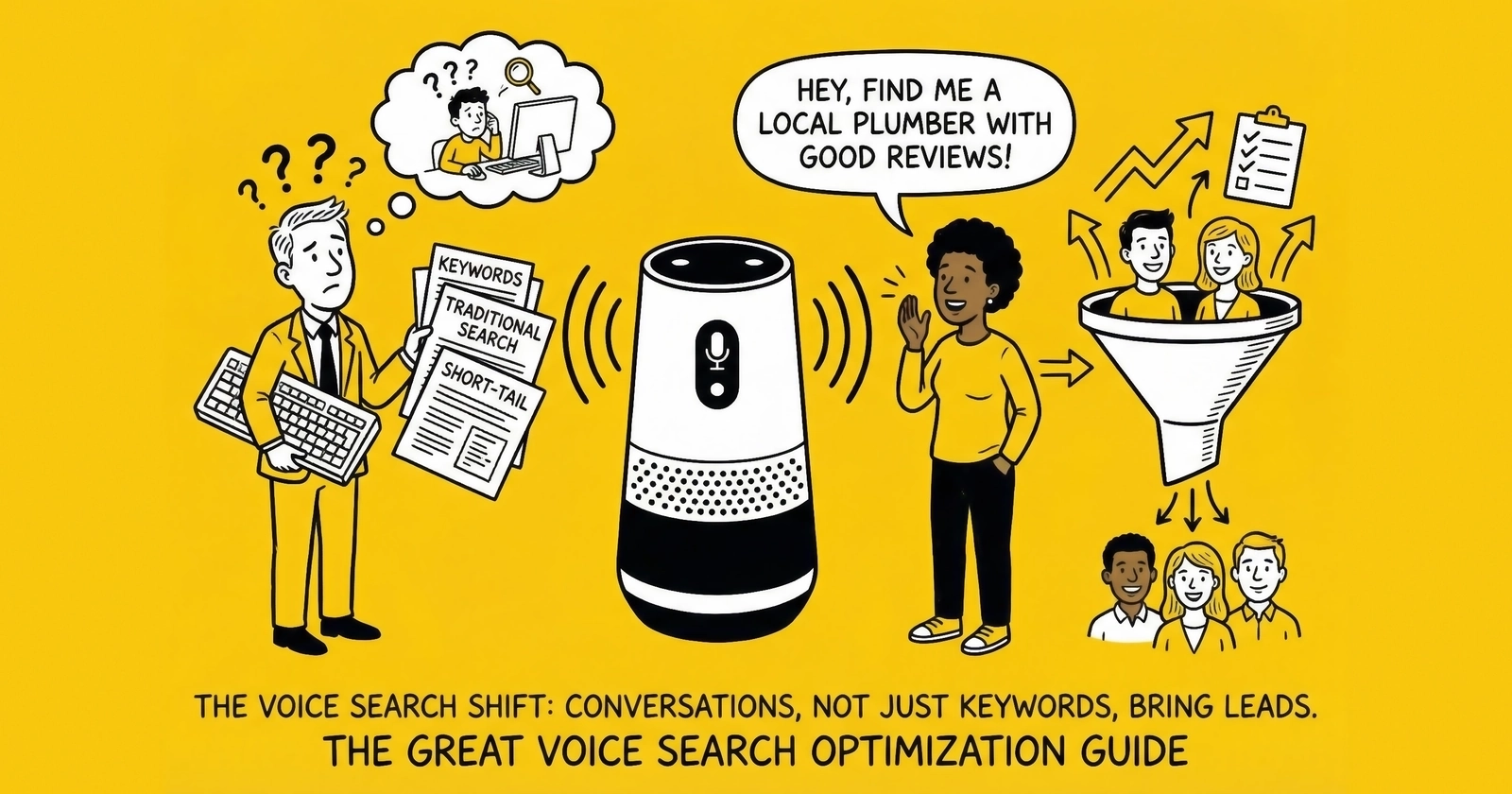
The way consumers find businesses has fundamentally changed. While you were optimizing meta titles and building backlink profiles, a parallel search ecosystem emerged – one where queries sound like conversations rather than keywords. Voice search now accounts for 27% of the global online population using mobile devices to speak their queries, and 58% of consumers have used voice search to find local business information in the past 12 months.
For lead generators, this shift represents both opportunity and strategic imperative. Those who understand voice search mechanics are capturing leads that competitors never see – queries that happen in cars, kitchens, and living rooms, spoken to devices that never type a single character.
This guide covers everything you need to know about voice search optimization for lead generation in 2026: the current landscape, technical requirements, local SEO integration, smart speaker strategies, and the specific tactics that drive conversational query traffic into your lead funnels.
The Voice Search Landscape in 2026
Understanding where we are requires examining the data. Voice search is no longer an emerging trend – it is a mature channel with specific user behaviors and technical requirements.
Current Adoption Statistics
The numbers tell a clear story of mainstream adoption. Half of all US consumers now use voice search daily, and 71% prefer speaking their queries over typing them. Globally, 27% of the online population uses mobile voice search regularly, with 46% of voice search users looking for local business information every day. The commercial impact is equally significant: 33.2 million US consumers have already shopped using smart speakers.
The virtual assistant market is projected to reach $309.9 billion by 2033, growing from approximately $15 billion in 2023. Smart speaker market valuations follow a similar trajectory – valued at $10.6 billion in 2022 with projections reaching $50.9 billion by 2030. More than one-third of US consumers own a smart speaker. This is not early adopter territory anymore. Voice search has crossed into mainstream consumer behavior.
Device Distribution for Local Voice Search
Understanding where voice searches originate helps prioritize optimization efforts. Smartphones dominate the landscape, with 56% of consumers having used voice search on mobile devices. Desktop and laptop computers account for 28% of voice search usage, while tablets represent 26%. Despite the media attention lavished on Alexa and Google Home, smart speakers account for only 18% of local voice searches.
This distribution has direct implications for your optimization priorities. Mobile voice search should receive the lion’s share of your attention, not because smart speakers are unimportant, but because smartphones are where the volume lives.
What Consumers Search For
Voice search users exhibit distinct behavioral patterns that reveal their intent. Weather checks lead at 17% of queries, followed closely by “near me” searches for local businesses at 16% and hands-free driving searches at 14%. When it comes to specific business categories, restaurants and cafes dominate at 51% of local business voice searches, followed by grocery stores at 41% and food delivery services at 35%.
What happens after the voice search tells you everything about conversion potential. Twenty-eight percent of users call the business after a voice search, while 27% visit the business website. The majority seek immediate, actionable information – contact details, addresses, directions, and operating hours. The pattern is clear: voice search users want immediate, actionable information. They are not browsing – they are deciding.
Demographic Patterns
Voice search adoption varies significantly by age group, and understanding these differences helps you target content and verticals appropriately. Millennials between ages 26 and 35 show the highest adoption at 35.8% monthly usage. Gen Z (ages 18-25) demonstrates strong adoption, particularly for entertainment and research queries. Gen X users between 36 and 55 show growing adoption, especially for local and home-related searches. Baby Boomers over 55 represent 10.1% of monthly usage, but this segment is growing rapidly.
Insurance and financial services see different voice search patterns than home services or retail. Knowing your vertical’s demographic alignment with voice adoption helps you prioritize investment in this channel.
The Accessibility Dimension
Voice search serves a critical accessibility function that extends beyond convenience. Users with visual impairments, motor disabilities, or situational constraints – driving, cooking, holding children – rely on voice for search access that would otherwise require typing.
This accessibility aspect has implications for compliance and content design. Making your content voice-accessible is not just SEO strategy – it expands your addressable market to users who cannot or prefer not to type their queries.
How Voice Search Differs From Traditional Search
Optimizing for voice requires understanding what makes spoken queries fundamentally different from typed searches.
Query Structure and Length
Traditional text searches tend toward brevity. Users type “plumber near me” or “best auto insurance rates.” Voice searches are conversational by nature – full sentences or questions that mirror natural speech patterns.
Consider the difference. A text search might read “plumber emergency 24 hour.” The same need expressed through voice becomes “Hey Google, who is the best emergency plumber open right now near my location?” Voice queries are typically longer, more specific, and structured as questions. The same information need manifests as completely different query strings.
Intent Signals
Voice search queries carry stronger intent signals than text queries. Transactional intent – purchasing, getting directions – dominates voice searches. Users speaking their queries are often engaged in high-intent consideration, actively looking for nearby services and ready to buy. The hands-free nature of voice search suggests urgent contexts where immediate need drives the query.
Mobile voice searches are three times more likely to be location-based than text searches. When someone speaks a query instead of typing it, they are typically in motion, multitasking, or in a context where typing is inconvenient – all signals of immediate intent.
The Featured Snippet Connection
Voice assistants do not read ten blue links. They provide one answer. Research on 10,000 Google Home results revealed that 40.7% of voice search answers come from featured snippets, and 74.9% of voice search results rank in the top three for that keyword on desktop. Seventy percent of all voice search answers occupy some form of SERP feature.
The implication is straightforward: if you are not capturing featured snippets and position zero rankings, you are invisible to voice search.
Technical Requirements for Voice Search Optimization
Voice search optimization is not a separate discipline from SEO – it is SEO executed with specific priorities and refinements.
Page Speed: The Non-Negotiable
The average voice search result page loads in 4.6 seconds. That is 52% faster than the average web page. Speed matters disproportionately for voice because voice assistants prioritize fast-loading sources, users expect immediate answers, and slow pages create poor assistant experiences.
Your speed optimization checklist should include:
- Target sub-3-second load times
- Implement lazy loading for images
- Use CDN for content delivery
- Minimize render-blocking resources
- Compress all images without quality loss
HTTPS Implementation
Voice assistants preferentially surface secure pages: 70.4% of voice search results use HTTPS, compared to 50% of general desktop results. If you are still running HTTP in 2026, you have larger problems than voice search. But the data confirms that security is a ranking factor with even more weight in voice results.
Mobile Optimization
Since 56% of local voice searches happen on smartphones, mobile optimization is foundational. Your site needs responsive design that adapts to all screen sizes, touch-friendly navigation elements, readable text without zooming, and fast mobile page speed measured separately from desktop metrics. Click-to-call functionality should be prominently displayed on every key page.
Domain Authority
The mean Domain Rating of voice search results is 76.8. Voice assistants surface answers from authoritative, established sources.
This creates a compound challenge for newer lead generation sites. Building domain authority takes time – quality backlinks, consistent content publication, and established web presence. Voice search rewards the operators who have been building authority for years.
For newer operations, focus on long-tail conversational queries with lower competition while building authority. Target specific local areas or niche topics where your relative authority is higher. The voice search game favors the patient player who compounds advantages over time.
Content Optimization for Conversational Queries
Voice search content optimization focuses on how people actually speak, not how they type.
Keyword Research for Voice
Voice search keywords fall into three distinct categories. Long-tail keywords are specific, lower-volume searches like “how to compare auto insurance quotes for first-time drivers in Texas.” These queries face less competition and signal high intent. Question keywords are queries starting with how, what, why, when, where, and who – representing the majority of voice searches. “How much does solar panel installation cost in Arizona?” is a voice-native query. Conversational keywords reflect natural speech patterns: “What is the best way to find a reliable plumber in my area?” These differ significantly from the truncated versions users type.
Your research process should use keyword tools to filter by question type, target low-to-medium keyword difficulty, prioritize queries that match your lead vertical, and build content around natural language variations.
Content Structure for Voice
The average voice search answer is 29 words. However, the average page word count for voice results is 2,312 words. This apparent contradiction makes sense: comprehensive pages provide more matching opportunities for the variety of ways people phrase questions. Within that comprehensive content, include concise, clear answer blocks.
The optimal structure opens sections with direct answer paragraphs of 30 to 50 words, then expands with supporting detail. Include multiple question-based subheadings throughout, maintain a 9th-grade reading level for clarity, and use natural, conversational language throughout.
FAQ Sections
FAQ pages are ideal for voice search optimization. They naturally match the question-and-answer format, provide multiple query targets per page, and signal topical authority to search engines and voice assistants alike.
For FAQ optimization, use actual customer questions as section headers and keep answers concise – 40 to 60 words is ideal for voice pickup. Structure with proper heading hierarchy using H2 for questions, include schema markup for FAQ content, and add related questions users might ask next.
Schema Markup Implementation
Structured data helps voice assistants understand and deliver your content. Essential schema types for lead generation include LocalBusiness for NAP data, hours, and service areas; FAQ for question and answer pairs; HowTo for step-by-step processes; Product/Service for offerings with pricing and descriptions; and Review for customer ratings and testimonials.
Implementing schema does not guarantee voice search inclusion, but it significantly improves the odds that assistants correctly interpret your content.
Reading Level Optimization
Voice search results use simple, clear language. Research indicates that the average voice search result is written at a 9th-grade reading level. This is not about dumbing down content – it is about clarity.
Write with short sentences for key points, use common vocabulary over jargon, construct sentences in active voice, make direct statements rather than circumlocution, and define technical terms when necessary. Complex topics can be explained simply. The goal is immediate comprehension when the answer is read aloud by an assistant. If your content requires re-reading to understand, it will not work for voice.
Answer Box Optimization
The ideal structure for voice search answers follows a specific pattern. The first sentence should answer the question completely in under 30 words – this is your direct answer. The second sentence adds essential context or qualification. Following sentences provide supporting information.
This inverted pyramid structure matches how voice assistants select and deliver answers. The assistant can stop after one sentence for simple queries or continue for users who want more detail.
Consider a query like “How much does a solar panel installation cost?” An optimized answer might read: “Solar panel installation typically costs between $15,000 and $25,000 for a standard residential system before tax incentives. Federal tax credits can reduce this by 30%, bringing the net cost to $10,500-$17,500. Actual costs vary based on system size, equipment quality, and local labor rates.” The first sentence answers the question. Everything after adds value but is not essential.
Local SEO for Voice Search
Voice search and local SEO are deeply intertwined. “Near me” searches represent 16% of all voice queries, and local intent dominates smart speaker usage patterns.
Google Business Profile Optimization
For Google Assistant queries – which power the majority of voice searches – your Google Business Profile (GBP) is the primary data source.
Complete every element of your profile for maximum voice visibility. Your NAP data (Name, Address, Phone) must be accurate and consistent across all platforms. Select primary and secondary categories precisely, and add all services with descriptions. Include product catalogs where applicable, and keep operating hours current including holiday variations. Add all relevant business attributes such as wheelchair accessibility, free parking, and other amenities. Upload quality images regularly and publish weekly updates about offers, events, and news. Seed common questions in the Q&A section and provide answers. Finally, actively request and respond to reviews.
Local Citations and Directories
Voice assistants pull from multiple data sources. Consistent presence across local directories strengthens your visibility. Maintain listings on Yelp, Bing Places, Apple Maps, industry-specific directories, local chamber of commerce listings, and regional business directories. NAP consistency across these platforms is critical. Conflicting information confuses voice assistants and degrades trust signals.
Local Keyword Targeting
Voice queries often include geographic modifiers spoken naturally. Users search for an “insurance agent near downtown Portland” or the “best personal injury lawyer in Cook County” or “solar installers that serve the east bay area.” Create content that incorporates neighborhood names, landmark references, and regional terminology that locals actually use – not just city names.
Review Strategy
Reviews influence voice search visibility in two ways. As a ranking signal, higher review counts and ratings improve local rankings. As answer content, voice assistants sometimes cite review content in responses.
User preferences reveal what people want from voice interactions: 54% want restaurant reservation capabilities, 46% want to hear business prices, and 35% want appointment booking for beauty and medical services. Encouraging reviews that mention these specific capabilities can improve your voice relevance.
Smart Speaker Marketing Strategies
Smart speakers represent a distinct channel within voice search, with unique opportunities for lead generators.
Platform Considerations
The major platforms have different implications for your optimization strategy. Amazon Alexa uses Bing for web search results, while Google Home and Nest devices use Google Search. Apple HomePod uses Siri with Google providing some query answers.
Optimizing only for Google means missing Alexa users entirely. Multi-platform visibility requires presence in multiple directories and search ecosystems.
Voice Commerce Opportunities
Voice commerce reached $1.8 billion in transaction value, with projections suggesting significant growth. Categories with traction include health and beauty products at 8.9 million purchases, electronics at 8.8 million, and household products at 8.5 million.
For lead generators, the opportunity is not direct commerce but capturing the research phase. Fifty-one percent of online shoppers research products via voice, and 33% add items to shopping lists using voice commands.
Skill and Action Development
For high-volume verticals, custom voice skills (Alexa) or actions (Google) can provide direct lead capture. Potential applications include insurance quote starters, home service appointment scheduling, legal consultation booking, and mortgage rate checks. Development requires investment, but creates owned channels within voice ecosystems.
The investment for custom voice skills ranges from $5,000 for basic functionality to $50,000 or more for sophisticated integrations with backend systems. Before committing resources, consider whether your vertical is conversational enough for voice interaction, whether you have sufficient volume to justify development costs, whether you can maintain and update the skill post-launch, and what competitive landscape exists for voice in your vertical.
For most lead generators, optimizing web content for voice search delivers higher ROI than custom skill development. Reserve skill development for established operations with proven voice search traction and clear use cases.
Consumer Preferences for Voice Marketing
Research indicates openness to marketing through voice. Fifty-two percent of voice-activated speaker owners want information about deals, sales, and promotions. Users prefer voice interactions for simple, transactional tasks, and appointment booking along with reservation making are highly desired features.
This signals opportunity for lead generation through promotional offers, service availability information, and booking functionality.
Optimizing Lead Forms for Voice Traffic
Voice search users have different expectations and behaviors than traditional search traffic. Lead capture must adapt accordingly.
Mobile-First Form Design
Since the majority of voice searches originate on mobile devices, forms must be mobile-optimized. Design with large, touch-friendly input fields and minimize required fields to five or fewer for initial capture. Enable auto-fill compatibility for common fields and make click-to-call a primary CTA where applicable. Use single-column layouts and include clear progress indicators for multi-step forms.
Speed-to-Value
Voice search users expect immediate results. They asked a question and want an answer now. Lead with value – a quote preview, availability check, or instant estimate – before asking for detailed data. Defer comprehensive data collection to follow-up interactions, use progressive profiling over multiple touchpoints, and provide immediate confirmation with clear next steps.
Phone-Centric Capture
Twenty-eight percent of voice search users call the business after searching. This represents a significant lead capture opportunity. Feature prominent phone numbers throughout landing pages with click-to-call buttons above the fold. Implement call tracking numbers for attribution and provide after-hours messaging with callback scheduling. Use dynamic number insertion based on traffic source to maintain attribution accuracy.
Chat and Messaging Integration
Voice search users are comfortable with conversational interfaces. Chat-based lead capture aligns with their interaction preferences. Consider chatbot-initiated qualification conversations, SMS-based lead capture options, messaging app integration through WhatsApp or Facebook Messenger, and conversational form experiences that feel natural rather than transactional.
Voice-to-Form Journey Optimization
The transition from voice discovery to form completion requires careful attention. Users who find you through voice search arrive with specific expectations. The landing page should answer the question they asked. Messaging should match conversational tone. Next steps should be immediately obvious, and the value proposition should be front and center.
Reduce friction at every step. Pre-fill form fields where possible and reduce total fields to the essential minimum. Provide instant value before requesting data and make phone contact equally prominent as form submission.
Voice search users are often in motion or multitasking. Every unnecessary step between discovery and conversion increases abandonment. Streamline the path ruthlessly.
Attribution and Analytics for Voice Search
Measuring voice search performance requires specific analytics approaches.
Tracking Challenges
Voice search presents attribution challenges that differ from traditional SEO measurement. Many voice queries do not result in website clicks. Direct answers provided by assistants may satisfy queries without referral traffic. Voice-to-call conversions may not track through traditional web analytics, and cross-device journeys complicate attribution.
Analytics Approaches
Google Search Console allows you to filter queries by question words (how, what, why, when, where) and monitor position zero features including featured snippets and knowledge panels. Track mobile search performance specifically to understand your voice search visibility.
For keyword tracking, monitor rankings for conversational, question-based queries and track featured snippet acquisition. Compare desktop versus mobile positions to understand where voice search traffic originates.
Call analytics deserve special attention. Implement call tracking for phone number leads and use dynamic number insertion by traffic source. Analyze call timing and duration, and track keyword-level call conversions where possible.
For conversion modeling, use position zero rankings as proxy metrics for voice visibility, track local pack appearances, and monitor Google Business Profile insights for query data.
KPIs for Voice Search
Your visibility metrics should include featured snippet ownership rate, position zero rankings count, local pack inclusion percentage, and average position for question-based queries. Engagement metrics encompass click-to-call rate from mobile, time-on-page for conversational traffic, and form completion rate for mobile visitors. Conversion metrics cover cost per lead from mobile organic, phone call lead quality scores, and local search to conversion rate.
Vertical-Specific Voice Search Strategies
Voice search opportunities vary significantly across lead generation verticals.
Insurance Leads
Insurance is naturally conversational – people discuss coverage needs, compare options, and ask for recommendations. High-value voice queries include “How much is car insurance for a new driver?” and “What does renters insurance cover?” and “Who has the best rates for Medicare supplement plans?”
Optimize with FAQ content around common coverage questions and local agent directory pages with city and neighborhood targeting. Ensure quote request functionality works flawlessly on mobile and feature click-to-call prominently on every page.
Home Services Leads
Home services benefit from voice search’s location-based nature and immediate intent signals. Users ask “Who is the best plumber near me open now?” and “How much does it cost to install solar panels?” and “What roofing companies are licensed in my area?”
Create service area pages for each neighborhood served and emphasize emergency service availability in your content. Provide pricing transparency with estimate ranges and encourage reviews emphasizing responsiveness and quality.
Legal Leads
Legal services face high-intent voice queries, often from people in immediate need. Common searches include “What should I do after a car accident?” and “How do I file for bankruptcy in California?” and “Do I need a lawyer for my workers comp claim?”
Develop educational content answering common legal questions and clearly state free consultation offers. Optimize practice area pages for conversational queries and include local court and jurisdiction references.
Mortgage and Finance Leads
Rate-sensitive and comparison-driven queries dominate this vertical. Users search for “What are current mortgage rates in Texas?” and “How much house can I afford with my salary?” and “What credit score do I need for a home loan?”
Update rate content regularly to maintain freshness signals. Provide calculator tools with mobile-friendly interfaces and streamline pre-qualification processes for mobile. Develop local lender comparison content.
Solar and Energy Leads
Solar leads benefit from the geographic nature of voice search and the high-value, research-driven purchase cycle. Searchers ask “How much do solar panels cost in my area?” and “What solar incentives are available in California?” and “Is my roof good for solar panels?”
Create state and county-specific incentive content. Optimize cost calculator tools for mobile. Build FAQ sections addressing common installation questions and develop local installer comparison content.
Education Leads
Education leads – whether for online programs, vocational training, or certification courses – represent growing voice search opportunity. Voice queries include “What are the best online MBA programs?” and “How do I become a certified nursing assistant?” and “Which trade schools are accredited near me?”
Develop program comparison content and include career outcome data and statistics. Provide clarity on accreditation and certification status and offer guidance on application processes.
Competitive Analysis for Voice Search
Understanding your competitive landscape in voice search requires different approaches than traditional SEO analysis.
Voice Search Audit Process
To understand your current voice position, start with query testing – physically test voice queries relevant to your vertical across devices. Document which sources appear for each query and analyze what successful content has in common. Identify gaps where you should appear but do not.
Competitive Gaps
Voice search often surfaces different competitors than text search. A business ranking fifth for a text query might dominate voice results for the same topic if they have better featured snippet optimization, clearer answer formatting, higher page speed, or more comprehensive FAQ content.
The competitive set for voice search may differ from your traditional SEO competitors. Conduct specific analysis for voice visibility.
Monitoring Competitor Voice Strategies
Watch for competitors implementing expanded FAQ sections, voice skill or action launches, local content expansion, or answer-format content restructuring. When competitors begin voice optimization, the window for establishing position narrows.
Future Trends: Voice Search Beyond 2026
The voice search landscape continues evolving. Operators should understand emerging developments.
AI Integration
Generative AI is changing how voice assistants formulate answers. Rather than simply reading featured snippets, assistants increasingly synthesize responses from multiple sources. Content must be accurate enough to survive AI synthesis. Authority signals become even more important. Structured data helps AI understand content context, and factual accuracy is critical – AI will fact-check claims.
Multimodal Experiences
Voice-first devices increasingly include screens (Echo Show, Google Nest Hub), creating multimodal search experiences where voice queries trigger visual responses. Visual content – images, video thumbnails – matters for voice results on screen devices. Rich media content should be optimized alongside text, and interactive elements may become part of voice search results.
Personalization
Voice assistants are becoming more personalized, learning user preferences and customizing results accordingly. Repeat user engagement becomes valuable. Building voice search “relationships” with users through skills and actions creates competitive advantage. Local relevance becomes even more personalized based on user history.
Commerce Integration
Voice commerce is projected to grow substantially, with AI agents increasingly capable of completing transactions autonomously. For lead generation, voice may become a direct conversion channel rather than just discovery. Booking, scheduling, and quote functionality through voice will expand. Integration with payment systems enables direct transactions, and lead forms may eventually be replaced by voice-based qualification conversations.
Implementation Roadmap
For lead generators approaching voice search optimization, prioritize actions in this sequence.
Phase 1: Foundation (Weeks 1-4)
Your technical requirements in this phase include auditing and improving page speed to sub-4-second loads, confirming HTTPS implementation across all pages, verifying mobile responsiveness and usability, and implementing or updating schema markup.
Conduct a content audit to identify existing content ranking for question queries, catalog featured snippet opportunities, review FAQ content or identify creation needs, and analyze competitor voice search visibility.
Phase 2: Local Optimization (Weeks 5-8)
Optimize your Google Business Profile by completing all profile sections, adding services and products, updating hours and attributes, and initiating a review request campaign.
Build citations by auditing NAP consistency across platforms, correcting conflicting information, expanding presence in relevant directories, and establishing industry-specific listings.
Phase 3: Content Development (Weeks 9-16)
Expand FAQ content by creating FAQ sections for key landing pages, developing comprehensive FAQ hub pages, implementing FAQ schema markup, and targeting featured snippet positions.
Develop conversational content by creating content addressing question-based queries, developing how-to guides for your vertical, building local content with neighborhood targeting, and maintaining 9th-grade reading level throughout.
Phase 4: Measurement and Refinement (Ongoing)
Set up analytics by configuring call tracking with source attribution, monitoring featured snippet acquisition, tracking mobile organic conversion rates, and analyzing query types driving traffic.
Pursue continuous optimization by testing and refining featured snippet content, updating FAQ sections based on new queries, expanding local content for underserved areas, and monitoring competitor voice search strategies.
Frequently Asked Questions
What percentage of searches are voice searches in 2026?
Voice search accounts for approximately 27% of the global online population using mobile voice search, with 50% of US consumers using voice search daily. While precise total search percentages vary by source, voice represents a significant and growing portion of search behavior, particularly for local and mobile queries. The key metric for lead generators is that 58% of consumers have used voice search to find local business information in the past year.
How do I optimize my website for voice search?
Voice search optimization requires a multi-faceted approach: improve page speed to under 4 seconds, implement HTTPS, ensure mobile responsiveness, and create content that answers questions directly and concisely. Structure content with question-based headings, maintain a 9th-grade reading level for clarity, implement schema markup, and develop comprehensive FAQ sections. Local businesses must also optimize Google Business Profile and maintain consistent NAP data across directories.
Do voice searches affect local SEO?
Voice search and local SEO are deeply connected. 46% of voice search users look for local business information daily, and “near me” searches represent 16% of all voice queries. Mobile voice searches are 3x more likely to be location-based than text searches. Optimizing for voice requires strong local SEO fundamentals: accurate Google Business Profile, consistent citations, local keyword targeting, and review generation.
What is the best content format for voice search?
FAQ format performs exceptionally well for voice search because it naturally matches the question-and-answer structure of voice queries. The average voice search answer is 29 words, so provide concise, direct answers within comprehensive content (average voice result pages contain 2,312 words). Use question-based headings, implement FAQ schema, and write at a 9th-grade reading level for maximum clarity.
How do smart speakers handle search queries?
Smart speakers route queries through their respective search ecosystems – Amazon Alexa uses Bing, Google Home uses Google Search, and Apple HomePod uses Siri (with some Google integration). Each platform pulls from local directories, review sites, and web content to provide spoken answers. 40.7% of voice search answers come from featured snippets, and 74.9% of voice results rank in the top 3 for that keyword on desktop search.
Can voice search generate leads for my business?
Voice search generates leads primarily through two paths: phone calls and website visits. Research shows 28% of voice search users call businesses after searching, and 27% visit business websites. For lead generators, optimizing for voice search expands visibility to users who prefer spoken queries, typically representing higher-intent audiences making location-based and immediate-need searches. See our guide on landing page optimization for conversion strategies. Industries with strong voice lead generation include restaurants, home services, legal services, and insurance.
What role do reviews play in voice search?
Reviews influence voice search visibility as a ranking factor for local results and as potential content for voice answers. Higher review counts and ratings improve local rankings, which directly affects voice search visibility. Users also indicate preferences for voice interactions that include pricing information and booking capabilities – features often mentioned in reviews. Actively generating and responding to reviews improves voice search performance.
How do I track voice search performance?
Direct voice search tracking is challenging because many queries receive answers without website clicks. Proxy metrics include: featured snippet ownership rates, position zero rankings for question-based queries, Google Business Profile insights for query volume, mobile organic performance, and call tracking data. Use Google Search Console to filter queries by question words and monitor SERP feature acquisition. Track call conversions separately from form submissions since voice search users are more likely to call.
Is voice search optimization different for B2B versus B2C?
B2C voice search optimization focuses heavily on local search, immediate intent, and consumer-facing queries. B2B voice search is less developed but growing, particularly for research queries and how-to content. B2B lead generators should focus on educational content optimized for voice, FAQ sections addressing buyer questions, and thought leadership content that establishes authority. The technical requirements (speed, mobile, schema) remain consistent across both segments.
What is the future of voice search for lead generation?
Voice search is evolving toward AI-synthesized answers, multimodal experiences combining voice and visual content, and increased commerce integration. Generative AI is changing how voice assistants formulate responses, emphasizing accuracy and authority. Lead generators should prepare for voice-based qualification conversations, booking functionality through voice interfaces, and potential direct transaction capabilities as voice commerce matures. Building voice search visibility now establishes positioning for these emerging capabilities.
Key Takeaways
The voice search opportunity is real and measurable. 58% of consumers have used voice search to find local business information, with 46% searching for local businesses daily. This represents significant lead generation potential for operators who optimize accordingly.
Technical fundamentals determine voice visibility. Page speed under 4 seconds, HTTPS implementation, mobile optimization, and schema markup are prerequisites for voice search success. Voice assistants surface content from fast, secure, authoritative sources.
Voice queries are fundamentally conversational. Optimize for question-based, long-tail keywords that match natural speech patterns. The average voice answer is 29 words, but successful pages average 2,312 words of comprehensive content.
Featured snippets are the gateway to voice results. 40.7% of voice search answers come from featured snippets, and 74.9% of voice results rank in the top 3 for desktop searches. Position zero optimization directly affects voice visibility.
Local SEO and voice search are inseparable. Mobile voice searches are 3x more likely to be location-based than text searches. Google Business Profile optimization, consistent NAP data, local citations, and review generation are essential for voice search visibility.
Phone calls remain a primary conversion path. 28% of voice search users call businesses after searching. Implement call tracking, feature click-to-call prominently, and ensure phone-based lead capture processes are optimized.
Start with foundation, expand systematically. Begin with technical requirements and local optimization before developing voice-specific content. Build FAQ sections, create question-based content, and continuously measure featured snippet acquisition.
Voice search rewards authority and consistency. The mean domain rating of voice search results is 76.8. Building domain authority takes time – newer operations should target long-tail conversational queries while establishing broader authority.
The trajectory points toward greater integration. Voice commerce, AI-synthesized answers, and multimodal experiences are emerging. Practitioners who build voice search visibility now position themselves for future capabilities as the channel matures.
Voice search is not replacing traditional search – it is expanding how consumers find businesses. For lead generators, this expansion creates new capture opportunities for audiences that may never type a query. Those who master voice search mechanics gain access to a growing segment of high-intent, location-aware, immediately-actionable leads.
The question is not whether voice search matters for lead generation. The data answers that clearly. The question is whether you will optimize for it before your competitors do.