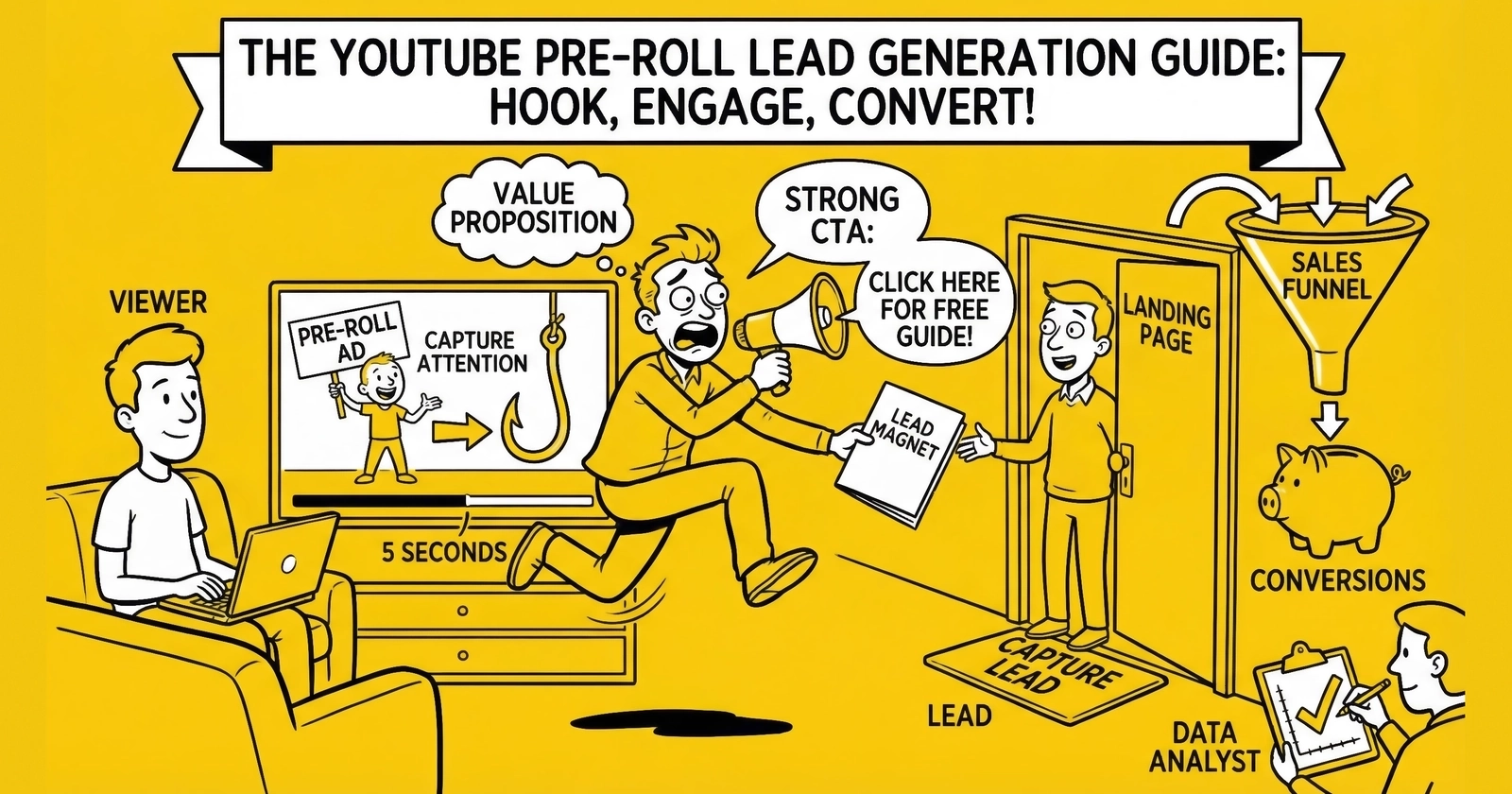
Master YouTube’s underutilized lead generation potential with proven targeting strategies, creative frameworks, and landing page optimization techniques that deliver cost-per-lead results competitive with search.
YouTube processes over 3 billion searches monthly, making it the world’s second-largest search engine. More than 2.5 billion users log in monthly, watching over 1 billion hours of video daily. Streaming now captures approximately 46% of all TV viewing time in the United States, surpassing cable and broadcast combined.
Most lead generators ignore this channel entirely.
They default to Google Search because the intent signal feels more direct. They overlook YouTube because they associate video advertising with brand awareness campaigns, not lead capture. They assume that viewers in entertainment mode will not convert.
This represents a significant strategic blind spot. YouTube combines search-level intent data (Google owns both platforms) with display-level scale and Facebook-level targeting precision. When deployed correctly for lead generation, YouTube delivers cost per lead that often undercuts search by 40-70% while maintaining conversion quality that exceeds display advertising by an order of magnitude.
The platform works particularly well for lead generation because it reaches consumers during extended engagement sessions. The average YouTube viewer watches 66 minutes of content daily. Unlike the split-second decisions of search advertising, YouTube pre-roll ads have time to tell a story, demonstrate value, and build enough trust to drive form submissions.
This guide covers everything you need to run profitable YouTube pre-roll campaigns for lead generation: format selection, targeting architecture, creative requirements, landing page integration, tracking implementation, CPL benchmarks, and scaling strategies that maintain quality as volume increases.
Understanding YouTube Ad Formats for Lead Generation
YouTube offers multiple ad formats, each with distinct characteristics that affect lead generation performance. Choosing the wrong format wastes budget without generating conversions. Understanding when to use each format prevents expensive learning curves.
TrueView In-Stream Ads (Skippable Pre-Roll)
TrueView in-stream ads play before, during, or after YouTube videos. Viewers can skip after 5 seconds. You pay only when viewers watch 30 seconds (or the complete ad if shorter) or engage with an interactive element like a call-to-action overlay.
This is the primary format for lead generation, and the economics explain why. The 5-second skip window creates a natural qualification filter. Viewers who are not interested in your offer skip immediately, and you pay nothing. Viewers who stay past 5 seconds have demonstrated initial interest, making subsequent conversion more likely.
Format Specifications
The recommended length for lead generation runs 30-90 seconds, with shorter durations reserved for remarketing. While there is technically no minimum, ads under 12 seconds lose critical persuasion time. Maximum length is unlimited, though performance degrades significantly past 3 minutes. The billing model is CPV (cost per view), charged at the 30-second mark or upon engagement.
Current Benchmarks (2025)
Average CPV ranges from $0.10-$0.30 depending on targeting and vertical. View rates (the percentage of impressions resulting in paid views) typically fall between 15-35%. Click-through rates run 0.5-2.0% of paid views, with landing page conversion rates between 5-15% depending on form length and vertical.
Best Use Cases
TrueView in-stream works best when your offer requires explanation, visual demonstration adds value, or your target audience consumes content related to their purchase intent. Solar, home improvement, insurance, and legal services see strong performance because these complex purchases benefit from video’s explanatory power.
Non-Skippable In-Stream Ads
Non-skippable ads must be watched in full before the viewer’s selected content plays. No skip option exists.
Format Specifications
Maximum length varies by placement but generally falls between 15-20 seconds. Billing uses a CPM (cost per thousand impressions) model, with guaranteed completion rates exceeding 90% due to forced viewing.
Current Benchmarks (2025)
Average CPM ranges from $4-$12 depending on targeting. Click-through rates run lower at 0.3-0.8%, and viewer sentiment is often negative due to forced viewing.
Non-skippable ads have limited application for direct lead generation from cold audiences. The forced viewing creates negative sentiment that can transfer to your brand. Viewers resent the interruption and are less likely to engage positively.
Best Use Cases
Reserve non-skippable formats for remarketing audiences who already know your brand. A viewer who has visited your landing page previously has demonstrated interest. A 15-second reminder to complete their quote request performs well because the interruption feels less intrusive to someone already considering your offer.
Bumper Ads
Bumper ads are 6-second non-skippable ads optimized for maximum reach with minimal message.
Format Specifications
Length is exactly 6 seconds with CPM billing and 100% completion rate due to forced viewing.
Current Benchmarks (2025)
Average CPM ranges from $1-$4, but direct response from cold audiences is near-zero.
Bumper ads do not work for direct lead generation. Six seconds provides insufficient time to establish credibility, communicate value, and drive action. Bumpers work for brand reinforcement within a larger campaign but should not carry lead generation weight.
Best Use Cases
Use bumpers exclusively for frequency capping in remarketing sequences. After a prospect has seen your longer TrueView ad and visited your landing page, a 6-second bumper can serve as a lightweight reminder without requiring significant budget or viewer patience.
Video Discovery Ads (YouTube In-Feed Ads)
Discovery ads appear as thumbnails in YouTube search results, alongside related videos, and on the YouTube homepage. Viewers choose to click, initiating playback of your video.
Format Specifications
Thumbnails can be automatically generated or custom selected. Headlines allow up to 100 characters, with two description lines of 35 characters each. Billing uses CPC (cost per click to play video).
Current Benchmarks (2025)
Average CPC ranges from $0.30-$1.00, with click-through rates between 2-5%. Video completion rates run higher than in-stream because viewers self-selected, and conversion rates typically reach 5-15% reflecting higher intent from self-selection.
Discovery ads represent an underutilized format for lead generation. Unlike pre-roll, which interrupts chosen content, discovery ads reach viewers who actively select your video. This self-selection creates higher intent, often resulting in better conversion rates despite lower volume.
Best Use Cases
Discovery ads work well for educational content where viewers actively seek information about your topic. “How to Choose Solar Panels for Your Home” or “Understanding Medicare Options” videos can attract viewers already researching these topics. The self-selection filters for serious prospects.
YouTube Shorts Ads
YouTube Shorts ads appear between short-form vertical videos in the Shorts feed. This format has grown rapidly as YouTube competes with TikTok.
Format Specifications
Videos can run up to 60 seconds in vertical (9:16 aspect ratio) orientation. Billing is CPV or CPM depending on format, and user demographics skew younger than standard YouTube.
Current Benchmarks (2025)
Monetization rates have more than doubled compared to traditional in-stream since 2023. Optimal video length runs 50-60 seconds for maximum views, reaching a user base of 2 billion monthly viewers.
Shorts ads are relatively new for lead generation, and benchmarks are still stabilizing. Initial tests suggest performance varies significantly by vertical. Products and services targeting younger demographics show promise, while traditional lead generation verticals (insurance, mortgage) may find limited audience match.
When YouTube Outperforms Search for Lead Generation
YouTube does not outperform Google Search for every vertical or situation. Understanding where video advertising creates competitive advantage prevents wasted experimentation.
The YouTube Advantage Conditions
Five conditions determine whether YouTube will deliver competitive cost per lead versus search.
Visual Demonstration Creates Tangible Value
Some products and services benefit enormously from being shown rather than described. Solar panel installation, home renovation, aesthetic services, and physical products all gain credibility through visual proof. A 45-second video showing a solar installation process, actual energy bill reductions, and satisfied homeowners creates persuasive impact that text ads cannot match.
Search CPCs Exceed Profitability Thresholds
When Google Search CPCs reach $20-$50 per click (common in legal, insurance, and financial services), the economics shift. YouTube CPVs of $0.10-$0.30 represent potential arbitrage. Even with lower conversion rates, the cost savings can deliver better blended CPL.
Consider a personal injury law firm facing $150 CPC on Google Search with 5% conversion rates, paying $3,000 per lead. On YouTube, even a $0.25 CPV with 1% CTR and 8% landing page conversion delivers leads at approximately $312 each. The math favors YouTube despite lower intent.
Your Audience Watches Relevant Content
YouTube targeting works best when your prospects consume content related to their purchase intent. Homeowners watch home improvement videos. Retirees watch financial planning content. Drivers involved in accidents might search YouTube for information about their rights. If your audience naturally gravitates toward YouTube content in your category, advertising there meets them in context.
You Can Produce Quality Video
Poor video production correlates directly with poor campaign performance. The 5-second skip decision happens fast, and amateur production triggers immediate dismissal. This does not mean you need Hollywood budgets, but you need professional-quality video that matches viewer expectations. Expect $3,000-$10,000 for initial creative production with professional quality. Agencies specializing in YouTube advertising creative typically charge $5,000-$15,000 for a campaign package with multiple variations.
Your Offer Requires Explanation
Complex products benefit from video’s explanatory power. Medicare supplement insurance, solar financing options, personal injury claim processes, mortgage rate comparisons – these topics have nuances that benefit from patient explanation. A 60-second video can address objections and clarify value propositions that text ads cannot convey.
Vertical Performance Comparison
The following benchmarks represent well-optimized campaigns with professional creative. For broader industry context, see our CPL benchmarks by industry. New campaigns typically start 30-50% above these ranges during optimization.
| Vertical | YouTube CPL Range | Search CPL Range | YouTube Savings | Notes |
|---|---|---|---|---|
| Solar | $45-$120 | $150-$300 | 60-70% | Visual demonstration critical |
| Roofing/HVAC | $35-$90 | $100-$200 | 60-65% | Before/after imagery performs |
| Legal (PI) | $80-$200 | $300-$800 | 70-75% | Largest CPL arbitrage |
| Auto Insurance | $25-$65 | $60-$150 | 50-60% | Geographic targeting essential |
| Medicare | $40-$85 | $75-$150 | 40-50% | AEP timing critical |
| Mortgage | $50-$130 | $125-$275 | 50-55% | Rate environment sensitive |
| Home Services | $30-$75 | $80-$150 | 55-60% | Local targeting reduces waste |
Where Search Dominates
Several categories favor search over YouTube. Urgent services like plumbers, locksmiths, and emergency repairs require search because a homeowner with a burst pipe is not watching YouTube videos – they need a solution now. The intent is too urgent for video’s persuasion timeline.
B2B enterprise software also favors search because decision-makers evaluating enterprise software are not typically watching YouTube for vendor selection during work hours. LinkedIn and Google Search capture this audience more effectively.
Hyper-local services face challenges because YouTube targeting becomes less precise below 5-mile radius. Small service areas like specific neighborhoods or towns may not have sufficient YouTube inventory for meaningful campaigns.
Low-consideration purchases also favor search because products and services with minimal consideration cycles do not benefit from video’s extended persuasion. If the decision takes 30 seconds, a 60-second video adds no value.
YouTube Targeting Strategies for Lead Generation
YouTube targeting combines Google’s search behavior data, YouTube’s viewing history, and your first-party customer data. The platform offers more sophisticated targeting options than most advertisers utilize.
Custom Intent Audiences
Custom Intent audiences target users based on their recent Google Search behavior. This is the highest-intent YouTube audience available because you are reaching people who searched for keywords related to your offer.
You upload a list of keywords that your ideal prospects search on Google, and YouTube then shows your ads to users who recently searched those terms across Google properties. For best results, upload 50-100 keywords per audience, include competitor brand terms, mix transactional and research keywords, and refresh keyword lists monthly based on search query data.
Custom Intent audiences typically deliver 20-30% lower CPL than other targeting methods because the search behavior indicates genuine interest.
Custom Affinity Audiences
Custom Affinity audiences target users based on their browsing behavior and website visits across the Google Display Network. You define interests based on URLs and topics, and Google identifies users who frequently visit similar sites, indicating affinity for those topics.
For lead generation, target visitors to competitor websites, reach consumers who browse review sites in your category, and find audiences who read relevant industry publications. Custom Affinity delivers broader reach than Custom Intent with lower precision – expect 10-20% higher CPL but significantly more volume.
In-Market Audiences
Google’s In-Market audiences are pre-built segments of users actively researching purchases in specific categories. Available lead generation categories include Auto Insurance Shoppers, Home Insurance Shoppers, Mortgage Shoppers (both Refinance and Purchase), Personal Loan Seekers, Solar Panel Buyers, and Legal Services Seekers.
In-Market audiences deliver consistent volume with moderate intent. They work well as foundational targeting layers supplemented by additional qualifications.
Life Events Targeting
Life Events targeting reaches users experiencing major transitions that trigger purchase consideration. Available events include Recently Moved, Getting Married, Having a Baby, Graduating College, Retiring, Starting a Business, and Buying a Home.
Life Events targeting is powerful for multi-product lead generation. A “Recently Moved” audience needs home insurance, home services, furniture, utilities, and potentially mortgage refinancing. A single event unlocks multiple lead types.
Demographic Layering
Demographic targeting layers reduce waste by excluding unqualified viewers before they see your ad. Available parameters include age ranges (18-24, 25-34, 35-44, 45-54, 55-64, 65+), gender, household income (Top 10%, 11-20%, 21-30%, Lower 50%), parental status, and homeownership status.
Critical application: for mortgage leads, exclude renters. For Medicare leads, exclude viewers under 55. For home improvement leads, layer homeowner status. Each exclusion reduces impressions served to unqualified viewers, improving effective CPL by 15-30%.
Remarketing Audiences
Remarketing reaches users who have previously interacted with your brand. Audience types include website visitors (all pages), landing page visitors (specific pages), video viewers (any percentage watched), channel subscribers, and customer email lists.
Website visitor remarketing typically delivers 40-60% lower CPL than cold audiences. Video viewers who watched 75% or more convert at 2-3x the rate of 25% viewers. Channel subscribers represent the smallest audience but highest intent.
Targeting Layering Architecture
Optimal YouTube campaigns layer multiple targeting parameters for precision. The recommended structure uses four layers: Layer 1 establishes the Intent Signal (Custom Intent OR In-Market), Layer 2 applies Demographic Qualification (Age, Homeowner, Income), Layer 3 restricts Geographic scope (State, Metro, Radius), and Layer 4 applies Exclusions (Existing customers, Recent converters).
This architecture ensures every impression reaches a viewer who has demonstrated relevant intent, matches demographic criteria, resides in your service area, and has not already converted.
Creative Requirements: Winning the First 5 Seconds
YouTube advertising success is determined in the first five seconds. This is the skip window – the moment when viewers decide whether to continue watching or move on to their selected content.
More than 76% of viewers skip ads when possible. Your creative must capture attention and communicate relevance before that skip button appears. Everything after 5 seconds is persuasion. The first 5 seconds is qualification.
The Five-Second Framework
Break the first five seconds into distinct beats that build toward viewer commitment.
Second 0-2: Pattern Interrupt
The viewer expects to watch their selected video. Your ad is an interruption. You have two seconds to disrupt the automatic skip response with something unexpected. Effective pattern interrupts include direct address (“Hey, Arizona homeowners…”), provocative questions (“What would you do with an extra $400 a month?”), unexpected visuals (movement, unusual imagery, contrast), unexpected audio (different voice register, sound effect, silence), and specific claims (“In the next 60 seconds, I’ll show you how to cut your energy bill in half”).
Second 2-3: Relevance Signal
The pattern interrupt bought attention. Now establish relevance to filter for qualified viewers. Effective relevance signals include geographic specificity (“Texas drivers are overpaying for car insurance by an average of $427”), demographic targeting (“Turning 65 this year? You have Medicare decisions to make”), situational framing (“If you’ve been injured in an accident that wasn’t your fault…”), and pain point identification (“Still paying full price for auto insurance despite your clean driving record?”).
Relevance signals serve dual purposes: they hold qualified viewers and encourage unqualified viewers to skip (saving you money on unproductive views).
Second 3-4: Value Promise
With attention and relevance established, preview the value of continued viewing. Effective value promises include “See how much you could save in 60 seconds,” “Get quotes from 5 carriers in one form,” “Find out if you qualify for zero-down solar,” and “I’ll show you the three questions every insurance company hopes you never ask.”
The value promise should be specific, achievable within the video length, and directly relevant to the viewer’s situation.
Second 4-5: Soft CTA
Close the 5-second window with an invitation to continue watching. Effective soft CTAs include “Stay with me for 30 seconds…,” “Let me show you exactly how this works…,” “Watch this quick comparison…,” and “Here’s what I discovered…”
Note: This is not the conversion CTA. This is permission to continue watching. The conversion CTA comes at the end.
Post-Skip Structure (6-60 Seconds)
Viewers who stay past 5 seconds have opted in. Now persuade them to take action through a structured progression.
Seconds 5-15: Problem Amplification
Expand on the pain point introduced in the relevance signal. Make the problem feel urgent and costly. Quantify the problem (“The average Texas driver overpays by $427 annually”), expand the impact (“That’s over $4,000 every decade you’re throwing away”), and add social proof (“And most people never find out because comparing quotes used to be complicated”).
Seconds 15-25: Solution Introduction
Present your solution to the amplified problem. Position the solution (“But now there’s a better way”), explain the mechanism (“Our free comparison tool pulls quotes from 5 major carriers in under 60 seconds”), and differentiate (“No phone calls, no pressure, just instant quotes you can compare yourself”).
Seconds 25-40: Proof and Credibility
Support your claims with evidence that builds trust. Effective proof elements include customer testimonials (brief quotes from real customers), social proof (“Over 250,000 drivers have found savings”), trust signals (“A+ rated with the BBB”), and specific results (“Average savings of $427 – some save over $800”).
Seconds 40-55: Process Clarity
Remove friction by showing exactly what happens next. Describe the process (“Just enter your zip code and basic info”), set expectations (“Takes about 60 seconds”), address objections (“No obligation, no spam calls”), and preview the outcome (“You’ll see your personalized quotes instantly”).
Seconds 55-60: Direct Call to Action
Close with explicit instruction. Effective closing CTAs include “Click the link below to get your free quotes now,” “Tap the button to see how much you could save,” and “Click to start your free comparison – it takes 60 seconds.”
Creative Mistakes That Kill Performance
Five common mistakes consistently undermine YouTube creative performance.
Brand-first openings waste the hook. Starting with a logo, brand name, or company history costs you the critical first seconds. Viewers do not care who you are until they understand why they should care. Lead with relevance, earn attention, then introduce the brand.
Television pacing fails on YouTube. Television commercials build slowly toward a reveal, but YouTube ads get skipped. The first 5 seconds must contain your core hook. Adapt television creative by front-loading the message.
Generic messaging resonates with no one. “Save money on insurance” could apply to anyone, so it connects with no one. “Arizona homeowners over 50 with clean driving records” resonates with that specific audience because it describes them precisely.
Single creative dependency creates failure points. One creative variation cannot carry a campaign. Viewer fatigue sets in quickly, and at $30,000+ monthly spend, creative burns out in 2-3 weeks. Plan to rotate 3-5 creative variations from launch.
Weak audio destroys performance. Over 95% of YouTube viewers watch with sound on (unlike Facebook where 85% watch muted). Audio is not optional. Poor audio quality, unclear speech, or missing sound destroys performance.
Landing Page Integration for Video Traffic
Traffic from YouTube pre-roll converts differently than traffic from Google Search. Visitors arrive with different expectations, different information, and different trust levels. Landing pages optimized for search often underperform with video traffic.
Video Visitor Psychology
Understanding how video viewers differ from search visitors informs landing page design.
Video viewers arrive with lower baseline intent because they were not actively searching. They were watching content and your ad interrupted. Intent is earned, not assumed. They also carry higher initial skepticism because the interruption creates resistance – viewers know they are being advertised to, so trust must be established more explicitly.
Attention span is shorter because viewers were in entertainment mode. Patience for complex experiences is lower than for search visitors who came with specific research purpose. However, visual expectations are higher because they just watched a video. Text-heavy landing pages feel like a downgrade, so visual design matters more.
Message context differs significantly as well. Unlike search visitors who may have seen only a headline and two lines of text, video visitors have absorbed 30-60 seconds of messaging. Repetition of that message builds trust; contradiction breaks it.
Landing Page Requirements for Video Traffic
Exact Message Match
The landing page headline must precisely mirror the video’s core promise. If your video promised “See how much you could save in 60 seconds,” the landing page headline should echo this: “Get Your Personalized Savings Quote in 60 Seconds.”
Message match accomplishes two things: it confirms that the click delivered what was promised (reducing bounce), and it maintains continuity from video context to form submission. Message match improves conversion rates by 30-50% for video traffic compared to generic landing pages.
Visual Continuity
The landing page should feel like a continuation of the video experience. Use the same color palette, similar imagery, and consistent design language. If talent appeared in the video, include their photo on the landing page. If specific visuals reinforced the message, echo them in the page design.
Form Above the Fold
Video visitors have been persuaded. They do not need more persuasion – they need the action opportunity. The form or primary CTA must be visible within 3-5 seconds of page load without scrolling. For mobile viewers (75%+ of YouTube traffic), “above the fold” means visible on a smartphone screen without scrolling.
Reduced Field Count
Video traffic tolerates less friction than search traffic. Forms optimized for search with 5-8 fields often underperform with video traffic. Consider 3-5 fields for initial capture, with additional qualification occurring post-submission.
Progress Indicators
Multi-step forms outperform single-page forms for video traffic. Breaking a 7-field form into 3 steps with progress indicators maintains engagement better than presenting all fields at once. The recommended structure uses Step 1 for basic info (zip code, basic demographics) with 2-3 fields, Step 2 for qualification details specific to the vertical with 2-3 fields, and Step 3 for contact information (name, phone, email) with 2-3 fields.
Mobile-First Design
Over 75% of YouTube viewing occurs on mobile devices. Landing pages must be designed mobile-first, with desktop as the adaptation rather than the reverse. Mobile requirements include touch-friendly form fields (minimum 48px tap targets), single-column layout, click-to-call functionality, auto-fill enabled, no horizontal scrolling, and load time under 2.5 seconds.
Speed Optimization
Page load time critically impacts conversion from video traffic. Viewers who clicked from a video expect immediate response. Every additional second of load time reduces conversions by approximately 7%. Target metrics include full page load under 3 seconds, Largest Contentful Paint under 2.5 seconds, First Input Delay under 100ms, and Cumulative Layout Shift under 0.1.
Tracking and Attribution for YouTube Campaigns
YouTube conversion tracking requires deliberate architecture due to cross-device behavior, view-through complexity, and the longer consideration cycles common in lead generation.
Essential Tracking Setup
Google Ads Conversion Tracking
Install the Google Ads global site tag on all landing pages. Create conversion actions for primary conversion events (form submissions) and micro-conversions (form starts, page engagement). Set appropriate conversion windows – for lead generation, 30-day click-through and 7-day view-through windows capture most conversions while maintaining attribution accuracy.
Enhanced Conversions
Enable Enhanced Conversions by passing hashed first-party data (email, phone) at conversion time. Google matches this data to signed-in users, improving attribution accuracy by 15-25% compared to standard conversion tracking. Enhanced Conversions is particularly important for YouTube because cross-device behavior is common – viewers watch on mobile but may convert on desktop.
View-Through Conversion Tracking
View-through conversions occur when a viewer sees your ad but does not click, then later converts through another path. YouTube’s view-through tracking captures these conversions. Analyze view-through conversions separately from click-through – typical view-through lift is 10-25% above click-through conversions alone. However, view-through can over-attribute to YouTube in multi-channel environments, so compare trends rather than absolute numbers.
Offline Conversion Import
The form submission is not the end of the lead generation funnel. Importing closed sales back into Google Ads allows optimization toward leads that become customers, not just leads that submit forms.
Implementation requires capturing Google Click ID (GCLID) on form submission, storing GCLID with each lead record in your CRM, flagging leads that convert to sales, and uploading conversion data to Google Ads (manual or via API). Offline conversion import – commonly integrated through lead distribution platforms – typically improves lead quality by 20-30% because the algorithm learns which viewer profiles result in sales rather than just form submissions.
Attribution Challenges and Solutions
| Challenge | Impact | Solution |
|---|---|---|
| Cross-device conversion | Viewers watch on mobile, convert on desktop | Enable Google Signals and cross-device conversion counting |
| View-through attribution | Unclear incremental value of impressions | Analyze view-through separately; typical lift is 10-25% |
| Multi-touch attribution | YouTube touches may occur before search conversion | Use data-driven attribution; YouTube typically receives 15-30% of credit in multi-touch |
| Lead-to-sale tracking | Optimizing for leads not sales | Import offline conversions with GCLID matching |
| Cookie blocking | Safari ITP blocks third-party cookies | Implement server-side tracking for 85-95% signal recovery |
Server-Side Tracking for YouTube
Browser-based tracking faces increasing restrictions. Safari’s Intelligent Tracking Prevention, ad blockers, and privacy-focused browsers can eliminate 20-40% of conversion data.
Server-side tracking sends conversion data from your server directly to Google, bypassing browser restrictions entirely. Implementation requires Google Tag Manager Server deployed on cloud infrastructure (Google Cloud Platform or AWS). For YouTube campaigns specifically, server-side tracking ensures that conversions from Safari and Firefox users (approximately 25-30% of traffic) are properly captured and attributed.
CPL Benchmarks and Quality Considerations
Understanding current benchmarks allows realistic expectation-setting and performance evaluation. These benchmarks represent well-optimized campaigns with professional creative.
YouTube CPL by Vertical
| Vertical | YouTube CPL Range | View Rate | Landing Page CVR | Notes |
|---|---|---|---|---|
| Solar | $45-$120 | 20-30% | 8-15% | Geographic targeting critical |
| Roofing/HVAC | $35-$90 | 18-28% | 10-18% | Seasonal variation significant |
| Legal (PI) | $80-$200 | 15-25% | 6-12% | Compliance-heavy creative |
| Auto Insurance | $25-$65 | 22-32% | 12-20% | State-level optimization important |
| Medicare | $40-$85 | 18-28% | 8-15% | AEP concentration October-December |
| Mortgage | $50-$130 | 16-26% | 8-14% | Rate sensitivity affects performance |
| Home Services | $30-$75 | 20-30% | 12-20% | Local targeting reduces waste |
| Education | $40-$95 | 18-28% | 10-18% | Degree type affects economics |
Quality Considerations
Lower CPL does not automatically mean better economics. YouTube leads typically require 10-20% more sales effort than search leads for three interconnected reasons.
Intent differential means the viewer was not actively searching when your ad appeared. They have been persuaded rather than self-selected, creating slightly lower baseline urgency. Information asymmetry means search visitors arrive having done research, while video visitors may have absorbed only your 60-second message and require more education during the sales process. Earlier consideration stage placement means video often reaches prospects earlier in their consideration cycle, so nurture sequences may be necessary before conversion-ready.
The key metric is not cost per lead but cost per qualified lead (CPQL) and cost per acquisition (CPA). A $50 YouTube lead converting at 3% and a $100 search lead converting at 6% produce identical $1,667 CPA.
Track downstream metrics rigorously: contact rate (ability to reach the lead), qualification rate (percentage meeting buyer criteria), conversion rate (percentage becoming customers), and return rate (percentage rejected by buyers).
Volume Capacity
YouTube’s scale typically exceeds Search for most verticals, creating scaling opportunity when search campaigns hit volume ceilings. A search campaign maxing at 500 leads/month might see YouTube potential of 2,000-5,000 leads/month at similar CPL, enabling a combined approach producing 2,500-5,500 leads/month at lower blended CPL.
The volume advantage comes from YouTube’s inventory depth. Even narrowly targeted campaigns can access millions of impressions daily. Search campaigns are constrained by query volume for specific keywords.
Scaling YouTube Campaigns Profitably
Scaling YouTube campaigns requires systematic expansion that maintains efficiency as volume increases. Aggressive scaling without proper foundation destroys performance.
The Scaling Sequence
Phase 1: Validation ($5,000-$15,000/month)
The goal is to prove concept, establish benchmarks, and identify winning creative and targeting combinations. Test 2-3 targeting audiences against 3-5 creative concepts. Set Target CPA bidding 20-30% above ultimate goal to allow learning. Measure view rate, CTR, conversion rate, and CPL over a 4-6 week minimum duration.
Success criteria: CPL within 30% of target with consistent volume. If CPL exceeds 50% of target, revisit creative or targeting before proceeding.
Phase 2: Optimization ($15,000-$30,000/month)
The goal is to reduce CPL to target, increase volume 2x, and establish remarketing infrastructure. Expand winning audiences with additional demographic layers. Launch remarketing campaigns for website visitors and video viewers. Implement frequency capping to control creative fatigue. Test landing page variations and refine bid strategies based on conversion data.
Success criteria: CPL at or below target with 2x Phase 1 volume. Remarketing CPL 40-60% below prospecting CPL.
Phase 3: Expansion ($30,000-$75,000/month)
The goal is to diversify targeting, test new markets, and scale volume 3-5x while maintaining CPL. Add new targeting categories (additional In-Market, new Custom Intent keywords). Expand geographic coverage to new states or metros. Diversify creative concepts to prevent audience fatigue. Test non-skippable ads for remarketing and implement automated creative refresh workflow.
Success criteria: 3-5x Phase 1 volume with stable CPL (+/- 10%). Multiple creative variations performing.
Phase 4: Maturity ($75,000+/month)
The goal is to maximize efficiency, automate operations, and expand to adjacent opportunities. Implement offline conversion optimization (optimize for sales, not leads). Test value-based bidding if lead values vary. Automate creative refresh every 2-4 weeks. Develop A/B testing pipeline for landing pages. Consider YouTube Shorts ads for incremental reach and build custom reporting and alerting.
Success criteria: Stable CPL with predictable volume. Automated operations requiring minimal daily management.
Scaling Constraints and Rules
Budget increase limits matter. Never increase budget by more than 20% per week. Larger increases disrupt algorithm learning and cause temporary CPL spikes. Patient scaling maintains efficiency.
Creative fatigue timing accelerates at scale. At $50,000+ monthly spend, creative variants fatigue in 2-3 weeks. Production pipeline must deliver new creative faster than fatigue degrades performance.
Quality degradation at scale is inevitable. The first 1,000 leads from any audience will typically outperform leads 5,000-10,000 from the same audience. As you exhaust core prospects, quality naturally declines. Diversifying targeting maintains quality at scale.
Remarketing pool size requirements exist. Remarketing audiences must reach minimum size (1,000 users for most targeting) before campaigns launch. Building these pools during Phase 1 enables remarketing launch in Phase 2.
Frequently Asked Questions
What is the best YouTube ad format for lead generation?
Skippable TrueView in-stream ads are the primary format for lead generation. The 5-second skip window creates a natural qualification filter where uninterested viewers skip immediately (costing you nothing) while interested viewers self-select to continue watching. You only pay when viewers watch 30 seconds or engage with your call to action. Discovery ads work well as a secondary format for educational content where viewers actively search for information. Non-skippable ads should be reserved for remarketing audiences who already know your brand.
How much do YouTube leads cost compared to Google Search?
YouTube leads typically cost 40-70% less than Google Search leads in the same vertical. Auto insurance leads run $25-$65 on YouTube versus $60-$150 on Search. Legal leads show the largest arbitrage at $80-$200 versus $300-$800. Solar leads cost $45-$120 on YouTube compared to $150-$300 on Search. The trade-off is that YouTube leads convert to sales at 10-20% lower rates due to lower baseline intent. Calculate cost per acquisition rather than cost per lead to determine true relative performance.
What is the minimum budget to test YouTube ads effectively?
Allocate $5,000-$10,000 for a meaningful test campaign spanning 4-6 weeks. This budget allows testing 2-3 targeting audiences against 3-5 creative variations with sufficient volume for statistical significance. Expect 50-70% of test budget to be spent during the learning phase before performance stabilizes. Budgets below $3,000 rarely generate enough data to draw conclusions, while budgets above $15,000 for initial testing risk scaling unproven approaches.
How long should a YouTube lead generation video be?
The optimal length for lead generation is 30-60 seconds. Shorter videos (under 30 seconds) lack sufficient time for persuasion and credibility building. Longer videos (90+ seconds) experience significant drop-off before the call to action. The first 5 seconds are critical for hook and qualification – this is the skip window. Structure creative with pattern interrupt and relevance signal in seconds 0-5, problem amplification in seconds 5-15, solution and credibility in seconds 15-40, and direct CTA in the final seconds.
Should I use skippable or non-skippable ads for lead generation?
Use skippable TrueView ads for cold audience lead generation. The skip function naturally qualifies intent – viewers who choose to watch past 5 seconds have demonstrated interest, making them more likely to convert. Non-skippable ads work for remarketing audiences who already know your brand but cost 20-40% more per qualified lead from cold audiences due to forced viewing creating negative sentiment. Reserve non-skippable formats for reinforcement within existing prospect relationships.
How do I track YouTube conversions accurately?
Implement four layers of tracking for comprehensive measurement. First, install Google Ads conversion tracking on your thank-you page with appropriate conversion windows (30-day click, 7-day view-through). Second, enable Enhanced Conversions by passing hashed first-party data (email, phone) at conversion time. Third, track view-through conversions separately, understanding that typical lift is 10-25% above click-through alone. Fourth, import offline conversions using GCLID matching to optimize for leads that become customers rather than just form submissions. Server-side tracking recovers 20-40% of signals lost to browser restrictions.
What targeting works best for YouTube lead generation?
Custom Intent audiences based on Google Search behavior typically deliver the lowest CPL because they reach viewers who recently searched for relevant keywords. Layer demographic targeting (age, income, homeowner status) to qualify viewers and reduce waste. For remarketing, target viewers who watched 75%+ of your previous videos – they convert at 2-3x the rate of 25% viewers. Geographic layering by state or metro area improves relevance for locally-oriented services. Exclusion targeting is equally important: exclude existing customers, recent converters, and irrelevant demographics to avoid wasted impressions.
How does YouTube lead quality compare to search leads?
YouTube leads typically convert to customers at 10-25% lower rates than search leads due to intent differences. Search visitors actively sought information; YouTube viewers were persuaded while consuming other content. YouTube leads often require more nurturing because they may be earlier in the consideration cycle. However, the significant CPL savings (40-70% lower than search) often result in similar or better cost per acquisition. Track conversion rates by source throughout the sales funnel – contact rate, qualification rate, and close rate – to determine true relative value. A $50 YouTube lead converting at 3% equals a $100 search lead converting at 6%.
When should I scale my YouTube budget?
Scale after achieving stable CPL at or below target for 2-3 consecutive weeks. Premature scaling during the learning phase locks in poor performance. When scaling, increase budget by no more than 20% per week – larger increases disrupt algorithm learning and cause temporary CPL spikes. Before significant scaling (2x+ current budget), ensure your creative refresh capacity can maintain 3-5 rotating variations. Monitor lead quality as volume increases; quality typically declines as you exhaust core audiences, requiring targeting diversification to maintain performance.
How do I integrate YouTube with my other advertising channels?
YouTube works best as part of an integrated multi-channel strategy. Use YouTube for prospecting and awareness (reaching audiences before they search), then capture the search demand you generate with Google Search campaigns. YouTube remarketing reinforces prospects who visited from other channels. Attribution data typically shows YouTube receiving 15-30% credit for conversions in multi-touch journeys where it touches prospects early. Budget allocation frameworks: Conservative (Search 50-60%, YouTube 25-35%, Display 10-15%), Aggressive (Search 35-45%, YouTube 40-50%, Display 10-15%). Combined strategies typically reduce blended CPL by 15-25% versus single-channel approaches.
What creative elements make YouTube ads successful?
The first 5 seconds determine success and must include a pattern interrupt (unexpected visual or audio), relevance signal (geographic or demographic specificity), and value promise (clear benefit of continued viewing). Avoid brand-first openings – logos in the first 5 seconds waste the hook. Use authentic-feeling production rather than over-polished corporate video. Audio quality is critical – over 95% of YouTube viewers watch with sound on. Test multiple variations (3-5 minimum) because creative performance varies unpredictably. Refresh creative every 2-4 weeks at scale to combat fatigue. Clear call-to-action in the final seconds with specific instruction (“Click below to get your free quote”) outperforms vague invitations (“Learn more”).
Key Takeaways
-
YouTube is the second-largest search engine and underutilized for lead generation. Over 2.5 billion monthly users watch 1 billion hours daily, with more than half of viewers reporting that YouTube ads are more relevant than traditional TV or competing streaming services. This captive audience offers cost-per-lead potential competitive with search at 40-70% lower rates.
-
Skippable TrueView in-stream ads are the primary format for lead generation. The 5-second skip window creates natural qualification – uninterested viewers skip (costing you nothing) while prospects self-select to continue. You pay only for engaged viewers at 30 seconds or interaction.
-
The first 5 seconds determine everything. Your hook must include pattern interrupt, relevance signal, and value promise before the skip button appears. More than 76% of viewers skip when possible – your creative must give them reason to stay.
-
YouTube CPL runs 40-70% lower than Search in most verticals. Solar shows $45-$120 versus $150-$300. Legal demonstrates $80-$200 versus $300-$800. The trade-off is 10-20% lower conversion rates, making cost per acquisition the true comparison metric.
-
Custom Intent targeting delivers lowest CPL. Target viewers based on their recent Google Search behavior for highest intent. Layer demographic qualifications (age, homeowner status, income) to reduce waste on unqualified viewers by 15-30%.
-
Landing pages require video-specific optimization. Message match between video and landing page headline improves conversion 30-50%. Reduce form fields versus search traffic (3-5 versus 5-8). Mobile-first design is essential – 75%+ of YouTube viewing is mobile.
-
Tracking requires deliberate architecture. Enable Enhanced Conversions, track view-through separately, implement server-side tracking to recover 20-40% of lost signals, and import offline conversions to optimize for customers rather than form submissions.
-
Scale systematically through four phases. Validate at $5,000-$15,000/month, optimize at $15,000-$30,000, expand at $30,000-$75,000, and mature at $75,000+. Never increase budget more than 20% weekly.
-
Creative refresh is essential at scale. At $50,000+ monthly spend, creative variants fatigue in 2-3 weeks. Build production pipelines that deliver 3-5 new variations monthly.
-
YouTube and search work best together. Combined strategies reduce blended CPL 15-25% versus single-channel approaches. Use YouTube for prospecting and search for capture. Attribution typically credits YouTube with 15-30% of multi-touch conversions.
This article provides strategic guidance on YouTube pre-roll advertising for lead generation based on current platform capabilities and industry benchmarks. Performance varies by vertical, geography, creative quality, and execution. Test strategies in your specific context before committing significant budget. Statistics reflect late 2024/early 2025 data and may change as platform features and market conditions evolve.