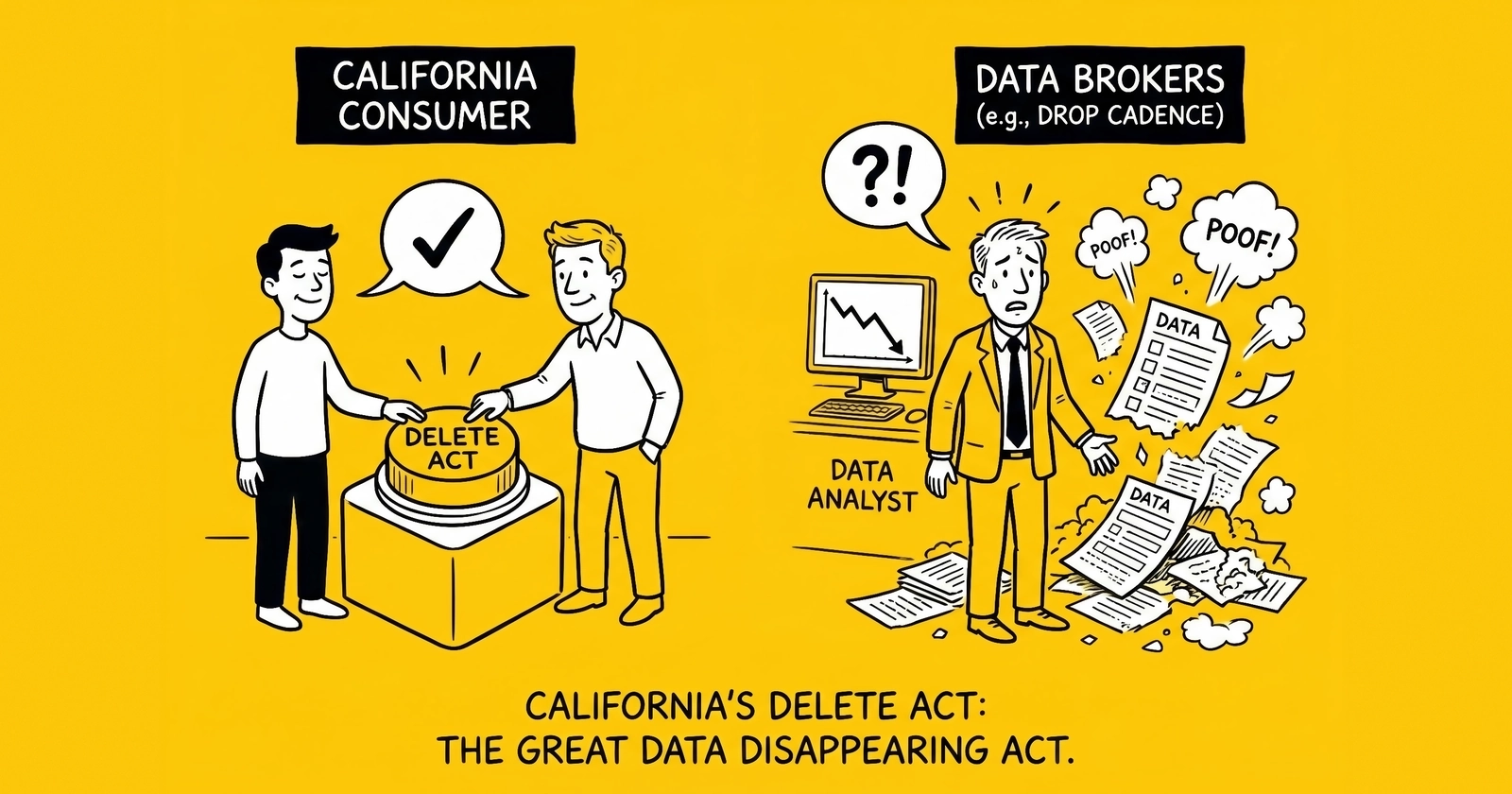
California’s Delete Request and Opt-Out Platform went live for consumers on January 1, 2026. The deadline that matters for data brokers is August 1, 2026 – when the 45-day deletion cadence starts. With the CPPA Strike Force already three named-respondent decisions deep and the remaining pre-August implementation window narrowing, the operational question for every lead-gen vendor with California-resident records is whether the architecture in place today can sustain a continuous-deletion workflow at scale. For most vendors, the honest answer is no.
The Pre-August Implementation Window and the Architecture Problem Sitting Behind It
The August 1, 2026 date has been on the books since the California Privacy Protection Agency finalized its DROP regulations in late 2025. As of publication, the remaining pre-August implementation window for California data brokers to begin downloading consumer deletion requests from the state’s Delete Request and Opt-Out Platform on a recurring forty-five-day cadence is closing toward the deadline. The operational reality of what that date requires has been steadily underestimated by the lead-generation vendors most exposed to it. The Delete Act’s registration regime was a paperwork problem. The DROP cadence is an architecture problem. Those are different categories of work, and the second category does not get done by January 31 fee renewals.
The Strike Force the CPPA’s Enforcement Division stood up in November 2025 has already produced three published decisions covering a combined $164,200 in fines, with the agency stating publicly that more than ten additional enforcement actions are in pipeline. The published decisions to date have all targeted unregistered brokers – Rickenbacher Data LLC d/b/a Datamasters, S&P Global Inc., and ROR Partners LLC – but the agency has signaled that registration enforcement is the warm-up. Once the August 1 cadence start arrives, the Strike Force has a far richer enforcement surface: every registered broker’s actual deletion behavior becomes auditable, every deletion certification becomes a regulatory artifact, and every downstream-store propagation gap becomes a discoverable failure. This analysis covers what DROP actually does at the API layer, why a forty-five-day cadence is structurally different from the consent-based deletion flows most vendors have built around the California Consumer Privacy Act, and what the remaining pre-August implementation window has to produce for a lead-gen data broker to arrive at August 1 with a system that runs rather than a system that fails its first cycle.
What DROP Actually Is – and Why It Is Not Another CCPA Workflow
The headline summary of DROP is straightforward enough. The Delete Request and Opt-Out Platform is a state-run portal that lets a California resident submit a single deletion request that propagates to every registered data broker in the state. The platform went live for consumers on January 1, 2026. As of late April 2026, more than six hundred data brokers are registered with the CPPA and visible on the public Data Broker Registry. The technical layer underneath the consumer-facing portal is more interesting than the consumer-facing piece, and it is where the operational difficulty lives.
The technical layer: hashed identifiers and the matching contract
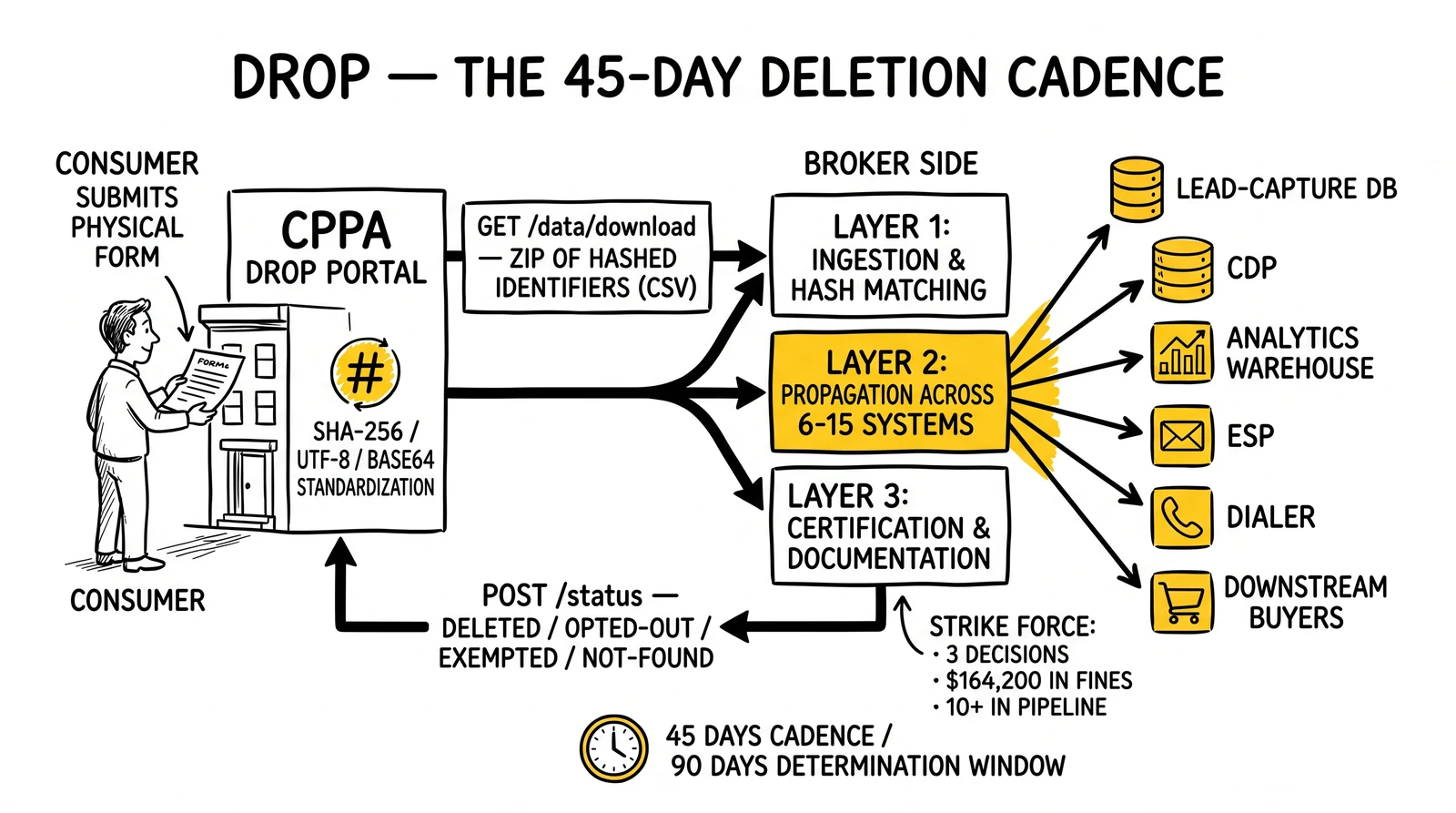
DROP does not transmit consumer personal information to data brokers. The architecture inverts that: consumers submit identifiers – primarily email addresses and phone numbers – into the CPPA’s portal, and DROP applies a standardized SHA-256 hash with UTF-8 input encoding and Base64 output. Data brokers, on a forty-five-day cadence at minimum, call a GET /data/download endpoint against the CPPA’s Data Broker API to retrieve a ZIP archive containing one CSV file per selected consumer deletion list. Each CSV row contains a hashed consumer identifier. The broker’s job is to apply the same standardization and hashing rules to its own records, match the resulting hashes against the CPPA’s list, and act on every match: delete the consumer’s personal information, opt the consumer out of sale, mark an applicable statutory exemption, or report no match. The broker then uploads a status file back to the CPPA confirming the disposition of each row.
Two design decisions in that architecture matter operationally. First, the matching contract is the broker’s responsibility, not the CPPA’s. A broker that stores email addresses with case variation, with formatting differences, or with embedded white space will miss matches that a properly standardized hash would have caught. The CPPA does not adjudicate near-misses. A miss is a failure to delete, and a failure to delete becomes a $200-per-consumer-per-day penalty exposure starting August 1. Second, the API exposes a sandbox environment for engineering integration testing, but the production environment is one-shot per cycle: each forty-five-day window produces a new deletion list, and a broker that fails to download, match, and respond within ninety days of retrieval has missed the window entirely.
Why this is not a CCPA workflow
Vendors that built California Consumer Privacy Act compliance flows around 2020-2023 typically structured them as one-off events: consumer submits a request through a vendor-hosted form, the vendor’s privacy team validates identity, the vendor’s engineering team runs a deletion query against the primary data store, and the vendor responds within forty-five days. That architecture works at the volume of consumer-initiated requests most vendors have historically received – tens to low hundreds per month for most lead-gen operators. DROP changes the volume profile and the operational profile simultaneously.
The volume profile changes because DROP is centralized. A consumer who clicks through the CPPA’s portal and submits a single request generates a deletion entry against every registered broker. The early consumer adoption signals from CalPrivacy’s late January 2026 update suggested deletion-list volumes in the thousands per cycle within the first month of consumer access. Those numbers will rise as awareness grows and as the press cycle around the August 1 broker-side deadline brings DROP into general consumer consciousness. A vendor that handled a hundred CCPA deletion requests in the calendar year 2025 may face a ten-thousand-row DROP deletion list in its first August 2026 cycle.
The operational profile changes because DROP is recurring. CCPA deletion requests arrive at the cadence consumers send them. DROP deletion requests arrive every forty-five days, every list cumulating new requests on top of the rolling backlog the broker has already worked through. A vendor whose deletion process was a quarterly half-day for the privacy team becomes, under DROP, a continuous process that must complete a full match-delete-certify cycle six to eight times per year on a fixed schedule. That is a workflow change. It is also an architecture change, because no manual process scales to a fixed-schedule, multi-thousand-row matching and propagation requirement without breaking on the first or second cycle.
The Three Architecture Layers DROP Actually Touches
The vendors who have started DROP architecture work in earnest treat the requirement as three distinct integration problems, each touching a different layer of the data stack. Vendors who treat it as a single problem – “build a DROP endpoint” – produce systems that handle the API surface but fail on the propagation surface, which is where the regulatory exposure actually lives.
Layer one: ingestion and identity matching
The first layer is the integration with DROP itself: authenticated API access using the X-API-KEY header, scheduled retrieval of the deletion list ZIP archive, parsing of the per-list CSV files, application of the standardization rules to the broker’s own consumer records, and SHA-256 hashing of those records for comparison against the CPPA’s list. This is the layer that vendors most often build first, and it is the smallest piece of the work. A capable engineering team can stand up a working DROP-ingest endpoint in three to five engineering weeks. The standardization rules are documented; the hashing algorithm is standard; the API surface is small.
The trap at this layer is the standardization rule. The CPPA’s hashing specification requires that input strings be normalized before hashing – lowercased, white-space-trimmed, with phone numbers in E.164 format and email addresses with case folding applied to the local-part as well as the domain. A broker whose identity-matching code was written assuming email addresses are already case-folded at write time, or whose phone numbers are stored in a mix of formats inherited from different acquisition channels, will silently produce different hash outputs than the CPPA. Those silent mismatches become missed deletions, and missed deletions become regulatory failures whether or not the broker noticed the mismatch. The right operational discipline is to run the same standardization-and-hashing pipeline against the broker’s own records, generate a reference hash dataset, and validate against the CPPA’s sandbox environment before the production cycle starts. Most vendors who have started this work have not yet validated.
Layer two: deletion propagation across systems of record
The second layer is the harder one. A lead-gen data broker rarely stores consumer personal information in a single system of record. The typical lead-gen stack contains the original lead-capture database, a customer data platform used for segmentation and analytics, a clean-room or matching layer for buyer-side handoffs, an analytics warehouse, an email service platform with its own subscriber records, an outbound-dialer or contact-center system for warm-transfer flows, and a downstream archive of records sold or transferred to lead buyers. Each of these systems holds a copy or derivative of the consumer’s personal information. Each is a deletion target.
A DROP match against the broker’s primary record store is not a deletion. The Delete Act and the implementing regulations require deletion of personal information across the broker’s holdings, with limited exemptions for records the broker is required to retain by other law (for example, certain TCPA consent records under federal regulations or financial records under state-specific retention rules). A broker that deletes from the primary store but leaves the consumer’s record live in the analytics warehouse, the email platform, and the contact-center dialer has not complied. That non-compliance is auditable: a CPPA enforcement inquiry can request the broker’s data-flow diagram and follow it to each downstream system, and a deleted-from-primary-only record produces a discoverable gap.
The propagation layer is where most vendors will struggle. Building a deletion propagation flow requires a complete system-of-record inventory, a machine-readable record-key correspondence between systems, an event-driven or batch-driven deletion fanout, and an audit trail confirming deletion at each system. Vendors whose data architecture grew organically over five to ten years often do not have a complete inventory, do not have consistent record keys, and do not have audit trails. Building these from a standing start while also doing the rest of the August 1 preparation is a six-to-twelve-month engineering project compressed into the remaining pre-August implementation window.
Layer three: certification, documentation, and the audit-ready file
The third layer is the documentation layer. Every DROP cycle produces a status file the broker uploads back to the CPPA. The status file’s surface-level purpose is to confirm to the CPPA that the broker handled the deletion list. Its operational purpose is regulatory exposure management. A status file that reports a row as “deleted” is a sworn certification that the broker has, in fact, deleted the record. A status file that reports “deleted” while the consumer’s record remains discoverable in a downstream system is a misstatement to a regulatory body – a category of exposure significantly worse than a missed deletion.
The documentation that has to sit behind every “deleted” status file is the audit-ready record: a timestamped log of the deletion fanout, a confirmation from each downstream system that the deletion executed, an attestation from the engineering owner of each system, and a retention record of the deletion certification itself. Vendors who have done consent documentation work for TCPA exposure management have the closest analog: every consent record carries a timestamp, an originating channel, an IP address, and a retention requirement that survives the underlying communication. DROP deletion certifications follow a similar discipline. The Strike Force has signaled that documentation review is part of its enforcement protocol; the agency’s January 2026 announcement explicitly cited compliance auditing as a remediation requirement in the S&P Global decision.
The vendors who are ahead on August 1 readiness are not the ones who have built the prettiest API integration. They are the ones who have a complete propagation map, a working downstream-deletion fanout, and a documentation discipline that produces the audit file before the status file goes back to the CPPA.
The Strike Force’s Pattern – and the Pipeline Beyond Three Decisions
The CPPA Enforcement Division stood up its Data Broker Enforcement Strike Force on November 19, 2025, with a public announcement framing it as a focused unit for Delete Act investigations. The Strike Force’s first three published decisions, in chronological order, are the ROR Partners settlement of approximately $56,600 in early December 2025, the Datamasters decision of $45,000 on January 8, 2026, and the S&P Global decision of $62,600 on the same date. The agency’s January 8 announcement also referenced “more than ten enforcement actions against additional unregistered data brokers” as part of the pipeline. The pattern across the three published decisions is more useful for predicting the next twelve months than the headline fines.
What the published decisions show about Strike Force priorities
The ROR Partners decision targeted a Nevada marketing firm that bundled custom-audience segments derived from consumer profiles into broader marketing services and argued that the bundling exempted it from data broker registration. The CPPA rejected that argument and stated explicitly in the decision that “a business cannot bypass the CCPA’s and the Delete Act’s requirements by selling personal information as part of a larger suite of products and services it offers.” The implication for lead-gen vendors that bundle audience or list services into broader packages is direct: bundling does not insulate the broker from the registration and DROP-cadence regime. A vendor whose pricing structure presents data services as part of a managed-marketing bundle is, on the ROR Partners reasoning, registrable.
The Datamasters decision targeted a Texas-based reseller selling lists segmented by health condition (Alzheimer’s disease, drug addiction, bladder incontinence among them), demographic category (“Senior Lists” and “Hispanic Lists”), and political view. The CPPA’s framing in the decision and in the public announcement emphasized consumer harm: head of enforcement Michael Macko stated that “in the wrong hands, these lists could be used to target people for more than just advertising. The same risks apply to selling lists of seniors, people who identify as conservative or liberal, or people who purchase sensitive health products. History teaches us that certain types of lists can be dangerous.” The penalty was structured around full removal from the California market, not just registration, which is a heavier remedy than a fine alone.
The S&P Global decision is the most operationally instructive for compliant intent vendors. The CPPA’s published narrative described the violation as resulting from an administrative error rather than willful avoidance, and the remedy required S&P Global to “adopt procedures for registration and compliance auditing to prevent similar errors in the future.” The fine was $62,600 – higher than the willful Datamasters fine – and the substantive remedy was a procedural one. The signal: even an established and well-resourced data company with no demonstrable intent to evade the Delete Act incurs a high-five-figure fine and a procedural-controls remediation requirement when it misses the registration deadline. Vendors who have informally absorbed the position that registration mistakes will be treated leniently because the underlying behavior was not predatory should re-read the S&P Global file.
The pipeline beyond the published decisions
The “more than ten” pipeline reference in the January 8 announcement is the operative number for the next two quarters of enforcement activity. The CPPA does not preview which named respondents are in the pipeline, but the pattern of the first three decisions suggests a mix: marketing services firms with audience-segment products that have not been registered, data resellers with health-condition or demographic-segmented inventory, and large-enterprise data companies caught by administrative oversights. The lead-gen vertical is exposed across all three categories.
The agency has also signaled a second-wave enforcement priority: deletion behavior under the August 1 cadence. Once the cadence starts, the published-status-file dataset and the underlying downstream deletion behavior become enforcement surfaces in their own right. Vendors who arrive at August 1 registered but architecturally unprepared will produce status files reporting deletions that did not fully execute, and the resulting pattern of recurrence – consumers receiving renewed marketing contact from brokers who reported deletion – becomes a discoverable signal for the next round of Strike Force investigations. The progression from registration enforcement (Q4 2025 through Q2 2026) to deletion-cadence enforcement (Q3 2026 onward) is the central regulatory dynamic for the next twelve months.
What the Pre-August Implementation Window Has to Produce
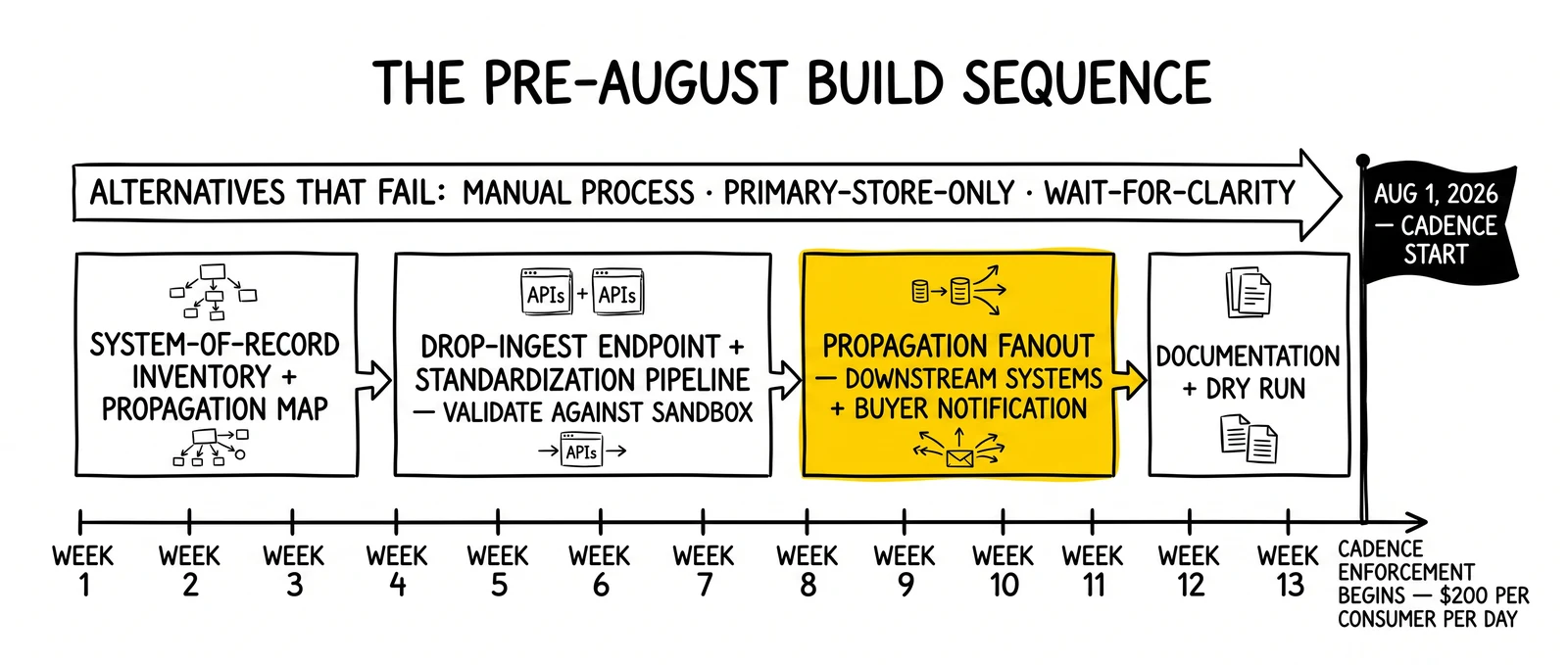
The right framing for the period from late spring through early August is sequence rather than scope. There is not enough time for a data broker entering this window with no DROP architecture in place to do everything well. There is enough time for a broker to do the right things in the right order such that the August 1 cadence start lands on a working system rather than a failing one.
Weeks one through three: system-of-record inventory and propagation map
The first work product is the data-flow diagram. Every system that holds California-resident consumer personal information becomes a node. Every record-key relationship between systems becomes an edge. Every retention requirement and every deletion-exemption rule becomes a node attribute. The deliverable is a propagation map that an engineer or a regulator can read and follow from a hashed identifier in the DROP list to every system where the matched record exists.
This is the work most vendors have not done thoroughly. A typical lead-gen stack has between six and fifteen systems holding consumer PII, and the implicit assumption that the primary lead-capture database is “the system of record” is rarely accurate at the moment of regulatory scrutiny. The right discipline is to interview each engineering and operations owner separately, produce a complete inventory, and validate the inventory by running a known consumer record through the propagation map and confirming the record appears in every system the map predicts.
Weeks four through seven: the DROP-ingest endpoint and the standardization pipeline
The second work product is the technical integration with DROP. This breaks into three subsystems: an authenticated client against the GET /data/download endpoint with scheduled retrieval, a parsing and standardization pipeline that produces hashed identifiers from the broker’s own records using the CPPA’s specification, and a matching engine that produces a per-row disposition (deleted, opted-out, exempted, not-found) for every entry in the DROP list. The CPPA’s sandbox environment is the validation surface. Vendors who skip sandbox validation and go straight to production deployment routinely discover their standardization pipeline produces hashes that do not match the CPPA’s hashes on edge cases – internationalized email addresses, phone numbers with extensions, addresses with apartment-number variations.
Weeks eight through eleven: the propagation fanout
The third work product is the deletion fanout itself. Each downstream system in the propagation map needs a deletion-execution interface: an API call, a database operation, a batch job, or in the case of legacy systems, a documented manual procedure. Each fanout needs a confirmation receipt: the downstream system must produce evidence that the deletion executed against the matched record. Each receipt needs to roll up to a per-DROP-row audit trail that ties the original hashed identifier to the disposition recorded in the status file uploaded to the CPPA.
The vendors who have started this work in earnest report that the fanout build is where the timeline pressure becomes acute. Legacy systems often lack deletion APIs. Email-service platforms expose deletion-by-list-membership rather than deletion-by-record-key. Contact-center systems retain call recordings under separate retention regimes that may or may not be DROP-exempt. Each integration becomes its own engineering decision, and each decision has to be made under a fixed deadline.
Weeks twelve through thirteen: documentation, training, and the dry run
The final work product is the operational readiness package: the documentation regime that captures every cycle’s audit trail, the operational runbook for the privacy and engineering teams handling each cycle, the escalation protocol for downstream-deletion failures, and the dry-run cycle against the CPPA’s sandbox environment to validate the end-to-end workflow before the production cycle begins. Vendors who skip the dry run typically discover at least one fanout-layer failure in the first production cycle. Vendors who run the dry run typically discover and remediate that failure before the cycle exposes them to actual regulatory risk.
The thirteen-week sequence does not produce a perfect system. It produces a system that works on August 1, that has a documented audit trail for the first cycle’s status file, and that improves with each subsequent cycle as the privacy team and the engineering team learn the failure modes. That outcome is the realistic target. The alternative – arriving at August 1 with a fragmented architecture and hoping the first cycle’s deletion list is small enough that gaps go unnoticed – is the failure mode the Strike Force will catch.
The Five-Year Overlay: Why DROP Is the Operational Template Other States Inherit
The regulatory layer above the August 1 deadline is the multi-state pattern that California’s DROP architecture establishes as a template. Three states have already advanced data broker registration regimes, and a fourth is likely to enact a DROP analog in 2026. The implications for vendor architecture extend well beyond California-resident records.
Vermont: the second universal deletion portal
Vermont’s H 211, which passed the Vermont House on March 25, 2026 and is in the Senate Committee process as of late April, would create the second state-run universal data deletion portal modeled on California’s DROP. Vermont’s existing data broker registry has approximately 283 registered entities as of 2025. The bill’s signature provision is the centralized deletion mechanism, and the bill’s design language closely tracks the California DROP architecture – hashed identifier matching, recurring deletion cadence, status-file reporting back to the state. If Vermont enacts the bill in its current form, vendors with Vermont-resident records in their data stores face a parallel compliance regime within twelve to eighteen months of California’s August 1 cadence start. The architecture work done for California ports directly to Vermont with relatively minor configuration changes; the propagation map and the fanout infrastructure are reusable.
Texas and Oregon: registration regimes positioning for the next step
Texas SB 2105, which took effect in 2024, defines a data broker as a business whose principal source of revenue is derived from collecting, processing, or transferring personal data not collected directly from data subjects. The Texas regime requires registration before commencing operations, with a $300 fee. Oregon’s data broker law operates on a similar registration-first framework, with annual renewal by December 31. Neither state currently operates a centralized deletion portal, but both states’ registration regimes produce the dataset of registered entities that a future DROP-style deletion portal would use as its target list. Oregon’s 2026 amendments – restrictions on selling data of consumers under 16 and on selling precise geolocation data within a 1,750-foot radius – signal that Oregon’s legislative direction is toward operational restrictions on broker behavior, not just registration.
The pattern across California, Vermont, Texas, and Oregon is convergent. Each state is moving toward a regime in which (a) data brokers must affirmatively register, (b) consumers have a centralized mechanism to demand deletion across the registered population, and (c) brokers must execute on those demands on a fixed cadence with documented certification. California is the operational template for a, b, and c. Vermont will likely follow on b within eighteen months. Texas and Oregon are likely to follow on b within thirty-six months as the legislative cycle catches up to the policy direction.
What this means for vendor architecture decisions
A data broker that builds DROP architecture for California in 2026 has already paid the architectural cost of multi-state compliance. The propagation map, the deletion fanout, the standardization pipeline, and the documentation regime are reusable across jurisdictions. The marginal cost of adding a second or third state to the system is small relative to the cost of building the first state’s architecture. A broker that decides in 2026 to handle California compliance through a manual or partial-architecture approach commits to repeating the same shortcut work for each additional state, with the regulatory surface area expanding as each state’s regime activates.
The five-year strategic question is whether to treat DROP-style deletion architecture as a California-specific project or as a general-purpose privacy capability that the broker now operates as a standing function. The vendors that treat it as the latter end up with a structural advantage in lead generation privacy compliance that extends across the multi-state regime as it expands. The vendors that treat it as the former pay the architectural cost three or four times in succession over the next thirty-six months.
Implementation Realities Most Vendors Are Underestimating
Three operational facts about DROP compliance recur in vendor conversations and tend to be underestimated. Each becomes acute as the August 1 deadline approaches.
The downstream-buyer propagation problem
Lead-gen data brokers do not just hold consumer records. They sell or transfer those records downstream to lead buyers – lenders, brokers, marketers, insurance agents, contact-center operators. A consumer record that has been transferred to a lead buyer continues to exist in the buyer’s systems after the original transfer. A DROP deletion request that arrives against the broker’s records does not, by default, reach the buyer’s systems. The Delete Act’s text addresses this gap: the broker is responsible for instructing each downstream recipient to delete the consumer’s information, and the broker’s deletion certification has to cover the downstream propagation as well as the broker’s own records.
Operationally, this means the broker’s contractual relationship with each lead buyer needs to include a DROP-deletion propagation clause and an associated technical mechanism – typically an automated notification to the buyer when a consumer’s record matches a DROP deletion. Most existing lead-buyer integration agreements do not include these clauses. Renegotiating the agreements and building the propagation mechanism is its own work stream, parallel to the broker-internal DROP architecture work, and the buyer-side cooperation is not guaranteed. A broker who has fifty active lead-buyer relationships needs fifty contract amendments and fifty technical integrations or a documented escalation pattern for buyers who refuse to cooperate. The escalation pattern matters because the broker remains responsible for the deletion regardless of buyer cooperation; a non-cooperating buyer is a regulatory exposure for the broker, not a regulatory exposure for the buyer.
The retention-exemption documentation problem
The Delete Act and the implementing regulations recognize a set of statutory exemptions to the deletion obligation. A consumer record that the broker is required to retain under another federal or state law – TCPA consent records under federal regulations, certain financial-services records under state retention rules, DNC compliance attestations under various state-level frameworks – can be marked as exempt rather than deleted. The status file reports the exemption rather than a deletion.
The exemption pathway is a regulatory necessity but also a regulatory exposure. A broker who reports a high proportion of exemptions in its status file invites scrutiny: the CPPA’s enforcement protocol can request the underlying retention basis for each exempted record, and an exemption that the broker cannot defend with a specific statutory citation becomes a misstatement to the agency. The right operational discipline is to document the retention basis for every exemption type at the system-of-record level, train the privacy and engineering teams on which exemptions apply to which record categories, and produce an audit trail that ties each exempted row in the status file to the specific statutory basis the broker is claiming. Vendors who treat the exemption as a default catch-all for records they would prefer not to delete are creating an enforcement target, not a compliance pathway.
The customer lifetime value math behind deletion
The economic question that DROP forces every data broker to answer is what a deleted consumer record is actually worth. For a lead-gen vendor, a consumer record’s value is the discounted stream of future revenue from selling, transferring, or remarketing against the record. The DROP deletion regime imposes a probabilistic claim on every California-resident record: with consumer awareness rising and the portal’s friction low, the probability that any given California consumer eventually submits a DROP request rises over time. The expected lifetime of a California-resident record in the broker’s data store is no longer indefinite; it has a half-life governed by DROP submission rates.
This shows up directly in the customer lifetime value math for California-resident records. A record that previously carried a five-to-seven-year revenue runway under the broker’s normal data retention practices may now carry a two-to-three-year effective runway as DROP submission rates compound. The economic implication is that California-resident record acquisition costs need to be re-priced against the shorter expected revenue window, and the broker’s margin on California inventory may compress materially over the next twenty-four months. Vendors who continue to price California-resident inventory on pre-DROP economics will find their margin assumptions invalidated within a year or two of the cadence start.
The Approaches That Will Underperform This Cycle
Three responses to the August 1 deadline are visible in vendor conversations and trade-press reporting. Each will produce worse outcomes than its proponents expect, and the reasons are worth being explicit about.
The first is the manual-process posture. The argument runs that the early DROP cycles will produce small deletion lists, that the broker’s privacy team can handle the matching and propagation by hand for the first few cycles, and that automation can be built in 2027 once the operational pattern stabilizes. The problem is that the manual process does not scale through the first volume spike, and the first volume spike is likely in the August-through-October window as consumer awareness compounds. A broker who handles the first cycle manually with three thousand rows may face a ten-thousand-row second cycle that the same manual process cannot complete within the ninety-day determination window. The resulting failure becomes a documented inability to execute on the cadence, which is exactly the regulatory artifact the Strike Force will examine in second-wave enforcement.
The second is the primary-store-only posture. The argument is that the broker can satisfy DROP by deleting from the central record store, that downstream system propagation is a refinement that can be deferred, and that consumer records in downstream systems will eventually expire under existing retention policies. This is wrong on two dimensions. The Delete Act explicitly requires deletion across the broker’s holdings, not just the primary store. And consumer records in downstream systems often do not expire on a useful timeline; they persist in analytics warehouses, archived data sets, and contact-center records for years. The compliance gap that primary-store-only deletion creates is precisely the gap the CPPA’s enforcement inquiry will follow. Brokers who report deletions on the basis of primary-store-only execution are misstating to the agency, and the misstatement is the worst category of regulatory exposure.
The third is the wait-for-clarity posture. The argument is that the regulations are still evolving, that the first round of enforcement will reveal the agency’s actual priorities, and that the broker can defer architecture investment until the picture is clearer. The clarity will not arrive in time. The Strike Force’s three-decision pattern already establishes the agency’s enforcement priorities – bundling does not exempt, administrative errors are not excused, and demographic segmentation is a headline-risk surface. The architectural investment needed for August 1 readiness has a thirteen-week minimum lead time. A broker who waits for further clarity in May or June will not have built the architecture by August. The wait-for-clarity posture, in practice, becomes the manual-process posture after enough delay accumulates.
The common pattern across these three approaches is that each underestimates the speed at which the operational reality will arrive. The August 1 cadence is not aspirational. The Strike Force pipeline is not theoretical. The volume spike from consumer adoption is not contingent. The brokers who treat any of these as deferrable are setting up a Q4 2026 enforcement event for themselves.
Key Takeaways
The August 1, 2026 cadence start is the operative deadline for every California-registered data broker rather than the policy-headline deadline that the consumer-facing DROP launch represented in January. The remaining pre-August implementation window is the architecture-build clock; the Strike Force has already produced three published decisions covering $164,200 in fines against Rickenbacher Data, S&P Global, and ROR Partners, with more than ten additional actions in pipeline.
DROP is an architecture problem rather than a policy problem. The technical surface – SHA-256 hashed-identifier matching, forty-five-day cadence retrieval, status-file reporting – is the smaller part of the work. The harder part is the propagation across systems of record, the documentation regime that supports the certification, and the downstream-buyer notification flow that extends the deletion obligation past the broker’s own holdings.
The propagation layer is where most vendors will struggle. A typical lead-gen stack has six to fifteen systems holding consumer PII, and a deletion executed against only the primary record store does not satisfy the Delete Act. The vendors who arrive at August 1 prepared have a complete propagation map, working downstream-deletion fanouts, and an audit-ready documentation discipline.
The Strike Force’s enforcement pattern through Q2 2026 is registration-focused. The Q3 2026 onward pattern shifts to deletion-cadence behavior, with status files and the underlying deletion execution becoming the audit surface. Brokers who arrive at August 1 registered but architecturally unprepared will produce status files that misrepresent actual deletion, and the resulting consumer-recurrence pattern becomes a discoverable enforcement signal.
Three approaches will underperform: the manual-process posture (does not scale through the first volume spike), the primary-store-only posture (misstates to the agency about actual deletion), and the wait-for-clarity posture (runs out of architecture lead time before August). Each underestimates the operational speed of the regime.
The five-year overlay points to multi-state convergence. Vermont’s H 211 is likely to enact a second universal deletion portal modeled on DROP within eighteen months. Texas and Oregon are positioned to follow within thirty-six months. Vendors who build DROP architecture as a general-purpose privacy capability rather than a California-specific project carry a structural advantage as the multi-state regime expands.
For lead-gen data brokers currently working through California Delete Act compliance, the next thirteen weeks are the build window: weeks one through three for the system-of-record inventory and propagation map, weeks four through seven for the DROP-ingest endpoint and standardization pipeline, weeks eight through eleven for the propagation fanout, and weeks twelve through thirteen for documentation, training, and a sandbox dry run. Vendors who run that sequence land on August 1 with a working system. Vendors who do not are running a manual process into a regulatory surface that does not forgive shortcuts.
Frequently Asked Questions
What is the Delete Act and what did it actually change?
California Senate Bill 362, the Delete Act, was enacted in 2023 and built on the existing California Consumer Privacy Act framework by adding two specific requirements aimed at data brokers. The first is annual registration with the California Privacy Protection Agency by January 31 of each year, with a current annual fee of $6,000 and a $200-per-day penalty for late registration. The second is participation in a centralized state-run deletion mechanism – the Delete Request and Opt-Out Platform, or DROP – which lets a California consumer submit a single deletion request that propagates to every registered data broker. The DROP system went live for consumers on January 1, 2026, and the broker-side obligation to begin processing DROP deletion requests on a forty-five-day cadence begins August 1, 2026.
What does DROP actually require a data broker to do every forty-five days?
Beginning August 1, 2026, every registered California data broker must, at least once every forty-five days, retrieve the current consumer deletion list from the CPPA’s Data Broker API. The list contains SHA-256 hashed consumer identifiers – primarily hashed email addresses and phone numbers – that the broker has to match against its own records using the CPPA’s published standardization rules. For each match, the broker must delete the consumer’s personal information unless a statutory exemption applies, opt the consumer out of sale of their personal information, and complete the determination within ninety days of retrieval. The broker then uploads a status file to the CPPA reporting the disposition of every row in the deletion list.
How is this different from a regular California Consumer Privacy Act deletion request?
CCPA deletion requests arrive at the cadence consumers send them through individual broker-hosted channels, typically a few hundred to a few thousand per year for a typical lead-gen vendor. DROP deletion requests are centralized through a single state-run portal and arrive on a fixed forty-five-day cadence with cumulative deletion lists. A single CCPA workflow handles consumer-initiated requests one at a time. A DROP workflow handles batch retrievals from a state-operated API, applies hashed-identifier matching at potentially tens of thousands of rows per cycle, propagates deletion across every downstream system of record holding the consumer’s data, and produces a regulatory status file back to the agency. The two workflows are compatible at the policy level but materially different at the operational level.
What is the Data Broker Enforcement Strike Force and what has it done?
The Data Broker Enforcement Strike Force is a unit within the CPPA’s Enforcement Division, launched on November 19, 2025, with a stated focus on Delete Act violations. The Strike Force has produced three published decisions to date: ROR Partners LLC ($56,600 fine, December 2025), Rickenbacher Data LLC d/b/a Datamasters ($45,000 fine plus full removal from the California marketplace, January 8, 2026), and S&P Global Inc. ($62,600 fine and procedural-controls remediation, January 8, 2026). The CPPA has also referenced “more than ten” additional enforcement actions in pipeline. Each published decision targets a different aspect of registration violation: ROR Partners on bundling-as-exemption arguments, Datamasters on willful avoidance with consumer-harm framing, S&P Global on administrative error.
How much can a registration or deletion failure cost a data broker?
The Delete Act establishes two distinct $200-per-day penalty regimes. The first is registration failure: a broker that misses the January 31 registration deadline or fails to register before commencing data broker operations is exposed to $200 per day for each day of non-registration. The second is deletion failure: a broker that fails to delete a consumer’s personal information following a DROP match is exposed to $200 per consumer per day for each day the failure persists. The actual fines extracted in the three published decisions ranged from $45,000 to $62,600 for registration violations alone. The deletion-failure regime activates August 1, 2026, and the per-consumer structure means that a single architecture gap that affects thousands of consumer records compounds into a substantially larger exposure than any single registration failure.
Which lead-gen vendors are actually classified as data brokers?
The Delete Act defines a data broker, with reference to the existing California statutory framework, as a business that knowingly collects and sells the personal information of consumers with whom the business does not have a direct relationship. The ROR Partners decision is the operative interpretation: a business cannot bypass the requirement by selling personal information as part of a larger suite of products and services. For lead-gen vendors, the practical implication is that almost any vendor that sells, transfers, or licenses consumer records to third parties without having captured those records through a direct consumer-initiated transaction is a registrable data broker. This includes list brokers, audience-segment vendors, lead aggregators selling to multi-buyer waterfalls, performance-marketing networks resyndicating leads, and any vendor whose product is fundamentally a consumer record sourced from upstream channels. The CPPA’s Data Broker Registry listed more than six hundred registered entities as of early 2026.
What does the DROP technical integration actually look like?
The DROP technical integration is built around a small REST API exposed by the CPPA at databroker.drop.privacy.ca.gov. A registered broker authenticates using an API key passed in an X-API-KEY header. The primary endpoint is GET /data/download, which retrieves a ZIP archive containing one CSV file per selected consumer deletion list. Each CSV row contains a hashed consumer identifier produced by applying the CPPA’s standardization specification (lowercase, white-space-trimmed, E.164 phone number formatting) followed by SHA-256 hashing with UTF-8 input and Base64 output. The broker applies the same standardization-and-hashing pipeline to its own records, matches the resulting hashes, executes deletion for each match, and uploads a status file documenting the per-row disposition. The CPPA exposes a sandbox environment for engineering integration testing, and the production environment operates on the forty-five-day cadence beginning August 1, 2026.
How should a data broker think about deletion propagation across multiple systems?
A typical lead-gen data stack contains six to fifteen distinct systems holding consumer personal information: the lead-capture database, a customer data platform, a clean-room or matching layer, an analytics warehouse, an email service platform, an outbound dialer or contact-center system, downstream archives of records sold to lead buyers, and various ad-hoc data exports. The Delete Act requires deletion across the broker’s holdings rather than only at the primary record store. Operationally, the broker has to produce a complete data-flow inventory mapping the path of any given consumer record from acquisition through every downstream system, build a deletion-execution interface for each system in the inventory, capture an audit-trail confirmation from each system at deletion time, and roll the per-system confirmations into a per-DROP-row audit record that supports the status file uploaded to the CPPA. Vendors who skip the inventory step typically discover at the first cycle that records persist in systems they did not list as holding PII.
What is the relationship between DROP compliance and downstream lead-buyer relationships?
A consumer record that a data broker has sold or transferred to a lead buyer continues to exist in the buyer’s systems after the original transfer. The Delete Act assigns the original broker responsibility for ensuring the deletion propagates downstream – the broker has to instruct each lead buyer to delete the consumer’s information and capture confirmation that the deletion executed. Most existing lead-buyer agreements were written before the DROP framework existed and do not include a propagation clause or technical mechanism for handling DROP-triggered deletion notifications. Operationally, this means brokers have to renegotiate buyer agreements, build buyer-side notification mechanisms, and document escalation patterns for buyers who refuse or fail to cooperate. The broker remains responsible for the deletion regardless of buyer cooperation, so non-cooperating buyers become a regulatory exposure for the broker rather than for the buyer.
How should a data broker handle records that are exempt from deletion?
The Delete Act recognizes a set of statutory exemptions for records the broker is required to retain under another federal or state law. Examples include certain TCPA consent records under federal regulations, financial-services records subject to specific state retention rules, and certain DNC-compliance attestations. When a DROP match falls on an exempt record, the broker reports an exemption status in the status file rather than a deletion. The exemption is not a default catch-all. The CPPA’s enforcement protocol can request the specific statutory basis for any exempted row, and an exemption the broker cannot defend with a citation becomes a misstatement to the agency. The right operational discipline is to document the retention basis for each exemption type at the system-of-record level, train the privacy and engineering teams on which exemptions apply to which record categories, and produce an audit trail tying every exempted row to its specific statutory citation.
What is the realistic timeline for a mid-sized lead-gen broker to get DROP-ready by August 1?
A thirteen-week sequence is the realistic minimum for a broker that does not have a DROP architecture in place as of late April 2026. Weeks one through three cover the system-of-record inventory and propagation map. Weeks four through seven cover the DROP-ingest endpoint, standardization pipeline, and matching engine, including sandbox validation against the CPPA’s test environment. Weeks eight through eleven cover the deletion fanout across each downstream system, with the engineering decisions about legacy systems, exemption-pathway coverage, and downstream-buyer notification falling primarily in this window. Weeks twelve through thirteen cover documentation, operational runbooks, team training, and the dry-run cycle. Brokers who started the sequence in late April land at August 1 with a working system. Brokers who started later face a compressed timeline that increasingly forces shortcut decisions; the manual-process and primary-store-only postures both emerge from compressed timelines, and both create regulatory exposure that exceeds the architectural cost they were intended to avoid.
How will DROP compliance evolve through 2029?
The five-year trajectory points to four sequential shifts. In the next twelve months, the CPPA Strike Force pivots from registration enforcement to deletion-cadence enforcement, with Q3 and Q4 2026 producing the first published decisions targeting deletion behavior under the new cadence. In the next eighteen months, Vermont’s H 211 or a successor bill enacts the second state-run universal deletion portal, with technical specifications likely tracking the California DROP framework closely. In the next thirty-six months, Texas and Oregon are likely to add centralized deletion mechanisms to their existing registration regimes, producing a four-state network of comparable systems. By 2029, the multi-state pattern likely extends to additional jurisdictions, and the operational architecture of DROP-style deletion becomes a standing privacy capability for any data broker operating across state lines. Vendors who build the architecture in 2026 as a general-purpose capability rather than a California-specific project carry a structural advantage as the multi-state regime expands.
Sources
Tier 1: Primary Government and Regulatory Sources
-
California Privacy Protection Agency, “CalPrivacy Brings New Round of Enforcement Actions Against Data Brokers,” CPPA Announcement, January 8, 2026 – https://cppa.ca.gov/announcements/2026/20260108.html
-
California Privacy Protection Agency, “CalPrivacy Launches Data Broker Enforcement Strike Force,” CPPA Announcement, November 19, 2025 – https://cppa.ca.gov/announcements/2025/20251119.html
-
California Privacy Protection Agency, “CalPrivacy Fines Marketing Firm for Selling Custom Audiences Without Data Broker Registration,” CPPA Announcement, December 3, 2025 – https://cppa.ca.gov/announcements/2025/20251203.html
-
California Privacy Protection Agency, “Accessible Deletion Mechanism – Delete Request and Opt-out Platform System Requirements,” accessed April 28, 2026 – https://cppa.ca.gov/regulations/drop.html
-
California Privacy Protection Agency, “Data Broker DROP Regulation Text,” CPPA Regulatory PDF, accessed April 28, 2026 – https://cppa.ca.gov/regulations/pdf/data_broker_drop_reg.pdf
-
California Privacy Protection Agency, “CalPrivacy Issues Enforcement Advisory Highlighting Data Broker Registration,” CPPA Announcement, December 17, 2025 – https://cppa.ca.gov/announcements/2025/20251217.html
-
California Privacy Protection Agency, “California Approves Delete Act Regulations,” CPPA Announcement, November 13, 2025 – https://cppa.ca.gov/announcements/2025/20251113.html
-
CPPA Data Broker Technical Documentation, accessed April 28, 2026 – https://databroker.drop.privacy.ca.gov/technical-docs
-
Privacy.ca.gov, “Data Brokers,” accessed April 28, 2026 – https://privacy.ca.gov/data-brokers/
-
Privacy.ca.gov, “Delete Request and Opt-out Platform (DROP),” accessed April 28, 2026 – https://privacy.ca.gov/drop/
Tier 2: Established Industry Research and Trade Press
-
Crowell & Moring LLP, “California Privacy Agency Launches Data Broker Strike Force Amid Delete Act Crackdown,” Client Alert, 2025 – https://www.crowell.com/en/insights/client-alerts/california-privacy-agency-launches-data-broker-strike-force-amid-delete-act-crackdown
-
Hunton Andrews Kurth, “California Privacy Protection Agency Issues Enforcement Advisory for Data Brokers,” Privacy and Information Security Law, 2025 – https://www.hunton.com/privacy-and-information-security-law/california-privacy-protection-agency-issues-enforcement-advisory-for-data-brokers
-
Hunton Andrews Kurth, “CPPA Enforces against Two Data Brokers for Failing to Register Under the Delete Act,” Privacy and Information Security Law, January 2026 – https://www.hunton.com/privacy-and-information-security-law/cppa-enforces-against-two-data-brokers-for-failing-to-register-under-the-delete-act
-
Hunton Andrews Kurth, “CPPA Fines Nevada Marketing Firm for Violation of California’s Delete Act,” Privacy and Cybersecurity Law Blog, December 2025 – https://www.hunton.com/privacy-and-cybersecurity-law-blog/cppa-fines-nevada-marketing-firm-for-violation-of-californias-delete-act
-
Inside Privacy (Covington & Burling), “CalPrivacy Announces $45,000 Fine Against Data Broker for Delete Act Violations,” January 2026 – https://www.insideprivacy.com/state-privacy/calprivacy-announces-45000-fine-against-data-broker-for-delete-act-violations/
-
Clark Hill PLC, “Is Your Business a ‘Data Broker’?: California’s DROP Goes Live, and CALPrivacy Continues to Enforce Delete Act,” 2026 – https://www.clarkhill.com/news-events/news/is-your-business-a-data-broker-californias-drop-goes-live-and-calprivacy-continues-to-enforce-delete-act/
-
Benesch, Friedlander, Coplan & Aronoff LLP, “The Era Of Centralized Deletion Is Here: Understanding CalPrivacy’s DROP Platform Before 2026,” 2025 – https://www.beneschlaw.com/resources/the-era-of-centralized-deletion-is-here-understanding-calprivacys-drop-platform-before-2026.html
-
Freshfields, “The Delete Act: CalPrivacy Seeks Input on Data Broker Audit Requirements,” 2026 – https://www.freshfields.com/en/our-thinking/blogs/a-fresh-take/the-delete-act-calprivacy-seeks-input-on-data-broker-audit-requirements-102mqe8
-
Wyrick Robbins, “CalPrivacy’s Latest Data Broker Crackdown: Three Practical Takeaways for Companies,” Practical Privacy, 2026 – https://practicalprivacy.wyrick.com/blog/calprivacys-latest-data-broker-crackdown-three-practical-takeaways-for-companies
-
Loeb & Loeb LLP, “CPPA Acts to Enforce Against Data Brokers’ Failure to Register,” QuickTakes, 2026 – https://quicktakes.loeb.com/post/102m1ih/cppa-acts-to-enforce-against-data-brokers-failure-to-register
-
Frankfurt Kurnit Klein & Selz, “California Privacy Regulators Fine ROR Partners for Unregistered Data Broker Activity,” Technology Law, 2025 – https://technologylaw.fkks.com/post/102lwwq/california-privacy-regulators-fine-ror-partners-for-unregistered-data-broker-acti
-
Kelley Drye & Warren LLP, “Getting Ready to Use the DROP,” Ad Law Access, 2025 – https://www.kelleydrye.com/viewpoints/blogs/ad-law-access/getting-ready-to-use-the-drop
-
International Association of Privacy Professionals, “CalPrivacy staff offers first look at DROP system,” IAPP News, 2025 – https://iapp.org/news/a/calprivacy-staff-offers-first-look-at-drop-system
Tier 3: Industry and Vendor Statements
-
AdExchanger, “The DROP Is Coming: Why Fines Under California’s Delete Act Are About to Spike,” Data-Driven Thinking, 2026 – https://www.adexchanger.com/data-driven-thinking/think-youre-not-a-data-broker-californias-delete-act-might-say-otherwise/
-
ComplianceHub.Wiki, “California’s Delete Act Is Live: What Data Brokers Must Do Before August 1, 2026,” 2026 – https://compliancehub.wiki/california-delete-act-drop-platform-compliance-guide-2026/
-
DataGrail, “The Delete Act and DROP: What You Need to Know,” 2026 – https://www.datagrail.io/blog/regulations/the-delete-act-and-drop-what-you-need-to-know/
-
OneTrust, “California’s DROP: What the Delete Act changes for consent, preferences, and data deletion,” 2026 – https://www.onetrust.com/blog/californias-drop-what-the-delete-act-changes-for-consent-preferences-and-data-deletion/
-
Transcend, “CalPrivacy’s DROP platform: A legal and engineering roadmap for DROP compliance,” 2026 – https://transcend.io/blog/calprivacy-drop-compliance-guide
-
Data Privacy and Security Insider (Robinson+Cole), “California’s DROP Regime will Change the Data Broker Risk Equation,” April 2026 – https://www.dataprivacyandsecurityinsider.com/2026/04/californias-drop-regime-will-change-the-data-broker-risk-equation/
Tier 4: Supporting Industry Commentary
-
California Lawyers Association, “Data Broker Regulation Framework: A Comparative Analysis of California, Texas, Vermont and Oregon,” Privacy Law, 2026 – https://calawyers.org/privacy-law/data-broker-regulation-framework-a-comparative-analysis-of-california-texas-vermont-and-oregon/
-
PrivacyLawMap, “Vermont’s Delete Act: H 211 Data Broker Bill Passes the House – What It Means for Businesses,” April 2026 – https://privacylawmap.com/blog/vermont-data-broker-delete-act-h211-2026
-
Electronic Frontier Foundation, “Why Are Hundreds of Data Brokers Not Registering with States?” Deeplinks, June 2025 – https://www.eff.org/deeplinks/2025/06/why-are-hundreds-data-brokers-not-registering-states
-
The Record from Recorded Future News, “Delete-your-data laws have a perennial problem: Data brokers who fail to register,” 2025 – https://therecord.media/state-data-broker-registries-california-vermont
-
Cookie-Script, “The California Delete Act: Is Your Business Considered a Data Broker?” 2026 – https://cookie-script.com/gdpr-ccpa/california-delete-act
-
Captain Compliance, “CalPrivacy Cracks Down on Data Broker Datamasters,” 2026 – https://captaincompliance.com/education/calprivacy-cracks-down-on-data-broker-datamasters/
-
Henson Legal PLLC, “California Privacy Agency Issues $50,000 Fine for Data Broker Registration Failure: What the ROR Partners Decision Means for Marketing Companies,” 2025 – https://www.henson-legal.com/newsroom/california-privacy-agency-issues-50000-fine-for-data-broker-registration-failure-what-the-ror-partners-decision-means-for-marketing-companies
Closing
The Delete Act’s August 1, 2026 cadence start will be remembered as the moment California operationalized what every other state’s privacy regime has so far only described. The headline narrative will treat it as the moment data brokers had to take consumer deletion seriously. That framing will undersell what actually happened. The structural event is the architectural reset: a forty-five-day continuous-deletion cadence, propagated across every system of record holding California-resident consumer information, certified through a status file that becomes a regulatory artifact each time it is uploaded. The CPPA Strike Force has spent the prior nine months building the enforcement muscle to examine that artifact in detail, and the pipeline of pending actions signals that the examination is coming. Lead-gen data brokers who treat August 1 as a registration-paperwork milestone will find themselves caught in the second-wave enforcement that the cadence-deletion behavior produces. Brokers who treat it as the architecture milestone it actually is will spend the remaining pre-August implementation window building a system that runs – propagation maps, fanout infrastructure, audit-ready documentation, downstream-buyer cooperation – and they will arrive at the cadence start with the operational template that every other state’s Delete Act analog will eventually inherit. The decision is whether to preserve evidence of working deletion now or defend missing evidence later, and engineering and compliance teams are making that decision in the architecture-build weeks before the August 1 cadence start.
Regulatory developments, enforcement decisions, and DROP technical specifications reflect publicly reported conditions through April 28, 2026. CPPA regulations, enforcement priorities, and DROP API specifications change continuously; verify current terms through primary sources before making operational decisions. This article provides general industry analysis and does not constitute legal, financial, or compliance advice. Consult qualified counsel for specific compliance questions related to data broker registration, DROP integration, deletion propagation, and downstream-buyer agreements.