Your lead distribution platform touches every dollar that flows through your operation. Choose wrong, and you spend years fighting limitations that should have been features. Choose right, and your platform becomes invisible infrastructure your business grows on top of.
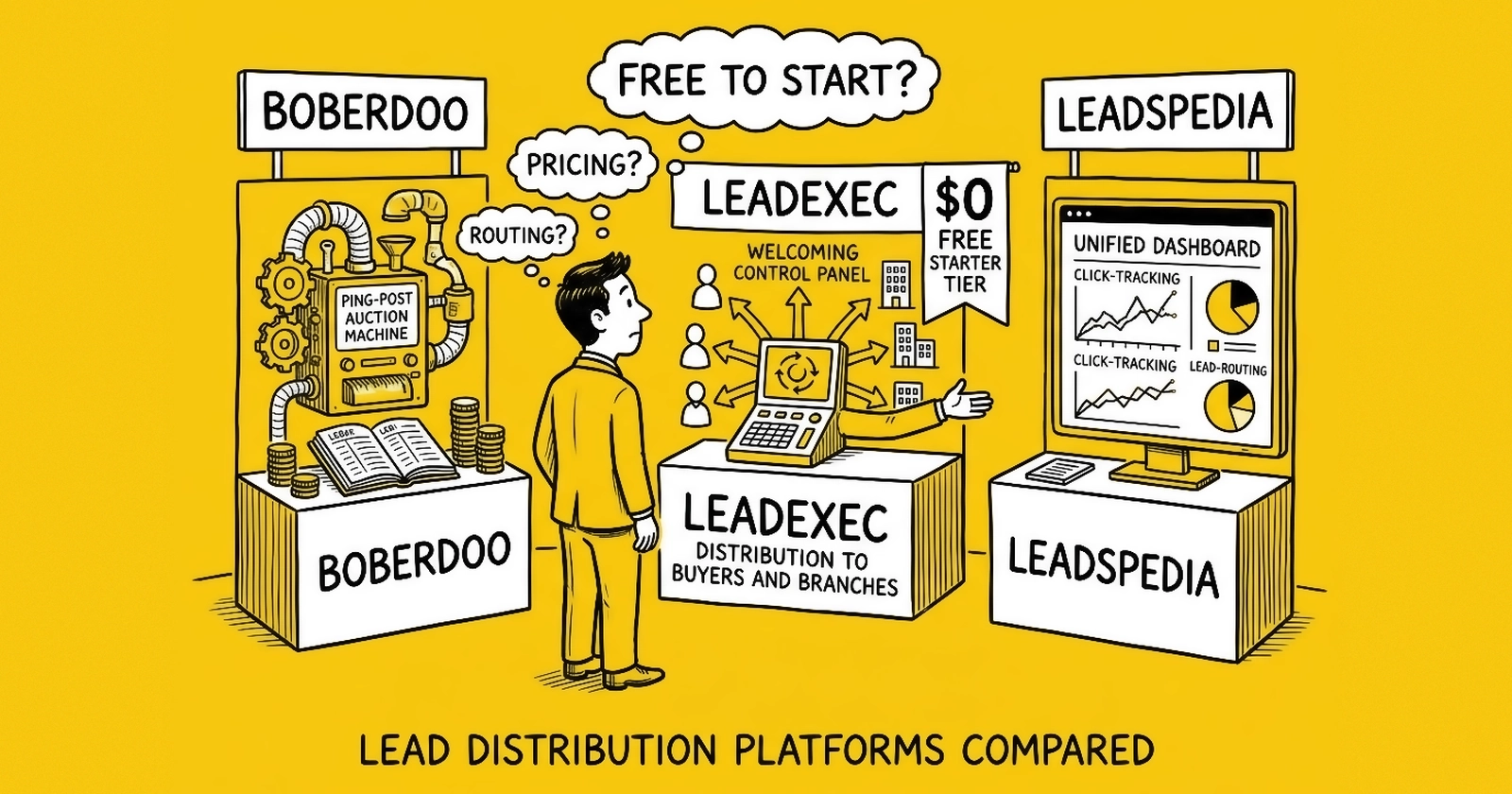
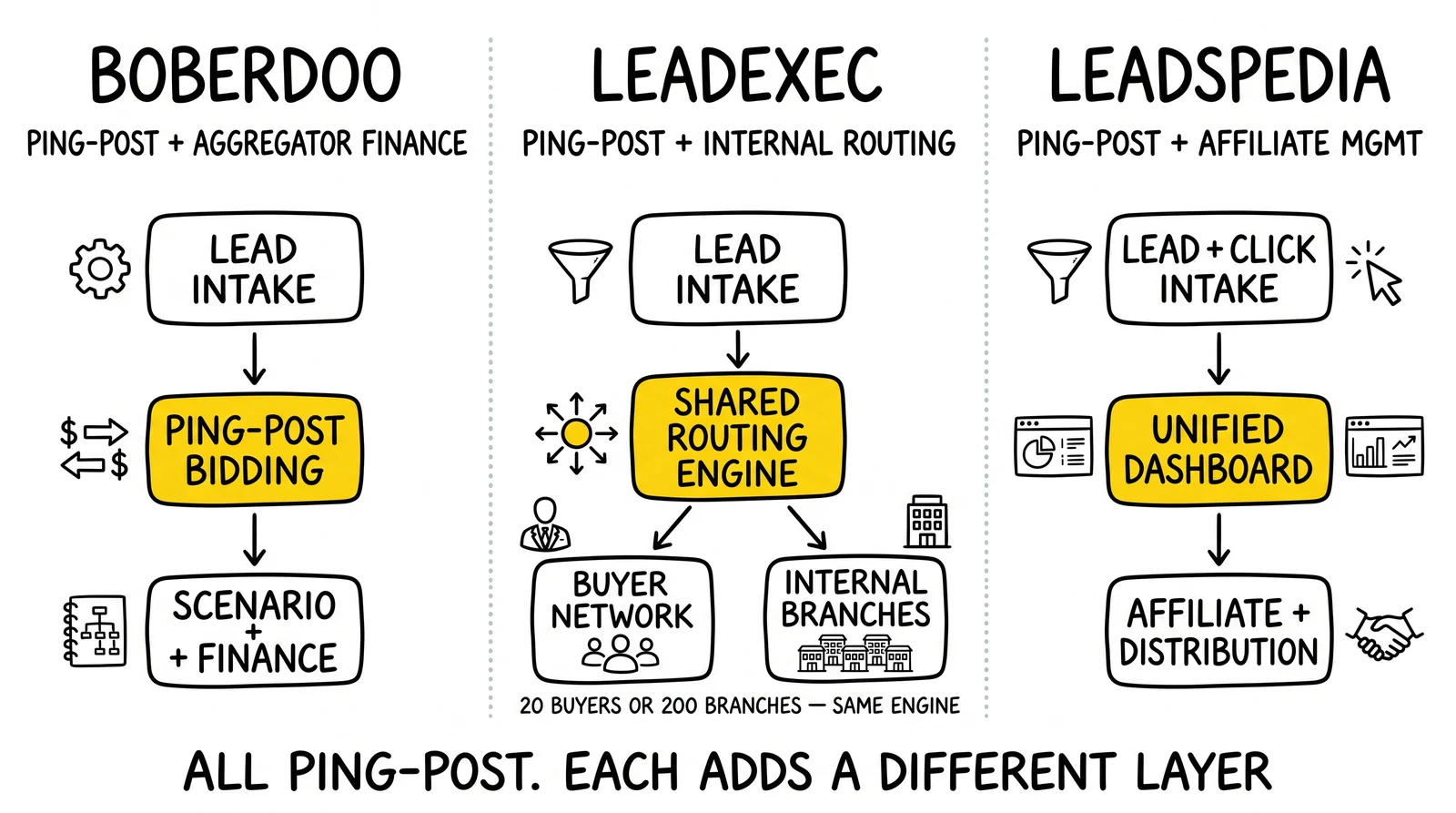
The lead distribution platform market gives operators three common starting points: boberdoo, LeadExec, and LeadsPedia. Each platform serves a different operational model. boberdoo is optimized for aggregator economics. LeadExec serves both buyer-network distribution and enterprise internal routing on a shared engine. LeadsPedia bridges affiliate management and lead distribution. This comparison maps what each platform delivers against what your operation actually needs.
The platform you select today will determine how quickly you can onboard buyers or internal recipients, how accurately you can route leads, how defensibly you can document consent, and whether your business grows through the platform or against it. This is not a software decision. It is an operational decision with software implications.
Operators spend months evaluating platforms by feature checklist, only to discover six months after implementation that they chose the wrong architecture for their business model. The platform with the longest feature list is not always the right platform. The platform that matches your operational reality is the right platform: your volume, your vertical mix, your buyer or recipient relationships, your compliance posture, and whether you are distributing to a buyer network, routing internally, or both. Here is what each platform actually delivers.
Understanding Lead Distribution Platforms
Before comparing specific platforms, it helps to understand what lead distribution software accomplishes. These systems sit at the center of lead operations, handling four core functions that determine operational effectiveness.
Lead routing and distribution forms the foundation. When a lead enters your system, the platform determines which recipient receives it based on configurable criteria: geography, lead type, price, buyer or branch capacity, time of day, and dozens of other factors. For a deeper look at routing mechanics, see our lead distribution systems guide. Sophisticated platforms support multiple routing algorithms including price-based auctions, priority cascades, round-robin distribution, and weighted allocation. The flexibility of these routing options directly affects how well you can optimize revenue while meeting recipient requirements.
Ping/post processing represents the industry-standard protocol for real-time lead trading. A “ping” sends lead attributes to potential buyers asking “do you want this lead?” Buyers respond with bids. A “post” delivers the complete lead data to the winning buyer. Platforms differ in how efficiently they handle ping/post workflows, particularly at high volumes.
Financial management adds another layer of complexity. Lead distribution generates intricate financial flows: buying from sources, selling to buyers, managing returns, tracking margins, processing payments, reconciling accounts. Understanding the sixty-day float rule is essential for managing these cash flows. Your platform should automate billing, manage buyer orders, track profitability by source and buyer, and handle the accounting complexity that scales with volume. Operations that underestimate this requirement find themselves buried in spreadsheets that should have been automated.
Compliance documentation has become non-negotiable. As detailed in our guide on consent and TCPA compliance, TCPA litigation has risen sharply in recent years, with average settlements exceeding $6.6 million (Womble Bond Dickinson, 2018). Your platform must integrate with consent documentation services like TrustedForm and Jornaya, store certificates for years, and provide retrieval capabilities when compliance inquiries arise. The platforms we’re comparing approach these functions differently, and understanding those differences matters more than feature checklists.
Six Functions Define a Lead Distribution Platform
Six functions define a lead distribution platform: capture across sources, qualification and compliance, multi-method distribution, billing and recipient management, source-level reporting, and integration depth. A platform missing one forces a second tool to cover the gap.
Capture across sources means accepting leads from web forms, landing pages, telephone inbound, chat, third-party feeds, affiliate networks, and direct API submissions through a single intake. The platform needs source-level attribution from the moment the lead enters.
Qualification and compliance covers validation (phone, email, address), duplicate detection, fraud filtering, and consent documentation. TCPA, GDPR, and state privacy laws make this non-negotiable. The platform needs to reject bad leads before they reach the recipient, document consent for every lead it accepts, and produce that documentation when legal review requires it.
Multi-method distribution is the platform’s core function: getting the lead to the right recipient through the right method. Ping/post for buyer-network auction. HTTP post for direct CRM integration. Email and SMS for endpoints without API integration. Live call transfer for voice inbound. Branded portal for buyers managing their own lead pickup. A single program often uses several methods simultaneously.
Billing and recipient management handles orders, invoices, returns, payment processing, and portal access. Operations distributing externally need invoicing and revenue collection. Operations routing internally need chargeback arrangements and recipient capacity management.
Source-level reporting answers the question every lead-gen operator asks every week: which sources are profitable, which recipients are converting, which routing rules are working. The platform needs to track the lead lifecycle from capture through delivery through recipient outcome.
Integration depth separates an established distribution platform from a workflow tool. Connections to validation providers, compliance services, CRM platforms, payment processors, form providers, and dialer systems. A platform requiring custom development for every connection adds technical overhead that compounds over time.
boberdoo, LeadExec, and LeadsPedia each cover the six functions, with characteristic depth in different areas. boberdoo concentrates depth in multi-method distribution through scenario optimization and ping-post bid mechanics suited to aggregator economics. LeadExec concentrates depth in multi-method distribution across both buyer networks and internal recipient networks, and in billing-and-recipient management through buyer self-service order configuration in the client portal. LeadsPedia concentrates depth in capture, where affiliate-click tracking joins lead capture in a single intake. The detailed sections that follow examine each platform on its own terms.
boberdoo: Financial Engineering for Lead Operations
History and Market Position
boberdoo has operated since 2001, making it the longest-running lead distribution platform still actively serving the market. Founded by Brad Seiler in Chicago, the company has spent more than two decades building infrastructure that processes pings daily for lead sellers and buyers across multiple verticals, and that longevity shows in the platform’s depth. boberdoo treats lead distribution as fundamentally a financial engineering problem. When you are managing cash flow between buying and selling, optimizing revenue per lead, handling complex billing relationships, and maintaining margin discipline across thousands of transactions, you need instrumentation designed for that complexity. The platform emphasizes 99.99% uptime and has built fraud detection and regulatory compliance automation into its core infrastructure. This reliability matters when your revenue depends on continuous operation across time zones and market conditions.
boberdoo’s market position is enterprise and high-volume aggregator operations. The platform handles complex distribution scenarios, large transaction volumes, and sophisticated financial reporting requirements. This positioning means smaller operations may find the platform more powerful than necessary, while high-volume operators may find nothing else meets their needs.
Core Capabilities
The platform’s “Shotgun Ping Post” sends pings to all matching buyers simultaneously rather than sequentially. The system collects bids, evaluates scenarios, and routes optimally.
Scenario optimization takes this further by automatically calculating whether selling exclusively to one buyer or sharing among multiple buyers generates more total revenue, then executing the optimal scenario. After any buyer rejection, the system recalculates remaining scenarios. boberdoo publishes a 20-40% additional revenue recovery claim from leads that initial buyers declined through this secondary optimization. For aggregators handling significant volume, that recovery rate represents potential margin improvement.
The platform’s AI Savings Model recalculates optimal matches every 10 minutes based on disposition feedback loops. This continuous optimization means your routing logic adapts to changing buyer performance rather than relying on static configurations. When a buyer’s conversion rates shift, whether due to internal changes, market conditions, or seasonal factors, your routing adapts automatically.
Financial instrumentation runs deep, with approximately 85 standard reports covering source performance, buyer conversion rates, profit analysis, billing reconciliation, and margin tracking. The “factoring” capabilities address cash flow timing between buying leads with immediate payment and receiving buyer payments on terms.
Customization depth sets boberdoo apart. Custom filter sets for each buyer define exactly what they can buy at what price. Custom billing cycles align with specific cash flow requirements. Custom reporting provides the metrics your business needs. The platform bends to your operational requirements rather than forcing you into predefined workflows.
Additional capabilities include a no-code form builder for lead capture forms, LeadQC validation providing quality checks at $0.02 per lead (Lite) or $0.20 per lead (Full), native integration with TrustedForm, Jornaya, and Blacklist Alliance for compliance documentation, and call routing functionality with Twilio integration where you bring your own Twilio account at no markup.
Pricing Structure
boberdoo uses a single volume-based monthly fee that adjusts automatically based on inbound action volume. Pricing is published as a range with active client spend typically falling between $500 and $3,000 per month. A $250 one-time onboarding fee covers training and system configuration. Billing operates month-to-month, billed in arrears.
Add-on services include LeadQC Full at $0.20 per lead, LeadQC Lite at $0.02 per lead, Bid Experiments at $500 per month, Cherry Picker at $500 per month, Direct DB Access at $500 per month, and consulting at $195 per hour.
All clients receive unlimited admin users, buyers, and vendors, unlimited outbound actions, unlimited timed reports, the no-code form builder, 50+ webhooks, 100+ reports, Active Vendor Directory listing, buyer auto rebilling, the ability to use your own Twilio account with no upcharges on minutes or numbers, and full API access. No long-term contracts required.
Ideal Use Cases
boberdoo serves lead aggregators processing high volumes who need sophisticated routing logic and financial instrumentation. The platform excels for operations requiring complex waterfall distributions with revenue optimization, multi-buyer parallel ping/post processing, detailed financial reporting and margin analysis, advanced scenario evaluation, and multi-channel operations handling leads, calls, and clicks through unified systems.
The learning curve is real. Users consistently report that boberdoo takes time to set up properly. Operators who make that investment also report that the platform scales from early-stage operations to seven-figure monthly revenues without requiring migration.
LeadExec: Lead Distribution and Enterprise Internal Routing
History and Market Position
LeadExec, from ClickPoint Software (founded 2007, headquartered in Scottsdale), occupies a distinctive position in the lead distribution market by serving two operational models on a shared routing engine. The first model is the lead seller or agency distributing leads to buyer networks through ping/post, batch delivery, or direct integration. The second model is the enterprise organization routing inbound leads internally to branches, franchises, regional teams, or in-house sales operations. Both are primary use cases. ClickPoint treats enterprise internal routing as equivalent in importance to buyer distribution, reflecting the operational reality that routing a lead to the right internal branch and routing the same lead to the right buyer are the same engineering problem with different recipient relationships.
The dual positioning distinguishes LeadExec from competitors built primarily around lead-seller economics, where enterprise internal routing is a secondary capability or absent entirely. Two decades of independent operation matter for buyers evaluating the platform. Product-roadmap continuity extends across LeadExec and the company’s separate lead management and sales engagement platform, SalesExec.
Core Capabilities
LeadExec handles the standard lead distribution feature set: ping/post processing, configurable routing rules, buyer and recipient management, batch and real-time delivery methods, native call routing, and three TCPA compliance paths: native validation, TrustedForm, and Jornaya. Routing supports geographic distribution, percentage-based allocation, price-based bidding, round-robin rotation, weighted allocation, and order priority.
The enterprise internal routing use case adds requirements that pure lead-seller platforms do not always handle well. Multi-location brands need geographic routing across hundreds or thousands of locations with overflow logic, time-zone awareness, and capacity-based throttling. Franchise systems need territory enforcement and parent-child recipient hierarchies. National service organizations need to route to the right regional team based on product line, jurisdiction, and current capacity. The same routing engine that distributes leads to 20 buyers can route leads to 200 internal branches.
Source management treats inbound traffic with the same configurability as buyer-side distribution. Lead capture forms, third-party feeds, telephone inbound, and direct API submissions all enter the same routing engine, where source-level attribution and source-level pricing rules apply uniformly. Reporting surfaces performance by source, by recipient, by vertical, and by routing rule, supporting routing-rule tuning over time.
A category distinction matters for buyer evaluation. LeadExec is not a CRM. LeadExec is not lead management software. These are categorically separate products. ClickPoint’s lead management and sales engagement platform is SalesExec, which handles the work that begins after a lead arrives at the assigned recipient: sales engagement, follow-up sequencing, disposition tracking, and pipeline reporting. Operations conflating these categories during platform selection often discover the mismatch months into implementation.
Pricing Structure
LeadExec publishes four tiers with monthly or annual billing. The Starter tier is free, covering 250 leads and 10,000 pings per month with no time limit, 1 hour of account setup, and 24-hour chat support. Starter is a fully functional plan, not a trial. Growth runs $825 per month ($660 with annual billing) and covers 10,000 leads and 100,000 pings, with overage at $0.03 per lead. Agency runs $1,650 per month ($1,320 annual) for 50,000 leads and 1,000,000 pings. Premium runs $2,500 per month ($2,000 annual) for 100,000 leads and 5,000,000 pings. Paid tiers include free setup hours scaling from 4 to 8 by tier, chat support, and a dedicated account manager. Annual billing saves 20 percent across the paid tiers.
Per-check costs apply uniformly across tiers: $0.02 for phone and email validation, $0.01 for USPS address verification, and $0.03 for TCPA certification. Call routing pricing scales by tier with local numbers at $3.00, toll-free at $4.00, and per-minute rates of $0.045 to $0.050.
Ideal Use Cases
LeadExec serves lead providers, agencies, and lead sellers distributing leads to buyer networks. The platform handles the core lead-seller workflow: ping/post auctions with custom buyer filter sets and per-buyer pricing, multiple delivery methods (ping/post, HTTP post, email, SMS, FTP, batch) to match how each buyer wants to receive leads, buyer self-service through a client portal where buyers configure their own order terms (volume, price, schedule, filter criteria), real-time validation and three-path TCPA compliance documentation, and source-level reporting that tracks revenue and conversion by source and buyer relationship. The free Starter tier lets new lead-seller operations build configurations and validate buyer relationships before committing to a paid plan.
The platform also serves enterprise organizations routing inbound leads internally across branches, franchises, regional teams, or in-house sales operations. The same routing engine handles territory enforcement, parent-child recipient hierarchies, and capacity-based throttling required for multi-location brands and franchise systems.
LeadsPedia: Bridging Affiliate and Lead Management
History and Market Position
LeadsPedia occupies a distinctive market position by combining a Lead Distribution System with an Affiliate Management System in a unified architecture. This hybrid approach allows operators to track both the “click” (EPC, conversion rates, publisher payouts) and the “lead” (routing, delivery, buyer billing) in a single dashboard.
For operations that both generate traffic through affiliate relationships and monetize that traffic through lead distribution, LeadsPedia removes the integration complexity that typically accompanies multi-platform configurations. The platform serves verticals including insurance, home services, education, and financial services, anywhere affiliate-driven traffic feeds lead distribution workflows. The unified view helps operators identify which traffic sources produce leads that actually convert with buyers, not just leads that meet initial quality filters.
Core Capabilities
The platform’s unified lead and affiliate tracking eliminates data reconciliation headaches that plague operators running separate systems. When your affiliate network sends traffic that converts to leads that route to buyers, seeing that entire journey in a single dashboard provides clarity that siloed systems cannot. You can trace performance from initial click through final buyer delivery, understanding true traffic source value rather than intermediate metrics that may not correlate with actual revenue.
Automated lead routing handles distribution based on predefined criteria including geographic location, lead quality, product type, and custom fields. Distribution supports price-based (highest bidder wins), priority-based (ranked buyer preference), round-robin (sequential rotation), and weighted (proportional allocation) distribution methods. The flexibility accommodates different buyer relationship types within the same operation.
Real-time analytics provide immediate visibility into campaign effectiveness, lead flow, and buyer performance. The reporting provides hybrid visibility into both traffic acquisition metrics and lead distribution performance, surfacing the complete picture from initial click through final buyer delivery. Customizable distribution rules allow operators to tailor routing logic to specific business models with advanced configuration options for geography, quality criteria, and buyer requirements.
Third-party integrations connect natively with Zapier, Stripe, Authorize.net, Jornaya, TrustedForm, Anura, DNC.com, The Blacklist Alliance, and webhooks for custom connections. The integration library covers major validation and compliance services for enhanced workflow automation. Call tracking and routing handles both web leads and phone calls within the same interface, with advanced call distribution and customizable IVR systems ensuring every call routes appropriately.
User reviews praise LeadsPedia’s interface accessibility. Operators report becoming productive quickly without extensive training. For teams without dedicated technical staff, this accessibility reduces implementation time and ongoing operational friction.
Pricing Structure
LeadsPedia offers tiered subscription pricing based on volume and features. The Lite Plan runs $1,500 per month and includes 25,000 leads, 1,000,000 pings, 150,000 clicks, 50,000 conversions, local numbers at $3.00, toll-free numbers at $4.00, cost per minute at $0.055, and standard support.
The Premium Plan costs $2,500 per month and includes 100,000 leads, 5,000,000 pings, 300,000 clicks, 150,000 conversions, local numbers at $1.50, toll-free numbers at $2.00, cost per minute at $0.045, and priority support.
Enterprise Plans offer custom pricing with custom volume allocations, custom phone rates, annual billing, and elite support tier.
Core features available at all tiers include API access, lead import, batch delivery, queue management, webhooks, and call tracking and routing.
Ideal Use Cases
LeadsPedia serves mid-market operations running both affiliate programs and lead distribution. The platform excels for hybrid affiliate and lead distribution businesses, operations frustrated by data reconciliation across separate systems, multi-vertical operations in insurance, home services, education, and financial services, and businesses needing unified click and lead tracking.
LeadsPedia’s sweet spot is operators processing 25,000 to 100,000 leads monthly who value unified affiliate and lead management over maximum customization depth. The hybrid architecture provides value that separate systems cannot replicate.
Feature Comparison
The following table provides a direct comparison of key capabilities across all three platforms:
| Feature | boberdoo | LeadExec | LeadsPedia |
|---|---|---|---|
| Core Focus | Lead distribution with financial engineering for aggregators | Distribution across buyer networks and enterprise internal routing | Hybrid lead distribution + affiliate management |
| Founded | 2000 | 2007 | 2014 |
| Headquarters | Illinois | Arizona | Tennessee |
| Ping/Post | Native | Native (concurrent deliveries) | Native |
| Call Tracking | Via Twilio integration | Native call routing, IVR, live transfer, dedicated pay-per-call product | Native call distribution with IVR |
| Affiliate Management | Limited | Limited | Full affiliate system included |
| Reporting | ~85 standard reports oriented to financial reconciliation | Customized pivot reports and lead forecasting | Hybrid affiliate-plus-lead reporting in unified dashboard |
| Scenario Optimization | Exclusive vs. shared auto-calculation | Native scenario optimization | Manual configuration |
| AI Features | AI Savings Model (10-minute bid recalculation) | AI Assist for delivery configuration, AI Chatbot, AI-powered call tracking | – |
| TrustedForm Integration | Native | Native | Native |
| Jornaya Integration | Native | Native | Native |
| Native TCPA Validation | – | Native | – |
| DNC.com Integration | Native | Native | Native |
| Known Litigator Screening | Via Trestle | Via Pure Caller ID, DNC.com, Trestle | Via Blacklist Alliance |
| Fraud Detection | Built-in | Via Pure Caller ID, Trestle, IPQualityScore | Via Anura |
| API Depth | Extensive (50+ webhooks) | Full API access plus Zapier marketplace (6,000+ app connections) | Comprehensive API and webhook support |
| Free Starter Tier | – | 250 leads / 10K pings monthly, no time limit | – |
| White-Label / Branded Portal | Available | Native branded buyer portal | Available |
| Uptime Guarantee | 99.99% | 99.9% SLA on Microsoft Azure | – |
| Billing Options | Month-to-month | Monthly or annual (20% discount on annual) | Monthly |
Pricing Comparison
| Component | boberdoo | LeadExec | LeadsPedia |
|---|---|---|---|
| Pricing Model | Single volume-based fee, automatically adjusted by inbound actions | Four tiers: Starter (free), Growth, Agency, Premium | Three tiers: Lite, Premium, Enterprise |
| Free Tier | – | Starter: 250 leads, 10K pings, no time limit | – |
| Published Pricing Range | Volume-based monthly fee; contact for current pricing | $0-$2,500/month monthly; annual saves 20% on paid tiers | $1,500-$2,500/month for Lite-Premium; Enterprise custom |
| Setup Fee | $250 one-time | None (free setup hours included by tier) | Not disclosed |
| Lead Volume / Month | Auto-adjusted by inbound actions | 250 / 10K / 50K / 100K by tier | 25K / 100K by tier |
| Per-Lead Overage | – | $0.03 per lead | Per tier terms |
| Per-Lead Validation | $0.02-0.20 (LeadQC) | $0.02 phone/email, $0.01 USPS, $0.03 TCPA | Via integrations |
| Local Phone Number | Use own Twilio | $3.00 | $1.50-3.00 by tier |
| Toll-Free Number | Use own Twilio | $4.00 | $2.00-4.00 by tier |
| Cost per Minute | Use own Twilio (no markup) | $0.045-0.050 by tier | $0.045-0.055 by tier |
| Contract Options | Month-to-month | Monthly or annual (20% off annual) | Monthly |
| Notable Add-ons | LeadQC, Bid Experiments, Cherry Picker, Direct DB Access ($500/mo each); Consulting ($195/hr) | Lead validation, USPS, TCPA cert (per-check) | Validation via integrations |
The three platforms use fundamentally different pricing structures, which makes base-fee comparisons misleading. boberdoo charges a single volume-based monthly fee that adjusts automatically with inbound action volume, predictable for high-volume operations but opaque for new buyers comparing upfront costs. LeadExec publishes four tiers with monthly or annual billing, ranging from $0 on Starter to $2,500 on Premium, with annual billing saving 20 percent on paid tiers. LeadsPedia publishes three tiers from $1,500 to $2,500 monthly, with Enterprise quoted on request.
Setup costs differ structurally. boberdoo charges a $250 one-time onboarding fee. LeadExec includes setup hours by tier (1 hour on Starter scaling to 8 hours on Premium) at no additional cost. LeadsPedia does not publish setup fee details.
Add-on pricing varies by platform. boberdoo offers LeadQC for per-lead validation and separately priced modules for advanced features (Bid Experiments, Cherry Picker, Direct DB Access). LeadExec bundles validation at per-check rates ($0.02 for phone and email, $0.01 for USPS address, $0.03 for TCPA certification) within the tier subscription. LeadsPedia handles validation through third-party integrations.
The bottom line: calculate actual expected monthly cost at your expected volume including per-lead fees, call minutes, validation, and overage charges before comparing platforms. Base subscription fees alone misrepresent total cost across platforms with different pricing models.
Implementation Complexity
Platform implementation complexity affects time-to-value and total cost of ownership. Understanding what each platform requires helps set realistic expectations and budget appropriately.
boberdoo Implementation
Implementation timelines run 4-8 weeks for standard operations and 8-16 weeks for complex multi-vertical implementations. The platform’s customization depth requires configuration expertise, with operations benefiting from having staff who understand ping/post mechanics, routing logic, and financial instrumentation.
Integration work reflects boberdoo’s philosophy of flexibility over simplicity. The platform’s 50+ webhooks and API access provide extensive flexibility, but you build most integrations rather than using pre-built connectors. The “bring your own Twilio” approach exemplifies this: more control, more configuration work.
Training investment is substantial. Users report the learning curve is real but worthwhile. Budget 2-4 weeks for core team training on campaign setup, routing configuration, and reporting. The $250 setup fee includes onboarding and system training, with ongoing consulting available at $195 per hour for complex implementations or optimization projects.
LeadExec Implementation
Implementation timelines vary by use case. Buyer-network distribution configurations typically run 2-6 weeks for standard operations. Enterprise internal-routing implementations run longer, with configuration time proportional to the complexity of the geographic, product, and capacity rules governing internal distribution, particularly for multi-location brands and franchise systems with hundreds or thousands of recipient destinations.
ClickPoint provides implementation support across all tiers. Free setup hours scale with the plan: 1 hour on Starter, 4 hours on Growth, 6 hours on Agency, 8 hours on Premium. All tiers include 24-hour chat support, with paid tiers adding a dedicated account manager. The free Starter tier allows operations to begin configuration and testing without commitment before deciding on a paid plan.
The platform reduces implementation friction through a setup wizard and AI Assist for delivery configuration, which automate the manual work of mapping fields, defining routing rules, and configuring buyer or recipient endpoints. Internal routing configurations generally benefit from a discovery phase that documents existing recipient hierarchies, territory definitions, and capacity rules before configuration begins. Operations that bring documented routing rules to the engagement complete configuration faster than those defining those rules during implementation.
LeadsPedia Implementation
Implementation timelines run 2-4 weeks for basic operations and 4-8 weeks for operations with substantial affiliate networks. Technical requirements are low to moderate, with the accessible interface enabling non-technical operators to become productive quickly. Complex custom integrations still require development resources.
Native integrations with major services (Stripe, Jornaya, TrustedForm, Zapier) reduce integration complexity for common use cases. The hybrid architecture means less stitching together separate systems. Training investment is moderate, with the interface accessibility reducing training time. Budget 1-2 weeks for core team training. Standard and priority support tiers are available, with enterprise tier including elite support.
Choosing the Right Platform
Platform selection should follow a structured decision framework rather than feature comparison alone. Your business model, volume, and technical capacity matter more than any feature checklist.
Evaluate Your Business Model First
If you are primarily a lead aggregator or broker buying leads from sources and reselling to a buyer network, boberdoo’s financial engineering capabilities, scenario optimization, and revenue recovery from rejected leads directly impact your margins. The platform is built for the aggregator business model.
If you operate a multi-location brand, franchise system, or enterprise organization with internal sales teams, branches, or regional operations needing inbound lead routing across that internal recipient network, LeadExec’s enterprise internal routing serves that use case as a primary design priority rather than an afterthought. The same engine also handles buyer-network distribution, which matters for hybrid operations that route some leads internally and sell others to buyers.
If you run affiliate programs alongside lead distribution, LeadsPedia’s hybrid architecture eliminates the integration complexity of managing separate affiliate and lead systems. The unified dashboard provides visibility that separate systems cannot. Track EPC, conversion rates, and publisher payouts alongside lead routing and buyer billing in a single interface.
Assess Your Volume and Scale
Under 10,000 leads monthly, consider whether you need an enterprise platform at all. LeadExec’s free Starter tier handles up to 250 leads and 10,000 pings monthly with no time limit, which may be sufficient for smaller operations. LeadsPedia’s Lite tier provides additional capabilities at $1,500 per month.
Between 10,000 and 100,000 leads monthly, all three platforms serve this range effectively. Your choice should depend on business model fit and specific feature requirements rather than scale concerns.
Over 100,000 leads monthly, boberdoo’s processing infrastructure and parallel ping/post become increasingly valuable for aggregator economics. Enterprise organizations with high internal-routing volume should request performance benchmarks from LeadExec during evaluation, particularly for configurations involving hundreds or thousands of recipient destinations.
Consider Your Technical Capacity
LeadExec and LeadsPedia both prioritize non-developer configuration. LeadExec ships a setup wizard, AI Assist for delivery configuration, and a user-serviceable account interface where operations teams handle ongoing changes without vendor billable hours. LeadsPedia emphasizes accessibility through its hybrid affiliate-plus-distribution interface.
With a strong technical team, boberdoo’s customization depth and API capabilities reward technical investment. The platform’s flexibility requires configuration expertise but provides operational control that simpler platforms cannot match.
Factor in Growth Trajectory
For rapid scaling, choose a platform that handles your projected volume three years out, not just current needs. boberdoo’s track record of scaling from early-stage to seven-figure monthly revenues without migration addresses this concern directly. LeadExec’s tier structure (Starter through Premium) supports growth through tier upgrades rather than platform migration. LeadsPedia’s Enterprise tier provides custom capacity for growing operations.
For stable operations where volume is predictable and you are optimizing rather than scaling, choose based on current needs and budget. The platform that best serves your operation today matters more than theoretical future capabilities.
Decision Framework Summary
| If Your Priority Is… | Consider |
|---|---|
| Unified lead distribution, affiliate management, and call tracking | LeadsPedia |
| AI Savings Model with bid recalculation every 10 minutes | boberdoo |
| Multi-method delivery breadth (ping/post, HTTP, webhook, email, SMS, FTP, batch) | LeadExec |
| Bid Experiments for A/B testing ping post pricing strategies | boberdoo |
| Multi-tier commission structures for performance marketing networks | LeadsPedia |
| Setup wizard plus AI Assist for delivery configuration | LeadExec |
| Return Best Price API parameter for pre-commit pricing visibility | boberdoo |
| Dynamic Number Insertion with keyword-level call attribution | LeadsPedia |
| Buyer self-service through client portal with buyer-defined order terms | LeadExec |
| Configuration changes handled by users rather than vendor-billable development tickets | LeadExec |
| Free starter tier with no time limit | LeadExec |
| Distribution paired with native sales engagement (LeadExec + SalesExec) | LeadExec |
| International multi-language and multi-currency operations | LeadExec |
Migration Considerations
Switching lead distribution platforms involves more complexity than typical software migrations. The systems touch every transaction, every buyer relationship, and years of compliance documentation. Plan accordingly.
Data Migration Requirements
Historical lead data presents the first challenge. Your existing platform contains lead records, transaction history, and performance data. Decide how much history to migrate versus archive. Most operations migrate 12-24 months of active data and archive older records separately.
Buyer and recipient configurations require meticulous documentation. Pricing, filters, caps, delivery methods, and relationship settings for each buyer or internal recipient must be recreated in the new platform. Document configurations in full before beginning migration. You will reference this documentation throughout the process.
Source mappings add another layer. Traffic source integrations, field mappings, and validation rules require rebuilding. Inventory all source integrations and their configuration details before starting migration work.
Consent certificates present the largest challenge for compliance. TCPA defense depends on accessible consent documentation. Ensure certificates transfer with lead records or maintain access to your previous platform for historical certificate retrieval. Given that average TCPA settlements exceed $6.6 million (Womble Bond Dickinson, 2018), this is not an area for shortcuts.
Parallel Operation Period
Run your new platform alongside your existing infrastructure for a minimum of 30 days before full cutover. This parallel operation verifies production performance matches proof-of-concept results, identifies integration issues that only emerge at scale, provides fallback if critical problems arise, and allows gradual traffic migration rather than hard cutover.
Budget time and operational complexity for this parallel period. It extends timelines but provides insurance against migration problems. Operations that skip parallel testing often regret the decision.
Training and Adoption
Platform capabilities are worthless if your team cannot use them effectively. Build training time into your migration timeline with formal training on platform capabilities and workflows, hands-on practice in staging environments before production access, documentation of your specific configurations and procedures, and designated experts who can support team members during transition.
Identify which team members need full training versus specific functional knowledge. Plan training tracks accordingly.
Timeline Expectations
Realistic migration timelines vary by operational complexity. Single vertical operations with few buyers typically require 4-6 weeks. Multi-vertical operations with moderate buyer counts need 8-12 weeks. Enterprise operations with many internal recipient destinations or many buyer integrations may require 3-6 months.
These timelines include requirements gathering, platform configuration, integration development, testing, parallel operation, and cutover. Rushed migrations create technical debt that haunts future operations. Plan conservatively.
Cost Considerations
Migration costs extend beyond new platform subscription fees. The overlap period requires running two platforms simultaneously. Integration development requires rebuilding source and buyer connections. Training time represents staff time learning new systems. Productivity loss reflects reduced efficiency during the learning curve. Consulting fees may be needed for platform vendor or third-party implementation assistance.
Budget for total migration cost, not just new platform fees. The investment is typically worthwhile for the right platform, but hidden costs surprise unprepared operators.
Frequently Asked Questions
Which platform is best for insurance lead distribution?
A lead generation agency selling insurance leads will find boberdoo, LeadExec, and LeadsPedia functionally similar for the core workflow: capturing leads, routing to agent or carrier buyers, managing billing, documenting consent. Differentiation shows up at the edges. LeadExec adds a second use case for carriers and MGAs routing inbound leads internally across their own agent networks. LeadsPedia adds affiliate management for agencies running publisher-driven traffic acquisition alongside lead distribution. boberdoo adds ping post bid mechanics like Bid Experiments and the Return Best Price parameter for operations optimizing pricing strategy. None of these differences make a platform “best for insurance”; they make a platform best for your operational model within insurance.
Can I switch platforms without losing historical data?
Yes, but plan carefully. Lead records, transaction history, and buyer or recipient configurations can be migrated, though the process requires careful mapping between platforms. Consent certificates present the largest challenge. Ensure certificates transfer with records or maintain access to your previous platform for historical certificate retrieval. TCPA defense depends on accessible documentation. Budget 4-12 weeks for migration depending on complexity.
What is the real cost difference between these platforms?
Entry costs differ structurally. LeadExec publishes four tiers: Starter at $0 (250 leads and 10,000 pings per month with no time limit, fully functional), Growth at $825 monthly, Agency at $1,650 monthly, and Premium at $2,500 monthly, with annual billing saving 20 percent across paid tiers. boberdoo uses a single volume-based monthly fee that adjusts with inbound action volume, with a $250 one-time setup fee. LeadsPedia starts at $1,500 per month for the Lite tier. Entry cost misleads regardless. Calculate total monthly cost at your expected volume including per-lead fees, validation charges, call minutes, add-ons, and overage charges.
Do I need a developer to implement these platforms?
LeadExec and LeadsPedia both prioritize non-developer implementation. LeadExec ships a setup wizard, AI Assist for delivery configuration, and a user-serviceable account interface where operations teams handle ongoing changes without vendor billable hours. LeadsPedia emphasizes accessibility through its hybrid affiliate-plus-distribution interface. boberdoo’s depth rewards technical investment and typically requires more configuration expertise. Users report the customization is powerful but takes time to set up. For any platform, custom integrations with non-standard sources or recipients benefit from development resources.
How do these platforms handle TCPA compliance?
All three platforms integrate with TrustedForm and Jornaya for consent documentation. LeadExec adds a third path, native TCPA validation built directly into the platform, which generates compliance documentation as part of lead processing rather than relying on a third-party service. All three connect to DNC.com for number scrubbing and Known Litigator screening. Beyond the shared baseline, each platform offers its own ecosystem of phone-validation and identity partners. LeadExec includes Pure Caller ID, Trestle, and IPQualityScore among others; boberdoo connects to Trestle; LeadsPedia uses Data8 for international coverage. None of these vendor differences indicate missing capability, only different partner choices for the same functional needs. Given the rising TCPA litigation environment and high average settlement values (Womble Bond Dickinson, 2018), strong compliance integration is essential.
Which platform has the best reporting?
boberdoo publishes approximately 85 standard reports covering lead flow, profit analysis, buyer activity, and financial reconciliation, with depth oriented toward aggregator financial instrumentation. LeadsPedia provides hybrid reporting across affiliate and lead metrics in a unified dashboard. LeadExec features customized pivot reports and lead forecasting covering source performance, recipient performance, vertical performance, and routing-rule effectiveness, with structure that serves both buyer-network distribution and internal multi-location routing. “Best” depends on what questions you need to answer.
What if my use case is pay-per-call rather than web lead distribution?
Pay-per-call is a related but distinct operational category. Platforms that specialize in voice-first distribution, including Ringba, Phonexa, and others, focus their entire product on call tracking depth. The three platforms in this comparison handle pay-per-call as part of their broader distribution feature set. boberdoo handles call routing via Twilio integration with an earnings-per-lead algorithm. LeadExec offers a dedicated pay-per-call product with AI-powered call tracking, IVR, and live call transfer. LeadsPedia includes call distribution and customizable IVR within its platform. For operations where calls are one channel alongside web leads, the platforms in this comparison serve the use case. For pure pay-per-call operations, evaluating dedicated voice-first platforms is worth the additional analysis.
What happens if I outgrow my platform?
All three platforms handle growth through tier upgrades or configuration expansion rather than platform migration. boberdoo positions itself for high-volume aggregator operations and claims to have processed substantial ping volume without performance issues at high volumes. LeadsPedia’s Enterprise tier provides custom capacity for growing networks. LeadExec covers volume growth on both sides of its dual use case: high-volume buyer-network distribution and high-volume internal routing across multi-location or franchise networks. Verify performance benchmarks with each platform during evaluation if you anticipate aggressive volume growth.
How long does implementation typically take?
Basic implementation runs 2-4 weeks for single-vertical operations with few buyers or recipients. Standard implementation takes 4-8 weeks for typical operations with moderate complexity. Enterprise implementation requires 8-16 weeks for complex operations with many integrations and custom requirements. Add 30+ days for parallel operation testing before full cutover. LeadExec and LeadsPedia both prioritize non-developer configuration, which reduces implementation time for teams without dedicated technical staff.
Should I evaluate platforms beyond these three?
Yes. While boberdoo, LeadExec, and LeadsPedia are common starting points for web lead distribution and enterprise routing evaluations, other platforms serve specific needs effectively. Phonexa serves multi-channel marketing automation with strong call-tracking emphasis. Lead Prosper offers accessible entry-level distribution with “bid penalties” for high-return buyers. Ringba specializes in pay-per-call with ring tree real-time bidding. ActiveProspect (LeadConduit) excels as compliance middleware and is the native home of TrustedForm. CAKE and Everflow serve affiliate-heavy operations. LeadHoop serves aggregators needing full funnel visibility. Evaluate platforms that match your specific business model rather than defaulting to commonly-named options.
Key Takeaways
boberdoo excels at financial engineering for high-volume aggregators. Parallel ping/post processing, scenario optimization, and 20-40% revenue recovery from rejected leads directly impact margins. Volume-based monthly pricing with a $250 setup fee rewards operators who invest in configuration. The platform has processed substantial ping volume with 99.99% uptime. Best for lead aggregators processing high volumes who need sophisticated routing and financial instrumentation.
LeadExec collapses a distinction the market usually treats as two separate problems: distributing leads to a buyer network and routing leads to an internal recipient network. The same engine handles both, which matters for hybrid operations selling some leads externally while routing others to internal branches or franchisees. The internal-routing side carries its own requirements that lead-seller-first platforms underserve: territory enforcement, parent-child recipient hierarchies, capacity throttling across hundreds of destinations. Category boundaries matter at selection time: LeadExec is purpose-built for distribution and routing, not CRM or post-routing sales engagement (SalesExec handles those). Best for multi-location brands and franchise systems on the internal-routing side, and lead sellers and agencies on the buyer-network side.
LeadsPedia uniquely combines lead distribution with affiliate management in a unified platform. The hybrid architecture eliminates integration complexity for operations running both functions. Accessible interface enables faster implementation without dedicated technical staff. Pricing from $1,500 per month with tiered lead volumes. Best for mid-market operations running affiliate programs alongside lead distribution who value unified tracking.
Platform selection is an operational decision, not a software decision. Match platform capabilities to your business model, volume, and technical capacity rather than comparing feature lists. The right platform becomes invisible infrastructure that scales with your business. The wrong platform becomes a constant friction point that limits growth.
Migration requires careful planning. Budget 4-12 weeks depending on complexity. Run parallel operation for 30+ days before full cutover. Factor in training time and productivity loss during transition. The investment is worthwhile for the right platform, but underestimating migration complexity leads to operational disruption.
Total cost of ownership matters more than entry pricing. Calculate expected monthly cost at your actual volume including all per-lead, per-call, and add-on fees before comparing platforms. The platform with the lowest base fee may not be the most economical at your volume.
Business model fit matters more than feature parity. Aggregator economics, hybrid affiliate-plus-distribution, and dual-use distribution-plus-internal-routing are three distinct operational models. Match the platform to the model rather than choosing a platform and forcing your model to fit.
Sources
- boberdoo Lead Distribution Software – Source for boberdoo’s pricing range, 99.99% uptime figure, founding year (2000), and feature set cited throughout the platform comparison
- Womble Bond Dickinson TCPA Annual Report 2018 – Source for $6.6M average TCPA class action settlement figure cited in the compliance documentation section
- ActiveProspect TrustedForm – Source for TrustedForm consent certificate integration referenced as a compliance feature across all three platforms
- Jornaya LeadiD – Source for Jornaya lead certification integration referenced alongside TrustedForm in platform compliance assessments
- LeadsPedia Platform – Source for LeadsPedia pricing ($1,500/month Lite, $2,500/month Premium), feature set, and hybrid affiliate/lead management architecture described in the LeadsPedia section
- ClickPoint Software LeadExec – Source for LeadExec’s dual-use positioning across buyer distribution and enterprise internal routing, founding year (2007), Scottsdale headquarters, four-tier pricing structure, and the separate SalesExec lead management platform
- 47 CFR § 64.1200 – FCC TCPA Regulations – Governing TCPA regulations that make consent documentation platform features legally necessary for covered operations
Platform pricing and features verified June 2026. Pricing may vary. Request current quotes before making selection decisions.