A comprehensive guide for lead generation professionals who want to leverage lookalike audiences to find new prospects at scale – without sacrificing the quality that keeps buyers happy and margins intact.
Lookalike audiences represent one of the most powerful targeting mechanisms available to lead generators. When built correctly, they allow you to find thousands – sometimes millions – of prospects who share characteristics with your best-performing leads. When built incorrectly, they become an expensive way to acquire leads that look good on paper but fail when the phone rings.
The difference between success and failure is not the technology. Meta, Google, LinkedIn, and TikTok all offer sophisticated machine learning that can identify patterns in your source data and find similar users at scale. The difference is the quality and composition of your seed list, your understanding of audience sizing tradeoffs, and your discipline in monitoring performance as you scale.
This guide covers everything you need to know about building lookalike audiences for lead generation: constructing effective seed lists from your best customers rather than all customers, selecting the right audience sizes for your budget and goals, scaling strategies that maintain quality as volume increases, and navigating the quality-versus-volume tradeoffs that determine long-term profitability.
Those who master lookalike targeting consistently outperform those relying solely on interest-based or demographic targeting. They find prospects at lower CPL, with higher contact rates, and better conversion to sales. The mechanics are straightforward – but the execution requires precision.
What Are Lookalike Audiences and Why They Matter for Lead Generation
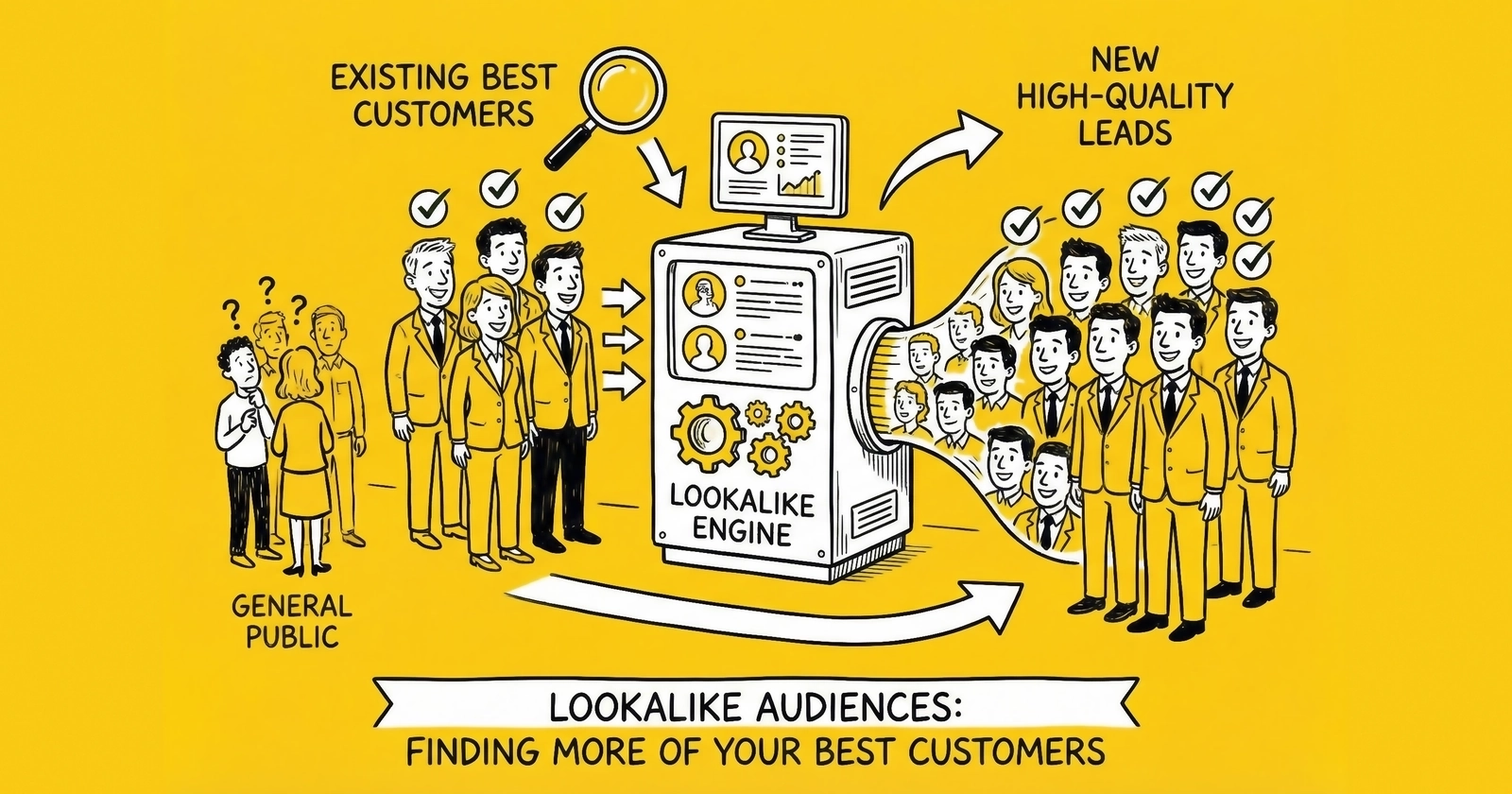
Lookalike audiences (also called similar audiences, depending on platform) are algorithmically generated targeting segments based on characteristics of your existing customers or leads. You provide a “seed” list of known valuable prospects, and the advertising platform’s machine learning identifies common patterns – demographics, behaviors, interests, online activity – then finds other users who share those patterns.
The fundamental premise is simple: people who resemble your best customers are more likely to become customers themselves than random users matching generic demographic criteria.
The Mechanics Behind Lookalike Targeting
When you upload a customer list to Meta, the platform’s algorithms analyze those users across thousands of data points: age, location, income indicators, purchase behavior, app usage, content engagement, device preferences, and behavioral patterns invisible to advertisers directly. The algorithms identify which combinations of attributes are statistically correlated with appearing on your list.
The platform then scans its entire user base to find others who share those patterns – creating an audience of potential prospects ranked by similarity to your seed. A 1% lookalike contains the users most similar to your source; a 10% lookalike extends further into less similar territory.
Why Lookalikes Outperform Other Targeting Methods
Interest-based targeting relies on self-reported preferences and observed behaviors that platforms categorize into broad buckets. Users “interested in insurance” include everyone from insurance professionals to consumers who clicked one article about coverage options last month. The signal is weak.
Demographic targeting is even weaker. Targeting homeowners aged 35-55 captures everyone matching those criteria regardless of their actual propensity to respond to your offer.
Lookalike audiences invert this logic. Rather than defining who might be interested, you start with people who already converted and let machine learning identify what makes them different from non-converters. This data-driven approach consistently outperforms human assumptions about who will respond.
For lead generators specifically, lookalikes offer three advantages:
Quality correlation: Lookalikes built from high-converting leads tend to produce leads that also convert at higher rates, because the algorithms identify patterns associated with conversion, not just form completion.
Scale without complexity: Reaching millions of prospects through interest layering requires complex campaign structures and constant optimization. Lookalikes achieve similar reach with simpler setup.
Continuous improvement: As you feed more data into your seed lists, the algorithms refine their pattern matching. Lookalike performance improves over time as your data improves.
Building Effective Seed Lists: The Foundation of Lookalike Success
Your seed list determines everything. A lookalike audience is only as good as the source data informing it. Feed the algorithm garbage, and it will find more garbage – efficiently and at scale.
The most common mistake in lookalike targeting is using all leads or all customers as your seed. This dilutes signal with noise. Your worst leads – the returns, the no-answers, the non-converters – are included alongside your best. The algorithm cannot distinguish quality when you do not teach it.
Minimum Seed List Requirements by Platform
Each platform enforces minimum requirements and recommends optimal sizes:
Meta (Facebook/Instagram): Minimum 100 users from a single country. Recommended seed size is 1,000-50,000 users. Meta explicitly states that quality matters more than quantity – a smaller list of high-value customers outperforms a larger list of mixed quality.
Google Ads: Similar segments require a minimum of 1,000 users in a remarketing list with sufficient similarity. Google deprecated standalone similar audiences in 2023 but maintains similar functionality through Optimized Targeting and Audience Expansion in Performance Max campaigns.
LinkedIn: Minimum 300 matched members for lookalike targeting. Recommended minimum of 1,000-10,000 for B2B campaigns where audiences are smaller.
TikTok: Minimum 100 users for lookalike creation, with 1,000+ recommended for stable performance.
Segmenting Your Seed List by Quality Outcomes
The power of lookalike targeting comes from segmentation. Rather than one lookalike from “all customers,” build multiple lookalikes from distinct customer segments:
Seed Type 1: High-Value Converters Include only leads that converted to customers at above-average rates. For insurance leads, this means leads that actually bound policies. For home services, leads that scheduled and completed jobs. For B2B, leads that closed deals.
This requires feedback data from your buyers – which creates operational complexity but dramatically improves targeting effectiveness. Even if only 20% of your leads have downstream conversion data, a 200-person seed of verified converters outperforms a 2,000-person seed of unqualified form submissions.
Seed Type 2: High-Contact-Rate Leads If you lack conversion data, contact rate is the next-best proxy. Leads that answer the phone and engage with sales reps share characteristics that algorithms can identify. Build seeds from leads with first-attempt contact rates above your average.
Seed Type 3: Low-Return Leads For lead generators selling to multiple buyers, return patterns reveal quality. Leads that were never returned across any buyer represent your highest-quality output. Understanding return rate benchmarks helps set expectations for this metric. This seed type requires consistent tracking of return reasons and source attribution.
Seed Type 4: Lifecycle-Based Seeds Different customer types at different stages provide different signals. Recent converters (last 60 days) capture current market conditions. Long-term customers with repeat purchases identify loyalty patterns. High lifetime value customers point toward prospects worth more to acquire.
Data Hygiene Requirements for Seed Lists
Platform matching rates depend on data quality. Sloppy data produces low match rates, which produce weak lookalikes.
Email best practices:
- Use primary email addresses, not secondary accounts
- Remove obviously fake emails (test@test.com, asdf@gmail.com)
- Normalize formatting (lowercase, trim whitespace)
- Remove duplicates before upload
Phone number best practices:
- Include country codes
- Remove extensions
- Validate phone number format before upload
- Mobile numbers match better than landlines
Name and address data:
- Standardize formats (St. vs Street, Ave vs Avenue)
- Include all name variations if available
- Verify address completeness
Match rates vary by platform: Meta typically achieves 50-80% match rates on well-formatted lists; LinkedIn ranges 30-60% for B2B data. If your match rate falls below 30%, investigate data quality before proceeding.
Recency and Freshness Considerations
Customer behavior patterns change. A lookalike built from 2022 data may target users who resemble 2022 buyers – but 2025 buyers may have different characteristics.
Recommended recency windows by vertical:
| Vertical | Optimal Seed Recency | Reasoning |
|---|---|---|
| Insurance | 90-180 days | Shopping patterns stable but rates change |
| Mortgage | 30-90 days | Rate sensitivity creates volatile buyer profiles |
| Solar | 120-180 days | Longer sales cycles; policy changes matter |
| Home Services | 60-120 days | Seasonal patterns affect buyer composition |
| Legal | 90-180 days | Case type trends shift with news cycles |
Update seed lists monthly at minimum. Stale seeds produce increasingly irrelevant lookalikes as market conditions evolve.
Audience Sizing: The Quality-Reach Tradeoff
Lookalike audience size directly affects both the reach of your campaigns and the quality of users within that audience. The 1% most similar users are – by definition – more like your source than the 5% or 10% most similar. But limiting to 1% may not provide sufficient reach for your budget.
Understanding Population-Based Percentages
Lookalike percentages represent population fractions, not similarity scores. A 1% lookalike audience in the United States captures approximately 2.1-2.5 million users – 1% of Meta’s active U.S. user base. A 1% lookalike in smaller markets produces proportionally smaller audiences:
| Country | 1% Lookalike Size (Approximate) |
|---|---|
| United States | 2.1-2.5 million |
| United Kingdom | 450,000-550,000 |
| Canada | 250,000-350,000 |
| Australia | 200,000-280,000 |
| Germany | 350,000-450,000 |
This population basis means the “right” percentage varies by market. A 1% U.S. audience may be larger than a 5% U.K. audience. Plan accordingly.
Recommended Starting Percentages by Market and Budget
Start narrow and expand based on performance data. These recommendations assume cold traffic prospecting:
United States (large audience):
- Budget under $5,000/month: 1% lookalike only
- Budget $5,000-$25,000/month: 1% and 2% as separate ad sets
- Budget $25,000-$100,000/month: 1-3% range, tested separately
- Budget over $100,000/month: 1-5% with expansion testing
United Kingdom, Canada, Australia (medium audiences):
- Budget under $5,000/month: 2-3% lookalike
- Budget $5,000-$25,000/month: 2-5% range
- Budget over $25,000/month: 3-7% with testing
Smaller markets (under 10 million platform users):
- Start at 5%+ to ensure sufficient daily reach
- May require combining with interest targeting
The Performance Curve: How Quality Declines with Size
Quality degradation is not linear. The difference between 1% and 2% is typically smaller than the difference between 5% and 10%. Performance curves vary by seed quality and vertical, but general patterns hold:
Typical relative performance by lookalike size (1% as baseline):
| Lookalike Size | Relative CPL | Relative Contact Rate | Relative Conversion |
|---|---|---|---|
| 1% | 1.00x (baseline) | 100% (baseline) | 100% (baseline) |
| 2% | 1.05-1.15x | 95-98% | 95-98% |
| 3% | 1.10-1.25x | 90-95% | 90-95% |
| 5% | 1.20-1.40x | 85-92% | 85-92% |
| 10% | 1.40-1.80x | 75-85% | 75-85% |
These are approximations. Your actual performance depends on seed quality, vertical competitiveness, and creative effectiveness. The pattern is consistent: larger audiences produce lower quality at higher volume.
When to Use Larger Lookalikes
Larger lookalikes make sense in specific circumstances:
High-volume demand: If your buyer needs 500 leads daily and your 1% lookalike exhausts at 100, you must expand. The key is understanding the quality tradeoff and pricing accordingly.
Testing and learning phases: Larger audiences provide faster statistical significance. A 5% lookalike collects learning data faster than 1%, even if quality is lower.
Broad appeal products: Some offers convert across wide demographics. A free home value estimate attracts both serious sellers and curious homeowners. Larger lookalikes find volume without catastrophic quality decline.
Layered targeting: Larger lookalikes combined with interest exclusions or demographic filters can maintain quality while expanding reach. A 5% lookalike minus competitors’ customers, for example.
Platform-Specific Implementation
Each advertising platform implements lookalike functionality differently. Understanding platform-specific mechanics improves performance.
Meta (Facebook/Instagram) Lookalike Audiences
Meta offers the most sophisticated lookalike targeting with the largest consumer audience. Key implementation considerations:
Source audience types:
- Customer file uploads (email, phone, MAID)
- Website Custom Audiences (pixel-based)
- App activity audiences
- Video engagement audiences
- Lead form engagement audiences
- Page engagement audiences
Customer file uploads from your CRM typically produce the highest-quality seeds because they contain verified conversion data. Proper lead tracking and attribution ensures this data is accurate. Website Custom Audiences capture broader intent signals but include non-converters.
Value-based lookalikes: Meta allows you to include customer lifetime value data in your uploads. The algorithm weights users accordingly, finding prospects similar to your highest-value customers rather than all customers equally. For lead generators with variable lead values by buyer or close rates by source, this feature significantly improves targeting.
Stacking multiple lookalikes: You can include up to 500 lookalike audiences in a single campaign. Stacking lookalikes from different seeds – converters, high-contact leads, high-value customers – sometimes outperforms any single lookalike. The audience overlap is handled automatically.
Audience refresh cadence: Meta lookalikes refresh automatically every 3-7 days as your source audience changes. Update source audiences regularly to benefit from this dynamic refresh.
Advantage+ and broad targeting interaction: Meta’s Advantage+ campaigns may expand beyond your selected lookalike to find additional conversions. Monitor actual audience delivery to ensure the platform isn’t abandoning your lookalike for cheaper traffic.
Google Ads Audience Targeting
Google’s approach to similar audiences has evolved significantly. Traditional similar audiences were deprecated in 2023, replaced by:
Optimized targeting: Available in Display, Discovery, and Video campaigns. When enabled, Google expands beyond your selected audiences to reach users likely to convert. This functions similarly to lookalike targeting but with less advertiser control.
Audience expansion in Performance Max: Performance Max campaigns automatically identify and target users similar to your converters across Google’s entire property network. The lack of transparency makes quality monitoring essential.
Customer Match: Upload customer lists to Google for targeting and exclusion. Google uses this data to identify similar users for automated expansion. Match rates typically range 30-60% depending on data quality.
Best practices for Google: Given reduced control over similar audience targeting, focus on feeding accurate conversion data through Enhanced Conversions and Offline Conversion Import. The algorithm’s expansion quality depends on learning from genuine conversions, not just form fills.
LinkedIn Lookalike Audiences
LinkedIn lookalikes are essential for B2B lead generation where professional targeting matters more than consumer behavior:
Minimum requirements: 300 matched members minimum, 1,000+ recommended for stable performance.
Source options: Company lists, contact lists, website audiences, single-image ad engagement, video ad engagement.
B2B-specific advantages: LinkedIn’s professional data – job titles, company size, industry, seniority – means lookalikes identify prospects by professional characteristics that other platforms miss. A lookalike from customers who closed will identify prospects with similar professional profiles, not just similar browsing behavior.
Size limitations: LinkedIn’s smaller user base (900+ million members globally, with varying active usage) means lookalike audiences reach smaller absolute numbers. A 1% lookalike on LinkedIn may be 50,000-100,000 users, requiring larger percentages or geographic expansion.
TikTok Lookalike Audiences
TikTok’s newer advertising platform offers lookalike targeting with unique characteristics:
Younger audience composition: TikTok’s user base skews younger than Meta. Lookalikes identify prospects within this demographic, which may not match your current customer base age distribution.
Engagement-based seeds: Video view and engagement audiences work well as lookalike seeds on TikTok because the platform’s algorithm excels at identifying content affinity patterns.
Lower CPMs: TikTok’s CPMs run 30-47% cheaper than Meta in many verticals. This means lookalike experiments cost less, allowing faster learning.
Creative dependency: TikTok performance depends heavily on creative quality. A strong lookalike cannot overcome weak creative on this platform.
Scaling Strategies for Lookalike Audiences
Scaling lookalike-driven campaigns requires different approaches than scaling broad interest-based targeting. The audience is defined algorithmically, which creates both opportunities and constraints.
Horizontal Scaling: Multiple Seed Types
The most sustainable scaling approach builds multiple lookalikes from different high-quality seeds rather than expanding a single lookalike to larger percentages.
Example horizontal scaling progression:
Phase 1 (Initial):
- 1% lookalike from all converters
- Budget: $10,000/month
Phase 2 (First expansion):
- 1% lookalike from high-contact leads
- 1% lookalike from low-return leads
- Original 1% converters lookalike
- Budget: $20,000/month across three ad sets
Phase 3 (Continued expansion):
- Add 1% lookalike from last-90-day converters
- Add 1% lookalike from high-LTV customers
- Original three lookalikes continue
- Budget: $35,000/month across five ad sets
This approach maintains quality because each 1% lookalike contains the highest-similarity users from its respective source. You scale through diversification rather than dilution.
Vertical Scaling: Percentage Expansion
When horizontal scaling exhausts available seed variations, expand lookalike percentages carefully:
The 1% → 2% → 3% protocol:
- Establish baseline performance with 1% lookalike for 2-4 weeks
- Add 2% lookalike as a separate ad set (not replacing 1%)
- Compare CPL, contact rates, and conversion for 2+ weeks
- If 2% maintains acceptable quality (within 15% of baseline metrics), add 3%
- Continue until quality degradation exceeds acceptable thresholds
Critical monitoring during expansion:
- CPL should increase proportionally (5-15% per percentage point expansion)
- Contact rates should decline gradually (2-5% per percentage point)
- Return rates should increase modestly (1-2 points per expansion)
- If any metric degrades sharply, pause expansion
Geographic Expansion
For U.S. operations, lookalike audiences can be expanded geographically by creating country-specific seeds and audiences:
State-level optimization: Create separate lookalikes for high-value states versus others. A 1% lookalike of Texas converters finds Texas prospects; a 1% lookalike of Florida converters finds Florida prospects. These may differ meaningfully by vertical.
International expansion: If your buyers accept leads from multiple countries, test lookalikes in new markets using your domestic seed. A U.S. customer list can generate Canadian lookalikes, though performance varies based on market similarity.
Budget Allocation Across Lookalike Tiers
As you scale across multiple lookalike audiences, allocate budget to maintain quality while building volume:
Recommended allocation framework:
- 50-60% of budget to 1% lookalikes (highest quality)
- 25-35% of budget to 2-3% lookalikes (quality with scale)
- 10-15% of budget to 4-5%+ lookalikes (volume testing)
Use Campaign Budget Optimization (CBO) on Meta to let algorithms allocate dynamically within these tiers, but separate tiers into distinct campaigns to maintain budget boundaries.
Quality vs. Volume Tradeoffs: Making the Right Decisions
Every lookalike scaling decision involves trading quality for volume or vice versa. Making these tradeoffs consciously – rather than discovering them through buyer complaints – is what separates professional operations from amateur ones.
The Economics of Quality Degradation
Quality degradation has quantifiable cost. Consider this example:
Baseline (1% lookalike):
- CPL: $35
- Contact rate: 65%
- Lead-to-sale conversion: 12%
- Effective cost per sale: $448
Expanded (5% lookalike):
- CPL: $28 (lower, due to easier targeting)
- Contact rate: 52% (20% decline)
- Lead-to-sale conversion: 9% (25% decline)
- Effective cost per sale: $598
The 5% lookalike produces cheaper leads but more expensive customers. If your buyer pays per lead without quality adjustment, the 5% looks attractive. If they pay based on conversion or have return provisions, the 5% destroys margin.
This is why buyer alignment matters. Operators selling to buyers who care only about volume can scale aggressively. Operators selling to buyers who track downstream conversion must scale conservatively.
Buyer Capacity as the Scaling Constraint
The limit on lookalike scaling often is not audience exhaustion but buyer absorption. You can find more prospects; the question is whether anyone will pay for them.
Before scaling lookalike audiences:
- Confirm primary buyer can absorb volume increase
- Identify secondary buyers for overflow
- Understand quality thresholds that trigger returns
- Calculate break-even quality levels by buyer
Scaling leads without buyer capacity produces warehoused inventory. Leads decay 10% per hour in most verticals. Leads you cannot sell today are worth less tomorrow.
When to Prioritize Quality Over Volume
Prioritize quality when:
- Buyer relationships depend on contact and conversion rates
- Your pricing model includes return provisions or quality guarantees
- You’re building reputation in a new vertical
- Market conditions favor sellers (strong buyer demand, limited supply)
- Your buyer’s sales team is constrained (they need closeable leads, not more leads)
When to Accept Volume Over Quality
Accept volume tradeoffs when:
- Buyer explicitly requests increased volume at adjusted quality expectations
- Your pricing model transfers quality risk to buyer (as-is pricing)
- You have secondary buyers who accept lower-quality leads at lower prices
- You’re testing new markets where quality thresholds are unknown
- Seasonal demand spikes create temporary capacity windows
Monitoring and Optimization Best Practices
Lookalike campaigns require ongoing monitoring different from other targeting methods. The audience is a black box – you cannot see which characteristics the algorithm uses – so output metrics become your only visibility into performance.
Essential Metrics by Phase
Launch phase (Week 1-2):
- Match rate (seed upload quality)
- CPM (auction competitiveness)
- CTR (creative relevance to lookalike audience)
- Form start rate (landing page relevance)
- CPL (initial cost efficiency)
Optimization phase (Week 3-8):
- Contact rate (lead quality indicator)
- Qualification rate (lead quality indicator)
- Return rate (buyer quality signal)
- Cost per qualified lead (adjusted efficiency)
- Audience saturation (frequency metrics)
Maturity phase (Week 8+):
- Lead-to-sale conversion (ultimate quality metric)
- Buyer satisfaction (relationship health)
- Audience freshness (seed recency)
- Competitive CPM trends (market dynamics)
Frequency and Saturation Monitoring
Lookalike audiences, especially smaller percentages, can saturate. When the same users see your ads too frequently, performance degrades.
Frequency thresholds by objective:
- Lead generation: 2-4 impressions per user per week
- Brand awareness: 4-6 impressions per user per week
- Retargeting: 6-10 impressions per user per week
When frequency exceeds thresholds:
- Expand to larger lookalike percentage
- Add new seed-based lookalikes
- Increase creative rotation velocity
- Reduce daily budget to slow delivery
A/B Testing Lookalike Variations
Test lookalike variations systematically:
Testing framework:
- Control: Your current best-performing lookalike
- Variant A: Different seed type (converters vs. high-contact leads)
- Variant B: Different percentage (1% vs. 2%)
- Variant C: Different recency (90-day vs. 180-day seed)
Run tests for 2+ weeks before drawing conclusions. Lookalike performance has higher variance than interest-based targeting in early delivery phases.
What to test and in what order:
- Seed composition (most impactful)
- Seed recency (second-most impactful)
- Audience percentage (third-most impactful)
- Platform-specific settings (least impactful but worth testing)
Refresh and Update Cadence
Seed list updates: Monthly minimum, weekly for high-volume operations. Fresh conversion data improves targeting as market conditions evolve.
Audience refresh: Platforms refresh lookalikes automatically (Meta: 3-7 days). Ensure your source audiences update so automatic refreshes incorporate new data.
Performance reviews: Weekly during active scaling, monthly during stable operations. Monthly reviews should assess whether existing lookalikes still outperform alternatives.
Frequently Asked Questions
What is the minimum seed list size needed for effective lookalike targeting?
Platform minimums are 100 users (Meta, TikTok) to 300 users (LinkedIn). However, effective targeting requires more. Meta recommends 1,000-50,000 users for optimal results. In practice, seed lists under 500 users produce unstable lookalikes with high performance variance. Aim for 1,000+ users in your seed, prioritizing quality over quantity. A 500-person seed of verified buyers outperforms a 5,000-person seed of mixed-quality leads.
Should I use all my customers or segment my seed lists?
Always segment. Using all customers dilutes quality signals by including low-value and problem customers alongside your best. Build separate lookalikes from high-converting leads, high-contact-rate leads, and low-return leads. Each seed produces a distinct lookalike optimized for that quality dimension. Stack multiple high-quality lookalikes rather than using one all-customer lookalike.
What lookalike percentage should I start with?
Start with 1% in the United States, 2-3% in medium-sized markets (UK, Canada, Australia), and 5%+ in smaller markets. These starting points balance quality with sufficient reach for learning. Expand only after documenting baseline performance – you need comparison data to know whether expansion degrades quality unacceptably.
How do Google’s similar audiences work after the 2023 deprecation?
Google deprecated standalone similar audiences but maintains similar functionality through Optimized Targeting and Audience Expansion in automated campaign types. These features automatically find users similar to your converters, but with less advertiser control than Meta’s explicit lookalike creation. Focus on feeding Google accurate conversion data through Enhanced Conversions and Offline Conversion Import to improve algorithm learning.
How often should I update my seed lists?
Monthly at minimum, weekly for high-volume operations or volatile markets. Customer behavior patterns shift over time, and stale seeds produce increasingly irrelevant targeting. Recency also matters: a 90-day seed captures current market conditions better than a 365-day seed that includes outdated customer patterns. Automate seed list updates through your CRM integration where possible.
Can I use lookalikes for B2B lead generation on Meta?
Yes, but with caveats. Meta’s consumer behavior data may not capture professional characteristics relevant to B2B. For B2B on Meta, use business email addresses in your seed (not personal emails), which sometimes improves matching to professional users. Consider layering lookalikes with job title or industry targeting available through Meta’s B2B targeting options. For pure B2B, LinkedIn lookalikes often outperform Meta.
How do I know if my lookalike is actually working?
Compare lookalike performance against two baselines: interest-based targeting for the same offer, and broad targeting with no audience restrictions. Lookalikes should produce lower CPL than broad targeting and higher quality metrics (contact rate, conversion) than interest targeting. If your lookalike performs worse than alternatives, investigate seed quality – the problem is usually upstream data, not the lookalike mechanism itself.
What is the relationship between lookalike size and CPL?
Larger lookalikes typically produce lower CPL but lower quality. Smaller audiences (1-2%) face more auction competition from other advertisers targeting the same high-value users, raising CPL. Larger audiences (5-10%) include less-contested users, lowering CPL. The tradeoff is that lower CPL often means lower-quality leads. Calculate effective cost per qualified lead or cost per sale, not just CPL, when evaluating audience size performance.
How do lookalikes interact with other targeting layers?
You can layer lookalikes with interest exclusions, demographic filters, and geographic restrictions. A 3% lookalike excluding competitor customers, for example, removes users already buying elsewhere. A 5% lookalike restricted to homeowners only targets the subset matching that criterion. Layering maintains reach while improving quality – but monitor audience size to ensure sufficient scale remains after filtering.
Should I exclude existing customers from lookalike campaigns?
Always. Upload your customer list as an exclusion audience to prevent paying to reach people who already converted. This exclusion should update regularly as new customers are added. Some platforms exclude source audiences automatically (Meta does this), but verify exclusions are working in your campaign delivery reports.
Key Takeaways
-
Seed quality determines everything. A lookalike audience is only as good as the source data informing it. Build seeds from your highest-converting, highest-contact-rate, lowest-return leads – never from all leads indiscriminately.
-
Start narrow and expand with data. Begin with 1% lookalikes in the U.S., 2-3% in medium markets. Expand only after documenting baseline performance so you can identify when quality degrades unacceptably.
-
Horizontal scaling beats vertical scaling. Building multiple 1% lookalikes from different high-quality seeds (converters, high-contact leads, low-return leads) produces better results than expanding a single lookalike to 5% or 10%.
-
Meta offers the most sophisticated tools, but Google requires different approaches. Meta lookalikes give you direct control over seed composition and audience sizing. Google’s deprecation of similar audiences means focusing on conversion data quality for automated expansion features.
-
Audience percentages represent population fractions, not similarity scores. A 1% U.S. lookalike is 2+ million users; a 1% Canadian lookalike is under 350,000. Plan audience sizes based on absolute reach needs, not just percentages.
-
Quality degradation follows predictable patterns. Contact rates and conversion typically decline 2-5% per percentage point of lookalike expansion. Build these tradeoffs into your unit economics before scaling.
-
Refresh seed lists monthly at minimum. Customer behavior patterns shift over time. Stale seeds produce targeting that matches yesterday’s buyers, not today’s. Automate seed updates through CRM integration where possible.
-
Buyer capacity limits scaling more than audience availability. You can find more prospects; the question is whether anyone will pay for them. Confirm buyer absorption capacity before scaling lookalike campaigns.
Lookalike audiences are the most efficient mechanism for finding new prospects who resemble your best existing customers. Those who master seed list construction, audience sizing, and quality monitoring consistently outperform those relying on intuition or generic targeting. The algorithms are powerful – but they only work when you feed them accurate signals about who you actually want to reach. Start with quality data, scale methodically, and monitor relentlessly. The leads you generate will be worth more than anything a broad interest-based campaign can produce.