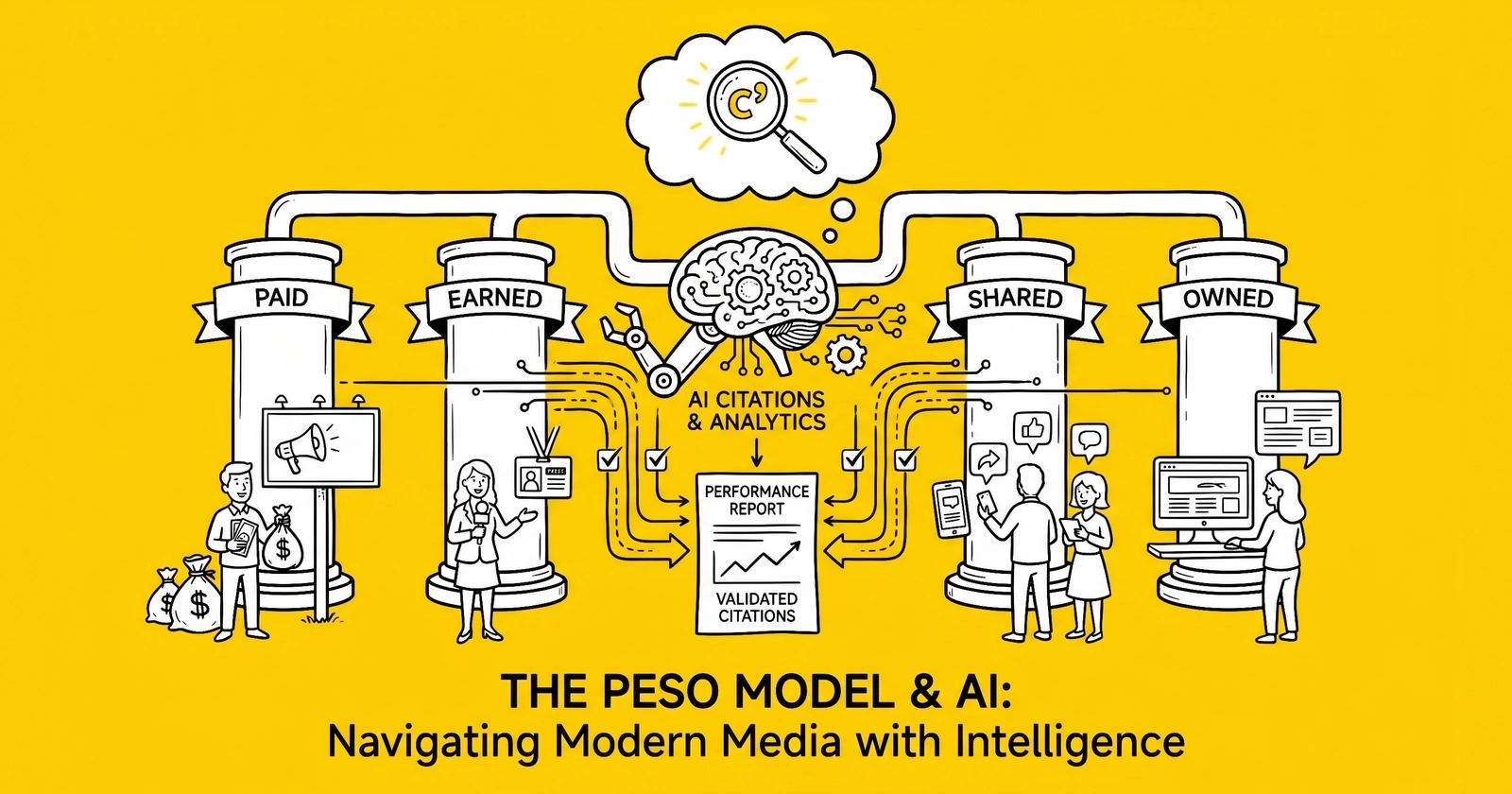
The PESO Model turned twelve in 2026, and the four channels Gini Dietrich named in 2014 no longer carry comparable economics – a fifth, AI Citations, has joined them whether the framework formally adopts it or not.
The Original PESO Model: Dietrich’s 2014 Framework
Gini Dietrich introduced the PESO Model in her 2014 book Spin Sucks: Communication and Reputation Management in the Digital Age and on the Spin Sucks blog she had been running since 2009. The acronym – Paid, Earned, Shared, Owned – solved a specific problem that had been plaguing communications departments since the rise of social media: the older silos of public relations, advertising, and content marketing had become indefensible because the same campaign frequently spanned all three.
A Facebook post boosted with media spend, picked up by a journalist, syndicated to subscribers via email, and republished on a brand blog was simultaneously paid, earned, shared, and owned. Dietrich’s contribution was to stop arguing about which department owned the post and instead categorize the channels themselves. Paid covered any media exposure purchased through bids or contracts: search ads, display, sponsored content, influencer partnerships with cash compensation. Earned covered third-party coverage that no one paid for directly: press mentions, organic backlinks, podcast features, customer reviews. Shared covered social media and community: organic posts, comments, user-generated content, brand communities. Owned covered properties the brand fully controlled: the website, the blog, email lists, mobile apps, the customer database.
The Public Relations Society of America formalized PESO in its professional development curriculum by 2017. The Institute for Public Relations referenced it in measurement standards. Most master’s-level communications programs taught it as the canonical integrated framework. Edelman, Ogilvy, Weber Shandwick, and most of the global agency networks built reporting templates around the four channels. Dietrich herself spent the next decade publishing extensions, certifications, and a cottage industry of training material that turned the model into the dominant vocabulary for integrated communications planning.
The model worked because it answered three operational questions cleanly. First, where does each campaign asset live? Second, what does success look like by channel? Third, how do channels reinforce each other across the customer journey? An earned-media placement linked to an owned blog post; the blog post fed an email nurture sequence; the email drove social engagement; social signals amplified paid retargeting. The flywheel was legible, and budgets allocated against the four channels were defensible to a CFO.
Twelve years later, the channels still exist. The framework still teaches well. But the assumption underneath it – that the four channels are roughly comparable in cost behavior, time horizon, and reliability – broke between 2023 and 2026 in ways the original model was not built to absorb.
Why the Four Channels Are Not Equal in 2026
Three structural shocks hit integrated communications between mid-2024 and the start of 2026. Each affected one or two PESO channels disproportionately. Together they made the four-channel mental model misleading for budget planning, even if the taxonomy itself remained useful.
The first shock was AI-generated search results. Google’s AI Overviews launched in May 2024 and reached majority query coverage on informational searches by mid-2025. Seer Interactive’s September 2025 study of 3,119 informational queries across 42 organizations and 25.1 million organic impressions found that organic click-through rate on AI Overview-triggered queries fell from 1.76% to 0.61% – a 65% drop. Paid CTR on the same queries fell 68%, from 19.7% to 6.34%. Pew Research, working with a separate methodology and a 900-person browsing panel earlier in 2025, found 8% click-through on AI-summary results pages versus 15% without – and 1% of clicks landing inside the summary itself. The earned-media value of an SEO backlink, calibrated for a decade against expected click volume, dropped accordingly. So did the paid cost-per-click economics, because every advertiser was now bidding on a smaller click pool. For deeper analysis of how the click cliff reshapes lead generation specifically, the LeadGen Economy site published a vertical-by-vertical AIO impact study in early 2026.
The second shock was the collapse of the small-business earned-media pipeline. Cision rebranded HARO as Connectively in 2023 and shut the platform down on December 9, 2024, ending a sixteen-year run that had connected approximately 800,000 sources to 75,000 journalists. The replacement market fragmented across Qwoted, Featured.com, SourceBottle, Muck Rack, and a handful of AI-driven sourcing tools that surface reporter requests from RSS and social feeds. On April 16, 2025, Cision announced the sale of the HARO brand to Featured.com; Featured relaunched HARO as a free, ad-supported service on April 22, 2025, restoring the three-times-daily digest format under new ownership. Even with the revival, the dominant Cision-era pipeline that funded most independent agencies’ digital PR motions disappeared during the December 2024–April 2025 gap, and the cost of earned placements in mid-tier publications rose 25–40% as supply contracted before partially recovering through 2025.
The third shock was cookieless targeting and the platform algorithm shift toward AI-curated recommendation feeds. Apple’s App Tracking Transparency, the iOS 17 link-tracking protections, and Chrome’s deprecation timeline (delayed but constraining) degraded behavioral targeting precision. Meta responded with Advantage+, Google responded with Performance Max, TikTok responded with Smart Performance – all three are AI-managed campaign types that trade advertiser control for automated optimization. Meta’s organic reach for business pages had already dropped to near zero by 2024; in 2026 the only reliably distributed organic content on Meta platforms is creator content the algorithm picks up, not brand content. Shared media as a free distribution channel for brands no longer exists at scale.
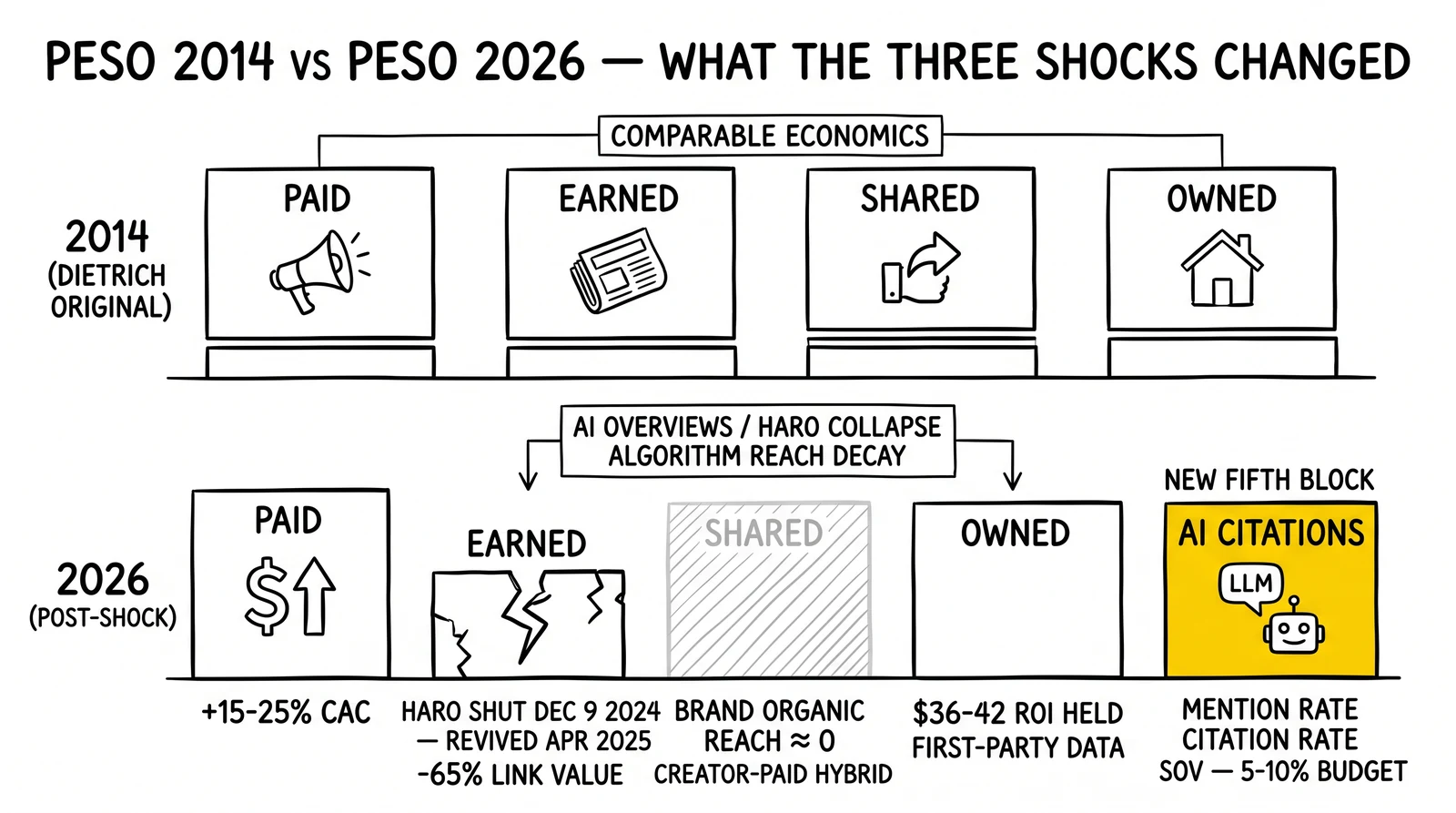
The cumulative effect: the four PESO channels diverged. Paid inflated. Earned contracted in supply and decayed in measurement. Shared became a paid-influencer subgenre wearing the costume of organic reach. Owned remained roughly stable in mechanics but became disproportionately valuable because it was the only channel left that did not depend on a platform whose economics were actively deteriorating. And a fifth channel emerged: AI Citations, where the answer engine names a brand directly without any of the four traditional channels mediating.
| Channel | 2014 Default Behavior | 2026 Reality | Net Direction |
|---|---|---|---|
| Paid | Predictable CPM/CPC, scalable with budget | CAC up 15–25% YoY; AI-managed campaigns reduce control | Inflating, opaque |
| Earned | HARO + journalist outreach + SEO backlinks | HARO retired; AIO drops link click value 65% | Contracting |
| Shared | Organic social reach for business pages | Near-zero brand organic reach; creator-paid hybrid | Effectively paid |
| Owned | Site, blog, email, app under brand control | Same mechanics; relatively more valuable as alternatives decay | Stable, more defensible |
| AI Citations (new) | Did not exist | Emerging measurement; LLM answer mentions ≠ traditional press | Growth, undefined economics |
Source: Seer Interactive (Sep 2025), Cision (HARO retirement Aug 2024), IAB Internet Advertising Revenue Report 2024, Meta investor reports 2024–2025.
Paid Media in 2026: CAC Inflation and the AI-Campaign Black Box
Paid media remains the largest line item in most lead generation and ecommerce budgets. The IAB Internet Advertising Revenue Report for 2024 (released April 2025) put US digital ad spend at $258.6 billion, up 14.9% year-over-year, with search and social capturing the bulk. But the relationship between spend and outcome diverged from the 2018–2022 baseline in ways that reshape how operators think about the channel.
The mechanical driver is straightforward. Search and social platforms responded to privacy-driven targeting decay by routing more inventory through AI-managed campaign types that bundle audience selection, bid management, placement, and creative optimization into a single algorithmic system. Google Performance Max launched in 2021 and became the default Google Ads campaign for most ecommerce advertisers by 2024. Meta Advantage+ Shopping Campaigns followed a similar trajectory. Both platforms reported in earnings calls that AI-managed campaigns drove the majority of incremental revenue growth in 2024 and 2025. Advertisers did not adopt these products because the products were measurably better than manual campaigns at every metric – they adopted them because manual campaigns lost access to the targeting signals that made them work.
The trade-off: AI-managed campaigns optimize for whatever conversion signal the advertiser sends. If the conversion signal is poorly defined or measured at the wrong moment, the algorithm optimizes against the wrong outcome efficiently. Lead generation operators learned this expensively in 2024. Performance Max campaigns optimized for Meta Pixel “lead” events delivered high lead volumes at low CPL – and those leads converted to sales at a fraction of the rate of leads from manual search campaigns. The platforms were doing exactly what they were instructed to do; the operators’ instructions were wrong.
CAC inflation compounds the measurement problem. Across multiple agency reports through 2025 – including Profitwell’s CAC index and ProfitMetrics’ B2C ecommerce benchmarks – customer acquisition costs increased 15–25% year-over-year for most lead generation verticals. The increase varied by category. Insurance and home services saw the steepest rises (25–40% in some sub-verticals) because compliance constraints and intent-keyword scarcity concentrated bid competition. SaaS and B2B saw smaller increases (10–18%) but from higher baselines. The story Operators tell about paid in 2026 is the story of working harder to hold flat performance – and recognizing that, at current trajectories, paid alone cannot scale without owned and earned media supplying cheaper alternatives.
For operators planning paid budgets in 2026, three discipline shifts have become standard practice. The first is conversion-signal hygiene: feeding AI-managed campaigns the conversion event that maps to actual revenue (closed-won deals, repeat purchases, qualified appointments), not the proxy event the platform suggests. The second is incrementality testing through holdout audiences and geo-experiments rather than platform-reported attribution, because last-click and platform-modeled conversions overstate paid’s contribution. The third is creative volume – Performance Max and Advantage+ both reward asset diversity, and operators producing 10–20 creative variants per campaign per quarter consistently outperform those producing 3–5. The full operational playbook for Google specifically is covered in the site’s Google Ads lead generation guide.
The strategic implication for PESO planning: paid is still the largest channel, but its marginal return has compressed enough that operators with mature programs increasingly cap paid spend at the point of incrementality break-even and reallocate the next dollar to owned media and AI-citation engineering instead.
Earned Media: The Death and Rebirth of Digital PR
The earned-media channel in 2026 looks little like the channel that existed in 2022. Three forces reshaped it: the HARO shutdown, AI Overviews’ impact on link click value, and the parallel emergence of AI sourcing tools that replaced human journalist relationships with algorithmic source-matching.
HARO’s December 9, 2024 shutdown – under the Connectively brand Cision had migrated it to in 2023 – removed the dominant small-business earned-media pipeline. From 2008 through 2023, the standard digital PR playbook for an independent agency or in-house communications team had been: monitor HARO emails three times daily, pitch responses to relevant journalist queries, and convert successful pitches into bylined quotes, expert mentions, and (occasionally) backlinks. The pipeline produced a long-tail flow of placements in mid-tier business publications, vertical trade press, and consumer outlets that funded most of the small-agency PR economy. On April 16, 2025, Cision announced the sale of the HARO brand to Featured.com; Featured relaunched HARO 2.0 on April 22, 2025 as a free, ad-supported service with the original three-times-daily digest cadence. The intervening four-month gap forced agencies onto a fragmented replacement market – Qwoted (focused on B2B and creator-economy outlets), Featured (focused on round-up and roundtable formats), SourceBottle (Australian-origin, broader vertical mix), Muck Rack’s source-pitch product (added to its journalist database in 2024), and a class of AI-driven tools that scrape RSS, X, and Bluesky for reporter call-outs. The revived HARO is rebuilding network density through 2026, but has not yet matched Cision-era reach.
None of the replacements achieved HARO’s network density. The result: earned-media placement supply contracted by 25–40% in mid-tier outlets, and effective placement cost (whether measured in agency time or paid PR-tool subscriptions) rose accordingly. The high end of earned media – major business press, peer-reviewed coverage, regulatory commentary – was less affected because those relationships never depended on HARO. The low end – long-tail blog mentions and content roundups – was largely automated by AI content sites that no longer needed human sources.
The second force, AI Overviews’ impact, hit the search-driven side of earned media hardest. The traditional earned-media SEO playbook treated each backlink as having two values: a direct referral traffic value and an organic ranking signal value. The Seer Interactive data made the referral value brittle: a backlink driving traffic from an article that now appears beneath an AI Overview generates 40–65% less click-through than the same backlink generated in 2022. The ranking-signal value persists but its monetization is decoupled from clicks because the page that ranks may not get the click.
The third force is more subtle: AI sourcing tools have reshaped how journalists themselves find sources. Tools like Pressfarm, JustReachOut, and the LLM-integrated source-discovery features added to Muck Rack and Cision allow a reporter to type a topic and receive a ranked list of expert sources based on prior coverage, citation patterns, and credibility signals. A brand that has been quoted in three relevant publications in the past 18 months is more discoverable to journalists using these tools than a brand that has not – independent of whether the brand pitched. Earned media became, in part, a function of earned media. Operators with no prior coverage face a discoverability cold-start problem that pure pitching cannot solve.
The rebirth: earned media in 2026 increasingly works as an entity-signal investment rather than a referral-traffic investment. A successful placement compounds three benefits: it adds to the brand’s expertise corpus that AI sourcing tools rank, it provides a citation that LLM training corpora ingest, and it generates the organic-search ranking signal that survives even when the click does not. Operators reporting on earned media now track placement count and domain authority less than they track AI-citation lift on relevant prompts in the 60–90 days following placement. The measurement shifted because the value mechanism shifted.
Shared Media: Algorithmic Reach Decay and the Community Pivot
The shared media channel in 2014 was understood primarily as organic social reach: brands posted, audiences engaged, the post was distributed to followers, and the resulting impressions, comments, and shares were free distribution. By 2026 that channel barely exists for brand pages. Meta confirmed in its 2023 and 2024 transparency reports what every social media manager already knew: organic reach for business pages on Facebook had dropped to near zero, and the Instagram equivalent followed in 2024. LinkedIn’s organic reach for company pages held longer but contracted sharply through 2025 as the platform shifted toward AI-curated feeds. TikTok’s For You algorithm never reliably distributed brand content; the platform was creator-first from launch.
The strategic adaptation: shared media in 2026 operates almost entirely through three mechanisms – paid amplification, creator partnerships, and brand-owned community. Paid amplification is structurally indistinguishable from paid media; the only reason it remains in the “shared” column at all is conventional reporting. Creator partnerships – paid relationships with individuals whose audiences trust them – have become the dominant organic-feeling channel. Influencer and creator marketing spend reached approximately $24 billion globally in 2024 and continued growing through 2025, according to Influencer Marketing Hub’s annual report. The economic logic is straightforward: when brand pages cannot reach audiences but individual creators can, brands pay creators to carry their message into feeds.
Brand-owned community is the third mechanism and the most defensible. Discord servers, Slack communities, Reddit moderation, private newsletter spaces, and customer forums create persistent audience access that does not depend on platform algorithms. The trade-off is that they require sustained editorial investment and produce smaller-but-engaged audiences rather than large-but-passive ones. For lead generation in particular, community-led shared media outperforms broadcast-style social posting by a wide margin in qualified-lead conversion rate. The site’s coverage of social media lead generation in 2026 examines vertical-specific dynamics in more detail.
The fundamental redefinition: shared media in 2026 is not a free distribution channel sitting between earned and owned. It is a hybrid of paid amplification, creator-economy spending, and community investment that happens to occur on social platforms. Treating it as a fourth-channel coequal to paid, earned, and owned in budget planning produces consistent under-investment in the channels (paid and creator) that actually drive distribution and over-investment in organic posting that no longer reaches audiences.
Owned Media: First-Party Data and the Most Defensible Asset
Owned media is the channel that did not change mechanically between 2014 and 2026 but became disproportionately more valuable because everything around it deteriorated. A brand’s website, blog, email list, mobile app, customer database, and customer data platform (CDP) operate on the same fundamentals they did a decade ago: traffic acquisition costs sit upstream, but once a user is in the owned environment the brand controls the experience, the data capture, and the long-term contact economics.
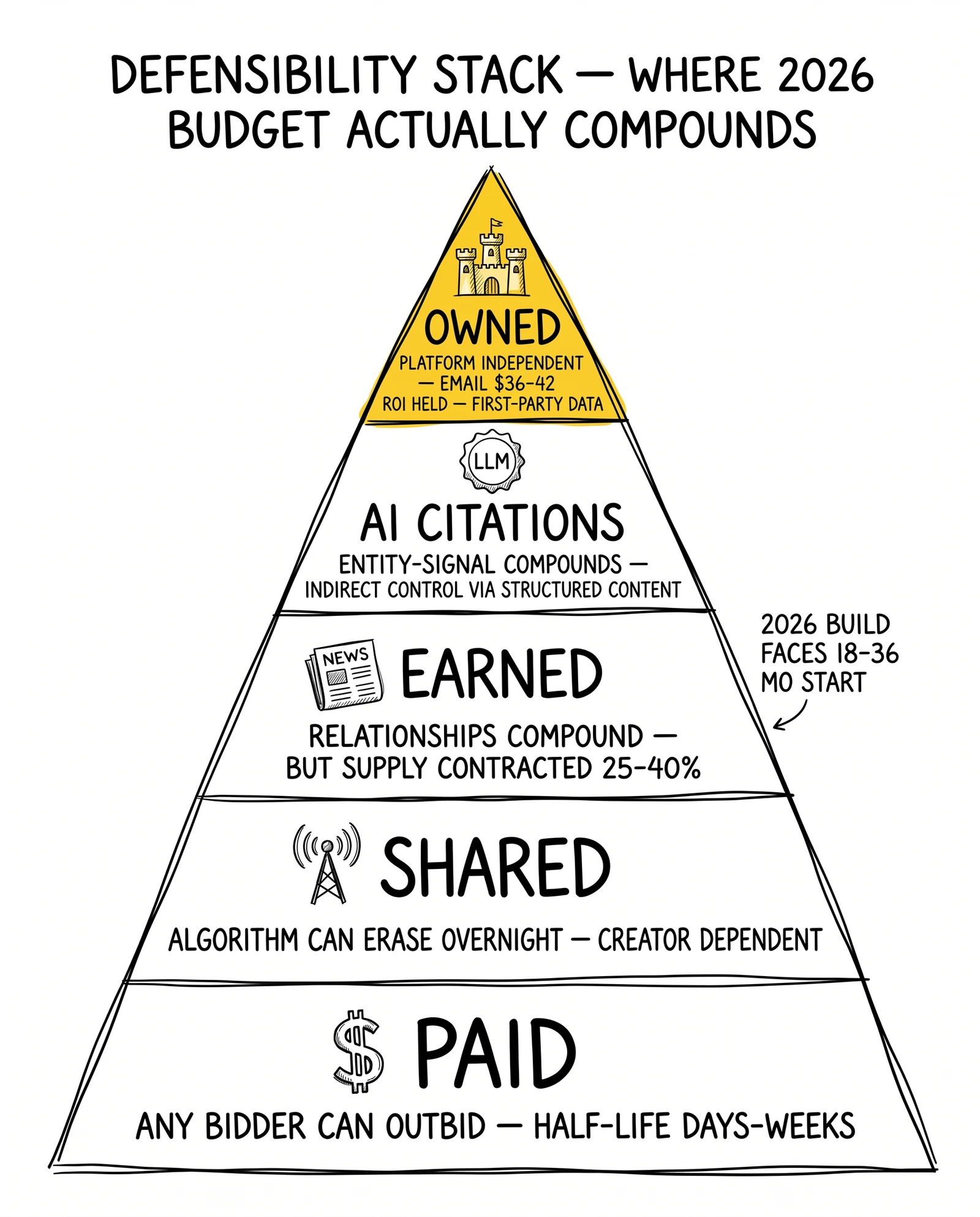
Three properties make owned media the most defensible PESO channel in 2026. The first is platform independence. An email list that the brand owns, with verified addresses and explicit consent, generates revenue regardless of what Google AI Overviews does to organic CTR or what Meta’s algorithm does to organic reach. The list is portable. The relationships it represents are direct.
The second property is first-party data accumulation. Every interaction with owned properties – page view, form fill, email click, purchase, support ticket – produces data the brand controls and can use for segmentation, personalization, and lookalike modeling. Operators who built CDPs (whether full enterprise platforms like Segment or BlueConic, or custom data warehouses with reverse ETL pipelines) between 2020 and 2024 found themselves with a structural advantage as third-party cookie deprecation accelerated. The site’s analysis of first-party data strategies for lead generation details the operational playbook.
The third property is content compounding for AI citation. Original research, proprietary data, and unique editorial published on owned properties has become the primary supply for AI training corpora and live-retrieval LLM systems. A piece of original research published on a brand-owned blog in 2025 might be cited by ChatGPT, Perplexity, and Google AI Overviews for years afterward – driving brand exposure entirely through the AI-citation layer rather than through clicks. The owned property is, in this sense, a long-duration entity-signal investment whose returns increasingly arrive through channels other than search traffic.
The downside of owned media is that it is slow. Building a 100,000-subscriber email list, a six-figure-traffic blog, or a 50-million-event customer data warehouse takes years of consistent investment. Operators who started in 2018–2020 and held the discipline through the privacy and AI shocks are reaping the compounding benefits in 2026. Operators starting in 2026 face an 18–36 month build cycle before owned media contributes meaningfully – but the build is the only thing on the budget that compounds rather than depreciates.
For PESO planning, the implication is that owned-media budget allocation should be evaluated on a multi-year horizon, not a quarterly performance one. Owned does not return ROI like paid does; it returns optionality – the ability to keep operating when paid CAC inflates beyond unit economics, when earned channels collapse, or when shared platforms change algorithms. That optionality is what makes it the most defensible channel and the one operators should fund first when planning a 2026 mix.
The Fifth Layer: AI Citations as a New Channel
AI Citations – mentions of a brand inside an answer generated by ChatGPT, Google AI Overviews, Perplexity, Claude, Gemini, Meta AI, or another LLM-based system – emerged as a distinct measurement category between mid-2024 and early 2026. The category is functionally similar to earned media because a third party (the model) describes a brand to an audience without the brand directly paying. But the operational mechanics diverge enough that most practitioners now treat AI citations as a fifth PESO channel rather than a subset of earned.
The differences are concrete. Traditional earned media has an editorial gatekeeper – a journalist, an editor, a producer – who can be pitched, briefed, and corrected. AI citations have no gatekeeper. The model’s behavior is governed by training data, fine-tuning signals, retrieval-augmented generation indexes, and prompt-context dynamics, none of which a brand can directly access. Traditional earned media produces a stable artifact: a published article exists in a permanent URL that can be cited and audited. AI citations are non-deterministic. The same prompt to the same model can produce different brand mentions across sessions, regions, and model versions. Traditional earned media is measured by placement count and reach. AI citations require new metrics – mention rate, citation rate, share-of-voice across a defined prompt set – that did not exist in PR measurement vocabulary before 2024.
The infrastructure to influence AI citations is also distinct. Brands cannot pitch ChatGPT. They can, however, influence what the model says about them through several channels. Original published content with specific entity-level structured data (Schema.org Article, Person, Organization, Product markup) is more reliably ingested into LLM training and retrieval pipelines. The emerging llms.txt convention – proposed in 2024 and adopted by an increasing number of high-authority sites through 2025 – provides AI crawlers a curated content map analogous to robots.txt. Brand co-occurrence in high-authority publications shapes the training corpus over time. And direct retrieval-augmented generation deals with platforms like Perplexity (which signed publisher partnerships with Time, Fortune, Der Spiegel, and others through 2024–2025) provide explicit citation pathways for participating publishers.
Measurement tooling consolidated around three primary metrics. Mention rate is the share of prompts in a defined prompt set where a brand is named in the answer. Citation rate is the share of answers that include a clickable source link to the brand’s owned properties. Answer share-of-voice is the brand’s mention frequency divided by competitor mention frequency on the same prompt set. Tools tracking these metrics include Profound, Athena HQ, Otterly, Peec AI, and the LLM-analytics modules added by Semrush, Ahrefs, and Conductor through late 2025. Reliability varies because answers are non-deterministic and prompt sets must be maintained as user query patterns evolve, but the metrics have stabilized enough that agencies report on them in client retainers.
The strategic question for PESO 2026 planning is how much budget to allocate to AI-citation work specifically. The honest answer is that the category is too new for stable benchmarks, but observed allocations across mature programs in 2026 sit at 5–10% of total integrated communications spend. The work is concentrated in three areas: structured-content publishing (which overlaps with owned media), publisher partnerships and AI-platform deals (which overlap with earned), and citation-engineering audits that map brand visibility across 50–200 prompt sets and identify gaps. The site’s analysis of AI search ROI measurement and LLMO metrics provides the operational measurement framework.
The deeper strategic question is whether AI citations will eventually subsume earned media entirely or remain a parallel channel. The argument for subsumption: as more buyers begin product research inside AI assistants rather than search engines, the AI citation becomes the primary discovery surface and traditional earned media becomes a feeder mechanism for AI training. The argument against: AI models are built on training data that is itself produced by traditional earned and owned channels, so the underlying journalism and content economy still matters. The 2026 consensus among practicing communications strategists is that AI citations are a distinct fifth channel for the next 3–5 years, after which the integration with traditional earned media may become tight enough to warrant a redefined framework.
| PESO Channel | Control | Cost Model | Half-Life | 2026 Defensibility | Primary Metric |
|---|---|---|---|---|---|
| Paid | High (creative, budget) | CPM/CPC bids, AI-managed | Days–weeks | Low (any bidder competes) | CAC, ROAS |
| Earned | Low (third-party editorial) | Agency time, PR tools | Months–years | Medium (relationships compound) | Placements, AI-citation lift |
| Shared | Medium (paid + creator) | Paid + creator fees | Days–weeks | Low–medium | Engagement, community LTV |
| Owned | High (full control) | Build + maintain | Years | High (platform independent) | Email revenue, organic traffic, CDP value |
| AI Citations | Low–medium (indirect) | Content + tooling | Months–years | Medium–high (entity-signal compounds) | Mention rate, citation rate, answer SOV |
Source: PRSA PESO curriculum (2017 reference), Edelman Trust Barometer 2025, Institute for Public Relations measurement standards 2024, Spin Sucks community surveys 2025–2026.
Lead Generation and Ecommerce: Integrated PESO Budget Allocation
PESO planning in 2026 produces meaningfully different mixes depending on the operator’s vertical, business model, and unit economics. The framework still applies; the allocations diverge. The table below summarizes observed median allocations across reporting agencies and direct operator surveys through Q1 2026, with the explicit caveat that the variance within each vertical is wider than the differences between verticals.
| Vertical | Paid | Earned | Shared | Owned | AI Citations |
|---|---|---|---|---|---|
| B2B SaaS lead generation | 35–40% | 12–15% | 15–20% | 22–28% | 6–10% |
| Insurance lead generation (auto/home) | 40–50% | 8–12% | 8–12% | 22–28% | 5–8% |
| Mortgage lead generation | 35–45% | 10–15% | 8–12% | 25–30% | 5–8% |
| Medicare lead generation | 30–40% | 12–18% | 6–10% | 28–35% | 5–8% |
| DTC ecommerce | 45–55% | 5–10% | 18–25% | 15–20% | 4–7% |
| Marketplace ecommerce | 50–60% | 5–8% | 12–18% | 15–20% | 3–6% |
| Home services | 40–50% | 8–12% | 12–18% | 22–28% | 5–8% |
| Legal lead generation | 35–45% | 12–18% | 8–12% | 25–32% | 5–10% |
Source: Cross-referenced from Spin Sucks community surveys (Q4 2025), MarketingProfs benchmark studies (2025), agency-reported retainer mixes (Edelman, Ogilvy, Weber Shandwick public benchmarks), and direct operator interviews via LeadGen Economy editorial 2026.
Three patterns repeat across the verticals. The first: regulated lead generation categories – insurance, mortgage, Medicare, legal – index more heavily toward owned and earned because compliance friction caps paid scale.
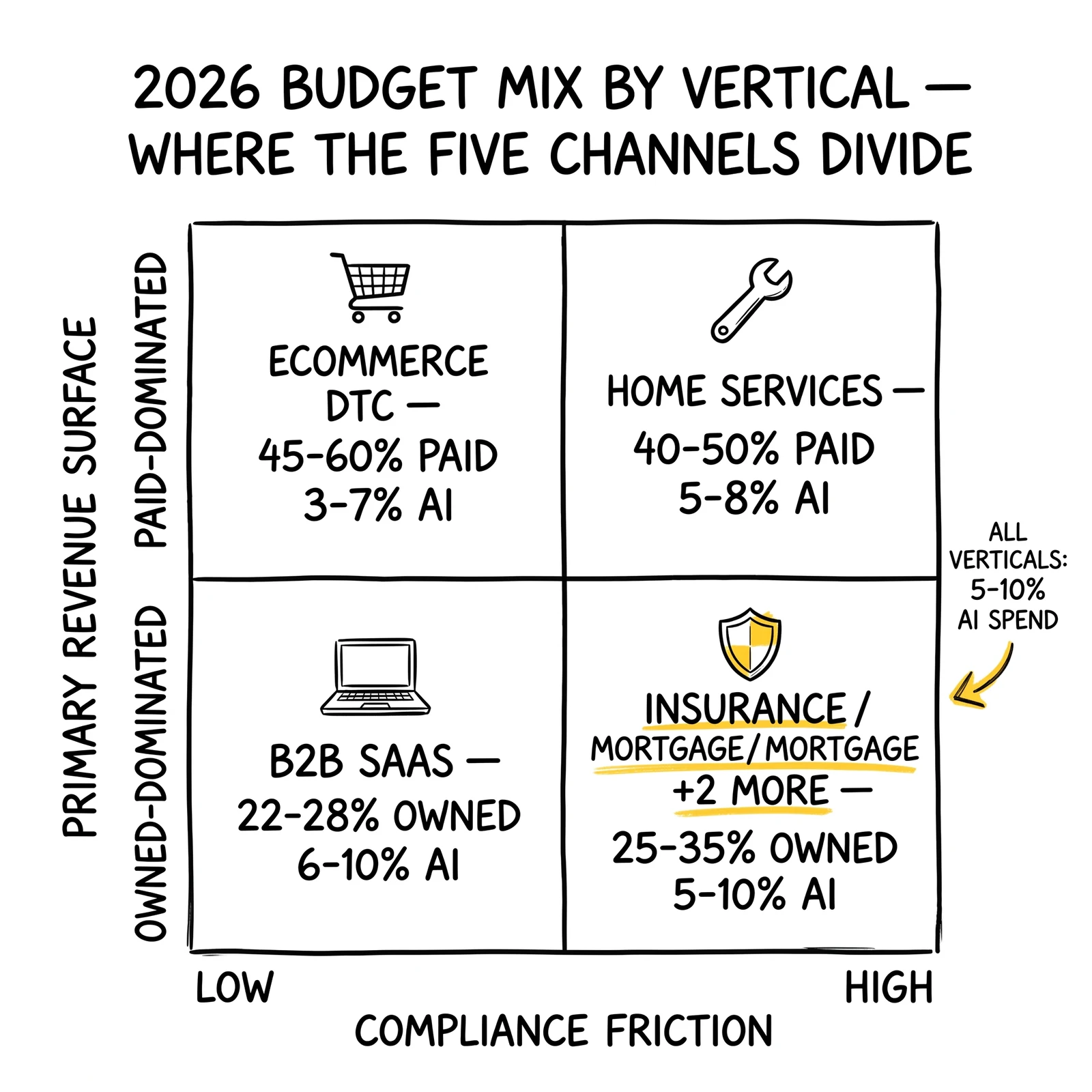
The second: ecommerce categories – DTC, marketplace, home services – index more heavily toward paid and shared because retail-media networks (Amazon Ads, Walmart Connect, Target’s Roundel), Performance Max, Advantage+ Shopping, and creator-led TikTok Shop drive a disproportionate share of revenue. Owned media still matters but takes a smaller relative share because the conversion volume of paid surfaces in ecommerce is structurally larger than in lead generation.
The third: AI-citation budget allocation is small but consistent across verticals at 5–10%, reflecting the still-emerging nature of the work and the lack of mature benchmarks. Operators in the 8–10% range typically report better answer share-of-voice and earlier visibility wins; operators below 5% are typically late to the channel and accumulating discoverability gaps.
The integration question – how the channels reinforce each other – is where 2026 PESO planning earns its keep. A well-designed mix produces a flywheel: paid traffic captures buyers in active search, owned content nurtures them through a CDP-driven email sequence, earned media builds the credibility that AI citations later mirror, shared community fuels ongoing engagement, and AI citations compound the discoverability of the owned content. A poorly designed mix funds each channel as a silo and produces redundant CAC across the board.
Practical implementation requires three discipline shifts. The first is unified attribution that crosses channel boundaries – last-click platform attribution systematically overstates paid and understates owned and earned. The second is multi-quarter horizon planning, because owned and AI-citation work do not return in-quarter ROI but compound over 12–24 months. The third is content-first creative production: the same research, case study, or analysis can fund a paid landing page, an earned pitch, a shared social post, an owned email, and an AI-citation-engineered structured-data corpus simultaneously. Operators producing content for one channel and republishing it across the others outperform operators producing channel-specific content. The site’s content marketing ROI measurement framework provides the operational model.
The 2026 PESO mix is more complex than the 2014 mix because the channels diverged. But the underlying logic – paid for reach, earned for credibility, shared for community, owned for defensibility, AI citations for emerging discovery – still produces a coherent integrated communications strategy when planned at the multi-channel level rather than as four (or five) silos. The framework Dietrich introduced in 2014 remains the most useful taxonomy in communications. It just needs an honest update for the economics of 2026.
Key Takeaways
- The PESO Model – Paid, Earned, Shared, Owned – was introduced by Gini Dietrich in 2014 and adopted by the PRSA, the IPR, and most communications graduate programs through 2017–2020. The taxonomy still works; the economics inside it diverged sharply between 2023 and 2026.
- AI Overviews collapsed organic CTR from 1.76% to 0.61% on triggered queries (Seer Interactive, September 2025) – a 65% drop that simultaneously inflated paid CAC and devalued earned-media SEO links. Operators planning 2026 budgets against 2022 channel-cost assumptions are systematically over-paying for paid and under-investing in owned.
- Cision shut down HARO (then operating as Connectively) on December 9, 2024, ending a 16-year, 800,000-source pipeline that funded most independent agencies’ digital PR motions. Featured.com acquired the HARO brand on April 16, 2025 and relaunched it as a free, ad-supported service on April 22, 2025. During the four-month gap, placement supply contracted 25–40% in mid-tier outlets and effective placement cost rose accordingly; the revived HARO is rebuilding network density through 2026.
- Meta organic reach for business pages dropped to near zero by 2024. Shared media as a free distribution channel for brands no longer exists at scale; what remains is paid amplification, creator partnerships, and brand-owned community – a hybrid that is functionally part-paid, part-earned, part-owned.
- Owned media became the most defensible PESO channel in 2026 because it is platform independent, compounds first-party data, and supplies the structured content that AI training corpora and retrieval-augmented generation systems cite. Email ROI held at $36–$42 per dollar across the privacy and AI shocks while every other channel’s ROI compressed.
- AI Citations emerged as a distinct fifth channel between 2024 and 2026. Functionally similar to earned media but operating without editorial gatekeepers, with non-deterministic outputs, and with new metrics (mention rate, citation rate, answer share-of-voice). Mature programs allocate 5–10% of integrated communications budget to AI-citation engineering.
- 2026 PESO budget allocation diverges by vertical. Regulated lead generation (insurance, mortgage, Medicare, legal) indexes 22–35% to owned because compliance caps paid scale. Ecommerce indexes 45–60% to paid because retail-media networks dominate revenue. AI-citation allocation sits at 5–10% across nearly all verticals.
- Integrated PESO planning in 2026 requires three discipline shifts: unified attribution that crosses channel boundaries, multi-quarter horizon planning that funds owned and AI-citation work on 12–24 month payoffs, and content-first creative production that recycles a single research asset across all five channels. Operators executing all three out-perform those running channels as silos by a measurable margin in qualified-lead efficiency.
Frequently Asked Questions
What is the PESO Model and who created it?
PESO is an integrated communications framework – Paid, Earned, Shared, Owned – that Gini Dietrich introduced in her 2014 book Spin Sucks and on the Spin Sucks blog she had been running since 2009. It replaced the older PR-versus-marketing silos with four channel categories: paid (advertising and sponsored content), earned (third-party press coverage and links), shared (social media and community), and owned (a brand’s own properties: site, blog, email, app). The model became the de facto curriculum reference for the PRSA, the IPR, and most communications graduate programs over the following decade.
Why does the PESO Model need updating in 2026?
Three simultaneous shocks in 2024–2026 broke the assumption that the four channels are comparable. AI Overviews collapsed organic search CTR from 1.76% to 0.61% on triggered queries (Seer Interactive, September 2025), inflating paid CAC and devaluing earned-media SEO links. Cision shut down HARO on December 9, 2024, ending the dominant earned-media sourcing pipeline; Featured.com acquired and relaunched HARO in April 2025, partially restoring the network. Meta’s organic reach for business pages dropped to near zero, making shared media a paid channel in disguise. The original four channels still exist, but their economics, half-lives, and risk profiles diverged enough that planning them together as equals produces bad budgets.
What is the AI Citation layer and is it earned media?
AI Citations are mentions of a brand, person, product, or claim inside an answer generated by ChatGPT, Google AI Overviews, Perplexity, Claude, Gemini, or another LLM-based system. Functionally they resemble earned media – a third party (the model) describes a brand to an audience without the brand paying – but they operate differently: there is no editorial gatekeeper, no contact to pitch, no link guaranteed, and citation can change between sessions. Most practitioners now treat AI citations as a fifth PESO channel rather than a subset of earned media because the inputs (structured data, llms.txt, brand co-occurrence in training corpora) and measurement (mention rate, citation rate, share-of-voice in answers) are unique.
How should integrated communications budgets be allocated across PESO in 2026?
There is no universal split, but the median allocation observed across reporting agencies (Edelman, Ogilvy, Spin Sucks community surveys) shifted toward owned and AI-citation work in 2025–2026. A defensible 2026 baseline for B2B lead generation: 35–45% paid (down from 55–60% in 2022), 10–15% earned/digital PR, 15–20% shared/social, 20–25% owned (content, email, CDP, community), and 5–10% AI-citation engineering. Ecommerce skews more paid (45–55%) because retail-media networks and Performance Max remain the dominant revenue lever. Regulated verticals – insurance, mortgage, Medicare – lean further into owned and earned because compliance friction limits paid scale.
Did Cision really shut down HARO?
Yes. Cision rebranded HARO as Connectively in 2023 and shut the platform down on December 9, 2024, ending a 16-year pipeline that connected approximately 800,000 sources to 75,000 journalists and shaped the bulk of small-business digital PR practice from 2008 onward. On April 16, 2025, Cision announced the sale of the HARO brand to Featured.com, which relaunched it as ‘HARO 2.0’ on April 22, 2025 – restoring the three-times-daily email digests and free-to-use journalist-source matching under new ownership. Alternatives that emerged during the gap – Qwoted, Featured, SourceBottle, and Muck Rack’s source-pitch product – fragmented the market, and AI sourcing tools that surface reporter requests from public RSS and social feeds developed in parallel. The earned-media motion still works, but the network effect HARO held under Cision is taking time to rebuild.
How is AI citation visibility measured?
Three primary metrics have stabilized in agency reporting through 2026: mention rate (the share of relevant prompts where a brand is named in the answer), citation rate (the share of answers that include a clickable source link to the brand), and answer share-of-voice (the brand’s mention frequency divided by competitor mention frequency on a defined prompt set). Tools tracking these include Profound, Athena HQ, Otterly, Peec AI, and the LLM analytics modules added by Semrush, Ahrefs, and Conductor in late 2025. Reliability varies because answers are non-deterministic and prompt sets must be maintained as user query patterns evolve.
Is paid media still the largest PESO channel for lead generation?
By spend, yes – paid media still represents the largest line item for most lead generation operators in 2026, though the share has compressed. The IAB Internet Advertising Revenue Report for 2024 (released April 2025) put US digital ad spend at $258.6 billion, up 14.9% year-over-year, with search and social capturing the bulk. By contribution to qualified pipeline, however, paid is no longer dominant in mature programs. Operators reporting attribution from a unified data layer – not platform-reported conversions – typically see paid contributing 35–50% of qualified leads while owned and earned contribute the remainder, often at lower per-lead cost.
What are the most defensible PESO channels in 2026?
Owned media – first-party data, email lists, customer communities, and proprietary content – remains the most defensible because it does not depend on platform algorithms, ad auction prices, or third-party gatekeepers. The second most defensible is AI citation positioning when grounded in unique data, original research, and entity-level structured content, because LLMs disproportionately cite sources with verifiable expertise signals. Paid is least defensible: any operator with capital can outbid an incumbent. Earned and shared sit in the middle, defensible to the extent that relationships and creator partnerships compound over time.
Sources
- Gini Dietrich, “The PESO Model” – Spin Sucks
- Seer Interactive, “AI Overviews CTR Study” (September 2025)
- Pew Research Center, “Google users are less likely to click on links when an AI summary appears” (July 2025)
- IAB Internet Advertising Revenue Report 2024 (released April 2025)
- Cision Connectively / HARO retirement notice
- Edelman Trust Barometer 2025
- Public Relations Society of America (PRSA), “The PESO Model”
- Institute for Public Relations, Measurement Standards
- Smart Insights, Digital Marketing Strategy Statistics 2026
- MarketingProfs, Integrated Marketing Research