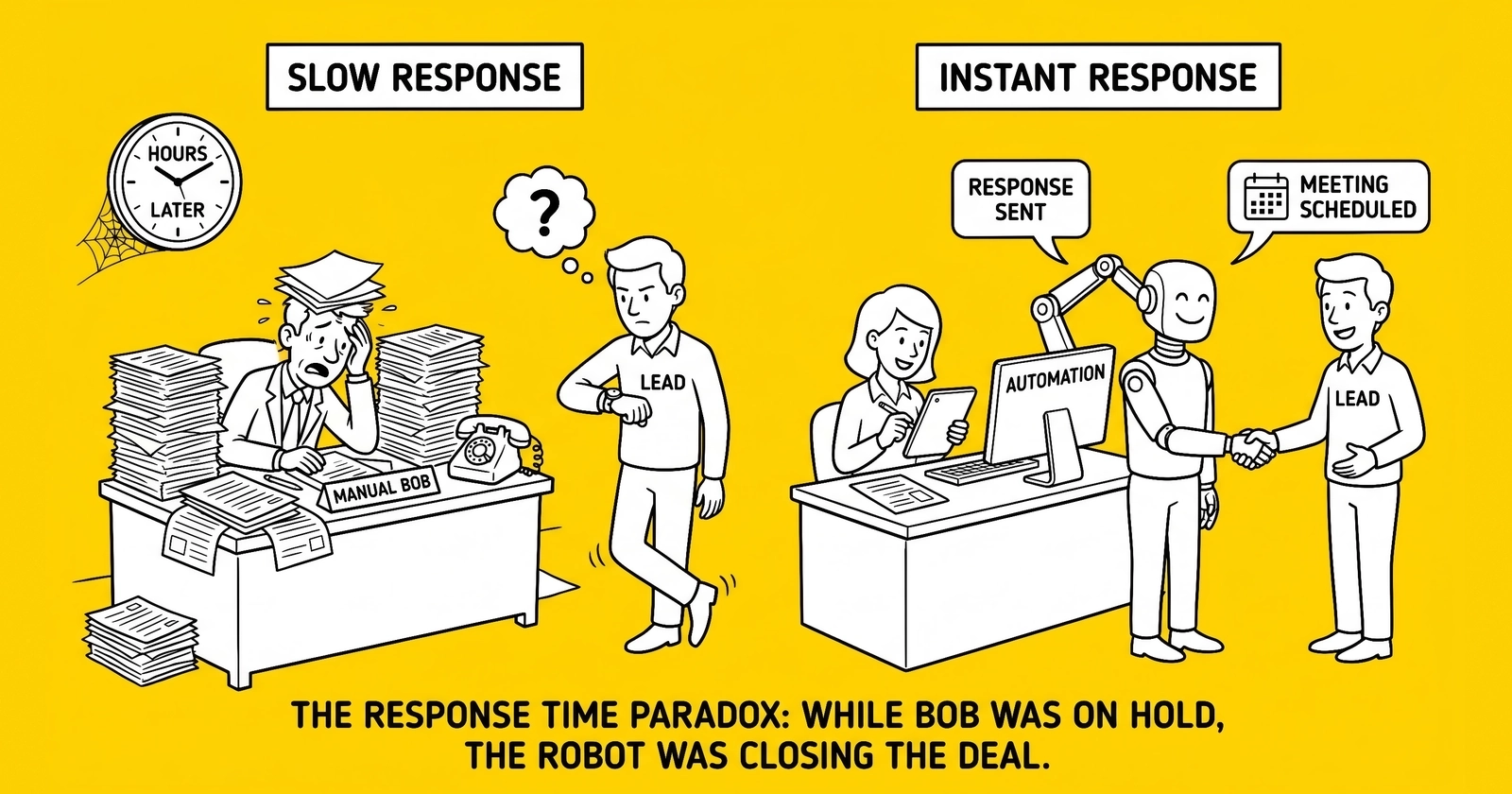
Speed-to-lead is a real driver of conversion and a real source of TCPA exposure. The operators winning in 2026 treat the two as a coupled system, not a tradeoff.
The Response-Time Evidence Base, Honestly Stated
Response time is one of the largest controllable variables in inbound lead conversion. The strength of that statement depends entirely on which evidence supports it, and the speed-to-lead literature has a single-source problem worth acknowledging before the operating recommendations follow.
The most-cited statistics – leads contacted within one minute convert at 391% higher rates than those contacted at 30 minutes, and qualification odds drop 21x between five-minute and 30-minute response – trace to one paper: Oldroyd, McElheran, and Elkington’s The Short Life of Online Sales Leads, published in Harvard Business Review in March 2011. The underlying dataset is InsideSales.com’s analysis of approximately 100,000 outbound call attempts, captured in 2007. That dataset predates the iPhone-era mobile lead form, SMS lead capture, AI dialing, the 2012 TCPA prior-express-written-consent rule, the FCC Reassigned Numbers Database, the 2025 vacatur of the FCC one-to-one consent rule, and the multi-buyer aggregator economy that now defines insurance, mortgage, solar, and Medicare lead distribution.
The 391% number is not wrong. It is a directional finding from a specific call-center sales motion, not a universal 2026 law. Treating it as ground truth – as most speed-to-lead playbooks do – is a fact-check failure. Vendor research from Drift, Velocify, Conversica, and Salesforce supports the directional claim that faster response correlates with higher conversion, with magnitudes that vary by vertical, lead source, and channel.
The defensible framing: speed materially improves conversion in most inbound contexts, but the specific multipliers cited in industry decks should be treated as illustrative of a 2007 single-buyer call-center context, not as universal benchmarks for 2026 multi-buyer aggregator economics.
The competitive overlay matters too. Drift’s 2024 Conversation Trends Report (now published under Salesloft after the February 2024 acquisition) found average B2B response times above 24 hours at the median, with only a small fraction of companies responding within five minutes. The Salesforce 2024 State of Sales Report shows similar dispersion. The aggregate gap between best-practice response and industry norm is real, even if the canonical multipliers should be hedged. Operators with consistent sub-15-minute response times still differentiate substantially in most verticals – the question is how to engineer that response time without manufacturing TCPA litigation surface in the process.
Why Speed Alone Is the Wrong Frame in 2026
The speed-to-lead playbook circulating in 2018 – fire an auto-dialer the moment a form posts, follow with auto-SMS, escalate to email – is the highest-risk lead generation pattern of 2025–2026. The reason is regulatory, not philosophical.
The Telephone Consumer Protection Act, administered by the FCC, governs automated calls and SMS to residential and wireless numbers. The 2012 prior-express-written-consent (PEWC) rule requires clear, conspicuous, signed consent specific to the seller before any automated marketing call or text. Statutory damages run $500 to $1,500 per violation, trebled for willful conduct, with no cap on aggregate exposure in class actions. Plaintiff firms specializing in TCPA litigation routinely extract seven- and eight-figure settlements from operators who scaled speed-to-lead automation without scaling consent infrastructure in parallel.
Two recent rulings reshape the operating environment. On January 24, 2025, the Eleventh Circuit issued Insurance Marketing Coalition v. FCC, vacating the FCC’s one-to-one consent rule before its scheduled effective date. The vacatur removed a specific implementation overhead – operators no longer need separate consent per seller per the rule’s framework – but did not touch the underlying PEWC requirement. Operators that read the headline as “TCPA is dead” misread the ruling badly; the underlying statute and 47 CFR 64.1200 remain in full force.
On March 30, 2026, the Northern District of Illinois issued Rabbit v. Rohrman Automotive Group, extending DNC liability to SMS marketing under the Illinois Telephone Solicitations Act. The ruling broadens exposure for SMS-heavy lead workflows that scrub against the federal National DNC Registry but ignore state SMS-specific protections. Operators with multi-state SMS campaigns now face a fragmented compliance map where a single national workflow may comply with federal TCPA and violate Illinois, Florida (FTSA), or Oklahoma (OTSA) mini-TCPA statutes.
The compliance gates that must fire before any automated dial or SMS:
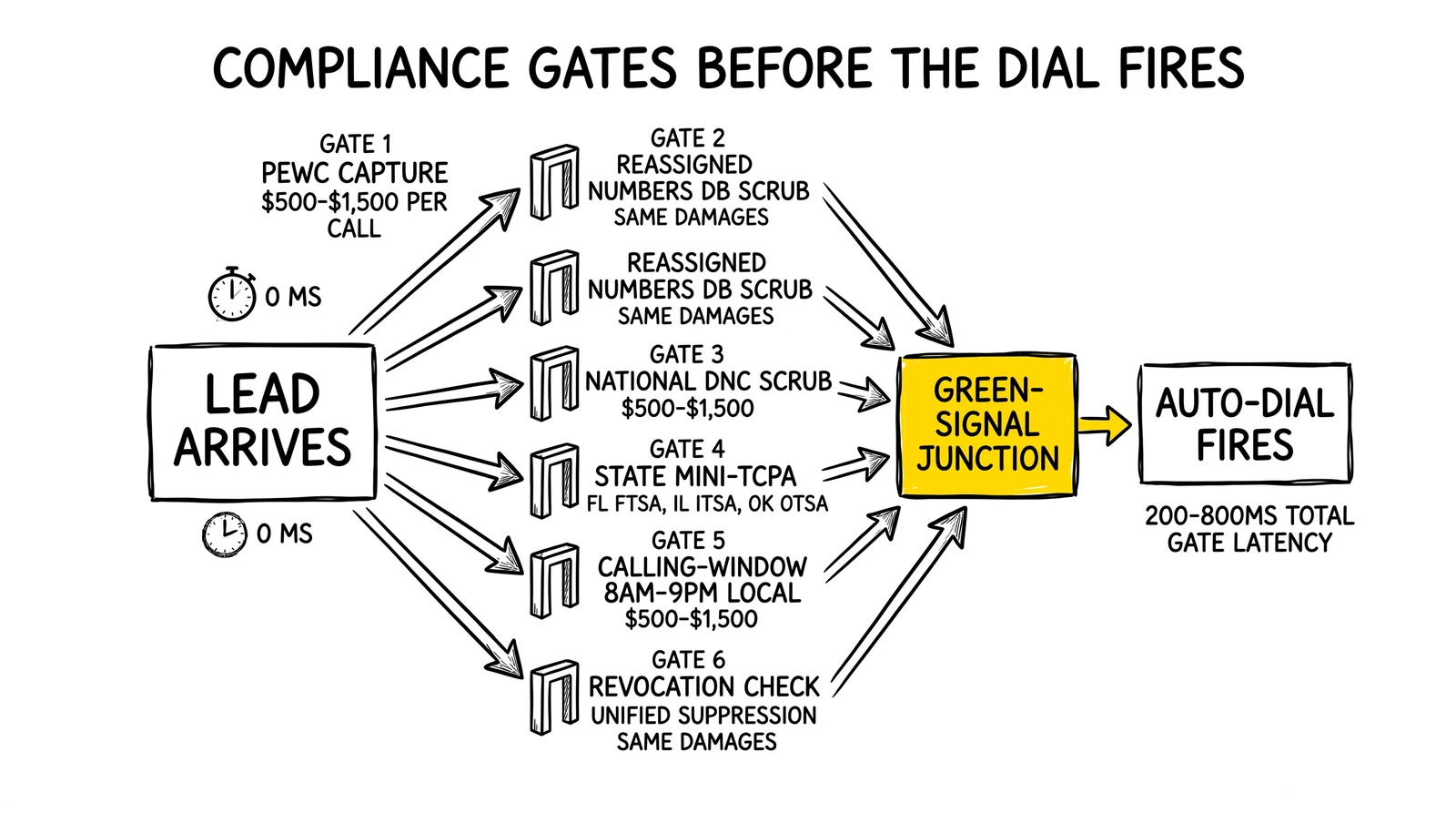
| Gate | What it checks | Where it lives | Failure cost |
|---|---|---|---|
| PEWC capture | Signed, seller-specific consent at the form | TrustedForm, Jornaya, or equivalent at point of capture | $500–$1,500 per call/text |
| Reassigned Numbers Database scrub | Number not reassigned since consent date | FCC RND, queried via authorized caller | Same statutory damages |
| National DNC Registry scrub | Number not on federal Do Not Call list | DNC.gov, scrubbed at minimum every 31 days | $500–$1,500 per call |
| State mini-TCPA scrub | State-specific DNC and SMS lists | FL FTSA, OK OTSA, IL ITSA, others | Mirrors federal damages, sometimes higher |
| Calling-window check | 8am–9pm in consumer’s local time zone | Time zone lookup at dial time | $500–$1,500 per call |
| Revocation check | Honor opt-out requests across all sellers | CRM and SMS platform synchronized | Same statutory damages |
The point is operational, not theoretical. Speed-to-lead automation that fires an auto-dial 30 seconds after form submission, before the RND scrub completes, against a number whose previous subscriber consented but whose current subscriber did not, is the dominant TCPA failure pattern of 2025–2026. The conversion lift from sub-minute response is real. So is a $4,500 per-violation exposure when the same automation fires across 10,000 leads where 200 numbers were reassigned. The math turns negative quickly.
The reframe: speed plus compliance equals win, reckless speed equals liability, and the engineering challenge in 2026 is designing automation where the compliance gates fire fast enough that they do not negate the speed advantage.
Vertical-Specific Optimal Windows
The five-minute window is a useful default and a poor universal. Optimal response time varies by vertical, lead source, and consent posture in ways the original Oldroyd dataset could not capture.
In mortgage refinance, where lead intent decays sharply because rate-watching consumers shop multiple lenders within hours, sub-five-minute live transfer matches consumer expectation when consent is captured at form. ICE Mortgage Technology’s Velocify research, sourced from millions of mortgage lead dispositions, shows answer rates above 70% for calls within five minutes and below 35% after one hour. The compliance overhead – RND scrubs, PEWC verification, calling-window checks – must fit inside that five-minute window for the speed advantage to materialize.
In auto and home insurance comparison shopping, where leads typically post to multiple buyers simultaneously through ping-post auctions, the first-responder advantage compresses. When eight buyers all dial within 30 seconds, being first by 12 seconds adds little. Conversion separates instead on agent licensing, vertical expertise, and post-contact persistence. Operators in this segment over-invest in sub-minute speed and under-invest in third- and fourth-touch persistence at their cost.
In Medicare, where AEP and OEP consumers face fixed enrollment windows, response speed matters but consent rigor matters more. CMS Medicare marketing rules layer on top of TCPA: scope-of-appointment forms, no unsolicited contact, recorded calls, and beneficiary-specific disclosures. An auto-dial that fires before scope-of-appointment is in place violates CMS rules even when the underlying TCPA consent is intact.
In B2B SaaS demo requests, sub-minute response often reads as aggressive. Buyer expectation centers on a thoughtful response within one to four hours, and the Drift 2024 data shows conversion lift plateauing well before the five-minute mark for high-consideration B2B purchases. Speed-to-lead orthodoxy applied to enterprise sales motion produces the wrong UX.
In solar and home services, where leads carry meaningful PPC cost and decision cycles span weeks, response time matters but content and channel matter more. A same-day callback with a tailored quote outperforms a 60-second auto-dial in most measured conversion studies because the consumer is comparing installers across multiple criteria where rushed contact loses ground. State-level solar consumer protection rules (most aggressively in California, Connecticut, and Massachusetts) layer additional disclosure requirements on top of TCPA, raising the bar for compliant outreach further.
In personal injury and legal services, response time intersects with state attorney advertising rules and bar association solicitation prohibitions. Several state bars restrict direct contact with prospective clients within specific time windows after qualifying events. Sub-minute auto-dial against a personal injury form submission can violate state bar rules independent of TCPA, with sanctions running through the firm’s licensure rather than monetary damages.
The practical rule: instrument response time by vertical and lead source, benchmark conversion by response cohort within each segment, and resist applying the 2007 InsideSales curve as if it were universal. The spread of optimal response times across verticals is wider than any single playbook captures.
The First-Responder Heuristic in Multi-Buyer Environments
The “first responder wins 35% to 50% of deals” claim, often attributed to a 2012 Google and Corporate Executive Board (CEB, since acquired by Gartner in 2017) study, was measured in single-buyer exclusive-lead contexts. In those contexts the heuristic still holds.
In shared-lead and ping-post environments, the heuristic collapses. The same lead is sold to multiple buyers – three to eight in typical insurance and mortgage workflows. All buyers receive the lead within seconds of form submission. All competent buyers fire automated outreach within one minute. The 12-second advantage of being first vanishes against the noise of seven other dialers reaching the same consumer within the same minute.
What separates conversion in shared-lead environments:
- Call-script quality and consultative capability. Consumers reach call decision after the third or fourth conversation, not the first.
- Agent licensing and vertical depth. A licensed agent quoting a real number outperforms a junior dialer reading from a script regardless of who got there first.
- Post-contact persistence. Velocify research shows contact rates rising substantially through five to seven dial attempts spread over several days. First-responder advantage evaporates against eighth-touch persistence.
- Channel mix. SMS follow-up converts consumers who do not pick up the initial call; multi-channel persistence outperforms single-channel speed.
The operational implication: lead buyers operating exclusively on shared leads should benchmark their actual contact-rate-to-close ratio against the average number of co-buyers per lead before optimizing automation budget toward sub-minute response. The marginal return on shaving 30 seconds off response time is usually lower than the marginal return on improving fifth-touch dial discipline.
This dimension is missing from most speed-to-lead playbooks, which generalize from exclusive-lead contexts to a multi-buyer aggregator economy where the underlying market structure no longer supports the central claim.
Response Automation Tool Landscape (2026)
The market consolidated meaningfully between 2023 and 2026. Salesloft acquired Drift in February 2024, folding conversational marketing into its outbound engagement stack. Outreach restructured pricing tiers. Several mid-market dialers exited or were acquired. The current landscape:
| Tool | Primary use case | Channels | Pricing tier | Compliance posture |
|---|---|---|---|---|
| Chili Piper | Inbound routing, meeting scheduling | Calendar, email | $30–$60/user/month | B2B-focused; not a TCPA-compliant dialer |
| LeanData | Lead-to-account matching, routing | CRM workflow | $40–$80/user/month | B2B-focused; routing only |
| Salesloft (incl. Drift) | Sales engagement, conversational | Phone, email, SMS, chat | $125–$165/user/month | TCPA gates available via integration |
| Outreach | Sales engagement, sequences | Phone, email | $130–$160/user/month | TCPA gates available via integration |
| Convoso | TCPA-compliant outbound dialing | Phone, SMS | Custom enterprise | Native RND, DNC, calling-window |
| Five9 | Cloud contact center, dialing | Phone, SMS, email | $149+/user/month | Native compliance modules |
| Intercom | Inbound chat, customer messaging | Chat, email, in-app | $74–$300+/seat/month | Inbound-only; minimal TCPA surface |
| HubSpot | CRM, workflow, conversations | Email, SMS, chat, basic dial | $90–$1,800+/month tiered | Workflow gates configurable |
| Twilio | Programmable communications API | SMS, voice, chat | Usage-based | API; compliance is the operator’s responsibility |
| Zapier | Workflow plumbing across the stack | Any integrated app | $30–$103+/month | Pass-through; not a compliance layer |
Pricing reflects publicly listed rates as of April 2026; enterprise contracts vary materially.
Two selection rules cover most decisions. First, in TCPA-regulated verticals, the dialing layer must include native RND, DNC, calling-window, and revocation enforcement – Convoso, Five9, and the enterprise tiers of Salesloft and Outreach with proper integration meet this bar; many sales-engagement tools marketed for B2B do not. Second, the compliance layer is non-delegable: Twilio, Zapier, and similar plumbing-tier platforms execute what the operator instructs and shift no liability. Regulators and plaintiff firms pursue the seller, not the API provider, when an auto-dial fires against a reassigned number.
For comparison work specific to dialer compliance, the TCPA-compliant dialers and IVR configuration guide covers the technical control surface in more depth.
Implementation Architecture
Effective response automation in regulated verticals follows a four-layer architecture where compliance gates fire in parallel with – not after – the speed path.
Ingestion layer. All lead sources connect to the routing system in real time via webhook or API. Web forms, lead aggregator feeds, advertising platform integrations (Facebook Lead Ads, Google Ads lead extensions, LinkedIn Lead Gen Forms), and partner referrals route through the same intake. Email-based delivery introduces minutes of latency that defeat the speed objective and should be replaced with API ingestion wherever the source supports it.
Compliance gate layer. Triggered in parallel with the routing decision. PEWC verification confirms consent metadata (source URL, timestamp, IP, TrustedForm or Jornaya certificate ID) is present and valid for the seller. RND scrub queries the FCC database for reassignment events since the consent date. DNC scrub checks the federal registry and applicable state lists. Calling-window check verifies local time. Revocation check queries the unified suppression list. Gate latency typically runs 200–800 milliseconds when properly architected; gates that take longer either need infrastructure investment or should run asynchronously with a hold on the dial action until the slow gate clears.
Routing and assignment layer. Determines which agent or queue handles the lead. Inputs include geographic territory, product line specialization, lead score, agent availability, and round-robin equity. Routing complexity matches business need – a single-product local agency does not need the routing logic of a national multi-product carrier.
Response execution layer. Translates the assignment into action only after compliance gates clear. The standard pattern: instant auto-email acknowledgment (no TCPA gate needed for transactional email), agent notification via desktop, mobile, and SMS, dialer queue population, calendar booking link delivery. The auto-dial fires only after every applicable gate returns clear.
Measurement layer. Tracks five metrics that together cover the optimization surface:
- Time to first touch (lead creation → first outreach attempt)
- Time to first successful contact (lead creation → live human conversation)
- Compliance gate latency (lead creation → all gates cleared)
- Contact rate (percentage of leads ever reached)
- Speed-adjusted conversion rate (close rate cohort by response time bucket)
The fifth metric isolates response-time impact from lead quality variation. The third metric is the one most operators ignore and the one most predictive of TCPA exposure. Operators with sub-30-second time-to-first-touch and 90-second compliance gate latency are running asynchronous gates and firing dials before scrubs complete – the exact pattern plaintiff firms target in deposition.
The architectural mistake worth flagging explicitly: building the speed path and the compliance path as separate systems that exchange status messages. The integration overhead and race conditions make the compliance path the bottleneck, which then either slows the speed path (defeating the speed objective) or gets bypassed under pressure (creating the litigation surface). The right pattern is unified – a single workflow where every dial action requires a green signal from every applicable gate, the gate calls run in parallel, and the dial fires within milliseconds of the last gate clearing. Convoso, Five9, and the better TCPA-compliant dialers ship this architecture out of the box. Building it in-house on top of a generic sales engagement platform requires meaningful engineering investment that operators routinely underestimate.
Phased Deployment
Response automation deployment benefits from staged rollout that contains risk. The four-phase model:
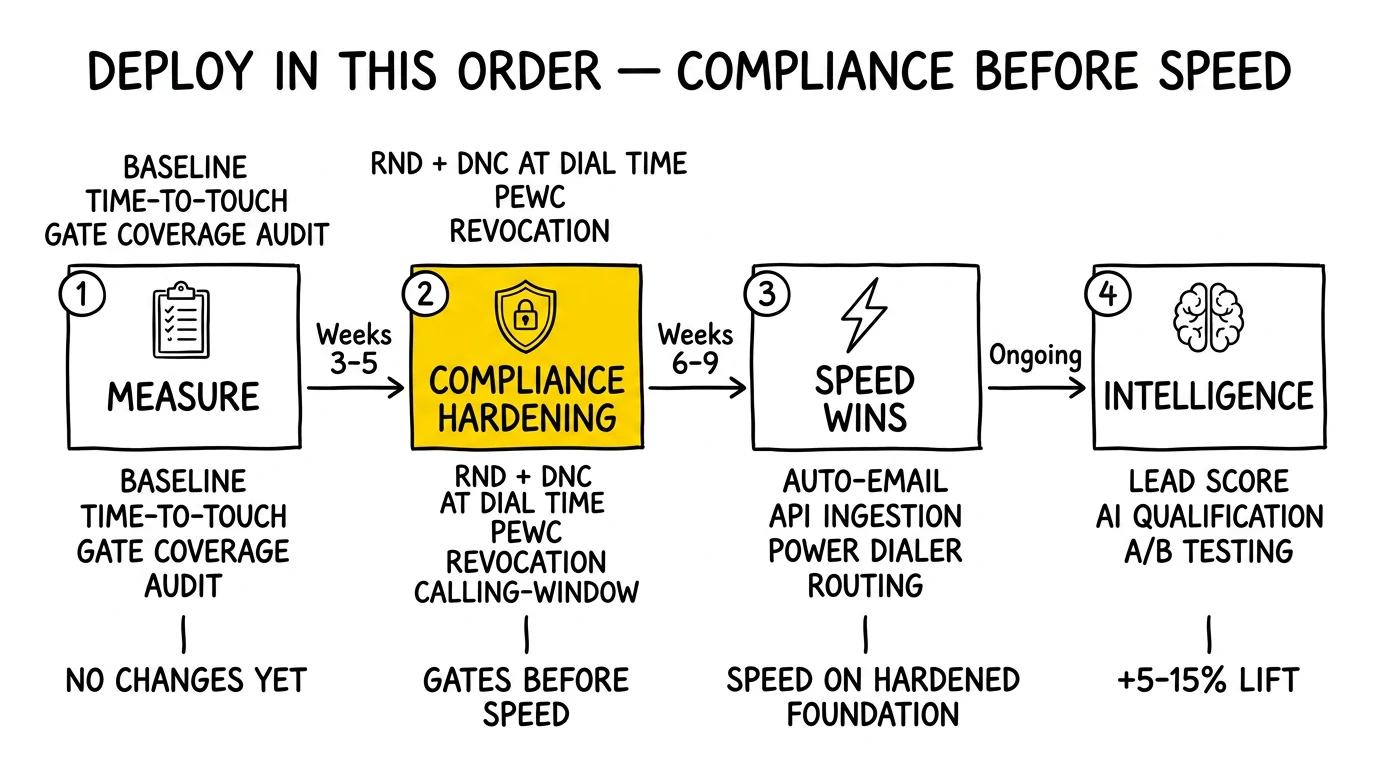
Phase 1: Measurement and baseline (weeks 1–2). Instrument current state before changing anything. Time-to-first-touch by lead source. Contact rate by channel. Conversion by response cohort. Compliance gate coverage audit – what scrubs run, when, against what data. Operators frequently discover that their current “compliant” workflow runs DNC scrubs nightly rather than at dial time, which fails any reasonable TCPA defense.
Phase 2: Compliance hardening (weeks 3–5). Before adding speed, fix gates. RND scrubs at dial time. DNC scrubs at dial time. PEWC verification at form post. Revocation propagation across all outreach systems. Calling-window enforcement. State mini-TCPA list integration where applicable. This is the phase most speed-to-lead initiatives skip and the phase most likely to prevent a class action two years later.
Phase 3: Speed wins (weeks 6–9). Auto-email acknowledgment to all form submissions. Agent notification across desktop, mobile, and SMS channels. API ingestion replacing any email-based lead delivery. Round-robin or rule-based routing covering the standard cases. Power dialer integration for high-volume outbound. Typical impact: response times drop from hours to minutes with relatively low integration risk because every step has been gated by the Phase 2 compliance work.
Phase 4: Intelligence (ongoing). Lead scoring drives prioritization of dialer queue. Conversational AI handles narrow qualification flows where compliance posture allows. A/B testing on response messaging and channel mix. Predictive analytics on optimal contact times within the consumer’s calling window. Intelligence layers add 5–15% conversion improvement on top of the foundation in most measured deployments – meaningful but secondary to getting Phases 1–3 right.
Measurement and Honest ROI
Response automation ROI separates into two patterns depending on baseline.
Severely degraded baselines (24+ hour response). Operators starting from email-based lead delivery and next-day human follow-up typically see double-digit conversion improvement from auto-email acknowledgment and instant agent notification alone. Payback is usually 60–90 days in single-buyer exclusive-lead contexts. In these cases the speed automation pays for itself before the compliance infrastructure does.
Already-optimized baselines (sub-30-minute response). Operators with mature inbound operations show single-digit lifts from further speed reduction, with returns concentrated in agent productivity (more dials per agent-hour, lower handle time on initial qualification) rather than top-line conversion. Payback extends to 6+ months and depends heavily on whether the deployment also captures unaddressed compliance gaps.
The investment math at typical 2026 pricing for a 25-rep operation:
- Sales engagement platform (Salesloft or Outreach) at $130–$160/user/month: $39K–$48K annually
- TCPA-compliant dialer (Convoso or Five9 enterprise tier): $25K–$60K annually depending on volume
- Routing layer (Chili Piper, LeanData, or HubSpot Workflows): $9K–$18K annually
- Integration and implementation labor: $30K–$80K one-time
Annual run-rate $75K–$130K plus implementation. The conversion lift required to justify that spend at $1,000 average customer value is roughly 75–130 incremental closes annually – typically achievable when starting from a degraded baseline, marginal when starting from an already-tight operation.
The honest framing: response automation is high-ROI when it eliminates clear inefficiency, modest-ROI when it incrementally improves an already-good operation, and negative-ROI when the compliance work it implies is left undone and a class action follows. The third scenario is rarer than it should be given how often the press covers it. A single TCPA class action settlement in the seven-figure range erases multiple years of conversion lift; the underwriting math forces operators to evaluate the speed-and-compliance system as a unified investment rather than the speed system as a profit center and the compliance system as a cost center.
For broader context on how response performance integrates with downstream lead quality controls, the lead quality control processes framework covers feedback loops between dialer outcomes and upstream sourcing. The speed-to-lead response workflow optimization article goes deeper on the routing logic. The Reassigned Numbers Database guide and the Illinois Rabbit v. Rohrman ruling analysis cover the compliance dimensions in depth.
Key Takeaways
-
The 391% conversion lift comes from a single 2007 InsideSales.com dataset published in HBR in 2011 (Oldroyd, McElheran, Elkington), measuring outbound calls in a single-buyer call-center context. Treat it as directional evidence of the speed-conversion relationship, not as a 2026 universal benchmark – the underlying market structure has shifted materially.
-
In TCPA-regulated verticals, speed without compliance gates is a class-action vector, not a best practice. Every auto-dial or auto-SMS must clear PEWC verification, RND scrub, DNC scrub, calling-window check, and revocation check before firing. Statutory damages of $500–$1,500 per violation compound quickly across automated workflows.
-
The Eleventh Circuit’s January 24, 2025 ruling in IMC v. FCC vacated the one-to-one consent rule but left the underlying PEWC requirement intact. Operators reading the headline as “TCPA is dead” misread the ruling badly. The March 30, 2026 Illinois ruling in Rabbit v. Rohrman extended DNC liability to SMS marketing under state law, broadening exposure for multi-state SMS workflows.
-
Optimal response time varies by vertical. Mortgage refinance rewards sub-five-minute live transfer; B2B SaaS demos plateau at one-to-four hours; Medicare layers CMS scope-of-appointment rules on top of TCPA; insurance ping-post compresses first-responder advantage to near zero. One universal curve fits poorly.
-
First-responder advantage collapses in shared-lead environments. When eight buyers dial within 30 seconds of the same lead, conversion separates on agent licensing, script quality, and fifth-touch persistence – not on who got there first. The 35–50% first-responder claim was measured in exclusive-lead contexts.
-
Drift was acquired by Salesloft in February 2024. Tool-comparison content predating that change misrepresents the current sales engagement market. Salesloft’s enterprise tier now bundles conversational marketing, outbound sequences, and dialer integration in a single contract.
-
Response automation deployment benefits from compliance hardening before speed wins. Phases 1 (measure), 2 (compliance gates), 3 (speed automation), 4 (intelligence). Operators that skip Phase 2 to chase Phase 3 conversion lift typically discover the cost when a class action surfaces 18–36 months later.
-
ROI separates into two patterns. Severely degraded baselines see double-digit lift in 60–90 days; already-tight operations see single-digit lift over 6+ months. The honest math at 2026 pricing for a 25-rep team runs $75K–$130K annually plus implementation, justified by 75–130 incremental closes at $1,000 customer value.
-
The compliance gate layer is non-delegable. API providers (Twilio, Zapier) and routing tools (Chili Piper, LeanData) execute what the operator instructs. Regulators and plaintiff firms pursue the seller – the lead generator or call center – not the platform vendor.
Sources
- Oldroyd, J., McElheran, K., Elkington, D. The Short Life of Online Sales Leads. Harvard Business Review, March 2011 – primary source for the 391% and 21x speed-to-lead findings, derived from InsideSales.com 2007 dataset.
- Salesforce. State of Sales Report, Sixth Edition. Salesforce Research, 2024 – B2B response time benchmarks and competitive dynamics data.
- U.S. Federal Communications Commission. Reassigned Numbers Database Order, FCC 18-177. FCC, December 2018 – establishment of the RND and operator query framework.
- United States Court of Appeals for the Eleventh Circuit. Insurance Marketing Coalition Ltd. v. Federal Communications Commission, No. 24-12054, January 24, 2025 – vacatur of the FCC one-to-one consent rule.
- U.S. Federal Communications Commission. 47 CFR § 64.1200 – Delivery restrictions. FCC.gov – TCPA implementing regulations including PEWC, calling-window, and DNC requirements.
- Drift (Salesloft). Conversation Trends Report 2024. Salesloft, 2024 – B2B response time distribution data; published under Salesloft following the February 2024 acquisition.
- ICE Mortgage Technology. Velocify Lead Response Optimization Research. ICE Mortgage Technology – mortgage-vertical contact rate and timing analysis.
- Twilio. State of Customer Engagement Report 2024. Twilio Inc., 2024 – SMS and voice automation benchmarks.
- Salesloft. Salesloft Acquires Drift. Salesloft press release, February 2024 – confirms the Drift–Salesloft transaction.
- Northern District of Illinois. Rabbit v. Rohrman Automotive Group, LLC, decided March 30, 2026 – extension of DNC liability to SMS marketing under the Illinois Telephone Solicitations Act. See FCC TCPA enforcement framework.
Speed-to-lead remains real and remains worth engineering. The 2026 reframe is that speed without compliance gates is liability arbitrage, not advantage. Operators that treat consent verification, RND scrubbing, and DNC discipline as constraints to route around will discover, often in deposition, that the constraints were the moat. The ones that treat compliance as the same kind of engineering problem as response time – measured in milliseconds, instrumented continuously, owned by the same team – will be the ones still operating when the next wave of enforcement settles.