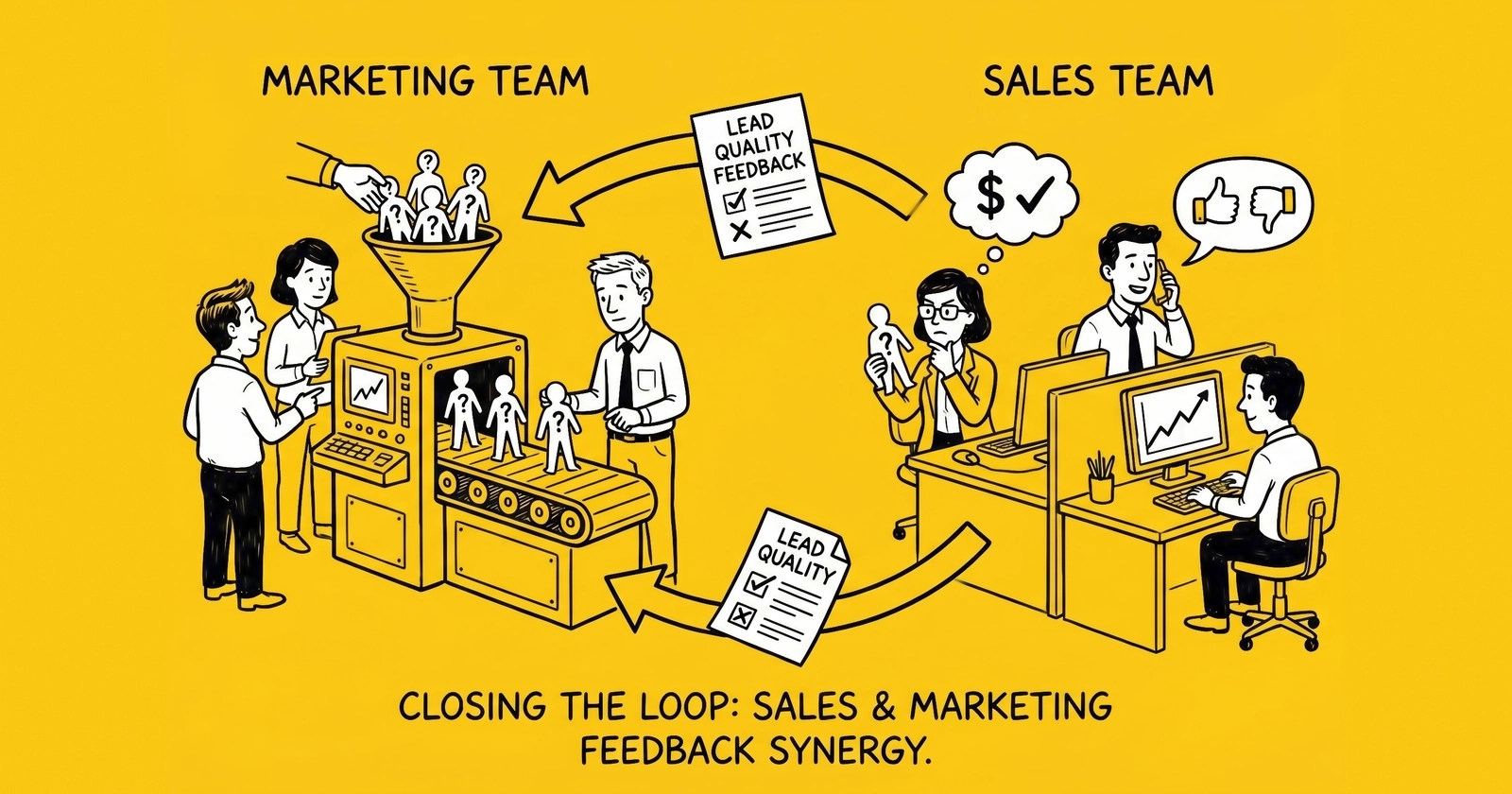
Disposition feedback is the only operational signal that ties lead spend to revenue outcomes. Without it, every other metric is a proxy.
The Feedback Gap in Lead Generation Operations
The gap between lead generation and sales execution is the most expensive recurring failure in performance lead businesses. Marketing-side teams generate volume against cost-per-lead targets; buyer-side sales operations work the leads, then either disposition them or don’t. When dispositions don’t flow back to the seller, the feedback loop collapses. The seller optimizes against form completions, the buyer accumulates unbillable contacts, and both sides rationalize the friction as the other’s problem.
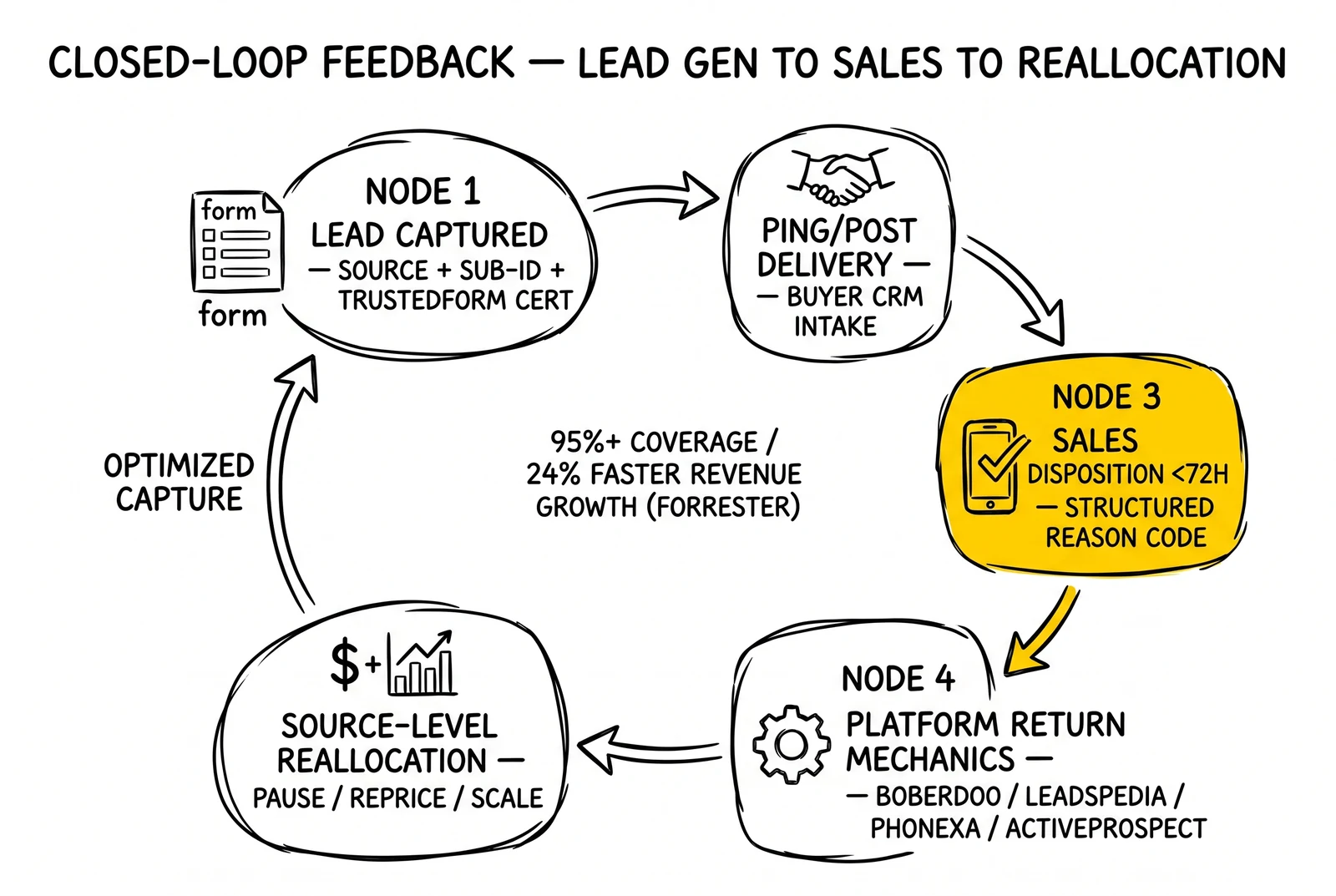
In ping/post lead exchanges, that collapse has a price tag. Buyers operating on platforms like boberdoo, LeadsPedia, Phonexa, and ActiveProspect typically reserve the right to return leads with reason codes inside 7-15 day dispute windows. Sellers without disposition visibility cannot defend disputes, cannot identify the sub-IDs driving returns, and cannot reprice underperforming sources before the next billing cycle locks in. The feedback architecture isn’t a nice-to-have – it’s the operational layer that decides whether a vendor relationship compounds or churns.
This analysis examines what disposition feedback should capture, how it flows across ping/post platforms and CRM stacks, how TCPA-driven consent verification merges with quality feedback, and how cadence and reason taxonomies vary by vertical. Forrester research linking tightly aligned revenue operations to 24% faster revenue growth provides the macro reference; the operational detail comes from the named platforms and the buyer-seller dispute mechanics that govern real lead exchanges. For operators experiencing chronic return-rate disputes or stagnant source-level performance, the feedback loop is the lever that turns scoring theory into billable conversions.
Definitional Anchors: The Operational Vocabulary
Before architecture, the terms that govern this discipline.
Disposition feedback – Structured outcome data captured by the sales side on each lead, including contact status, qualification result, reason code, and conversion result. Disposition is the atomic unit of feedback; without it, all higher-order analysis fails.
Ping/post return – A buyer-initiated dispute submitted through the lead-distribution platform’s API or portal that requests a credit or refund based on a structured reason code. boberdoo and LeadsPedia track returns natively; Phonexa and ActiveProspect’s LeadConduit do the same with consent-record validation.
Closed-loop attribution – The operational pattern that connects every lead-source dollar to a billable conversion outcome by reconciling spend, disposition, and revenue at the source-and-sub-ID level. Forrester (formerly SiriusDecisions) research consistently identifies closed-loop reporting as the alignment behavior with the largest revenue effect.
Sales-accepted lead (SAL) – A lead that the buyer’s sales operation has reviewed, contacted, and confirmed worth working. SAL rate, not lead volume, is the metric that should govern source-level scoring.
Disposition coverage – The percentage of delivered leads that receive a structured disposition within a defined window (commonly 72 hours). Coverage below 90% breaks pattern analysis; coverage above 95% is the operational target.
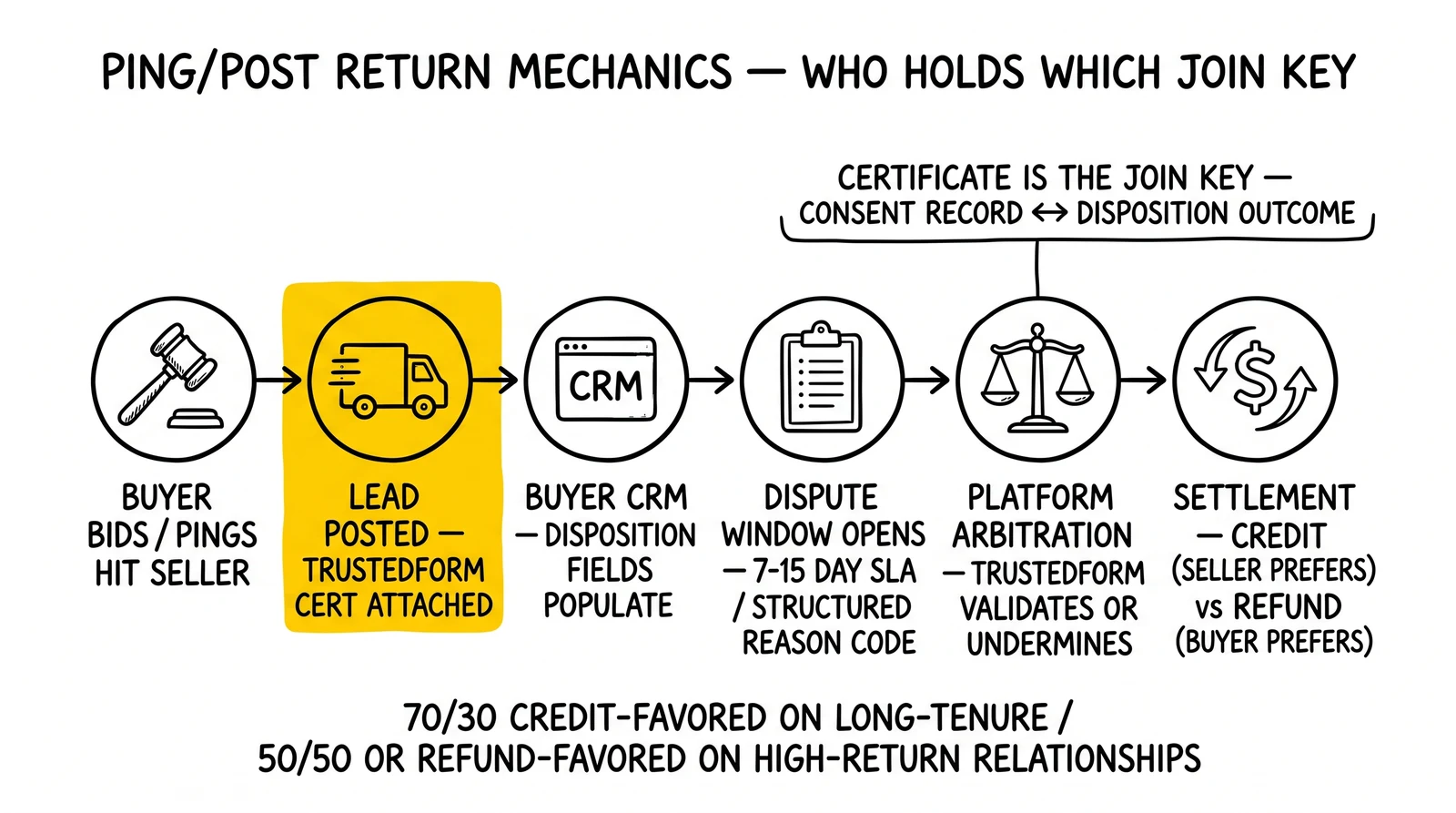
TrustedForm certificate – A consent and form-event record issued by ActiveProspect at lead capture, used to validate disclosure language, IP, and form interaction. The certificate serves as the join key between the consent record and the disposition outcome in compliance-aware feedback loops.
Reason code taxonomy – The structured picklist that buyers and sellers agree on for disqualification. LeadsCouncil and platform-native taxonomies typically cover wrong-number, not-interested, already-purchased, duplicate, timeline, qualification-fit, and contact-validity reasons.
Refund versus credit – The settlement outcome of an accepted return. Refunds reverse the original charge; credits offset the next invoice. Sellers prefer credits; buyers prefer refunds. The mix is a contract term, not a default.
Why Most Feedback Loops Fail
The prevalence of failure suggests barriers beyond technical implementation. Forrester alignment research links tightly aligned revenue operations to 24% faster revenue growth and 27% faster profit growth, yet industry surveys consistently report that fewer than one in four organizations operate disposition feedback systems their sales teams complete reliably. That gap between recognized importance and operational reality has identifiable causes.
Attribution Disconnect Between Generation and Conversion
Lead generation optimizes against proxies that produce signal in days; sales conversion produces signal in weeks or months. Cost per lead, form completion rates, and immediate scores are measurable against ad spend within hours. Conversion data lags by the length of the sales cycle, which ranges from minutes (live-transfer auto insurance) to months (commercial solar, mass-tort legal). The seller’s optimization timeline and the buyer’s outcome timeline rarely align, and the platforms that bridge them charge in real time while settling outcomes weeks later.
This timing asymmetry produces a structural temptation: optimize against the metric that produces signal now, even if the signal is uncorrelated with revenue. A paid-search campaign that drives high form completion at low CPL appears strong on day one and weak on day 60. Without disposition data flowing back, the seller has already spent against the day-one signal.
Incentive Misalignment Across the Handoff
Volume targets reward marketing for generating leads regardless of disposition. Conversion targets reward sales for closing the leads most likely to close, often by abandoning leads that would have converted with different handling. Neither incentive structure rewards quality handoff. The 24-72 hour window in which a lead is most likely to convert sits exactly at the seam between marketing’s KPI dashboard and the buyer’s sales floor, and the seam absorbs the cost.
Information Asymmetry Both Ways
Marketing knows the source, sub-ID, landing page, consent path, and TrustedForm certificate. Sales knows whether the contact info worked, whether the prospect was qualified, whether they were already insured by a competitor, and what objections came up on the call. Both sides hold information the other needs to act on. The pieces rarely cross the seam in structured form, because the systems that hold them – the lead-distribution platform, the buyer’s CRM, the TrustedForm record store – typically don’t share schemas without explicit integration work.
Feedback System Architecture: What Information Flows Where
Effective feedback systems define what to capture, who provides it, when, and how it flows between the lead-distribution platform, the buyer CRM, and the seller’s optimization layer.
Disposition Feedback From Sales
The core feedback record captures the buyer-side outcome on every delivered lead.
The minimum disposition payload includes contact-attempt status, qualification outcome, structured reason code, and conversion outcome. Contact-attempt status covers reached, no-contact after defined attempts, and invalid contact. Qualification outcome covers qualified for opportunity, disqualified with reason, and pending. Reason codes follow a structured taxonomy: invalid contact (wrong number, bounced email, wrong person), not qualified (criteria mismatch, wrong company size, wrong state), not interested (changed mind, no genuine intent, competitor choice), already purchased (bought elsewhere, internal solution), and timing (not in buying cycle, budget, organizational changes). Conversion outcomes capture opportunity created with value estimate, proposal delivered, contract signed with actual value, and customer lifetime value where the integration retains it.
Free-text comments add context but cannot replace structured fields. Pattern analysis only works on values that aggregate, and free text fragments instantly across reps and shifts.
Contextual Information From Generation to Sales
Feedback flows in both directions. Marketing should provide source attribution, scoring rationale, behavioral signals, and consent context that helps sales work leads effectively.
Source and channel attribution covers traffic source (paid search, organic, referral, social), campaign and sub-ID, landing page, and entry point. Scoring data includes score components, key qualification data points, and behavioral signals (pages viewed, content downloaded, time on site, exit intent triggers). Consent context – the TrustedForm or Jornaya certificate URL, the disclosure language shown, the timestamp, and the IP – gives sales the evidence to defend TCPA exposure and gives the buyer the join key for closed-loop reconciliation. Historical engagement context (prior leads from the same household, repeat form fills, email engagement) surfaces patterns that change the appropriate sales approach.
Feedback Timing and Cadence
When feedback is captured affects accuracy, completeness, and platform settlement.
Initial disposition (within 24-72 hours of handoff) captures contact outcomes while context is fresh and falls inside most ping/post return windows. Stage progression feedback updates at sales milestones (SAL, opportunity, proposal, closed-won) and is typically CRM-automated. Final outcome feedback at close or loss completes the attribution chain. Periodic aggregation rolls individual records into source-level patterns at weekly and monthly intervals.
| Feedback Type | Window | Primary Purpose | Update Mechanism |
|---|---|---|---|
| Initial disposition | 24-72 hours | Quality issue identification, return submission | Sales-initiated or dialer/email-event automated |
| Stage progression | At each milestone | Pipeline visibility | CRM workflow automated |
| Final outcome | At close/loss | Attribution completion | CRM workflow automated |
| Quality assessment | Weekly or at close | Pattern identification | Sales-prompted picklist |
| Source aggregation | Weekly/monthly | Reallocation decisions | Platform reporting |
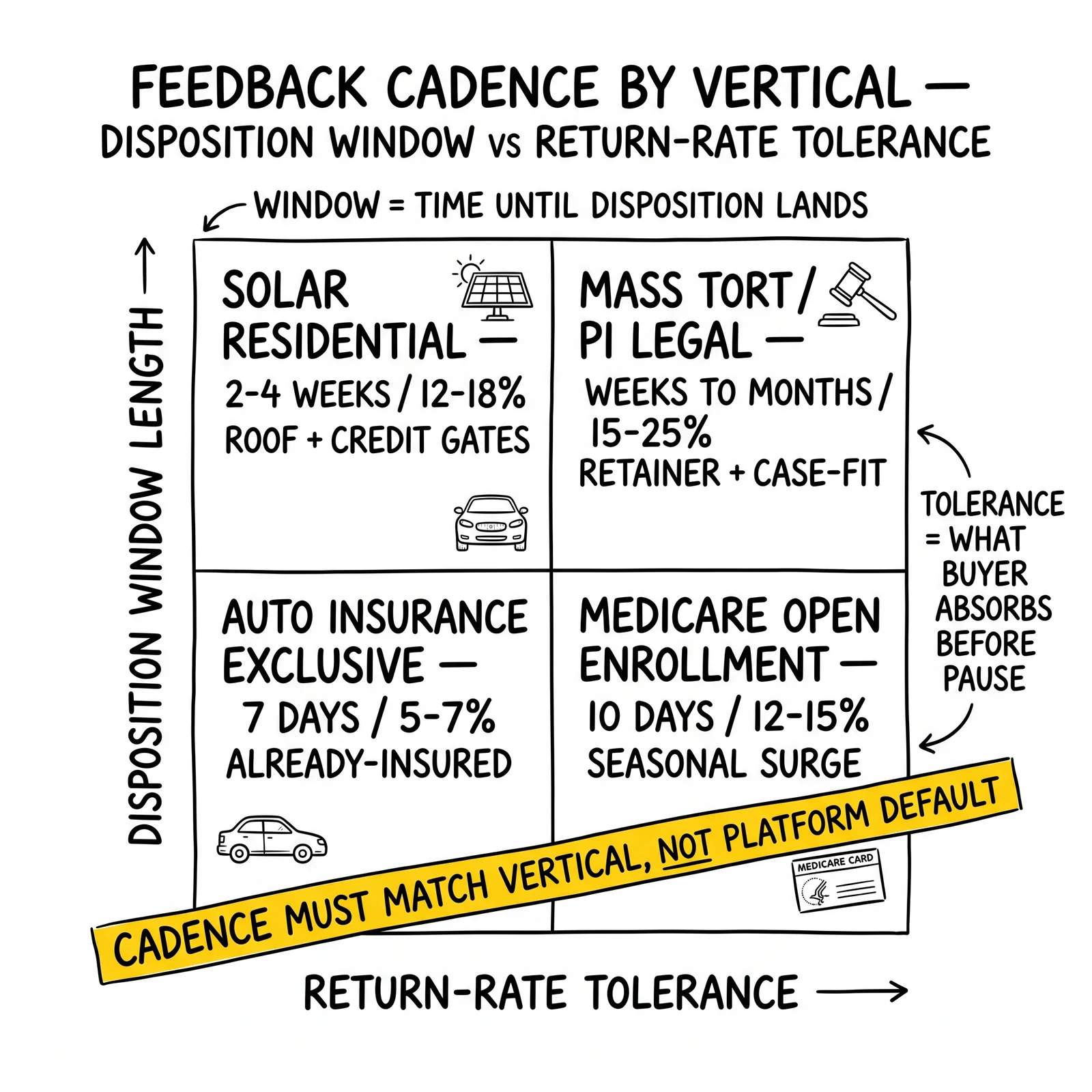
Cadence has to match the vertical, not the platform default. Auto insurance dispositions land in 24-48 hours because agents quote in minutes. Mortgage dispositions take 3-7 days as credit and rate factors resolve. Solar dispositions can run 2-4 weeks because qualification requires roof and credit checks. Mass-tort legal dispositions run weeks to months because case-criteria review and retainer paperwork drive the timeline. A 72-hour SLA across all four verticals would generate either bad data or empty fields depending on which vertical the team is working.
Ping/Post Return Mechanics: The Operational Layer Most Articles Skip
For lead generators selling into ping/post exchanges, disposition feedback isn’t an alignment ideal – it’s the input that drives return submission, credit settlement, and vendor scoring. The mechanics deserve their own section because they govern the cash flow the seller actually receives.
How Returns Work on Named Platforms
boberdoo operates one of the most widely used ping/post stacks in insurance, mortgage, and home services lead generation. Buyers submit returns through the platform’s dispute interface or API with a structured reason code; the seller has a contractually defined window (commonly 7-15 days) to accept, dispute, or counter-offer. Accepted returns settle as credits against the next invoice or as refunds depending on the contract.
LeadsPedia layers similar dispute workflow onto a routing engine that supports both form leads and inbound calls. Phonexa unifies form-lead and call disposition data so a single buyer can return a form lead and a transferred call under the same dispute ID. ActiveProspect’s LeadConduit routes leads through configurable filters at capture time and pairs the routing event with the TrustedForm certificate, giving both parties the same consent-record join key when a dispute arises.
The settlement outcome – refund versus credit – is a contract term that carries economic weight. Sellers prefer credits because they preserve cash and obligate the buyer to continue purchasing. Buyers prefer refunds because they restore working capital. The mix typically negotiates to 70/30 credit-favored on long-term seller relationships and 50/50 or refund-favored on short-tenure or high-return relationships. The disposition feedback record is the document that decides which side wins each individual dispute.
Return Rate Thresholds and Vendor Scoring
Buyers operating waterfall routing or multi-vendor pools score sellers on rolling return rate, contact rate, and revenue per lead. Persistent return rates above contracted thresholds trigger automated repricing or pause logic. Common thresholds:
| Vertical | Lead Type | Typical Return-Rate Threshold | Disposition Window |
|---|---|---|---|
| Auto insurance (shared) | Web form | 10-12% | 7 days |
| Auto insurance (exclusive) | Web form | 5-7% | 7 days |
| Medicare (open enrollment) | Web form / call | 12-15% | 10 days |
| Mortgage (refi/purchase) | Web form | 10-15% | 14 days |
| Solar (residential) | Web form | 12-18% | 21 days |
| Personal injury / mass tort | Inbound call | 15-25% | 30 days |
| Final expense | Web form / call | 10-15% | 10 days |
Indicative thresholds based on platform documentation and trade-association practice; individual buyer contracts vary.
When the rolling return rate exceeds the threshold for two consecutive periods, the buyer’s automated routing engine typically suppresses the seller’s bids on incoming pings until the rate normalizes. The seller sees the symptom as falling fill rate; the cause is the disposition data flowing back from the buyer’s CRM. Sellers without their own copy of that disposition data are debugging blind.
TrustedForm and TCPA-Driven Feedback
Where the lead is dialed under TCPA, consent quality is a compliance requirement, not an optimization input. The TrustedForm certificate captures the disclosure language displayed at the form, the visitor’s IP, the page URL, the timestamp, and the form-interaction record. If the buyer’s sales floor produces a disposition like wrong-number or denied-consent, the certificate either supports the dispute (the consent path was clean and the contact was just bad) or undermines it (the disclosure language was missing or the form was bot-driven). For analysis of the consent stack itself, see the consent and TCPA PEWC requirements guide.
Closed-loop attribution becomes closed-loop compliance when the certificate is the join key. ActiveProspect’s LeadConduit filters can drop leads at capture if the certificate doesn’t validate, and the disposition record on the buyer side can flag certificates that produced billable contact but unfavorable consent records – a signal that the form copy or the source needs review. This is the operational reason TCPA-aware sellers run feedback loops that other industries can treat as optional.
Implementation Framework: Building Feedback Systems That Stick
Effective feedback systems balance information completeness against capture burden. Systems that demand too much sales input go unused; systems that capture too little produce no actionable insight.
CRM Configuration That Supports Feedback Capture
The CRM is the primary platform for feedback capture and storage on the buyer side. Configuration that supports feedback objectives includes structured fields for source attribution (primary source, sub-ID, campaign, channel, content, TrustedForm or Jornaya certificate URL), disposition tracking (status with structured picklist, reason code, disposition timestamp, free-text detail for exceptional context), quality assessment (lead quality rating, contact validity rating, intent accuracy rating, qualification accuracy rating), and conversion tracking (opportunity created flag and date, opportunity value estimated and actual, close date, close reason).
Salesforce and HubSpot both support stage-advancement validation rules that block lead progression without disposition entry. Webhook integration patterns push disposition events back to the ping/post platform on update; inbound webhooks update the lead record when buyer-side returns or refunds clear. Bidirectional sync ensures both sides operate on the same lead-state record. For buyer-side configuration patterns specifically, see the CRM integration guide for lead buyers.
Low-Friction Capture That Sales Teams Actually Use
The 30-second test governs adoption. If routine disposition takes longer than that, completion rates collapse below the 90% threshold pattern analysis requires. Single-click reason codes in the dialer, post-call disposition prompts that auto-populate from call outcome, and CRM rules that block stage advancement until disposition is logged all keep capture under the threshold.
Mobile-first interfaces matter where sales operates from the field – captive insurance agents, solar canvassers, mortgage loan officers in the field. Inline feedback during workflow (post-call disposition in the dialer, post-meeting assessment in the calendar) captures information when context is fresh without requiring a separate feedback activity. Batch processing for high-volume verticals (auto insurance, final expense) lets reps disposition 20-50 leads in a single workflow rather than one-at-a-time.
The behavioral lever sits above the interface. Sales teams complete feedback when they see the consequences. When a seller pauses an underperforming source because the buyer’s disposition data flagged it, communicate that back to the sales floor: the leads from sub-ID 4471 stopped because you flagged them, and last week’s batch from the new source converted at twice the rate. That feedback loop on the feedback loop is what sustains adoption past the first month of compliance.
Quality Control for Feedback Accuracy
Feedback only improves outcomes if it accurately reflects reality. Validation against objective signals catches the easy errors: contact-validity feedback can be checked against actual call-attempt records; conversion feedback can be validated against revenue postings. Pattern analysis surfaces the harder ones – individual reps with feedback patterns that diverge sharply from peer averages either have a performance issue or a calibration issue, and either way the feedback record needs review before it drives source-level decisions.
Periodic sampling with manual verification confirms that feedback reflects actual disposition. If sampled leads show different patterns than the aggregate feedback suggests, calibration is needed. The most reliable diagnostic on feedback accuracy is whether marketing-side optimization based on the feedback produces the expected lift; if reallocating budget away from a flagged source doesn’t improve overall conversion, the feedback may not be telling the truth.
From Feedback to Optimization: Making Disposition Data Actionable
Disposition feedback creates value only when it drives optimization. The analytical processes that translate feedback into action deserve as much attention as the capture mechanics.
Source-Level Pattern Analysis
Individual disposition records become actionable when aggregated by source, sub-ID, campaign, segment, and time window. Sources with consistently high return rates and low qualification rates warrant reduced investment or pause. Sources with consistently strong patterns warrant increased allocation.
| Source | Lead Volume | Contact Valid | Qualified | Return Rate | Revenue per Lead |
|---|---|---|---|---|---|
| Paid search brand (auto) | 1,200 | 94% | 72% | 6% | $34 |
| Paid search generic (auto) | 3,400 | 91% | 48% | 11% | $18 |
| Facebook lead ads (Medicare) | 2,800 | 78% | 41% | 17% | $22 |
| Content syndication (mortgage) | 1,600 | 88% | 35% | 19% | $11 |
| Referral program (any) | 400 | 97% | 85% | 4% | $58 |
Indicative figures derived from platform-aggregated benchmarks and buyer-supplied disposition reporting; values vary by buyer, geography, and window.
Campaign-level analysis examines patterns within sources to identify high and low performers. Two paid-search campaigns with similar CPL can show dramatically different return rates and revenue per lead – the difference that CPL hides is exactly what the disposition data reveals. Segment-level analysis examines variation by lead characteristics: state, age band for Medicare and life insurance, credit band for mortgage, roof type for solar. Temporal analysis identifies whether a previously strong source is degrading or whether a recent fix is sticking.
Reason-code analysis tells the operator what specifically is breaking. If 40% of disqualifications cite already-insured, the targeting is hitting saturated households. If 40% cite invalid contact, the form is leaking bots or the source is selling inventory through suspect funnels. Different reason mixes call for different fixes; the feedback record is what makes the diagnosis possible.
Closed-Loop Optimization Cadence
Analysis must connect to action through defined optimization processes. Weekly reviews catch obvious quality issues and immediate adjustments. Monthly reviews drive source-level reallocation and pricing renegotiation. Quarterly reviews govern channel-mix decisions and contract renewals. Daily reviews tend to react to noise rather than pattern and should be reserved for incident response, not routine optimization.
Defined escalation thresholds trigger action when patterns cross limits: contact validity below 85% triggers source investigation and potential pause; qualification rate below the buyer’s contracted floor triggers targeting review; return rate above threshold for two consecutive periods triggers price renegotiation or vendor rotation. Budget reallocation protocols enable shifting resources mid-cycle when the data justifies it.
Feedback Integration With Lead Scoring
Lead scoring models should incorporate disposition data to improve prediction accuracy over time. Outcome-based score validation compares scored predictions against actual outcomes. Model retraining uses actual conversion outcomes to recalibrate scoring algorithms; for implementation guidance on machine-learning scoring, see AI lead scoring with machine learning prioritization. Dynamic scoring adjustment can increase or decrease scores based on source performance, and qualification-criteria refinement updates the definition of qualified based on conversion patterns.
Vertical-Specific Feedback Patterns
Feedback architecture is not one-size-fits-all. Cadence, reason taxonomies, and dispute economics vary materially across the verticals that drive most lead-generation revenue.
Insurance: Fast Cadence, Tight Reason Codes
Auto and home insurance agents quote in minutes. Disposition data lands within 24-48 hours, often automated through dialer integration. Reason codes cluster around already-insured (the dominant reason in shared-lead exchanges), wrong-state-license, rate-shopping, and policy-already-bound. Return-rate thresholds typically run 10-12% for shared and 5-7% for exclusive. Medicare adds open-enrollment seasonality: returns spike during October-December when volume floods in and qualification disciplines slip. Final expense follows similar fast-cadence patterns with reason codes weighted toward age, health, and beneficiary disqualification.
Mortgage: Slower Cadence, Rate-Sensitive Disposition
Mortgage feedback runs 3-7 days because credit-pull, rate-quote, and qualification take longer than insurance. Reason codes lean toward credit-score, loan-purpose mismatch, LTV constraint, debt-to-income, and timeline. Rate volatility complicates the feedback loop: the same lead is worth different amounts week-to-week, and a disposition recorded against one rate environment may be irrelevant when the rate moves 50 basis points. Buyers often demand longer dispute windows (14 days is common) and weight reason codes more heavily in source scoring.
Solar: Long Cadence, Multi-Stage Qualification
Residential solar feedback often takes 2-4 weeks because qualification requires roof inspection, credit check, and utility-bill review. Reason codes lean toward shading and roof orientation, ownership (renter vs. owner), credit band, and system-size constraints. Return-rate thresholds are higher (12-18% common) because the qualification cycle exposes more disqualification reasons over time. Commercial solar runs longer still (60-90 days) and feedback at that timescale typically rolls into quarterly source reviews rather than weekly cadence.
Legal: Longest Cadence, Highest Stakes per Conversion
Mass-tort and personal-injury feedback runs weeks to months because retainer signing and case-criteria validation drive the timeline. Reason codes center on statute-of-limitations, retainer execution, case-fit (injury type, jurisdiction, damages threshold), and prior representation. Return-rate thresholds tolerate 15-25% because the per-converted-case economics absorb higher dispute rates.
Organizational and Technology Layers
Technical systems and analytical processes provide the infrastructure for feedback loops; organizational alignment and integration architecture determine whether the infrastructure produces results.
Shared Metrics That Make Feedback Productive
When marketing and sales optimize against different metrics, feedback becomes ammunition for blame rather than input for improvement. Aligned metrics create shared interest in lead quality. Revenue-based marketing metrics shift accountability toward outcomes: marketing-sourced revenue rather than lead volume, revenue per lead rather than CPL, sales-accepted lead rate rather than MQL count. For analysis of how pricing models affect alignment incentives, see revenue share versus fixed price lead agreements. Lead-quality-based sales metrics shift sales accountability toward working leads effectively: speed to lead, contact rate, disposition compliance, lead-to-opportunity conversion. For analysis of how response timing affects conversion, see the speed-to-lead workflow optimization analysis. Shared accountability metrics – overall lead-to-revenue conversion rate, customer acquisition cost across marketing and sales, pipeline velocity, lead-quality score trends – create joint ownership.
Cross-Functional Governance
Effective feedback loops require governance structures that span the marketing-sales boundary. Regular cross-functional reviews bring leadership together to examine feedback data and align on implications. Joint accountability for quality assigns shared ownership rather than separate domains. Defined escalation processes resolve disputes when marketing and sales disagree about quality. Resource allocation decisions involve both functions when feedback suggests reallocation rather than either side acting unilaterally.
The cultural overlay matters as much as the structure. Blameless problem-solving orientation focuses on improvement rather than fault-finding. Data-driven decision culture accepts that feedback should influence decisions even when it contradicts preferences. Psychological safety for honest feedback ensures sales reps feel comfortable providing accurate disposition, including dispositions that might reflect on their own performance. Organizations that use feedback for blame discover quickly that feedback stops flowing.
Technology Integration Requirements
The critical integrations connect marketing automation, the lead-distribution platform, the buyer CRM, and analytics. Marketing automation to lead-distribution platform: source attribution and consent certificate flow with the lead. Lead-distribution platform to CRM: lead delivery posts source, sub-ID, certificate, and scoring data into the appropriate CRM record. CRM to lead-distribution platform: disposition events post back to the platform via webhook or scheduled sync, supporting return submission and source scoring. CRM to analytics: complete lead lifecycle data flows into the source-level reporting layer, enabling pattern analysis at the cadence the business runs.
Automation reduces manual effort and improves consistency. Automated disposition detection infers dispositions from activity patterns: bounced emails, disconnected numbers, leads without activity for defined periods. Automated feedback prompts request assessment at appropriate moments – when leads age without progress, when leads close, or at regular intervals. Automated alert generation surfaces patterns requiring attention. Automated reporting and distribution ensures stakeholders receive analysis without manual report creation.
Measuring Feedback System Effectiveness
Feedback systems require their own measurement to confirm they’re working as intended.
System health metrics include disposition coverage (target 95%+ within 72 hours), feedback timeliness (initial disposition median time), field completion rate (target 80%+ complete records with reason codes), and feedback consistency across reps and shifts. Outcome metrics include lead-quality-score trend over time, source-optimization ROI (whether reallocations produce expected lift), prediction accuracy improvement in scoring models, and reduction in marketing-sales quality disputes. Buyer-side proxies include declining return rates against vendor thresholds, shrinking time-to-disposition, and stable refund-versus-credit ratios.
Continuous improvement of the feedback system itself prevents stagnation. Regular system audits examine whether the feedback record is capturing the right information in the right way as business needs evolve. User feedback from sales reps surfaces friction points the metrics don’t show. Benchmark comparison against industry baselines or historical trends flags whether the system is drifting. Technology currency ensures the integration layer keeps pace as platforms add new disposition fields, consent attestation features, or routing capabilities.
Key Takeaways
-
Disposition feedback is the only signal that connects lead spend to billable outcomes. Coverage above 95% within 72 hours is the operational floor; below that, source-level pattern analysis fails and optimization becomes guesswork.
-
Ping/post return mechanics are the cash-flow layer most generic feedback frameworks ignore. Buyers operating on boberdoo, LeadsPedia, Phonexa, and ActiveProspect run automated dispute and vendor-scoring logic on disposition data; sellers without their own copy of that data debug blind.
-
TrustedForm certificates are the join key for closed-loop compliance, not just closed-loop attribution. When the certificate validates, returns get defended; when it doesn’t, the source needs review before the next billing cycle.
-
Cadence has to match the vertical, not the platform default. Insurance dispositions land in 24-48 hours; mortgage in 3-7 days; solar in 2-4 weeks; legal in weeks to months. A uniform 72-hour SLA produces either bad data or empty fields depending on which vertical the team is working.
-
Reason-code taxonomies make pattern analysis possible. LeadsCouncil’s reason taxonomies and platform-native picklists give sellers and buyers a shared vocabulary; free-text comments fragment instantly and break aggregation.
-
Forrester research links tightly aligned revenue operations to 24% faster revenue growth and 27% faster profit growth. The mechanism is closed-loop disposition feedback, not the alignment language itself.
-
The 30-second test governs sales adoption. Single-click reason codes in the dialer, automated disposition from call and email events, and stage-advancement rules that block progression without disposition all keep capture under the threshold.
-
The feedback loop on the feedback loop sustains adoption. When sales sees that flagging a source led to that source being paused or repriced, completion rates climb. When they don’t see the consequence, completion rates collapse within a quarter.
Sources
- Forrester (formerly SiriusDecisions): B2B Sales and Marketing Alignment Research – 24% faster revenue growth and 27% faster profit growth with tightly aligned revenue operations.
- ActiveProspect: TrustedForm Consent and Lead Certification Documentation – Certificate-based consent attestation, dispute validation, and closed-loop join-key mechanics.
- boberdoo: Lead Distribution and Return Management Platform – Ping/post routing, dispute and return workflows, and buyer disposition APIs.
- LeadsCouncil: Industry Standards for Lead Generation – Disposition reason taxonomies, buyer-seller dispute norms, and trade-association practice.
- FCC: Telephone Consumer Protection Act Rules and Enforcement – Consent requirements that make consent-quality feedback a compliance obligation, not just an optimization input.
- Gartner: B2B Sales Cycle and Buying Committee Research – Sales-cycle dynamics, qualification criteria, and buying-committee behavior across verticals.
- Salesforce: State of Sales Report Series – CRM adoption, lead-management practice, and sales-team feedback processes.
- Phonexa: All-in-One Performance Marketing Platform – Unified form-lead and call-disposition data architecture.
Closing
The lead generators who win the next decade will be the ones whose feedback architecture turns every disposition record into a routing, pricing, and compliance decision. Forrester’s alignment research provides the macro signal; ping/post return economics, TrustedForm-validated dispute defense, and vertical-specific cadence patterns provide the operational detail. Operators still treating sales-to-marketing handoff as a one-way transaction are paying for the asymmetry every billing cycle in unbillable returns, vendor churn, and TCPA exposure they can’t document. The feedback loop isn’t an alignment ideal – it’s the cash-flow layer that decides whether next quarter’s source-level reallocations are evidence-based or aspirational.